A box of mass 15 kg is placed on a rough plane inclined at 60° to the horizontal. If the box is at rest, calculate the normal reaction to the plane. [Take g = 10 ms−2]
A fair die is tossed 60 times and the results are recorded in the table. Number on Die: 1, 2, 3, 4, 5, 6 Frequency: 15, 10, 14, 2, 8, 11 Find the probability of obtaining a prime number
A.7/30
B.1/6
C.7/15
D.8/15
Show the answer and explanation
Answer: D (8/15)
Explanation
Primes on a die are 2, 3 and 5: 10 + 14 + 8 = 32 of 60 throws. P = 32/60 = 8/15.
A stone is thrown vertically upwards and its distance, S metres, after t seconds is given by S = 12t + (5/2)t2 − t3. Calculate the maximum height reached.
A.418.5 m
B.56.0 m
C.31.5 m
D.24.0 m
Show the answer and explanation
Answer: C (31.5 m)
Explanation
dS/dt = 12 + 5t − 3t² = 0 gives (3t + 4)(t − 3) = 0, t = 3. S = 36 + 22.5 − 27 = 31.5 m.
A stone is thrown vertically upwards and its distance, S metres, after t seconds is given by S = 12t + (5/2)t2 − t3. Calculate the distance travelled in the third second
A.5.5 m
B.14.5 m
C.26.0 m
D.30.0 m
Show the answer and explanation
Answer: A (5.5 m)
Explanation
The third second is from t = 2 to t = 3: S(3) − S(2) = 31.5 − (24 + 10 − 8) = 5.5 m (the stone is still rising).
A committee consists of 6 boys and 4 girls. In how many ways can a sub-committee consisting of 3 boys and 2 girls be formed if one particular boy and one particular girl must be on the sub-committee?
A.120
B.80
C.56
D.30
Show the answer and explanation
Answer: D (30)
Explanation
Choose the other 2 boys from 5 and the other girl from 3: ⁵C₂ × ³C₁ = 10 × 3 = 30.
Consider the following statements x: Benita is polite y: Benita is neat z: Benita is intelligent Which of the following symbolizes the statement: 'Benita is neat if and only if she is neither polite nor intelligent'?
A.y ⇔ ~x ∨ z
B.y ⇔ ~x ∨ ~z
C.y ⇔ ~x ∧ ~z
D.y ⇔ ~x ∧ z
Show the answer and explanation
Answer: C (y ⇔ ~x ∧ ~z)
Explanation
'Neither polite nor intelligent' means not polite AND not intelligent: ~x ∧ ~z. So the statement is y ⇔ (~x ∧ ~z).
A bag contains 8 red, 4 blue and 2 green identical balls. Two balls are drawn randomly from the bag without replacement. Find the probability that the balls drawn are red and blue.
A.12/91
B.16/91
C.30/91
D.32/91
Show the answer and explanation
Answer: D (32/91)
Explanation
Red then blue or blue then red: (8/14)(4/13) + (4/14)(8/13) = 32/182 + 32/182 = 32/91.
The table shows the distribution of marks obtained by some students in a test. Marks: 0−9, 10−19, 20−29, 30−39, 40−49 Frequency: 4, 12, 16, 6, 2 What is the upper class boundary of the upper quartile class?
A.49.5
B.39.5
C.29.5
D.19.5
Show the answer and explanation
Answer: C (29.5)
Explanation
There are 40 students, so the upper quartile is the 30th mark. Cumulative frequencies 4, 16, 32 put it in 20−29, whose upper boundary is 29.5.
The table shows the distribution of marks obtained by some students in a test. Marks: 0−9, 10−19, 20−29, 30−39, 40−49 Frequency: 4, 12, 16, 6, 2 Find the modal class mark.
A.4.5
B.14.5
C.24.5
D.34.5
Show the answer and explanation
Answer: C (24.5)
Explanation
The modal class is 20−29 (frequency 16); its class mark is (20 + 29)/2 = 24.5.
The polynomial f(x) = 2x3 + px2 + qx − 5 has (x − 1) as a factor and a remainder of 27 when divided by (x + 2), where p and q are constants. Find the values of p and q.
Show the model answer
Model answer
f(1) = 0: 2 + p + q − 5 = 0, so p + q = 3. f(−2) = 27: −16 + 4p − 2q − 5 = 27, so 2p − q = 24. Adding: 3p = 27, p = 9 and q = −6.
Explanation
Use the factor theorem and remainder theorem to get two equations.
The table shows the distribution of monthly income (in thousands of naira) of workers in a factory. Monthly Income (₦'000): 135−139, 140−149, 150−154, 155−164, 165−169 Number of workers: 20, 42, 28, 38, 22 (a) Draw a histogram for the distribution. (b) Use your graph to estimate the mode of the distribution.
Show the model answer
Model answer
(a) Boundaries (widths): 134.5–139.5 (5), 139.5–149.5 (10), 149.5–154.5 (5), 154.5–164.5 (10), 164.5–169.5 (5). Unequal widths: plot frequency per 5 (₦'000) – heights 20, 21, 28, 19, 22 – as touching bars on the boundaries. (b) Tallest bar 149.5–154.5. Cross lines from its top corners to the neighbouring bars (21 and 19): mode ≈ 149.5 + 5 × 7/(7 + 9) ≈ 151.7, i.e. about ₦151 700.
Explanation
With unequal class widths, bar heights must be frequency densities.
A bag contains 24 mangoes out of which six are bad. If 6 mangoes are selected randomly from the bag with replacement, find the probability that not more than 3 are bad.
(a) The speed of a moving bus reduced from 45 ms−1 to 5 ms−1 with a uniform retardation of 10 ms−2. Calculate the distance covered. (b) A bucket full of water with mass 16 kg is pulled out of a well with a light inextensible rope. Find its acceleration when the tension in the rope is 240 N. [Take g = 10 ms−2]
Show the model answer
Model answer
(a) v² = u² + 2as: 25 = 2025 − 20s, so s = 100 m. (b) T − mg = ma: 240 − 160 = 16a, a = 5 ms⁻² (upwards).
(a) A jogger is training for a 15 km Charity race. He starts with a run of 500 metres, then he increases the distance he runs daily by 250 metres. (i) How many days will it take the jogger to reach a distance of 15 km in training? (ii) Calculate the total distance he would have run in the training. (b) The second term of a Geometric Progrssion (G.P.) is −3. If its sum to infinity is 25/2, find its common ratios.
Show the model answer
Model answer
(a)(i) 500 + 250(n − 1) = 15 000 gives n − 1 = 58, n = 59 days. (ii) S = 59/2 × (500 + 15 000) = 457 250 m = 457.25 km. (b) ar = −3 and a/(1 − r) = 25/2. With a = −3/r: −6 = 25r(1 − r), so 25r² − 25r − 6 = 0, (5r + 1)(5r − 6) = 0. r = −1/5 or 6/5; a sum to infinity needs |r| < 1, so r = −1/5 (a = 15).
P and Q are two linear transformations in the x − y plane defined by P: (x, y) → (−3x + 6y, 4x + y) and Q: (x, y) → (2x − 3y, −4x − 6y). (a) Write down the matrices of P and Q. (b) What is the image of (−2, −3) under the transformation Q? (c) Obtain a single transformation representing the transformation Q followed by P. (d) Find the image of (1, 4) when transformed by Q followed by P. (e) Find the image P1 of the point (−√2, 2√2) under an anticlockwise rotation of 225° about the origin.
Show the model answer
Model answer
Matrices written row by row: (a) P = (−3 6 / 4 1), Q = (2 −3 / −4 −6). (b) Q(−2, −3) = (−4 + 9, 8 + 18) = (5, 26). (c) Q followed by P is PQ = (−30 −27 / 4 −18). (d) PQ(1, 4) = (−30 − 108, 4 − 72) = (−138, −68). (e) Rotation matrix (cos 225° −sin 225° / sin 225° cos 225°) = (−√2/2 √2/2 / −√2/2 −√2/2). Image = (1 + 2, 1 − 2) = (3, −1).
Explanation
'Q followed by P' means apply Q first, so the matrix is PQ.
(a) Find the equation of the normal to the curve y = (x2 − x + 1)(x − 2) at the point where the curve cuts the x-axis. (b) The coordinates of the points P, Q and R are (−1, 2), (5, 1) and (3, −4) respectively. Find the equation of the line joining Q and the midpoint of PR.
Show the model answer
Model answer
(a) x² − x + 1 has no real roots, so the curve cuts the x-axis only at (2, 0). dy/dx = (2x − 1)(x − 2) + (x² − x + 1) = 3 at x = 2; normal gradient −1/3. y = −(x − 2)/3, i.e. x + 3y − 2 = 0. (b) Midpoint of PR = (1, −1). Gradient to Q(5, 1) = 2/4 = ½. y + 1 = ½(x − 1), i.e. x − 2y − 3 = 0.
A box contains 5 red, 7 blue and 4 green identical bulbs. Two bulbs are picked at random from the box without replacement. Calculate the probability of picking (a) same colour of bulbs; (b) different colour of bulbs; (c) at least one red bulb.
The table shows the frequency distribution of heights (in cm) of pupils in a certain school. Heights (cm): 100−109, 110−119, 120−129, 130−139, 140−149, 150−159, 160−169 Frequency: 27, 58, 130, 105, 50, 25, 5 (a)(i) Construct a cumulative frequency table. (ii) Use the table to draw a cumulative frequency curve. (b) Using the curve, estimate the: (i) median height; (ii) interquartile range; (iii) percentage of students whose heights are at most 130 cm.
Show the model answer
Model answer
(a)(i) Upper boundaries 109.5, 119.5, …, 169.5; cumulative frequencies 27, 85, 215, 320, 370, 395, 400. (ii) Plot these (start at (99.5, 0)) and join with a smooth curve. (b)(i) Median = 200th value ≈ 119.5 + (115/130) × 10 ≈ 128.4 cm. (ii) Q₁ (100th) ≈ 120.7 cm, Q₃ (300th) ≈ 137.6 cm; IQR ≈ 16.9 cm. (iii) About 220 pupils are at most 130 cm: 220/400 ≈ 55%. (Values read from a graph may differ slightly.)
Explanation
Read the median at half the total frequency on the cumulative curve.
The position vectors of P, Q and R with respect to the origin are (4i − 5j), (i + 3j) and (−5i + 2j) respectively. If PQRM is a parallelogram, find: (a) the coordinates of M; (b) the acute angle between PM and PQ, correct to the nearest degree.
Show the model answer
Model answer
(a) In PQRM, PM = QR, so M = P + R − Q = (4 − 5 − 1, −5 + 2 − 3) = (−2, −6). (b) PM = −6i − j, PQ = −3i + 8j. Dot product = 18 − 8 = 10. cos θ = 10/(√37 × √73) ≈ 0.1924, θ ≈ 79°.
Explanation
Opposite sides of a parallelogram are equal vectors.
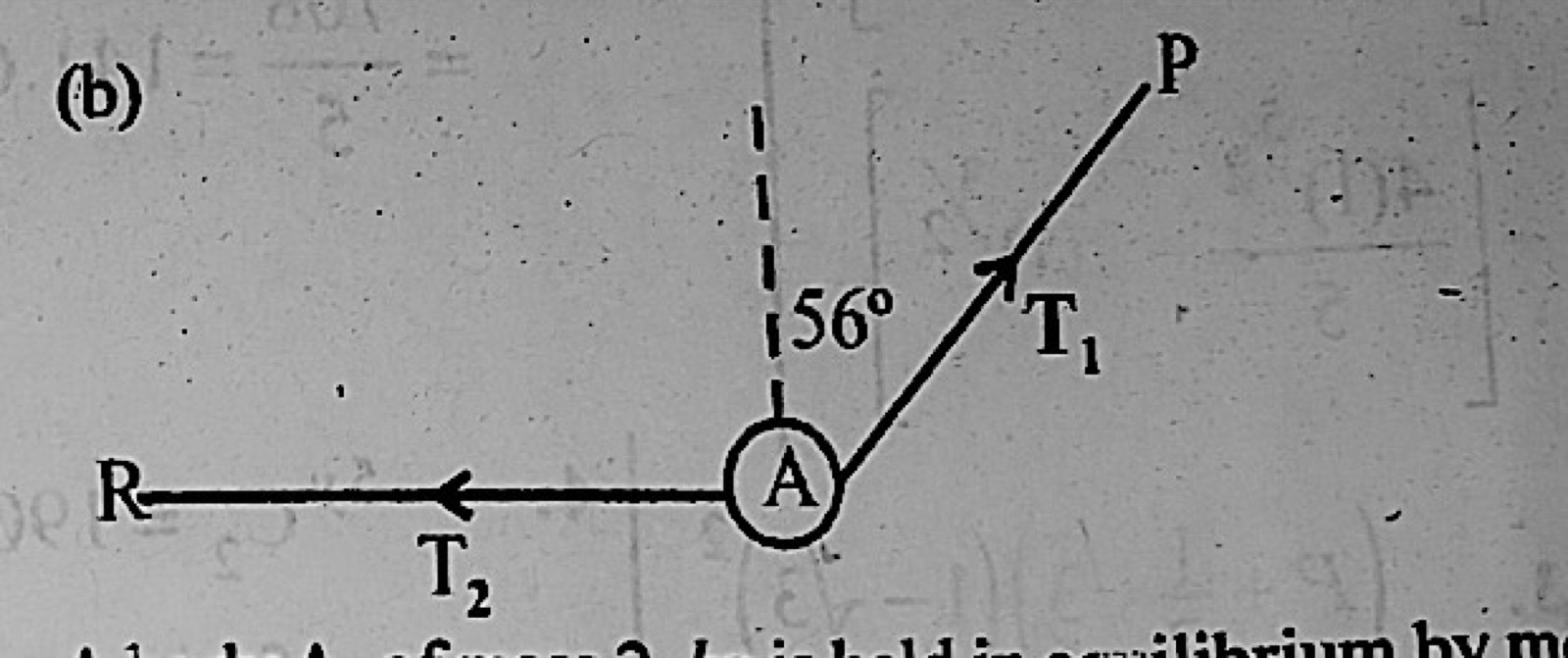
(a) A girl threw a stone horizontally with a velocity of 30 ms−1 from the top of a cliff 50 m high. How far from the foot of the cliff does the stone strike the ground? [Take g = 10 ms−2] (b) A body A, of mass 2 kg is held in equilibrium by means of two strings AP and AR. AP is inclined at 56° to the upward vertical and AR is horizontal. Find the tensions T1 and T2 in the strings. [Take g = 10 ms−2]
Show the model answer
Model answer
(a) Fall time: 50 = 5t², t = √10 ≈ 3.16 s. Horizontal distance = 30 × 3.16 ≈ 94.9 m. (b) Vertically: T₁ cos 56° = 20, so T₁ ≈ 35.8 N. Horizontally: T₂ = T₁ sin 56° = 20 tan 56° ≈ 29.7 N.
Explanation
Horizontal and vertical motion are independent; resolve the tensions in two directions.