Use the information below to answer the question. Farmers have discovered that prices of their crops are never stable. Lower prices are usually recorded during harvests while higher prices are recorded after harvests. The lower prices recorded during harvests is mainly as a result of
Use the information below to answer the question. Farmers have discovered that prices of their crops are never stable. Lower prices are usually recorded during harvests while higher prices are recorded after harvests. A likely reason for the higher prices experienced after harvests is the
A.supply being equal to demand
B.excess demand for the crop
C.inadequate number of middlemen
D.absence of market for the crop
Show the answer and explanation
Answer: B (excess demand for the crop)
Explanation
After harvest supply is scarce, so demand exceeds supply.
In a country where an income tax of $100 was levied on an income of $1000 while an income of $5000 attracted a levy of $500, the tax system can be said to be
If the demand for chicken is inelastic between October and December but elastic at other months in the year, then to increase total revenue, the farmer should
A.reduce price throughout the year
B.reduce price between October and December and increase price at other months in the year
C.increase price throughout the year
D.increase price between October and December and reduce price at other months in the year
Show the answer and explanation
Answer: D (increase price between October and December and reduce price at other months in the year)
Explanation
Raise price when demand is inelastic and cut it when demand is elastic.
A rational individual bought a good at $20 per unit and achieved equilibrium when the 10th unit was consumed, this implies that the marginal utility of this utils is
A.10 utils
B.200 utils
C.2 utils
D.20 utils
Show the answer and explanation
Answer: D (20 utils)
Explanation
At equilibrium MU equals price: 20 utils (taking 1 util as worth $1).
Figure 1 below shows the marginal utilities derived from the consumption of different quantities of commodity X which is sold for $4 per unit. Study the graph and answer the questions that follow. (a) At which level(s) of the consumption of commodity X is: (i) the consumer at the point of saturation; (ii) marginal utility of X (MUx) declining but positive; (iii) total utility of X (TUx) decreasing; (iv) total utility of X (TUx) at maximum? (b) Identify two laws that the positive segment of the marginal utility curve illustrates. (c) Explain what the consumer should do in order to achieve equilibrium when consuming: (i) 1 unit of commodity X; (ii) 4 units of commodity X.
Show the model answer
Model answer
(a)(i) 5 units, where MUx = 0. (ii) From the 1st to the 4th unit (MU falls from 6 to 1 but stays above zero). (iii) At the 6th and 7th units (MU is negative). (iv) At 5 units (MU = 0). (b) The law of diminishing marginal utility; the law of demand (downward-sloping demand). (c)(i) At 1 unit MU (6) is greater than the price ($4, taking 1 util as worth $1), so he should consume more until MU = price, i.e. 2 units (MU = 4). (ii) At 4 units MU (1) is less than the price ($4), so he should consume less, back to 2 units where MU = 4 = price.
Explanation
Equilibrium for one good is where MU equals price.
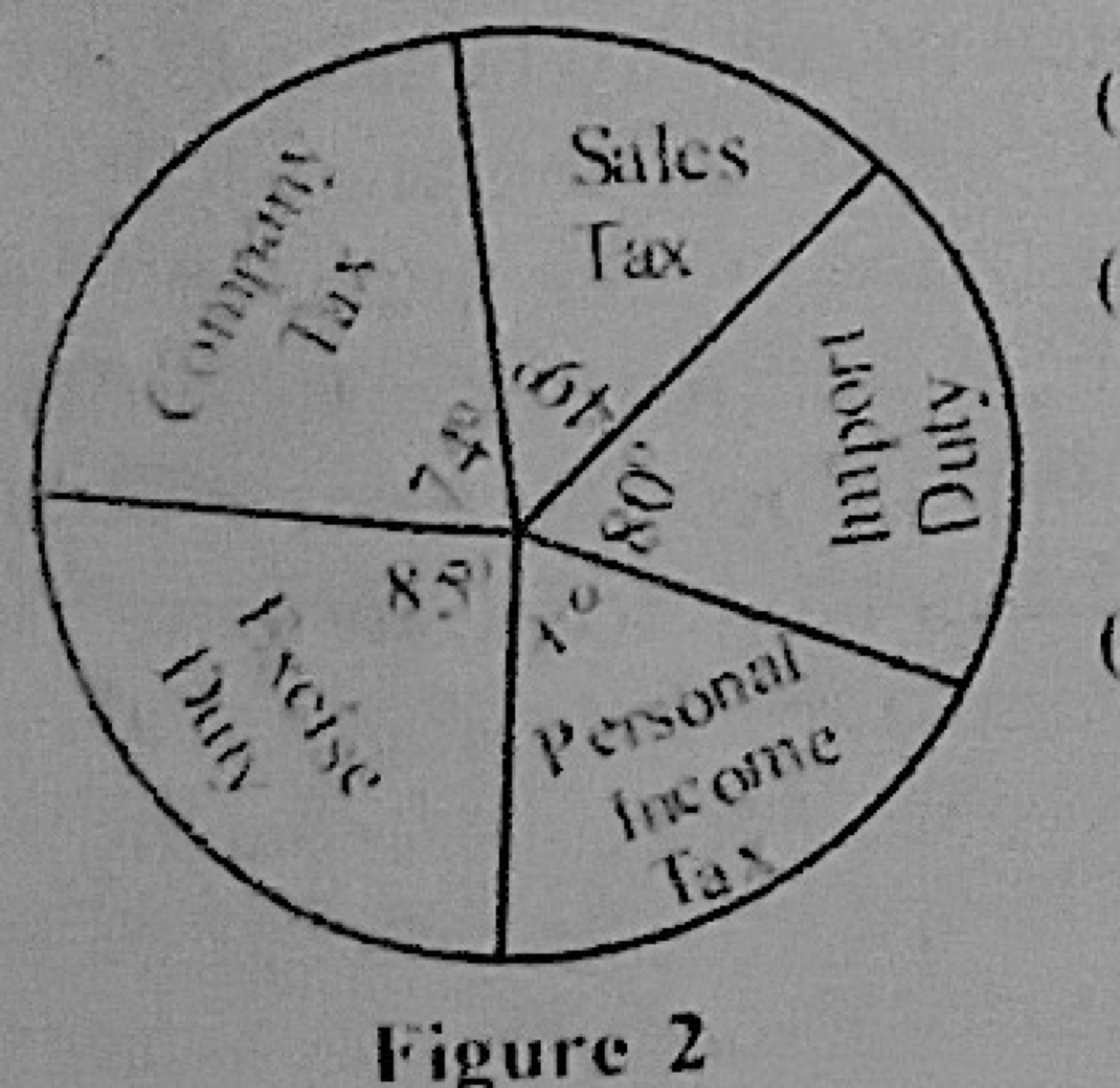
The statistical representation in Figure 2 below shows the sources of revenue for Country P in the year 2014. Use it to answer the questions that follow. (a) What name is given to the diagram above? (b) Define an excise duty. (c) If revenue from personal income tax was $800 million, calculate the: (i) total revenue for the year; (ii) total direct tax for the year. (d) Determine the percentage of total revenue that was collected from indirect tax. (e) State two advantages indirect taxes have over direct taxes.
Show the model answer
Model answer
(a) A pie chart. (b) An excise duty is a tax on goods produced (manufactured) within the country. (c) Personal income tax angle x = 360° − (74° + 49° + 80° + 85°) = 72°. (i) 72° ↔ $800 million, so total revenue = 360/72 × 800 = $4,000 million. (ii) Direct taxes = company tax 74° + personal income tax 72° = 146°: 146/360 × 4,000 ≈ $1,622.2 million. (d) Indirect taxes = excise 85° + sales tax 49° + import duty 80° = 214°: 214/360 × 100 ≈ 59.4%. (e) Any two: difficult to evade (included in prices); convenient, paid in small amounts; wide coverage including the informal sector; cheap to collect; can discourage harmful goods; can protect infant industries; does not directly reduce the incentive to work.
Explanation
Find the missing angle first; the angles add up to 360°.
(a) Explain why a scale of preference is important to an individual. (b) Discuss how the knowledge of the basic concepts of Economics can help a producer. (c) State any four factors that can help a producer to increase the supply of a commodity.
Show the model answer
Model answer
(a) An individual's income is limited while wants are many; listing wants in order of importance lets him satisfy the most pressing first, make rational choices, get maximum satisfaction from his income, and know the opportunity cost of each choice. (b) Scarcity tells the producer resources are limited; choice and scale of preference help him decide what to produce based on expected profit; opportunity cost shows what he gives up in each choice, so he allocates resources to the most profitable uses efficiently. (c) Any four: rise in the price of the commodity; lower cost of inputs; better technology; government subsidies or lower taxes; good weather; more capital/credit; better storage and transport.
Explanation
Scarcity, choice, scale of preference and opportunity cost are the basic concepts.
(a) With an example each, differentiate between: (i) consumer goods and producer goods; (ii) primary production and tertiary production. (b) Explain the following forms of capital and give an example in each case. (i) Fixed capital; (ii) working capital; (iii) social capital
Show the model answer
Model answer
(a)(i) Consumer goods satisfy wants directly, e.g. bread, clothes; producer goods are used to produce other goods, e.g. tractors, machines. (ii) Primary production extracts resources from nature, e.g. farming, mining, fishing; tertiary production provides services, e.g. banking, transport, teaching. (b)(i) Fixed capital: durable assets used many times, e.g. buildings, machinery. (ii) Working capital: inputs used up in one round of production or money for running costs, e.g. raw materials, fuel, cash for wages. (iii) Social capital: assets owned by the community/government for public use, e.g. roads, schools, hospitals.
(a) Distinguish between a firm and an industry. (b) Match the following characteristics to these business entities: sole proprietorship, partnership and public limited liability company: (i) much red tape and legal expense in starting the firm; (ii) owner(s) personal assets can be used to settle business debts; (iii) no specialized management; (iv) has a life independent of its owner(s); (v) permits some but not a great deal of specialization; (vi) greatest ability to acquire funds for expansion of the firm; (vii) unresolved disagreements among members can end the business; (viii) distinct separation of ownership and control of the business. (c) With the aid of a diagram, explain the equilibrium position of a profit-maximizing firm that is making a loss in a monopolistic competition.
Show the model answer
Model answer
(a) A firm is a single business unit producing goods or services; an industry is all the firms producing the same or similar products. (b)(i) Public limited company; (ii) sole proprietorship (and partnership); (iii) sole proprietorship; (iv) public limited company; (v) partnership; (vi) public limited company; (vii) partnership; (viii) public limited company. (c) The firm produces where MC = MR (MC cutting from below) and charges the price on its downward-sloping AR curve. If AC is above AR at that output, it makes a loss = (AC − AR) × output, shown as a rectangle between AC and price. Diagram: falling AR and MR, U-shaped MC and AC, AC above AR at the equilibrium output, loss area shaded. In the long run some firms leave until the rest earn normal profit.
Explanation
A loss occurs when AC is above AR at the MC = MR output.
(a) Define industrialization. (b) Distinguish between location of industry and localization of industry. (c) Where will an entrepreneur site the following firms? Give reasons for your answer in each case. (i) A sawmill; (ii) A ceramic tile producing factory; (iii) An egg-producing poultry farm
Show the model answer
Model answer
(a) Industrialization is the process of building up manufacturing industries so that they produce a growing share of output and employment. (b) Location of industry is the choice of site for a particular firm; localization of industry is the concentration of many firms of the same industry in one area. (c)(i) Sawmill: near the forest (source of raw material), because logs are bulky and heavy to transport. (ii) Ceramic tile factory: near deposits of clay/kaolin, because the raw material is heavy and loses weight in processing (or near the market if tiles are fragile). (iii) Egg-producing poultry farm: near the market (towns), because eggs are fragile and perishable.
Explanation
Bulky raw materials pull firms to sources; fragile or perishable products pull them to markets.
The economy of Country X grew by 5% annually over the past five years, with gross domestic product (GDP) rising from $80 billion to over $100 billion. However, per capita income was low at $838; poverty rates remained high at 37% and unemployment stood at 23%. The government launched an economic plan to improve education and healthcare, but it faced a lot of challenges. As a result, living standards did not significantly improve for many citizens, and the execution of the economic plan was deemed unsuccessful. Using the scenario above, (a) explain the relationship between economic growth and economic development in Country X; (b) explain how economic growth relates to the standard of living in Country X; (c) state any four possible reasons the economic plan of country X was not successfully implemented.
Show the model answer
Model answer
(a) Economic growth is the rise in output (GDP from $80 billion to over $100 billion); economic development is growth plus improvements in welfare – lower poverty and unemployment, better education and health. Country X had growth without development, since poverty (37%) and unemployment (23%) stayed high. (b) Growth raises living standards only if the extra income is shared widely and outpaces population growth; in Country X per capita income stayed low ($838), so most people's living standards did not improve. (c) Any four: inadequate funding; corruption and misuse of funds; political instability or change of government; poor data and planning; shortage of skilled manpower; poor implementation and monitoring; rapid population growth; over-dependence on foreign aid; unrealistic targets.
Explanation
Growth is about output; development is about people's welfare.
(a) Explain the following terms: (i) import quotas; (ii) embargo; (iii) import licences; (iv) foreign exchange control. (b) Outline three ways in which exports can be promoted in a country.
Show the model answer
Model answer
(a)(i) Import quotas: limits on the quantity of a commodity that may be imported in a period. (ii) Embargo: a total ban on the import or export of a commodity or on trade with a country. (iii) Import licences: official permits required before goods can be imported, used to control the type and volume of imports. (iv) Foreign exchange control: government regulation of the buying and selling of foreign currency to limit imports and capital outflow. (b) Any three: export subsidies and tax relief; export credit and insurance; devaluation of the currency; improving product quality and standards; trade fairs and export promotion agencies; removing export duties; trade agreements; better infrastructure and ports.
Explanation
Quotas limit quantity; embargoes ban trade completely.