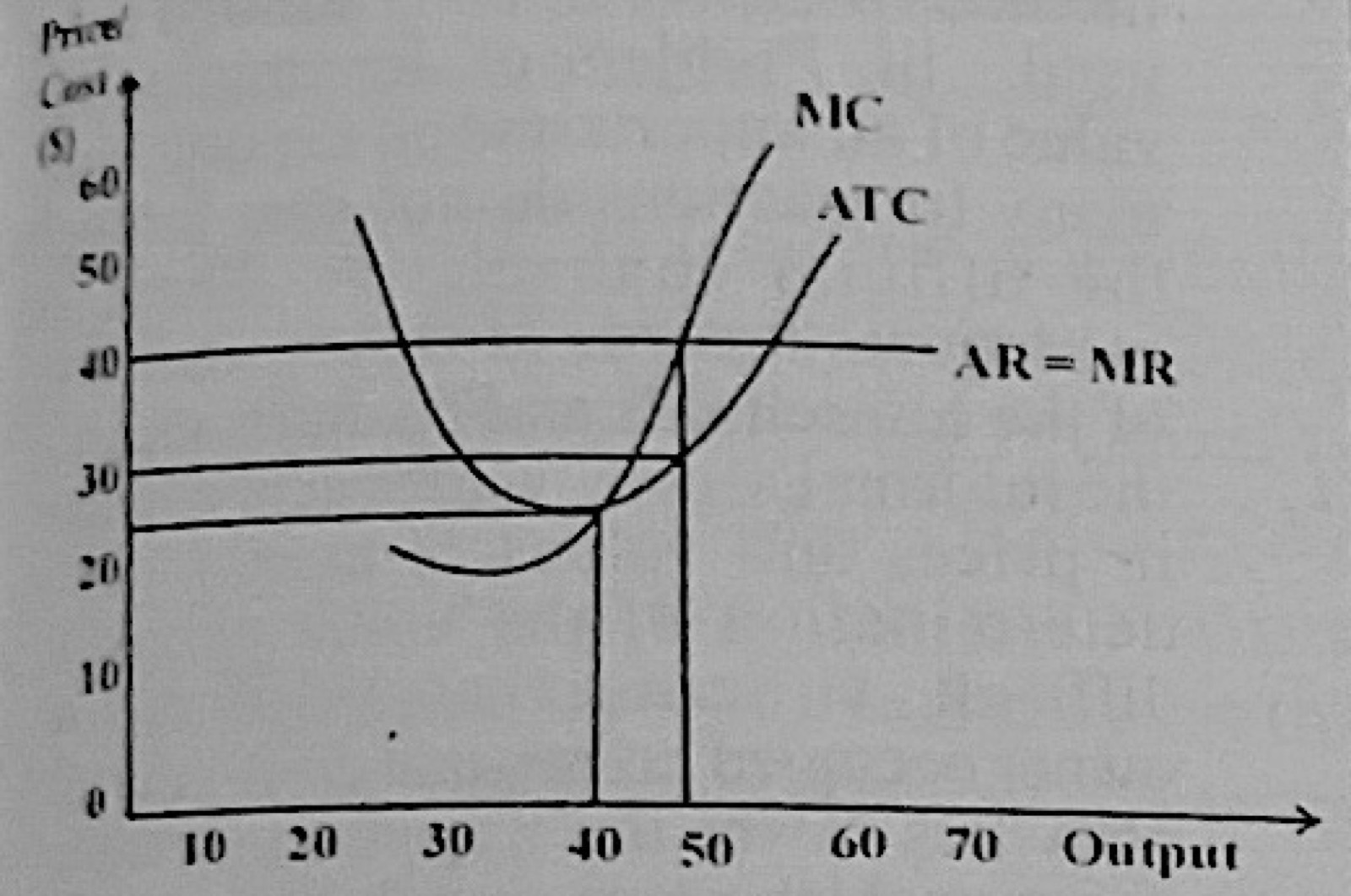
The equilibrium position of a firm is illustrated in the diagram below. Study the diagram and answer the questions that follow. (a) Determine the firm's: (i) equilibrium output level; (ii) equilibrium price. (b) At the equilibrium output level, calculate the firm's: (i) total cost; (ii) total revenue; (iii) total profit. (c) Is the firm operating in the long-run or short-run? Explain your answer. (d)(i) What type of market is the firm operating in? (ii) List three features of the market type identified in d (i).
Show the model answer
Model answer
(a)(i) 50 units (where MC = MR, MC rising); (ii) $40. (b)(i) ATC at 50 units = $30: TC = 30 × 50 = $1,500; (ii) TR = 40 × 50 = $2,000; (iii) profit = 2,000 − 1,500 = $500. (c) Short run: the firm earns supernormal profit (price above ATC); in the long run new firms would enter and remove it. (d)(i) Perfect competition (AR = MR is horizontal). (ii) Any three: many buyers and sellers; homogeneous product; free entry and exit; perfect knowledge; firms are price takers; perfect mobility of factors.
Explanation
Equilibrium is where MC = MR; profit = (AR − ATC) × Q.
Table 1 below represents the output levels of a firm producing hand sanitizer. Use the information to answer the questions that follow. Output (units) | 0 | 10 | 18 | 28 | 36 | 45 If the cost function of the firm is given as C = 30 + 4q, where C is the total cost and q is the units produced, calculate the: (a) total cost in dollars of producing: (i) 18 units; (ii) 36 units. (b) Average cost in dollars of producing: (i) 28 units; (ii) 45 units. (c) What is the marginal cost in dollars of producing 28 units? (d) Determine the profit made from producing 45 units when the market price is fixed at $5.00 per unit. (e) Determine the fixed cost of the firm. Explain your answer.
Show the model answer
Model answer
(a)(i) 30 + 4(18) = $102; (ii) 30 + 4(36) = $174 (b)(i) TC = 30 + 4(28) = 142; AC = 142 ÷ 28 ≈ $5.07; (ii) TC = 30 + 4(45) = 210; AC = 210 ÷ 45 ≈ $4.67 (c) MC = (TC28 − TC18) ÷ (28 − 18) = (142 − 102) ÷ 10 = $4 (each extra unit adds $4) (d) TR = 5 × 45 = $225; TC = $210; profit = $15 (e) $30: at q = 0, C = 30 + 4(0) = 30, the cost that must be paid even with no output.
(a) Distinguish between: (i) money cost and opportunity cost; (ii) normal good and inferior good. (b) Explain how the scale of preference assists the following economic groups in making efficient allocation of their resources: (i) individuals; (ii) firms; (iii) governments.
Show the model answer
Model answer
(a)(i) Money cost is the amount of money paid to obtain or produce a good; opportunity cost is the next best alternative given up. (ii) A normal good is one whose demand rises when income rises; an inferior good is one whose demand falls when income rises. (b)(i) Individuals rank their wants and spend limited income on the most pressing ones first, getting maximum satisfaction. (ii) Firms rank possible products/projects by expected profit and put their limited capital into the most profitable first. (iii) Governments rank projects by importance to citizens' welfare (e.g. health, education, roads) and fund the most urgent first within the budget.
Explanation
A scale of preference ranks wants so the most important are met first.
(a) Define economic system. (b) Distinguish between a capitalist economy and a socialist economy under the following: (i) aim of production; (ii) consumer sovereignty; (iii) competition. (c) State three features of land as a factor of production.
Show the model answer
Model answer
(a) An economic system is the way a society organises the ownership and use of its resources to decide what, how and for whom to produce. (b)(i) Aim: capitalism – profit; socialism – social welfare of all citizens. (ii) Consumer sovereignty: capitalism – consumers' spending decides what is produced; socialism – the state planners decide, so consumer sovereignty is limited. (iii) Competition: capitalism – many firms compete; socialism – little or no competition as the state controls production. (c) Any three: fixed in supply; free gift of nature; geographically immobile; subject to diminishing returns; varies in fertility/quality; its reward is rent.
(a) Differentiate between a sole proprietorship and a partnership. (b) List four characteristics of a sole proprietorship. (c) Outline four advantages of a public limited liability company.
Show the model answer
Model answer
(a) A sole proprietorship is owned, financed and controlled by one person who takes all profits and bears all losses; a partnership is owned by two to twenty persons who contribute capital and share profits and losses according to an agreement. (b) Any four: one owner; unlimited liability; small capital; owner takes all decisions and profit; easy to form; no separate legal entity; lack of continuity; personal contact with customers. (c) Any four: limited liability; large capital from the public; continuity (separate legal entity); shares freely transferable; professional management; economies of scale; easier access to loans.
(a) Define location of industry. (b) Explain how the following factors influence where a firm is sited: (i) raw materials; (ii) market; (iii) government policy. (c) Outline three advantages of localization of industry.
Show the model answer
Model answer
(a) Location of industry is the choice of the place where a firm sets up its factory/business. (b)(i) Raw materials: firms using bulky or weight-losing raw materials locate near them to cut transport costs (e.g. cement near limestone). (ii) Market: firms making bulky, fragile or perishable goods locate near consumers (e.g. bakeries, soft drinks). (iii) Government policy: incentives (tax holidays, industrial estates) or restrictions direct firms to particular areas for balanced development or security. (c) Any three: pool of skilled labour; shared infrastructure and services; ancillary/supporting industries develop; specialised institutions (banks, training centres); reputation of the area; easier exchange of information; lower costs (external economies).
Explanation
Localization means concentration of one industry in an area.
(a) Define Gross Domestic Product (GDP). (b) Describe the output approach as a method of computing national income. (c) Identify any three problems associated with the expenditure approach of calculating national income.
Show the model answer
Model answer
(a) GDP is the total money value of all final goods and services produced within a country's borders in a year. (b) The output approach adds the money value of final output (or value added) of all sectors – agriculture, mining, manufacturing, services – in a year; intermediate goods are excluded or only value added is counted to avoid double counting; net factor income from abroad is added to get GNP. (c) Any three: double counting of intermediate spending; difficulty in separating consumption and investment spending; unrecorded spending (informal sector, subsistence); transfer payments wrongly included; price changes/inflation; inadequate and unreliable data; illiteracy and poor records.
(a) What is an embargo? (b) Outline any three reasons for imposing tariffs on imports. (c) Explain any three reasons against the use of tariffs.
Show the model answer
Model answer
(a) An embargo is a total ban on trade (imports or exports) in a commodity or with a particular country. (b) Any three: to raise government revenue; to protect infant industries; to reduce imports and correct balance of payments deficit; to prevent dumping; to discourage harmful goods; to create local employment; for retaliation. (c) Any three: higher prices for consumers; protected firms may remain inefficient; other countries may retaliate; reduced choice and quality; encourages smuggling; reduces gains from specialisation and trade; may cause imported inflation for inputs.