The mining sector of an economy contributes 60% to the Gross Domestic Product (GDP). If the GDP is $540, what is the contribution of the mining sector?
If the quantity demanded of a commodity increases from 20 units to 30 units when there is an increase in price from $4.00 to $5.00, the elasticity of demand is
A.0.50
B.0.65
C.2.00
D.2.50
Show the answer and explanation
Answer: C (2.00)
Explanation
Quantity rises 50% for a 25% price rise: 50 ÷ 25 = 2.00.
A hypothetical national income data for a country in a particular year is presented below. Item | $ Million Wages and salaries | 250 Income paid abroad | 75 Income from self employment | 120 Stock appreciation | 5 Interest | 10 Income received from abroad | 50 Rent | 25 Depreciation allowance | 3 Royalties | 2 Profits and dividends | 35 From the data above, answer the following questions. Calculate the: (a) Gross Domestic Product (GDP); (b) Gross National Product (GNP); (c) Net National Product (NNP)
Show the model answer
Model answer
(a) GDP (income method) = wages 250 + self-employment 120 + interest 10 + rent 25 + royalties 2 + profits 35 − stock appreciation 5 = $437 million (b) GNP = GDP + income from abroad − income paid abroad = 437 + 50 − 75 = $412 million (c) NNP = GNP − depreciation = 412 − 3 = $409 million
Explanation
Stock appreciation is a price gain, not output, so it is subtracted.
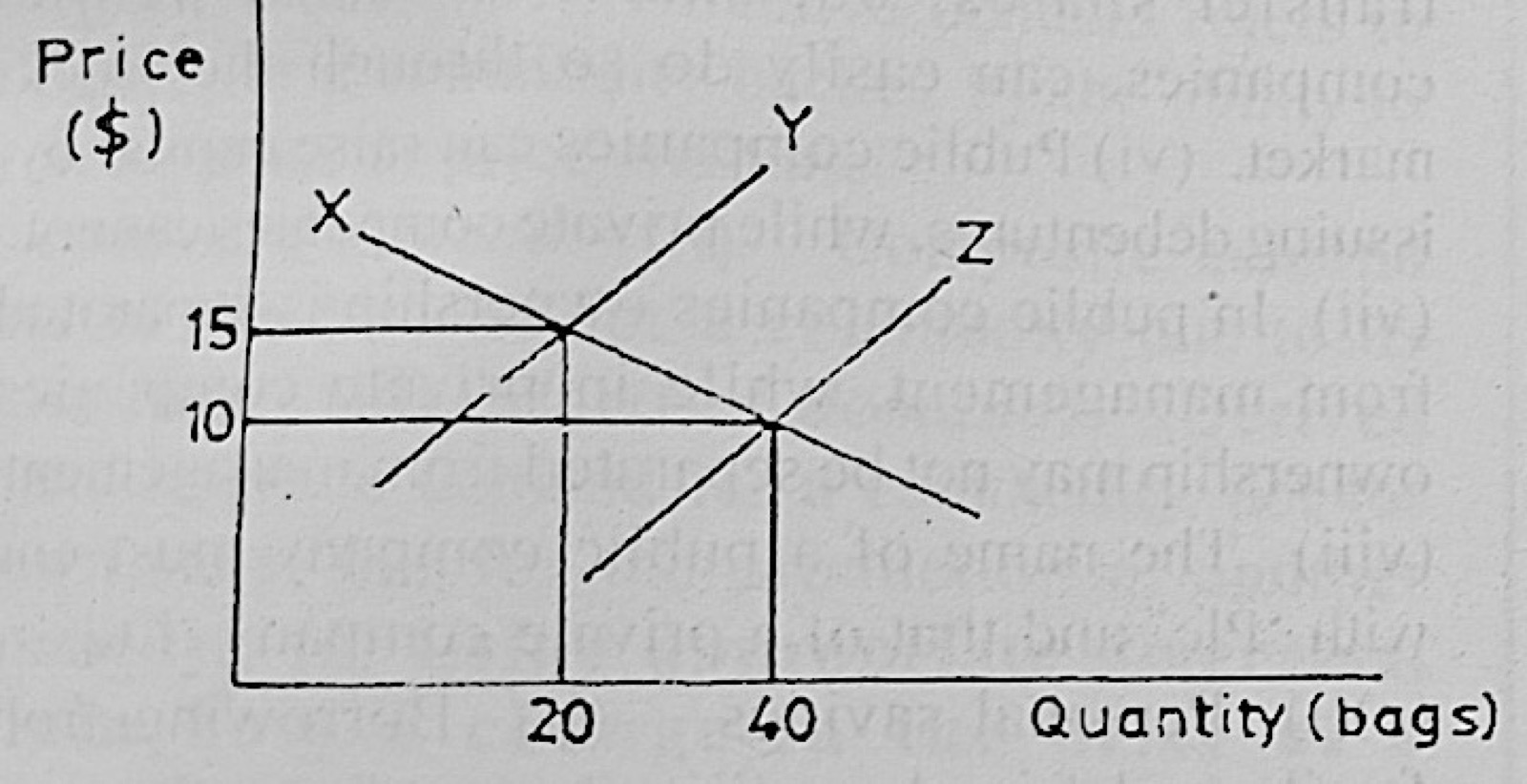
The diagram below shows the effects of the introduction of a subsidy on the production of maize. Study the diagram and answer the questions that follow: (a)(i) Identify the curves labelled X, Y and Z. (ii) State the direction of change in price and quantity with the introduction of subsidy. (b) Calculate the total revenue of the producers: (i) before the introduction of subsidy; (ii) after the introduction of subsidy. (c) Calculate the percentage increase or decrease in the total revenue of the producers with the introduction of subsidy. (d) If the quantity demanded of maize increases from 20 to 40 bags as a result of a fall in price from $15 to $10, calculate the price elasticity of demand. (e) State the type of elasticity of demand in 2(d).
Show the model answer
Model answer
(a)(i) X = demand curve; Y = original supply curve (before subsidy); Z = new supply curve (after subsidy). (ii) Price falls from $15 to $10; quantity rises from 20 to 40 bags. (b)(i) 15 × 20 = $300; (ii) 10 × 40 = $400 (c) (400 − 300)/300 × 100 = 33.3% increase (d) % change in quantity = 20/20 × 100 = 100%; % change in price = −5/15 × 100 = −33.3%; Ed = 100 ÷ 33.3 = 3 (ignoring the sign) (e) Elastic demand (coefficient greater than 1).
(a) Define the term limited liability. (b) Describe four differences between a public joint-stock company and a private joint-stock company. (c) Outline three sources of finance available to sole proprietorship.
Show the model answer
Model answer
(a) Limited liability means the owners' responsibility for the firm's debts is limited to the capital they invested; their private property cannot be taken. (b) Any four: membership – private 2 to 50, public at least 7 with no maximum; public company sells shares to the general public (stock exchange), private cannot; shares of a public company are freely transferable, private shares are restricted; public company must publish its accounts, private need not; public company may issue debentures to the public; ownership and management are more separated in a public company; names end in 'Plc' and 'Ltd'. (c) Any three: personal savings; loans from family and friends; bank loans and overdrafts; ploughed-back profits; trade credit; hire purchase; government grants/loans; sale of assets.
(a) Distinguish between labour force and efficiency of labour. (b) Describe five factors which determine the size of the labour force in a country.
Show the model answer
Model answer
(a) Labour force is the number of people of working age who are employed or actively seeking work; efficiency of labour is the ability of workers to produce more output, of good quality, in a given time. (b) Any five: total population size; age structure of the population; school-leaving age and length of education; retirement age; participation of women; attitudes to work and leisure/wage rates; health of the population; migration; social and religious customs.
Explanation
Labour force is about numbers; efficiency is about output per worker.
(a) What is a demand schedule? (b) Explain each of the following terms: (i) effective demand; (ii) composite demand; (iii) derived demand. (c) Using appropriate diagrams, explain how a change in the price of a commodity would influence the demand of its: (i) substitute; (ii) complement.
Show the model answer
Model answer
(a) A demand schedule is a table showing the quantities of a commodity consumers are willing and able to buy at various prices at a given time. (b)(i) Effective demand: desire backed by ability and willingness to pay. (ii) Composite demand: a commodity demanded for several different uses (e.g. sugar for drinks, bakery and home use). (iii) Derived demand: a good or factor wanted for what it helps to produce (e.g. labour, cement). (c)(i) If the price of a commodity rises, demand for its substitute increases: the substitute's demand curve shifts right (a fall in price shifts it left). (ii) If the price of a commodity rises, demand for its complement falls: the complement's demand curve shifts left (a fall in price shifts it right). Diagrams show D0 and D1 with labelled price and quantity axes.
Explanation
Substitutes move in the same direction as the other good's price; complements move opposite.
(a) Explain the following types of taxes: (i) specific tax; (ii) value-added tax. (b) With the aid of diagrams, describe the effects of an indirect tax on a commodity when demand is: (i) perfectly inelastic; (ii) perfectly elastic.
Show the model answer
Model answer
(a)(i) Specific tax: a fixed amount of tax per unit of a commodity, whatever its price (e.g. $2 per litre). (ii) Value-added tax: a tax charged at each stage of production and distribution on the value added at that stage, finally borne by the consumer. (b) The tax shifts the supply curve upward by the tax. (i) Perfectly inelastic (vertical) demand: quantity is unchanged and price rises by the full tax; the consumer bears all of it. (ii) Perfectly elastic (horizontal) demand: price is unchanged, quantity falls; the producer bears all the tax.
Explanation
The side of the market that cannot respond bears the tax.
(a) Distinguish between a: (i) mortgage bank and a merchant bank; (ii) commercial bank and a development bank. (b) Explain any four functions of commercial banks.
Show the model answer
Model answer
(a)(i) A mortgage bank gives long-term loans for buying and building houses, secured on the property; a merchant bank serves businesses, e.g. accepting bills of exchange, issuing and underwriting shares, giving medium-term loans and advice. (ii) A commercial bank takes deposits from the public, offers current accounts and cheques and gives mainly short-term loans for profit; a development bank gives medium- and long-term loans to finance development projects in agriculture, industry, etc., and does not usually take deposits from the public. (b) Any four: accepting deposits; lending (loans, overdrafts); creating credit; providing means of payment (cheques, transfers, cards); safekeeping of valuables; foreign exchange services; financial advice; acting as agents for customers (standing orders).
Explanation
Compare who each bank serves and the length of its loans.
(a) What is economic integration? (b) Outline any three short-comings of the Economic Community of West African States (ECOWAS). (c) Highlight any three achievements of the Economic Community of West African States (ECOWAS).
Show the model answer
Model answer
(a) Economic integration is the coming together of countries to remove trade barriers and co-ordinate their economic policies for mutual benefit. (b) Any three: different currencies; political instability and coups; poor transport and communication links; similar export products so little trade among members; loyalty to former colonial powers; non-implementation of protocols; smuggling and border harassment; unequal benefits. (c) Any three: free movement of persons (visa-free travel, ECOWAS passport); trade liberalisation scheme; peacekeeping (ECOMOG) in member states; regional infrastructure projects (roads, West African Gas Pipeline); common external tariff; ECOWAS Bank for Investment and Development.