WAEC Economics 2016 past questions and answers

58 questions. Try each one, then open the answer to check yourself and read the explanation.

Question 1

Basic Concepts

Human wants are insatiable because wants are

  1. A.limited while means are scarce.
  2. B.unlimited and means are also unlimited.
  3. C.limited and means are also limited.
  4. D.unlimited while means are scarce.
Show the answer and explanation

Answer: D (unlimited while means are scarce.)

Explanation

Wants have no end, but the means to satisfy them are limited.

Open this question

Question 2

Basic Concepts

Scale of preference is important for the following reasons except in

  1. A.satisfying wants.
  2. B.making rational choice.
  3. C.making optimum allocation of resources.
  4. D.using scarce resources efficiently.
Show the answer and explanation

Answer: A (satisfying wants.)

Explanation

A scale of preference ranks wants so choices are rational and resources are used well; it cannot satisfy all wants.

Open this question

Question 3

Economic Systems

In a socialist economy, prices of commodities are determined by

  1. A.forces of demand and supply.
  2. B.producers of the commodities.
  3. C.the central planning authority.
  4. D.consumers who are sovereign.
Show the answer and explanation

Answer: C (the central planning authority.)

Explanation

Under socialism the state planners fix prices.

Open this question

Question 4

Theory of Production

Which of the following cannot be classified as land in economics?

  1. A.Bauxite deposit in the ground
  2. B.A lake used for irrigation
  3. C.A bulldozer for clearing farm land
  4. D.Grazing field for cattle
Show the answer and explanation

Answer: C (A bulldozer for clearing farm land)

Explanation

A bulldozer is man-made equipment, i.e. capital.

Open this question

Question 5

Public Finance

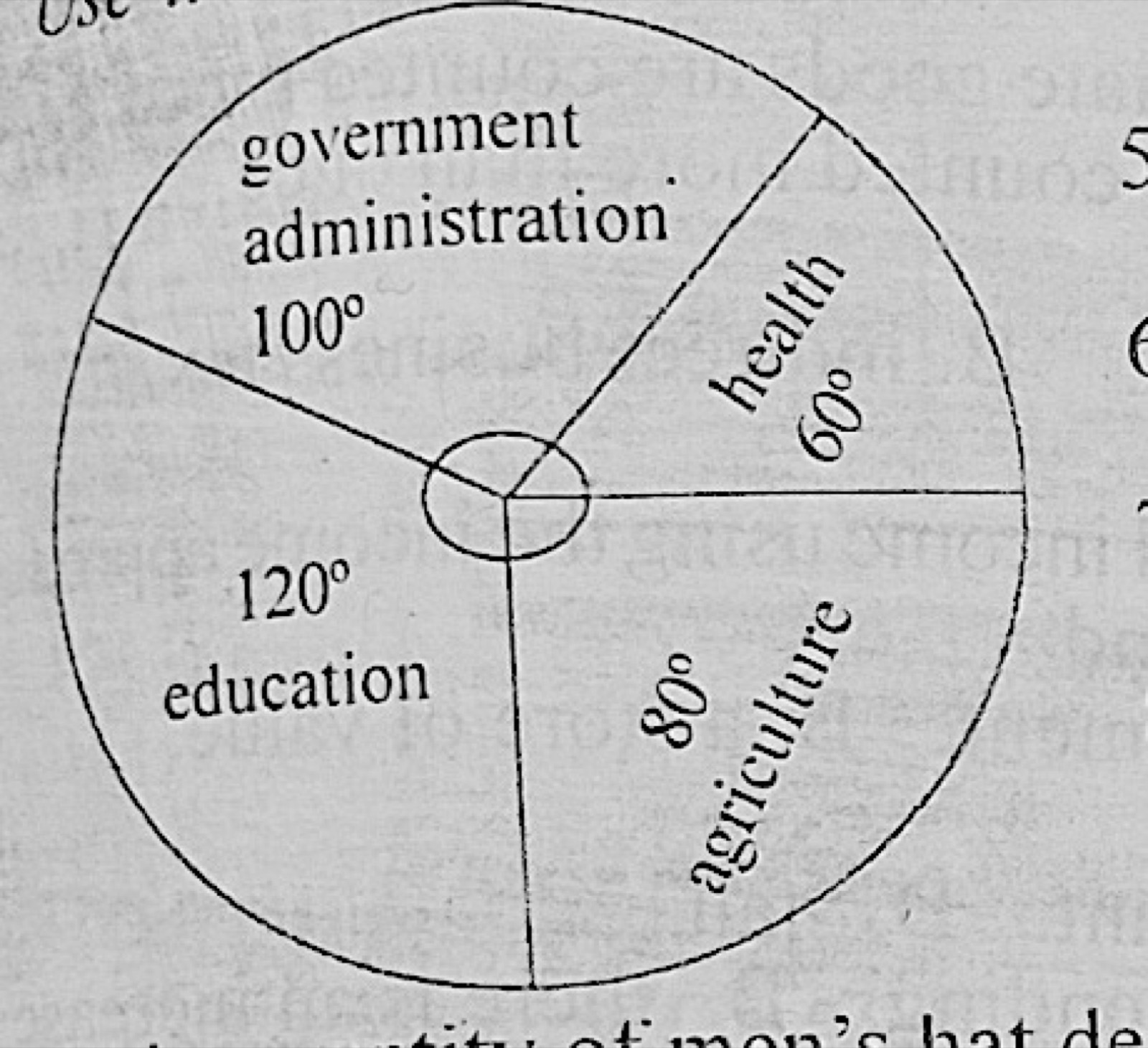
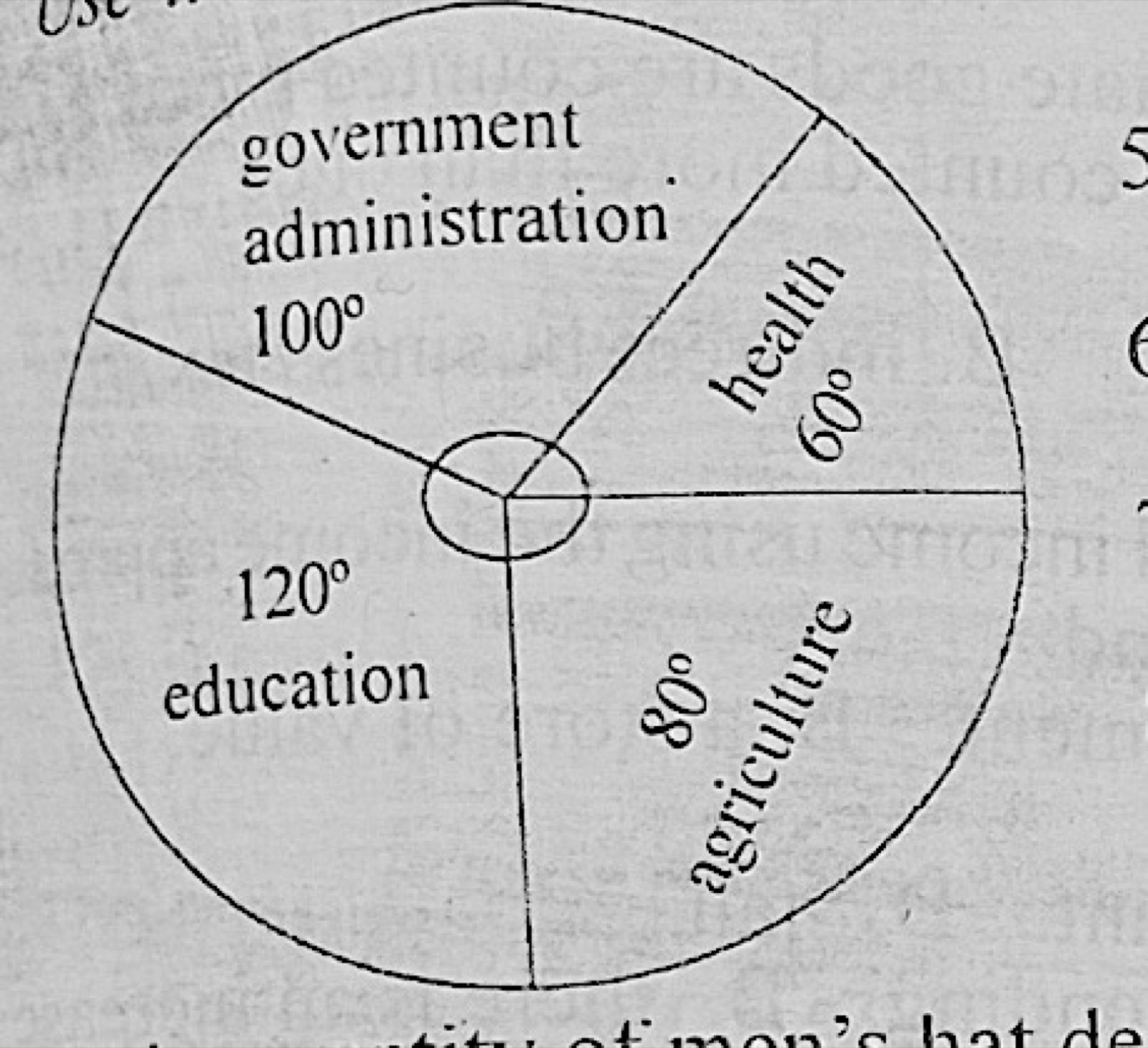
A country's budget allocation to various sectors of the economy is shown in the pie chart. If the budget of the country was $7,200.00, how much is allocated to Education?

Diagram for this question
  1. A.$2,400.00.
  2. B.$2,000.00
  3. C.$1,200.00
  4. D.$1,000.00
Show the answer and explanation

Answer: A ($2,400.00.)

Explanation

Education has 120° of 360°: 120/360 × 7,200 = $2,400.

Open this question

Question 6

Public Finance

A country's budget allocation to various sectors of the economy is shown in the pie chart. What is the ratio of expenditure on health to Agriculture?

Diagram for this question
  1. A.2:3
  2. B.3:4
  3. C.4:3
  4. D.5:4
Show the answer and explanation

Answer: B (3:4)

Explanation

Health 60° : agriculture 80° = 3 : 4.

Open this question

Question 7

Elasticity

The demand curve for a necessity is usually

  1. A.vertical.
  2. B.backward bending.
  3. C.horizontal.
  4. D.negatively sloped.
Show the answer and explanation

Answer: D (negatively sloped.)

Explanation

People buy necessities even when prices rise, so demand is inelastic and the curve is steep. But they still buy slightly less at higher prices, so it slopes downwards (negatively sloped).

Open this question

Question 8

Elasticity

What effect will an increase in price have on the total revenue of a firm whose product has inelastic demand? Total revenue will

  1. A.increase.
  2. B.fall.
  3. C.fluctuate.
  4. D.remain unchanged.
Show the answer and explanation

Answer: A (increase.)

Explanation

With inelastic demand quantity falls by a smaller percentage than price rises, so revenue goes up.

Open this question

Question 9

Theory of Demand

If the quantity of men's hat demanded per week is represented by the function Qd = 20 − (1/3)P, where P is price, how many hats are demanded when the price is $9.00?

  1. A.11
  2. B.17
  3. C.23
  4. D.47
Show the answer and explanation

Answer: B (17)

Explanation

Qd = 20 − 9/3 = 20 − 3 = 17.

Open this question

Question 10

Theory of Demand

The demand for torch and batteries is an example of

  1. A.competitive demand.
  2. B.composite demand.
  3. C.complementary demand.
  4. D.derived demand.
Show the answer and explanation

Answer: C (complementary demand.)

Explanation

A torch and its batteries are used together: complementary (joint) demand.

Open this question

Question 11

Elasticity

Price elasticity of supply measures how responsive

  1. A.consumers are to a change in price.
  2. B.sellers are to a change in buyers' income.
  3. C.sellers are to a change in price.
  4. D.buyers are to a change in income.
Show the answer and explanation

Answer: C (sellers are to a change in price.)

Explanation

Elasticity of supply measures how much sellers change the quantity supplied when price changes.

Open this question

Question 12

Labour Market

The tendency for workers to value their leisure hours more than hours of work as wage rate increases gives rise to

  1. A.positively sloping supply curve.
  2. B.perfectly elastic supply curve.
  3. C.backward bending supply curve.
  4. D.perfectly inelastic supply curve.
Show the answer and explanation

Answer: C (backward bending supply curve.)

Explanation

Beyond some wage, workers choose more leisure, so the labour supply curve bends backwards.

Open this question

Question 13

Theory of Supply

The supply of rice in tons is given by the function: Qs − 80 − 0.7P = 0. Where Qs = quantity supplied P = price in Dollars ($). Find Qs, when P = $40.

  1. A.108 tons.
  2. B.52 tons.
  3. C.−52 tons.
  4. D.−108 tons.
Show the answer and explanation

Answer: A (108 tons.)

Explanation

Qs = 80 + 0.7 × 40 = 80 + 28 = 108 tons.

Open this question

Question 14

Theory of Supply

How does producers' expectation of a price fall affect the supply curve of a product? There will be

  1. A.a movement along the curve.
  2. B.a leftward shift.
  3. C.no shift of the supply curve.
  4. D.a shift to the right.
Show the answer and explanation

Answer: D (a shift to the right.)

Explanation

Expecting lower prices later, producers sell more now, so present supply increases (shifts right).

Open this question

Question 15

Theory of Consumer Behaviour

One relationship between marginal utility and total utility is that when total utility is

  1. A.rising, marginal utility is rising.
  2. B.falling, marginal utility is negative.
  3. C.maximum, marginal utility is maximum.
  4. D.falling, marginal utility is rising.
Show the answer and explanation

Answer: B (falling, marginal utility is negative.)

Explanation

If total utility is falling, each extra unit subtracts satisfaction, so marginal utility is negative.

Open this question

Question 16

Price Determination

A shift in the supply curve to the right while demand curve remains the same will cause equilibrium price

  1. A.and quantity to fall.
  2. B.and quantity to rise.
  3. C.to rise and quantity to fall.
  4. D.to fall and quantity to rise.
Show the answer and explanation

Answer: D (to fall and quantity to rise.)

Explanation

More supply at every price lowers the price and raises the quantity traded.

Open this question

Question 17

Price Determination

A price floor results in

  1. A.excess demand.
  2. B.excess supply.
  3. C.parallel market.
  4. D.hoarding of goods.
Show the answer and explanation

Answer: B (excess supply.)

Explanation

A floor (minimum price) above equilibrium makes quantity supplied greater than quantity demanded: a surplus.

Open this question

Question 18

Theory of Production

An entrepreneur is encouraged to adopt division of labour in production because it

  1. A.provides more employment opportunities.
  2. B.leads to increased output and lower cost of production.
  3. C.brings about equal cost and employment opportunities.
  4. D.leads to increased cost of production and lower output.
Show the answer and explanation

Answer: B (leads to increased output and lower cost of production.)

Explanation

Specialisation raises output per worker and lowers cost per unit.

Open this question

Question 19

Theory of Production

The long run is a period when

  1. A.only the variable factors can be altered.
  2. B.all factors become variable.
  3. C.the firm will cease to exist.
  4. D.only the fixed factors can be altered.
Show the answer and explanation

Answer: B (all factors become variable.)

Explanation

In the long run every factor can be changed.

Open this question

Question 20

Market Structures

The necessary condition for a firm to be in equilibrium is that marginal revenue is

  1. A.greater than marginal cost.
  2. B.equal to marginal cost.
  3. C.less than average revenue.
  4. D.equal to average cost.
Show the answer and explanation

Answer: B (equal to marginal cost.)

Explanation

A firm maximises profit where MR = MC.

Open this question

Question 21

Market Structures

At which stage of production should a firm shut down? When

  1. A.AVC = ATC
  2. B.AVC < Price
  3. C.AVC > Price
  4. D.AVC = MC
Show the answer and explanation

Answer: C (AVC > Price)

Explanation

If price cannot cover average variable cost, producing adds to losses, so the firm shuts down.

Open this question

Question 22

Market Structures

Charging different prices for the same commodity is a feature of a

  1. A.perfect competition.
  2. B.commodity market.
  3. C.monopolistic competition.
  4. D.monopoly market.
Show the answer and explanation

Answer: D (monopoly market.)

Explanation

Price discrimination needs market power over separate groups of buyers, which a monopolist has.

Open this question

Question 23

Business Organisations

In a partnership, the conduct of members is guided by

  1. A.a memorandum of understanding.
  2. B.the articles of partnership.
  3. C.an article of association.
  4. D.a partnership constitution.
Show the answer and explanation

Answer: B (the articles of partnership.)

Explanation

Partners sign a deed or articles of partnership setting out their rights and duties.

Open this question

Question 24

Business Organisations

Indigenization policy is a measure aimed at

  1. A.privatizing the existing businesses owned by the state.
  2. B.commercializing state-owned businesses.
  3. C.reducing foreign economic domination.
  4. D.making the indigenes managing directors of businesses.
Show the answer and explanation

Answer: C (reducing foreign economic domination.)

Explanation

Indigenisation transfers ownership of businesses from foreigners to citizens.

Open this question

Question 25

Distributive Trade

Which of the following measures will hinder efficient distribution of goods in West Africa?

  1. A.Improving road networks
  2. B.Provision of adequate storage facilities
  3. C.Instituting price control
  4. D.Formation of producers' co-operative societies
Show the answer and explanation

Answer: C (Instituting price control)

Explanation

Price control leads to hoarding, shortages and black markets, which disrupt distribution.

Open this question

Question 26

Labour Market

The type of unemployment that occurs as a result of physical or mental disability of labour is known as

  1. A.frictional unemployment.
  2. B.structural unemployment.
  3. C.cyclical unemployment.
  4. D.residual unemployment.
Show the answer and explanation

Answer: D (residual unemployment.)

Explanation

Residual unemployment affects people who are hard to employ because of disability.

Open this question

Question 27

Population

One feature of a growing population is

  1. A.increase in the number of young people.
  2. B.increase in the number of old people.
  3. C.decrease in the dependent population.
  4. D.decrease in the life expectancy.
Show the answer and explanation

Answer: A (increase in the number of young people.)

Explanation

A growing population has high birth rates and so a large share of young people.

Open this question

Question 28

Labour Market

Efficiency of labour in a country is determined by the following factors except the

  1. A.social attitude to work.
  2. B.education and training.
  3. C.working conditions of workers.
  4. D.total population.
Show the answer and explanation

Answer: D (total population.)

Explanation

Efficiency is output per worker; the size of the population does not decide it.

Open this question

Question 29

Agriculture

Which of the following will encourage capital intensive farming?

  1. A.Encouraging communal system of land ownership
  2. B.Adopting policies that will encourage rural-urban migration
  3. C.Provision of subsidies on equipment
  4. D.Restrictive lending policies by banks
Show the answer and explanation

Answer: C (Provision of subsidies on equipment)

Explanation

Subsidies make machines cheaper for farmers to buy.

Open this question

Question 30

Economic Growth and Development

Which of the following best explains why more foreign investments are not attracted to West Africa?

  1. A.Small population size
  2. B.Small sizes of market places
  3. C.Instability in political and industrial policies
  4. D.Lack of manpower needed to work in industries
Show the answer and explanation

Answer: C (Instability in political and industrial policies)

Explanation

Investors avoid countries where politics and policies keep changing.

Open this question

Question 31

Industrialisation

Location of firms in rural areas may

  1. A.enable the firms to enjoy existing infrastructural facilities.
  2. B.make finance readily available.
  3. C.enhance even or balanced development.
  4. D.make such firms enjoy external economies of scale.
Show the answer and explanation

Answer: C (enhance even or balanced development.)

Explanation

Spreading firms to rural areas spreads development more evenly.

Open this question

Question 32

National Income

In national income accounting, double counting occurs when

  1. A.intermediate goods are counted twice.
  2. B.intermediate goods are counted with the final goods.
  3. C.final goods are counted more than once.
  4. D.different people count the products.
Show the answer and explanation

Answer: B (intermediate goods are counted with the final goods.)

Explanation

Counting intermediate goods as well as the final goods that contain them counts their value twice.

Open this question

Question 33

National Income

The difference between GDP and GNP is

  1. A.consumption of fixed capital.
  2. B.indirect business tax.
  3. C.net factor income from abroad.
  4. D.public transfer payments.
Show the answer and explanation

Answer: C (net factor income from abroad.)

Explanation

GNP = GDP + net factor income from abroad.

Open this question

Question 34

National Income

Which of the following items is not included in the measurement of the national income using the income approach?

  1. A.Wages and salaries
  2. B.Government purchases
  3. C.Interest
  4. D.Dividend
Show the answer and explanation

Answer: B (Government purchases)

Explanation

Government purchases belong to the expenditure approach; the income approach adds factor incomes.

Open this question

Question 35

Money and Inflation

A bank note is said to be a legal tender because it is

  1. A.printed by government.
  2. B.a store of value.
  3. C.signed by the head of state.
  4. D.backed by law.
Show the answer and explanation

Answer: D (backed by law.)

Explanation

Legal tender is money that the law says must be accepted in payment.

Open this question

Question 36

Money and Inflation

During inflation, interest rate will

  1. A.rise.
  2. B.fluctuate.
  3. C.remain constant.
  4. D.fall.
Show the answer and explanation

Answer: A (rise.)

Explanation

Lenders demand higher interest to make up for the falling value of money, and central banks raise rates.

Open this question

Question 37

Money and Inflation

Cost-push inflation is likely to arise when

  1. A.there is an increase in bank lending.
  2. B.there is an increase in subsidies.
  3. C.demand for higher wages is granted.
  4. D.there is a decrease in bank lending.
Show the answer and explanation

Answer: C (demand for higher wages is granted.)

Explanation

Higher wages raise production costs, which firms pass on as higher prices.

Open this question

Question 38

Financial Institutions

Which of the following financial institutions cannot be found on the capital market of a country?

  1. A.Commercial bank
  2. B.Mortgage bank
  3. C.Stock exchange
  4. D.Agricultural bank
Show the answer and explanation

Answer: A (Commercial bank)

Explanation

Commercial banks deal mainly in short-term funds (money market); mortgage and agricultural banks give long-term loans.

Open this question

Question 39

Financial Institutions

The stock market is a market for

  1. A.new and second hand shares.
  2. B.debentures.
  3. C.goods and services.
  4. D.short-term securities.
Show the answer and explanation

Answer: A (new and second hand shares.)

Explanation

Both new issues and existing shares are traded on the stock market.

Open this question

Question 40

Public Finance

Indirect taxes are generally

  1. A.progressive.
  2. B.regressive.
  3. C.equitable.
  4. D.proportionate.
Show the answer and explanation

Answer: B (regressive.)

Explanation

Indirect taxes take a larger share of a poor person's income.

Open this question

Question 41

Public Finance

Fiscal policy that can control inflation will include the use of

  1. A.balanced budgeting.
  2. B.tax holidays.
  3. C.budget deficit.
  4. D.budget surplus.
Show the answer and explanation

Answer: D (budget surplus.)

Explanation

A surplus budget takes more money out of the economy than it puts in, reducing demand.

Open this question

Question 42

Economic Growth and Development

Which of the following is a cause of under-development in West Africa?

  1. A.Availability of manpower
  2. B.Increasing population
  3. C.High rate of capital formation
  4. D.Large size of market places
Show the answer and explanation

Answer: B (Increasing population)

Explanation

Rapid population growth absorbs the gains from economic growth.

Open this question

Question 43

Economic Growth and Development

Which of the following is not a major problem of development planning?

  1. A.Shortage of skilled manpower
  2. B.Inadequate data for planning
  3. C.Political instability
  4. D.Poor identification of projects
Show the answer and explanation

Answer: D (Poor identification of projects)

Explanation

Skilled manpower shortage, poor data and political instability are the major problems; project identification is a lesser issue.

Open this question

Question 44

International Trade

The principle of comparative cost advantage was propounded by

  1. A.David Ricardo.
  2. B.Alfred Marshal.
  3. C.J. S. Mill.
  4. D.Adam Smith.
Show the answer and explanation

Answer: A (David Ricardo.)

Explanation

David Ricardo developed the theory of comparative advantage.

Open this question

Question 45

International Trade

The rate at which a country's exports is exchanged for her imports is

  1. A.trade balance.
  2. B.balance of payments.
  3. C.terms of trade.
  4. D.balance on current account.
Show the answer and explanation

Answer: C (terms of trade.)

Explanation

Terms of trade measure how many imports a unit of exports buys.

Open this question

Question 46

Balance of Payments and Exchange Rates

Balance of payments surplus implies that receipts for exports are

  1. A.at par with payments for imports.
  2. B.greater than payments for imports.
  3. C.less than payments for imports.
  4. D.proportional to payments for imports.
Show the answer and explanation

Answer: B (greater than payments for imports.)

Explanation

A surplus means receipts exceed payments.

Open this question

Question 47

Balance of Payments and Exchange Rates

When the international value of a country's currency rises, other things being equal, the country's

  1. A.net exports tend to increase.
  2. B.imports tend to decrease.
  3. C.net exports tend to decrease.
  4. D.exports tend to be stable.
Show the answer and explanation

Answer: C (net exports tend to decrease.)

Explanation

A stronger currency makes exports dearer abroad and imports cheaper at home, so net exports fall.

Open this question

Question 48

International Trade

One of the physical measures that can be used to reduce the volume of imports is the

  1. A.reduction of personal income tax.
  2. B.removal of import duties.
  3. C.use of foreign exchange control.
  4. D.liberalization of credit for importers.
Show the answer and explanation

Answer: C (use of foreign exchange control.)

Explanation

Exchange control limits the foreign currency available for imports.

Open this question

Question 49

International Economic Organisations

When a number of countries agree to remove all trade barriers among themselves and at the same time charge a common tariff against non-member countries, it is known as

  1. A.free trade area.
  2. B.common market.
  3. C.customs union.
  4. D.economic community.
Show the answer and explanation

Answer: C (customs union.)

Explanation

Free trade among members plus a common external tariff is a customs union.

Open this question

Question 50

International Economic Organisations

Which of the following international organizations is concerned with the stabilization of the balance of payments? The

  1. A.International Monetary Fund (IMF)
  2. B.World Bank (IBRD)
  3. C.United Nations Organization (UNO)
  4. D.Economic Commission for Africa (ECA)
Show the answer and explanation

Answer: A (International Monetary Fund (IMF))

Explanation

The IMF helps members with balance of payments problems.

Open this question

Theory question 101

Public Finance

The following data shows the budget of a hypothetical country in 2006. Study the data and answer the questions that follow:
Revenue | [$ millions]
Company tax | 240
Workers' income tax | 160
Excise duties | 80
Taxes on exports | 100
Value added tax | 150
Import duties | 90
Non-tax revenue | 40
Expenditure | [$ millions]
Construction of roads | 100
Building of schools | 120
Payment of workers' salaries | 150
Government administration | 200
Maintenance of health facilities | 220
Extension of electricity to rural areas | 180
Maintenance of official vehicles | 70
(a) Calculate the total (i) direct taxes; (ii) indirect taxes.
(b) Calculate the total (i) recurrent expenditure; (ii) capital expenditure.
(c) What percentage of total revenue was collected as indirect tax?
(d) State two examples of non-tax revenue.
(e) What was the budget surplus or deficit? Explain your answer.

Show the model answer
Model answer

(a)(i) Direct taxes = company tax 240 + workers' income tax 160 = $400 m
(ii) Indirect taxes = excise 80 + export taxes 100 + VAT 150 + import duties 90 = $420 m
(b)(i) Recurrent = salaries 150 + administration 200 + maintenance of health facilities 220 + maintenance of vehicles 70 = $640 m
(ii) Capital = roads 100 + schools 120 + rural electricity 180 = $400 m
(c) Total revenue = 400 + 420 + 40 = $860 m; indirect share = 420/860 × 100 ≈ 48.84%
(d) Any two: rents and royalties; fees and fines; profits of public enterprises; grants and aid; sale of government property.
(e) Total expenditure = 640 + 400 = $1,040 m; 1,040 − 860 = $180 m deficit, because expenditure is greater than revenue.

Explanation

Indirect taxes are on goods and trade; capital spending builds new assets.

Open this question

Theory question 102

Theory of Consumer Behaviour

The utility schedule of a consumer for a brand of ice cream is shown in the table below. Use the information to answer the questions that follow:
Units Consumed (Q) | Total Utility (TU) | Marginal Utility (MU)
0 | 0 | –
1 | 10 | 10
2 | 19 | R
3 | P | 6
4 | 30 | 5
5 | 31 | S
6 | Q | 0
7 | 29 | −2
(a) Calculate the values of P, Q, R and S.
(b) Given that the price of ice cream is $1.00 per unit, at what level of consumption is the consumer in equilibrium? Explain your answer.
(c) Using a graph sheet, draw the marginal utility curve.
(d) State the law of diminishing marginal utility.

Show the model answer
Model answer

(a) P = 19 + 6 = 25; Q = 31 + 0 = 31; R = 19 − 10 = 9; S = 31 − 30 = 1
(b) At 5 units, where MU (1) equals the price ($1.00, taking 1 util as worth $1): buying the 5th unit gives satisfaction just equal to what is paid; a 6th unit gives MU 0, less than the price.
(c) Units on the horizontal axis, MU on the vertical axis; plot 10, 9, 6, 5, 1, 0, −2 for units 1–7 and join: a downward-sloping curve that cuts the horizontal axis at 6 units and goes below it at 7.
(d) As a consumer takes more and more units of a commodity in a given period, the additional satisfaction from each extra unit eventually decreases.

Explanation

MU = change in TU; equilibrium for one good is where MU = price.

Open this question

Theory question 103

Basic Concepts

(a) What is a production possibility curve?
(b) Draw a production possibility curve and indicate any: (i) point P, where resources are fully utilized; (ii) point U, where resources are under-utilized; (iii) point X, where production is not feasible.
(c) Explain any two factors that can make production at point X feasible.
(d) Why is the production possibility curve negatively sloped?

Show the model answer
Model answer

(a) A production possibility curve shows the different combinations of two goods that an economy can produce when all its resources are fully and efficiently used with given technology.
(b) Concave curve between the two axes (each axis one good): P on the curve; U inside the curve; X outside the curve.
(c) Any two: improvement in technology; discovery of new resources; increase in the quantity of labour or capital (investment, population growth); better education and skills; foreign aid/investment. These shift the curve outward so X becomes attainable.
(d) Resources are scarce: to produce more of one good, some of the other must be given up (opportunity cost), so the curve slopes downward.

Explanation

Points on the curve: full use; inside: under-use; outside: unattainable now.

Open this question

Theory question 104

Agriculture

(a) What is: (i) peasant farming? (ii) co-operative farming?
(b) Identify any five ways through which the government can assist peasant farmers.

Show the model answer
Model answer

(a)(i) Peasant farming: small-scale farming on small plots, using simple tools and family labour, mainly for family consumption with a little surplus for sale.
(ii) Co-operative farming: farmers voluntarily pool land, labour, capital and equipment, farm and market together and share the benefits.
(b) Any five: credit/loans at low interest; subsidised fertilisers, seeds and chemicals; extension services and training; provision of rural infrastructure (roads, storage, water); guaranteed minimum prices/marketing; land reform; mechanisation (tractor hire services); irrigation schemes; research into improved varieties; insurance against crop failure.

Explanation

Help should raise productivity or income of small farmers.

Open this question

Theory question 105

Elasticity

(a) What is price elasticity of supply?
(b) Differentiate between joint supply and competitive supply.
(c) Explain any four determinants of elasticity of supply.

Show the model answer
Model answer

(a) Price elasticity of supply is the degree of responsiveness of quantity supplied to a change in the commodity's price: % change in quantity supplied ÷ % change in price.
(b) Joint supply: two goods produced together from one process, so more of one automatically gives more of the other (e.g. beef and hides, palm oil and kernel). Competitive supply: goods that compete for the same resources, so more of one means less of the other (e.g. cocoa and coffee on the same land).
(c) Any four: time period; nature/perishability of the good; availability of spare capacity and stocks; mobility of factors; length of production period; cost of production; ease of entry of new firms; government policy.

Explanation

Joint: produced together; competitive: compete for resources.

Open this question

Theory question 106

Financial Institutions

(a) Define: (i) Building Society; (ii) Central Bank.
(b) Highlight any five instruments of the Central Bank in regulating the supply of money.

Show the model answer
Model answer

(a)(i) A building society is a financial institution that accepts savings from members/the public and gives long-term loans (mortgages) for buying or building houses.
(ii) A central bank is the apex financial institution of a country that issues currency, acts as banker to government and commercial banks, and controls money supply and credit.
(b) Any five: open market operations; bank rate/monetary policy rate; cash reserve ratio; liquidity ratio; special deposits; selective credit control; moral suasion; credit ceilings; direct directives.

Explanation

Instruments change the banks' ability to create credit.

Open this question

Theory question 107

Market Structures

(a) Who is a discriminating monopolist?
(b) Explain any four conditions necessary for a monopolist to practise price discrimination.
(c) Explain any two benefits enjoyed by a discriminating monopolist.

Show the model answer
Model answer

(a) A discriminating monopolist is a sole seller who charges different prices to different buyers or markets for the same product for reasons not related to cost.
(b) Any four: the seller must be a monopolist (no close substitutes); markets must be separable so buyers cannot resell (no seepage); different elasticities of demand in the markets; consumer ignorance or indifference; distance, tariffs or time separating markets; nature of the product (personal services such as medical care); legal sanction.
(c) Any two: higher total revenue and profit; can sell to more buyers by charging low prices to the poor/elastic market; can use excess capacity; can dispose of surplus abroad (dumping); covers costs of services that would otherwise be unprofitable.

Explanation

Separate markets with different elasticities are essential.

Open this question

Theory question 108

National Income

Explain the following National Income concepts: (a) Gross Domestic Product (GDP); (b) Gross National Product (GNP); (c) Cost of living; (d) Per Capita income; (e) Standard of living.

Show the model answer
Model answer

(a) GDP: the total money value of all final goods and services produced within a country's borders in a year, by both citizens and foreigners.
(b) GNP: the total money value of all final goods and services produced by a country's citizens and their firms at home and abroad in a year; GDP + net factor income from abroad.
(c) Cost of living: the amount of money needed to buy the goods and services a person or family needs to maintain a given standard of living over a period.
(d) Per capita income: national income divided by the population; average income per person.
(e) Standard of living: the level of material well-being of people, measured by the quantity and quality of goods and services they enjoy (food, housing, health, education).

Explanation

GDP is about location; GNP is about ownership by citizens.
Open this question