The table below shows Mr. Y's schedule of total utility for oranges and mangoes. The prices of oranges and mangoes are set at $1.00 each. Mr. Y has $10.00 to spend on the goods. Use the information contained in the table to answer the questions that follow. Oranges | Total utility | Mangoes | Total utility 1 | 100 | 1 | 50 2 | 190 | 2 | 95 3 | 270 | 3 | 135 4 | 340 | 4 | 170 5 | 400 | 5 | 200 6 | 450 | 6 | 225 7 | 490 | 7 | 245 8 | 520 | 8 | 260 (a) Calculate the marginal utility for all the levels of consumption for the goods. (b) At equilibrium, how many (i) oranges, (ii) mangoes will the consumer buy? (c) (i) State the law of diminishing marginal utility. (ii) State the marginal condition for utility maximization.
Show the model answer
Model answer
(a) MU = TUn − TUn−1 Oranges: 100, 90, 80, 70, 60, 50, 40, 30 Mangoes: 50, 45, 40, 35, 30, 25, 20, 15 (b) Spend $10 so that MU per dollar is equal: (i) 7 oranges (MU 40); (ii) 3 mangoes (MU 40); 7 + 3 = 10 dollars. (c)(i) As a consumer takes more and more units of a commodity in a given period, the extra satisfaction from each additional unit eventually falls. (ii) MUO/PO = MUM/PM (and all income is spent).
Explanation
Equilibrium is where the last dollar spent on each good gives the same marginal utility and the whole $10 is used.
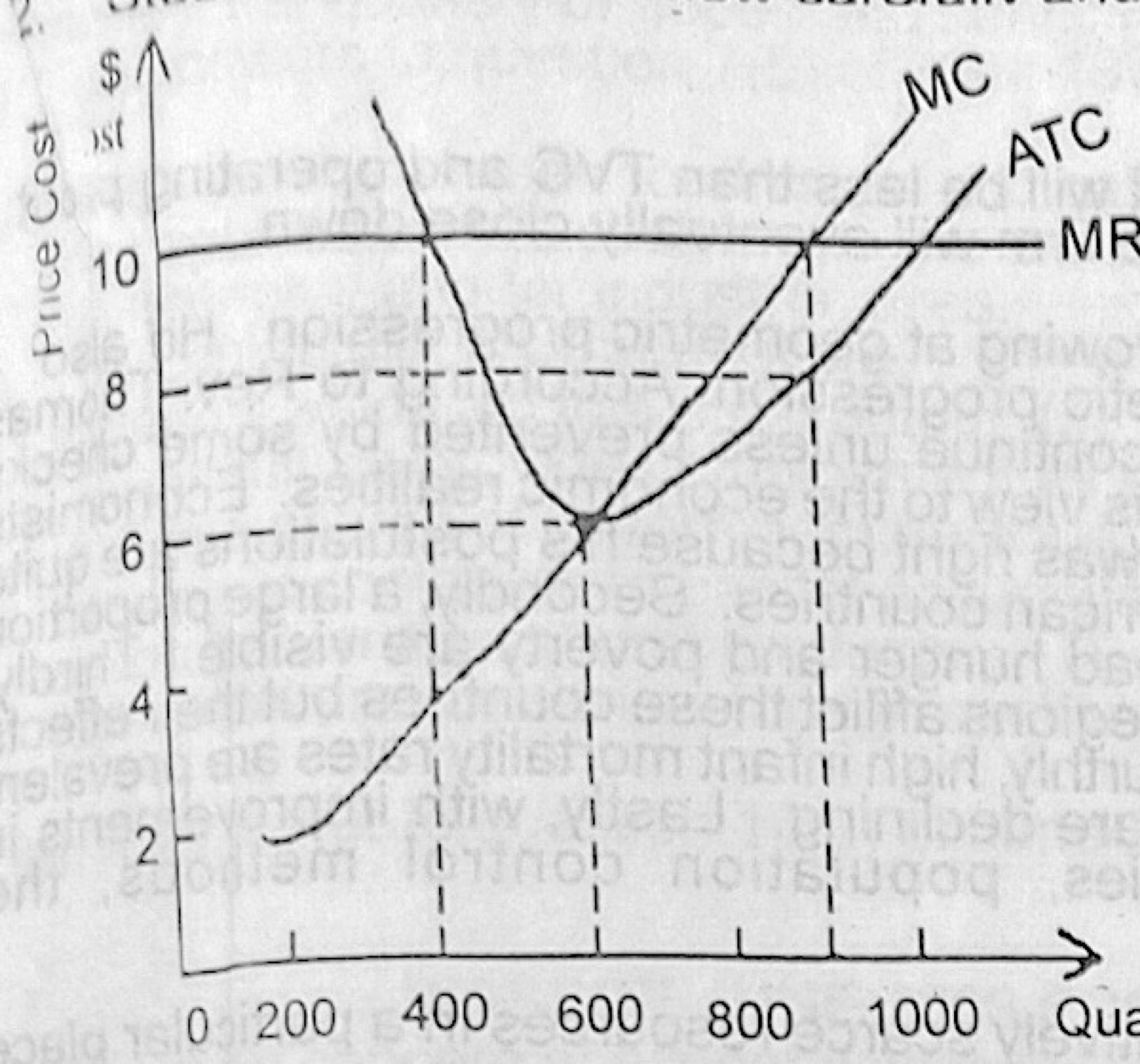
Study the diagram below carefully and use the given information to answer the questions that follow. (a) Determine: (i) the profit maximizing output; (ii) the firm's profit if it produces 600 units of output; (iii) the total cost if the firm produces 400 units. (b) Calculate the: (i) total revenue; (ii) profit of the firm at the output level of 900 units. (c) What will happen if a firm's market price falls below its average variable cost?
Show the model answer
Model answer
(a)(i) 900 units, where MC = MR (MC cuts MR from below). (ii) At 600 units price (MR = AR) = $10 and ATC = $6: profit = (10 − 6) × 600 = $2,400 (TR $6,000 − TC $3,600). (iii) TC = ATC at 400 units × 400, with ATC read from the graph (the printed graph does not show a clear ATC value at 400 units). (b)(i) TR = 10 × 900 = $9,000. (ii) ATC at 900 units is about $8 (dashed line): TC ≈ 8 × 900 = $7,200, so profit ≈ 9,000 − 7,200 = $1,800. (c) The firm cannot cover even its variable costs, so it shuts down (stops production) in the short run.
Explanation
Read ATC at each output from the graph, then TC = ATC × Q and profit = TR − TC.
(a) Give two major views of Rev. Thomas Malthus in population theory. (b) How relevant are his views to the economic realities of West African countries?
Show the model answer
Model answer
(a) Population tends to grow in geometric progression (1, 2, 4, 8…) while food supply grows in arithmetic progression (1, 2, 3, 4…); population would outstrip food; positive checks (famine, disease, war) and preventive checks (late marriage, moral restraint) would bring population back in line; population doubles about every 25 years. (b) Partly relevant: rapid population growth, food shortages, hunger, poverty and high dependency are visible in many West African countries. Less relevant: improved farming technology, fertilisers and food imports have raised food supply; family planning and education are reducing birth rates; Malthus ignored international trade and technical progress.
Explanation
Give his two progressions and the checks, then weigh evidence for and against in West Africa.
(a) What is an economic system? (b) Explain any three characteristics of a mixed economic system. (c) State any two disadvantages of a mixed economic system.
Show the model answer
Model answer
(a) The way a society organises ownership and use of its resources to answer what, how and for whom to produce. (b) Any three: both private and public ownership of the means of production; price mechanism works alongside government planning and regulation; profit motive exists with social welfare goals; government provides essential services and controls strategic industries; consumers have freedom of choice within regulations. (c) Any two: inefficiency and corruption in public enterprises; government controls can discourage private initiative; conflict between public and private sectors; bureaucracy and delays; tax burden to finance the public sector.
Explanation
A mixed economy combines features of capitalism and socialism.
(a) Define elasticity of supply. (b) When is supply described as (i) elastic; (ii) inelastic? (c) Outline any two factors that influence elasticity of supply.
Show the model answer
Model answer
(a) The degree of responsiveness of quantity supplied to a change in price: % change in quantity supplied ÷ % change in price. (b)(i) Elastic: % change in quantity supplied is greater than % change in price (coefficient > 1). (ii) Inelastic: % change in quantity supplied is less than % change in price (coefficient < 1). (c) Any two: time period; nature/perishability of the good; availability of spare capacity and stocks; mobility of factors of production; length of the production period; ease of entry of firms.
Explanation
Elastic means coefficient greater than 1; inelastic less than 1.
(a) State the law of diminishing returns. (b) What is (i) marginal product, (ii) average product? (c) Explain any three factors that determine the size of firms.
Show the model answer
Model answer
(a) If more and more units of a variable factor are added to a fixed factor, the marginal product of the variable factor will at first rise but will eventually fall. (b)(i) Marginal product: the change in total product from employing one more unit of the variable factor (ΔTP/ΔL). (ii) Average product: total product divided by the number of units of the variable factor (TP/L). (c) Any three: size of the market; availability of capital; managerial ability of the entrepreneur; nature of the product; government policy; availability of raw materials and labour; level of technology; type of business organisation.
Explanation
Marginal product is the extra output; average product is output per unit of the variable factor.
(a) Distinguish between labour and labour force. (b) State four reasons for the differences in earnings among workers.
Show the model answer
Model answer
(a) Labour is the human effort, physical and mental, used in production in return for a reward; labour force (working population) is the number of people of working age who are willing and able to work, whether employed or seeking work. (b) Any four: differences in skill, education and training; nature of the job (risk, unpleasantness); demand and supply of each type of labour; trade union strength; government policy (minimum wage); differences in productivity; experience and length of service; discrimination by sex, location or race; prestige of the job.
Explanation
Labour is the factor of production; labour force is the group of people available to work.
Explain each of the following: (a) Nationalization; (b) Commercialization; (c) Privatization; (d) Joint Ventures.
Show the model answer
Model answer
(a) Nationalization: government taking over ownership and control of privately owned businesses, usually with compensation. (b) Commercialization: reorganising a public enterprise to run on commercial lines, covering its costs and making profit, without government subsidy, while it stays government-owned. (c) Privatization: transfer of ownership of public enterprises, wholly or partly, to private individuals or firms, usually by selling shares. (d) Joint venture: a business owned and controlled jointly by two or more parties, e.g. government and foreign firms, sharing capital, risks and profits.
Explanation
Give a clear one-line definition and an example for each.
(a) Outline any three disadvantages of monopoly. (b) In what two ways can monopoly power be controlled?
Show the model answer
Model answer
(a) Any three: higher prices than under competition; restricted output; consumers have no choice; poor quality goods and services; exploitation of consumers through price discrimination; inefficiency because there is no competition; abnormal profits at consumers' expense. (b) Any two: price control/regulation by government; nationalisation; anti-monopoly laws; heavy taxes on monopoly profits; encouraging competition (removing barriers, allowing imports); consumer protection agencies.
Explain (a)(i) supply of money (ii) value of money (b) Highlight the three motives for holding money.
Show the model answer
Model answer
(a)(i) Supply of money: the total stock of money in circulation in an economy at a given time, i.e. currency with the public plus bank deposits. (ii) Value of money: the purchasing power of money, the quantity of goods and services a unit of money can buy; it moves inversely with the general price level. (b) Transactions motive (day-to-day spending); precautionary motive (for emergencies); speculative motive (to take advantage of changes in interest rates and bond prices).
Explanation
These are Keynes's three motives for liquidity preference.
(a) Distinguish between food crops and cash crops. (b) Outline any four contributions of agriculture to the economic development of your country.
Show the model answer
Model answer
(a) Food crops are grown mainly for consumption by the farmer and the local population (e.g. yam, cassava, maize); cash crops are grown mainly for sale, often for export or industry (e.g. cocoa, cotton, rubber). (b) Any four: provides food; provides raw materials for industries; earns foreign exchange through exports; provides employment; source of government revenue; market for industrial goods; provides capital through savings of farmers; contributes to national income.
(a) What is economic integration? (b) Highlight any three problems of economic integration in West Africa.
Show the model answer
Model answer
(a) Economic integration is the coming together of two or more countries to remove trade barriers and co-ordinate their economic policies for mutual benefit, e.g. ECOWAS. (b) Any three: different currencies and exchange controls; political instability and lack of commitment; similar products, so little trade among members; poor transport and communication links; loss of customs revenue; unequal sharing of benefits among members; language differences and colonial ties; smuggling; insecurity.
Explanation
Explain each problem briefly with reference to ECOWAS.