WAEC Economics 2003 past questions and answers

58 questions. Try each one, then open the answer to check yourself and read the explanation.

Question 1

Basic Concepts

Economics as a field of study is a

  1. A.pure science
  2. B.political science
  3. C.social science
  4. D.physical science.
Show the answer and explanation

Answer: C (social science)

Explanation

Economics studies human behaviour in society, so it is a social science.

Open this question

Question 2

Economic Systems

The three major agents of an economic system are the

  1. A.consumers, workers and producers.
  2. B.markets, telecommunication and banks
  3. C.schools, hospitals and universities
  4. D.individuals, firms and government.
Show the answer and explanation

Answer: D (individuals, firms and government.)

Explanation

The decision-makers in any economy are households (individuals), firms and the government.

Open this question

Question 3

Tools of Economic Analysis

Which of the following is not an advantage of tabular presentation of data? It

  1. A.enables easy location of required figures
  2. B.makes for easy comparison of figures
  3. C.occupies more space than mathematical equation
  4. D.shows whether the figures are increasing or decreasing.
Show the answer and explanation

Answer: C (occupies more space than mathematical equation)

Explanation

Taking up more space than an equation is a drawback, not an advantage, of tables.

Open this question

Question 4

Basic Concepts

The problem of scarcity is reduced by

  1. A.controlling consumption of goods and services
  2. B.producing everything needed by consumers
  3. C.ensuring efficient allocation of resources
  4. D.restricting consumer choices and tastes.
Show the answer and explanation

Answer: C (ensuring efficient allocation of resources)

Explanation

Using scarce resources efficiently gets the most output from them, which eases scarcity.

Open this question

Question 5

Theory of Production

The reward for labour is

  1. A.wages
  2. B.profit
  3. C.rent
  4. D.dividends
Show the answer and explanation

Answer: A (wages)

Explanation

Labour earns wages; land earns rent, capital interest and the entrepreneur profit.

Open this question

Question 6

Theory of Production

Which of the factors of production consists of man made goods?

  1. A.Land
  2. B.Labour
  3. C.Capital
  4. D.Entrepreneur
Show the answer and explanation

Answer: C (Capital)

Explanation

Capital is man-made wealth (machines, tools, buildings) used to produce more goods.

Open this question

Question 7

Theory of Production

One major function of the entrepreneur is

  1. A.bearing of risk
  2. B.maximizing profits
  3. C.taking charge of day to day management
  4. D.determining the selling price of his products.
Show the answer and explanation

Answer: A (bearing of risk)

Explanation

The entrepreneur's distinctive function is bearing the uninsurable risks of the business.

Open this question

Question 8

Theory of Production

A major limiting factor of mass production is

  1. A.efficient management
  2. B.adequate labour supply
  3. C.small size of the market
  4. D.adequate supply of raw materials.
Show the answer and explanation

Answer: C (small size of the market)

Explanation

Mass production is worthwhile only if there is a large market to buy the output.

Open this question

Question 9

Theory of Production

Division of labour leads to

  1. A.improved carftsmanship
  2. B.the production of standardized goods
  3. C.increase in the cost of goods
  4. D.trade by barter
Show the answer and explanation

Answer: B (the production of standardized goods)

Explanation

When each worker repeats one small task, products come out identical (standardised), while all-round craftsmanship is lost.

Open this question

Question 10

Industrialisation

Which of the following is an advantage of localization of industry?

  1. A.Development of subsidiary firms
  2. B.Creation of parallel markets
  3. C.Development of slums
  4. D.Attraction of foreign capital
Show the answer and explanation

Answer: A (Development of subsidiary firms)

Explanation

When an industry is concentrated in one area, subsidiary firms grow up to supply it with parts and services.

Open this question

Question 11

Theory of Consumer Behaviour

The additional satisfaction derived from the consumption of one more unit of a good is called

  1. A.marginal product
  2. B.marginal utility
  3. C.marginal revenue
  4. D.marginal cost
Show the answer and explanation

Answer: B (marginal utility)

Explanation

Marginal utility is the extra satisfaction from one more unit consumed.

Open this question

Question 12

Theory of Production

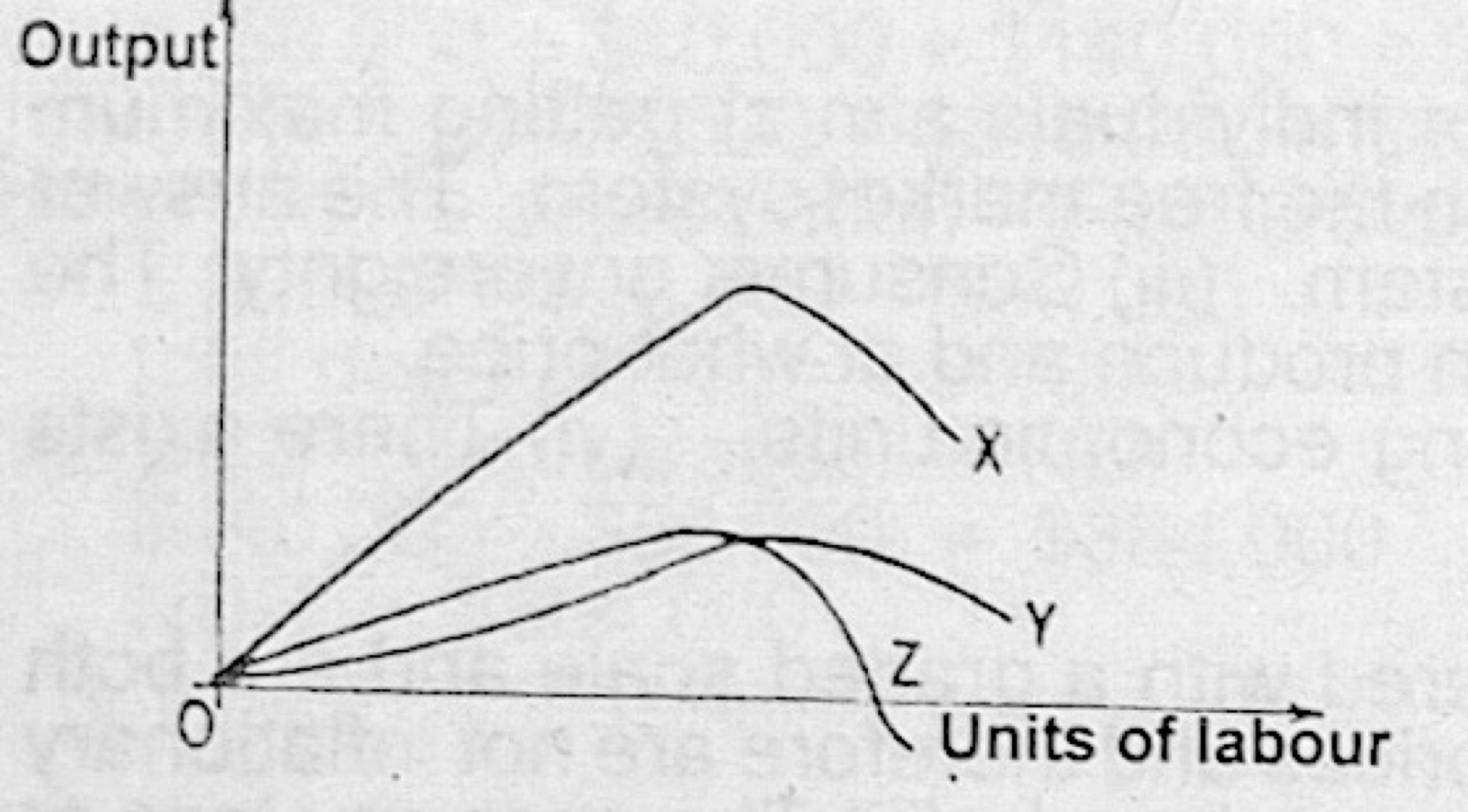
Use the diagram below to answer question 12.
The curve labelled X is the

Diagram for this question
  1. A.total revenue curve
  2. B.total product curve
  3. C.marginal product curve
  4. D.marginal revenue curve.
Show the answer and explanation

Answer: B (total product curve)

Explanation

With output on the vertical axis and labour on the horizontal, the highest curve, which rises to a peak and then falls, is total product; Y and Z are average and marginal product.

Open this question

Question 13

Theory of Production

When the total product is at its maximum, marginal product is

  1. A.increasing
  2. B.positive
  3. C.negative
  4. D.zero
Show the answer and explanation

Answer: D (zero)

Explanation

TP stops rising when the extra unit adds nothing, so MP = 0 at maximum TP.

Open this question

Question 14

Theory of Costs and Revenue

Marginal cost can be derived from the

  1. A.total product
  2. B.total revenue
  3. C.total cost
  4. D.average fixed cost.
Show the answer and explanation

Answer: C (total cost)

Explanation

MC = change in total cost when output rises by one unit.

Open this question

Question 15

Theory of Supply

The market supply curve slopes upwards from left to right indicating that

  1. A.at a lower price, more is supplied
  2. B.two commodities can be supplied at the same time
  3. C.at a lower price, less is supplied
  4. D.producers pay high taxes
Show the answer and explanation

Answer: C (at a lower price, less is supplied)

Explanation

An upward-sloping supply curve means quantity supplied falls as price falls (and rises as price rises).

Open this question

Question 16

Theory of Costs and Revenue

Use the table below to answer question 16.
Output | Total Revenue (N)
1 | 40
2 | 49
3 | 56
4 | 61
5 | 65
The marginal revenue when output is 4 units is

  1. A.5 naira
  2. B.8 naira
  3. C.56 naira
  4. D.61 naira
Show the answer and explanation

Answer: A (5 naira)

Explanation

MR = TR at 4 − TR at 3 = 61 − 56 = N5.

Open this question

Question 17

Population

The term underpopulation refers to a situation where the population is

  1. A.dispersed over the country
  2. B.small in relation to available resources
  3. C.greater than the available resources
  4. D.concentrated in a few areas.
Show the answer and explanation

Answer: B (small in relation to available resources)

Explanation

Underpopulation means too few people to make full use of the available resources.

Open this question

Question 18

Population

West African countries experience rapid population growth due to

  1. A.existence of birth control clinics
  2. B.early marriages
  3. C.adequate sex education in schools.
  4. D.late marriages.
Show the answer and explanation

Answer: B (early marriages)

Explanation

Early marriage lengthens the child-bearing period, raising the birth rate.

Open this question

Question 19

Labour Market

Which of the following could be used to measure the efficiency of labour?

  1. A.Education and training
  2. B.Rate of inflation
  3. C.Level of unemployment
  4. D.Input-Output ratio
Show the answer and explanation

Answer: D (Input-Output ratio)

Explanation

Labour efficiency is measured as output per worker or per hour, i.e. the ratio of output to input.

Open this question

Question 20

Business Organisations

Which of the following is necessary for the survival of small firms in West Africa?

  1. A.Access to land for development
  2. B.Inadequate collaterals for bank loans
  3. C.Government assistance in the form of loans and tax holidays
  4. D.High transportation costs
Show the answer and explanation

Answer: C (Government assistance in the form of loans and tax holidays)

Explanation

Small firms lack capital, so government loans and tax relief help them survive.

Open this question

Question 21

Theory of Demand

A normal demand curve slopes

  1. A.downwards from left to right
  2. B.upwards from left to right
  3. C.downwards from right to left
  4. D.upwards from the origin.
Show the answer and explanation

Answer: A (downwards from left to right)

Explanation

Quantity demanded rises as price falls, so the demand curve slopes downward from left to right.

Open this question

Question 23

Elasticity

Price elasticity of supply measures the responsiveness of quantity supplied to

  1. A.changes in suppliers' income
  2. B.changes in prices of other commodities
  3. C.a change in the price of the commodity
  4. D.a change in the demand for the product.
Show the answer and explanation

Answer: C (a change in the price of the commodity)

Explanation

Elasticity of supply measures how quantity supplied responds to a change in the good's own price.

Open this question

Question 24

Business Organisations

The most common type of business in West African countries is

  1. A.joint-stock companies
  2. B.sole proprietorships
  3. C.partnerships
  4. D.public enterprises
Show the answer and explanation

Answer: B (sole proprietorships)

Explanation

Sole proprietorships (petty traders, artisans, farmers) are by far the most numerous businesses.

Open this question

Question 25

Business Organisations

Which of the following is a type of business organization?

  1. A.Stock exchange
  2. B.Insurance company
  3. C.Chain stores
  4. D.Co-operative
Show the answer and explanation

Answer: D (Co-operative)

Explanation

Co-operative societies are a form of business ownership, like sole proprietorships and companies.

Open this question

Question 26

Business Organisations

One advantage of the sole proprietorship is that

  1. A.control and supervision is under one man
  2. B.accounts must be publicized
  3. C.it is always successful
  4. D.funds are easy to obtain
Show the answer and explanation

Answer: A (control and supervision is under one man)

Explanation

One owner controls and supervises the business, so decisions are quick.

Open this question

Question 27

Business Organisations

The shares which do not carry any fixed rate of dividend are known as

  1. A.debentures
  2. B.cumulative preference shares
  3. C.ordinary shares
  4. D.participating preference shares.
Show the answer and explanation

Answer: C (ordinary shares)

Explanation

Ordinary shareholders get a dividend that varies with profit; preference shares carry a fixed rate.

Open this question

Question 29

Agriculture

One of the factors responsible for low agricultural production in West Africa is

  1. A.inadequate labour
  2. B.shortage of land
  3. C.inadequate implements
  4. D.inadequate research.
Show the answer and explanation

Answer: C (inadequate implements)

Explanation

Farmers rely on crude implements like hoes and cutlasses, which keep output low.

Open this question

Question 30

Distributive Trade

Efficient distribution of goods in West Africa will be facilitated by

  1. A.poor storage facilities
  2. B.adequate transportation system
  3. C.high standard of living
  4. D.high cost of living
Show the answer and explanation

Answer: B (adequate transportation system)

Explanation

Good transport moves goods quickly and cheaply from producers to consumers.

Open this question

Question 31

Money and Inflation

The demand for money is

  1. A.derived demand
  2. B.composite demand
  3. C.joint demand
  4. D.complimentary demand.
Show the answer and explanation

Answer: A (derived demand)

Explanation

Money is wanted not for itself but for what it can buy, so its demand is derived.

Open this question

Question 32

Money and Inflation

Money becomes a very poor store of value in a period of

  1. A.deflation
  2. B.depression
  3. C.recession
  4. D.inflation.
Show the answer and explanation

Answer: D (inflation.)

Explanation

During inflation money loses purchasing power, so holding it is a poor way to store value.

Open this question

Question 33

Money and Inflation

A continuous fall in the general price level is called

  1. A.recession
  2. B.depression
  3. C.deflation
  4. D.stagflation.
Show the answer and explanation

Answer: C (deflation)

Explanation

Deflation is a persistent fall in the general price level.

Open this question

Question 34

Financial Institutions

Which of the following is a function of the central bank?

  1. A.Accepting deposits from the public
  2. B.Lending to the commercial banks
  3. C.Discounting bills of exchange
  4. D.Agent of payment for individuals
Show the answer and explanation

Answer: B (Lending to the commercial banks)

Explanation

As the bankers' bank and lender of last resort, the central bank lends to commercial banks.

Open this question

Question 35

Money and Inflation

Cost-push inflation is likely to raise when

  1. A.there is an increase in government spending.
  2. B.there is an increase in direct taxes
  3. C.demand for higher wages is granted
  4. D.there is a decrease in bank lending.
Show the answer and explanation

Answer: C (demand for higher wages is granted)

Explanation

Higher wages raise production costs, and firms pass them on as higher prices: cost-push inflation.

Open this question

Question 36

Financial Institutions

The most important function of merchant banks is the

  1. A.issuing of currency
  2. B.provision of short term loans
  3. C.provision of medium and long term loans
  4. D.provision of short and long term loans
Show the answer and explanation

Answer: C (provision of medium and long term loans)

Explanation

Merchant banks mainly provide medium- and long-term finance to businesses.

Open this question

Question 37

Money and Inflation

Precautionary motive relates to

  1. A.demand for money
  2. B.demand for goods
  3. C.supply of money
  4. D.supply of goods
Show the answer and explanation

Answer: A (demand for money)

Explanation

The precautionary motive is one of Keynes' reasons for holding (demanding) money.

Open this question

Question 38

Balance of Payments and Exchange Rates

Invisible trade refers to trade in

  1. A.services
  2. B.goods and services
  3. C.tangible goods
  4. D.crude oil
Show the answer and explanation

Answer: A (services)

Explanation

Invisible trade covers services such as shipping, banking, insurance and tourism.

Open this question

Question 39

Balance of Payments and Exchange Rates

When the demand for foreign exchange exceeds its supply, the value of the domestic currency

  1. A.appreciates
  2. B.depreciates
  3. C.inflates
  4. D.expands.
Show the answer and explanation

Answer: B (depreciates)

Explanation

Excess demand for foreign currency raises its price, so the domestic currency loses value (depreciates).

Open this question

Question 40

Balance of Payments and Exchange Rates

Which of the following is part of the capital account of the balance of payments?

  1. A.Net investment from abroad
  2. B.Import of machinery
  3. C.Insurance
  4. D.Transportation costs.
Show the answer and explanation

Answer: A (Net investment from abroad)

Explanation

Investment flows are capital movements; machinery imports, insurance and transport are current account items.

Open this question

Question 42

Public Finance

Governments of West African countries levy taxes to

  1. A.prevent prices from falling
  2. B.make people richer
  3. C.limit the number of banks
  4. D.finance government projects
Show the answer and explanation

Answer: D (finance government projects)

Explanation

The main purpose of taxation is to raise revenue to finance government spending.

Open this question

Question 43

Public Finance

Which of the following is a direct tax?

  1. A.Import duties
  2. B.Purchase tax
  3. C.Export duties
  4. D.Personal income tax
Show the answer and explanation

Answer: D (Personal income tax)

Explanation

Personal income tax is paid directly by the person who earns the income.

Open this question

Question 44

Public Finance

The tax whose rate increases as the level of income increases is known as

  1. A.regressive tax
  2. B.proportional tax
  3. C.progressive tax
  4. D.company tax
Show the answer and explanation

Answer: C (progressive tax)

Explanation

A progressive tax takes a higher percentage as income rises.

Open this question

Question 45

Public Finance

Public expenditure on education and health is known as expenditure on

  1. A.general services
  2. B.social services
  3. C.commercial services
  4. D.economic services
Show the answer and explanation

Answer: B (social services)

Explanation

Education and health are social services.

Open this question

Question 46

Public Finance

Budget deficit can be financed by

  1. A.reducing the level of taxation
  2. B.printing more money
  3. C.lending to financial institutions
  4. D.employing more workers
Show the answer and explanation

Answer: B (printing more money)

Explanation

Government can cover a deficit by creating new money (or borrowing); the other options widen it.

Open this question

Question 47

International Economic Organisations

A major problem facing the Economic Community of West African States (ECOWAS) as an economic integration, is the

  1. A.increasing population
  2. B.willingness of members to co-operate
  3. C.geographical contiguity
  4. D.weak trade relations.
Show the answer and explanation

Answer: D (weak trade relations.)

Explanation

Members produce similar primary goods and trade more with Europe than with one another, so intra-regional trade is weak.

Open this question

Question 48

Economic Systems

In a socialist economy, the means of production is owned and controlled by the

  1. A.state
  2. B.rich
  3. C.entrepreneur
  4. D.traders
Show the answer and explanation

Answer: A (state)

Explanation

Under socialism, the state owns and controls the means of production.

Open this question

Question 49

National Income

It is necessary to estimate the national income of a country because it

  1. A.indicates the overall performance of the economy
  2. B.ensures equitable distribution of wealth
  3. C.assists investors in identifying profitable ventures
  4. D.enables governments to conserve national resources.
Show the answer and explanation

Answer: A (indicates the overall performance of the economy)

Explanation

National income figures show how well the whole economy is performing and growing.

Open this question

Theory question 101

Population

Section A (data response: answer one question only from this section)
Study the following extract on country Y's population data and answer the questions that follow:
The population of country Y in 1970 was 60 million. From 1971 to 1975 the total number of births was 25 million and deaths stood at 3 million. 8 million immigrants and 4 million emigrants were recorded in the reporting period.
(a) Present the above data in a table.
(b)(i) Determine the net migration within the period. (ii) Calculate the population of the country in 1975.
(c) What is the percentage increase in the population of the country from 1970 to 1975?

Show the model answer
Model answer

(a) Table with a title and headings, e.g.
Item | Million
Population 1970 | 60
Births 1971–75 | 25
Deaths 1971–75 | 3
Immigrants 1971–75 | 8
Emigrants 1971–75 | 4
Population 1975 | 86
(b)(i) Net migration = immigrants − emigrants = 8 − 4 = +4 million.
(ii) Population 1975 = 60 + (25 − 3) + 4 = 86 million.
(c) Increase = 86 − 60 = 26 million; 26/60 × 100 = 43.33%.

Explanation

Natural increase is births minus deaths; add net migration.

Open this question

Theory question 102

Public Finance

Section A (data response: answer one question only from this section)
The table below shows the tax payments of four income earners in a year. Use the information in the table to answer the questions that follow:
Income Earners | Income Base (N) | Tax Payments A (N) | Tax Payments B (N)
Jawara | 15,000.00 | 1,500.00 | 1,200.00
Ade | 25,000.00 | 2,500.00 | 2,000.00
Eke | 32,000.00 | 3,200.00 | 2,240.00
Audu | 60,000.00 | 6,000.00 | 3,000.00
(a) Determine the percentage rate of taxation paid by (i) Jawara in columns A and B (ii) Audu in columns A and B (iii) Ade in column B (iv) Eke in column B.
(b)(i) Identify the systems of taxation employed in columns A and B. (ii) Which of the income earners has the least burden under column B?
(c)(i) If government increases its rate of taxation to 15% flat rate, how much revenue will be generated from the payees? (ii) At 15% flat rate taxation, calculate the disposable incomes of Messrs Jawara, Ade, Eke and Audu.

Show the model answer
Model answer

(a)(i) Jawara: A = 1,500/15,000 × 100 = 10%; B = 1,200/15,000 × 100 = 8%.
(ii) Audu: A = 6,000/60,000 × 100 = 10%; B = 3,000/60,000 × 100 = 5%.
(iii) Ade, B = 2,000/25,000 × 100 = 8%.
(iv) Eke, B = 2,240/32,000 × 100 = 7%.
(b)(i) Column A: proportional tax (same 10% rate for all). Column B: regressive tax (rate falls from 8% to 5% as income rises).
(ii) Audu (lowest rate, 5%).
(c)(i) Total income = 15,000 + 25,000 + 32,000 + 60,000 = N132,000; 15% of it = N19,800.
(ii) Disposable income = 85% of income: Jawara N12,750; Ade N21,250; Eke N27,200; Audu N51,000.

Explanation

Tax rate = tax paid ÷ income × 100.

Open this question

Theory question 103

Basic Concepts

Section B (answer four questions only from this section)
(a) Why is the scale of preference important?
(b) Explain the concept, opportunity cost.
(c) State the opportunity cost in each of the following actions: (i) A shirt was purchased for N500.00 instead of a pair of shoes. (ii) Onions were planted on a farm realizing N20,000.00 instead of maize that could have realized N25,000.00

Show the model answer
Model answer

(a) A scale of preference lists wants in order of importance. It helps the consumer/firm/government to choose rationally with limited means, satisfy the most pressing wants first, avoid waste, get maximum satisfaction and plan spending; it shows the opportunity cost of each choice.
(b) Opportunity cost is the next best alternative given up (forgone) when a choice is made. Because resources are scarce, choosing one thing means doing without another; it is real cost, not money cost.
(c)(i) The pair of shoes forgone.
(ii) The maize (worth N25,000) that could have been grown.

Explanation

Opportunity cost is the alternative forgone, not the money spent.

Open this question

Theory question 104

Population

Section B (answer four questions only from this section)
Why do governments conduct population census?

Show the model answer
Model answer

To know the size of the population and its growth rate.
To know the age and sex distribution, and so the size of the labour force and dependants.
To know the geographical distribution for siting of amenities (schools, hospitals, roads).
To know the occupational distribution.
For economic planning and budgeting.
To calculate per capita income and standard of living.
For sharing of revenue and political representation (constituencies).
To plan for future needs such as food, housing and jobs.

Explanation

Each reason should show how the information is used.

Open this question

Theory question 105

Elasticity

Section B (answer four questions only from this section)
(a) What is price elasticity of demand?
(b) With carefully labelled diagrams, illustrate each of the following: (i) perfectly inelastic demand (ii) unitary elastic demand (iii) fairly elastic demand (iv) perfectly elastic demand

Show the model answer
Model answer

(a) Price elasticity of demand is the degree of responsiveness of quantity demanded of a commodity to a change in its own price: PED = % change in quantity demanded ÷ % change in price.
(b) Each diagram with price on the vertical axis and quantity on the horizontal axis:
(i) Perfectly inelastic (PED = 0): vertical demand curve; quantity is the same at all prices.
(ii) Unitary elastic (PED = 1): rectangular hyperbola; a price change causes an equal proportional change in quantity, so total spending is constant.
(iii) Fairly elastic (PED > 1): a gently sloping (flat) demand curve; a small price change causes a larger proportional change in quantity.
(iv) Perfectly elastic (PED = ∞): horizontal demand curve; buyers take any amount at one price and nothing above it.

Explanation

Label axes, curves and the price/quantity changes on each diagram.

Open this question

Theory question 106

Business Organisations

Section B (answer four questions only from this section)
Explain any four of the following terms: (a) Nationalization (b) Commercialization (c) Privatization (d) Indigenization (e) Joint Ventures.

Show the model answer
Model answer

(a) Nationalisation: government takes over ownership and control of privately owned enterprises, usually with compensation.
(b) Commercialisation: government-owned enterprises are reorganised to run on commercial (profit-making) lines and become self-financing, without selling them.
(c) Privatisation: transfer of ownership of government enterprises (wholly or partly) to private individuals and firms, e.g. by sale of shares.
(d) Indigenisation: government policy transferring ownership and control of businesses from foreigners to citizens.
(e) Joint venture: a business owned jointly by two or more parties, e.g. government and a foreign firm, sharing capital, risks and profit (e.g. NNPC and oil companies).

Explanation

Any four, each defined with an example.

Open this question

Theory question 107

Money and Inflation

Section B (answer four questions only from this section)
(a) Distinguish between cost-push inflation and demand pull inflation.
(b) Explain any four ways of controlling inflation.

Show the model answer
Model answer

(a) Demand-pull inflation is caused by aggregate demand exceeding aggregate supply ('too much money chasing too few goods'), e.g. through increased government spending or credit expansion. Cost-push inflation is caused by rising costs of production (higher wages, raw material and fuel prices, import costs, taxes) which producers pass on as higher prices.
(b) Any four: Monetary policy: raise bank rate, sell securities in open market operations, raise reserve requirements to cut money supply.
Fiscal policy: cut government expenditure and raise taxes (surplus budget).
Increase production of goods and services.
Price control and wage restraint (prices and incomes policy).
Liberalise imports to increase supply.
Reduce costs of production, e.g. subsidies on inputs.

Explanation

Show cause in (a) and how each measure reduces demand or increases supply in (b).

Open this question

Theory question 108

Labour Market

Section B (answer four questions only from this section)
(a) Define the term unemployment.
(b) Highlight the effects of unemployment on an economy.

Show the model answer
Model answer

(a) Unemployment is a situation in which people who are able and willing to work at the current wage rate cannot find jobs.
(b) Loss of output, so national income is lower than it could be.
Low standard of living and poverty.
Increase in crime and social vices.
Waste of human resources and skills.
Loss of government revenue from income tax and increased welfare spending.
Rural-urban migration and brain drain.
Fall in aggregate demand, which worsens recession.
Political instability and unrest.
Increased dependency burden.

Explanation

Explain at least five effects.

Open this question

Theory question 109

Financial Institutions

Section B (answer four questions only from this section)
Write notes on each of the following: (a) Savings account (b) Current account (c) Fixed deposit account

Show the model answer
Model answer

(a) Savings account: meant for small savers; operated with a passbook or card; earns interest; withdrawals limited in number; cheques not issued; encourages saving.
(b) Current account: operated with cheque books; money withdrawable on demand; usually no interest paid and the bank charges fees; holders can get overdrafts; used mainly by businesses and organisations for payments.
(c) Fixed (time) deposit account: money deposited for a fixed period (e.g. 30, 90 days); earns higher interest than savings; cannot be withdrawn before maturity without notice or loss of interest; used for idle funds.

Explanation

For each account give its main features and who uses it.

Open this question

Theory question 110

International Trade

Section B (answer four questions only from this section)
In what ways is foreign trade different from domestic trade?

Show the model answer
Model answer

Foreign trade crosses national boundaries; domestic trade takes place within one country.
Foreign trade involves different currencies and foreign exchange; domestic trade uses one currency.
Foreign trade faces tariffs, quotas, embargoes and exchange controls; domestic trade does not.
Different weights, measures, laws and customs in foreign trade.
Language and cultural differences in foreign trade.
Foreign trade involves longer distances, higher transport and insurance costs and more risk.
Foreign trade requires more documents (bills of lading, import licences, certificates of origin).
Factors of production move less freely between countries.

Explanation

Set out each difference point against point.

Open this question

Theory question 111

International Economic Organisations

Section B (answer four questions only from this section)
(a) Explain the term economic integration.
(b) Highlight any four problems of economic integration in West Africa.

Show the model answer
Model answer

(a) Economic integration is the coming together of countries, usually in a region, to remove trade barriers and co-ordinate economic policies for mutual benefit, e.g. ECOWAS.
(b) Any four: Uneven development among members and fear of domination by bigger economies (e.g. Nigeria).
Differences in currencies and monetary/fiscal policies.
Political instability and differences in ideology.
Loyalty to former colonial powers (Anglophone/Francophone divide).
Poor transport and communication links.
Members produce similar primary goods, so little to trade with one another.
Reluctance to give up sovereignty and customs revenue.
Language barriers.
Inadequate funding of the community.

Explanation

Define then list four problems with short explanations.

Open this question

Theory question 112

Economic Growth and Development

Section B (answer four questions only from this section)
(a) What is economic planning?
(b) Outline the problems associated with economic planning in West Africa.

Show the model answer
Model answer

(a) Economic planning is a deliberate effort by government to set economic targets for a given period and to direct the allocation of resources to achieve them, e.g. a development plan.
(b) Inadequate capital/finance.
Inadequate and unreliable statistical data.
Shortage of skilled manpower and experts.
Political instability and frequent changes of government.
Corruption, nepotism and mismanagement.
Over-dependence on foreign aid and fluctuating export earnings.
Unrealistic targets and wrong priorities.
Rapid population growth.
Inflation raising project costs.
Poor implementation and lack of monitoring.
Explanation

Several clear problems, each briefly explained.

Open this question