WAEC Civic Education 2025 past questions and answers

56 questions. Try each one, then open the answer to check yourself and read the explanation.

Question 1

National Values

The training of oneself in subjection to self-rules and self-control is achieved as a result of

  1. A.integrity.
  2. B.discipline.
  3. C.contentment
  4. D.commitment.
Show the answer and explanation

Answer: B (discipline.)

Explanation

Discipline is training oneself to obey rules and control oneself.

Open this question

Question 2

National Values

A situation where people are encouraged to define their own values and respect other people's values is known as value

  1. A.mobilization
  2. B.clarification.
  3. C.classification.
  4. D.orientation.
Show the answer and explanation

Answer: B (clarification.)

Explanation

Value clarification helps people identify their own values while respecting others'.

Open this question

Question 3

Citizenship and Citizenship Education

A Gambian who wishes to become a Nigerian citizen by naturalization must be

  1. A.18 years old and above and have spent at least 15 years in Nigeria.
  2. B.18 years old and above and have spent at least 25 years in Nigeria.
  3. C.21 years and above and have spent at least 10 years in Nigeria.
  4. D.21 years old and above and have spent at least 5 years in Nigeria.
Show the answer and explanation

Answer: A (18 years old and above and have spent at least 15 years in Nigeria.)

Explanation

Section 27 of the 1999 Constitution requires full age (18) and 15 years' residence in Nigeria.

Open this question

Question 4

Citizenship and Citizenship Education

The major reason for studying Civic Education is that it

  1. A.encourages the struggle for political power in the state.
  2. B.inculcates the spirit of nationalism and patriotism in the citizens of a state.
  3. C.helps students and citizens to study and understand their physical environment.
  4. D.enables students and citizens to identify the problems in their society without offering functional solutions to them.
Show the answer and explanation

Answer: B (inculcates the spirit of nationalism and patriotism in the citizens of a state.)

Explanation

Civic Education aims to make citizens patriotic and responsible.

Open this question

Question 5

Nationalism and National Symbols

Which of the following is not a national symbol?

  1. A.National flag
  2. B.Voters card
  3. C.National currency
  4. D.Coat of arms
Show the answer and explanation

Answer: B (Voters card)

Explanation

A voter's card is a personal document, not a national symbol.

Open this question

Question 6

Nationalism and National Symbols

The newspapers established by the nationalists helped in

  1. A.revealing the weaknesses of the colonial powers.
  2. B.fighting racial discrimination in the country.
  3. C.protecting the rights of the traditional rulers.
  4. D.promoting the image of the nationalists.
Show the answer and explanation

Answer: A (revealing the weaknesses of the colonial powers.)

Explanation

Nationalist papers such as the West African Pilot exposed colonial injustice and weaknesses.

Open this question

Question 8

Human Rights

How many articles are contained in the Universal Declaration of Human Rights (UDHR) of 1948?

  1. A.30
  2. B.33
  3. C.48
  4. D.50
Show the answer and explanation

Answer: A (30)

Explanation

The UDHR has 30 articles.

Open this question

Question 9

Human Rights

A person who is found guilty of an offence and sentenced to prison by a competent court of law would forfeit his/her

  1. A.freedom of expression and right to fair hearing.
  2. B.right to life and right to personal liberty.
  3. C.right to movement and association.
  4. D.right to fair hearing and right to movement.
Show the answer and explanation

Answer: C (right to movement and association.)

Explanation

A prisoner cannot move about or associate freely; he keeps his right to life and has already had a fair hearing.

Open this question

Question 10

Human Rights

A person who writes false statements on social media that harms another person's reputation will be found guilty of

  1. A.blackmail.
  2. B.sedition.
  3. C.slander.
  4. D.libel.
Show the answer and explanation

Answer: D (libel.)

Explanation

False damaging statements in written or published form are libel; spoken ones are slander.

Open this question

Question 11

Rule of Law and Constituted Authority

The notion that the law should apply to everyone irrespective of their status implies

  1. A.supremacy of the law.
  2. B.fair hearing.
  3. C.equality before the law.
  4. D.right to appeal.
Show the answer and explanation

Answer: C (equality before the law.)

Explanation

This is equality before the law.

Open this question

Question 13

Responsible Parenthood

Responsible parenthood is important to national development because it

  1. A.promotes political participation.
  2. B.ensures upbringing of strict leaders.
  3. C.emphasizes equality in the society.
  4. D.helps in reduction of social vices.
Show the answer and explanation

Answer: D (helps in reduction of social vices.)

Explanation

Well-raised children are less likely to fall into social vices.

Open this question

Question 14

Traffic Regulations

Traffic regulations mean

  1. A.rules of traffic jam.
  2. B.rules guiding pedestrians.
  3. C.codes and ethics of traffic.
  4. D.driving on express roads.
Show the answer and explanation

Answer: C (codes and ethics of traffic.)

Explanation

Traffic regulations are the codes and rules for using roads.

Open this question

Question 15

Traffic Regulations

Traffic wardens assist in

  1. A.presentation of traffic legislation.
  2. B.mounting of traffic signs.
  3. C.control of traffic flow.
  4. D.formulation of rules and regulations.
Show the answer and explanation

Answer: C (control of traffic flow.)

Explanation

Traffic wardens direct and control the flow of traffic.

Open this question

Question 16

Interpersonal and Inter-communal Relationships

Conflict resolution mechanisms in inter-communal relationships include

  1. A.reorientation.
  2. B.compromise.
  3. C.commendation.
  4. D.diligence.
Show the answer and explanation

Answer: B (compromise.)

Explanation

Compromise lets each side give up something to reach agreement.

Open this question

Question 18

Drug Abuse

Which of the following cannot be identified as drug abuse?

  1. A.Consumption of the right dosage of prescribed drugs
  2. B.Trafficking of hard substances
  3. C.Consumption of high dosage of legal drugs
  4. D.Taking drugs without authorization
Show the answer and explanation

Answer: A (Consumption of the right dosage of prescribed drugs)

Explanation

Taking the right dose of a prescribed drug is proper use.

Open this question

Question 19

Human Trafficking

An aspect of human trafficking involves

  1. A.liberation of victims.
  2. B.counseling of victims.
  3. C.empowerment of victims.
  4. D.recruitment of victims.
Show the answer and explanation

Answer: D (recruitment of victims.)

Explanation

Trafficking begins with recruiting victims.

Open this question

Question 20

Human Trafficking

Women are trafficked mainly for

  1. A.entrepreneurship.
  2. B.sexual servitude.
  3. C.debt bondage.
  4. D.empowerment.
Show the answer and explanation

Answer: B (sexual servitude.)

Explanation

Most trafficked women are forced into prostitution.

Open this question

Question 21

HIV/AIDS

Human Immunodeficiency Virus (HIV) mainly leads to

  1. A.immune repletion.
  2. B.immune deficiency.
  3. C.virus deficiency.
  4. D.virus repletion.
Show the answer and explanation

Answer: B (immune deficiency.)

Explanation

HIV destroys the immune system, causing immune deficiency (AIDS).

Open this question

Question 22

HIV/AIDS

The most common way for babies to contract Human Immunodeficiency Virus (HIV) is through

  1. A.blood transfusion.
  2. B.sharp object sharing.
  3. C.breast feeding.
  4. D.sexual transmission.
Show the answer and explanation

Answer: C (breast feeding.)

Explanation

Babies get HIV from their mothers; of the options, breastfeeding is that route (most infections happen around pregnancy and birth).

Open this question

Question 23

Youth Empowerment

Youth empowerment can be enhanced through

  1. A.imposition of taxes.
  2. B.political lobbying.
  3. C.granting of bursaries.
  4. D.provision of startup capital.
Show the answer and explanation

Answer: D (provision of startup capital.)

Explanation

Start-up capital lets trained youths begin their own businesses.

Open this question

Question 24

Youth Empowerment

One of the vital skills needed for youth empowerment is

  1. A.transversal skills.
  2. B.cross-curricular skills.
  3. C.manipulative skills.
  4. D.non-cognitive skills.
Show the answer and explanation

Answer: C (manipulative skills.)

Explanation

Manipulative (hand) skills are the basis of trades and crafts.

Open this question

Question 25

Youth Empowerment

Which of the following is not a youth empowerment skill?

  1. A.Leadership skills
  2. B.Communication skills
  3. C.Self-reliance skills
  4. D.Investigation skills
Show the answer and explanation

Answer: D (Investigation skills)

Explanation

Investigation is a specialised professional skill, not one of the usual empowerment skills.

Open this question

Question 26

Structure and Organs of Government

The power to impeach the president of a country resides in the

  1. A.executive
  2. B.judiciary
  3. C.legislature.
  4. D.supreme court.
Show the answer and explanation

Answer: C (legislature.)

Explanation

Impeachment is done by the legislature.

Open this question

Question 27

The Constitution and Constitutional Democracy

Laws made by both federal and state governments are contained in the

  1. A.residual list.
  2. B.exclusive list.
  3. C.concurrent list.
  4. D.joint list.
Show the answer and explanation

Answer: C (concurrent list.)

Explanation

Both tiers can legislate on concurrent list matters.

Open this question

Question 28

The Constitution and Constitutional Democracy

Which of the following government functions is reserved to the exclusive list?

  1. A.Provision of education
  2. B.Defence of the nation
  3. C.Provision of good roads
  4. D.Establishment of industries
Show the answer and explanation

Answer: B (Defence of the nation)

Explanation

Defence is on the exclusive list (federal only).

Open this question

Question 29

Structure and Organs of Government

Which organ of government do ministers, commissioners and supervisory councillors belong to?

  1. A.Executive
  2. B.Legislature
  3. C.Judiciary
  4. D.Civil service
Show the answer and explanation

Answer: A (Executive)

Explanation

They are political heads in the executive at federal, state and local levels.

Open this question

Question 30

Structure and Organs of Government

A local government administration supports

  1. A.unitary government.
  2. B.consensus politics.
  3. C.grassroot government.
  4. D.foreign culture.
Show the answer and explanation

Answer: C (grassroot government.)

Explanation

Local government is government at the grassroots.

Open this question

Question 31

Structure and Organs of Government

The adoption of a federal system of government is necessitated by

  1. A.fear of ethnic domination.
  2. B.inclusion of a secretive clause in the constitution.
  3. C.availability of abundant natural resources.
  4. D.adoption of a written constitution.
Show the answer and explanation

Answer: A (fear of ethnic domination.)

Explanation

Federalism protects minority groups from domination by larger ones.

Open this question

Question 32

Democracy and Elections

One feature of representative government is

  1. A.minority rule.
  2. B.inter-regional cooperation.
  3. C.centralization of power.
  4. D.periodic elections.
Show the answer and explanation

Answer: D (periodic elections.)

Explanation

Representatives are chosen through periodic elections.

Open this question

Question 33

Democracy and Elections

Direct democracy implies that the governance of a country involves

  1. A.only male citizens.
  2. B.only adult male citizens.
  3. C.citizens' representatives.
  4. D.all the citizens.
Show the answer and explanation

Answer: D (all the citizens.)

Explanation

In direct democracy all citizens take part directly.

Open this question

Question 34

Democracy and Elections

Individual freedom in a democratic country can be enhanced by

  1. A.one party system.
  2. B.multi-party system.
  3. C.autocratic system.
  4. D.communal system.
Show the answer and explanation

Answer: B (multi-party system.)

Explanation

Several parties give citizens choice and freedom of association.

Open this question

Question 35

Rule of Law and Constituted Authority
WASSCE 2025: Civic Education terms I to VII
I. Political apathy
II. Law and order
III. Human trafficking
IV. HIV/AIDS
V. Popular participation
VI. Responsible parenting
VII. Fundamental Human Rights

Absence of one of the following pairs will spell doom for the society.

  1. A.I and III
  2. B.IV and V
  3. C.III and VI
  4. D.II and VII
Show the answer and explanation

Answer: D (II and VII)

Explanation

Without law and order and fundamental human rights, society collapses.

Open this question

Question 36

Human Rights

The entitlements of every child in the society are

  1. A.II and V.
  2. B.V and VII.
  3. C.VI and VII.
  4. D.II and VI.
Show the answer and explanation

Answer: C (VI and VII.)

Explanation

Every child is entitled to responsible parenting (VI) and fundamental human rights (VII).

Open this question

Question 37

Civil Society

Trade unions, market women associations and student unions are examples of

  1. A.professional associations.
  2. B.pressure groups.
  3. C.civil societies.
  4. D.political parties.
Show the answer and explanation

Answer: B (pressure groups.)

Explanation

These groups press government to protect their members' interests: pressure groups.

Open this question

Question 38

Democracy and Elections

Inept and irresponsible governance can best be checked by

  1. A.criticism of government officials.
  2. B.attacks on government officials.
  3. C.revolt against such governments.
  4. D.recourse to constitutional means.
Show the answer and explanation

Answer: D (recourse to constitutional means.)

Explanation

Elections, courts and impeachment are lawful ways to check bad government.

Open this question

Question 39

Structure and Organs of Government

In order to avoid undue interference in the process of governance, there should be

  1. A.more roles for traditional rulers.
  2. B.clear-cut separation of governmental powers.
  3. C.proper fusion of government functions.
  4. D.checks and balances.
Show the answer and explanation

Answer: B (clear-cut separation of governmental powers.)

Explanation

Separating powers keeps each arm to its own work.

Open this question

Question 40

Structure and Organs of Government

Which of the following is the implication of immunity clause?

  1. A.Some public officers cannot be sued
  2. B.The president can grant pardon to any prisoner/criminal
  3. C.Public officers are not accountable to the electorate
  4. D.There is absence of arbitrary rule
Show the answer and explanation

Answer: A (Some public officers cannot be sued)

Explanation

Section 308 protects the President, Vice-President, Governors and their deputies from civil and criminal proceedings while in office.

Open this question

Question 41

Public Service

Neutrality of civil servants implies that they should

  1. A.be appointed by a neutral body.
  2. B.be recruited on the basis of federal character.
  3. C.have security of tenure.
  4. D.not be affiliated to any political party.
Show the answer and explanation

Answer: D (not be affiliated to any political party.)

Explanation

Civil servants must not take sides in party politics.

Open this question

Question 42

Political Apathy and Popular Participation

The following are forms of political apathy except

  1. A.refusal to register for voting.
  2. B.rigging of elections.
  3. C.lack of interest.
  4. D.refusal to give information.
Show the answer and explanation

Answer: B (rigging of elections.)

Explanation

Rigging is electoral malpractice, not apathy.

Open this question

Question 43

Rule of Law and Constituted Authority

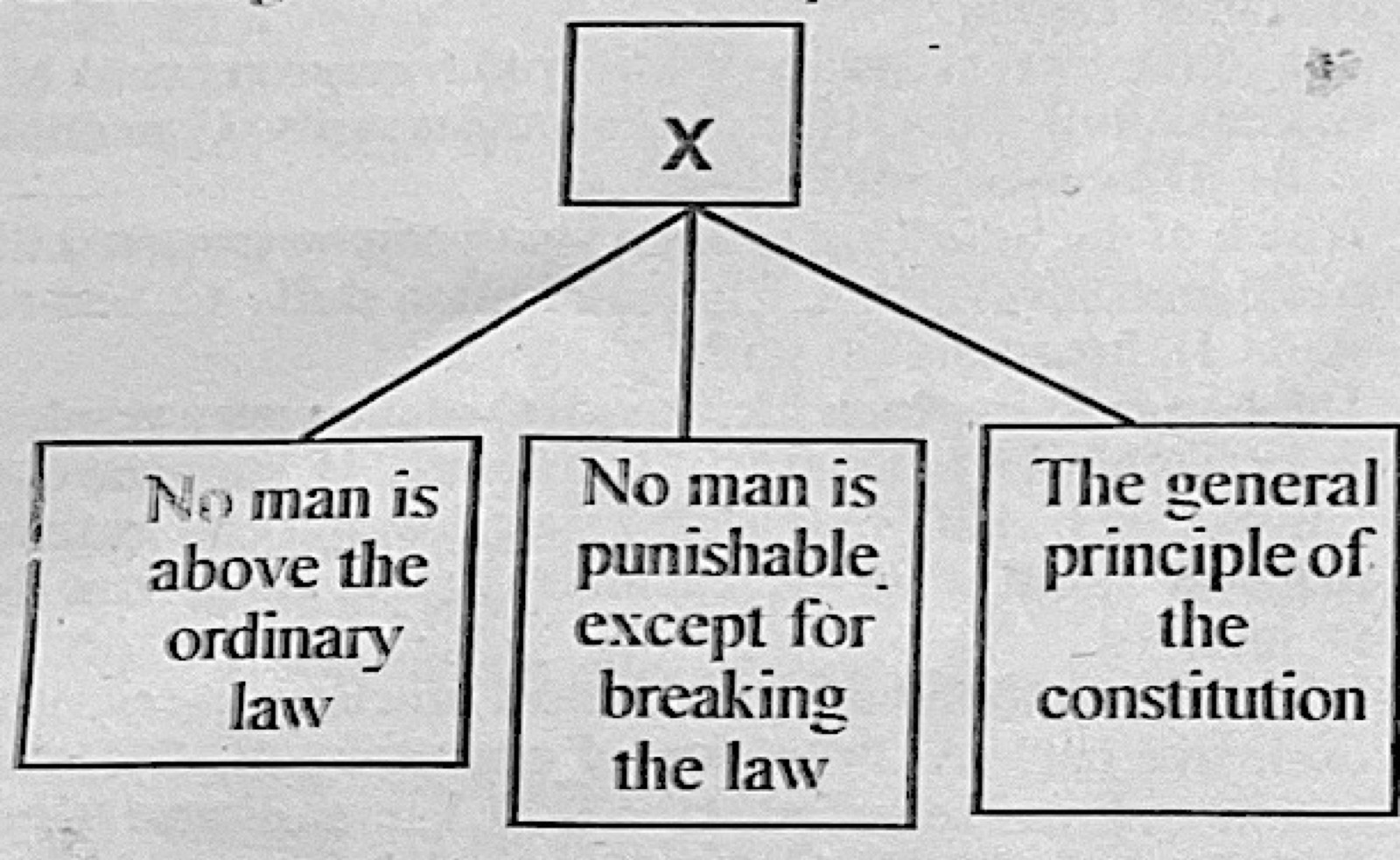
What does letter X in the diagram stand for?

Diagram for this question
  1. A.Separation of powers
  2. B.Checks and balances
  3. C.Democratic division
  4. D.Rule of law
Show the answer and explanation

Answer: D (Rule of law)

Explanation

No one above the law, no punishment except for breaking the law, and rights from the constitution's principles are Dicey's three pillars of the rule of law.

Open this question

Question 44

The Constitution and Constitutional Democracy

The letter X as illustrated in the diagram is an integral feature of

Diagram for this question
  1. A.limited government.
  2. B.absolute monarchy.
  3. C.constitutional democracy.
  4. D.aristocratic government.
Show the answer and explanation

Answer: C (constitutional democracy.)

Explanation

The rule of law is a core feature of constitutional democracy.

Open this question

Question 45

Civil Society

Inadequate funding may force Civil Society Organizations (CSOs) to

  1. A.lobby for funds from the government.
  2. B.contest for political power.
  3. C.scale back activities.
  4. D.stimulate debate and discussion.
Show the answer and explanation

Answer: C (scale back activities.)

Explanation

Without money they must cut down their activities.

Open this question

Question 46

Civil Society

Civil Society Organisations (CSOs) assist government in alleviating poverty by

  1. A.influencing government decisions.
  2. B.promoting youth empowerment.
  3. C.criticizing electoral malpractice.
  4. D.exerting influence on legislation.
Show the answer and explanation

Answer: B (promoting youth empowerment.)

Explanation

Empowerment programmes give people means of livelihood.

Open this question

Question 47

Civil Society

Which of the following is a major source of funding for civil societies?

  1. A.Government allocation
  2. B.Membership dues
  3. C.Foreign donations
  4. D.Taxation and borrowing
Show the answer and explanation

Answer: C (Foreign donations)

Explanation

Many Nigerian CSOs depend heavily on foreign donors.

Open this question

Question 48

Civil Society

Civil Society Organisations (CSOs) are not characterized by

  1. A.establishing new political parties.
  2. B.advocating for benefits of democracy.
  3. C.checkmating the excesses of government.
  4. D.acting as training ground for future leaders.
Show the answer and explanation

Answer: A (establishing new political parties.)

Explanation

CSOs do not form parties or seek power.

Open this question

Question 49

Public Service

An established way public servants protest to protect their interests is by

  1. A.police action.
  2. B.hunger strike.
  3. C.industrial strike.
  4. D.mass resignation.
Show the answer and explanation

Answer: C (industrial strike.)

Explanation

Workers' unions use strikes.

Open this question

Question 50

Public Service

Anonymity of civil servants implies that civil servants are

  1. A.not expected to take credit or blame in their duty.
  2. B.expected to abstain from voting during elections.
  3. C.expected to be fair and impartial in judgement.
  4. D.not expected to be politically known in the society.
Show the answer and explanation

Answer: A (not expected to take credit or blame in their duty.)

Explanation

Ministers take public credit or blame for their ministries; civil servants stay anonymous.

Open this question

Theory question 101

Responsible Parenthood

Section A: National Ethics, Discipline, Rights and Obligations
(a) Outline three ways negative media reportage affect the goals of responsible parenthood.
(b) Highlight three ways parents can equip their children against negative media influence.

Show the model answer
Model answer

(a) Any three: exposes children to violence, indecency and immoral behaviour; promotes negative foreign values and unrealistic lifestyles; encourages fraud, drug use and other vices; distracts children from studies; spreads misinformation; makes children rebellious toward parental authority.
(b) Any three: monitor and limit children's media use; teach good values and critical thinking; discuss what they watch; use parental controls; provide good alternatives (books, sports); be good role models.

Explanation

Three and three.

Open this question

Theory question 102

Citizenship and Citizenship Education

Section A: National Ethics, Discipline, Rights and Obligations
(a) State five conditions an alien must fulfil to become a citizen of a country.
(b) Highlight five ways responsible citizens can show loyalty to their country.

Show the model answer
Model answer

(a) Nigeria (s.27, 1999 Constitution), any five: be of full age (18) and capacity; be of good character; show a clear intention to live in Nigeria; be acceptable to the local community where he lives; be able to contribute to Nigeria's progress; renounce previous citizenship; take the Oath of Allegiance; have resided in Nigeria for 15 years.
(b) Any five: obeying laws; paying taxes; respecting national symbols; defending the country; reporting sabotage and crime; voting and taking part in politics; protecting public property; patronising local goods.

Explanation

Use the constitutional conditions in (a).

Open this question

Theory question 103

Traffic Regulations

Section A: National Ethics, Discipline, Rights and Obligations
Fifteen-year-old Timmy was receiving a call while driving. He ran a red light and got hit by a truck.
(a) Identify three key traffic-related issues highlighted in the above scenario.
(b) State three measures required to prevent the occurence of such incident.

Show the model answer
Model answer

(a) Underage driving (15 is below the minimum age for a licence, so he is unlicensed); using a phone while driving (distraction); disobeying traffic lights (running a red light).
(b) Any three: enforce minimum driving age and licensing; parents must not let children drive; ban and punish phone use while driving; enforce traffic light rules with officials/cameras; road safety education.

Explanation

Pick the issues from the scenario.

Open this question

Theory question 104

Youth Empowerment

Section B: Emerging Issues in the Society
Describe how five government initiatives have contributed to the empowerment of youths in your country.

Show the model answer
Model answer

Any five (Nigeria): N-Power (job placement and skills training); National Directorate of Employment (vocational training); NYSC Skill Acquisition and Entrepreneurship Development (SAED); Bank of Industry/SMEDAN loans for small businesses; Student loans (NELFUND, 2024); Youth Investment Fund; agricultural schemes for youths; Government Enterprise and Empowerment Programme (TraderMoni, MarketMoni). Each described with how it helps youths.

Explanation

Name real programmes and say how each helps.

Open this question

Theory question 105

Drug Abuse

Section B: Emerging Issues in the Society
Mosi, a high school student, recently joined a new group of friends who offered him pills believed to enhance relaxation and enjoyment.
(a) Enumerate five consquences Mosi could face if he agrees to take the pills.
(b) Highlight five steps Mosi could take to resist the offer.

Show the model answer
Model answer

(a) Any five: addiction; mental illness; damage to liver, kidneys and brain; poor academic performance and drop-out; criminal behaviour; arrest and prosecution (NDLEA); expulsion from school; death from overdose.
(b) Any five: say no firmly; leave the group and choose good friends; tell parents, teachers or counsellors; learn the dangers of drugs; take part in healthy activities; report the dealers to authorities.

Explanation

Consequences in (a); steps in (b).

Open this question

Theory question 106

Human Trafficking

Section B: Emerging Issues in the Society
Naje escaped from a conflict zone and is now staying in a refugee camp.
(a) Enumerate seven ways her displacement could increase risk of being trafficked.
(b) Outline four protection strategies that government can adopt to protect Naje from being trafficked.

Show the model answer
Model answer

(a) Any seven: poverty and lack of food; separation from family; lack of documents/identity; lack of education and jobs; overcrowded, poorly secured camps; desperation for a better life abroad; false promises by traffickers; corruption of camp officials; trauma and vulnerability.
(b) Any four: secure camps with security personnel; registration and identity documents for refugees; provision of food, education and skills; awareness campaigns on trafficking; prosecution of traffickers (NAPTIP); family tracing and reunion; resettlement programmes.

Explanation

Seven risks; four strategies.

Open this question

Theory question 107

Structure and Organs of Government

Section C: Governmental System and Processes
(a) Identify five functions of local government.
(b) Outline five sources of local government revenue.

Show the model answer
Model answer

(a) Any five (Fourth Schedule): collection of rates and taxes; markets and motor parks; registration of births, deaths and marriages; refuse disposal and sanitation; local roads and streets; primary health care; primary education (with the state); naming of streets; licensing of bicycles, canoes and radios; cemeteries.
(b) Any five: statutory allocation from the Federation Account; share of state revenue (10% of state internally generated revenue); rates and local taxes; market and motor park fees; licences and permits; fines; grants and loans.

Explanation

Five functions; five revenue sources.

Open this question

Theory question 108

Rule of Law and Constituted Authority

Section C: Governmental System and Processes
Highlight five ways by which effective application of the rule of law can discourage arbitrary rule.

Show the model answer
Model answer

Any five:
Supremacy of the law limits leaders' powers.
Equality before the law: leaders can be tried.
Courts can void unlawful government acts.
Protects citizens' rights against abuse.
Requires due process and fair hearing.
Promotes accountability and transparency.
Checks and balances among the arms.

Explanation

Five ways.

Open this question

Theory question 109

Political Apathy and Popular Participation

Section C: Governmental System and Processes
(a) Define traditional mode of popular participation.
(b) Advance six benefits of traditional mode of popular participation.

Show the model answer
Model answer

(a) Traditional popular participation is the involvement of people in the affairs of their community through customary institutions, e.g. village/town meetings, age grades, councils of elders, community development associations and communal labour.
(b) Any six: promotes community development through self-help; gives everyone a voice in local decisions; settles disputes peacefully; preserves culture and values; promotes unity and co-operation; trains future leaders; links people with government; ensures accountability of local leaders.
Explanation

Define with examples; six benefits.

Open this question