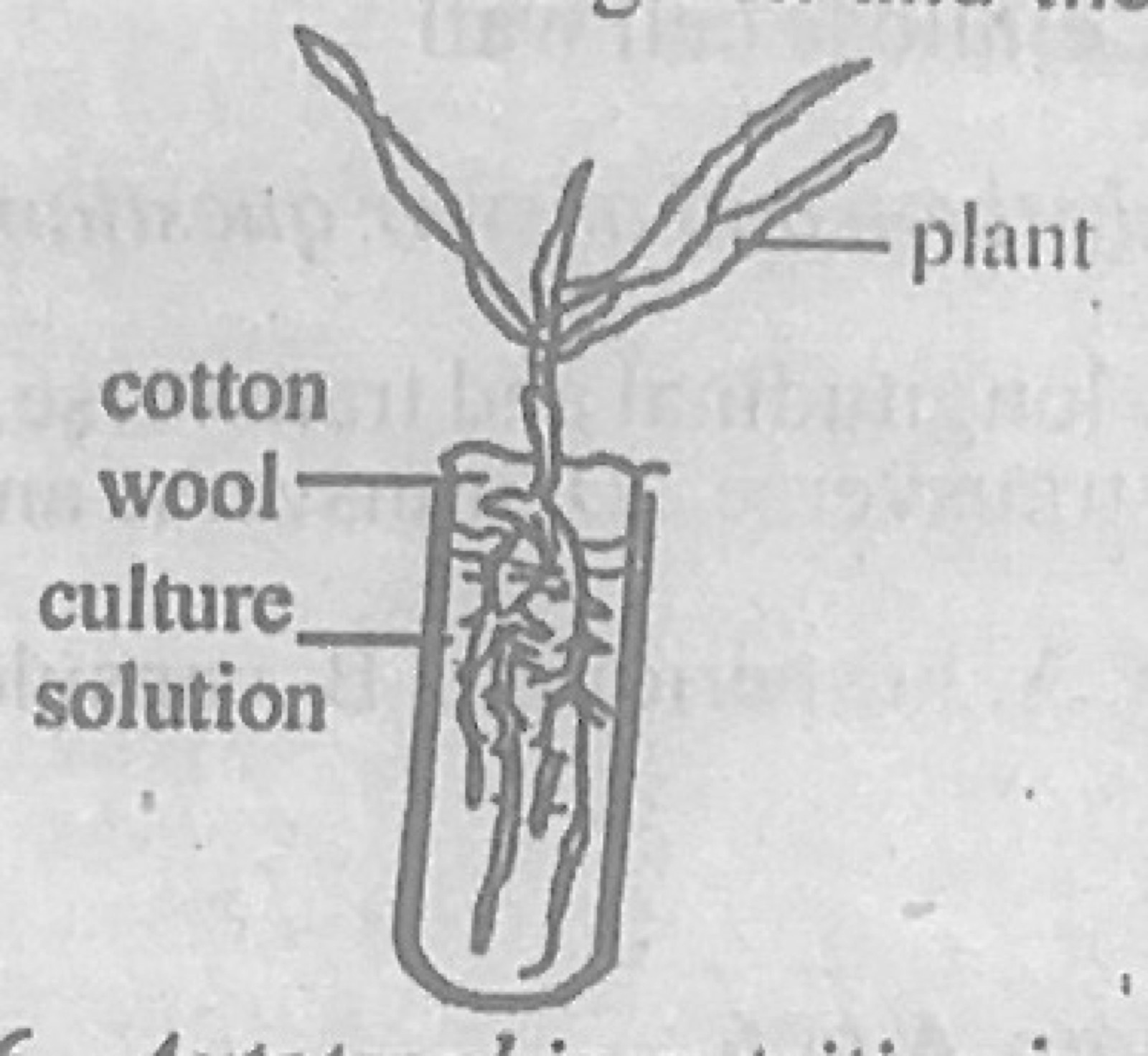
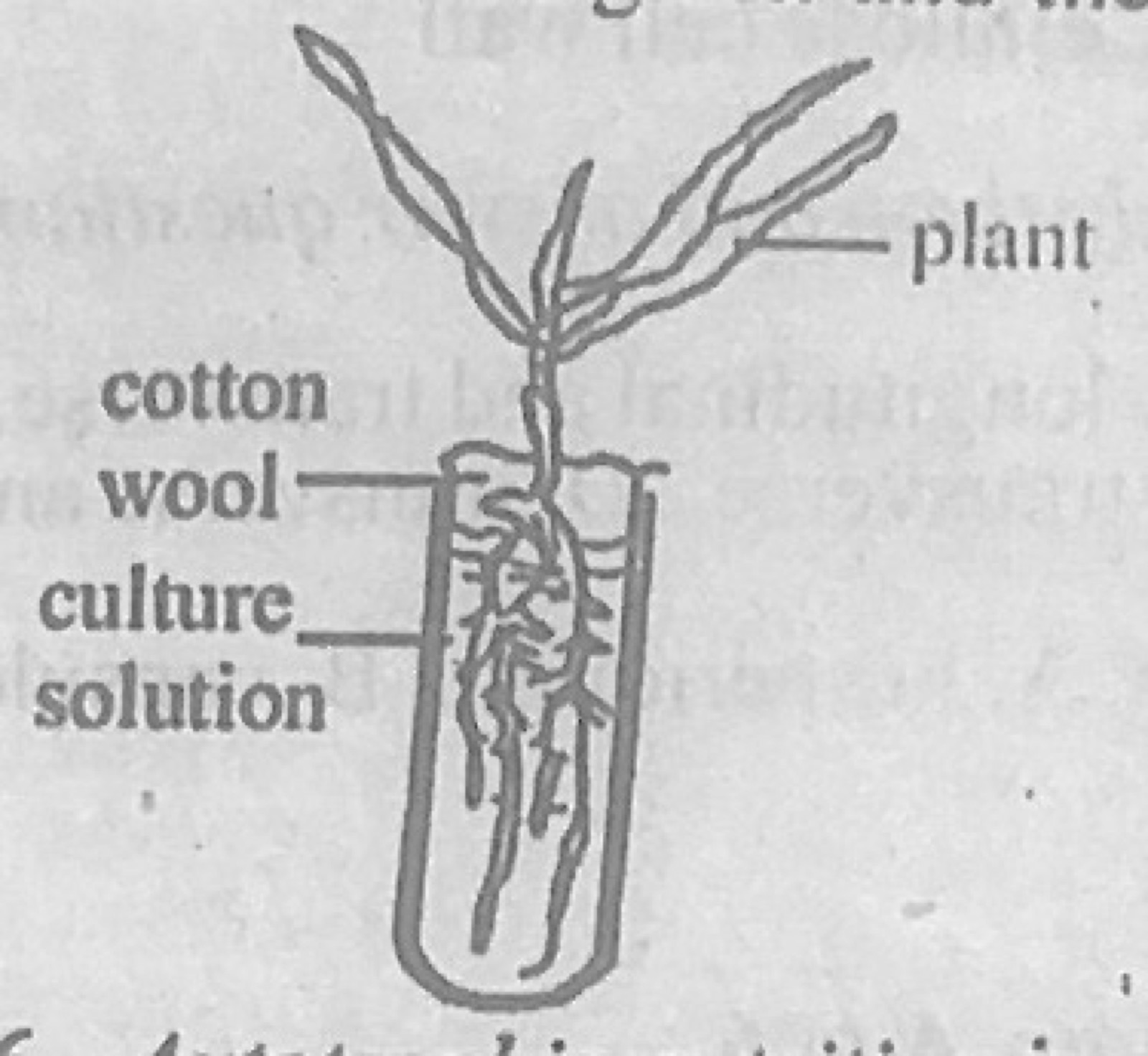
The diagram is an illustration of the growth of a plant in a water culture. After a few days, the solution turned green and the plant died. What precaution should have been taken to prevent the solution from turning green?
A.Use a non-green plant for the experiment
B.Aerate the solution daily
C.Cover the culture vessel with opaque paper
D.Keep cotton wool around the seedling to make it dry.
Show the answer and explanation
Answer: C (Cover the culture vessel with opaque paper)
Explanation
The green colour is algae growing in the light; covering the vessel with opaque paper keeps light out so algae cannot grow.
The diagram is an illustration of the growth of a plant in a water culture. After a few days, the solution turned green and the plant died. The death of the plant was likely caused by
A.excess supply of nutrients to the plant.
B.inadequate supply of water to the plant.
C.algal growth in the solution that used up the nutrients.
D.inability of the plant to make food due to lack of sunlight.
Show the answer and explanation
Answer: C (algal growth in the solution that used up the nutrients.)
Explanation
The algae used up the mineral nutrients (and oxygen) in the solution, so the plant could not survive.
The illustration below is a food chain. Grass → grasshopper → domestic fowl → hawk What would happen if the population of domestic fowl decreases? The population of
A.grasshoppers would decrease
B.hawks would increase
C.grasshoppers would increase
D.grasses available to grasshoppers would increase.
Show the answer and explanation
Answer: C (grasshoppers would increase)
Explanation
Fewer fowls means fewer grasshoppers are eaten, so the grasshopper population rises (and hawks, losing food, fall).
Which of the following behaviours is correctly matched with the corresponding diseases? A. Smoking cigarette — liver cirrhosis, lung cancer, AIDS B. Having multiple sexual partners — liver cirrhosis, syphilis, AIDS C. Living near dirty gutter — lung cancer, syphilis, river blindness D. Eating uncooked meat — dysentery, cholera, food poisoning
A.A
B.B
C.C
D.D
Show the answer and explanation
Answer: D (D)
Explanation
Uncooked or contaminated food can carry the germs of dysentery, cholera and food poisoning. Each other row includes a disease not caused by that behaviour (e.g. AIDS from smoking, lung cancer from gutters).
In humans, pointed eyebrows (B) is a dominant trait over smooth eyebrows (b). A student and the mother have smooth eyebrows while the father has pointed eyebrows. What is the genotype of the father?
A.BB
B.Bb
C.bb
D.BBbb
Show the answer and explanation
Answer: B (Bb)
Explanation
The student is bb, getting one b from each parent. The father shows the dominant trait but must also carry b, so he is Bb.
A sample of human blood was put in a test tube and allowed to spin in a centrifuge. The components of the blood sample were clearly separated. (a) List the four main components of blood that would be in the test tube. (b) Name the component of the blood that: (i) would form the top layer in the test tube; (ii) destroys pathogens; (iii) is biconcave in shape; (iv) would be relatively low in a haemophilic condition; (v) is produced in the bone marrow; (vi) is a thrombocyte; (vii) is nucleated. (c) Mention three chemical substances transported by the blood component named in 1(b)(i). (d) List four diseases associated with blood. (e) Explain briefly why a disease of the blood could be dangerous.
Show the model answer
Model answer
(a) Plasma; red blood cells (erythrocytes); white blood cells (leucocytes); platelets (thrombocytes). (b)(i) Plasma. (ii) White blood cells. (iii) Red blood cells. (iv) Platelets (clotting factors). (v) Red blood cells (also white cells and platelets). (vi) Platelets. (vii) White blood cells. (c) Any three: digested food (glucose, amino acids); hormones; urea; mineral salts; carbon dioxide (as hydrogencarbonate); antibodies; vitamins; plasma proteins. (d) Any four: anaemia; sickle cell anaemia; leukaemia; haemophilia; malaria; hepatitis B; HIV/AIDS; septicaemia. (e) Blood flows to every part of the body and carries oxygen, food and defence cells; a disease of the blood can spread quickly to all organs and stop vital transport and defence, threatening life.
Explanation
Plasma is the lightest component, so it settles on top after spinning.
(a) What is dentition in animals? (b) Describe briefly the generalised structure of a tooth in animals. (c) List three food substances that plants manufacture from glucose. (d) Make a diagram, 6 cm to 8 cm long of an experimental set-up to show that oxygen is produced during photosynthesis.
Show the model answer
Model answer
(a) Dentition is the type, number and arrangement of teeth in the jaws of an animal. (b) A tooth has a crown (above the gum), a neck (at the gum) and a root (in the jawbone socket); the crown is covered by enamel, the hardest substance; beneath it is dentine, forming most of the tooth; inside is the pulp cavity with blood vessels and nerves; the root is covered by cement and held in the socket by periodontal fibres. (c) Any three: starch; sucrose; cellulose; proteins (with nitrogen); fats/oils. (d) Labelled diagram of correct size: a beaker of water containing an aquatic plant (e.g. Elodea/Hydrilla) under an inverted filter funnel; an inverted test tube full of water over the funnel stem; bubbles of gas rising and collecting at the top of the test tube (labelled oxygen); sunlight shown; title.
Explanation
The gas collected relights a glowing splint, proving it is oxygen.
(a) Complete the table below by placing each of the following organisms under the appropriate heading: Algae, Bacteria, Dog, Water lettuce, Tadpole, Cat, Lemna, Waterleaf, Mucor, Mushroom Headings: Decomposer | Producer | Consumer (b)(i) Name four products of decomposition. (ii) Mention three roles of decomposers on a refuse dump. (c) List three materials found in a refuse dump which would not be affected by the action of decomposers.
Show the model answer
Model answer
(a) Decomposer: bacteria, Mucor, mushroom. Producer: algae, water lettuce, Lemna, waterleaf. Consumer: dog, tadpole, cat. (b)(i) Any four: carbon dioxide; water; ammonia/ammonium compounds; mineral salts (nitrates, phosphates); humus; heat; methane. (ii) Any three: break down dead organic matter and waste; reduce the volume of refuse; recycle nutrients back to the soil; remove bad smell and clean the environment; form manure/compost. (c) Any three: plastics/polythene; glass; metals (cans, iron); rubber; ceramics; stones.
Explanation
Non-biodegradable materials stay in the dump because decomposers cannot digest them.
(a) Complete the table below by naming five wildlife animals in West Africa and one body part each that makes them endangered because of the activities of humans. Headings: Animal | One body part that makes animal endangered (b) State three effects each of the following factors on the conservation of natural resources: (i) Poor economy of a nation; (ii) poaching. (c) State four roles played by the Government in conservation of natural resources.
Show the model answer
Model answer
(a) Any five pairs: elephant — tusks (ivory); leopard — skin; crocodile — skin; pangolin — scales; rhinoceros — horn; python — skin; parrot — feathers; gorilla/chimpanzee — meat (bushmeat)/hands; antelope — horns. (b)(i) Poor economy: little money for parks, guards and research; people depend on hunting, logging and bush burning for food and income; weak enforcement of laws; poor public education; corruption allowing illegal trade. (ii) Poaching: reduces animal numbers; leads to endangerment and extinction; upsets food chains and ecological balance; loss of tourism income; loss of genetic resources. (c) Any four: making and enforcing conservation laws; establishing game reserves, national parks and forest reserves; funding research and training; public education/awareness; afforestation programmes; licensing hunting and logging; international cooperation (e.g. CITES); employing forest guards and game wardens.
Explanation
For (a) pair each animal with the part people hunt it for.
(For candidates in Nigeria only) (a) Complete the table below by naming the nutrient cycle that involves each of the given processes and give three other processes involved in the nutrient cycle. Process | Nutrient cycle | Three other processes involved in the named nutrient cycle Combustion | ________ | ________ Precipitation | ________ | ________ Lightning | ________ | ________ (b)(i) What is irritability? (ii) Complete the table below by stating the type of response elicited by each of the given actions. Action | Type of response Euglena moving towards source of light | ________ Opening and closing of Mimosa plant leaves | ________ Mosquitoes avoiding repellants | ________ Earthworm moving away from light | ________ Sperm cell moving towards chemical substances of an ovum | ________ Four o'clock plant opening at 4.00 p.m. | ________ Shoot of bean seedling growing towards sunlight | ________ (c) Name three animals each that exhibit: (i) territoriality; (ii) seasonal migration; (iii) display.
Show the model answer
Model answer
(a) Combustion — carbon cycle — photosynthesis, respiration, decay/decomposition (also feeding, fossilisation). Precipitation — water cycle — evaporation, transpiration, condensation (also run-off, infiltration). Lightning — nitrogen cycle — nitrogen fixation by bacteria, nitrification, denitrification (also putrefaction/ammonification, absorption by plants). (b)(i) Irritability is the ability of a living organism to detect and respond to changes (stimuli) in its environment. (ii) Euglena towards light — positive phototaxis; Mimosa leaves closing — nastic movement (thigmonasty/seismonasty); mosquitoes avoiding repellents — negative chemotaxis; earthworm away from light — negative phototaxis; sperm towards ovum's chemicals — positive chemotaxis; four o'clock flower opening at 4 p.m. — nastic movement (photonasty/nyctinasty); bean shoot towards sunlight — positive phototropism. (c)(i) Territoriality: agama lizard, dog, lion, robin, cock, fish such as tilapia. (ii) Seasonal migration: swallows/cattle egrets/storks, wildebeest, salmon, locusts, eels. (iii) Display: peacock, agama lizard, cock/turkey, birds of paradise, frogs.
Explanation
Taxis is movement of a whole organism; tropism is a growth response; nastic responses do not depend on stimulus direction.