Use the following Classes of Arthropoda: I. Crustacea II. Insecta III. Arachnida IV. Chilopoda. Which members of the Classes live mainly in an aquatic habitat?
A.I
B.II
C.III
D.IV
Show the answer and explanation
Answer: A (I)
Explanation
Crustaceans (crabs, prawns, shrimps, water fleas) mostly live in water and breathe with gills. Insects, spiders and centipedes are mainly land animals.
Use the following Classes of Arthropoda: I. Crustacea II. Insecta III. Arachnida IV. Chilopoda. Which of the Classes is characterised by the possession of two pairs of antennae?
A.I
B.II
C.III
D.IV
Show the answer and explanation
Answer: A (I)
Explanation
Crustaceans have two pairs of antennae. Insects and centipedes have one pair, and arachnids have none.
In an experiment, mould and yeast cells were transferred into an environment with low oxygen concentration. After a few days, the mould died while the yeast cells did not. Which of the following statements best explains the above observation?
A.The yeast cells carried out photosynthesis while the mould did not
B.Photosynthesis does not take place in the absence of oxygen
C.Respiration can take place in yeast cells in the absence of oxygen
D.Respiration does not occur in the mould
Show the answer and explanation
Answer: C (Respiration can take place in yeast cells in the absence of oxygen)
Explanation
Yeast can respire anaerobically (fermentation), so it gets energy even without oxygen. The mould needs oxygen and died.
Which of the following tissues does not provide support in flowering plants?
A.Collenchyma
B.Parenchyma
C.Xylem
D.Phloem
Show the answer and explanation
Answer: D (Phloem)
Explanation
Collenchyma and lignified xylem give mechanical support, and parenchyma supports herbaceous plants when its cells are turgid. Phloem carries food and is not a supporting tissue.
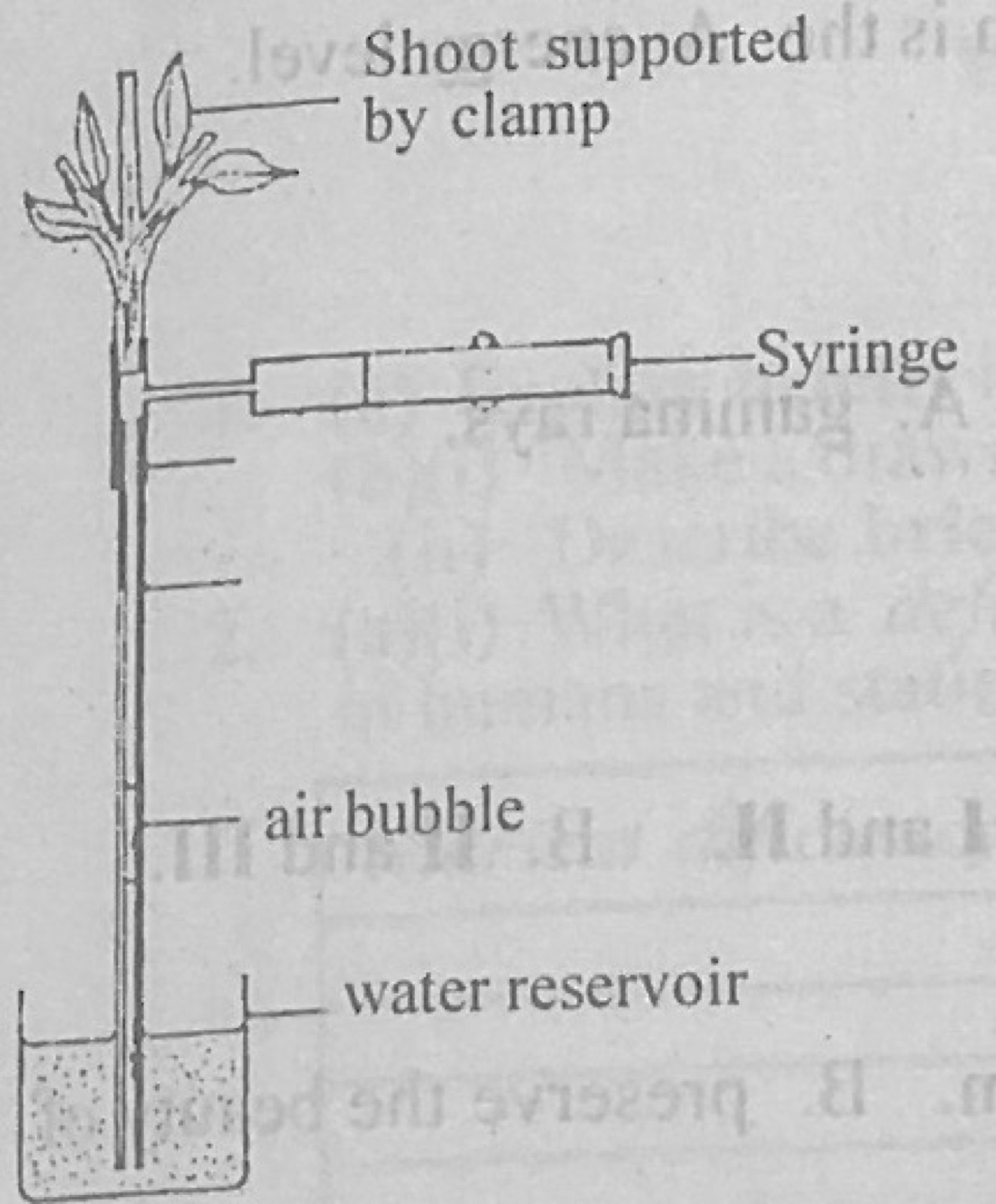
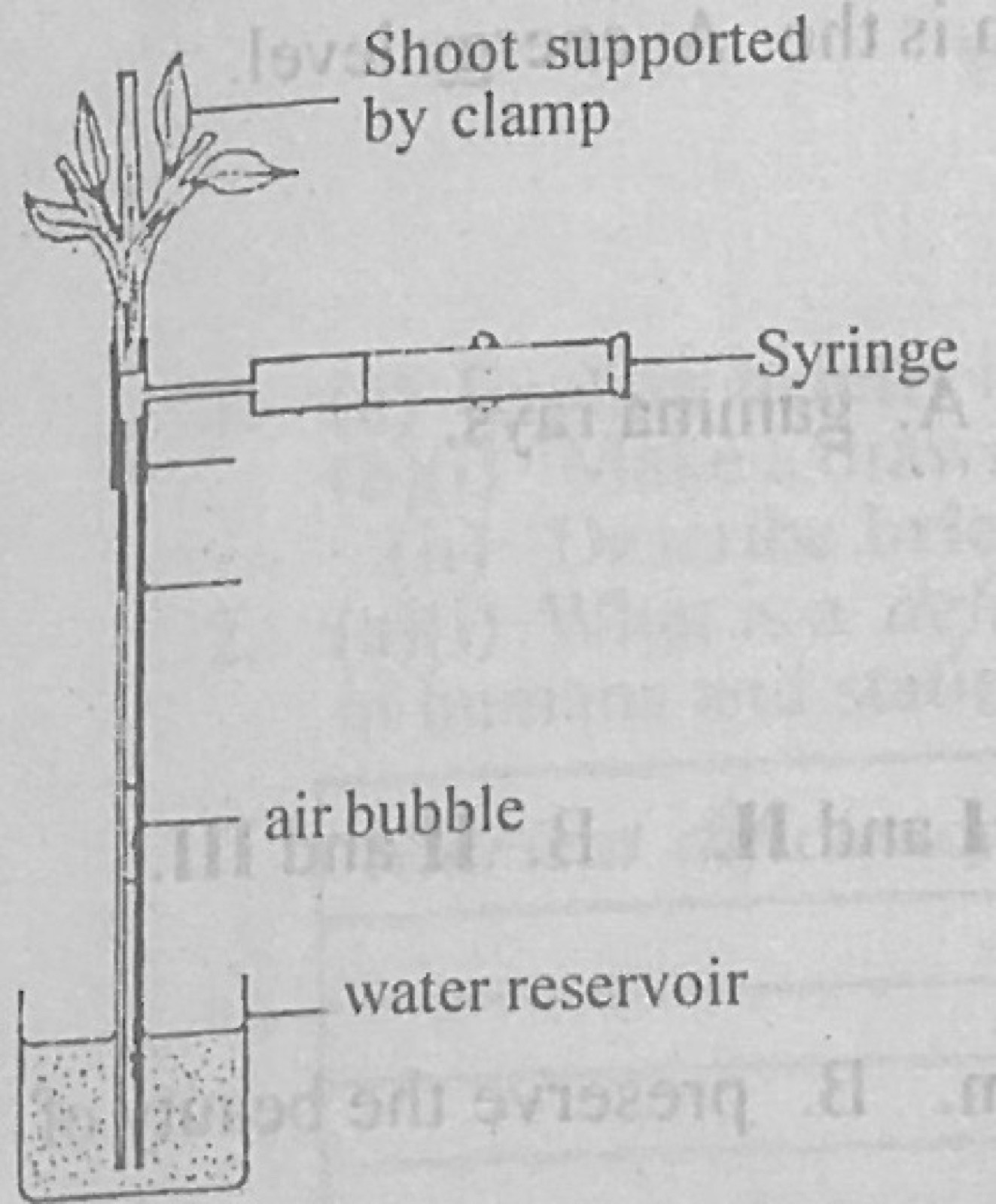
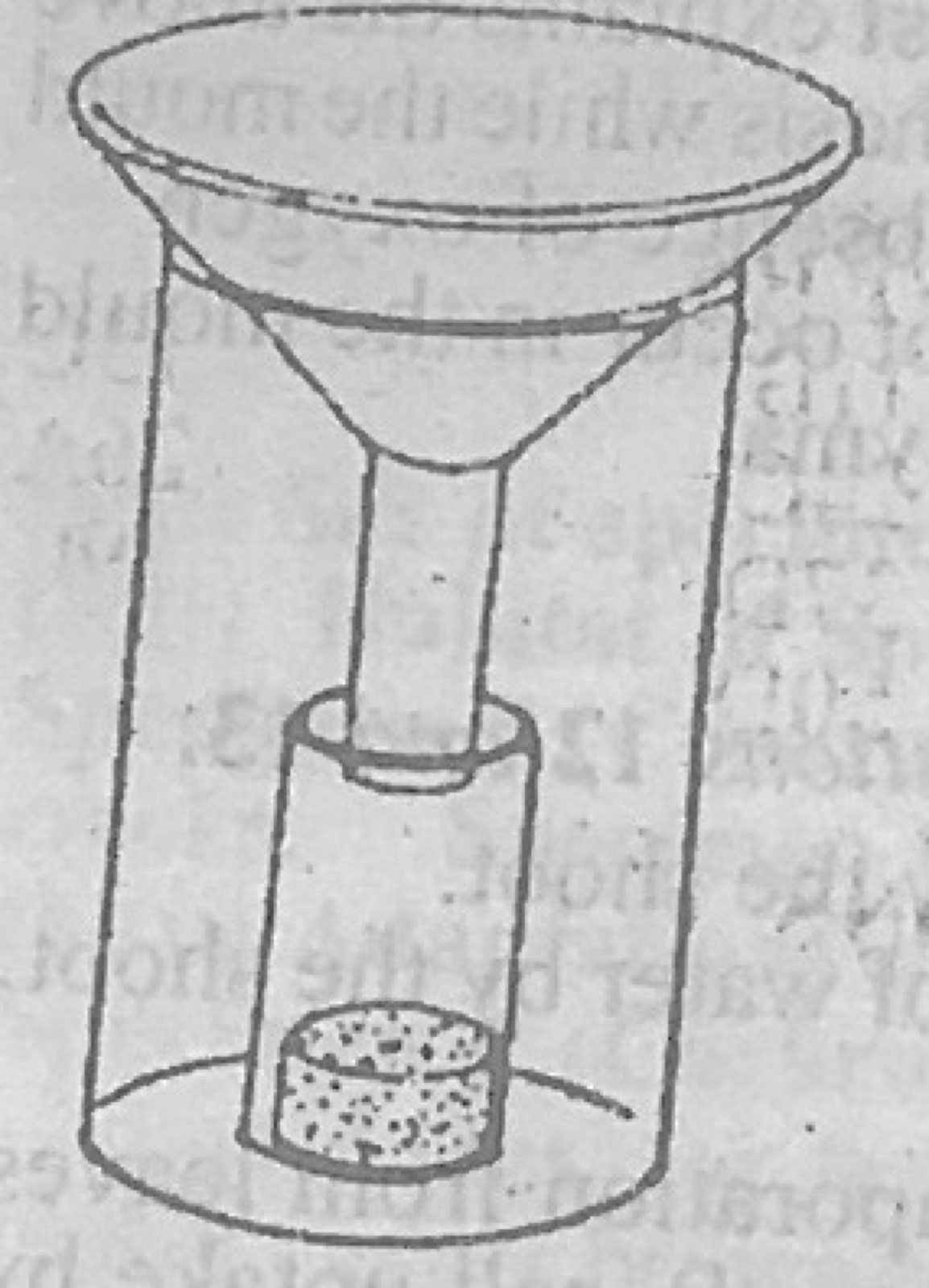
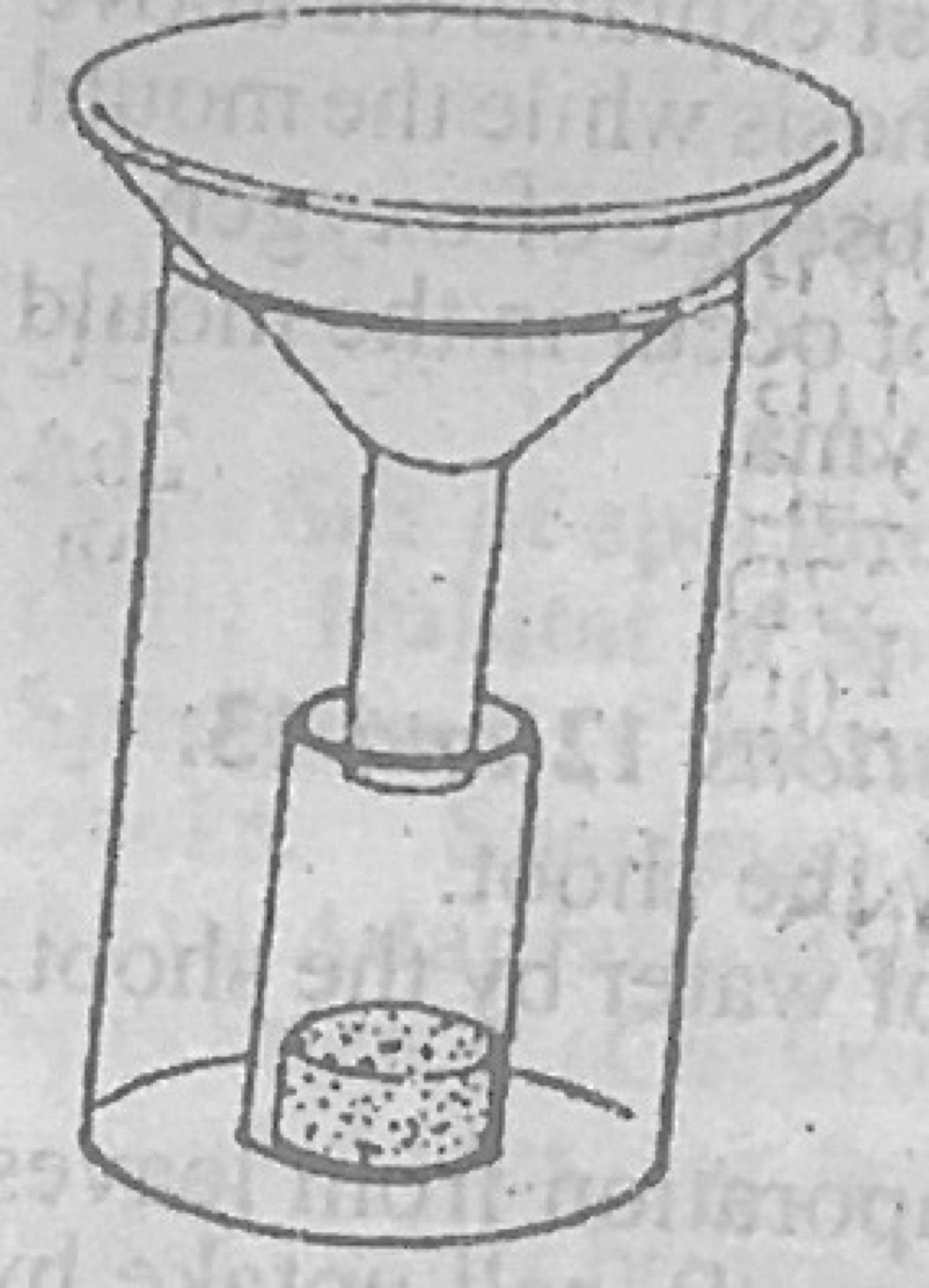
The diagram below is an illustration of an experimental set-up. The set-up directly measures
A.transpiration of water by the shoot.
B.evaporation of water from the leaves.
C.absorption of water by the shoot.
D.loss of mineral salts from the leaves.
Show the answer and explanation
Answer: C (absorption of water by the shoot.)
Explanation
This is a potometer. The air bubble moves as the cut shoot draws water from the tube, so what is measured directly is the rate of water uptake. Transpiration is estimated from it.
The part of the central nervous system that controls unconscious actions in humans is the
A.cerebellum.
B.cerebrum.
C.spinal cord.
D.optic nerves.
Show the answer and explanation
Answer: A (cerebellum.)
Explanation
The cerebellum controls balance, posture and the smooth coordination of muscles without our thinking about it. The cerebrum controls conscious, voluntary actions.
What happens when the ciliary muscles of the eye contract? The
A.lens becomes more concave.
B.lens becomes more convex.
C.lens gets a longer focal length.
D.suspensory ligament becomes tight.
Show the answer and explanation
Answer: B (lens becomes more convex.)
Explanation
Contraction of the ciliary muscles slackens the suspensory ligaments, so the elastic lens becomes rounder (more convex). This is how the eye focuses on near objects.
Trace elements (micronutrients) are needed in tiny amounts; copper is one. Potassium, calcium and magnesium are macronutrients needed in larger amounts.
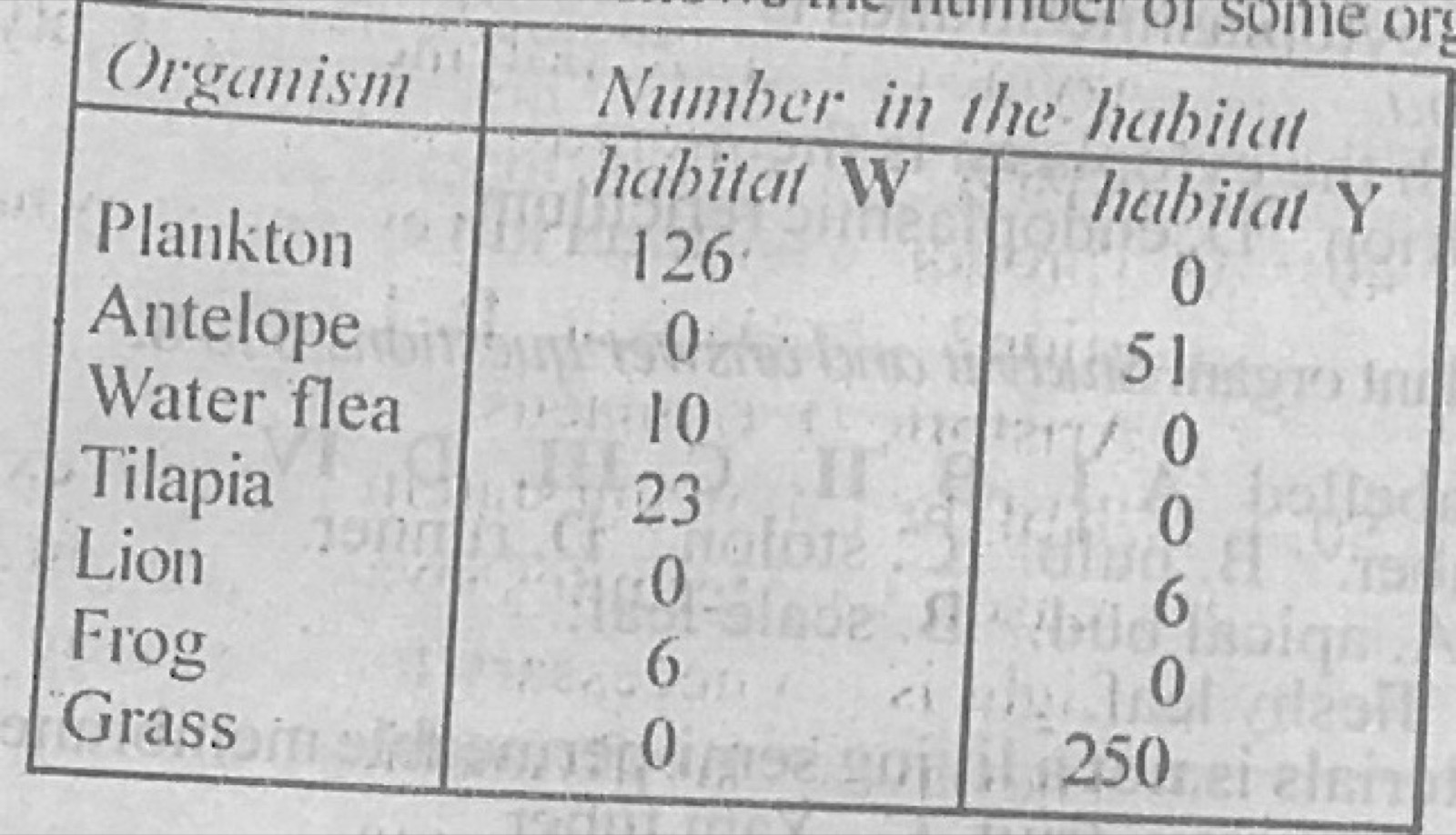
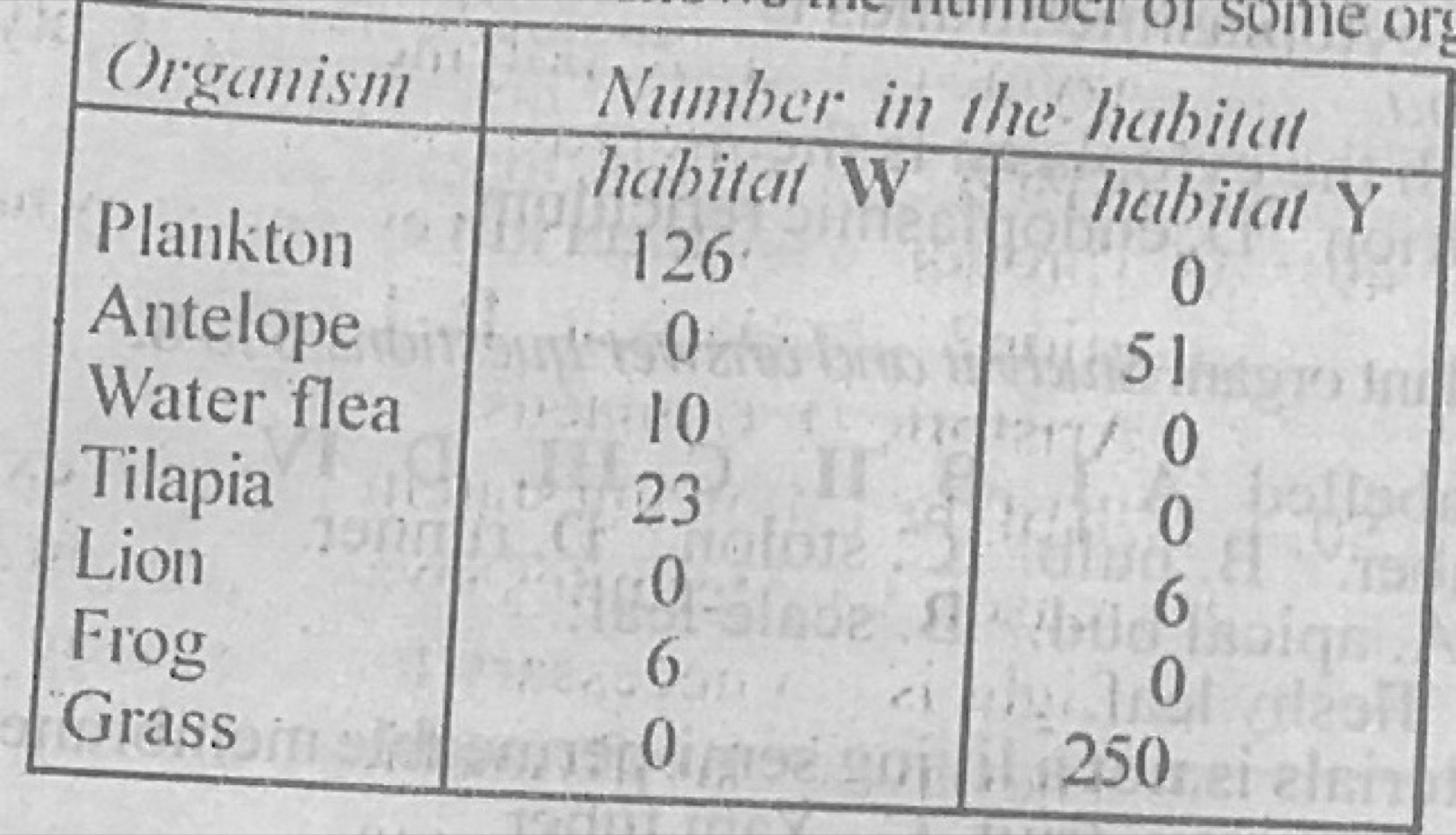
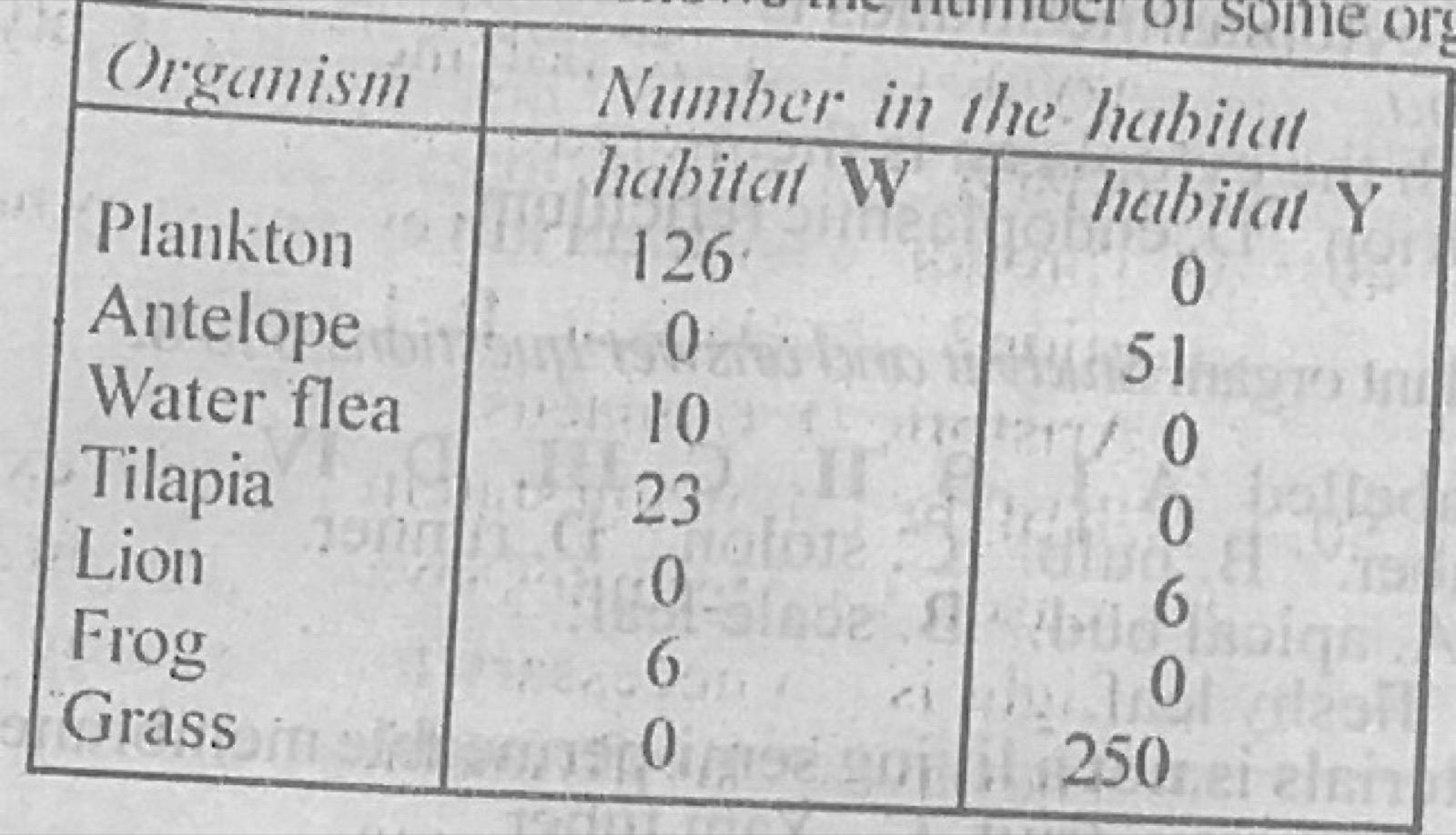
The table below shows the number of some organisms in habitats W and Y. Organism: habitat W, habitat Y Plankton: 126, 0 Antelope: 0, 51 Water flea: 10, 0 Tilapia: 23, 0 Lion: 0, 6 Frog: 6, 0 Grass: 0, 250 What type of habitat is W?
A.Rainforest
B.Pond
C.Desert
D.Ocean
Show the answer and explanation
Answer: B (Pond)
Explanation
Habitat W has plankton, water fleas, tilapia and frogs, which are freshwater organisms. It is a pond.
The table below shows the number of some organisms in habitats W and Y. Organism: habitat W, habitat Y Plankton: 126, 0 Antelope: 0, 51 Water flea: 10, 0 Tilapia: 23, 0 Lion: 0, 6 Frog: 6, 0 Grass: 0, 250 Which of the following statements about habitat W is correct? The
A.absence of lions and antelopes shows that the habitat is terrestrial.
B.presence of Tilapia and planktons shows that the habitat is not aquatic.
C.type of organisms present indicate that the habitat is aquatic.
D.absence of grasses indicates that the habitat is terrestrial.
Show the answer and explanation
Answer: C (type of organisms present indicate that the habitat is aquatic.)
Explanation
Plankton, water fleas and tilapia live only in water, so the organisms show that habitat W is aquatic.
The table below shows the number of some organisms in habitats W and Y. Organism: habitat W, habitat Y Plankton: 126, 0 Antelope: 0, 51 Water flea: 10, 0 Tilapia: 23, 0 Lion: 0, 6 Frog: 6, 0 Grass: 0, 250 The number of lions and antelopes in habitat Y shows that the lion
A.is the prey while the antelope is the predator.
B.is the predator while the antelope is the prey.
C.and the antelopes are preys to each other.
D.and the antelopes are predators.
Show the answer and explanation
Answer: B (is the predator while the antelope is the prey.)
Explanation
There are many more antelopes (51) than lions (6). Predators are usually fewer than their prey, so the lion is the predator.
Use the list of insects below: I- Cotton stainer II- Honeybee III- Termite IV- Weevil. The insects whose activities are both beneficial and harmful to humans are
A.I and II.
B.II and III.
C.II and IV.
D.III and IV.
Show the answer and explanation
Answer: B (II and III.)
Explanation
Honeybees give honey and pollinate crops but can sting. Termites recycle dead plant matter and aerate soil but damage wood and crops.
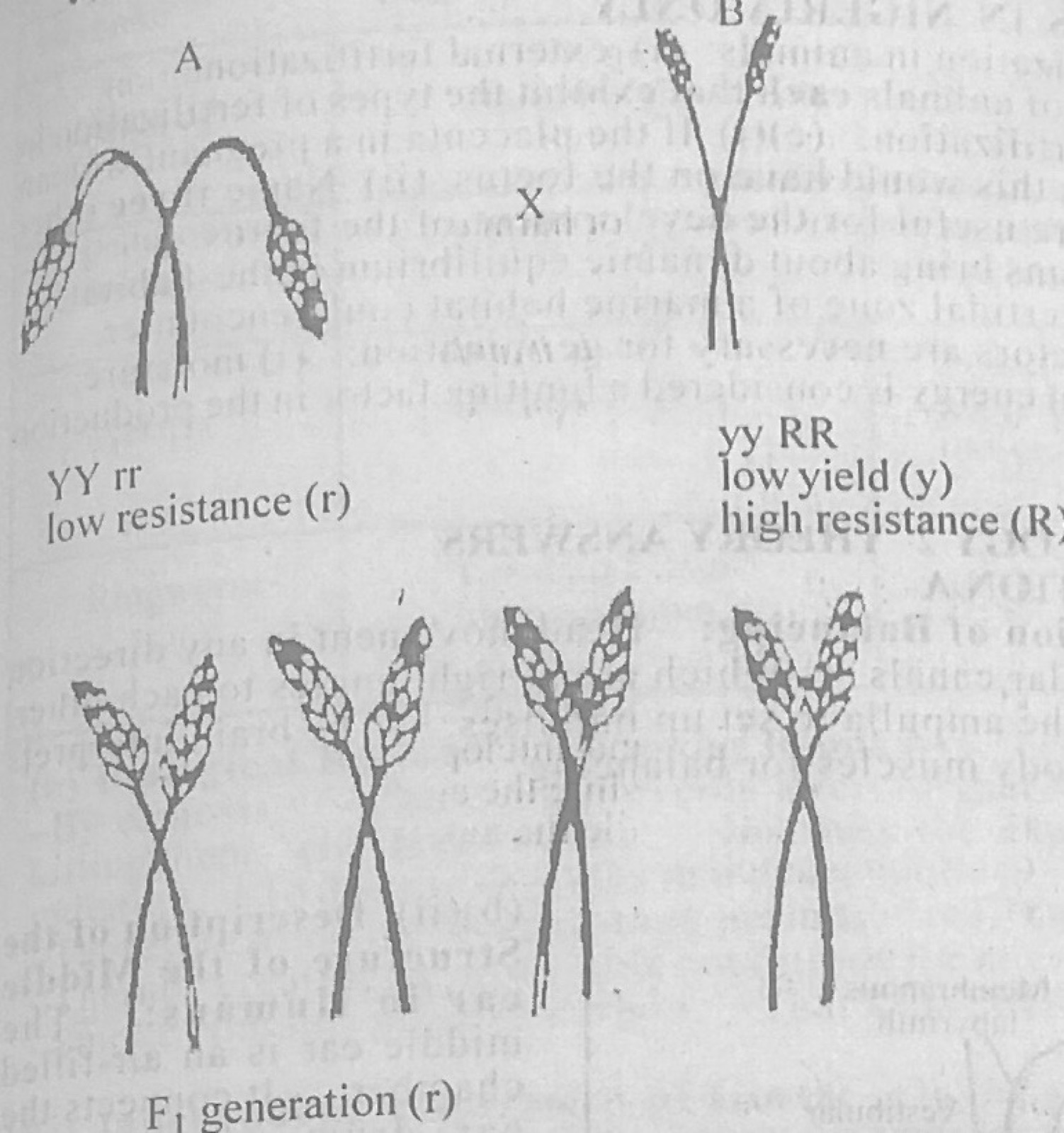
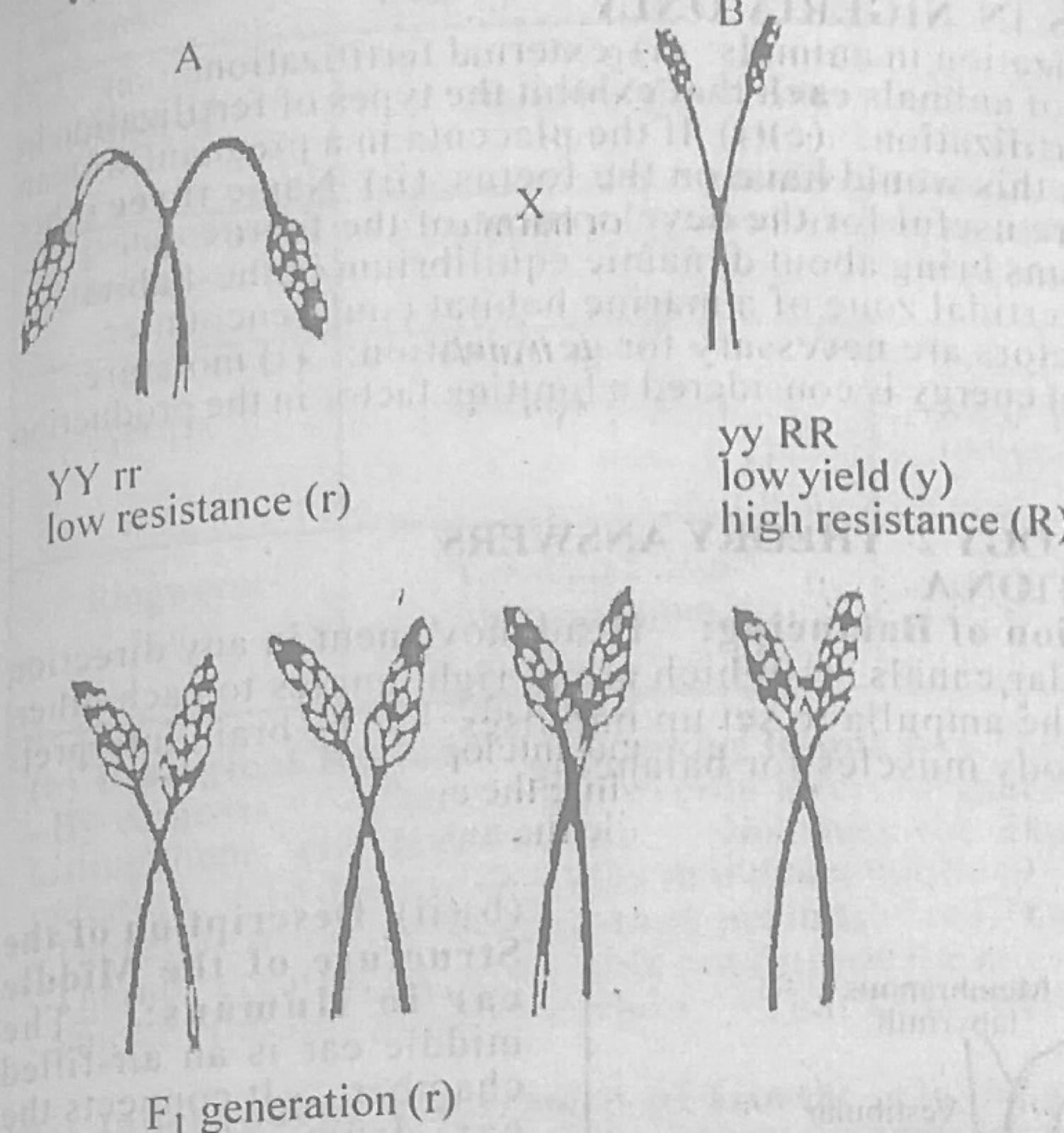
The diagram below is an illustration of a cross between plants A and B of the same species. If the F1 generation are plants with high yield and resistance, the genotype of the F1 generation plants would be
A.YYRR.
B.YyRr.
C.yyRr.
D.yyrr.
Show the answer and explanation
Answer: B (YyRr.)
Explanation
Plant A (YYrr) makes only Yr gametes and plant B (yyRR) makes only yR gametes. Every F1 plant is therefore YyRr: high yield and high resistance.
(a) Explain briefly how the human ear carries out its function of balancing. (b)(i) Make a drawing 8 cm – 10 cm long of the structure of the human ear and label fully. (ii) Describe briefly the structure of the middle ear in humans.
Show the model answer
Model answer
(a) Balance is controlled by the inner ear: the three semicircular canals (at right angles to each other, one for each plane) and the utriculus and sacculus are filled with endolymph. When the head moves, the endolymph moves and bends the sensory hair cells in the ampullae (or the otoliths in the utriculus/sacculus shift with gravity). The hair cells send impulses along the auditory (vestibular) nerve to the cerebellum, which interprets them and sends impulses to muscles to keep the body balanced. (b)(i) Drawing 8–10 cm with title and labels: pinna, external auditory meatus, tympanum (eardrum), malleus, incus, stapes, oval window, round window, Eustachian tube, semicircular canals with ampullae, utriculus, sacculus, cochlea, auditory nerve; outer, middle and inner ear marked. (ii) The middle ear is an air-filled cavity in the skull bone between the eardrum and the inner ear; it contains three small bones (ossicles): malleus (hammer) attached to the eardrum, incus (anvil) and stapes (stirrup) fitting into the oval window; they are linked to one another and pass and amplify vibrations; the Eustachian tube connects the middle ear to the throat (pharynx) and keeps air pressure equal on both sides of the eardrum; the round window is also on its inner wall.
Explanation
Name the semicircular canals, endolymph and hair cells and say how they detect movement.
(a)(i) What is a deficiency disease? (ii) Complete the table below by naming five nutrient dificiency diseases in humans and stating one remedy each for the diseases. Nutrient dificiency disease | Remedy (b) Outline a chemical test for. (i) starch in a tuber of yam; (ii) glucose in orange fruit.
Show the model answer
Model answer
(a)(i) A deficiency disease is a disease caused by lack of (or too little of) a particular nutrient, such as a vitamin, mineral or protein, in the diet. (ii) Any five, each with its remedy: kwashiorkor – eat protein-rich food (beans, eggs, fish, meat); marasmus – enough protein and energy foods; rickets – vitamin D and calcium (milk, eggs, sunshine); scurvy – vitamin C (oranges, fresh fruit and vegetables); beriberi – vitamin B1 (unpolished rice, whole grains); night blindness – vitamin A (carrots, palm oil, liver); anaemia – iron (liver, green vegetables); goitre – iodine (iodised salt, sea food); pellagra – niacin (vitamin B3). (b)(i) Peel and cut a slice of yam (or mash some in water); add a few drops of iodine solution; a blue-black colour shows starch is present. (ii) Squeeze some orange juice into a test tube; add an equal volume of Benedict's solution (or Fehling's A and B); heat in a water bath; a colour change from blue to green, yellow and finally brick-red (orange-red precipitate) shows glucose (reducing sugar) is present.
Explanation
For each test say what is added, what is done, what is seen and what it shows.
(a) Complete the table below: Disease | Causative organism | Vector | Control Cholera | | | | Trypanosome | | | | Female Anopheles mosquito | Ringworm | | None | (b) Explain briefly the biological basis of preserving foods using each of the following methods: (i) salting; (ii) irradiation; (iii) smoking.
Show the model answer
Model answer
(a) Cholera – causative organism: Vibrio cholerae (bacterium); vector: none (spread by contaminated water/food, houseflies can carry it); control: boil or treat drinking water, good sanitation, wash hands, cover food, vaccination. Sleeping sickness (trypanosomiasis) – Trypanosoma; vector: tsetse fly; control: clear bushes where tsetse flies breed, use insecticides and traps, treat patients. Malaria – Plasmodium; vector: female Anopheles mosquito; control: sleep under treated nets, clear stagnant water and bushes, spray insecticides, take antimalarial drugs. Ringworm – a fungus (e.g. Tinea/Trichophyton); vector: none (spread by contact and shared items); control: personal hygiene, avoid sharing combs, towels and clothes, antifungal creams. (b)(i) Salting: salt draws water out of the food and out of microorganisms by osmosis; without water, bacteria and fungi cannot grow, so the food does not rot. (ii) Irradiation: exposing food to radiation (e.g. gamma rays) kills microorganisms and insects in it, and slows ripening or sprouting. (iii) Smoking: heat dries the food (removes water) and the chemicals in smoke kill or stop the growth of microorganisms.
Explanation
In the table fill each blank cell; give the scientific name of each organism.
(a) Explain briefly: (i) independent assortment of genes; (ii) the reason blood group O in humans can only exist in homozygous form while blood groups A and B can exist both in homozygous and heterozygous forms. (b) Complete the table below by naming the Classes of vertebrates in their evolutionary trend and giving one example each of the Classes. Class of vertebrate | One example
Show the model answer
Model answer
(a)(i) Independent assortment (Mendel's second law): when gametes form, the alleles of one gene separate into the gametes independently of the alleles of another gene (on a different chromosome), so all combinations of the alleles are equally likely in the gametes. (ii) The allele for O is recessive to both A and B. A person shows group O only when both alleles are O (OO). The A and B alleles are dominant over O, so group A can be AA or AO and group B can be BB or BO. (b) In evolutionary order, each with one example: Pisces (fish) – tilapia; Amphibia – toad/frog; Reptilia – lizard/snake/crocodile; Aves (birds) – domestic fowl/pigeon; Mammalia – human/goat/rat.
Explanation
List the five classes from the oldest (fish) to the most recent (mammals).
(a) Explain briefly the following types of fertilization in animals: (i) external fertilization; (ii) internal fertilization. (b) Name two groups of animals each that exhibit the types of fertilization in 6(a): (i) external fertilization; (ii) internal fertilization. (c)(i) If the placenta in a pregnant woman is detached from uterine wall, give three effects this would have on the foetus. (ii) Name three other features in the uterus of pregnant woman that are useful for the development of the foetus. (d) Explain briefly how the activities of organisms bring about dynamic equilibrium in the habitat. (e) State four problems that organisms in the intertidal zone of a marine habitat could encounter. (f) Explain briefly the reason that following factors are necessary for germination: (i) moisture; (ii) viable seed. (g) Explain briefly the reason light energy is considered a limiting factor in the production of food by autotrophs.
Show the model answer
Model answer
(a)(i) External fertilisation: the male and female gametes are released into water and fuse outside the female's body. (ii) Internal fertilisation: the male places sperm inside the female's body and the gametes fuse inside her reproductive tract. (b)(i) External, any two: fishes (bony fish such as tilapia), amphibians (toads, frogs). (ii) Internal, any two: mammals, birds, reptiles, insects. (c)(i) Any three: the foetus will not get oxygen; it will not get food (nutrients); its wastes (CO2, urea) will not be removed; it will lose protection by maternal antibodies; it may die (miscarriage/stillbirth); bleeding. (ii) Any three: umbilical cord; amnion (amniotic sac) with amniotic fluid; chorion; thick, blood-rich uterine wall (endometrium); muscular uterine wall. (d) Producers make food, consumers eat producers and other consumers, and decomposers return nutrients to the soil; predators keep prey numbers in check and prey numbers limit predators; materials such as carbon, nitrogen and water are cycled. These feeding relationships and cycles keep population sizes and materials fairly steady over time, which is dynamic equilibrium. (e) Any four: drying out (desiccation) when the tide goes out; changes in temperature; changes in salinity; strong wave action that can wash them away; predators from land and sea at different tides; changes in oxygen supply; strong sunlight. (f)(i) Moisture: water activates the enzymes in the seed, softens the seed coat and dissolves stored food so it can move to the growing embryo. (ii) Viable seed: only a seed with a living embryo can respire and grow; a dead (non-viable) seed cannot germinate whatever the conditions. (g) Light supplies the energy for photosynthesis. When light is weak (or absent), the rate of photosynthesis is held back even if CO2, water and temperature are favourable, so the factor in shortest supply (light) limits how much food autotrophs can make.
Explanation
Section C (candidates in Nigeria only). Answer every lettered part briefly.