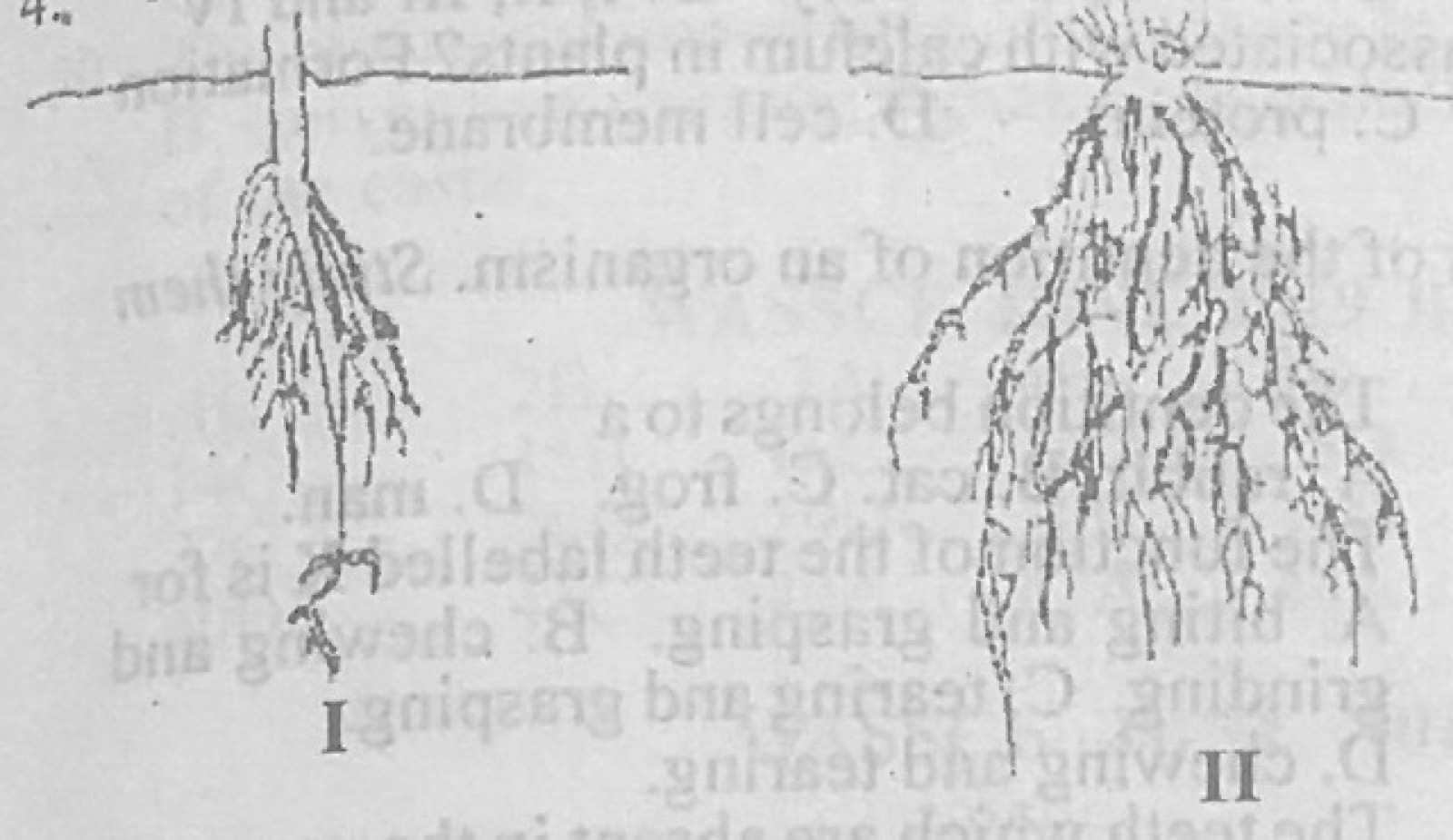
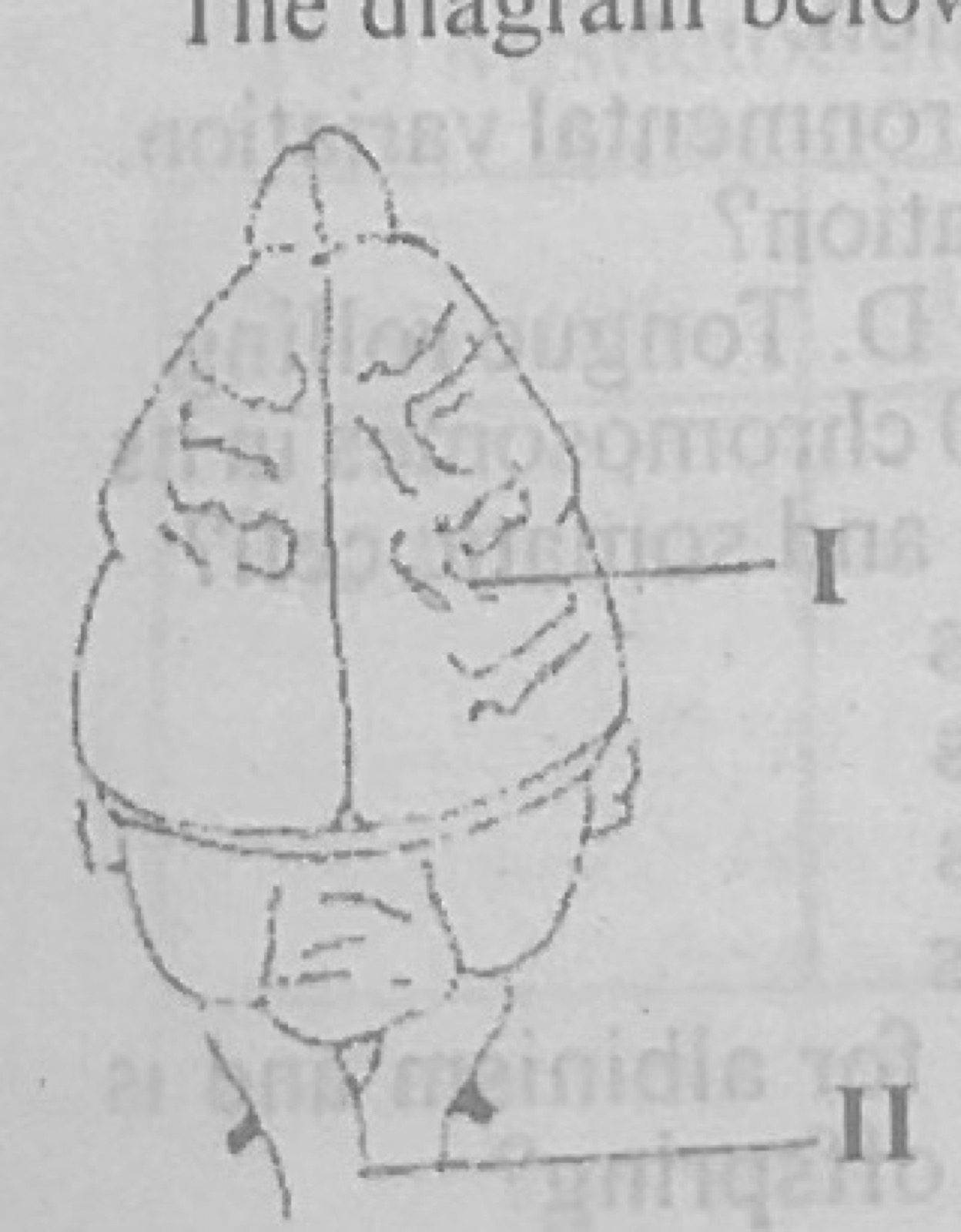
The classes of plants the root systems in diagrams I and II below represent respectively are
A.Dicotyledoneae and Monocotyledoneae.
B.Monocotyledoneae and Dicotyledoneae.
C.Dicotyledoneae and Dicotyledoneae.
D.Monocotyledoneae and Monocotyledoneae.
Show the answer and explanation
Answer: A (Dicotyledoneae and Monocotyledoneae.)
Explanation
Diagram I shows one main root with smaller side roots: a tap root system, found in dicots. Diagram II shows many roots of similar size from the base of the stem: a fibrous root system, found in monocots.
Muscle fatigue in the body of an athlete is due to
A.low pH.
B.high oxygen content.
C.accumulation of lactic acid.
D.accumulation of carbonic acid.
Show the answer and explanation
Answer: C (accumulation of lactic acid.)
Explanation
During hard exercise muscles run short of oxygen and respire anaerobically, producing lactic acid. Lactic acid builds up and causes fatigue and cramps.
Which of the following statements is not true about hormones?
A.Their responses are voluntary
B.They may affect more than one target organ
C.They are chemical messengers in animals
D.They are transported by the blood to the target organs
Show the answer and explanation
Answer: A (Their responses are voluntary)
Explanation
Hormones are chemical messengers carried in the blood, and one hormone can act on several organs. Their effects happen automatically, not by choice, so they are not voluntary.
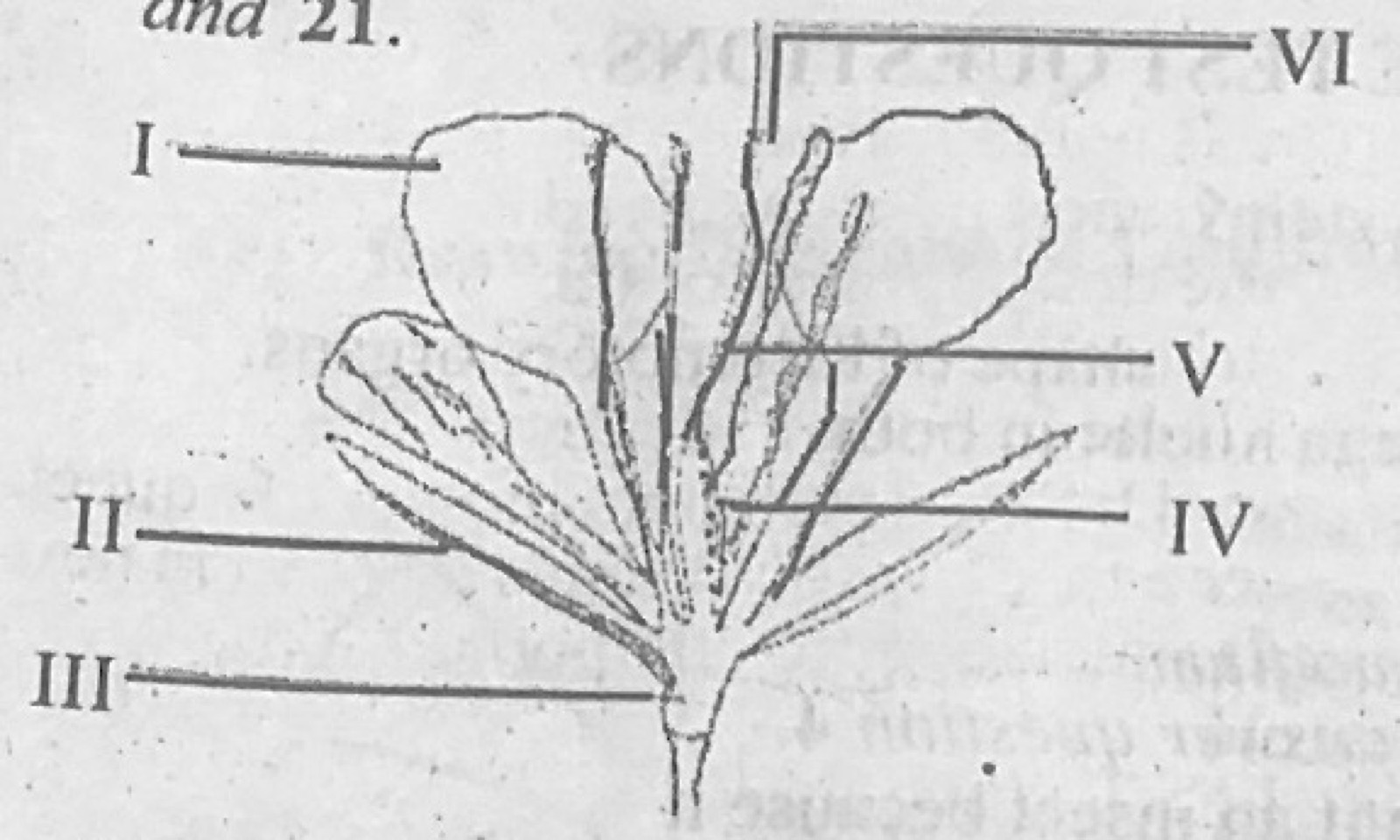
The diagram below is an illustration of the longitudinal section of a flower. Which part of the flower is responsible for the protection of young flower buds?
A.I
B.II
C.III
D.IV
Show the answer and explanation
Answer: B (II)
Explanation
Part II is the sepal. Sepals enclose and protect the flower while it is still a bud.
Which of the following factors is not a source of variation in living organisms?
A.Environment
B.Inheritance
C.Mitosis
D.Meiosis
Show the answer and explanation
Answer: C (Mitosis)
Explanation
Mitosis makes daughter cells identical to the parent cell, so it produces no variation. Meiosis, inheritance and the environment all cause differences.
In a complete dominance monohybrid cross between a pure breeding yellow flowered plant Y and a pure breeding white flowered plant y, the result of the first filial generation is
A.50 % yellow flowers.
B.75 % yellow flowers.
C.all yellow flowers.
D.all white flowers.
Show the answer and explanation
Answer: C (all yellow flowers.)
Explanation
YY × yy gives only Yy offspring. Yellow is dominant, so every F1 plant has yellow flowers.
A man whose blood group is heterozygous B is married to a woman whose blood group is also heterozygous B. Which of the following statements is correct about the blood group of their four offspring?
A.Three of them belong to blood group B
B.Three of them belong to blood group O
C.None of them belongs to blood group O
D.Two of them belong to blood group B
Show the answer and explanation
Answer: A (Three of them belong to blood group B)
Explanation
BO × BO gives BB, BO, BO and OO. Three of the four expected children are group B and one is group O.
The cross between RrTt and rrtt where R is a gene for red colour and T for tallness will result in
A.all the offspring being tall with red fruits.
B.25 % tall with red fruits.
C.50 % tall with red fruits.
D.75 % tall with red fruits.
Show the answer and explanation
Answer: B (25 % tall with red fruits.)
Explanation
RrTt makes four kinds of gametes (RT, Rt, rT, rt) and rrtt makes only rt. The offspring are RrTt, Rrtt, rrTt and rrtt in equal numbers, so 1 in 4 (25%) is red and tall.
(a)(i) Complete the table below with the respiratory surface of each of the listed organisms. Organism | Respiratory surface Tadpole (2 days old) | Cockroach | Domestic fowl | Talinum | Earthworm | Amoeba | (ii) State five characteristic features of respiratory surfaces in organisms. (b) Make a drawing, 4 cm – 6 cm long of the respiratory organ in Tilapia and label fully.
Show the model answer
Model answer
(a)(i) Tadpole (2 days old): external gills. Cockroach: tracheoles (tracheal system). Domestic fowl: lungs (alveoli/air capillaries). Talinum: stomata (and lenticels) – the moist surfaces of the mesophyll cells. Earthworm: moist skin (body surface). Amoeba: cell membrane (body surface). (ii) Any five: large surface area; thin (one cell thick); moist; permeable to gases; well supplied with blood capillaries (where there is a blood system); well ventilated so a concentration gradient is kept. (b) Drawing of a single gill, 4–6 cm, with title and labels: gill arch (bar), gill rakers, gill filaments (lamellae), (afferent and efferent blood vessels).
Explanation
Name the actual surface across which gases pass, not just the organism's organ.
The table below shows the percentage composition of fat and protein in six different meat types. Study it and answer questions 2(a) to 2(d). Meat type | Fat (%) | Protein (%) A | 07.2 | 21.3 B | 25.3 | 10.6 C | 20.0 | 22.5 D | 03.1 | 28.2 E | 12.6 | 17.3 F | 13.2 | 14.3 (a)(i) Which two of the meat types may be recommended for an obese patient? (ii) State one reason for the answer in 2(a)(i). (b)(i) Which two of the meat types would provide the most energy? (ii) State two reasons for the answer in 2(b)(i). (c)(i) Which three of the meat types could be recommended for a child suffering from kwashiorkor? (ii) State one reason for the answer in 2(c)(i). (d) Which of the meat types would most likely be suitable for: (i) an active teenager; (ii) a 70 - year old human? (e) Which other class of food provides energy? (f) State three uses of fat in the human body. (g) Describe briefly the procedure for testing for fat in a meat sample using a piece of white paper.
Show the model answer
Model answer
(a)(i) A and D. (ii) They have the lowest fat content (and are rich in protein), so they add little extra energy to be stored as fat. (b)(i) B and C. (ii) They have the highest fat content; fat releases about twice as much energy per gram as carbohydrate or protein when oxidised. (c)(i) D, C and A (the highest protein: 28.2, 22.5, 21.3%). (ii) Kwashiorkor is caused by lack of protein, so the child needs meat rich in protein. (d)(i) Active teenager: C (high in both fat for energy and protein for growth); B or E also accepted. (ii) 70-year-old: D (high protein for repair, very low fat). (e) Carbohydrates. (f) Any three: source of energy; insulation (keeps body heat in); protects delicate organs; store of food; forms part of cell membranes; dissolves and carries vitamins A, D, E and K. (g) Rub (or press) a piece of the meat on a clean white paper; leave the paper to dry (or warm it gently); hold it up to the light; a translucent (greasy) spot that does not dry away shows that fat is present.
Explanation
Read the numbers from the table carefully before choosing.
(a) Classify the following biological associations under the headings in the table below: (i) Remora and shark; (ii) Lichen; (iii) Cattle and white Egret; (iv) Tapeworm in the gut of humans; (v) Flowers and Honeybees; (vi) Mistletoe and Cacao plant. Parasitism | Mutualism | Commensalism (b)(i) State three adaptive features of parasites. (ii) State two effects of parasites on their hosts. (c)(i) What are saprophytes? (ii) Give four examples of saprophytes.
Show the model answer
Model answer
(a) Parasitism: tapeworm in the gut of humans; mistletoe and cacao plant. Mutualism: lichen; flowers and honeybees. Commensalism: remora and shark; cattle and white egret. (b)(i) Any three: hooks and suckers (or haustoria) for attachment; thick cuticle or anti-enzymes protect against digestion by the host; reduced or no digestive system, absorb digested food; produce very large numbers of eggs/spores; hermaphrodite (self-fertilising); resistant cysts or eggs; secondary hosts help spread them; reduced sense organs and locomotory organs. (ii) Any two: deprive host of food, causing weakness and loss of weight; cause disease; damage tissues; cause anaemia (blood loss); produce toxins; may kill the host; reduce crop yield in plants. (c)(i) Saprophytes are organisms that feed on dead and decaying organic matter, secreting enzymes onto it and absorbing the digested products. (ii) Any four: Rhizopus (bread mould), Mucor, mushroom, yeast, Penicillium, saprophytic bacteria.
Explanation
In commensalism one partner gains and the other is not affected.
Use the information below to answer questions 4(a)(i) and 4(a)(ii). HbA represents normal haemoglobin. HbS represents sickled haemoglobin. (a) A female heterozygote for sickle cell married a sickler. With the aid of a genetic diagram, determine the: (i) possible genotypes of their offspring; (ii) phenotypic ratio of the offspring. (b) Explain briefly the reason why a Rhesus negative woman married to a Rhesus positive man might lose her second pregnancy. (c) Name two examples of features in animals that support the theory of use and disuse of body parts as used by Lamarck. (d) List three structures in mammals that are vestigial.
Show the model answer
Model answer
(a) Parents: HbAHbS (carrier) × HbSHbS (sickler). Gametes: HbA, HbS and HbS, HbS. (i) Offspring genotypes: HbAHbS, HbAHbS, HbSHbS, HbSHbS (AS and SS). (ii) Phenotypic ratio 1 carrier (sickle-cell trait, normal) : 1 sickler (sickle-cell anaemia). (b) If the first baby is Rh positive, some of its blood enters the mother's blood at birth; she makes anti-Rh (anti-D) antibodies. In the second pregnancy with an Rh-positive baby these antibodies cross the placenta and destroy (agglutinate) the baby's red blood cells (haemolytic disease of the newborn), so the baby may die. (c) Any two: long neck of the giraffe (stretching to reach leaves); webbed feet of water birds (stretching toes while swimming); long legs of wading birds; strong arm muscles of a blacksmith; loss of eyes in cave animals and of legs in snakes (disuse). (d) Any three: appendix (vermiform appendix); coccyx (tail bones); ear muscles (pinna muscles); wisdom teeth; body hair; nictitating membrane (plica semilunaris) in humans.
Explanation
In a genetic diagram always show parents, gametes, fusion and offspring.
(a) Explain briefly the importance of the following factor and organisms in the nitrogen cycle: (i) lightning; (ii) Nitrosomonas; (iii) Azotobacter. (b) Name the excretory organ in: (i) insects; (ii) earthworm. (c) Explain briefly the following diseases: (i) hepatitis; (ii) kidney stones. (d)(i) State three effects of lack of sense receptors in the skin of humans. (ii) List three layers of the epidermis in the skin of humans. (e)(i) What is metamorphosis? (ii) State the type of metamorphosis exhibited by each of the following insects listed in the table below. Insect | Type of metamorphosis Grasshopper | Cockroach | Butterfly | Mosquito | Housefly |
Show the model answer
Model answer
(a)(i) Lightning: its energy makes nitrogen and oxygen in the air combine into oxides of nitrogen, which dissolve in rain and reach the soil as nitrates. (ii) Nitrosomonas: a nitrifying bacterium that changes ammonium compounds into nitrites. (iii) Azotobacter: a free-living nitrogen-fixing bacterium in the soil that turns atmospheric nitrogen into nitrogen compounds. (b)(i) Insects: Malpighian tubules. (ii) Earthworm: nephridia. (c)(i) Hepatitis: inflammation of the liver, usually caused by a virus (hepatitis A, B, C), spread through contaminated food/water or blood and body fluids; signs include jaundice, fever, tiredness; can lead to liver damage. (ii) Kidney stones: hard deposits of salts (e.g. calcium oxalate) that form in the kidney; they can block urine flow and cause severe pain and blood in urine; linked to low water intake. (d)(i) Any three: inability to feel pain, so injuries go unnoticed; cannot feel heat, so burns may result; cannot sense touch or pressure; cannot sense cold, so body may not respond to cold; increased risk of injury and infection. (ii) Any three: cornified layer (stratum corneum); granular layer; Malpighian (germinative) layer. (e)(i) Metamorphosis is the series of changes in form that an insect goes through from egg to adult. (ii) Grasshopper: incomplete. Cockroach: incomplete. Butterfly: complete. Mosquito: complete. Housefly: complete.
Explanation
Section C (candidates in Nigeria only). Incomplete metamorphosis has a nymph stage; complete metamorphosis has larva and pupa.