WAEC Biology 2002 past questions and answers

64 questions. Try each one, then open the answer to check yourself and read the explanation.

Question 1

Cell Structure and Organisation

Which of the following characteristics differentiates a palisade cell from a liver cell? The possession of

  1. A.a cell wall and cytoplasm
  2. B.a vacuole and a nucleus
  3. C.non-cell membrane and chloroplast
  4. D.a cell wall and chloroplast
Show the answer and explanation

Answer: D (a cell wall and chloroplast)

Explanation

A palisade cell is a plant cell, so it has a cellulose cell wall and many chloroplasts. A liver cell is an animal cell and has neither.

Open this question

Question 2

Viruses, Monera, Protista and Fungi

Which of the following organisms has both plant and animal-like features?

  1. A.Paramecium
  2. B.Euglena
  3. C.Amoeba
  4. D.Spirogyra
Show the answer and explanation

Answer: B (Euglena)

Explanation

Euglena has chloroplasts and makes its own food like a plant, but it also moves with a flagellum and can feed like an animal.

Open this question

Question 3

Cell Structure and Organisation

Which part of a plant cell contains cellulose?

  1. A.Vacuole
  2. B.Cytoplasm
  3. C.Cell wall
  4. D.Chloroplast
Show the answer and explanation

Answer: C (Cell wall)

Explanation

The plant cell wall is made mainly of cellulose, which gives the cell its firm shape.

Open this question

Question 4

Cell Structure and Organisation

Animal cells are different from plant cells because animal cells have

  1. A.definite cell wall
  2. B.large vacuoles
  3. C.centrioles
  4. D.chloroplasts
Show the answer and explanation

Answer: C (centrioles)

Explanation

Centrioles, which help in cell division, are found in animal cells but not in the cells of flowering plants. Cell walls, large vacuoles and chloroplasts belong to plant cells.

Open this question

Question 5

Animal Kingdom

Which of the following depicts the external features of a rat as a mammal?

  1. A.Long intestine and tail
  2. B.Diaphragm and lungs
  3. C.Milk and sweat production
  4. D.Fur and whiskers
Show the answer and explanation

Answer: D (Fur and whiskers)

Explanation

Hair (fur) and whiskers can be seen on the outside of the body and are typical of mammals. The intestine, diaphragm and lungs are internal.

Open this question

Question 6

Cell Structure and Organisation

Which of the following represents the correct sequence, from the most simple, to the most complex of organisations?

  1. A.Mitochondrion, Muscle, Alimentary canal, Rabbit, Heart, Neurone
  2. B.Mitochondrion, Neurone, Muscle, Heart, Alimentary canal, Rabbit
  3. C.Alimentary canal, Neurone, Muscle, Heart, Rabbit, Mitochondrion
  4. D.Rabbit, Mitochondrion, Heart, Neurone, Alimentary canal, Muscle.
Show the answer and explanation

Answer: B (Mitochondrion, Neurone, Muscle, Heart, Alimentary canal, Rabbit)

Explanation

The order is organelle (mitochondrion), cell (neurone), tissue (muscle), organ (heart), system (alimentary canal) and finally the whole organism (rabbit).

Open this question

Question 7

Transport in Plants

Which of the following will cause wilting in plants?

  1. A.Humidity
  2. B.Coldness
  3. C.Adequate soil water
  4. D.Excessive transpiration.
Show the answer and explanation

Answer: D (Excessive transpiration.)

Explanation

When a plant loses water by transpiration faster than its roots can take it up, its cells lose turgor and the plant wilts.

Open this question

Question 8

Excretion

Which of the following definitions best describes excretion? The

  1. A.liberation of energy from food
  2. B.release of faeces from the body
  3. C.breakdown of food molecules
  4. D.removal of the waste products of metabolism.
Show the answer and explanation

Answer: D (removal of the waste products of metabolism.)

Explanation

Excretion is getting rid of waste made by the body's own chemical reactions (metabolism). Faeces are undigested food, so passing them is egestion, not excretion.

Open this question

Question 9

Transport in Plants

Study the information below. In an experiment to study the rate of water loss in plants, leaves of a potted plant were treated as follows:
I. Upper surface covered with vaseline
II. Lower surface covered with vaseline
III. Both surfaces covered with vaseline
IV. None of the leaf surfaces covered
Indicate in a descending order, the rate of water loss from the leaves

  1. A.I, II, III and IV
  2. B.II, I, III and IV
  3. C.III, II, I and IV
  4. D.IV, I, II and III.
Show the answer and explanation

Answer: D (IV, I, II and III.)

Explanation

Most stomata are on the lower surface. Uncovered leaves (IV) lose most water, then leaves with only the upper surface covered (I), then those with the lower surface covered (II), and leaves covered on both sides (III) lose least.

Open this question

Question 10

Growth and Development

The following are methods of measuring plant growth except

  1. A.determining the fresh and dry weights of the plant
  2. B.counting the number of fruits produced.
  3. C.measuring the increase in height of the shoot
  4. D.measuring the length and breadth of a leaf.
Show the answer and explanation

Answer: B (counting the number of fruits produced.)

Explanation

Growth is a permanent increase in size or mass, measured by weight, height or leaf size. The number of fruits shows reproduction, not growth.

Open this question

Question 11

Support and Movement

Which of the following will ease the friction between the ends of bones in a movable joint?

  1. A.Serum
  2. B.Tissue
  3. C.Blood plasma
  4. D.Synovial fluid.
Show the answer and explanation

Answer: D (Synovial fluid.)

Explanation

Synovial fluid, made by the synovial membrane, lubricates movable joints so the bone ends slide smoothly.

Open this question

Question 12

Cell and Its Environment

Diffusion is most effective in living organisms, when the surface area is

  1. A.large and the thickness is also large
  2. B.small while the thickness is large
  3. C.large while the thickness is small
  4. D.the same as its thickness.
Show the answer and explanation

Answer: C (large while the thickness is small)

Explanation

A large surface lets more molecules pass at once, and a thin surface gives them a short distance to travel, so diffusion is fastest.

Open this question

Question 13

Transport in Animals

The function of the red blood cells is to

  1. A.engulf invading bacteria
  2. B.aid in protein formation
  3. C.transport oxygen to the cells
  4. D.control blood glucose level.
Show the answer and explanation

Answer: C (transport oxygen to the cells)

Explanation

Red blood cells contain haemoglobin, which carries oxygen from the lungs to the body cells. Engulfing bacteria is done by white blood cells.

Open this question

Question 14

Transport in Plants

Which of the following is used to measure the rate of water uptake in plants?

  1. A.Potometer
  2. B.Hydrometer
  3. C.Hygrometer
  4. D.Aspirator.
Show the answer and explanation

Answer: A (Potometer)

Explanation

A potometer measures how fast a leafy shoot takes up water. A hygrometer measures humidity and a hydrometer measures the density of liquids.

Open this question

Question 15

Respiration

Which of the following does not occur during inhalation in mammals?

  1. A.Rib cage is raised up
  2. B.Diaphragm contracts and becomes dome shaped
  3. C.Inter-costal muscle contracts
  4. D.Volume of the thoracic cavity increases.
Show the answer and explanation

Answer: B (Diaphragm contracts and becomes dome shaped)

Explanation

When we breathe in, the diaphragm contracts and flattens. It becomes dome-shaped when it relaxes during exhalation.

Open this question

Question 16

Photosynthesis and Plant Nutrition

The oxygen released during photosynthesis is obtained

  1. A.from the catalytic splitting of carbon-dioxide in plant tissues
  2. B.from the breakdown of glucose molecules in cells.
  3. C.during the photolysis of water using energy trapped in chlorophyll
  4. D.by the excretion of excess oxygen in plant tissues.
Show the answer and explanation

Answer: C (during the photolysis of water using energy trapped in chlorophyll)

Explanation

In the light stage, light energy trapped by chlorophyll splits water (photolysis) into hydrogen and oxygen, and the oxygen is given off.

Open this question

Question 17

Excretion

In which of the following processes in mammals is liquid passed from blood capillaries to Bowman's capsule?

  1. A.Filtration
  2. B.Diffusion
  3. C.Osmosis
  4. D.Reabsorption.
Show the answer and explanation

Answer: A (Filtration)

Explanation

High blood pressure in the glomerulus forces water and small dissolved substances into Bowman's capsule. This is ultrafiltration.

Open this question

Question 18

Hormonal Coordination

Adrenalin is considered as a hormone for "fright and flight" because it

  1. A.controls the fluid content of the body
  2. B.is used in protein metabolism
  3. C.plays a role in the pH balance of the body fluids
  4. D.prepares the body for action.
Show the answer and explanation

Answer: D (prepares the body for action.)

Explanation

Adrenalin raises heart rate, breathing rate and blood sugar so the body is ready to fight or run away in an emergency.

Open this question

Question 19

Excretion

Which of the following organs in humans is responsible for the removal of excess water?

  1. A.The spleen
  2. B.The kidney
  3. C.Large intestine
  4. D.Small intestine.
Show the answer and explanation

Answer: B (The kidney)

Explanation

The kidneys control the body's water content and remove excess water in urine.

Open this question

Question 20

Hormonal Coordination

In humans, which of the following pairs of hormones correspond to male and female respectively?

  1. A.Oestrogen and adrenalin
  2. B.Progesterone and testosterone
  3. C.Testosterone and oestrogen
  4. D.Adrenalin and progesterone.
Show the answer and explanation

Answer: C (Testosterone and oestrogen)

Explanation

Testosterone is the main male sex hormone (from the testes) and oestrogen is a main female sex hormone (from the ovaries).

Open this question

Question 21

Nervous Coordination

If the cerebellum of a person is slightly damaged, which of the following will be impaired?

  1. A.Vision
  2. B.Walking
  3. C.Breathing
  4. D.Digestion.
Show the answer and explanation

Answer: B (Walking)

Explanation

The cerebellum controls balance and muscle coordination, so damage to it affects walking. Breathing is controlled by the medulla.

Open this question

Question 22

Sense Organs

The structure of the ear that is responsible for balancing is the

  1. A.semi-circular canals.
  2. B.pinna
  3. C.auditory nerve
  4. D.fenestra ovalis.
Show the answer and explanation

Answer: A (semi-circular canals.)

Explanation

The semi-circular canals in the inner ear contain fluid that moves when the head moves, which tells the brain about balance.

Open this question

Question 23

Sense Organs

When a person moves from a darkroom into bright light, the pupil becomes

  1. A.red
  2. B.larger
  3. C.white
  4. D.smaller.
Show the answer and explanation

Answer: D (smaller.)

Explanation

In bright light the circular muscles of the iris contract, making the pupil smaller so less light enters and the retina is protected.

Open this question

Question 24

Reproduction in Plants

Which of the following is not an example of entomophilous flower?

  1. A.Hibiscus
  2. B.Flamboyant
  3. C.Guinea grass
  4. D.Allamanda.
Show the answer and explanation

Answer: C (Guinea grass)

Explanation

Entomophilous flowers are pollinated by insects. Grasses such as guinea grass are wind-pollinated, with small dull flowers.

Open this question

Question 25

Reproduction in Plants

In flowering plants, fertilization would occur when

  1. A.the pollen grows downwards penetrating the style
  2. B.a pollen grain is transferred to the stigma
  3. C.one of the nuclei inside the pollen tube fuses with the ovum
  4. D.the nucleus of the pollen tube divides.
Show the answer and explanation

Answer: C (one of the nuclei inside the pollen tube fuses with the ovum)

Explanation

Fertilization is the fusion of a male nucleus with the egg (ovum). Transfer of pollen to the stigma is pollination, and pollen tube growth comes before fertilization.

Open this question

Question 26

Reproduction in Plants

After fertilization in the flowering plants, the zygote develops into the

  1. A.plumule
  2. B.radicle
  3. C.cotyledon
  4. D.embryo.
Show the answer and explanation

Answer: D (embryo.)

Explanation

The zygote divides to form the embryo. The plumule, radicle and cotyledons are parts of that embryo.

Open this question

Question 27

Photosynthesis and Plant Nutrition

Which of the following substances is contained in chloroplasts?

  1. A.Starch
  2. B.Sugar
  3. C.Glycogen
  4. D.Dextrin.
Show the answer and explanation

Answer: A (Starch)

Explanation

Glucose made during photosynthesis is turned into starch and stored as starch grains inside the chloroplasts. Glycogen is stored in animals and fungi, not plants.

Open this question

Question 28

Nutrient Cycling

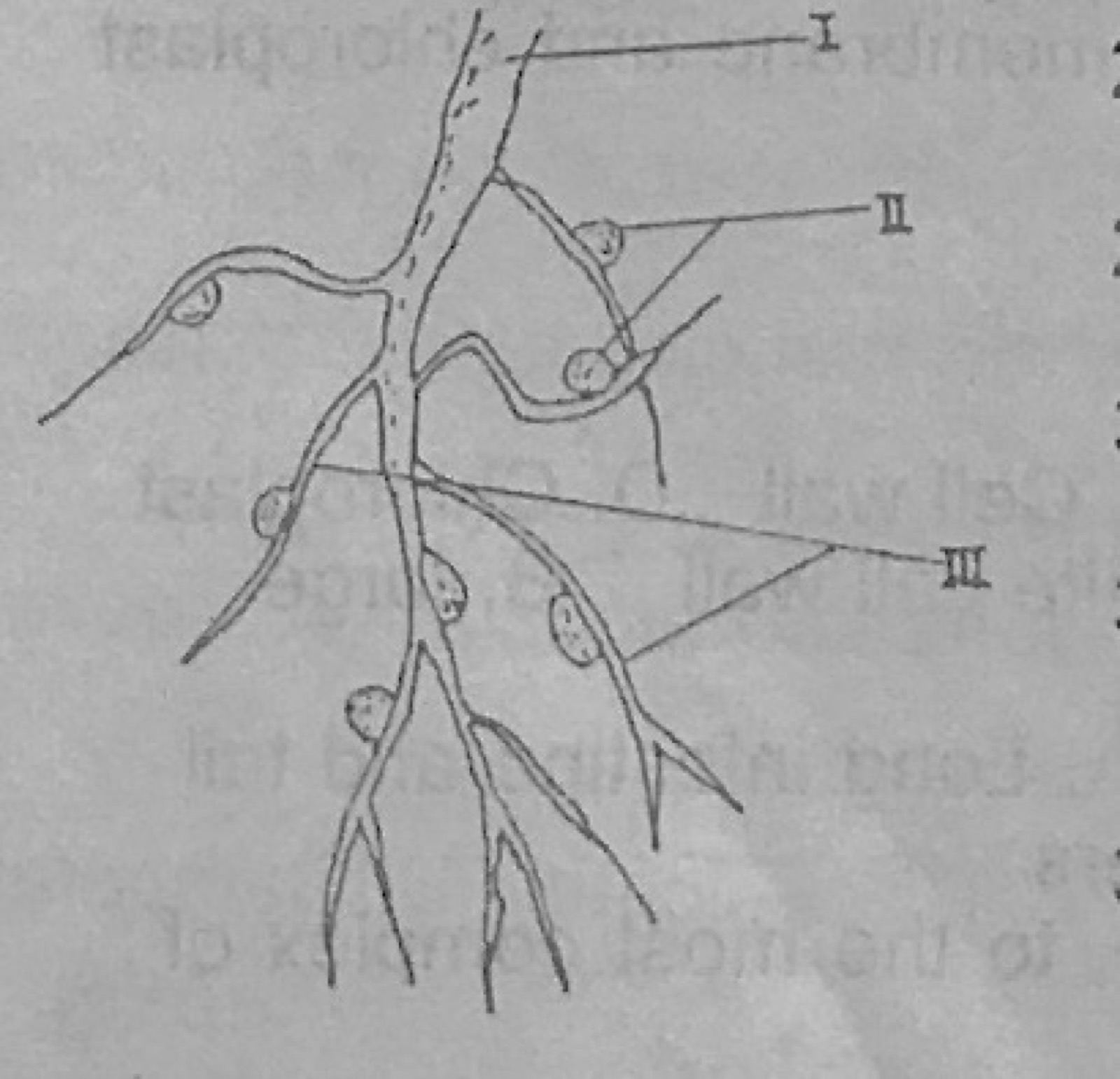
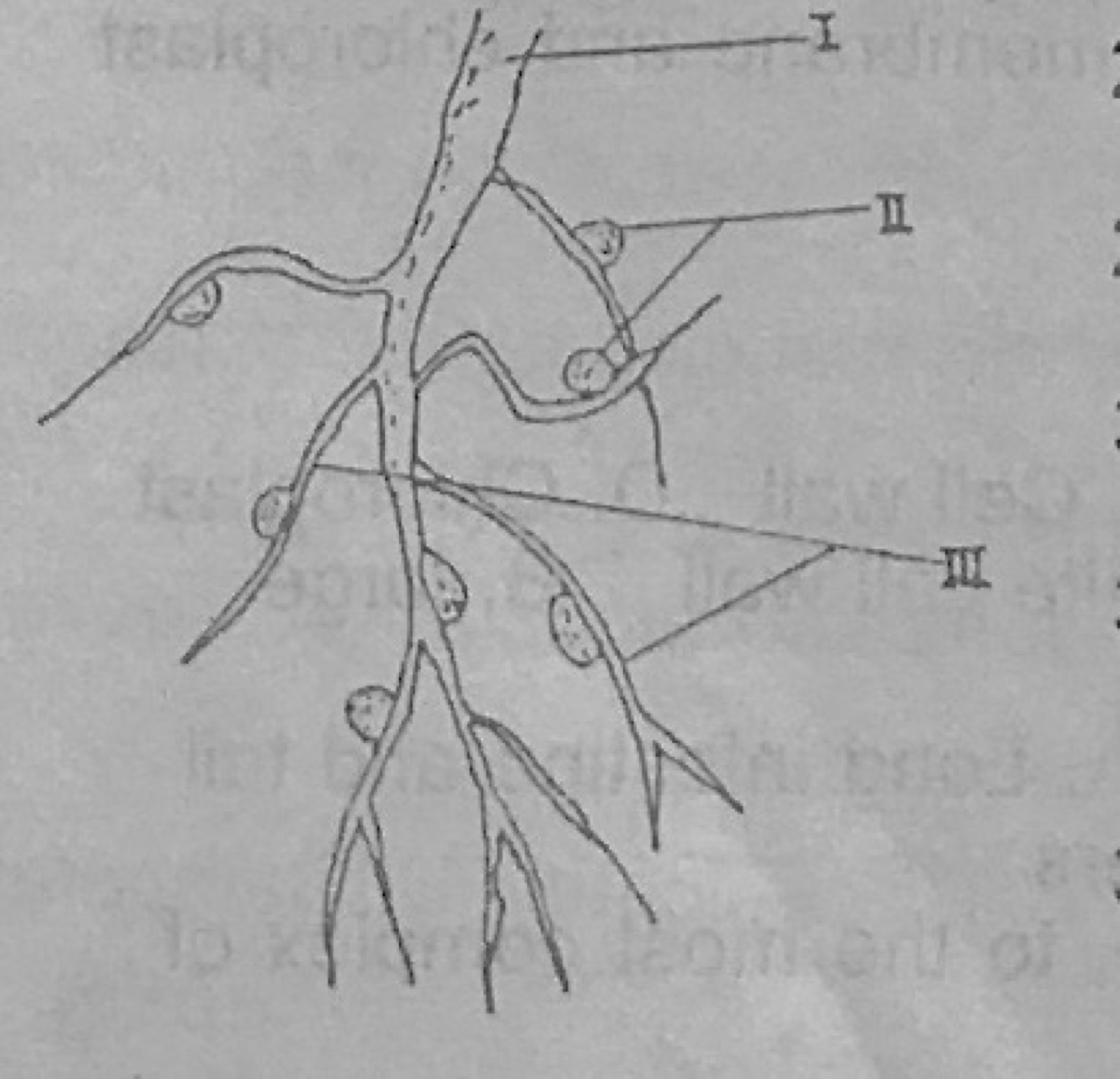
The diagram below is the root system of a leguminous plant. Study it and answer the question.
The structures labelled II are

Diagram for this question
  1. A.groundnut seeds
  2. B.underground root nuts
  3. C.root tubers
  4. D.root nodules.
Show the answer and explanation

Answer: D (root nodules.)

Explanation

The small swellings on the roots of a legume are root nodules.

Open this question

Question 29

Nutrient Cycling

The diagram below is the root system of a leguminous plant. Study it and answer the question.
The structures labelled II are associated with

Diagram for this question
  1. A.storage of plant nutrients
  2. B.organic acids
  3. C.nitrogen-fixing bacteria
  4. D.putrefying microbes.
Show the answer and explanation

Answer: C (nitrogen-fixing bacteria)

Explanation

Root nodules contain Rhizobium bacteria, which fix nitrogen from the air into compounds the plant can use.

Open this question

Question 30

Food Substances and Enzymes

The deficiency disease that results from the lack of vitamin B due to frequent eating of rice, is

  1. A.rickets
  2. B.night blindness
  3. C.scurvy
  4. D.beri-beri.
Show the answer and explanation

Answer: D (beri-beri.)

Explanation

Polished rice lacks vitamin B1 (thiamine), and a shortage of it causes beri-beri. Rickets, night blindness and scurvy are caused by lack of vitamins D, A and C.

Open this question

Question 31

Food Substances and Enzymes

When a food substance gives a purple colour on the addition of sodium hydroxide and a drop of copper sulphate, then the food substance is likely to contain

  1. A.carbohydrates
  2. B.fat
  3. C.protein
  4. D.sugar.
Show the answer and explanation

Answer: C (protein)

Explanation

Sodium hydroxide plus copper sulphate is the Biuret test; a purple (violet) colour shows protein.

Open this question

Question 32

Animal Nutrition

In mammals, digested food is absorbed in the

  1. A.stomach
  2. B.ileum
  3. C.colon
  4. D.duodenum.
Show the answer and explanation

Answer: B (ileum)

Explanation

The ileum has many villi with a rich blood supply, giving a huge surface for absorbing digested food.

Open this question

Question 33

Food Substances and Enzymes

Using, iodine solution, Biuret test, Benedict reagents and ethanol, respectively in testing for reducing sugars, which of the following trends of colour changes would be observed?

  1. A.Blue-black→blue→brown→clear
  2. B.Brown→blue→brick red→clear
  3. C.Brown→violet→blue→clear
  4. D.Brown→blue→violet→milky.
Show the answer and explanation

Answer: B (Brown→blue→brick red→clear)

Explanation

A reducing sugar gives no starch (iodine stays brown), no protein (Biuret stays blue), a brick-red Benedict's result and no fat (the ethanol test stays clear).

Open this question

Question 34

Ecosystem and Ecological Factors

Ecology simply means the study of

  1. A.the properties of a habitat
  2. B.interrelationship between organisms and their environment
  3. C.several species of plants and animals
  4. D.interrelationship between plants and animals.
Show the answer and explanation

Answer: B (interrelationship between organisms and their environment)

Explanation

Ecology is the study of how living things relate to one another and to their surroundings.

Open this question

Question 35

Nutrient Cycling

Which of the following processes removes water from the water cycle?

  1. A.Condensation
  2. B.Perspiration
  3. C.Photosynthesis
  4. D.Transpiration.
Show the answer and explanation

Answer: C (Photosynthesis)

Explanation

In photosynthesis water molecules are split and built into food, so that water is taken out of the cycle. Transpiration and perspiration put water vapour back into the air.

Open this question

Question 37

Feeding Relationships and Energy Flow

In any food chain, the first member must be a

  1. A.carnivore
  2. B.herbivore
  3. C.zooplankton
  4. D.autotroph.
Show the answer and explanation

Answer: D (autotroph.)

Explanation

Every food chain starts with a producer, an autotroph that makes its own food, usually by photosynthesis.

Open this question

Question 38

Pollution

Which of the following measures is most likely to cause a damage to the ecosystem in the control of pests and weeds?

  1. A.Use of ladybird insects to feed on aphids
  2. B.Introduction of bacterium to kill larvae of butterfly
  3. C.Introduction of Tilapia fish in ponds to feed on mosquito larvae.
  4. D.Spraying insecticides to destroy cotton- stainers in a cotton-field.
Show the answer and explanation

Answer: D (Spraying insecticides to destroy cotton- stainers in a cotton-field.)

Explanation

Insecticides also kill useful insects and other animals and can pollute soil and water. The other options are biological control, which targets the pest.

Open this question

Question 39

Feeding Relationships and Energy Flow

The total amount of energy entering a food chain is that which is present in the

  1. A.consumer
  2. B.ecosystem
  3. C.producer
  4. D.decomposer.
Show the answer and explanation

Answer: C (producer)

Explanation

Energy enters a food chain when producers trap sunlight in photosynthesis; all other organisms get their energy from them.

Open this question

Question 40

Adaptation

Which of the following terms ensures the survival of an organism in its environment?

  1. A.Hibernation
  2. B.Succession
  3. C.Adaptation
  4. D.Competition.
Show the answer and explanation

Answer: C (Adaptation)

Explanation

Adaptations are features that suit an organism to its environment and so help it survive.

Open this question

Question 42

Habitats and Biomes

The possession of breathing roots is a characteristic of plants growing in

  1. A.mangrove swamp
  2. B.coastal savanna
  3. C.guinea savanna
  4. D.shrub biome.
Show the answer and explanation

Answer: A (mangrove swamp)

Explanation

Mangrove mud is waterlogged and short of oxygen, so mangrove plants have breathing roots (pneumatophores) that grow up into the air.

Open this question

Question 43

Population Ecology

The numbers in a population would rise, if there was an increase in the

  1. A.spread of disease
  2. B.number of deaths
  3. C.number of predators
  4. D.amount of food available.
Show the answer and explanation

Answer: D (amount of food available.)

Explanation

More food lets more individuals survive and breed, so the population grows. Disease, deaths and predators all reduce it.

Open this question

Question 44

Microorganisms and Health

Measles in infants can be prevented by

  1. A.sleeping under mosquito nets
  2. B.providing clean water supply
  3. C.taking anti-malaria tablets
  4. D.vaccinating young children.
Show the answer and explanation

Answer: D (vaccinating young children.)

Explanation

Measles is a viral disease spread through the air, and vaccination gives children immunity against it.

Open this question

Question 45

Nutrient Cycling

Micro-organisms are important in recycling nutrients because

  1. A.they are capable of multiplying quickly
  2. B.they are eaten by large organisms
  3. C.they break down dead organic materials
  4. D.many of them are parasites.
Show the answer and explanation

Answer: C (they break down dead organic materials)

Explanation

Bacteria and fungi decompose dead plants and animals, releasing nutrients back into the soil for plants to use again.

Open this question

Question 46

Soil

A vegetable farmer will benefit from a cattle rearer if

  1. A.the faecal remains of the cattle are made available to the farmer
  2. B.the farmer makes available fresh green vegetables for consumption by the cattle daily.
  3. C.the farmer provides shelter for the cattle and the cattle rearer.
  4. D.the cattle rearer makes available meat to the farmer daily.
Show the answer and explanation

Answer: A (the faecal remains of the cattle are made available to the farmer)

Explanation

Cattle dung is a good manure that adds nutrients to the soil, so it helps the farmer's vegetables grow.

Open this question

Question 47

Conservation of Natural Resources

Wildlife conservation is enhanced by

  1. A.enacting laws to encourage poaching
  2. B.discouraging elimination of endangered species
  3. C.encouraging creation of satellite hunting unit
  4. D.suppressing the activities of wildlife conservation agencies.
Show the answer and explanation

Answer: B (discouraging elimination of endangered species)

Explanation

Conservation means protecting wildlife, so stopping the killing of endangered species helps. The other options would harm wildlife.

Open this question

Question 48

Variation

Which of these statements is true about fingerprint patterns?

  1. A.Consistent for a lifetime
  2. B.May be exactly the same for two individuals
  3. C.Prominent only at puberty
  4. D.Correlate with the individual blood group
Show the answer and explanation

Answer: A (Consistent for a lifetime)

Explanation

A person's fingerprint pattern forms before birth and does not change for life, and no two people have exactly the same prints.

Open this question

Question 49

Conservation of Natural Resources

Some species of animals and plants are considered as endangered, because

  1. A.they are found in large numbers in most habitats.
  2. B.they are harmful to their natural habitats
  3. C.their populations have become so small that they may soon die out
  4. D.they should be killed or only kept in cages.
Show the answer and explanation

Answer: C (their populations have become so small that they may soon die out)

Explanation

An endangered species is one with so few individuals left that it is at risk of extinction.

Open this question

Question 50

Variation

Which of the following is a continuous variation, in human population?

  1. A.Sex
  2. B.Rh factor
  3. C.Height
  4. D.Down's syndrome.
Show the answer and explanation

Answer: C (Height)

Explanation

Height changes gradually from short to tall with many in-between values, so it is continuous. Sex and Rh factor fall into clear separate groups.

Open this question

Question 51

Mendelian Inheritance

Which of the following statements about blood groups in human is not correct?

  1. A.Siblings may not belong to the same blood group
  2. B.There are four possible blood groups
  3. C.People with blood group O can receive blood from all other groups.
  4. D.People with blood group AB are universal recipients.
Show the answer and explanation

Answer: C (People with blood group O can receive blood from all other groups.)

Explanation

Group O people can give blood to all groups (universal donors) but can receive only group O blood, so statement C is wrong.

Open this question

Question 52

Mendelian Inheritance

When Mendel crossed round seeds with wrinkled seeds of Pea Plant, what was the ratio of wrinkled seeds to round seeds in the F2 plants?

  1. A.3 : 1
  2. B.2 : 1
  3. C.1 : 3
  4. D.1 : 2.
Show the answer and explanation

Answer: C (1 : 3)

Explanation

Round is dominant, so the F2 has 3 round : 1 wrinkled. Wrinkled to round is therefore 1 : 3.

Open this question

Question 53

Variation

Which of the following is not a morphological variation in human beings?

  1. A.Size
  2. B.Blood groups
  3. C.Colour
  4. D.Fingerprints.
Show the answer and explanation

Answer: B (Blood groups)

Explanation

Morphological variations can be seen on the body (size, colour, fingerprints). Blood group can only be found by a laboratory test, so it is a physiological variation.

Open this question

Question 54

Chromosomes, DNA and Sex Linkage

The name given to a sudden change in a gene or chromosome that can be passed on to the offspring is

  1. A.inheritance
  2. B.linkage
  3. C.alleles
  4. D.mutation.
Show the answer and explanation

Answer: D (mutation.)

Explanation

A mutation is a sudden change in a gene or chromosome; if it is in a sex cell it can be inherited.

Open this question

Question 55

Chromosomes, DNA and Sex Linkage

In humans, sex is determined by

  1. A.two homologous chromosomes
  2. B.a dominant gene for maleness present in a male
  3. C.two similar sex chromosomes in the male and dissimilar in the female
  4. D.the differences in the nature of the X and Y chromosomes in the male.
Show the answer and explanation

Answer: D (the differences in the nature of the X and Y chromosomes in the male.)

Explanation

Females are XX and males are XY. The father's sperm carries either X or Y, and this decides the child's sex.

Open this question

Question 56

Mendelian Inheritance

A man with heterozygous genotype for blood group B marries a woman with heterozygous A, what percentage (%) of their children would be universal donor?

  1. A.50%
  2. B.25%
  3. C.15%
  4. D.10%.
Show the answer and explanation

Answer: B (25%)

Explanation

Cross BO × AO gives AB, AO, BO and OO in equal numbers. Only OO (group O, the universal donor) is 1 in 4, which is 25%.

Open this question

Question 57

Mendelian Inheritance

The genes affecting the same trait and are located at the same position on the homologous chromosomes are called

  1. A.autosomes
  2. B.alleles
  3. C.loci
  4. D.chromatids.
Show the answer and explanation

Answer: B (alleles)

Explanation

Alleles are different forms of a gene for the same trait, found at the same place (locus) on a pair of homologous chromosomes.

Open this question

Question 58

Adaptation

Which of the following is an adaptation by plants to reduce the rate of water loss in a dry habitat? Possession of

  1. A.a few sunken stomata on the lower epidermis only
  2. B.long leaf tendrils
  3. C.leaves with serrated edges
  4. D.strong tap root.
Show the answer and explanation

Answer: A (a few sunken stomata on the lower epidermis only)

Explanation

Few stomata, sunk in pits and only on the shaded lower surface, let out less water vapour. A tap root helps get water but does not reduce water loss.

Open this question

Question 59

Behaviour

The following are social insects except

  1. A.wasps
  2. B.termites
  3. C.bees
  4. D.cotton stainer.
Show the answer and explanation

Answer: D (cotton stainer.)

Explanation

Wasps, termites and bees live in organised colonies with castes. Cotton stainers live alone and are not social insects.

Open this question

Question 60

Evolution

Which of the following can be considered as a direct evidence of evolution?

  1. A.Classification
  2. B.Comparative anatomy
  3. C.Comparative embryology
  4. D.Fossil record.
Show the answer and explanation

Answer: D (Fossil record.)

Explanation

Fossils are actual remains of past organisms showing how life changed over time, so they are direct evidence. The others are indirect comparisons.

Open this question

Theory question 101

Ecological Associations

(a) Explain the terms:
(i) Parasitism (ii) Commensalism
(b) Mention:
(i) one fungal parasite of a plant and its host
(ii) one bacterial parasite of humans.
(c)(i) List four symptoms of malaria. (ii) Mention six methods of controlling malaria in West Africa

Show the model answer
Model answer

(a)(i) Parasitism: a close association between two organisms of different species in which one (the parasite) lives in or on the other (the host), gets food or shelter from it and harms it.
(ii) Commensalism: an association between two organisms of different species in which one (the commensal) benefits while the other is neither helped nor harmed.
(b)(i) Any one, e.g. Puccinia (rust) on maize or wheat; Phytophthora palmivora (black pod) on cocoa; Phytophthora infestans (blight) on potato or tomato; Ustilago (smut) on maize.
(ii) Any one, e.g. Vibrio cholerae (cholera); Mycobacterium tuberculosis (tuberculosis); Salmonella typhi (typhoid); Clostridium tetani (tetanus); Neisseria gonorrhoeae (gonorrhoea).
(c)(i) Any four: high fever; shivering/chills; headache; pains in the joints; loss of appetite; vomiting; weakness/tiredness; paleness (anaemia).
(ii) Any six: sleep under (treated) mosquito nets; put wire gauze/nets on windows and doors; drain stagnant water and remove empty cans and containers; spray stagnant water with oil to kill larvae; spray insecticides or burn mosquito coils; use mosquito repellent creams; clear bushes around homes; introduce fish (e.g. Tilapia) to eat larvae; take anti-malarial drugs to prevent or treat the disease; educate the public on malaria control.

Explanation

Name each parasite with its host or disease, and give exactly the number of points asked.

Open this question

Theory question 102

Sense Organs

(a) What is a receptor? (b) Describe the general features common to all receptors.
(c)(i) Make a labelled diagram 8 cm – 10 cm long, to show the outer and middle ear only of human.
(ii) List three ways of caring for the ear

Show the model answer
Model answer

(a) A receptor is a sensory cell (or group of cells) that detects a stimulus and starts a nerve impulse, which is carried by sensory neurones to the central nervous system.
(b) Made of specialised sensory cells; each is sensitive to one kind of stimulus (light, sound, touch, chemicals, heat); the free ends of the cells often bear fine hair-like processes; the cells are connected at their bases to sensory nerve fibres; they change the stimulus into nerve impulses; they are often grouped together in sense organs.
(c)(i) Diagram (title, clear lines, correct size) labelled: outer ear – pinna, external auditory canal (meatus), ear drum (tympanic membrane); middle ear – malleus, incus, stapes (ossicles), oval window, round window, Eustachian tube, middle ear cavity.
(ii) Any three: do not push sharp objects (pins, sticks) into the ear; clean only the outer ear gently, e.g. with cotton buds; avoid very loud noise and loud earphones; do not pour hot or dirty liquids into the ear; see a doctor quickly about ear pain or discharge; treat infections such as measles, catarrh or meningitis promptly.

Explanation

Only the outer and middle ear are asked for in the diagram; do not draw the inner ear.

Open this question

Theory question 103

Transport in Animals

(a) List the main constituent of mammalian blood
(b) State two functions of each constituent
(c) Tabulate six differences between arteries and veins (d) Name the main artery which transports blood to the: (i) Lung (ii) Kidney

Show the model answer
Model answer

(a) Plasma; red blood cells (erythrocytes); white blood cells (leucocytes); platelets (thrombocytes).
(b) Plasma: carries dissolved food, hormones, urea and carbon dioxide; distributes heat; carries antibodies and clotting proteins.
Red blood cells: carry oxygen as oxyhaemoglobin; help carry carbon dioxide.
White blood cells: engulf (phagocytose) germs; make antibodies/antitoxins.
Platelets: start blood clotting; help seal wounds and stop bleeding/entry of germs.
(c) Arteries | Veins:
carry blood away from the heart | carry blood to the heart;
thick, muscular, elastic walls | thin walls with little muscle;
narrow lumen | wide lumen;
no valves (except at their base) | have valves along their length;
blood under high pressure and flows in spurts | low pressure, smooth flow;
carry oxygenated blood (except pulmonary artery) | carry deoxygenated blood (except pulmonary vein);
usually deep in the body | many near the surface.
(d)(i) Pulmonary artery. (ii) Renal artery.

Explanation

In (c) each difference must compare the same feature for both vessels.

Open this question

Theory question 104

Reproduction in Animals

(a) What is sexual reproduction?
(b) State five functions of the placenta and four functions of the umbilical cord of a mammal
(c) List four types of placentation in flowering plants
(d) State four conditions necessary for seed germination.

Show the model answer
Model answer

(a) Sexual reproduction is the production of new individuals by the fusion of male and female gametes (fertilization) to form a zygote.
(b) Placenta (any five): lets oxygen pass from mother to foetus; lets digested food pass to the foetus; lets carbon dioxide and urea pass from foetus to mother; passes antibodies to the foetus; keeps the two blood systems apart (protects the foetus from the mother's high blood pressure and some germs); makes hormones such as progesterone; attaches the foetus to the uterus wall.
Umbilical cord (any four): joins the foetus to the placenta; umbilical vein carries oxygen and food to the foetus; umbilical arteries carry carbon dioxide and wastes to the placenta; carries antibodies to the foetus; allows the foetus to move freely in the amniotic fluid.
(c) Any four: marginal; axile; parietal; free central; basal.
(d) Water (moisture); oxygen (air); suitable (warm) temperature; a viable embryo (and end of dormancy).

Explanation

Keep placenta and umbilical cord functions in separate lists.

Open this question

Theory question 107

Population Ecology

(a)(i) Define ecological succession (ii) List four characteristics of ecological succession of plants
(b) Explain four factors which affect population size
(c) State the adaptation of tapeworm (Taenia Solium) to its habitat in the gut of human.

Show the model answer
Model answer

(a)(i) Ecological succession is the gradual, orderly change in the kinds of organisms (communities) living in an area over time, until a stable climax community is formed.
(ii) Any four: it starts on bare or disturbed land with pioneer species such as lichens, mosses or grasses; each community changes the habitat (e.g. builds soil) and makes it suitable for the next; species number and variety increase over time; plants become larger and more complex; it is slow at first then speeds up; it ends in a stable climax community.
(b) Any four, explained: food supply – plenty of food raises the population, shortage lowers it; predators – more predators lower prey numbers; disease – epidemics cause many deaths; birth (natality) and death (mortality) rates – more births than deaths raise the population; immigration and emigration add or remove individuals; space/shelter and competition – overcrowding leads to competition and fewer survivors; climate/natural disasters such as floods or drought kill many.
(c) Thick cuticle resists digestion by the host's enzymes; scolex with hooks and suckers holds it to the gut wall; absorbs digested food over its whole body surface (no gut); flat, thin body gives a large surface for absorption; can respire anaerobically in the low-oxygen gut; hermaphrodite and produces very many eggs; ripe proglottids pass out with faeces to reach a new host; secretes anti-enzymes.

Explanation

In (b) explain how each factor raises or lowers the population, not just its name.

Open this question

Theory question 108

Feeding Relationships and Energy Flow

(a) Explain the following terms:
(i) Producer (ii) Consumer (iii) Community
(iv) Decomposer
(b) List four characteristics each of:
(i) Trees of the Tropical Rain Forest (ii) Trees/Shrubs of the Savanna

Show the model answer
Model answer

(a)(i) Producer: an autotrophic organism, usually a green plant, that makes its own food from simple substances by photosynthesis and is the first link in a food chain.
(ii) Consumer: a heterotrophic organism (animal) that cannot make its own food and feeds on producers or other consumers.
(iii) Community: all the populations of different species living together and interacting in one habitat.
(iv) Decomposer: an organism such as a bacterium or fungus that breaks down dead organic matter and wastes, releasing simple nutrients back into the soil.
(b)(i) Rain forest trees (any four): very tall (often over 30 m); straight trunks with branches only near the top; thin, smooth bark; large, broad, evergreen leaves, often with drip tips; form layers and a closed canopy; buttress or stilt roots; shallow roots; many climbers and epiphytes on them.
(ii) Savanna trees/shrubs (any four): short and scattered; thick, fissured, fire-resistant bark; small or leathery leaves, often shed in the dry season; long, deep tap roots; twisted or umbrella-shaped crowns; some store water in their trunks (e.g. baobab); some have thorns.

Explanation

Give clear one-line definitions, then four distinct features for each vegetation type.
Open this question