Which of the following processes occurs when the body temperature of a mammal rises above the normal? I. The arterioles in the skin dilate. II. Sweat production is reduced. III. The erector muscles contract.
A.I only
B.II only
C.I and III only
D.II and III only
Show the answer and explanation
Answer: A (I only)
Explanation
When the body is too hot, skin arterioles dilate to lose heat; sweating increases (not reduces) and the erector muscles relax.
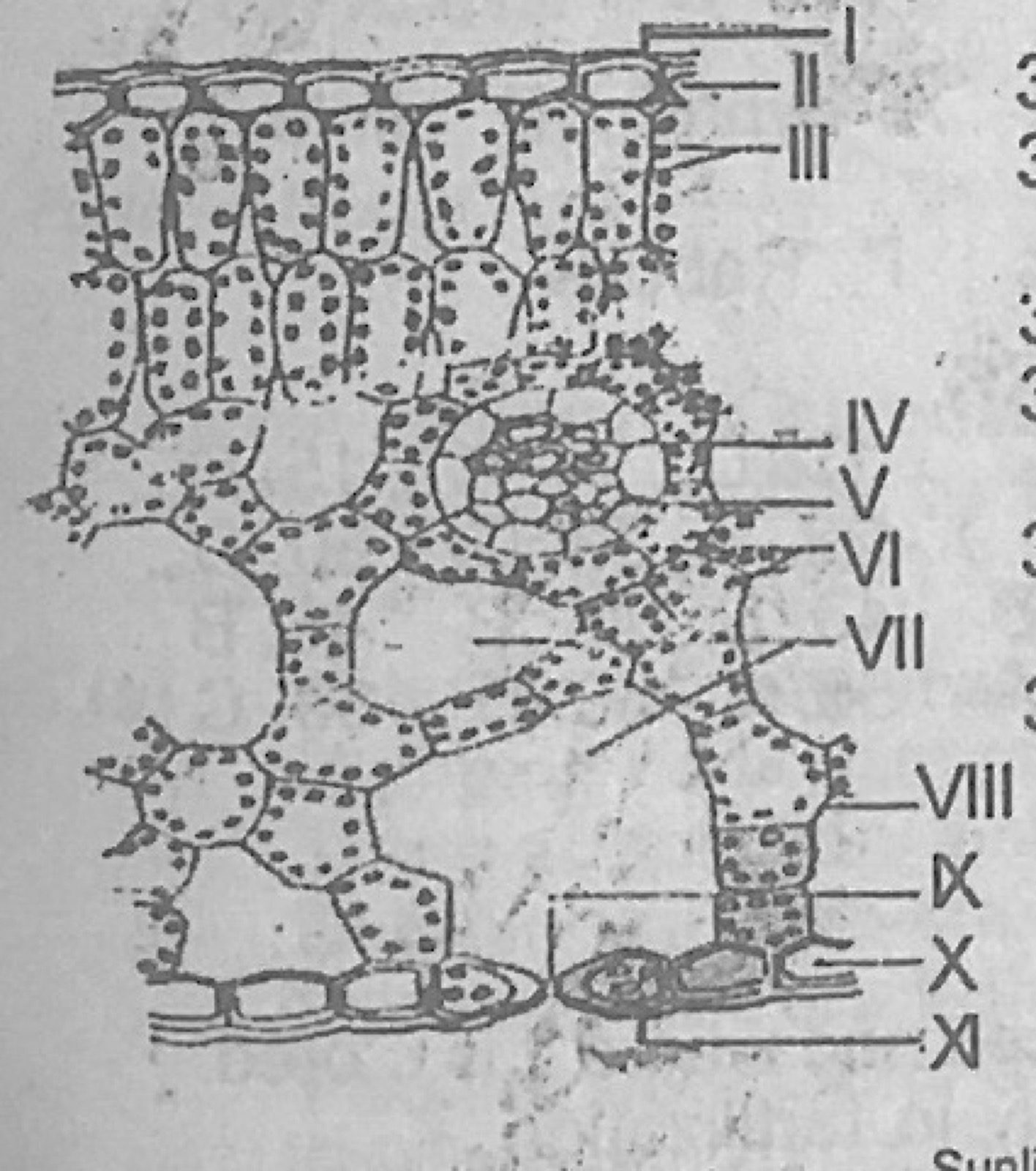
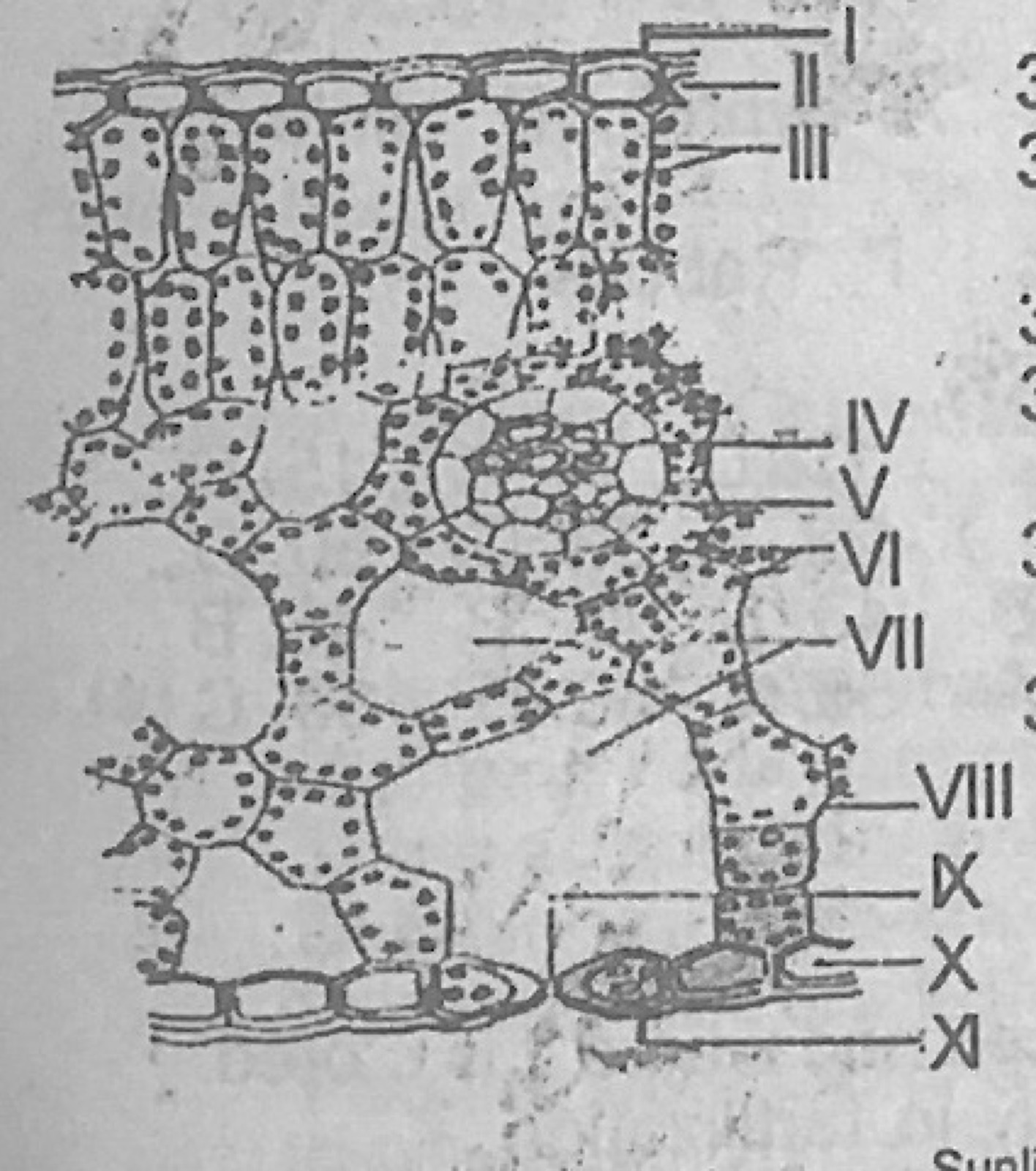
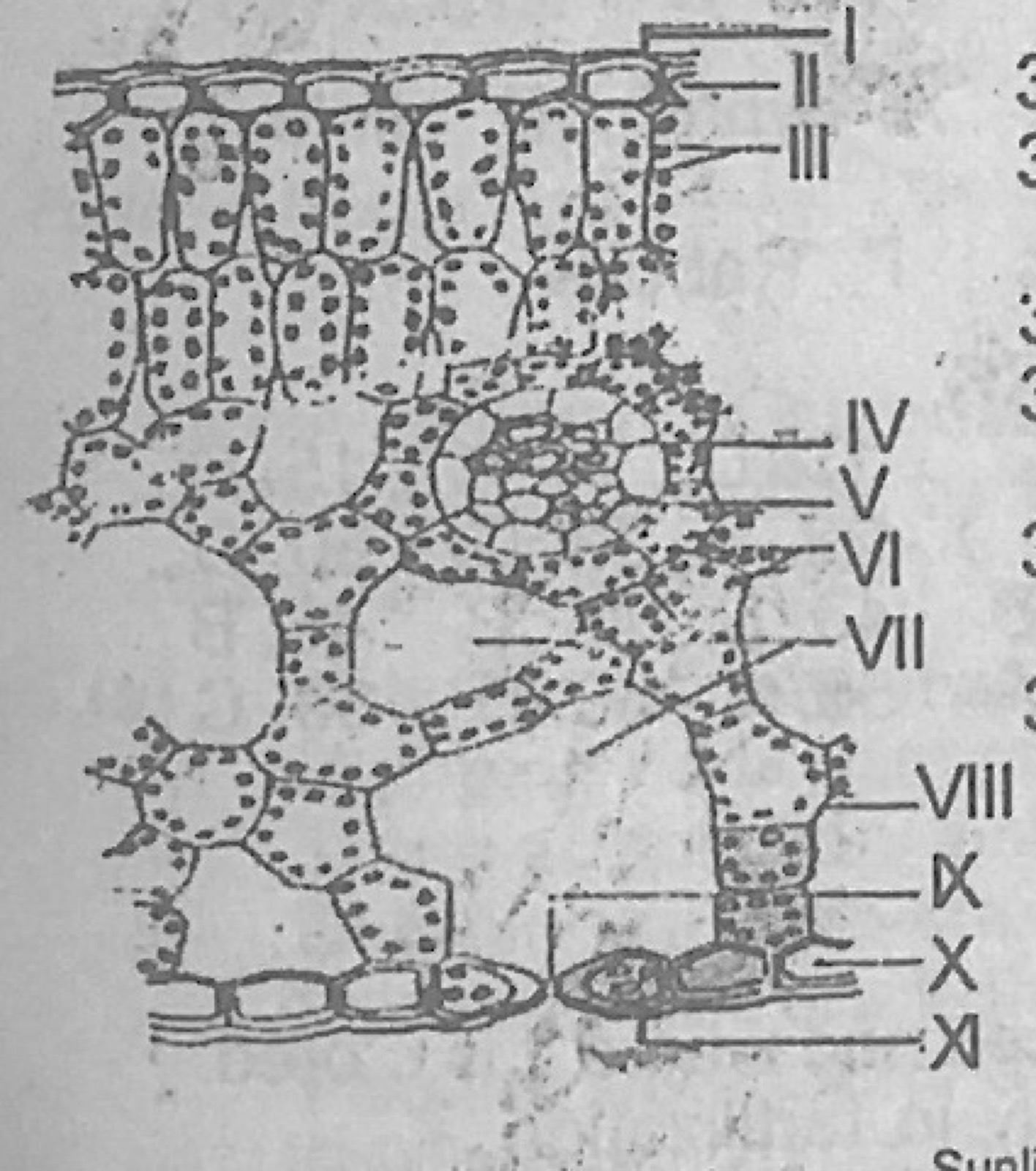
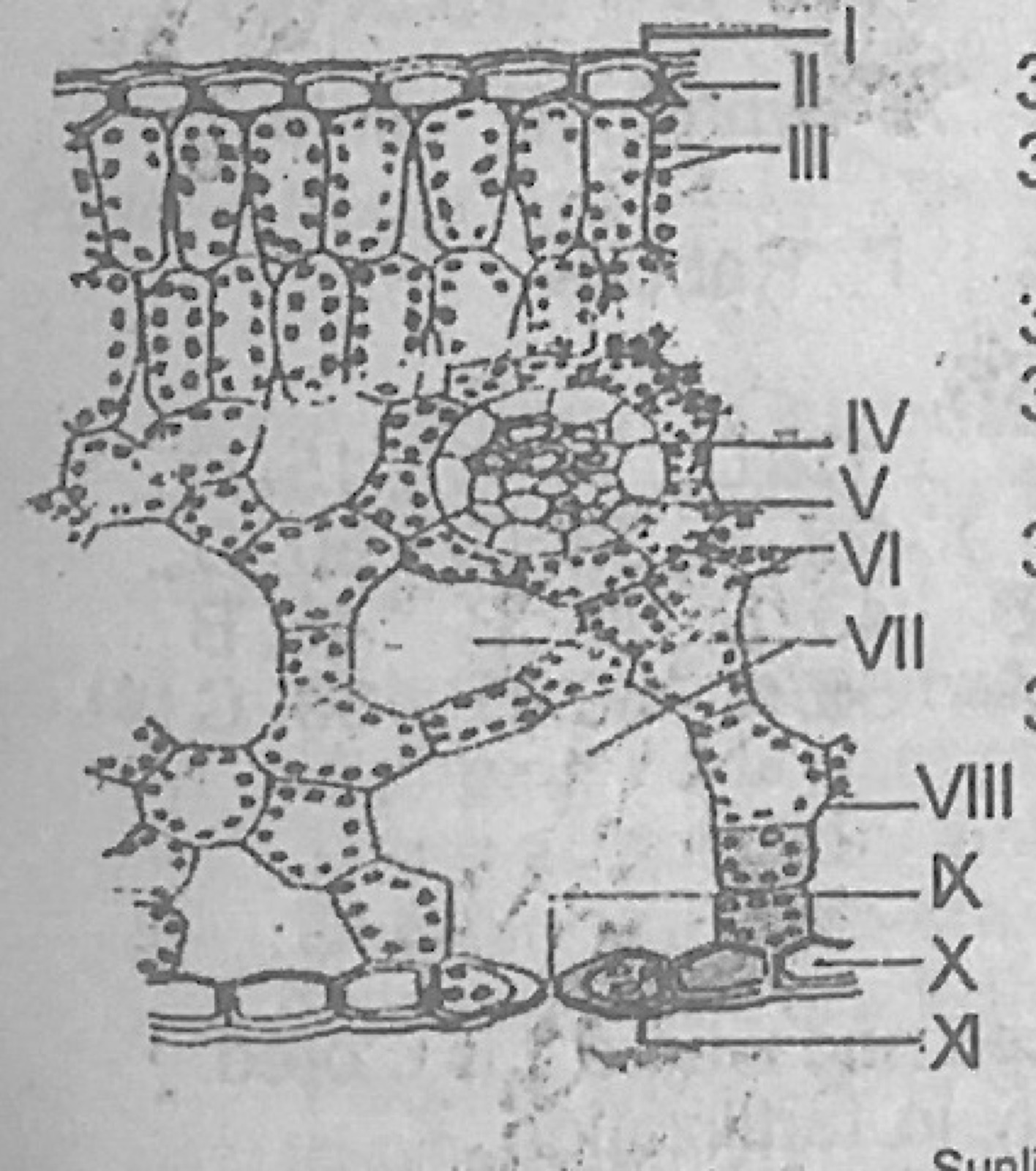
Which of the groups of structures listed below contains chloroplast?
A.I, II and III
B.II, III and VII
C.III, VIII and IX
D.III, VIII and XI
Show the answer and explanation
Answer: D (III, VIII and XI)
Explanation
Chloroplasts are found in the palisade (III) and spongy mesophyll (VIII) cells and in the guard cells (XI); the cuticle, epidermis and air spaces have none.
Use the following human characteristics to answer this question. I. Complexion II. Height III. Blood Rh factor IV. Colour blindness Which of the above human characteristics are discontinuous variations?
A.I and III only
B.II and III only
C.II and IV only
D.III and IV only
Show the answer and explanation
Answer: D (III and IV only)
Explanation
Rh factor and colour blindness fall into clear-cut groups (you either have it or not); complexion and height vary continuously.
(a) (i) Draw and label the human sperm cell. (ii) State where the sperm cell is produced and where it is stored. (b) Explain how the structure of the sperm cell enables it to function effectively in fertilization. (c) Mention four advantages of sexual reproduction.
Show the model answer
Model answer
(a)(i) Drawing of the sperm cell with oval head, short middle piece and long tail; labels: acrosome, nucleus, head, middle piece, mitochondria, centriole, tail (flagellum); title. (ii) Produced in the seminiferous tubules of the testes; stored in the epididymis. (b) The acrosome at the tip contains enzymes that dissolve the egg membrane so the sperm can enter; the middle piece has many mitochondria to supply energy for swimming; the long tail (flagellum) lashes to move the sperm towards the egg; the nucleus carries the father's genetic material (haploid) that fuses with the egg nucleus; the small, streamlined shape helps it swim. (c) Any four: produces variation among offspring; new varieties/better adapted offspring; allows production of hybrids with desirable traits; offspring can survive in changing environments; leads to formation of new species (evolution); keeps the chromosome number constant through meiosis and fertilisation.
(a) (i) Draw and label the mammalian heart. (ii) Explain briefly pulmonary circulation in mammals. (b) State five processes by which the mammalian body reduces its temperature.
Show the model answer
Model answer
(a)(i) Drawing of the vertical section of the heart with labels: right and left auricles, right and left ventricles, septum, tricuspid valve, bicuspid valve, semilunar valves, chordae tendineae, anterior and posterior vena cava, pulmonary artery, pulmonary vein, aorta (aortic arch). (ii) The right ventricle contracts and pumps deoxygenated blood through the pulmonary artery to the lungs; in the lung capillaries carbon dioxide is given out and oxygen taken in; the oxygenated blood returns through the pulmonary veins to the left auricle. (b) Any five: more sweating (evaporation cools the skin); vasodilation of skin arterioles; relaxation of hair erector muscles so hair lies flat; panting (in dogs); reduced metabolic rate; less muscular activity; seeking shade/cool places; taking cold drinks; licking fur (in some animals).
Explanation
Pulmonary circulation: right ventricle → lungs → left auricle.
(a) State eight human activities that may pollute water bodies. (b) Explain the measures that may be used to prevent pollution of water bodies. (c) Mention four methods of purifying water.
Show the model answer
Model answer
(a) Any eight: dumping refuse into water; discharging untreated sewage; oil spills from drilling and tankers; run-off of fertilisers and pesticides; discharging industrial chemicals, dyes and detergents; hot water from factories (thermal pollution); radioactive waste; using chemicals (e.g. gammalin) or explosives for fishing; washing and bathing in drinking water sources; mining waste. (b) Treat sewage before discharge; dispose of refuse properly (burn, bury, recycle) and not in water; treat industrial waste and cool hot water before release; use fertilisers and pesticides in correct amounts; use biodegradable detergents; clean up oil spills (detergents/booms); laws and penalties against polluters and against chemical fishing; educate the public. (c) Any four: boiling; filtration; sedimentation (settling) with alum; chlorination; distillation; use of ultraviolet light; aeration.
Explanation
List distinct activities, not the same one in different words.
(a) (i) Define tropic and nastic movements. (ii) List four differences between tropic and nastic movements. (b) Describe an experiment to show that auxins are produced in the apical cells of a shoot. (c) (i) Name two plant hormones, other than auxins. (ii) Give two examples of tropism.
Show the model answer
Model answer
(a)(i) A tropic movement (tropism) is a growth movement of part of a plant in response to a stimulus coming from one direction. A nastic movement is a non-directional movement of part of a plant in response to a stimulus, not related to the direction the stimulus comes from. (ii) Tropic vs nastic: direction of response related to the stimulus vs not related; growth movement vs often turgor (non-growth) movement; slow vs usually fast; usually irreversible vs reversible; involves auxins vs usually changes in turgor; e.g. stems bending to light vs closing of Mimosa leaves. (b) Use three similar seedlings (e.g. maize coleoptiles) A, B and C. Leave A intact (control). Cut off the tip of B and leave it. Cut off the tip of C, place it on an agar block for some hours, then put the agar block on the cut stump of C. After a few days A and C grow, B does not. So a growth substance (auxin) made in the tip passed into the agar and caused growth. (c)(i) Any two: gibberellins; cytokinins; abscisic acid; ethylene. (ii) Any two: phototropism; geotropism; hydrotropism; thigmotropism (haptotropism); chemotropism.
Explanation
Tropic = direction matters; nastic = direction does not matter.
(a) What is an ecosystem? (b) Name two abiotic factors each which affect plants and animals in a terrestrial habitat. (c) Describe the effects of three abiotic factors on a named plant and an animal in the habitat mentioned in (b) above.
Show the model answer
Model answer
(a) An ecosystem is a natural unit made up of a community of living organisms interacting with one another and with their non-living environment. (b) Any two for each: temperature; rainfall/water; light; wind; relative humidity; soil (edaphic) factors such as pH and texture; topography. (c) Name a plant and an animal (e.g. maize and the grasshopper/lizard) and give three factors, e.g. Temperature: high temperature increases transpiration and may wilt the plant; animals become more active up to a point, very high heat makes them seek shade or aestivate. Rainfall/water: enough rain allows germination and growth; drought causes wilting/death; animals need water and breed in the rainy season. Light: plants need light for photosynthesis and flowering; animals use light for vision and their activity follows day length (e.g. lizards bask in sunlight). Wind: spreads pollen and seeds and increases transpiration; may damage plants; affects flight of insects.
Explanation
Always name the plant and animal you are describing.
(a) (i) Name two types of competition (ii) State four factors that bring about competition among organisms. (b) Outline the relationship between competition and succession. (c) (i) Explain briefly Darwin's Theory of Natural Selection. (ii) List five evidences to support the occurrence of evolution.
Show the model answer
Model answer
(a)(i) Intraspecific competition (between members of the same species) and interspecific competition (between different species). (ii) Any four: limited food/nutrients; space; light; water; mates; shelter/breeding sites; oxygen. (b) During succession new species invade an area and compete with those already there for light, water and nutrients; stronger competitors replace weaker ones, changing the community step by step until a stable climax community is reached; so competition drives the replacement of species in succession. (c)(i) Organisms produce many more offspring than can survive; so there is a struggle for existence; offspring vary; those with variations that suit the environment survive (survival of the fittest) and reproduce, passing these variations to their young; over many generations this gives rise to new species. (ii) Any five: fossil records; comparative anatomy (homologous organs); vestigial organs; comparative embryology; geographical distribution; comparative biochemistry/molecular evidence; adaptive radiation; observed changes such as industrial melanism and drug/pesticide resistance.
Explanation
Struggle, variation, survival of the fittest, inheritance: the four steps of natural selection.