Study the list below and use it to answer questions 10-12 The vertebral column of mammals consists of the following: I. Lumbar vertebrae II. Thoracic vertebrae III. Caudal vertebrae IV. Cervical vertebrae V. Sacral vertebrae. Which of the following are found immediately next to the skull?
A.I
B.II
C.III
D.IV
E.V
Show the answer and explanation
Answer: D (IV)
Explanation
The cervical vertebrae (neck) are joined to the skull.
The vertebral column of mammals consists of the following: I. Lumbar vertebrae II. Thoracic vertebrae III. Caudal vertebrae IV. Cervical vertebrae V. Sacral vertebrae. Which of the following articulates with the ribs?
The vertebral column of mammals consists of the following: I. Lumbar vertebrae II. Thoracic vertebrae III. Caudal vertebrae IV. Cervical vertebrae V. Sacral vertebrae. Which of the following articulates with the pelvic girdle?
A.V
B.IV
C.III
D.II
E.I
Show the answer and explanation
Answer: A (V)
Explanation
The sacral vertebrae are fused to the pelvic girdle. Note that the options run backwards, so V is option A.
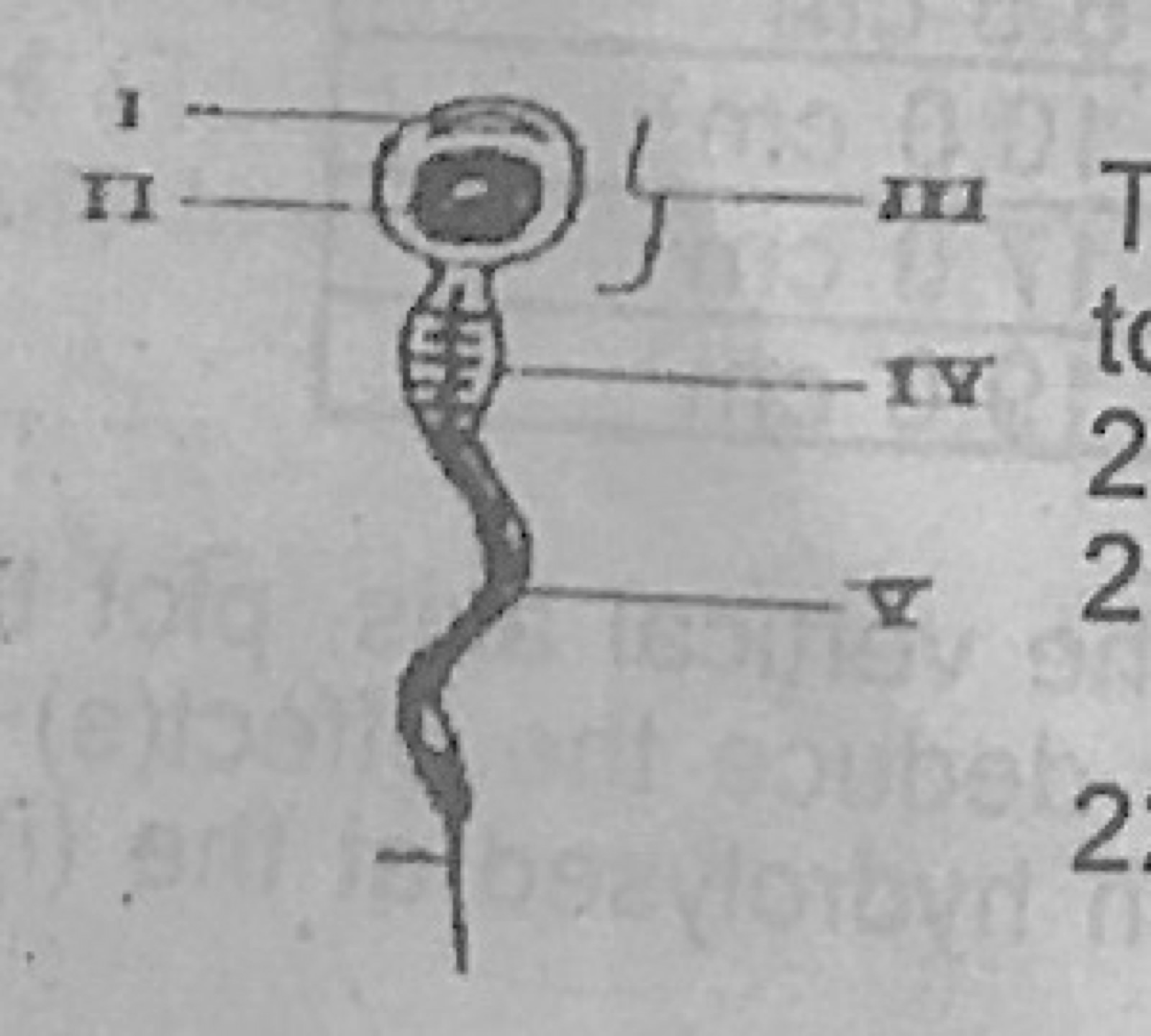
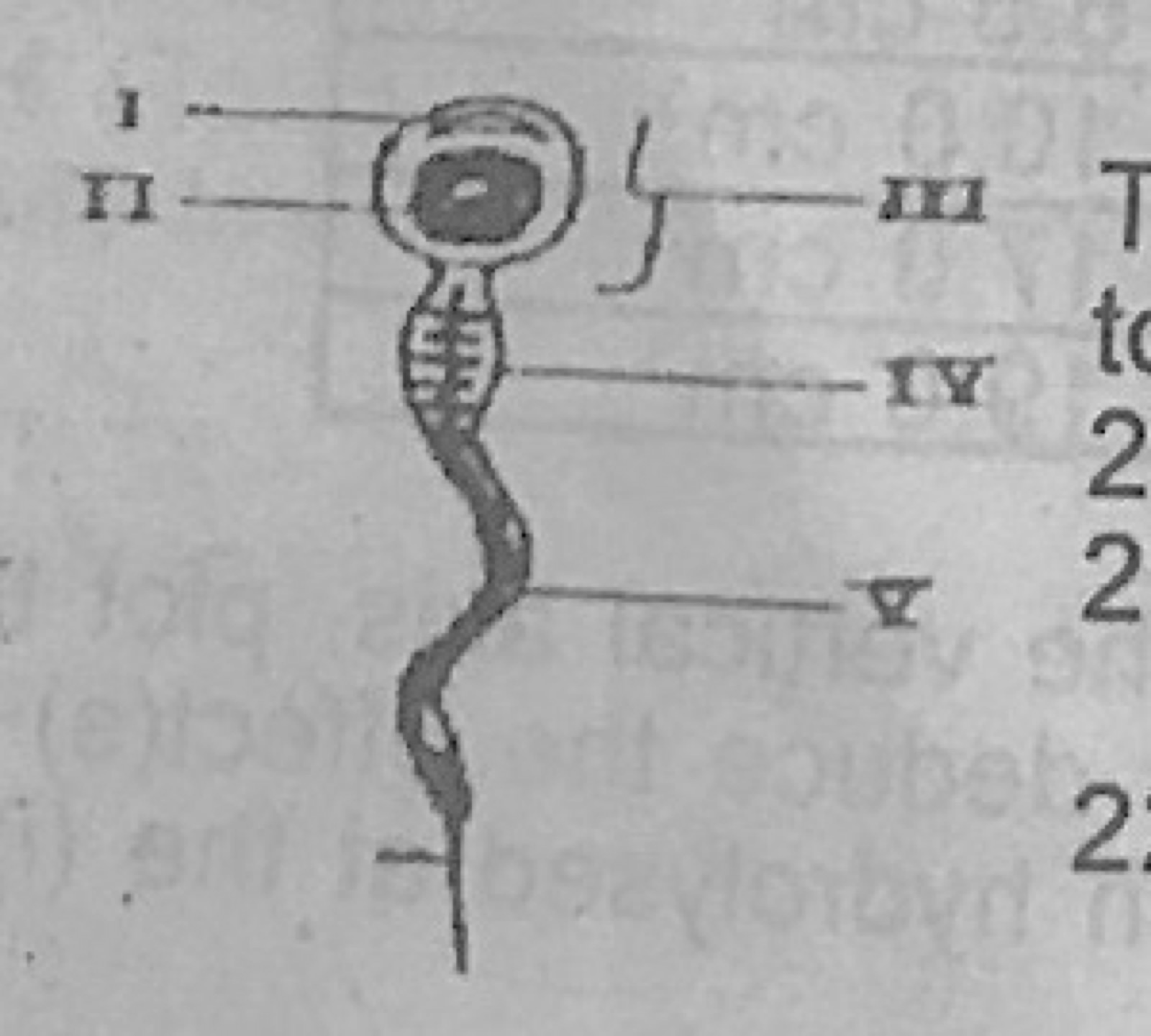
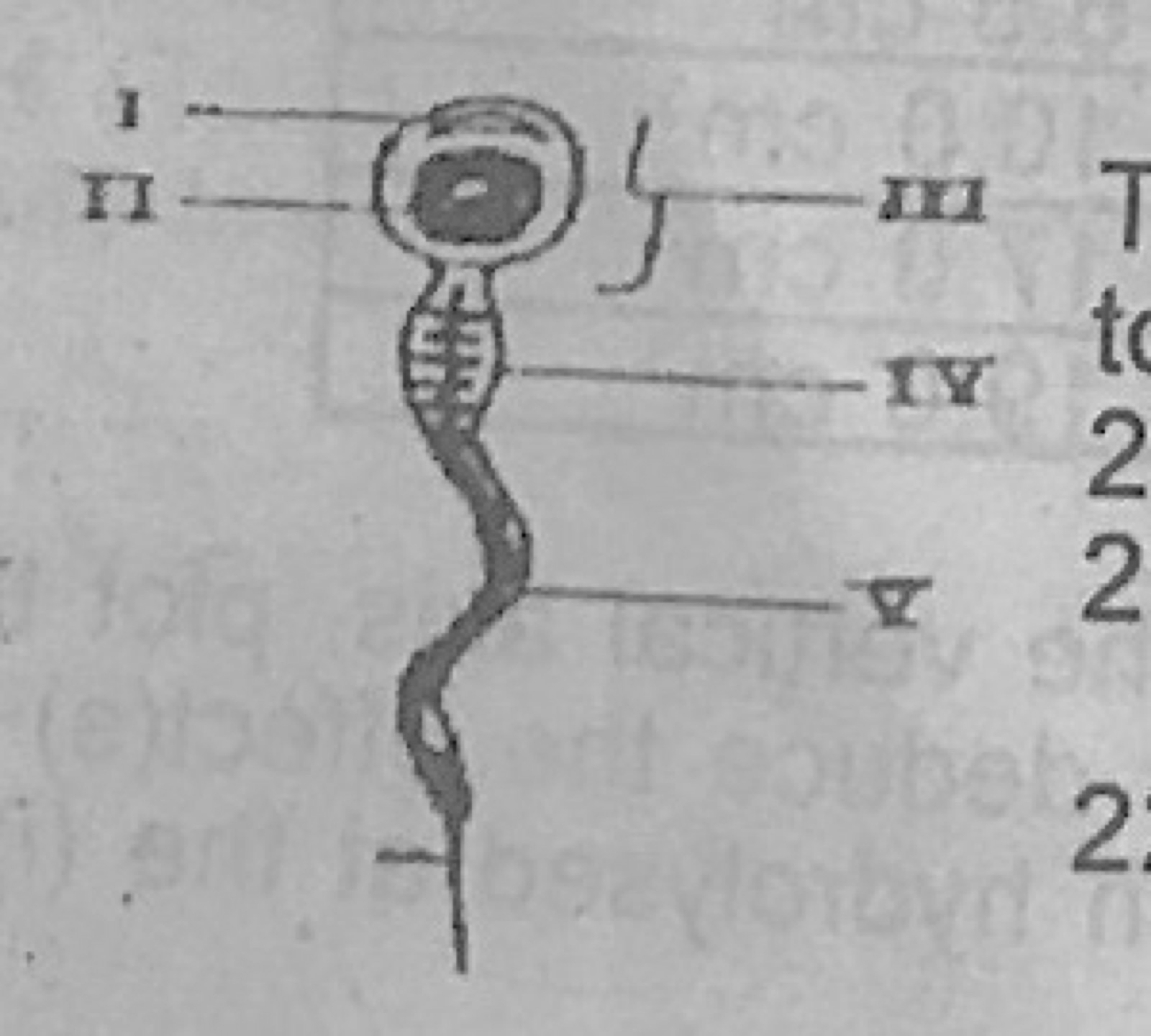
Use the drawing of a mammalian spermatozoan (parts labelled I to V). Which of the following labelled structures secretes enzymes which facilitate penetration of the egg?
A.I
B.II
C.III
D.IV
E.V
Show the answer and explanation
Answer: A (I)
Explanation
I is the acrosome at the tip of the head, which releases enzymes to dissolve a way into the egg.
Use the drawing of a mammalian spermatozoan (parts labelled I to V). Which of the following labelled structures is similar to the locomotory structure in Euglena?
In a water culture experiment, the culture solution in a transparent beaker turned green. What precaution should have been taken to prevent the culture solution from turning green?
A.Changing the culture solution regularly
B.Increasing the number of times the culture is aerated
C.Covering the transparent beaker with black cloth
D.Adding warm alcohol to bleach the green colour
E.Sterilizing the beaker in a hot oven before use
Show the answer and explanation
Answer: C (Covering the transparent beaker with black cloth)
Explanation
Green algae grew in the light; covering the beaker keeps light out so algae cannot grow.
The following are pathways of energy in the biosphere: I. Heat energy is lost from body metabolism to the surrounding air II. Energy passes to decomposers and parasites III. Energy is transferred to the next higher level in a food chain IV. Energy is also passed by conduction to clothing and other objects Use the pathways to answer questions 36 and 37 Which pathway directly leads to transfer of useful energy within a biological community?
A.I only
B.II and III only
C.I and III only
D.I and II only
E.IV only
Show the answer and explanation
Answer: B (II and III only)
Explanation
Energy passed to decomposers and parasites (II) and up the food chain (III) stays in living things; heat lost to air or objects is wasted.
The following are pathways of energy in the biosphere: I. Heat energy is lost from body metabolism to the surrounding air II. Energy passes to decomposers and parasites III. Energy is transferred to the next higher level in a food chain IV. Energy is also passed by conduction to clothing and other objects Which of the following pathways will energy follow to reach plasmodium in the red blood cells?
A.I, II and III
B.I and II
C.II only
D.III and IV
E.IV and I
Show the answer and explanation
Answer: C (II only)
Explanation
Plasmodium is a parasite, so it gets energy by pathway II.
One of Mendel's experiments was repeated by crossing a red variety of pepper with that of a yellow variety which produced all red offspring. The red offspring were then self pollinated and these produced both red and yellow pepper. The yellow colour can be said to be
A.dominant to red
B.recessive to red
C.homozygous to red
D.heterozygous to red
E.linked to red
Show the answer and explanation
Answer: B (recessive to red)
Explanation
Yellow disappeared in F₁ and reappeared in F₂, so it is recessive.
The phenomenon whereby some organisms get established in an environment after struggling for existence by taking advantage of some special features possessed by the organism is called
A.partial selection
B.artificial selection
C.natural selection
D.mutation
E.competition
Show the answer and explanation
Answer: C (natural selection)
Explanation
Organisms with helpful features survive the struggle and become established: natural selection.
The statements below are about evolution of species I. Members of a species vary II. Organisms produce many offspring III. The mechanism of evolution is inheritance of acquired characters IV. Changes in the phenotype is brought about by the individual itself Which of the statement(s) is/are related to the Darwin's theory of evolution?
A.I only
B.II only
C.I, II and IV
D.I and II only
E.II and IV only
Show the answer and explanation
Answer: D (I and II only)
Explanation
Variation (I) and over-production of offspring (II) are Darwin's ideas; III and IV are Lamarck's.
(a) State two advantages of complex structural organisation in higher organisms (b) (i) List two differences between colonial organisms and filamentous organisms (ii) Give one example each of a colonial organism and a filamentous organism (c) Make a labelled diagram 10-12cm long to show the structure of a named filamentous alga.
Show the model answer
Model answer
(a) Any two: division of labour – cells specialised for particular jobs work more efficiently; larger size possible; better adaptation to varied environments; internal environment controlled (homeostasis); organs and systems allow faster transport and coordination (b)(i) Colonial: cells grouped in a ball/cluster; cells often similar and can live independently; some division of labour (e.g. reproductive cells in Volvox); Filamentous: cells joined end to end in a chain; all cells similar; little or no division of labour (ii) Colonial – Volvox (or Pandorina); filamentous – Spirogyra (or Ulothrix, Oedogonium) (c) Spirogyra, 10–12 cm drawing with title: cell wall, mucilage layer, spiral chloroplast(s), pyrenoids, nucleus held by cytoplasmic strands, large vacuole, cross wall between cells
Explanation
Give the drawing a title and keep it the required size.
(a) Describe the process of osmoregulation in (i) a named unicellular organism (ii) man (b) Describe how the mammalian skin can react to regulate the body temperature in a hot room
Show the model answer
Model answer
(a)(i) Amoeba (freshwater): water enters continuously by osmosis because its cytoplasm is more concentrated than the surroundings; the contractile vacuole collects the excess water, swells, moves to the surface and bursts, expelling the water; this repeats, so the cell does not burst (ii) Man: osmoreceptors in the hypothalamus detect the water content of blood; if blood is too concentrated the pituitary releases more ADH, the distal tubules and collecting ducts reabsorb more water and little concentrated urine is made; thirst makes the person drink; if blood is too dilute less ADH is released and much dilute urine is passed; salts are also regulated by the kidney (aldosterone) (b) Vasodilation – skin arterioles widen, more blood flows near the surface and loses heat by radiation; sweat glands produce more sweat, whose evaporation takes latent heat from the skin; hair erector muscles relax so hairs lie flat and trap little air; metabolic rate falls
(a) What is meant by competition (b) Explain briefly the terms (i) inter-species competition (ii) intra-species competition (c) Explain two ways each by which the toad/frog is structurally adapted to the following: (i) obtaining food; (ii) protection; (iii) movement.
Show the model answer
Model answer
(a) Competition is the struggle between organisms for resources that are in limited supply (food, water, light, space, mates) (b)(i) Inter-species competition: between members of different species for the same resource, e.g. goats and cattle for grass (ii) Intra-species competition: between members of the same species, e.g. maize plants in an overcrowded farm for light and nutrients; usually more severe because their needs are identical (c)(i) Food: long sticky tongue attached at the front of the mouth, flicked out to catch insects; wide mouth; protruding eyes for spotting prey; small teeth on upper jaw to grip prey (ii) Protection: colour of skin matches surroundings (camouflage); skin glands secrete poisonous/distasteful substances (toad's parotid glands); eyes on top of the head see danger while body is under water; slimy skin (iii) Movement: long, strong hind limbs for jumping; webbed hind feet for swimming; short fore limbs absorb landing shock; streamlined body
Explanation
Give two separate structures for each of the three headings.
(a) List three transmittable characters in (i) human beings (ii) plants (b) State three ways in which genetics has contributed to improvement of agriculture (c) A homozygous tall parent was crossed with a homozygous short parent. The offspring in F1 generation were all tall. An offspring of F1 generation was then crossed with another homozygous short individual (i) Illustrate the crosses with suitable diagrams (ii) What is the phenotypic ratio of offspring in the F2 generation? (iii) What is the genotypic ratio of offspring in the F2 generation? (d) What is the probability that an individual that has genotype Tt will produce a gamete with T gene? Briefly explain your answer.
Show the model answer
Model answer
(a)(i) Any three: blood group, skin colour, height, eye colour, tongue rolling, sickle cell trait, albinism (ii) Any three: flower colour, seed shape, plant height, fruit size/colour, disease resistance (b) Any three: breeding high-yielding varieties; disease- and pest-resistant crops and animals; early-maturing varieties; drought-tolerant varieties; better quality products (e.g. more milk, meat, eggs); hybrid vigour from cross-breeding (c)(i) Let T = tall, t = short; parents TT × tt; gametes T and t; F₁ all Tt (tall) Back-cross: Tt × tt; gametes T, t × t; offspring Tt, Tt, tt, tt (ii) Phenotypic ratio: 1 tall : 1 short (iii) Genotypic ratio: 1 Tt : 1 tt (d) Probability = 1/2 (50%): during meiosis the two alleles separate (segregate) into different gametes, so half the gametes carry T and half carry t
Explanation
Show parents, gametes and offspring for both crosses, with a key.