Home › Past questions › WAEC › Biology › 1995 61 questions. Try each one, then open the answer to check yourself and read the explanation.
Sign up free to answer these questions on a CBT screen with a timer, then see your score and every answer explained.
Start practising free
Question 1 Cell Structure and Organisation At what level of organisation is Amoeba?
A. Tissue B. Organ C. Cellular D. System E. Filament Show the answer and explanation Answer: C (Cellular )
Explanation Amoeba is a single cell that carries out every life process: the cellular level.
Open this question
Question 2 Cell Structure and Organisation Which of these could be regarded as an advantage of complexity in higher organisms?
A. There is no cellular differentiation B. Cellular differentiation leads to loss of independence of the cells C. Complexity stops at cellular differentiation only D. Cellular differentiation leads to internal structural specialization Show the answer and explanation Answer: D (Cellular differentiation leads to internal structural specialization )
Explanation Specialised cells, tissues and organs each do one job very well, which is the advantage of complexity.
Open this question
Question 3 Viruses, Monera, Protista and Fungi Which of the following organisms is one-celled and free-living?
A. Volvox B. Spirogyra C. Rhizopus D. Chlamydomonas E. Hydra Show the answer and explanation Answer: D (Chlamydomonas )
Explanation Chlamydomonas is a single free-swimming cell; Volvox is a colony and the others are many-celled.
Open this question
Question 4 Cell Structure and Organisation One of the differences between plant and animal cells is that in plants
A. cells have less distinct outline, but animal cells have distinct outline B. cell wall is made of cellulose, but animal cell wall is made of chitin C. large vacuoles are absent, but present in animals D. plastids are absent, but present in animals E. carbohydrates are stored as starch, but as glycogen in animals Show the answer and explanation Answer: E (carbohydrates are stored as starch, but as glycogen in animals )
Explanation Plants store carbohydrate as starch; animals store it as glycogen.
Open this question
Question 5 Photosynthesis and Plant Nutrition Carbondioxide enters the stomata during photosynthesis through the process known as
A. osmosis B. active transport C. diffusion D. inhalation E. ventilation Show the answer and explanation Answer: C (diffusion )
Explanation CO₂ diffuses in because its concentration inside the leaf is lower while photosynthesis uses it up.
Open this question
Question 6 Support and Movement Which of the following groups carry out similar functions in living things?
A. Vertebral column, chitin, and guard cells B. Sclerenchyma, cartilage and chitin C. Tendon, chitin and neurone D. Collenchyma, intercellular spaces and blood vessels E. Blood vessels, lymph and shell Show the answer and explanation Answer: B (Sclerenchyma, cartilage and chitin )
Explanation Sclerenchyma, cartilage and chitin all give support.
Open this question
Question 7 Support and Movement Which of the following statements is correct? The
A. biceps muscles has its origin on the head of the humerus B. biceps muscle is inserted at the ulna C. triceps muscle originated at the scapula and head of the humerus D. ulna is pulled up when the biceps is relaxed E. radius is the point of insertion of triceps muscle Show the answer and explanation Answer: C (triceps muscle originated at the scapula and head of the humerus )
Explanation The triceps arises from the scapula and humerus and is inserted on the ulna; the biceps is inserted on the radius.
Open this question
Question 8 Support and Movement Which of the folllowing pairs of tissues is responsible for strengthening the plant?
A. Phloem and Epidermis B. Parenchyma and Cambium C. Collenchyma and Sclerenchyma D. Collenchyma and Cambium E. Xylem and Cambium Show the answer and explanation Answer: C (Collenchyma and Sclerenchyma )
Explanation Collenchyma and sclerenchyma are the supporting (strengthening) tissues of plants.
Open this question
Question 9 Structure of Flowering Plants Which of the following is not a tissue found in plants?
A. Epidermis B. Phloem C. Xylem D. Dermis E. Mesophyll Show the answer and explanation Answer: D (Dermis )
Explanation The dermis is a layer of animal skin.
Open this question
Question 10 Transport in Animals Higher organisms use a transport system and not diffusion only to distribute nutrients because
A. the ratio of their surface area to volume is small B. metabolic waste products diffuse to the surface of the organisms C. the rate at which nutrients and other substances diffuse increases D. substances to be transported move shorter distances to reach the numerous cells E. the internal structures of the organisms are in direct contact with the environment Show the answer and explanation Answer: A (the ratio of their surface area to volume is small )
Explanation Large organisms have a small surface area for their volume, so diffusion alone is too slow.
Open this question
Question 11 Feeding Relationships and Energy Flow In complex food relationships in a community, the primary, secondary and tertiary consumers are referred to as
A. symbionts B. omnivores C. heterotrophs D. autotrophs E. carnivores Show the answer and explanation Answer: C (heterotrophs )
Explanation Consumers cannot make their own food, so they are heterotrophs.
Open this question
Question 12 Cell and Its Environment The cell membrane of a cell is said to be semi-permeable because
A. it allows only large molecular substances to pass through it into the cell B. it is actively involved in energy production in the cell C. it actively allows all substances to pass through it by diffusion D. it is actively selective in allowing substances pass through it E. fatty acids are only the building blocks of the membrane Show the answer and explanation Answer: D (it is actively selective in allowing substances pass through it )
Explanation The membrane lets some substances through but not others: it is selective.
Open this question
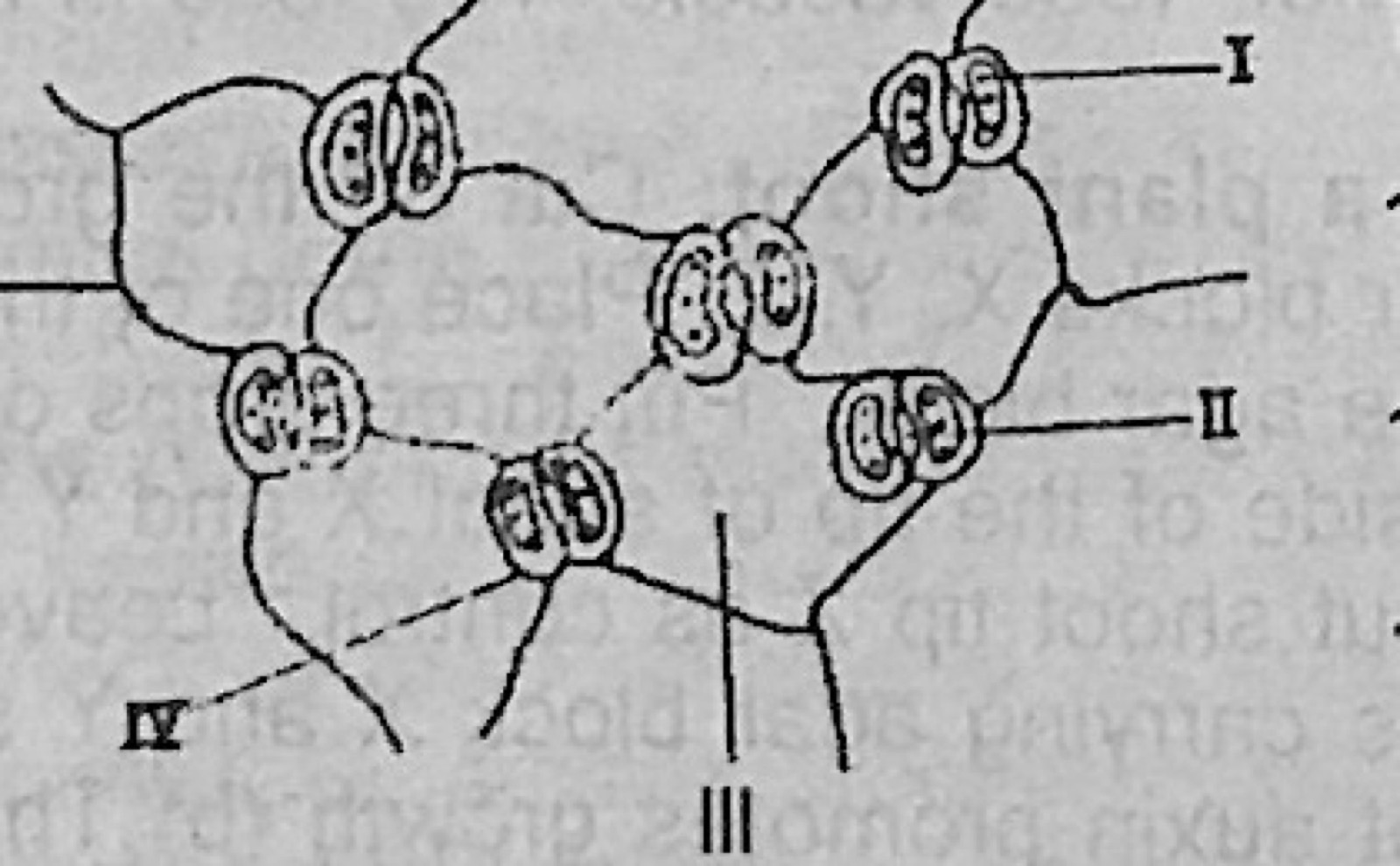
Question 13 Photosynthesis and Plant Nutrition Use the diagram below to answer questions 13 to 15
A. controlling water loss B. trapping solar energy C. absorbing water D. storing sugar E. transporting sugar Show the answer and explanation Answer: B (trapping solar energy )
Explanation I points to the chloroplasts in a guard cell, which trap light energy for photosynthesis.
Open this question
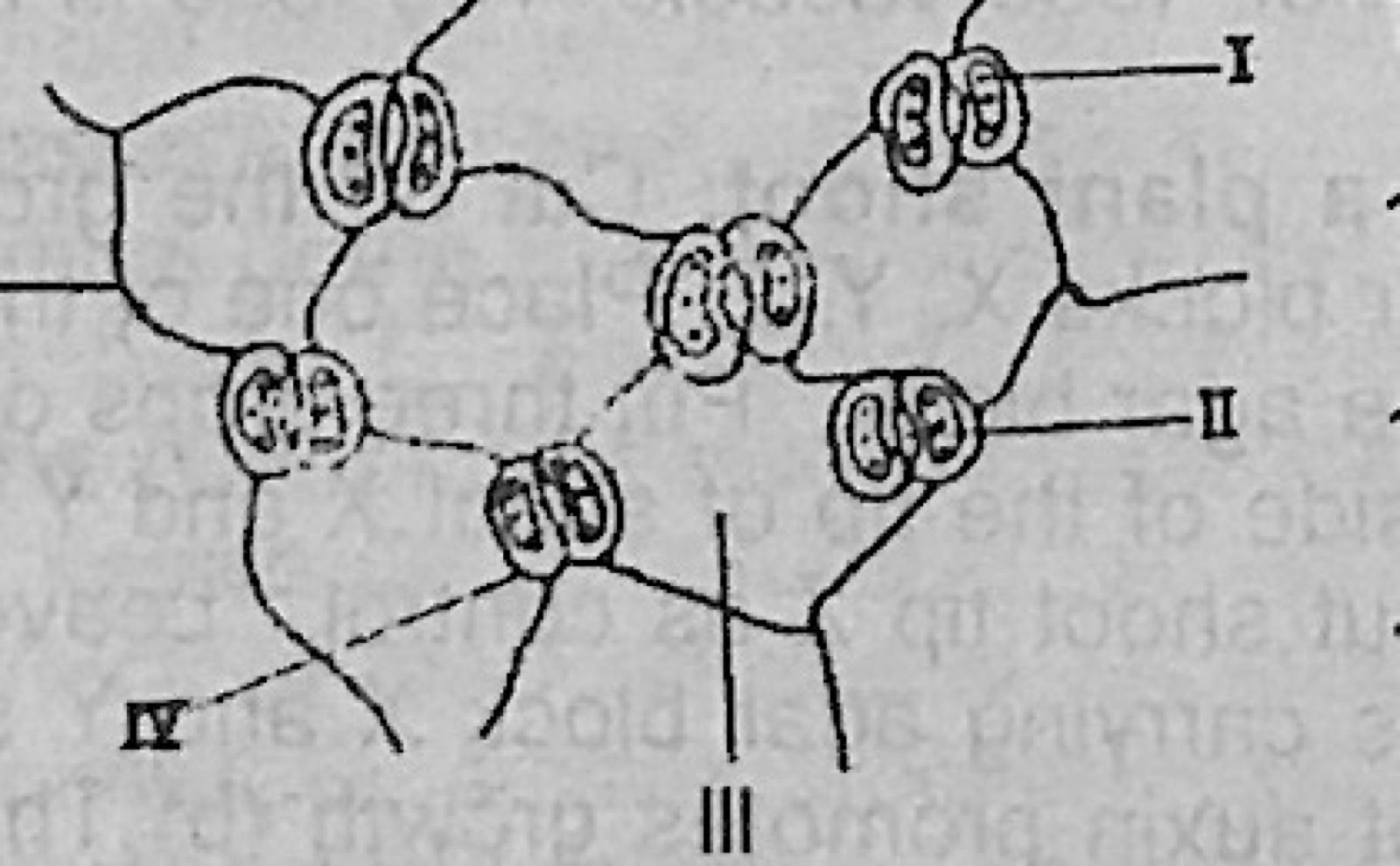
Question 14 Photosynthesis and Plant Nutrition Use the diagram (parts labelled I to IV, surface view of leaf epidermis with stomata) to answer this question.
A. stoma B. palisade cell C. spongy cell D. guard cell E. epidermal cell Show the answer and explanation Answer: A (stoma )
Explanation II points to the pore between a pair of guard cells: a stoma.
Open this question
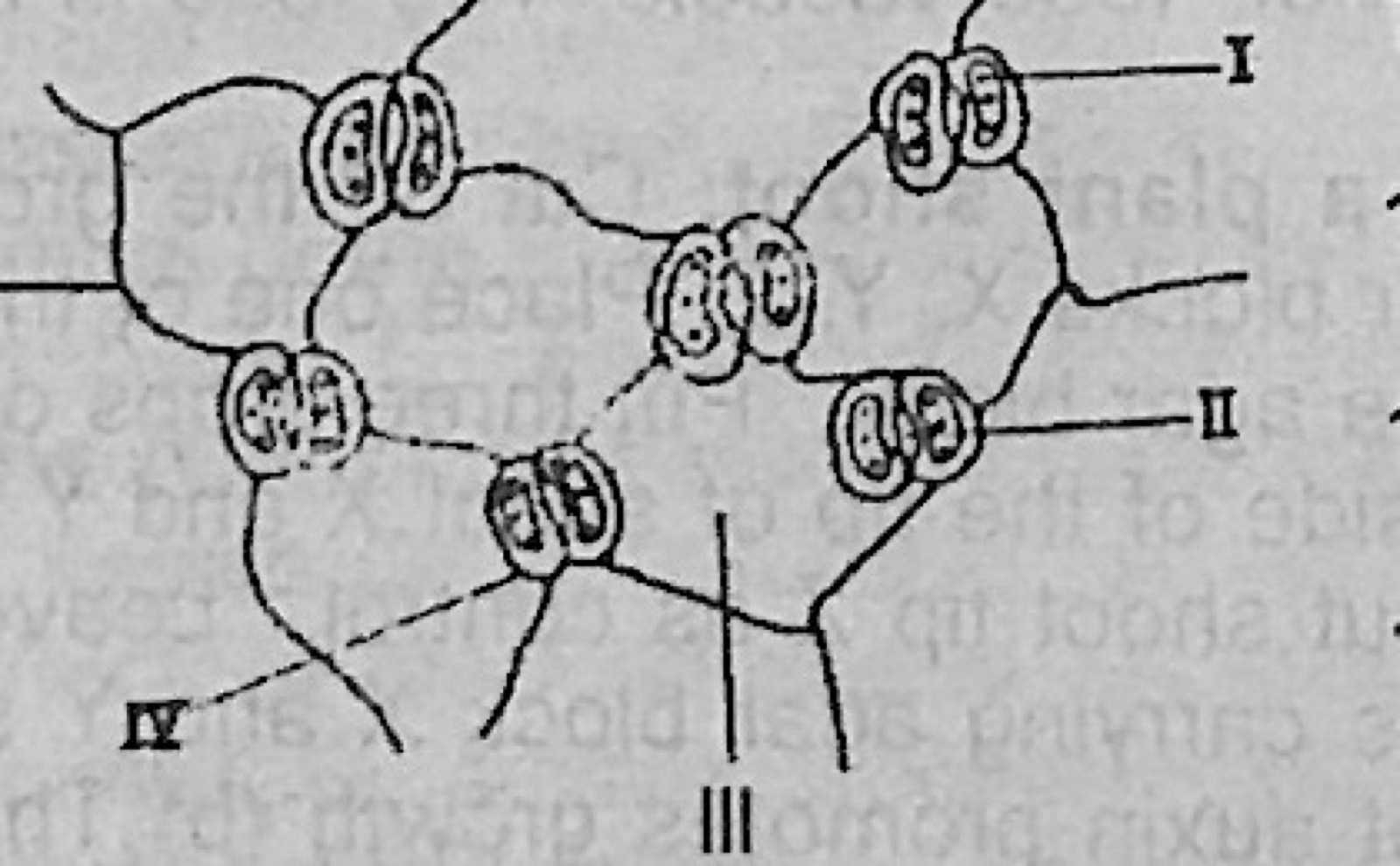
Question 15 Photosynthesis and Plant Nutrition Use the diagram (parts labelled I to IV, surface view of leaf epidermis with stomata) to answer this question.
A. I B. II C. III D. IV E. V Show the answer and explanation Answer: A (I )
Explanation Iodine turns starch blue-black; starch is formed in the chloroplasts (I) of the guard cells.
Open this question
Question 16 Respiration In the anaerobic stage of respiration, the net ATP molecules produced per glucose molecule is
A. one B. two C. three D. four E. five Show the answer and explanation Answer: B (two )
Explanation Glycolysis uses 2 ATP and makes 4, a net gain of 2 ATP per glucose.
Open this question
Question 17 Excretion Reabsorption of the metabolic products along the kidney tubules is made possible by the
A. closeness of the intestine to the kidney B. convoluted nature of the tubules C. presence of convoluted tubules in the medulla D. presence of network of capillaries around the convoluted tubules E. joining of the main collecting tubules to the kidney tubules Show the answer and explanation Answer: D (presence of network of capillaries around the convoluted tubules )
Explanation Useful substances pass from the tubules into the capillaries wrapped around them.
Open this question
Question 18 Hormonal Coordination Hormones are transported around the mammalian body by
A. water B. nerves C. blood D. osmosis E. diffusion Show the answer and explanation Answer: C (blood )
Explanation Endocrine glands release hormones into the blood, which carries them round the body.
Open this question
Question 19 Hormonal Coordination Which of the following is not a function of insulin?
A. Accelerates the rate at which glucose is converted to glycogen B. Promotes the uptake of glucose by tissues C. Regulates the amount of glucose in the blood D. Accelerates the absorption of glucose at the glomerulus E. Stimulates muscles to oxidise glucose Show the answer and explanation Answer: D (Accelerates the absorption of glucose at the glomerulus )
Explanation Insulin acts on liver, muscle and other body cells; glucose is reabsorbed in the kidney tubules, not at the glomerulus, and insulin does not control that.
Open this question
Question 20 Nervous Coordination Which of the following is the correct route of transmission of impulses along a reflex arc?
A. Receptor → sensory neurone → synapse → intermediate neurone → synapse → motor neurone → effector B. Receptor → motor neutron → synapse → intermediate neurone → synapse → sensory neurone→ effector C. Receptor → synapse → sensory neurone → intermediate neurone → synapse → effector → motor neurone D. Effector → motor neurone → synapse → sensory neurone → synapse → intermediate neurone → receptor E. Effector → intermediate neurone → synapse → motor neurone → synapse → sensory neurone → receptor Show the answer and explanation Answer: A (Receptor → sensory neurone → synapse → intermediate neurone → synapse → motor neurone → effector )
Explanation The impulse goes receptor → sensory neurone → relay neurone → motor neurone → effector, crossing synapses between neurones.
Open this question
Question 21 Sense Organs Which of the following statements is false?
A. Human sense of smell is easily fatigued B. The skin can perceive the sensations of touch, pain, pressure and temperature C. Taste buds and olfactory cells are active when wet as well as when dry D. Sensory nerve endings receive stimuli and send to the central nervous system E. Senses of smell and taste can be weakened by catarrh or blocked nose Show the answer and explanation Answer: C (Taste buds and olfactory cells are active when wet as well as when dry )
Explanation Taste and smell receptors detect only chemicals dissolved in moisture, so they do not work when dry.
Open this question
Question 22 Sense Organs The following are directly involved in transmission of sound waves to the brain except
A. eardrum B. auditory meatus C. auditory ossicles D. eustachian tube E. cochlea Show the answer and explanation Answer: D (eustachian tube )
Explanation Sound travels down the auditory meatus to the eardrum, ossicles and cochlea; the Eustachian tube only equalises air pressure.
Open this question
Question 23 Reproduction in Plants The term syncarpous is used to describe a flower when the carpels are
A. many and fused B. two only C. two and separate D. many and free E. lying at different parts of a flower Show the answer and explanation Answer: A (many and fused )
Explanation Syncarpous means the carpels are joined together.
Open this question
Question 24 Reproduction in Plants Which of the following structures are characteristics of insect pollinated flowers?
A. Dull coloured flowers with no nectar B. Very light, numerous, and pendulous stamen C. Brightly coloured petals, scent and nectar D. Flowers are usually small and inconspicuous E. Stigma are large, feathery and hang outside the flower Show the answer and explanation Answer: C (Brightly coloured petals, scent and nectar )
Explanation Bright petals, scent and nectar attract insects; the others are features of wind-pollinated flowers.
Open this question
Question 25 Population Ecology Which of the following statements is not correct?
A. Shortage of food may be caused by pestilence, rinderpest and neglect of farming B. Shortage of food may lead to competition, emigration, death and decline in the rate of reproduction C. Over-crowding may lead to scarcity of food D. Dispersal of seeds and fruits prevents over-crowding E. Territorial defence encourages food scarcity in a habitat Show the answer and explanation Answer: E (Territorial defence encourages food scarcity in a habitat )
Explanation Defending a territory spaces animals out and protects their food supply; it reduces food scarcity.
Open this question
Question 26 Reproduction in Plants Which of the following is an advantage of dispersal of fruits and seeds? It allows
A. fair distribution of source of food for animals B. growth in close association with parent plant C. even distribution of plants and reduction of intraspecific competition D. keen competition for food E. the seeds to evolve new species Show the answer and explanation Answer: C (even distribution of plants and reduction of intraspecific competition )
Explanation Dispersal spreads young plants away from the parent so they do not compete with it and each other.
Open this question
Question 27 Growth and Development The series of changes that occur in a seed by which the embryo develops into a seedling is known as
A. fertilization B. gametogenesis C. pollination D. germination E. regeneration Show the answer and explanation Answer: D (germination )
Explanation Germination is the growth of the embryo into a seedling.
Open this question
Question 28 Ecological Associations Which of the following organisms has a symbiotic relationship with green algae?
A. Amoeba B. Paramecium C. Hydra D. Euglena E. Chlamydomonas Show the answer and explanation Answer: C (Hydra )
Explanation Green Hydra has algae (Chlorella) living in its cells; the algae get shelter and Hydra gets food and oxygen.
Open this question
Question 29 Photosynthesis and Plant Nutrition At the end of photosynthesis, the green leaf is tested for starch and not glucose, because
A. the glucose is used up immediately to provide energy for the needs of the leaf B. the glucose formed is immediately converted to starch C. starch is stored only in leaves D. there are no chemicals for glucose test in leaves E. it is easy to test for starch Show the answer and explanation Answer: B (the glucose formed is immediately converted to starch )
Explanation Glucose made in the leaf is quickly turned into starch for storage, so starch is the product we can detect.
Open this question
Question 30 Photosynthesis and Plant Nutrition Which of the following equations is not associated with photosynthesis?
A. H2 O → H + OH B. C6 H12 O6 → 2C2 H5 OH + 2CO2 C. CO2 + [4H] → CH2 O + H2 O D. 4[OH] → 2H2 O + O2 E. 6CO2 + 6H2 O → C6 H12 O6 + 6O2 Show the answer and explanation Answer: B (C6 H12 O6 → 2C2 H5 OH + 2CO2 )
Explanation Breaking glucose into ethanol and carbon dioxide is fermentation (anaerobic respiration), not photosynthesis.
Open this question
Question 31 Nutrient Cycling Which of these processes removes carbon from the atmosphere?
A. Putrefaction of animals B. Burning of fuels C. Photosynthesis D. Volcanic eruption E. Respiration in plants Show the answer and explanation Answer: C (Photosynthesis )
Explanation Photosynthesis takes CO₂ out of the air; the others add it.
Open this question
Question 32 Photosynthesis and Plant Nutrition Which of the following conditions is not necessary for photosynthesis to occur in plants?
A. There must be light B. There must be xylem tissue used to conduct water C. There must be chlorophyll to trap radiant energy D. Carbondioxide must be present E. Water must be present Show the answer and explanation Answer: B (There must be xylem tissue used to conduct water )
Explanation Algae such as Spirogyra photosynthesise without any xylem; light, chlorophyll, CO₂ and water are the real needs.
Open this question
Question 33 Habitats and Biomes The distribution of organisms in a fresh - water habitat like a stream or pond is determined by the following except
A. rainfall B. temperature C. pH of soil D. light penetration E. tidal movements Show the answer and explanation Answer: E (tidal movements )
Explanation Tides happen in the sea, not in streams or ponds.
Open this question
Question 34 Habitats and Biomes Which of the following is characteristics of a swamp?
A. Vegetation with stratified arrangement B. Mesophytes with broad leaves C. The ground is flooded most of the time D. Predominance of climbing plants E. Many plants with fire resistant structures Show the answer and explanation Answer: C (The ground is flooded most of the time )
Explanation A swamp is land that is waterlogged or flooded most of the time.
Open this question
Question 35 Habitats and Biomes Very low annual rainfall, sparse vegetation, high day temperatures and cold nights are the characteristics of the biome known as
A. swamp B. tropical forest C. southern guinea savanna D. afro alpine E. desert Show the answer and explanation Answer: E (desert )
Explanation These are the conditions of a desert.
Open this question
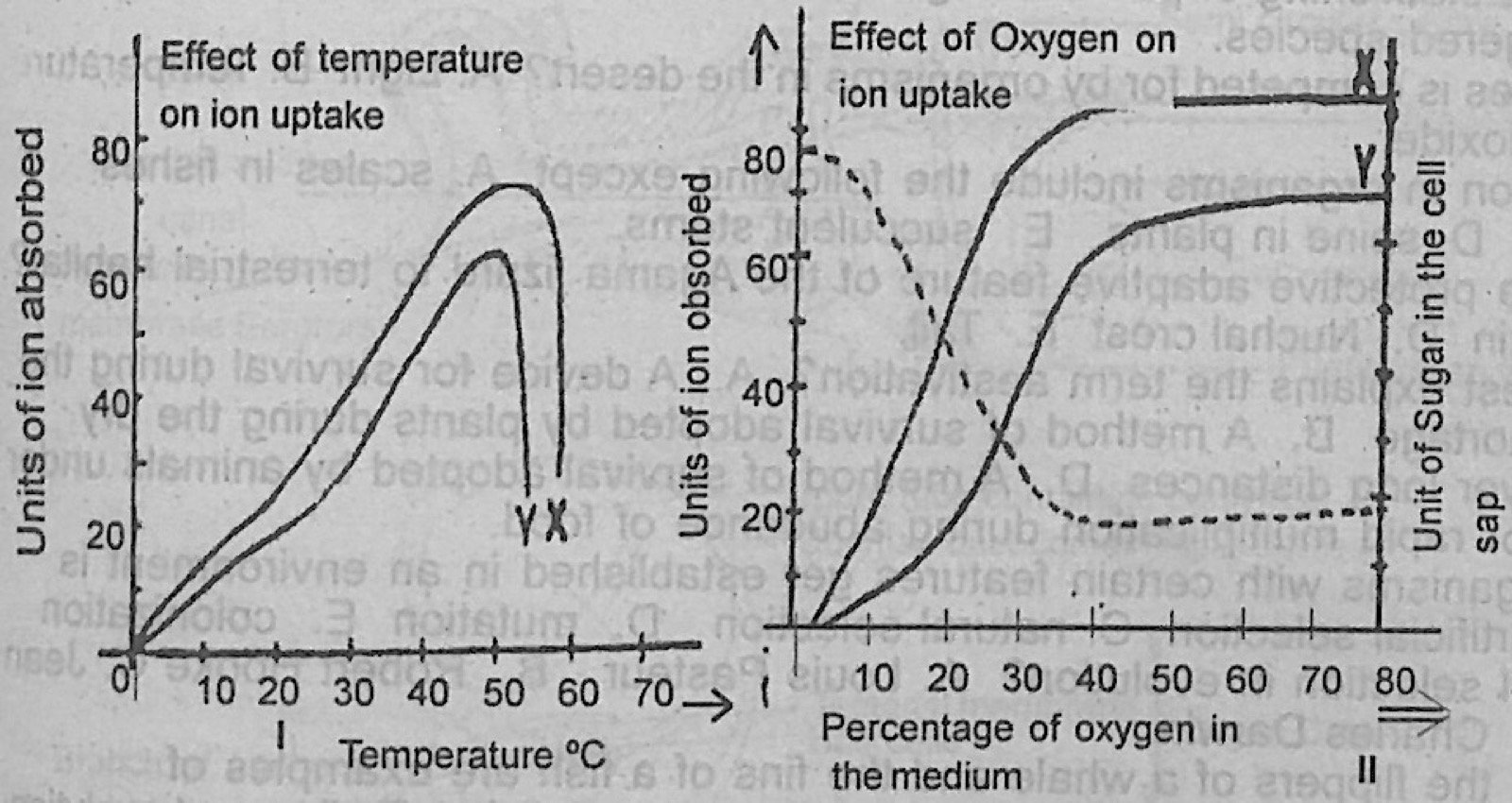
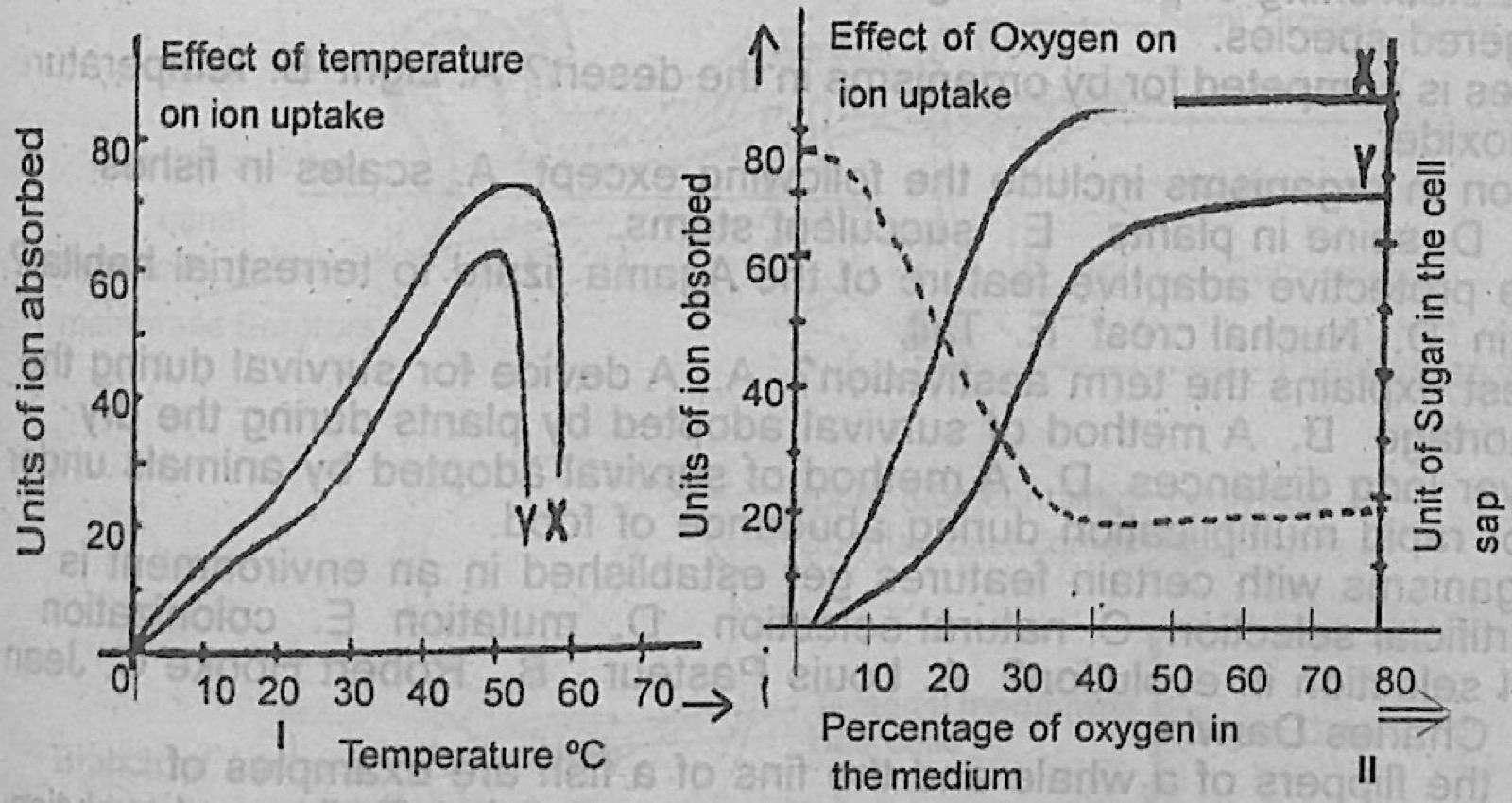
Question 36 Transport in Plants The graphs below show the results of experiments which investigated the effect of temperature and oxygen on the rate of uptake of certain ions labelled X and Y by a plant root. Use them to answer questions 36 and 37
A. Ion is taken up more rapidly at suitable temperature B. Suitable oxygen concentration increases ion uptake C. Ion uptake requires energy from aerobic respiration of sugar D. Ion uptake occurs most rapidly in adequate supply of respiratory substrate E. The quantity of ions absorbed is inversely proportional to the quantity of carbohydrate (sugar) synthesised Show the answer and explanation Answer: E (The quantity of ions absorbed is inversely proportional to the quantity of carbohydrate (sugar) synthesised )
Explanation The graphs link ion uptake to temperature, oxygen and sugar used in respiration; they show nothing about sugar being synthesised.
Open this question
Question 37 Transport in Plants The graphs show the results of experiments which investigated the effect of temperature and oxygen on the rate of uptake of certain ions labelled X and Y by a plant root.
A. 0 – 10°C B. 15 – 20°C C. 30-40°C D. 45 – 50°C E. above 50°C Show the answer and explanation Answer: D (45 – 50°C )
Explanation Ion uptake rises to its highest at about 45–50 °C; above that it drops sharply as enzymes are destroyed.
Open this question
Question 38 Feeding Relationships and Energy Flow Which of the following is the correct chain for the organism found in an aquatic community?
A. Paramecium, Phytoplankton, Prawn, Waterflea, Tilapia, Shark B. Waterflea, Paramecium, Phytoplankton, Prawn, Tilapia, Shark C. Phytoplankton, Waterflea, Paramecium, Prawn, Shark, Tilapia D. Phytoplankton, Paramecium, Waterflea, Prawn, Tilapia, Shark E. Paramecium, Phytoplankton, Waterflea, Prawn, Shark, Tilapia Show the answer and explanation Answer: D (Phytoplankton, Paramecium, Waterflea, Prawn, Tilapia, Shark )
Explanation A food chain must start with the producer (phytoplankton) and end with the top predator (shark).
Open this question
Question 39 Feeding Relationships and Energy Flow In a food chain the position occupied by an organism is called
A. the trophic level B. energy level C. the feeding level D. the habitat level E. niche Show the answer and explanation Answer: A (the trophic level )
Explanation Each feeding position in a food chain is a trophic level.
Open this question
Question 40 Feeding Relationships and Energy Flow Which of these statements about food chain is not correct?
A. Animals in the chain are consumers B. A food chain usually begins with a green plant C. All organisms in a food chain are animals D. Living things are dependent on one another E. The food chain involves energy transfer in an ecosystem Show the answer and explanation Answer: C (All organisms in a food chain are animals )
Explanation Food chains begin with plants (producers), so not all members are animals.
Open this question
Question 41 Nutrient Cycling Which of these is not applicable to the circulation of water in nature?
A. Water removed from oceans are permanently lost B. Water constantly evaporates from the seas, rivers, lakes and soil C. Water vapour rises, cools, condenses and precipitates as rain and dew D. Water is absorbed by plants and animals from their external environment E. Plants lose water by transpiration and decay Show the answer and explanation Answer: A (Water removed from oceans are permanently lost )
Explanation Water evaporated from the oceans returns as rain; it is never permanently lost.
Open this question
Question 42 Ecological Associations An association between two organisms in which both benefit is called
A. parasitism B. commensalism C. symbiosis D. predation E. competition Show the answer and explanation Answer: C (symbiosis )
Explanation Symbiosis (mutualism) benefits both partners.
Open this question
Question 43 Population Ecology Which of the following is not an outcome of ecological succession?
A. There is a progressive change in species structure, organic matter and energy flow B. The climax stage consists of a comparatively long lasting species composition C. There is no dynamic equilibrium between the community and habitat in the climax stage D. Communities occurring later in the sequence of succession are more complex E. There are fewer dominant species in the late stages of succession Show the answer and explanation Answer: C (There is no dynamic equilibrium between the community and habitat in the climax stage )
Explanation At the climax the community is in dynamic equilibrium with its habitat, so C is not an outcome.
Open this question
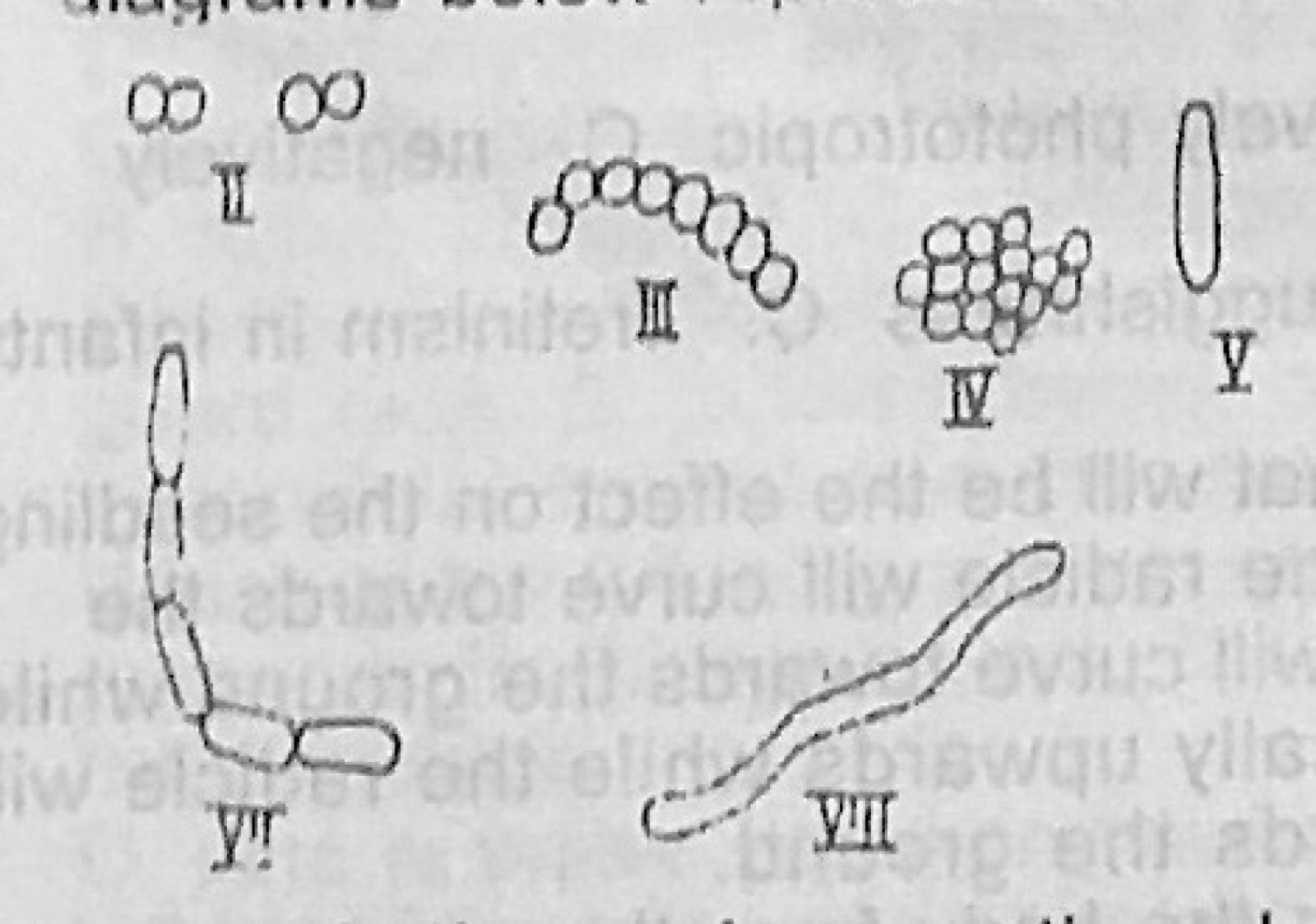
Question 45 Viruses, Monera, Protista and Fungi The diagrams below represent the shape of major groups of bacteria. Use them to answer question 45
A. I and II B. II and IV C. III and VII D. IV and VII E. IV and VIII Show the answer and explanation Answer: D (IV and VII )
Explanation Staphylococci are round cells in a bunch (IV); streptobacilli are rods in a chain.
Open this question
Question 46 Soil Prevention of erosion could best be carried out by
A. crop rotation and mulching B. contouring of slopping ground and afforestation C. grazing terracing and shifting cultivation D. strip cropping and poaching E. bush fallowing and crop rotation Show the answer and explanation Answer: B (contouring of slopping ground and afforestation )
Explanation Contours slow water running downhill and trees hold the soil with their roots.
Open this question
Question 47 Conservation of Natural Resources The following are useful measures for conserving forest except
A. preventing and controlling accidental forest fire B. encouraging the use of charcoal for industrial and domestic purposes C. combating and preventing plant diseases D. reafforestation of depleted forest E. protection of young growing trees Show the answer and explanation Answer: B (encouraging the use of charcoal for industrial and domestic purposes )
Explanation Making charcoal means cutting down more trees.
Open this question
Question 48 Soil The following practices are aimed at soil conservation except
A. contour ridging B. application of manures C. strip cropping D. bush clearing E. crop rotation Show the answer and explanation Answer: D (bush clearing )
Explanation Clearing the bush exposes soil to erosion.
Open this question
Question 49 Conservation of Natural Resources Which of the following natural resources is most readily available to all organisms?
A. Water B. Oil C. Food D. Air E. Mineral salts Show the answer and explanation Answer: D (Air )
Explanation Air surrounds all land organisms and is dissolved in water for aquatic ones.
Open this question
Question 50 Variation Which of the following is an example of discontinuous variation?
A. Height B. Size of head C. Blood group D. Skin colour E. Length of foot Show the answer and explanation Answer: C (Blood group )
Explanation Blood groups fall into distinct classes with no in-between forms.
Open this question
Question 51 Variation Hereditary variation is best described as
A. characters transmitted from generation to generation B. traits acquired from diseases C. characters that show up due to social conditions D. traits acquired from habits and environmental conditions E. characters that result from physical injuries Show the answer and explanation Answer: A (characters transmitted from generation to generation )
Explanation Hereditary variations are carried by genes and passed from parents to offspring.
Open this question
Question 54 Mendelian Inheritance Which of the following is a definition of heredity? It is the
A. non-resemblance of closely related organisms B. total absence of parental traits in offspring C. absence of variation in organisms D. transfer of characteristics from parents to offspring E. cause of infant mortality Show the answer and explanation Answer: D (transfer of characteristics from parents to offspring )
Explanation Heredity is the passing of characters from parents to offspring.
Open this question
Question 55 Variation Which of the following is not a reason why an offspring looks different from its parents?
A. Random reorganisation of chromosome during gamete formation B. Existence of multiple alleles in organisms C. Formation of chasmata in chromatids during meiosis D. Mutation which gives rise to new combination of gene E. Mitosis of the zygote produces new combination of chromosomes Show the answer and explanation Answer: E (Mitosis of the zygote produces new combination of chromosomes )
Explanation Mitosis makes exact copies of the zygote's chromosomes; it does not create new combinations.
Open this question
Question 56 Mendelian Inheritance The pair of genes expressed in a heterozygous individual is described as
A. allele B. chromatid C. dominant gene D. centrosome E. chromomere Show the answer and explanation Answer: C (dominant gene )
Explanation In a heterozygote the gene that shows itself is the dominant gene.
Open this question
Question 57 Adaptation The following structures are adaptation for water conservation except
A. sunken stomata B. scales in animals C. lenticels in stems D. spines in plants E. thick leaves Show the answer and explanation Answer: C (lenticels in stems )
Explanation Lenticels are pores for gas exchange and actually let water out; spines reduce water loss.
Open this question
Question 58 Ecosystem and Ecological Factors Which of the following ecological factors causes food shortage?
A. Low rate of reproduction B. Emigration C. Drought D. Topography E. wind direction Show the answer and explanation Answer: C (Drought )
Explanation Drought kills crops and pasture, causing food shortage.
Open this question
Question 59 Population Ecology Density, mortality rate, birth rate are the factors that affect
A. population B. dominance C. cover D. habitat E. abiotic community Show the answer and explanation Answer: A (population )
Explanation These are characteristics that determine the size of a population.
Open this question
Question 60 Excretion Ultra-filtration process at the Bowman's capsule is facilitated by
A. the volume of water in the blood B. the high concentration of urea in the blood of the Bowman's capsule C. the differential blood pressure between the glomerulus and the Bowman's capsule D. the differential blood volume between the glomerulus and the Bowman's capsule E. heavy weight of the urea, water, glucose and amino acids in the Bowman's capsule Show the answer and explanation Answer: C (the differential blood pressure between the glomerulus and the Bowman's capsule )
Explanation The afferent arteriole is wider than the efferent one, so blood pressure in the glomerulus is high and forces fluid into the capsule.
Open this question
Theory question 101 Animal Nutrition (a) Make a labelled diagram of the vertical section of the mammalian tooth
Show the model answer Model answer (a) Labels: crown, neck (gum line), root; enamel, dentine, pulp cavity with blood vessels and nerves, cement, gum, periodontal fibres, jaw bone, root canal
Explanation For the food test, state reagents, method and the positive result.
Open this question
Theory question 102 Feeding Relationships and Energy Flow (a) With reference to the food chain, explain the role of the following: (i) green plants (ii) herbivores (iii) carnivores (iv) decomposers.
Show the model answer Model answer (a)(i) Green plants: producers – make food by photosynthesis, trapping the sun's energy; first trophic level; food for all other organisms
Explanation Label every arrow in the carbon cycle diagram with its process.
Open this question
Theory question 103 Cell Division (a) What is a cell?
Show the model answer Model answer (a) A cell is the basic unit of structure and function of a living organism, consisting of protoplasm (nucleus and cytoplasm) surrounded by a membrane
Explanation Describe the stages of mitosis in their correct order.
Open this question
Theory question 104 Sense Organs (a) What is a sensory cell?
Show the model answer Model answer (a) A sensory cell (receptor) is a specialised cell that detects a particular stimulus and changes it into nerve impulses
Explanation In (d) mention both the pupil and the retina's sensitivity.
Open this question Sign up free for every WAEC Biology year, practice by topic and timed mocks.
Start practising free