Home › Past questions › WAEC › Biology › 1994 63 questions. Try each one, then open the answer to check yourself and read the explanation.
Sign up free to answer these questions on a CBT screen with a timer, then see your score and every answer explained.
Start practising free
Question 1 Feeding Relationships and Energy Flow All animals are dependent on green plants because plants
A. shelter them from excessive heat from the sun B. give them protection from enemies C. are used for building houses and furniture D. beautify their surroundings E. manufacture food for animals Show the answer and explanation Answer: E (manufacture food for animals )
Explanation Only green plants make food from simple substances; every animal depends on them, directly or indirectly, for food.
Open this question
Question 2 Cell Structure and Organisation The scientist who discovered the cell while examining a thin slice of cork under the microscope was
A. Robert Hooke B. Anton van Leeuwenhoek C. Matthias Schleiden D. Theodor Schwann E. Alexander Fleming Show the answer and explanation Answer: A (Robert Hooke )
Explanation Robert Hooke saw tiny compartments in cork and named them cells.
Open this question
Question 3 Transport in Plants The two important physical processes involved in the absorption and transport of materials in plants are
A. diffusion and plasmolysis B. cohesion and diffusion C. flacidity and turgidity D. osmosis and diffusion E. plasmolysis and capillarity Show the answer and explanation Answer: D (osmosis and diffusion )
Explanation Water enters root hairs by osmosis and many dissolved substances and gases move by diffusion.
Open this question
Question 4 Photosynthesis and Plant Nutrition The process by which plants manufacture food from carbondioxide and water, using energy from the sun is termed
A. chemosynthesis B. photosynthesis C. autotrophism D. heterotrophism E. transpiration Show the answer and explanation Answer: B (photosynthesis )
Explanation Photosynthesis uses light energy to make sugar from carbon dioxide and water.
Open this question
Question 5 Reproduction in Animals The process in which insects undergo conspicuous changes in form and appearance during development is known as
A. ecdysis B. metamorphosis C. aestivation D. migration E. hibernation Show the answer and explanation Answer: B (metamorphosis )
Explanation Metamorphosis is the change in body form during development, e.g. egg → larva → pupa → adult.
Open this question
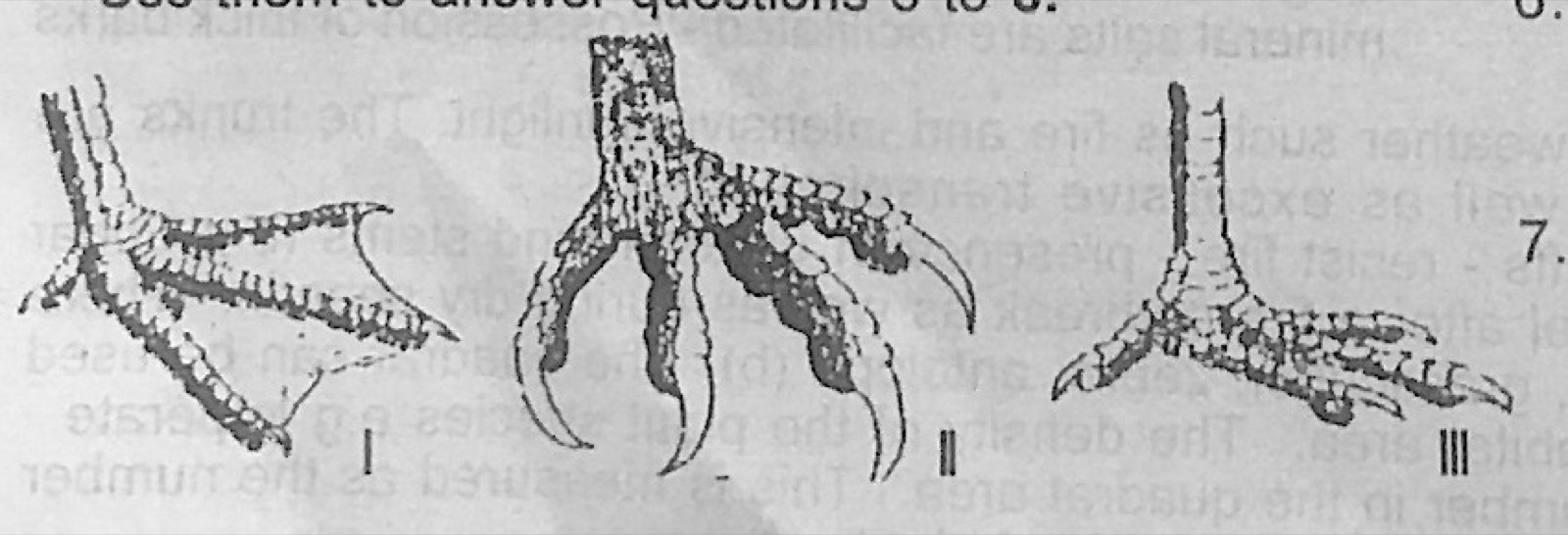
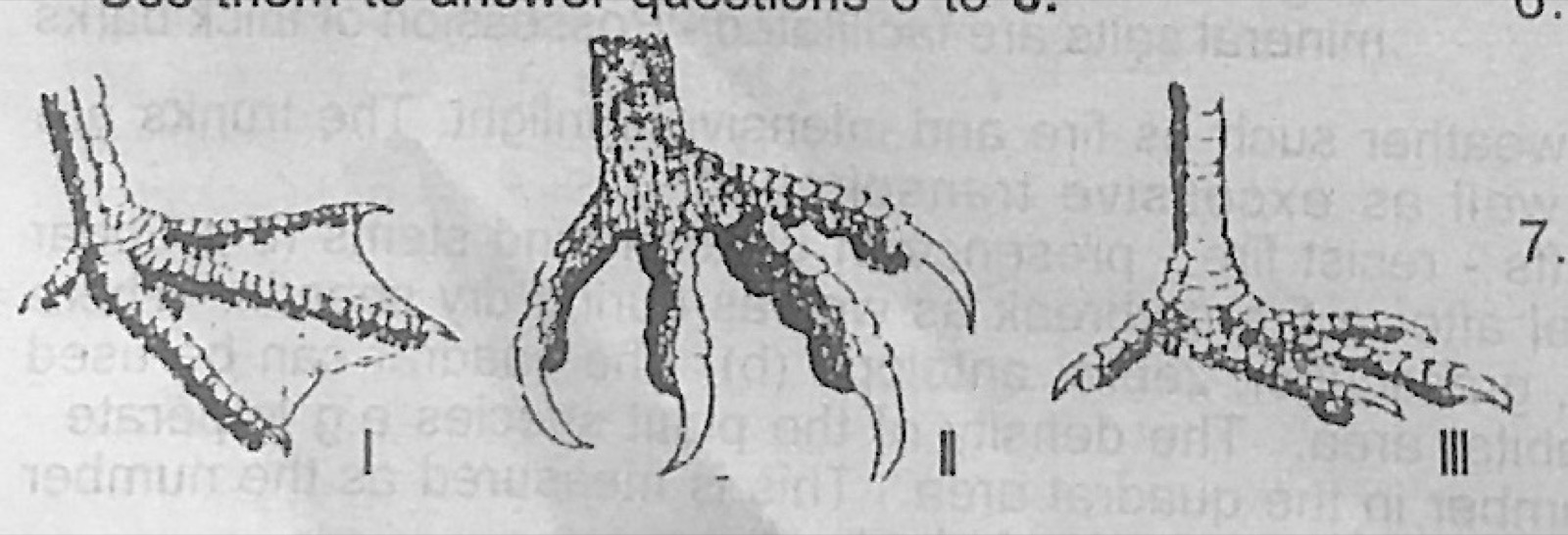
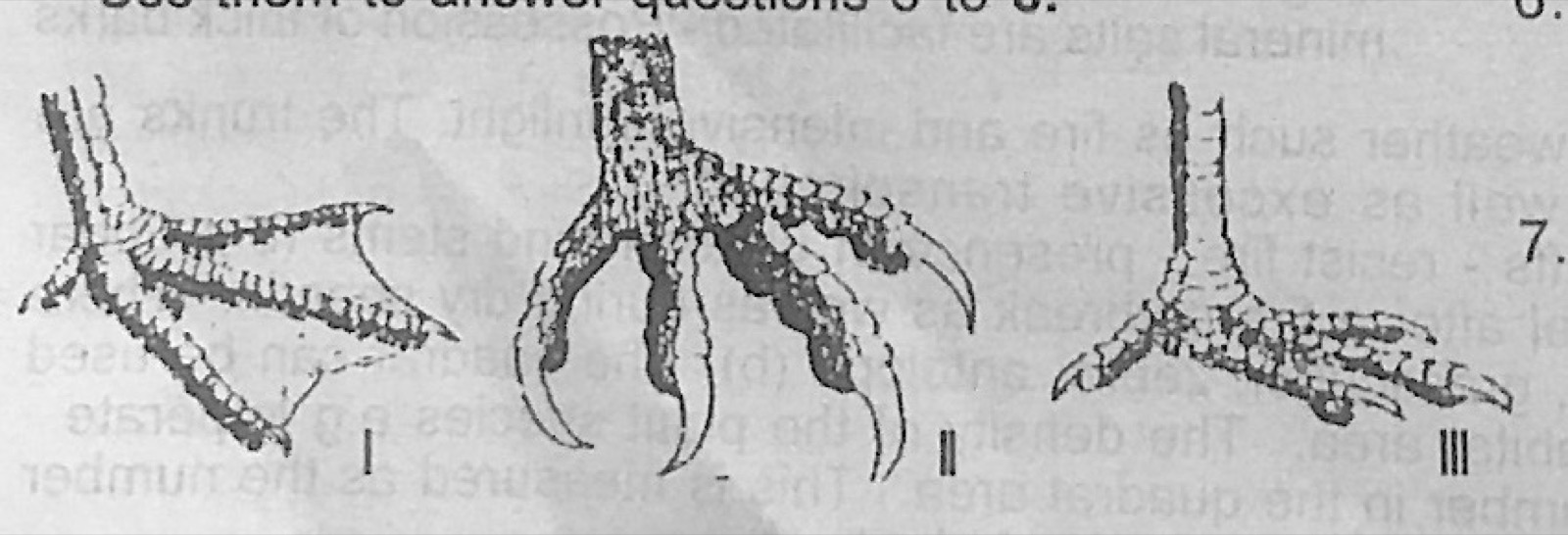
Question 6 Adaptation Diagrams I, II and III below illustrate the feet of birds adapted to various modes of feeding and movement. Use them to answer questions 6 to 8.
A. Feeding on flesh B. Eating grains C. Swimming in water D. Perching on trees E. Catching insects in flight Show the answer and explanation Answer: C (Swimming in water )
Explanation Foot I has a web of skin between the toes, which works like a paddle for swimming.
Open this question
Question 7 Adaptation Diagrams I, II and III illustrate the feet of birds adapted to various modes of feeding and movement.
A. is a scavenger B. is a bird of prey C. is a marine bird D. uses the foot to scratch the soil E. uses the foot to supplement wing action in flight Show the answer and explanation Answer: D (uses the foot to scratch the soil )
Explanation Strong feet with blunt claws suit scratching the ground for food, as a domestic fowl does.
Open this question
Question 8 Adaptation Diagrams I, II and III illustrate the feet of birds adapted to various modes of feeding and movement.
A. hold onto its prey B. paddle in water C. glide in the air D. scratch the earth for worms E. burrow into the soil Show the answer and explanation Answer: A (hold onto its prey )
Explanation Long, sharp, curved talons let birds of prey seize and hold their prey.
Open this question
Question 9 Microorganisms and Health Conventional method of sewage disposal involves all the following except defaecating
A. into pit latrines B. in open fields C. into cesspit D. into bucket latrine E. into water borne sewage system Show the answer and explanation Answer: B (in open fields )
Explanation Defaecating in open fields is not a proper method of sewage disposal and spreads disease.
Open this question
Question 10 Nervous Coordination Which of the following actions is not an example of a simple reflex action?
A. Knee jerk B. Blinking of the eye C. Withdrawal of hand from hot object D. Reading a book E. Contraction of the iris Show the answer and explanation Answer: D (Reading a book )
Explanation Reading is a voluntary, learned action controlled by the cerebrum; the others are automatic reflexes.
Open this question
Question 11 Cell Structure and Organisation In which of the following is a cellulose cell wall present?
A. Amoeba B. Mammalian white blood corpuscle C. Spirogyra D. Paramecium E. Parasitic worms Show the answer and explanation Answer: C (Spirogyra )
Explanation Spirogyra is a green alga (a plant), so its cells have cellulose walls.
Open this question
Question 12 Viruses, Monera, Protista and Fungi Which of the following organisms exists as a filament?
A. Euglena B. Amoeba C. Volvox D. paramecium E. Spirogyra Show the answer and explanation Answer: E (Spirogyra )
Explanation Spirogyra cells are joined end to end to form long filaments.
Open this question
Question 13 Nutrient Cycling All the following can illustrate the dynamic nature of the ecosystem except
A. nitrogen cycle B. carbon cycle C. water cycle D. nutrient cycle E. locomotion in organisms Show the answer and explanation Answer: E (locomotion in organisms )
Explanation Cycles show materials moving through the ecosystem; locomotion is an activity of single organisms.
Open this question
Question 14 Conservation of Natural Resources Which of the following mesaures does not ensure conservation?
A. Establishing forest and game reserves B. Encouraging people to plant ttrees C. Founding societies that promote conservation D. Enacting conservation laws and bye-laws E. Enclosing fishes in ponds where they will not be stolen Show the answer and explanation Answer: E (Enclosing fishes in ponds where they will not be stolen )
Explanation Keeping fish safe from thieves protects private property; it is not a way of conserving natural stocks.
Open this question
Question 15 Photosynthesis and Plant Nutrition Which of the following is not required for primary production to occur in plants?
A. Chlorophyll B. Sugar C. Water D. Carbon dioxide E. Solar energy Show the answer and explanation Answer: B (Sugar )
Explanation Sugar is the product of photosynthesis, not something needed for it.
Open this question
Question 16 Transport in Animals Which of the following blood group(s) is/are the universal donor(s)?
A. O B. A C. B D. AB E. AB and O Show the answer and explanation Answer: A (O )
Explanation Group O red cells have no A or B antigens, so they can be given to people of any group.
Open this question
Question 17 Mendelian Inheritance The branch of science which deals with resemblances, origin and expression of biological variations is called
A. embryology B. ecology C. entomology D. genetics E. taxonomy Show the answer and explanation Answer: D (genetics )
Explanation Genetics studies heredity and variation.
Open this question
Question 18 Conservation of Natural Resources Which of the following can cause desert encroachment?
A. Afforestation B. Irrigation C. Planting of trees D. Establishment of game reserve E. Overgrazing Show the answer and explanation Answer: E (Overgrazing )
Explanation Overgrazing strips the vegetation and exposes soil to wind erosion, so the desert spreads.
Open this question
Question 19 Adaptation The morphological, physiological and behavioural characteristics which enable an organism to survive in its environment is called
A. heredity B. ecology C. competiton D. adaptation E. variation Show the answer and explanation Answer: D (adaptation )
Explanation Features that help an organism survive in its environment are adaptations.
Open this question
Question 20 Excretion Which of the following performs the same function as the contractile vacuole of a unicellular organism?
A. Kidney B. Alimentary canal C. Liver D. Pancreas E. Bladder Show the answer and explanation Answer: A (Kidney )
Explanation Both the kidney and the contractile vacuole control the water content of the body (osmoregulation).
Open this question
Question 21 Feeding Relationships and Energy Flow Which of the following represents the correct order in a possible food chain?
A. Crustacean → diatom → fish → man B. Fish → crustacean → man → diatom C. Man → fish → crustacean → diatom D. Diatom → crustacean → fish → man E. Man → diatom → fish → crustacean Show the answer and explanation Answer: D (Diatom → crustacean → fish → man )
Explanation The chain starts with the producer (diatom), eaten by a crustacean, eaten by fish, eaten by man.
Open this question
Question 22 Ecological Associations Which of the following relationships illustrates competition?
A. Cattle egret moving along with cattle B. Goats and cows grazing on a small grass lawn C. Mosses succeeding lichens in a rocky terrain D. Red mangrove swamp dying and replaced by white mangrove E. Forest trees, shrubs and grasses replacing white mangrove in a swamp Show the answer and explanation Answer: B (Goats and cows grazing on a small grass lawn )
Explanation Goats and cows both need the same limited grass, so they compete.
Open this question
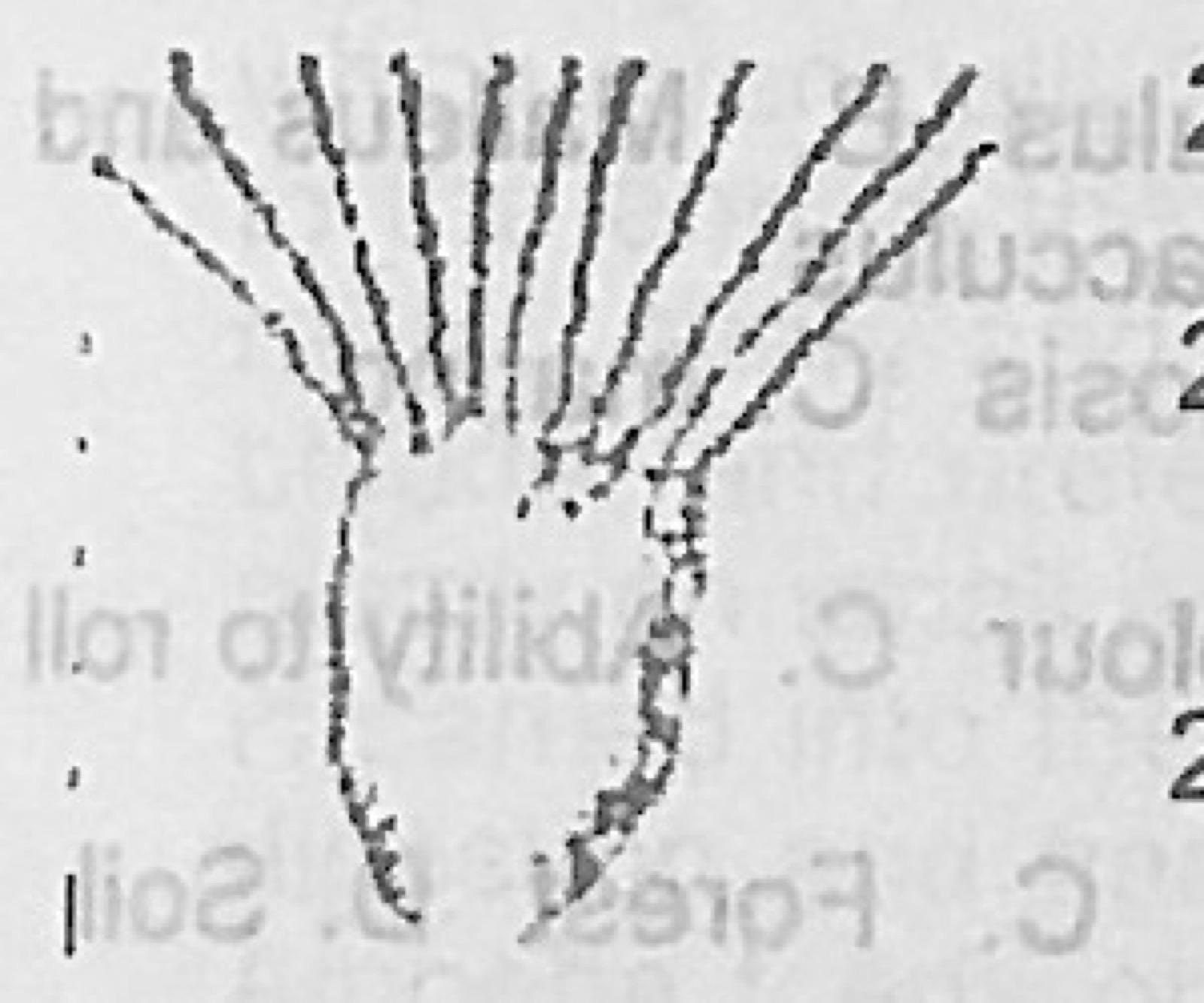
Question 23 Reproduction in Plants Use the diagram below to answer question 23
A. Man B. Water C. Wind D. Explosive mechanism E. Animal Show the answer and explanation Answer: C (Wind )
Explanation The seed carries a tuft of long hairs that acts as a parachute in the wind.
Open this question
Question 24 Sense Organs The structure used by fishes to detect the presence and movement of other animals by the vibration they produce is the
A. eye B. nostril C. lateral line D. scales E. fins Show the answer and explanation Answer: C (lateral line )
Explanation The lateral line has sense cells that detect vibrations and pressure changes in water.
Open this question
Question 25 Support and Movement Muscles are attached to bones by means of
A. ligament B. cartilage C. capillaries D. tendons E. arteries Show the answer and explanation Answer: D (tendons )
Explanation Tendons join muscles to bones.
Open this question
Question 26 Sense Organs The ability of the eye to alter the focal length of the lens, with regard to the distance of the object from the eye is known as
A. binocular vision B. nocturnal vision C. distortion D. accommodation E. focusing Show the answer and explanation Answer: D (accommodation )
Explanation Accommodation is the changing of the lens shape to focus near or far objects.
Open this question
Question 27 Reproduction in Plants What is the fate of the ovary of a flower after fertilization? It
A. becomes the seed B. withers away C. becomes the fruit D. develops more nuclei E. develops into sepals Show the answer and explanation Answer: C (becomes the fruit )
Explanation After fertilisation the ovary grows into the fruit and the ovules become seeds.
Open this question
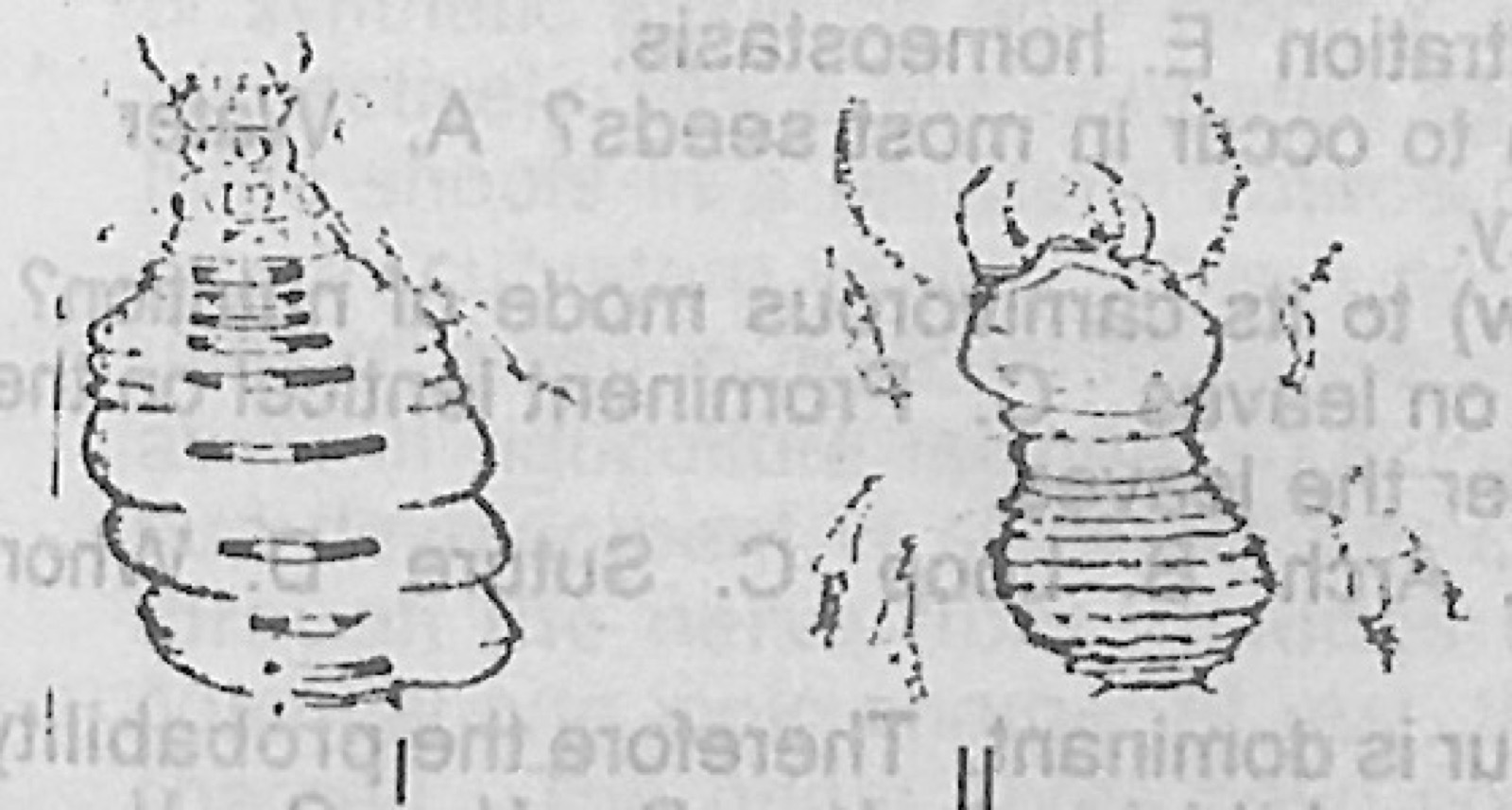
Question 28 Behaviour Use the diagrams below to answer questions 28 and 29
A. colonial B. parasitic C. soldier D. carnivorous E. symbiotic Show the answer and explanation Answer: A (colonial )
Explanation The drawings are termites (a queen with a swollen abdomen and another caste); termites live in colonies.
Open this question
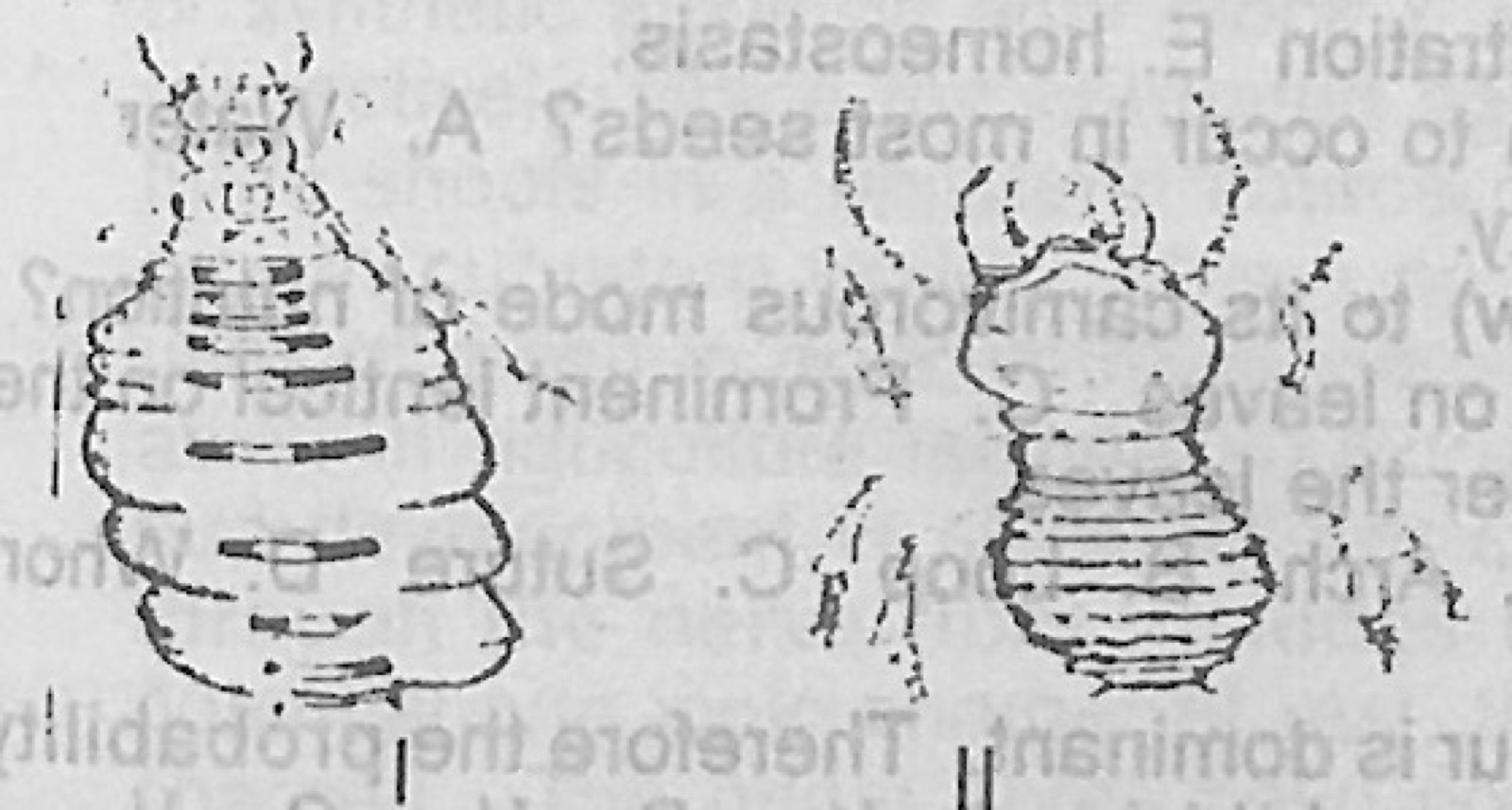
Question 29 Behaviour Use the diagrams of termites labelled I and II (questions 28 and 29).
A. worker B. soldier C. queen D. drone E. reproductive Show the answer and explanation Answer: A (worker )
Explanation II has a small rounded head without the huge jaws of a soldier, so it is a worker, which builds the nest and gathers food.
Open this question
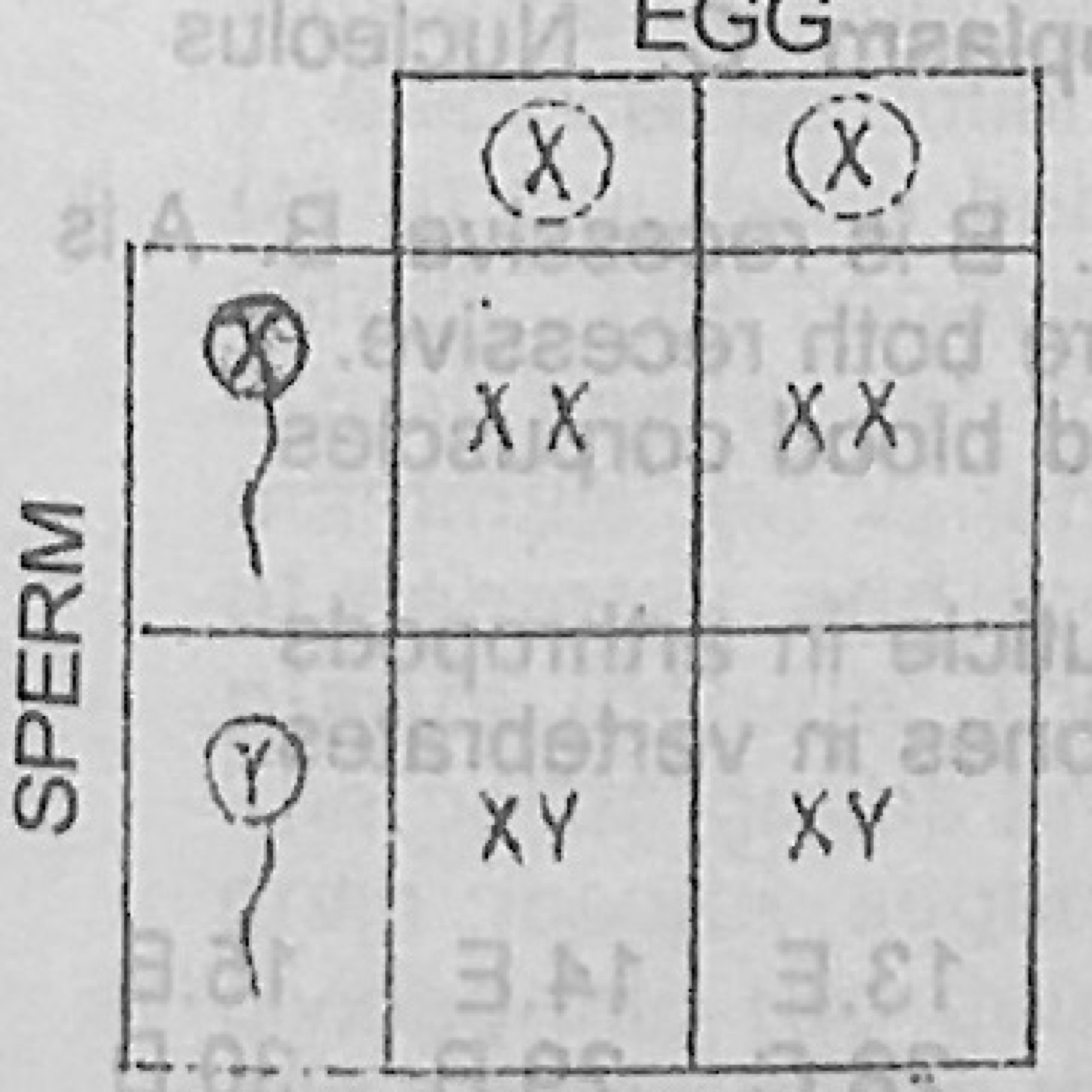
Question 30 Chromosomes, DNA and Sex Linkage The table below is a Punnett square for sex determination in man. Use it to answer questions 30 and 31
A. X B. Y C. XX D. XY E. YY Show the answer and explanation Answer: D (XY )
Explanation A male has one X and one Y chromosome.
Open this question
Question 31 Chromosomes, DNA and Sex Linkage The table below is a Punnett square for sex determination in man (egg: X, X; sperm: X, Y; offspring XX, XX, XY, XY).
A. 1/2 B. 1/4 C. 1/3 D. 1 E. 2/3 Show the answer and explanation Answer: A (1/2 )
Explanation Two of the four boxes are XY, so the chance of a boy is 2/4 = 1/2.
Open this question
Question 32 Support and Movement Which of these is not part of the appendicular skeleton?
A. Clavicle B. Vertebral column C. Scapula D. Femur E. Humerus Show the answer and explanation Answer: B (Vertebral column )
Explanation The vertebral column belongs to the axial skeleton.
Open this question
Question 33 Population Ecology Which of the following factors does not control population growth?
A. Food shortage B. Emigration C. Abundance of food D. Predation E. Natural disaster Show the answer and explanation Answer: C (Abundance of food )
Explanation Food shortage, emigration, predation and disasters all keep numbers down; plenty of food does not check growth.
Open this question
Question 34 Ecological Associations The following conditions form the basis of competition in a habitat except
A. food B. space C. reproductive mate D. light E. body structure Show the answer and explanation Answer: E (body structure )
Explanation Organisms compete for resources such as food, space, mates and light, not for body structure.
Open this question
Question 35 Sense Organs The part of the ear which equalises air pressure on either side of the eardrum is the
A. auditory meatus B. malleus C. eustachian tube D. oval window E. stapes Show the answer and explanation Answer: C (eustachian tube )
Explanation The Eustachian tube links the middle ear to the throat and balances the pressure.
Open this question
Question 36 Evolution Mutation leads to evolution in that it
A. gives rise to offspring which have the same characteristics as the parents B. Kills all organisms where it has occurred C. gives rise to new individuals which differ considerably from their parents D. always confers adaptability to the offspring E. does not confer adaptability to the offspring Show the answer and explanation Answer: C (gives rise to new individuals which differ considerably from their parents )
Explanation Mutations produce new characters; useful ones can spread by natural selection.
Open this question
Question 37 Excretion The process whereby poisonous compounds are made harmless in the liver is called
A. deamination B. glycolysis C. dehydration D. detoxification E. denitrification Show the answer and explanation Answer: D (detoxification )
Explanation Detoxification is making poisons harmless.
Open this question
Question 38 Photosynthesis and Plant Nutrition The deficiency of calcium in a plant may result in
A. stunted growth and poor root development B. poor growth, leaves become orange or brown C. stunted growth, slender stem and yellowing of leaves D. very small leaves and yellowing of leaves E. tall weedy and reddish leaves Show the answer and explanation Answer: A (stunted growth and poor root development )
Explanation Calcium is needed for cell walls and growing tips, so its lack gives stunted growth and poor roots.
Open this question
Question 39 Reproduction in Animals Which of the following is the least safe method of birth control? Using
A. spermicide creams B. contraceptive pills C. barriers such as condoms D. intrauterine device E. the withdrawal method Show the answer and explanation Answer: E (the withdrawal method )
Explanation Withdrawal often fails because some sperm may be released before withdrawal.
Open this question
Question 40 Conservation of Natural Resources Which of the following does not imply attempt at conservation?
A. Limit on the size of nets used in fishing B. Limit on the size of vessels to be used in fishing C. Prohibition of hunting or fishing at a certain season D. Prudent management of natural resources E. Refraining from the use of the natural resource Show the answer and explanation Answer: E (Refraining from the use of the natural resource )
Explanation Conservation means wise use, not refusing to use resources at all.
Open this question
Question 41 Evolution The gradual, cumulative, adaptive and heritable changes in an organism over a long period of time resulting in emergence of new species is known as
A. adaption B. survival C. regeneration D. variation E. organic evolution Show the answer and explanation Answer: E (organic evolution )
Explanation Organic evolution is the slow change of living things over generations, producing new species.
Open this question
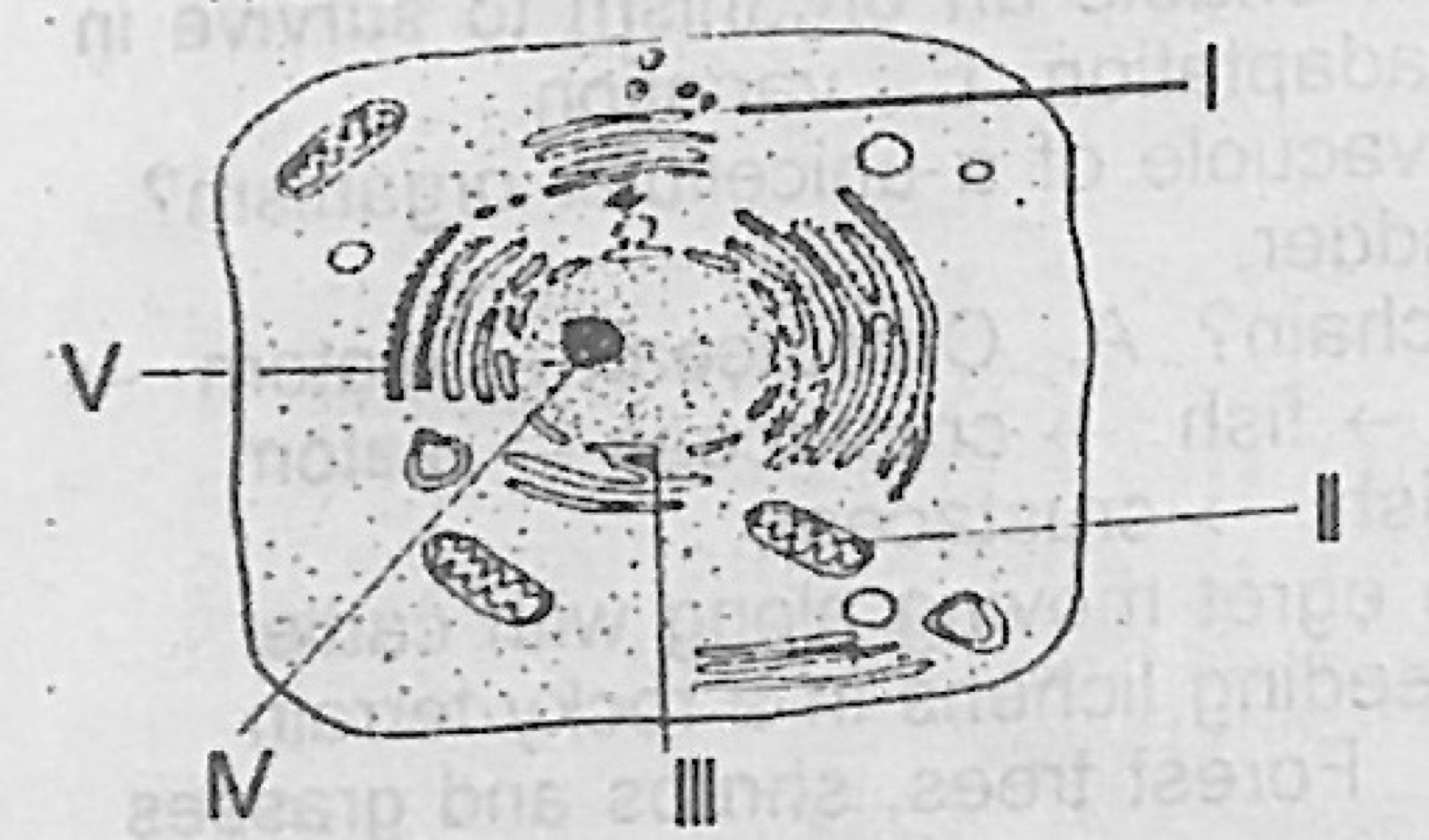
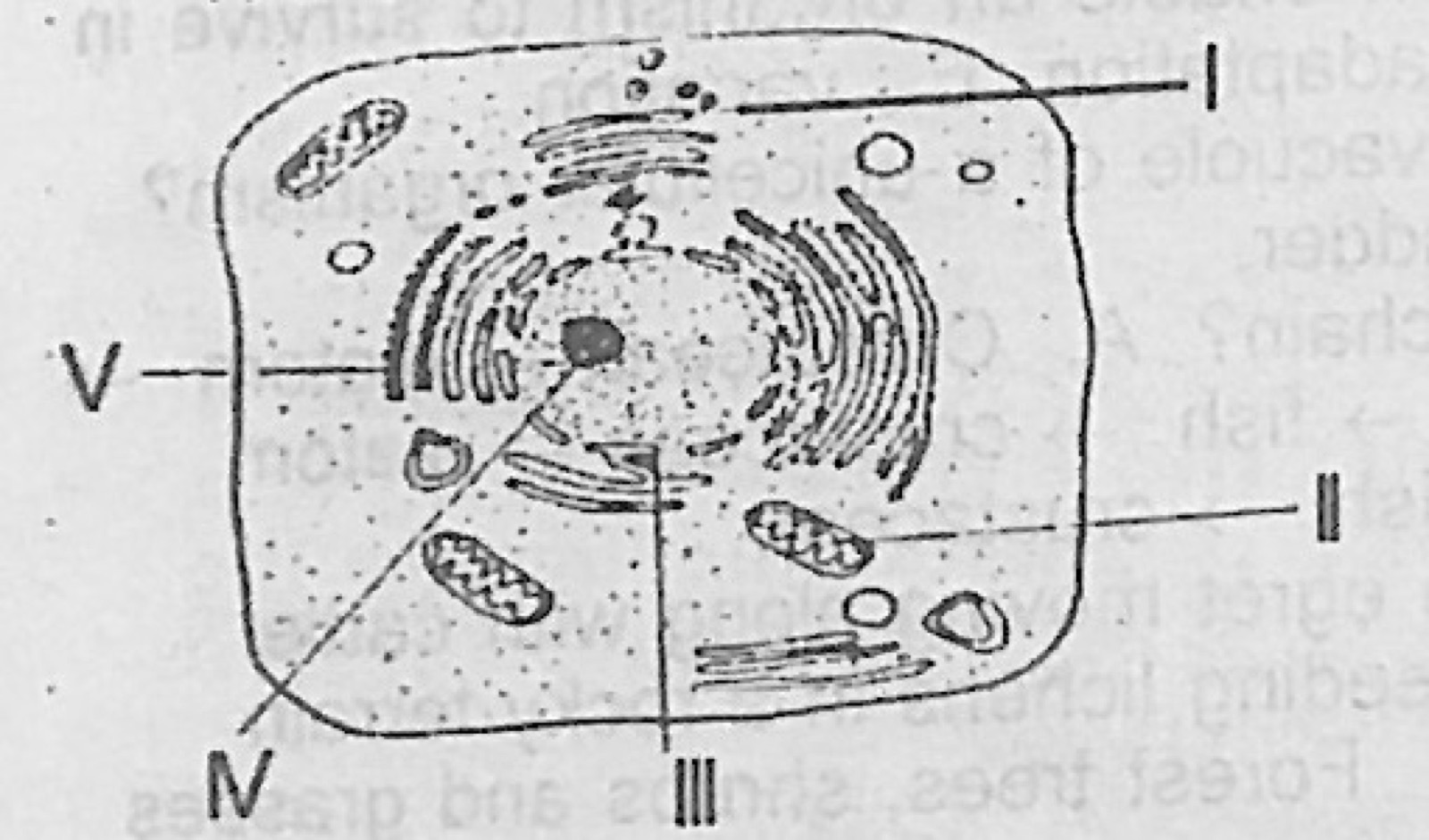
Question 42 Cell Structure and Organisation The diagram below illustrates the structure of a cell. Use it to answer questions 42 and 43
A. I B. II C. III D. IV E. V Show the answer and explanation Answer: B (II )
Explanation II is an oval body with folded inner membranes: a mitochondrion, where respiration releases energy.
Open this question
Question 43 Cell Structure and Organisation Use the diagram of a cell (parts labelled I to V).
A. mitochondrion B. ribosome C. nucleus D. centriole E. nucleolus Show the answer and explanation Answer: B (ribosome )
Explanation V points to the dark granules along the endoplasmic reticulum, which are ribosomes.
Open this question
Question 44 Respiration In which of the following organisms is the siphon found?
A. Tadpole B. Pupa of mosquito C. Tilapia D. Crayfish E. Butterfly Show the answer and explanation Answer: B (Pupa of mosquito )
Explanation Mosquito young hang from the water surface and breathe air through tubes (siphon in the larva, trumpets in the pupa).
Open this question
Question 45 Pollution Which of the following is not a pollution control measure?
A. Penalising those who dump refuse on water or land B. Controlling the emission of smoke from automobiles and industries C. Ensuring that there is no spillage of oil D. Establishing government agencies like Federal Environmental Protection Agency (FEPA) E. Channelling sewage into streams Show the answer and explanation Answer: E (Channelling sewage into streams )
Explanation Putting sewage into streams pollutes the water.
Open this question
Question 46 Sense Organs Which pair of structures contributes to balance in mammals?
A. Utriculus and Sacculus B. Malleus and Stapes C. Sacculus and cochlea D. Utriculus and pinna E. Fenestra ovalis and sacculus Show the answer and explanation Answer: A (Utriculus and Sacculus )
Explanation The utriculus and sacculus (with the semicircular canals) detect position and keep balance.
Open this question
Question 47 Reproduction in Animals Spermatogenesis and Oogenesis are both terms used to describe
A. mitosis B. meiosis C. mating D. implantation E. gametogenesis Show the answer and explanation Answer: E (gametogenesis )
Explanation Both mean the formation of gametes (sperm and eggs): gametogenesis.
Open this question
Question 48 Variation Which of the following is not a continuous variation?
A. Height of plants B. Skin colour C. Ability to roll tongue D. Length of fingers E. Leaf size Show the answer and explanation Answer: C (Ability to roll tongue )
Explanation You can either roll your tongue or not; there are no in-between values, so it is discontinuous.
Open this question
Question 49 Conservation of Natural Resources Which of the following is not a conservable natural resource?
A. Water B. Sunlight C. Forest D. Soil E. Minerals Show the answer and explanation Answer: B (Sunlight )
Explanation Sunlight cannot be stored or used up by man, so it is not conserved.
Open this question
Question 50 Microorganisms and Health Which of the following plant diseases is indicated when grains of cereals are covered with a mass of spores?
A. Smut B. Mosaic C. Maize streak D. Fungal blast E. Rust Show the answer and explanation Answer: A (Smut )
Explanation In smut disease the grains are replaced by black masses of fungal spores.
Open this question
Question 51 Homeostasis Which of the following structural features in animals does not affect control of body temperature?
A. Scales B. Skin C. Fur D. Capillaries E. Feathers Show the answer and explanation Answer: A (Scales )
Explanation Scales protect the body but do not help keep body temperature steady; fur, feathers, skin and capillaries do.
Open this question
Question 52 Homeostasis The control of water and salt requirements of the body in order to maintain a stable internal environment is known as
A. osmosis B. excretion C. plasmolysis D. ultrafiltration E. homeostasis Show the answer and explanation Answer: E (homeostasis )
Explanation Keeping the body's internal conditions, including water and salt, steady is homeostasis (here, osmoregulation).
Open this question
Question 53 Growth and Development Which of the following is not a condition necessary for germination to occur in most seeds?
A. Water B. Air C. Activation of enzymes D. Temperature E. Soil fertility Show the answer and explanation Answer: E (Soil fertility )
Explanation Seeds use stored food to germinate; water, air and warmth are needed, but not fertile soil.
Open this question
Question 54 Photosynthesis and Plant Nutrition Which of the following structural features adapts Drosera (Sundew) to its carnivorous mode of nutrition?
A. Long root with glandular hairs B. Club-shaped glandular hairs on leaves C. Prominent lenticel on the stem D. Broad leaves with long spines E. Wide stomata under the leaves Show the answer and explanation Answer: B (Club-shaped glandular hairs on leaves )
Explanation Sundew leaves have sticky club-shaped glandular hairs that trap and digest insects.
Open this question
Question 55 Variation Which of the following terms is not associated with finger prints?
A. Arch B. Loop C. Suture D. Whorl E. Compound Show the answer and explanation Answer: C (Suture )
Explanation Arch, loop, whorl and compound are fingerprint patterns; a suture is a skull joint.
Open this question
Question 56 Mendelian Inheritance In human beings the albino trait it recessive and the normal skin colour is dominant. Therefore the probability of parents that are heterozygous for albinism, having an albino child is
A. 1/4 B. 1/2 C. 1/3 D. 2/3 E. 1 Show the answer and explanation Answer: A (1/4 )
Explanation Aa × Aa gives AA, Aa, Aa, aa; only aa (1 in 4) is albino.
Open this question
Question 57 Chromosomes, DNA and Sex Linkage Which of the following is the carrier of hereditary materials?
A. Centriole B. Cytoplasm C. Nucleolus D. Chromosome E. Lysosome Show the answer and explanation Answer: D (Chromosome )
Explanation Chromosomes carry the genes.
Open this question
Question 58 Mendelian Inheritance Which of these statements is correct in the human ABO blood grouping system?
A. B is recessive B. A is dominant over B C. O is recessive D. O has antigene A and B E. A and B are both recessive Show the answer and explanation Answer: C (O is recessive )
Explanation O is recessive to both A and B (A and B are co-dominant with each other).
Open this question
Question 59 Microorganisms and Health In man, adult schistosoma is found in the
A. blood vessels of the bladder B. red blood corpuscles C. lymphatic vessel D. blood vessels of the lung E. white blood cells Show the answer and explanation Answer: A (blood vessels of the bladder )
Explanation Adult Schistosoma haematobium lives in the veins around the urinary bladder.
Open this question
Question 60 Support and Movement Which of the following structures does not function as support in animals?
A. Cuticle in arthropods B. Scales in birds C. Cartilage in mammals D. Body fluid in earthworms E. Bones in vertebrates Show the answer and explanation Answer: B (Scales in birds )
Explanation Scales on a bird's legs only protect; the others form skeletons (exo-, endo- or hydrostatic).
Open this question
Theory question 101 Habitats and Biomes (a) List three major zones in the marine habitat, stating one characteristic feature of each zone.
Show the model answer Model answer (a) Any three: splash (supralittoral) zone – above high tide, wetted only by spray; intertidal (littoral) zone – covered at high tide and exposed at low tide; neritic zone – shallow water over the continental shelf, well lit, rich in plankton; oceanic (pelagic) zone – open deep sea; benthic/abyssal zone – sea floor, dark and cold
Explanation For each zone give one feature that sets it apart from the others.
Open this question
Theory question 102 Animal Nutrition (a) Describe the general arrangement of the viscera of a named mammal
Show the model answer Model answer (a) Named mammal e.g. rabbit; body cavity divided by the diaphragm into thorax and abdomen
Explanation Name the mammal before describing its viscera.
Open this question
Theory question 104 Behaviour (a) (i) Explain the term courtship behaviour in animals (ii) How does courtship aid reproduction in animals
Show the model answer Model answer (a)(i) Courtship behaviour: the series of instinctive actions (display, songs, dances, colour changes, territorial defence, pairing) by which male and female of a species attract each other before mating
Explanation Describe the pollen tube's journey before the two fusions.
Open this question Sign up free for every WAEC Biology year, practice by topic and timed mocks.
Start practising free