Home › Past questions › WAEC › Biology › 1992 61 questions. Try each one, then open the answer to check yourself and read the explanation.
Sign up free to answer these questions on a CBT screen with a timer, then see your score and every answer explained.
Start practising free
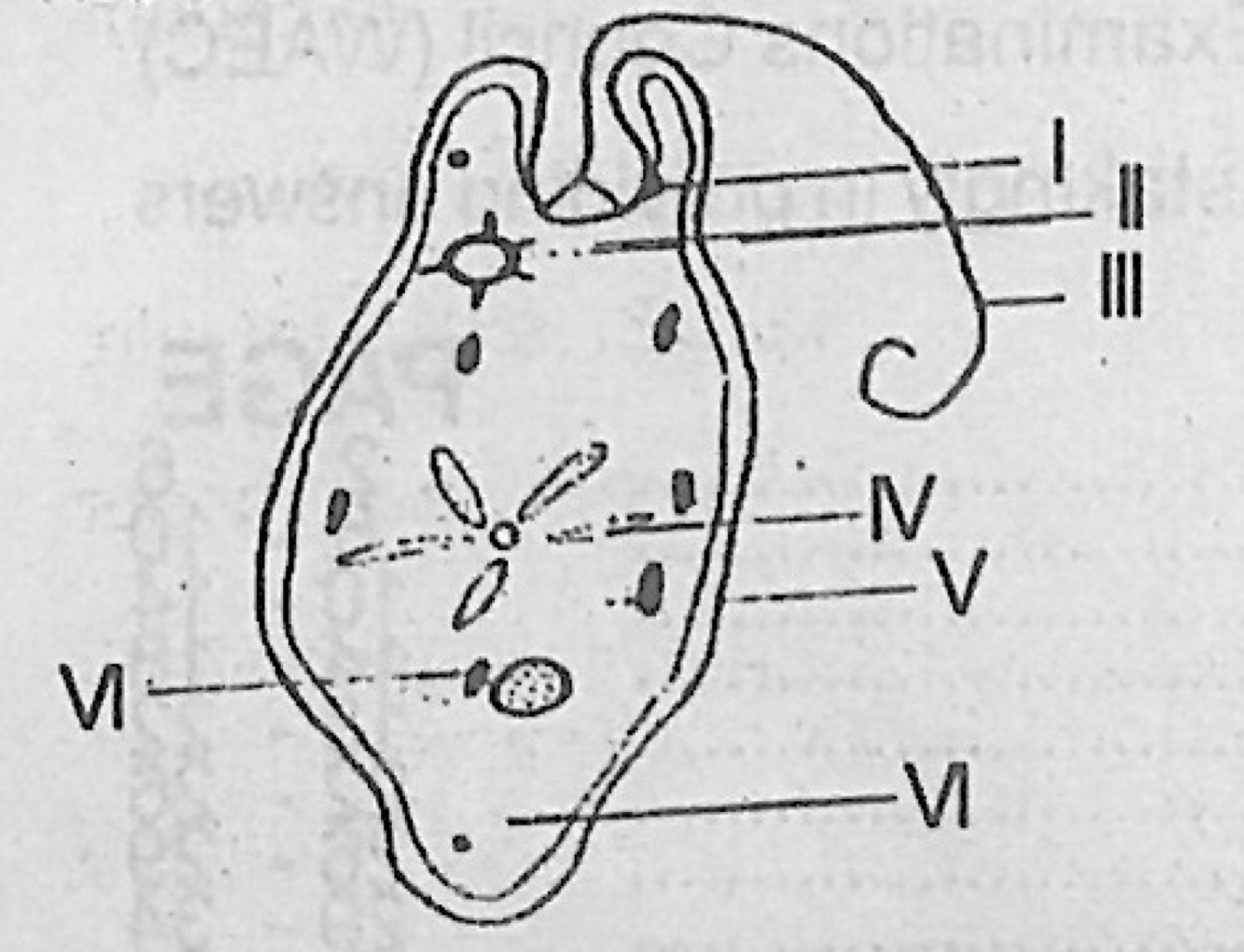
Question 1 Viruses, Monera, Protista and Fungi The diagram below illustrates the structure of Euglena. Use it to answer questions 1 to 3.
A. I B. II C. III D. IV E. V Show the answer and explanation Answer: B (II )
Explanation II is the contractile vacuole near the reservoir, which pumps out excess water.
Open this question
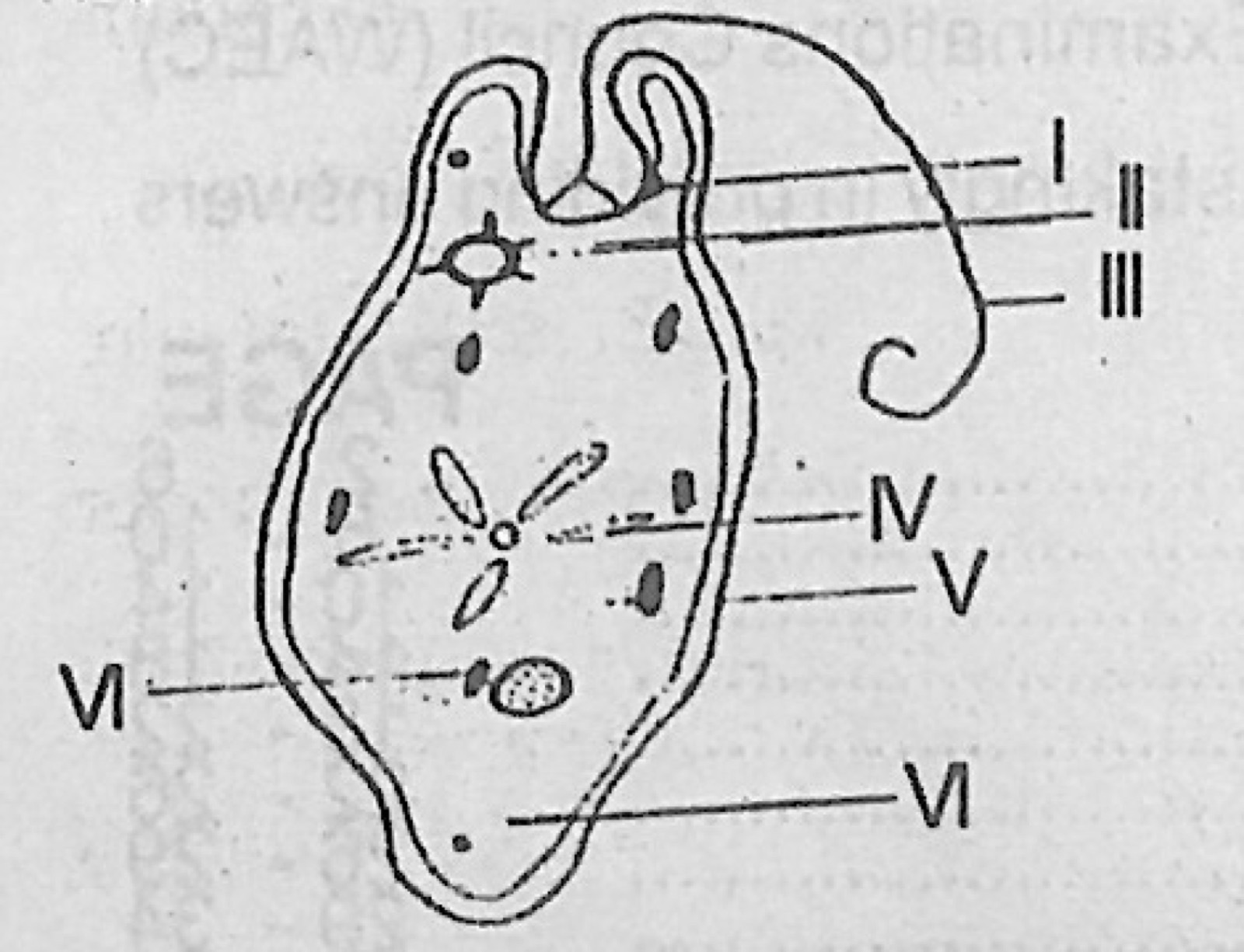
Question 2 Viruses, Monera, Protista and Fungi The diagram illustrates the structure of Euglena (parts labelled I to VI).
A. I B. III C. IV D. V E. VI Show the answer and explanation Answer: D (V )
Explanation Waste such as carbon dioxide and ammonia diffuses out through the body surface (pellicle/cell membrane), labelled V.
Open this question
Question 4 Cell Structure and Organisation Below is a list of the levels of organisation in organisms. Use it to answer questions 4 and 5
A. I, II, III, IV B. III, I, IV, II C. III, IV, I, II D. IV, III, I, II E. IV, I, II, III Show the answer and explanation Answer: B (III, I, IV, II )
Explanation Cells form tissues, tissues form organs and organs form systems: III, I, IV, II.
Open this question
Question 5 Viruses, Monera, Protista and Fungi Which of the following organelles is used for locomotion in Paramecium?
A. Pseudopodium B. Trichocyst C. Cilium D. Pellicle E. Contractile vacuole Show the answer and explanation Answer: C (Cilium )
Explanation Paramecium swims by beating its many cilia.
Open this question
Question 6 Cell Structure and Organisation Which of the following is not true of the nucleus of a living cell? It contains
A. chromosomes B. nucleolus C. nucleoplasm D. chromatids E. ribosomes Show the answer and explanation Answer: E (ribosomes )
Explanation The nucleus contains nucleoplasm, chromosomes (made of chromatids) and a nucleolus; ribosomes are found in the cytoplasm.
Open this question
Question 7 Cell Structure and Organisation The cell membrane consists of
A. carbohydrates and lipids B. vitamins and proteins C. lipids and proteins D. water and sugar E. starch and cellulose Show the answer and explanation Answer: C (lipids and proteins )
Explanation The cell membrane is made mainly of a double layer of lipids with proteins in it.
Open this question
Question 8 Cell Structure and Organisation Which of the following is not likely to be found in the cell of a ripe tomato fruit?
A. Plastids B. Chlorophyll C. Cellulose cell wall D. Mitochondrion E. Mineral salts Show the answer and explanation Answer: B (Chlorophyll )
Explanation When tomato ripens its chlorophyll breaks down and red pigment takes over.
Open this question
Question 9 Cell and Its Environment Osmosis can be defined as diffusion of
A. attoms and molecules thorugh a membrane to an area of higher concentration B. water molecules from a dilute solution to a concentrated solution across a permeable membrane C. water molecules from an area of high concentration to an area of low concentration D. water molecules from a dilute solution to a concentrated solution through a semi-permeable membrane E. perspiration and excretion Show the answer and explanation Answer: D (water molecules from a dilute solution to a concentrated solution through a semi-permeable membrane )
Explanation Osmosis is water moving from a dilute to a concentrated solution through a semi-permeable membrane.
Open this question
Question 11 Respiration In cellular respiration, energy is stored in the from of
A. adenosine diphosphate (ADP) B. adenosine monophosphate (AMP) C. adenosine triphosphate (ATP) D. heat energy E. electrical energy Show the answer and explanation Answer: C (adenosine triphosphate (ATP) )
Explanation Energy released in respiration is stored in ATP, which the cell uses when it needs energy.
Open this question
Question 12 Cell Division Which of the following processes is responsible for the increase in length and dry mass in a root tip?
A. Meiosis B. Absorption C. Mitosis D. Conjugation E. Fertilization Show the answer and explanation Answer: C (Mitosis )
Explanation Cells at the root tip divide by mitosis, making more cells, so the root grows.
Open this question
Question 13 Transport in Animals Which of the following explains the need for transport system in large mammals?
A. The area to volume ratio in large animals is high B. The area to volume ratio diminishes with large size C. Diffusion as an adquate means of transport is lacking D. Large animal have internal fluid which contains different types of cells E. Large animals have four-chambered heart Show the answer and explanation Answer: B (The area to volume ratio diminishes with large size )
Explanation Big animals have a small surface area compared with their volume, so diffusion alone is too slow; they need a transport system.
Open this question
Question 14 Transport in Animals Oxygenated blood from the lungs is carried to the left auricle of the heart through the
A. pulmonary vein B. pulmonary artery C. hepatic portal vein D. renal portal vein E. superior vena cava Show the answer and explanation Answer: A (pulmonary vein )
Explanation The pulmonary vein returns oxygenated blood from the lungs to the left auricle.
Open this question
Question 15 Transport in Animals Which of the following is not correct about blood platelets? They
A. are also known as thrombocytes B. have no nucleus C. are formed in the red bone marrow D. neutralize the toxins in the blood E. help in clotting of blood Show the answer and explanation Answer: D (neutralize the toxins in the blood )
Explanation Platelets help blood to clot; neutralising toxins is done by antibodies (antitoxins).
Open this question
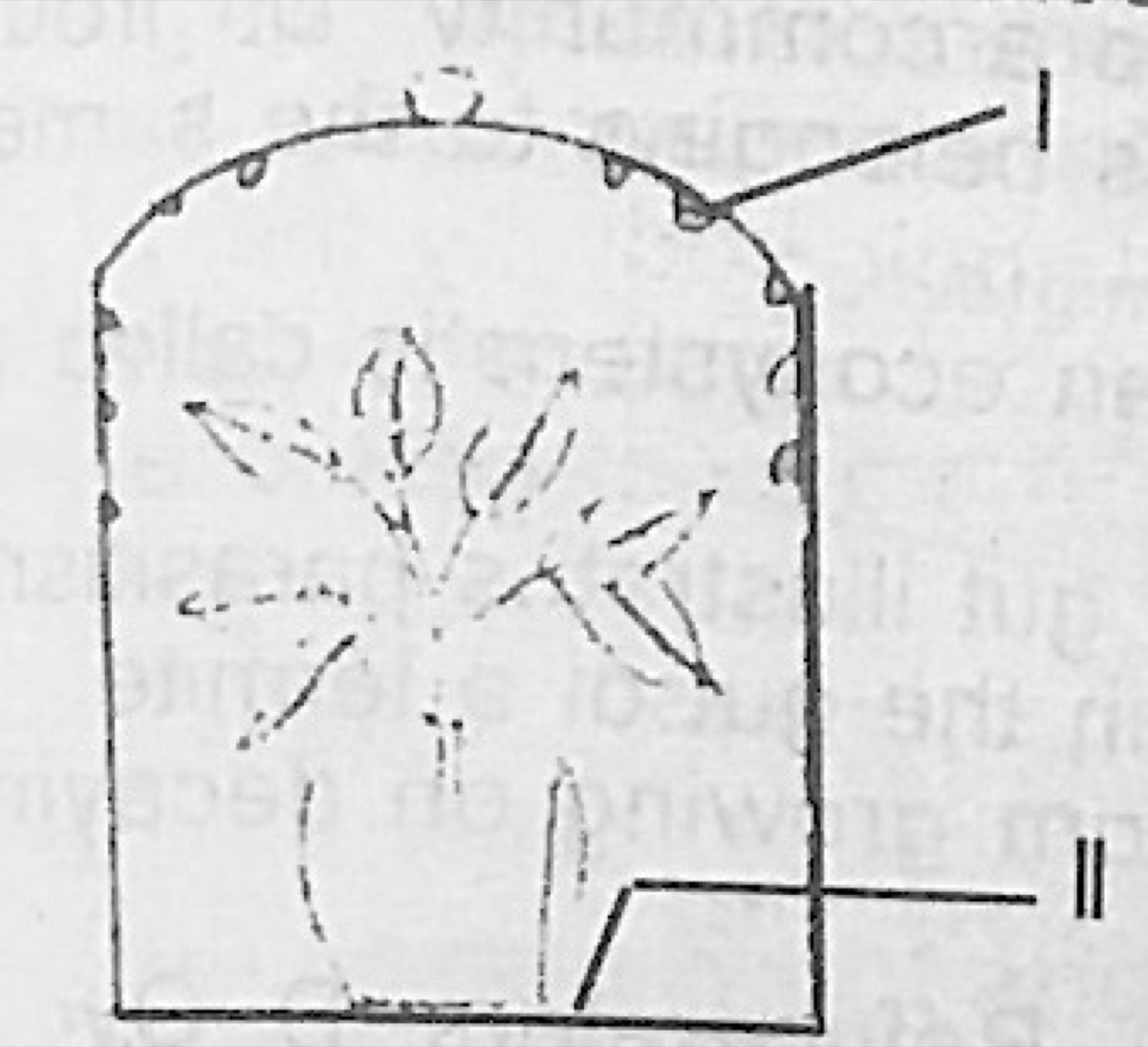
Question 16 Transport in Plants The diagram illustrates an experimental set-up. Use it to answer questions 16 and 17
A. a micro-organism B. a developing insect C. a water droplet D. an oil droplet E. a soil particle Show the answer and explanation Answer: C (a water droplet )
Explanation Water vapour transpired by the plant condenses into droplets on the inside of the bell jar.
Open this question
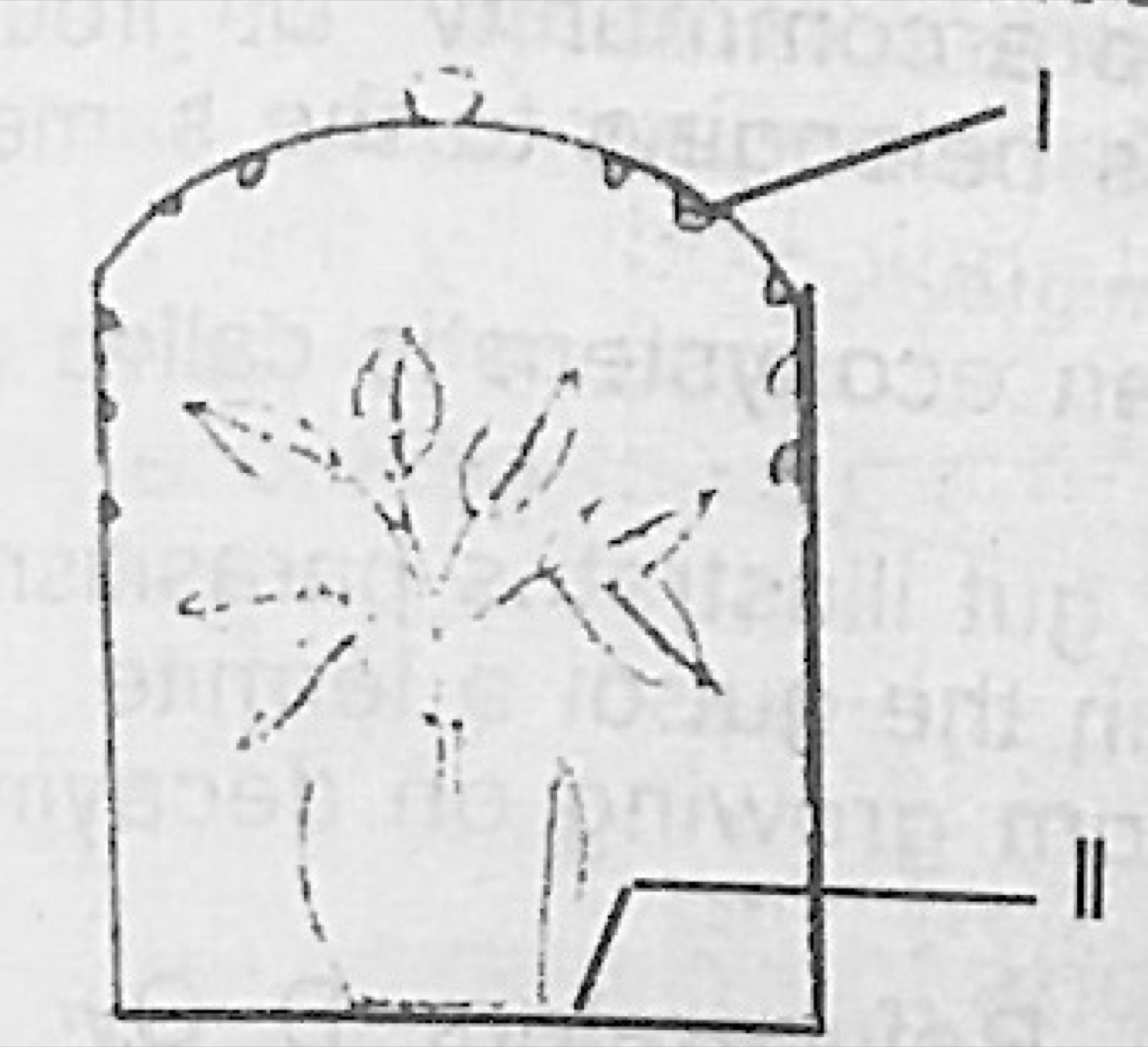
Question 17 Transport in Plants Use the diagram of the experimental set-up (a potted plant under a bell jar).
A. prevent the entry of insects into the soil B. prevent the entry of light into the soil C. prevent light from shining on the delicate roots D. prevent evaporation from the soil E. make the container air tight Show the answer and explanation Answer: D (prevent evaporation from the soil )
Explanation Covering the soil stops water evaporating from it, so any water collected must come from the leaves.
Open this question
Question 18 Transport in Plants Which of the following can be used to detect the loss of water vapour from the leaves of plants?
A. Hydrated copper sulphate B. Blue litmus paper C. Red litmus paper D. Blue cobalt chloride paper E. Lead acetate paper Show the answer and explanation Answer: D (Blue cobalt chloride paper )
Explanation Dry cobalt chloride paper turns from blue to pink when it absorbs water.
Open this question
Question 19 Transport in Animals The medium in which dissolved nutrients are transported in the body of vertebrates is called
A. latex B. urine C. cell sap D. blood E. haemoglobin Show the answer and explanation Answer: D (blood )
Explanation Blood plasma carries dissolved food around the vertebrate body.
Open this question
Question 20 Respiration Which of the following organisms and organs of gaseous exchange are not appropriately matched?
A. Earthworm body surface B. Fish - gills C. Adult toad-gills D. Grasshopper-trachea E. Lizard - lungs Show the answer and explanation Answer: C (Adult toad-gills )
Explanation Adult toads breathe with lungs, skin and mouth lining; only tadpoles have gills.
Open this question
Question 21 Photosynthesis and Plant Nutrition Which of the following structures of the leaf contains air?
A. Guard Cell B. Palisade layer C. Intercellular space D. Vascular bundle E. Upper epidermis Show the answer and explanation Answer: C (Intercellular space )
Explanation Air fills the intercellular spaces of the spongy mesophyll, linked to the stomata.
Open this question
Question 22 Respiration Which of the following organs is specially adapted for gaseous exchange in aquatic organisms?
A. Lung B. Trachea C. Gills D. Tracheoles E. Alveoli Show the answer and explanation Answer: C (Gills )
Explanation Gills take dissolved oxygen from water.
Open this question
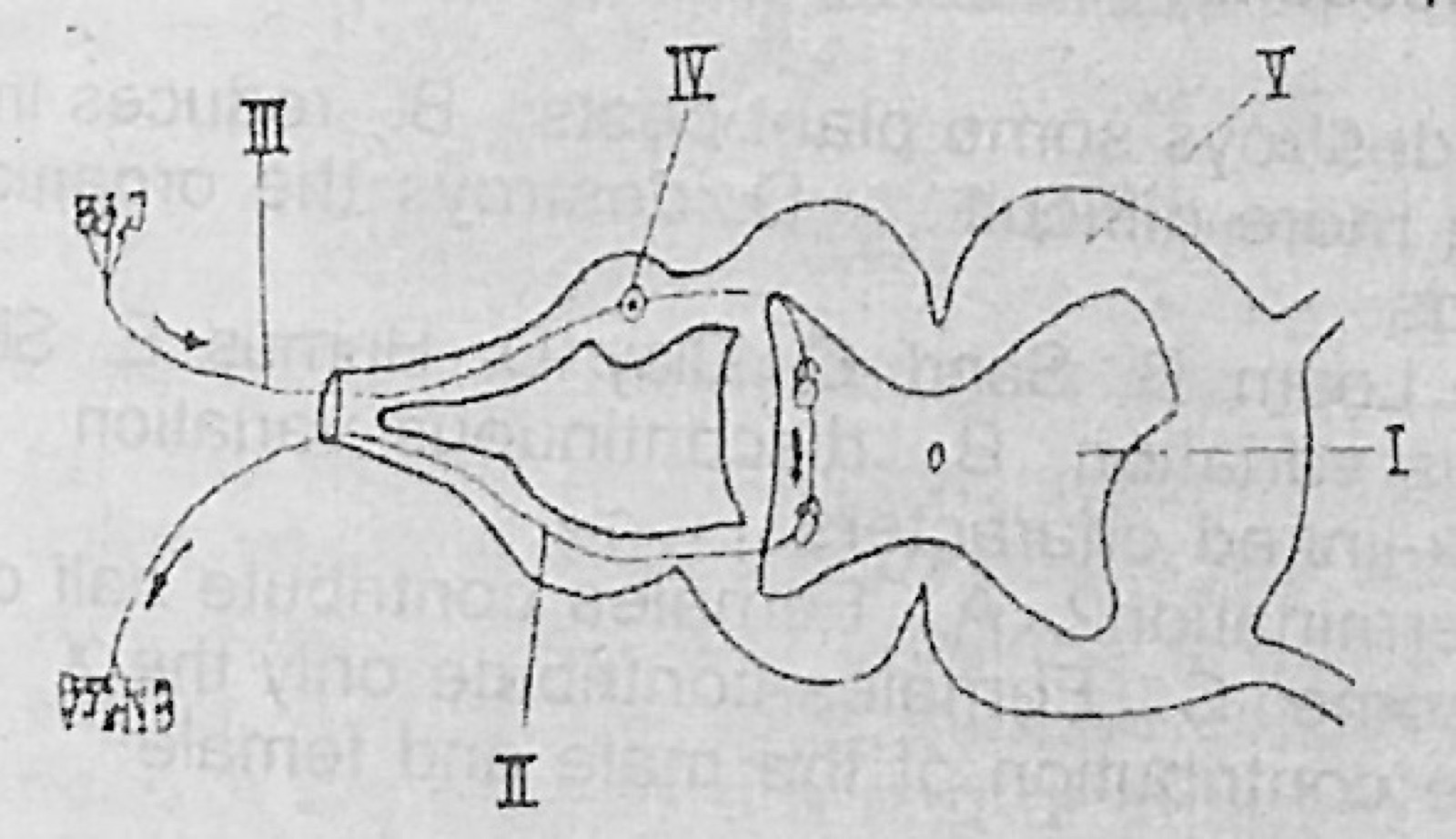
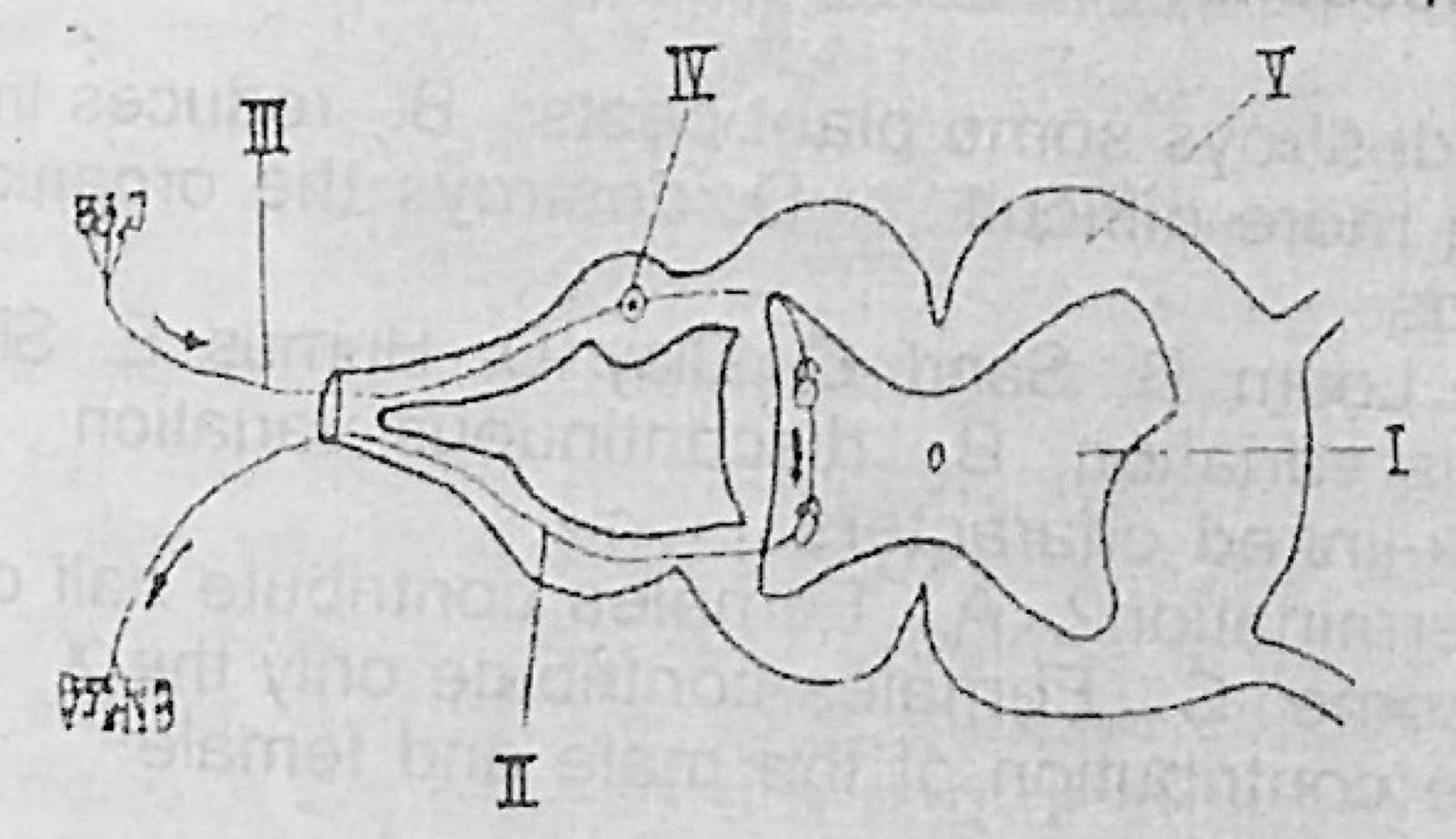
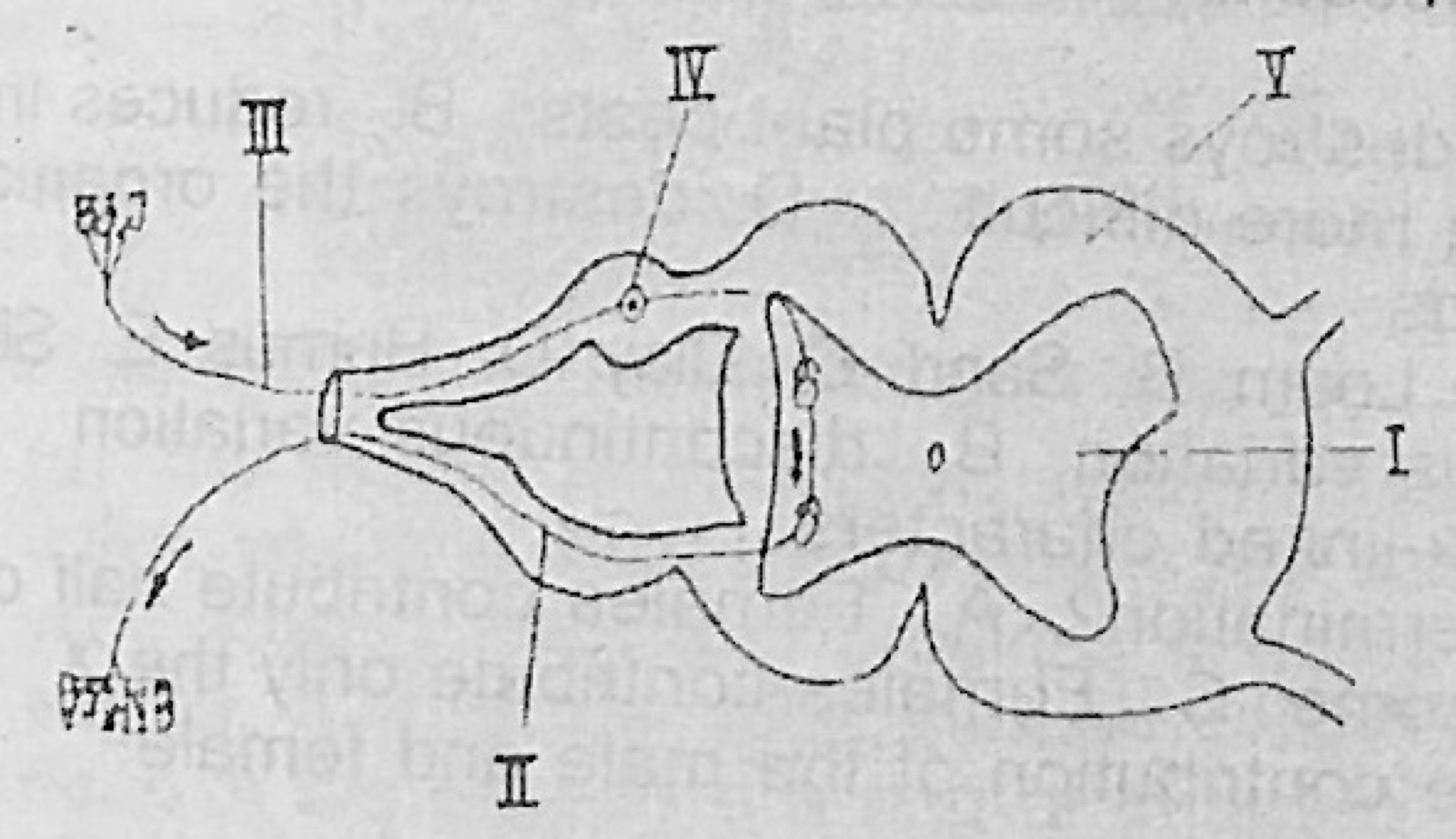
Question 23 Nervous Coordination Use the diagram below to answer questions 23 to 25
A. white matter B. grey matter C. central canal D. synapse E. ganglion Show the answer and explanation Answer: B (grey matter )
Explanation I points to the dark H-shaped inner region of the spinal cord, the grey matter.
Open this question
Question 24 Nervous Coordination Use the diagram of the spinal cord and reflex arc (parts labelled I to V) to answer this question.
A. Conducting nerve impulses to the receptor organ B. Conducting nerve impulses to the effector organ C. Translating the impulses into messages D. Amplifying the impulses received from the organ E. Transmitting the impulses to the brain Show the answer and explanation Answer: E (Transmitting the impulses to the brain )
Explanation III is the sensory nerve fibre from the receptor; it carries impulses into the spinal cord, from where they are passed on to the brain.
Open this question
Question 25 Nervous Coordination Use the diagram of the spinal cord and reflex arc (parts labelled I to V) to answer this question.
A. consists mainly of cell bodies B. conducts impulses to the spinal cord C. conducts impulses from the spinal cord to the effector organs D. conducts impulses to the brain E. interprets stimulus in the spinal cord Show the answer and explanation Answer: B (conducts impulses to the spinal cord )
Explanation The sensory neurone carries impulses from the receptor into the spinal cord.
Open this question
Question 26 Nervous Coordination What part of the brain is concerned with the regulation of the heart beat, body temperature and breathing rate?
A. Cerebellum B. Medulla C. Cerebrum D. Olfactory lobe E. Cortex Show the answer and explanation Answer: B (Medulla )
Explanation The medulla oblongata controls automatic activities such as heartbeat and breathing.
Open this question
Question 27 Homeostasis The mammalian skin can insulate the body from cold because it has
A. epidermal cells B. nerve endings C. the subcutaneous fatty layer D. sebaceous glands E. the Malpighian layer Show the answer and explanation Answer: C (the subcutaneous fatty layer )
Explanation Fat is a poor conductor of heat, so the fat layer under the skin keeps body heat in.
Open this question
Question 28 Sense Organs Which of the following parts of the tongue is sensitive to sugar
A. Tip B. Back C. Right side D. Left side E. Under surface Show the answer and explanation Answer: A (Tip )
Explanation Sweet tastes are detected mainly at the tip of the tongue.
Open this question
Question 29 Sense Organs The organ which is sensitive to smell in a cockroach is the
A. nostril B. pedipalp C. antenna D. mandible E. anal cercus Show the answer and explanation Answer: C (antenna )
Explanation Insects smell with receptors on their antennae.
Open this question
Question 30 Sense Organs Which of the following is the most sensitive spot of the retina?
A. Conjuctiva B. Cornea C. Lens D. Yellow spot E. Blind spot Show the answer and explanation Answer: D (Yellow spot )
Explanation The yellow spot (fovea) has the most cones and gives the sharpest vision.
Open this question
Question 31 Reproduction in Animals The correct route through which the ovum passes from the ovary to the vagina is
A. ovary → cervix → fallopian tube → fallopian funnel → vagina B. ovary → fallopian funnel → uterus → cervix → vagina C. ovary → fallopian tube → cervix → uterus → vagina D. ovary → cervix → uterus → fallopian tube → vagina E. ovary → fallopian tube → fallopian funnel → cervix → vagina Show the answer and explanation Answer: B (ovary → fallopian funnel → uterus → cervix → vagina )
Explanation The ovum is caught by the funnel of the oviduct, passes down to the uterus, then through the cervix to the vagina.
Open this question
Question 32 Reproduction in Plants Which of the following is the function of bright coloration of petals in flowers?
A. Beautifying the environment B. Providing warning coloration for insects C. Attracting pollinating insects D. Production of chloroplasts for photosynthesis E. Synthesizing dyes for textile industries Show the answer and explanation Answer: C (Attracting pollinating insects )
Explanation Bright petals attract insects, which carry pollen between flowers.
Open this question
Question 33 Behaviour The series of activities preceding mating of the male and female animals is generally known as
A. conjugation B. pairing C. courtship D. nuptial flight E. territoriality Show the answer and explanation Answer: C (courtship )
Explanation Courtship is the behaviour that leads up to mating.
Open this question
Question 34 Reproduction in Plants Which of the following is not a feature of a seed or fruit dispersed by the wind?
A. Light weight B. Parachute C. Pappus D. Wings E. Hooks Show the answer and explanation Answer: E (Hooks )
Explanation Hooks catch on animals' fur, so they suit animal dispersal.
Open this question
Question 35 Photosynthesis and Plant Nutrition The following are necessary for photosynthesis to take place except
A. chlorophyll B. water C. carbondioxide D. light E. oxygen Show the answer and explanation Answer: E (oxygen )
Explanation Oxygen is a product of photosynthesis, not a requirement.
Open this question
Question 36 Nutrient Cycling Which of the following bacteria reduces nitrates in the soil to gaseous nitrogen?
A. Putrefying bacteria B. Nutrifying bacteria C. Saprophytic bacteria D. Denitrifying bacteria E. Parasitic bacteria Show the answer and explanation Answer: D (Denitrifying bacteria )
Explanation Denitrifying bacteria turn nitrates back into nitrogen gas.
Open this question
Question 38 Animal Nutrition Which of the following is not an example of a heterotrophic mode of nutrition?
A. Symbiosis B. Parasitism C. Commensalism D. Holophytism E. Saprophytism Show the answer and explanation Answer: D (Holophytism )
Explanation Holophytic nutrition is photosynthesis, an autotrophic mode.
Open this question
Question 39 Ecosystem and Ecological Factors Predation is an example of a factor in an ecological system referred to as
A. edaphic B. topograhic C. abiotic D. biome E. biotic Show the answer and explanation Answer: E (biotic )
Explanation Predation is caused by a living organism, so it is a biotic factor.
Open this question
Question 40 Habitats and Biomes Which of the following world biomes is found in Nigeria?
A. Sahel Savannah B. Tundra C. Desert D. Afro-alpine vegetation E. Temperate deciduous forest Show the answer and explanation Answer: A (Sahel Savannah )
Explanation The Sahel savanna occurs in the far north of Nigeria.
Open this question
Question 41 Ecosystem and Ecological Factors A hygrometer is used for measuring
A. relative humidity B. specific gravity C. light intensity D. turbidity E. wind Show the answer and explanation Answer: A (relative humidity )
Explanation A hygrometer measures the relative humidity of the air.
Open this question
Question 42 Ecosystem and Ecological Factors Which of the following is used for the collection of small insects from soil, leaf litter and crevices?
A. Pooter B. Quadrat C. Sweep net D. Drag net E. Butterfly net Show the answer and explanation Answer: A (Pooter )
Explanation A pooter sucks small insects into a collecting tube.
Open this question
Question 43 Feeding Relationships and Energy Flow A food web can be described as a
A. complex feeding relationship in a community B. transfer of food energy from one community to another C. complex pattern of food production in a community D. group of many populations competing for the same type of food E. group of organisms belonging to the same trophic level Show the answer and explanation Answer: A (complex feeding relationship in a community )
Explanation A food web is many food chains linked together: a complex feeding relationship.
Open this question
Question 44 Nutrient Cycling The pathway through which nutrient elements are replenished and circulated in an ecosystem is called a
A. cycle B. food chain C. food web D. Kreb's cycle E. pyramid of numbers Show the answer and explanation Answer: A (cycle )
Explanation Nutrients go round and round in cycles (e.g. carbon, nitrogen cycles).
Open this question
Question 45 Ecological Associations Which of the following statements is not correct?
A. Ascaris living in the human gut illustrates parasitism B. Rhizobium in the root nodules of legumes illustrates symbiosis C. Bacteria in the gut of a termite illustrates symbiosis D. Cattle and cattle egret are commensals E. Mushroom growing on decaying wood illustrates parasitism Show the answer and explanation Answer: E (Mushroom growing on decaying wood illustrates parasitism )
Explanation A mushroom feeding on dead, decaying wood is a saprophyte, not a parasite.
Open this question
Question 46 Microorganisms and Health In which of the following are food grains best preserved?
A. Silos B. Sacks C. Refrigerators D. Ovens E. Baskets Show the answer and explanation Answer: A (Silos )
Explanation Silos keep grain dry and free of pests for long periods.
Open this question
Question 47 Adaptation Which of the following is not a structural adaptation of desert plants for water conservation?
A. Tiny leaves B. Sunken stomata in leaves C. Stems and leaves with heavy cuticle D. Broad leaves with numerous stomata E. Scale leaves Show the answer and explanation Answer: D (Broad leaves with numerous stomata )
Explanation Broad leaves with many stomata lose a lot of water, the opposite of what desert plants need.
Open this question
Question 48 Pollution Which of the following is a pollutant of air?
A. Oxygen B. Water vapour C. Carbon monoxide D. Nitrogen E. Hydrogen Show the answer and explanation Answer: C (Carbon monoxide )
Explanation Carbon monoxide from engines and fires is a poisonous air pollutant.
Open this question
Question 49 Microorganisms and Health Transmission of the malaria parasite is effected through the bite of the
A. male Anopheles mosquito B. female Anopheles mosquito C. infected male Anopheles mosquito D. infected Aedes mosquito E. infected female Anopheles mosquito Show the answer and explanation Answer: E (infected female Anopheles mosquito )
Explanation Only a female Anopheles that already carries Plasmodium can pass malaria on when it bites.
Open this question
Question 50 Soil The burning of farmlands should be discouraged because it
A. destroys some plant pests B. reduces the population of wild animals on the farm C. makes bush clearing more difficult D. destroys the organic part of the soil E. reduces the dormancy period of some weeds Show the answer and explanation Answer: D (destroys the organic part of the soil )
Explanation Burning destroys humus and soil organisms, making the soil poorer.
Open this question
Question 51 Soil Which of the following soil types retains the least amount of water?
A. Loam B. Sand C. Clay D. Humus E. Silt Show the answer and explanation Answer: B (Sand )
Explanation Sand has large particles and large pore spaces, so water drains through quickly.
Open this question
Question 52 Variation Blood groups and tongue-rolling are examples of
A. continuous variation B. discontinuous variation C. variation due to environment D. adaptive variation E. sex-linked characters Show the answer and explanation Answer: B (discontinuous variation )
Explanation You either have a blood group or you don't, and can or cannot roll your tongue: clear-cut groups, so discontinuous variation.
Open this question
Question 53 Chromosomes, DNA and Sex Linkage Which of the following statements is not correct about sex-determination?
A. Females contribute half of the sex chromosomes B. Males contribute an X or Y chromosome C. Females contribute only the X chromosome D. The sex of an individual is determined by the contribution of the male and female E. Females alone determines the sex of of child Show the answer and explanation Answer: E (Females alone determines the sex of of child )
Explanation The father's sperm (X or Y) decides the sex; the mother always gives an X.
Open this question
Question 54 Variation Which of the following is not a type of finger-print?
A. Whorl B. Compound C. Simple D. Loop E. Arch Show the answer and explanation Answer: C (Simple )
Explanation The fingerprint patterns are arch, loop, whorl and compound (composite); 'simple' is not one of them.
Open this question
Question 55 Chromosomes, DNA and Sex Linkage Which of the following is the precise location of the gene?
A. Chromosome B. Centresome C. Centriole D. Ribosome E. Endoplasmic reticulum Show the answer and explanation Answer: A (Chromosome )
Explanation Genes are found at particular places along the chromosomes.
Open this question
Question 56 Chromosomes, DNA and Sex Linkage How many chromosomes are found in the human ovum?
A. 46 B. 23 C. 33 D. 13 E. 43 Show the answer and explanation Answer: B (23 )
Explanation Gametes are haploid, so a human ovum has 23 chromosomes.
Open this question
Question 57 Mendelian Inheritance If a black guinea pig of genotype BB, is crossed with a white guinea pig of genotype bb, what will be the phenotype of the F1 generation?
A. Half of the offspring would be black while the other half would by white B. All the offsprings would be black C. All the offsprings would be grey D. One-third of the offspring would be black while two-third would be white E. Two-thirds of the offspring would be black while one-third would be white Show the answer and explanation Answer: B (All the offsprings would be black )
Explanation BB × bb gives only Bb, and black is dominant, so all are black.
Open this question
Question 58 Adaptation How are Savannah plants protected from bush fires? They
A. have sunken stomata B. roll their leaves during hot days C. have thick barks D. always produce flowers E. shed their leaves gradually throughout the year Show the answer and explanation Answer: C (have thick barks )
Explanation Thick, corky bark protects savanna trees from fire.
Open this question
Question 59 Evolution The failure of a species to adapt to any environment leads to
A. domination B. competition C. stunted growth D. extinction E. adaptation Show the answer and explanation Answer: D (extinction )
Explanation A species that cannot adapt dies out: extinction.
Open this question
Question 60 Evolution The theory of use and disuse of organs was propounded by
A. Gregor Mendel B. Charles Darwin C. Jean Lamarck D. Louis Pasteur E. Robert Hooke Show the answer and explanation Answer: C (Jean Lamarck )
Explanation Lamarck proposed the theory of use and disuse.
Open this question
Theory question 101 Sense Organs (a) List the principal sense organs in mammals and their functions
Show the model answer Model answer (a) Eye – sight; ear – hearing and balance; nose – smell; tongue – taste; skin – touch, pressure, pain, heat and cold
Explanation Long-sighted people see far objects clearly; the image of near objects forms behind the retina.
Open this question
Theory question 102 Reproduction in Animals (a) Describe briefly the female reproductive system of a named mammal (A diagram is essential).
Show the model answer Model answer (a) Named mammal (e.g. human/rabbit); labelled diagram: two ovaries, oviducts (Fallopian tubes) with funnels, uterus, cervix, vagina, vulva
Explanation A labelled diagram is required in (a).
Open this question
Theory question 103 Population Ecology (a) Mention six ways by which the government is contributing towards self-sufficiency in food production
Show the model answer Model answer (a) Any six: loans/credit to farmers; subsidised fertilizers and agro-chemicals; supplying improved seeds and seedlings; agricultural research institutes; extension services/teaching farmers; irrigation schemes and river basin authorities; building rural roads and storage facilities; programmes such as Operation Feed the Nation/Green Revolution; guaranteed prices/marketing; mechanisation (tractor hire)
Explanation Name each practice and say what part of the ecosystem it damages.
Open this question
Theory question 104 Hormonal Coordination (a) Explain the following terms (i) voluntary action (ii) involuntary action
Show the model answer Model answer (a)(i) Voluntary action: an action done consciously, by will, controlled by the cerebrum, e.g. writing, walking
Explanation Give an example with each definition in (a).
Open this question Sign up free for every WAEC Biology year, practice by topic and timed mocks.
Start practising free