WAEC Agricultural Science 2023 past questions and answers

54 questions. Try each one, then open the answer to check yourself and read the explanation.

Question 1

Processing and Storage of Farm Produce

The storage structure usually installed by the government for bulk storage of grains in West Africa is

  1. A.bin.
  2. B.crib.
  3. C.silo.
  4. D.rhombus
Show the answer and explanation

Answer: C (silo.)

Explanation

Governments build large silos for strategic grain reserves.

Open this question

Question 2

Agricultural Development

Rural-urban migration of farm labour could be prevented by

  1. A.increasing the size of farmland for cultivation.
  2. B.employing more extension agents for farmers.
  3. C.increasing the cost of acquiring farmland.
  4. D.establishing agro-based industries in villages.
Show the answer and explanation

Answer: D (establishing agro-based industries in villages.)

Explanation

Rural industries give jobs and income, so young people stay.

Open this question

Question 3

Farming Systems

The farming system generally recommended for farm settlement scheme is

  1. A.mixed cropping.
  2. B.pastoral farming.
  3. C.mixed farming.
  4. D.continuous cropping.
Show the answer and explanation

Answer: C (mixed farming.)

Explanation

Mixed farming combines crops and animals that support each other.

Open this question

Question 4

Farm Machinery and Mechanisation

The part of a disc plough to which discs are connected is

  1. A.scraper.
  2. B.beam.
  3. C.furrow wheel.
  4. D.standard.
Show the answer and explanation

Answer: D (standard.)

Explanation

Each disc hangs from a standard fixed to the plough's beam.

Open this question

Question 5

Farm Machinery and Mechanisation

A combine harvester is mainly used for harvesting

  1. A.groundnut.
  2. B.pepper.
  3. C.rice.
  4. D.tomato.
Show the answer and explanation

Answer: C (rice.)

Explanation

Combines harvest grain crops such as rice.

Open this question

Question 6

Farm Power

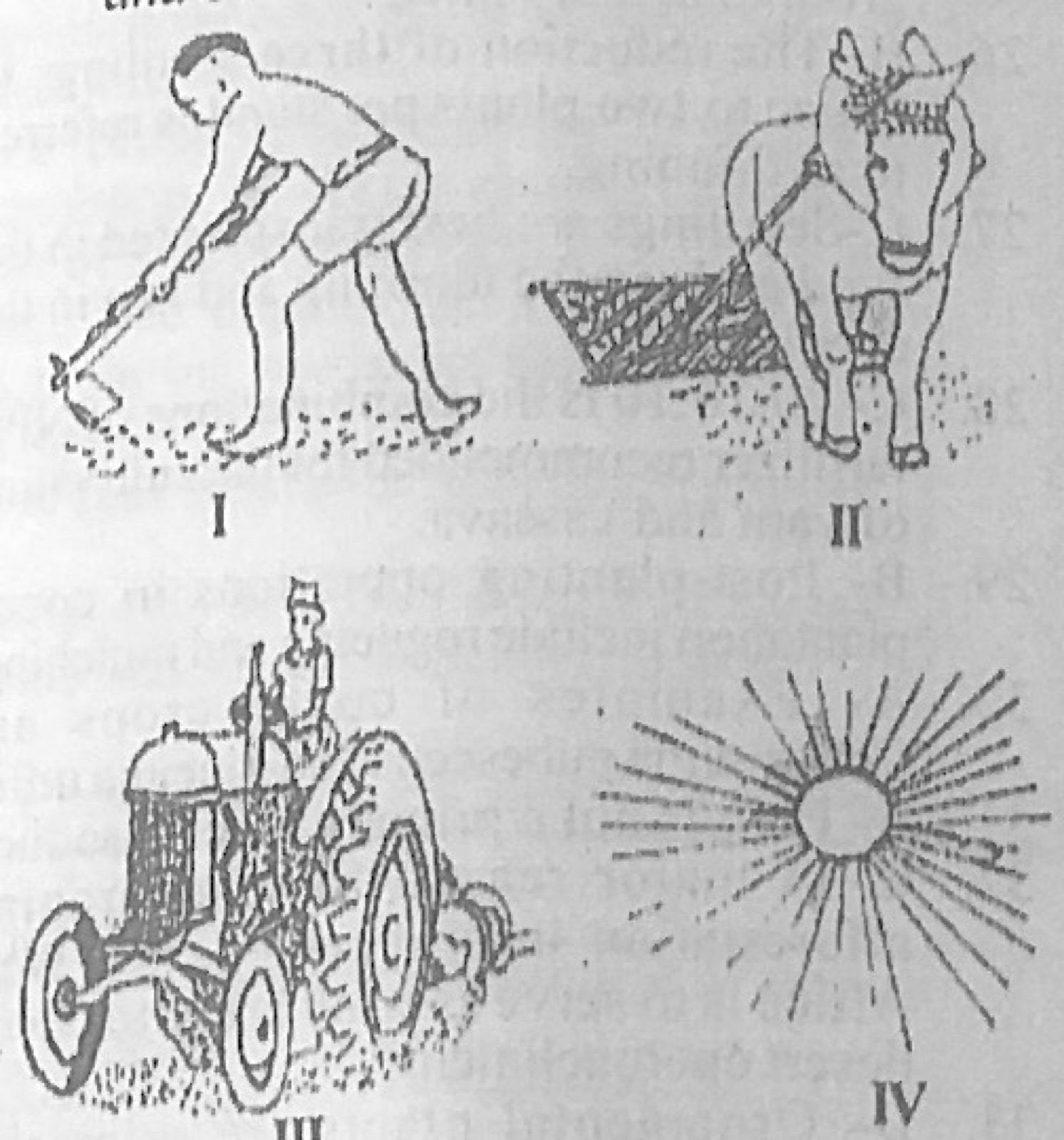
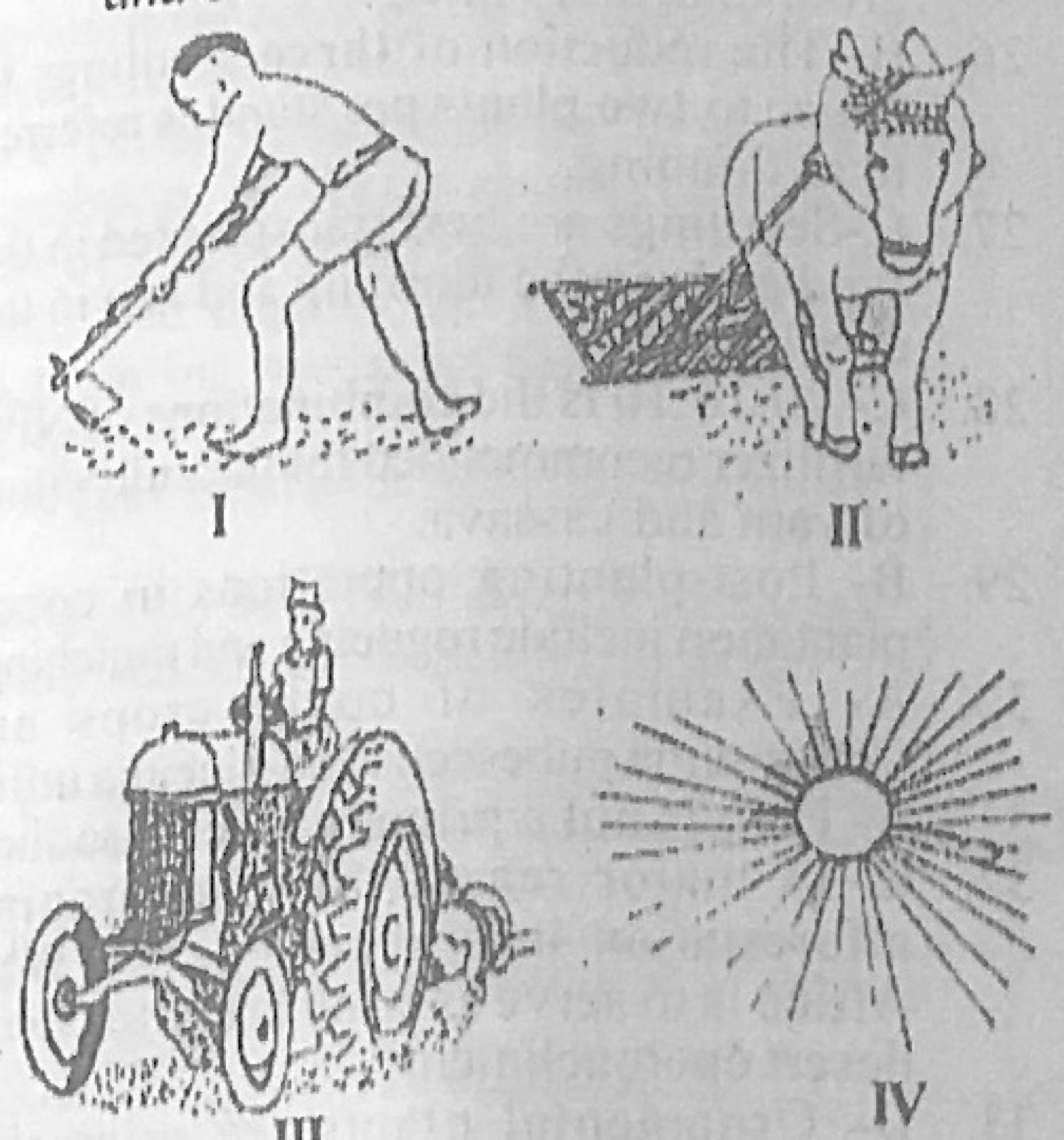
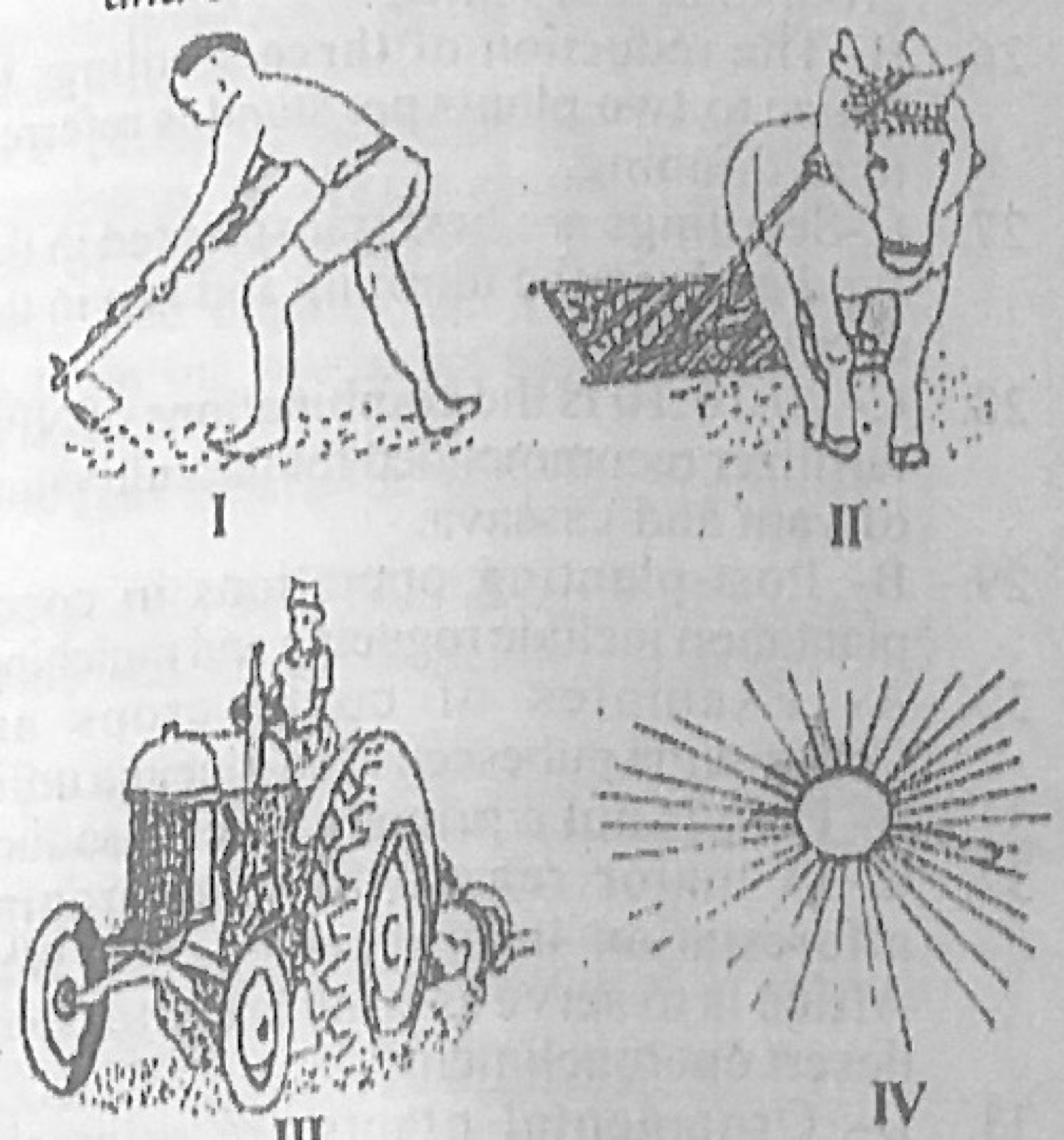
The diagrams below illustrate different sources of farm power.
Which of the illustrated sources of farm power is the cheapest?

Diagram for this question
  1. A.I
  2. B.II
  3. C.III
  4. D.IV
Show the answer and explanation

Answer: D (IV)

Explanation

IV is the sun; solar energy is free.

Open this question

Question 7

Farm Power

The diagrams below illustrate different sources of farm power.
The machinery illustrated in diagram III could be used to power
I. planters
II. dryers
III. sprayers

Diagram for this question
  1. A.I and II only.
  2. B.I and III only.
  3. C.II and III only.
  4. D.I, II and III.
Show the answer and explanation

Answer: B (I and III only.)

Explanation

A tractor pulls planters and drives boom sprayers.

Open this question

Question 8

Farm Power

The diagrams below illustrate different sources of farm power.
Which of the illustrated sources of farm power decreases in efficiency due to constant use?

Diagram for this question
  1. A.I and II only.
  2. B.I and III only.
  3. C.II and III only
  4. D.I, II and III
Show the answer and explanation

Answer: D (I, II and III)

Explanation

Humans and animals tire, and tractors wear with continuous use.

Open this question

Question 9

Poultry Production

High relative humidity in a brooder house could lead to

  1. A.heat stress.
  2. B.reduced feed intake.
  3. C.production of dry litter.
  4. D.build-up of pests and diseases.
Show the answer and explanation

Answer: D (build-up of pests and diseases.)

Explanation

Damp, humid houses favour germs and parasites.

Open this question

Question 10

Plant Forms and Crop Classification

Day-neutral crops are crops that produce flowers regardless of

  1. A.extremely low temperature.
  2. B.day length being longer than the length of night.
  3. C.extremely high temperature.
  4. D.amount of sunlight received by flowering plants.
Show the answer and explanation

Answer: B (day length being longer than the length of night.)

Explanation

Day-neutral plants flower whatever the day length.

Open this question

Question 11

Soil Properties

Which of the following tools are used in soil analysis?
I. pH meter
II. Sieve
III. Hygrometer

  1. A.I and II only.
  2. B.I and III only.
  3. C.II and III only.
  4. D.I, II and III
Show the answer and explanation

Answer: A (I and II only.)

Explanation

A pH meter tests acidity and sieves separate particles; a hygrometer measures air humidity.

Open this question

Question 12

Soil Properties

If 200 ml of water was poured on a soil sample in a beaker and 25% of the water drained the soil, determine the amount of water retained in the soil.

  1. A.25ml
  2. B.50ml
  3. C.150ml
  4. D.175ml
Show the answer and explanation

Answer: C (150ml)

Explanation

25% of 200 = 50 ml drained, so 200 − 50 = 150 ml stayed.

Open this question

Question 13

Soil Properties

Soil structure is described as the

  1. A.proportion of different sizes of soil particles.
  2. B.degree of soil aeration within the soil.
  3. C.arrangement of soil particles into aggregates.
  4. D.degree of water percolation within the soil.
Show the answer and explanation

Answer: C (arrangement of soil particles into aggregates.)

Explanation

Structure is how particles group into crumbs or blocks; proportions describe texture.

Open this question

Question 14

Land Preparation and Cultural Practices

A beneficial effect of bush burning is that it

  1. A.increases the population of soil microorganisms.
  2. B.encourages the regeneration of grasses.
  3. C.increases the organic matter of soil.
  4. D.replenishes oxygen in the atmosphere.
Show the answer and explanation

Answer: B (encourages the regeneration of grasses.)

Explanation

Burning old grass makes fresh, tender grass regrow for grazing.

Open this question

Question 15

Soil Fertility and Plant Nutrition

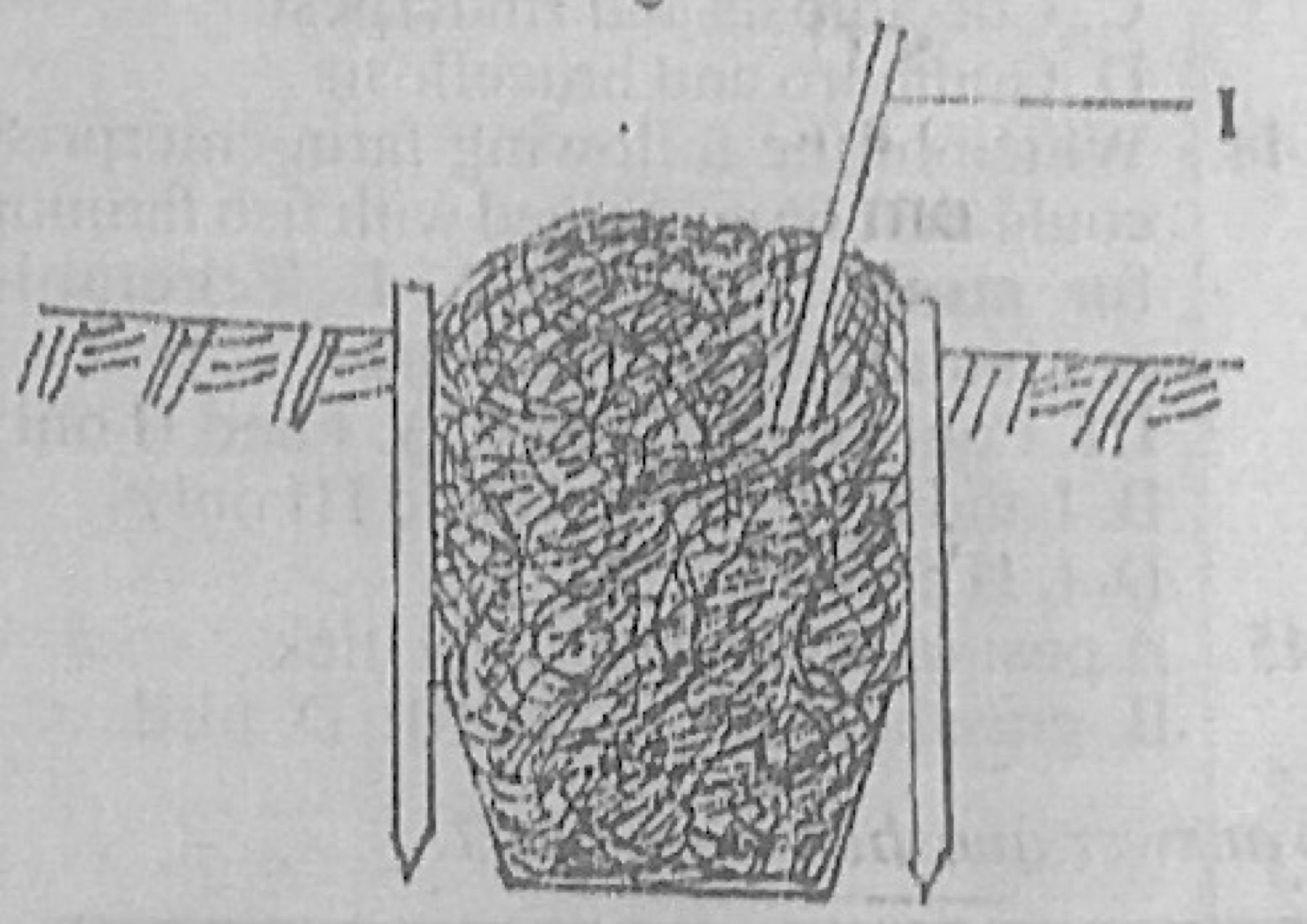
The diagram below illustrates a method of compost making.
The method of compost making illustrated in the diagram is

Diagram for this question
  1. A.heap.
  2. B.bin.
  3. C.pit.
  4. D.sheet.
Show the answer and explanation

Answer: C (pit.)

Explanation

The materials are packed into a hole in the ground: pit composting.

Open this question

Question 16

Soil Fertility and Plant Nutrition

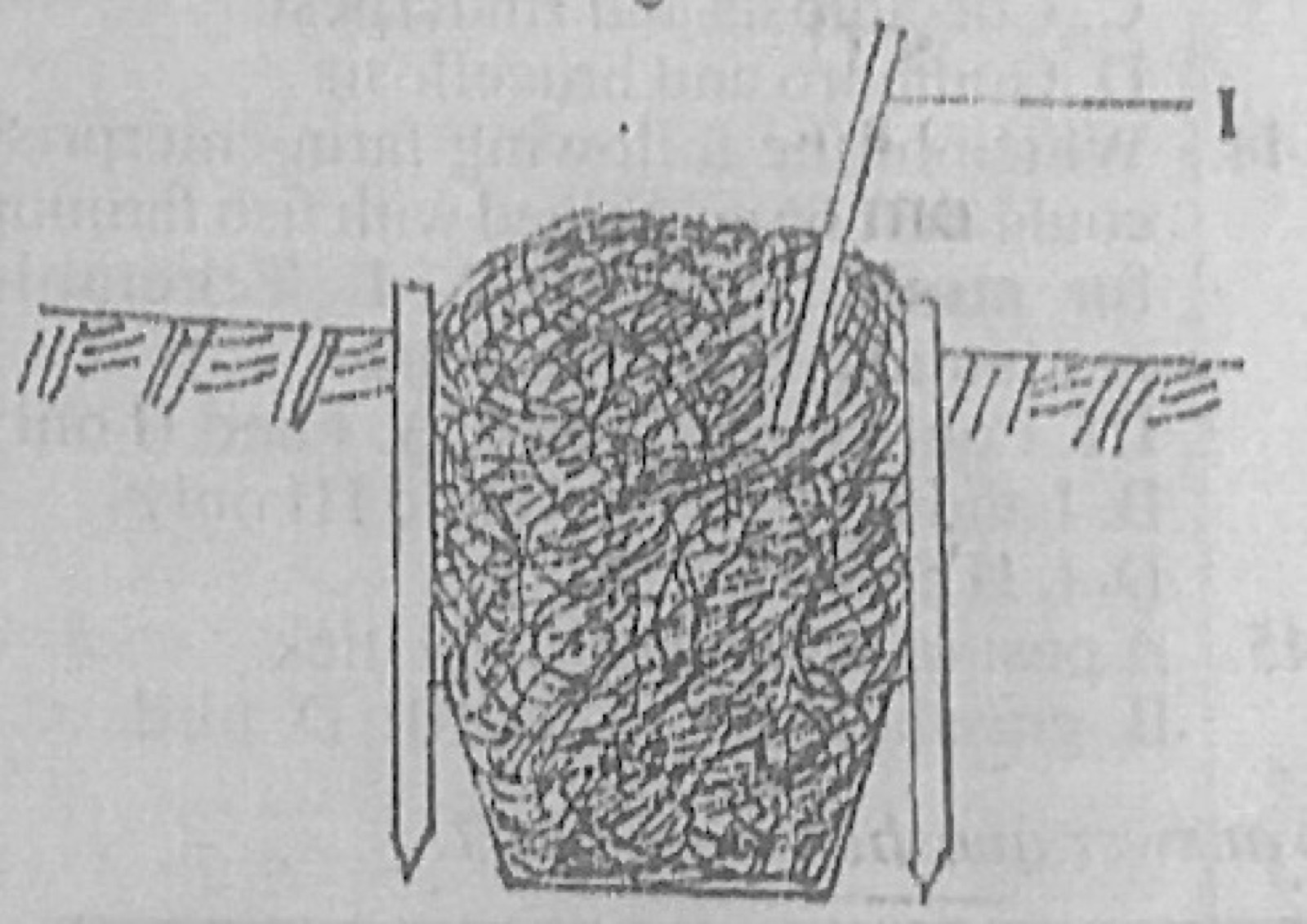
The diagram below illustrates a method of compost making.
The part labelled I is used for

Diagram for this question
  1. A.turning the compost materials.
  2. B.checking the decomposition rate.
  3. C.stacking the compost materials.
  4. D.hastening the fermentation rate.
Show the answer and explanation

Answer: B (checking the decomposition rate.)

Explanation

A test stick shows how warm and well-rotted the compost is.

Open this question

Question 17

Soil Fertility and Plant Nutrition

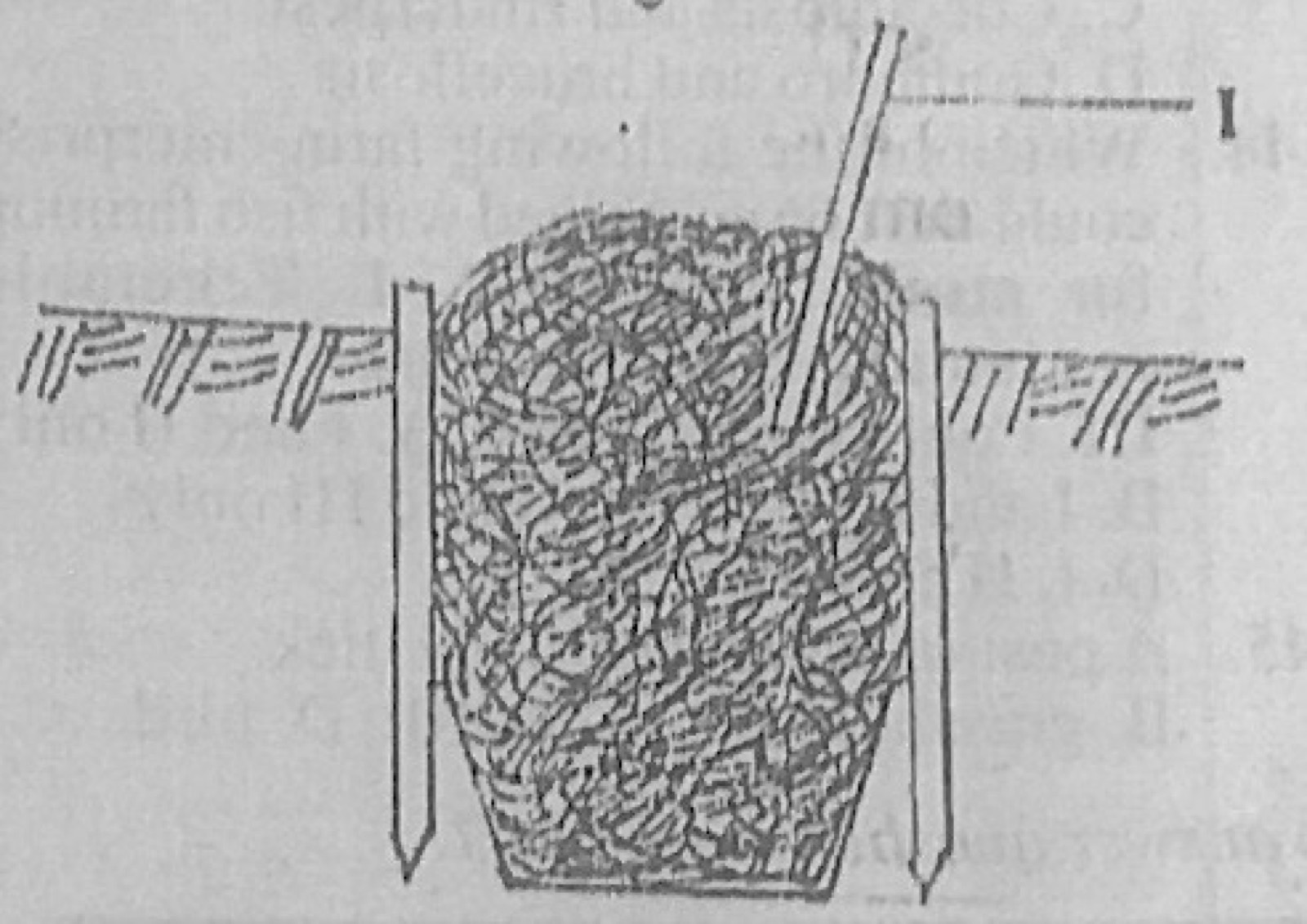
The diagram below illustrates a method of compost making.
A material that could be used as starter in the method of compost making illustrated is

Diagram for this question
  1. A.blood.
  2. B.ash.
  3. C.straw.
  4. D.urine.
Show the answer and explanation

Answer: D (urine.)

Explanation

Nitrogen-rich urine speeds up the microbes that make compost.

Open this question

Question 18

Soil Fertility and Plant Nutrition

The bacterium which is responsible for conversion of ammonium compounds to nitrites in the nitrogen cycle is

  1. A.Azotobacter.
  2. B.Rhizobium.
  3. C.Nitrosomonas.
  4. D.Nitrobacter.
Show the answer and explanation

Answer: C (Nitrosomonas.)

Explanation

Nitrosomonas turns ammonium into nitrite.

Open this question

Question 19

Irrigation and Drainage

Which of the following statements about underground drainage is true?

  1. A.Ditches are constructed to remove excess water.
  2. B.Water seeps into tiles to reach an outlet where it is discharged.
  3. C.Ditches are dug from a source of water to the farmland.
  4. D.Furrows are constructed to direct water out of the farmland.
Show the answer and explanation

Answer: B (Water seeps into tiles to reach an outlet where it is discharged.)

Explanation

Underground drains are buried tiles or pipes.

Open this question

Question 20

Plant Forms and Crop Classification

Monocotyledonous crops are characterized by

  1. A.net-veined leaves.
  2. B.taproot system.
  3. C.parallel-veined leaves.
  4. D.woody stems and branches.
Show the answer and explanation

Answer: C (parallel-veined leaves.)

Explanation

Monocots have parallel veins and fibrous roots.

Open this question

Question 21

Processing and Storage of Farm Produce

Maceration is carried out in the processing of

  1. A.cocoa.
  2. B.cotton.
  3. C.oil palm.
  4. D.paddy rice.
Show the answer and explanation

Answer: C (oil palm.)

Explanation

Palm fruits are pounded (macerated) to free the oil-bearing pulp.

Open this question

Question 22

Land Preparation and Cultural Practices

If the seed rate for the cultivation of cowpea is 25kg per hectare, determine the quantity of cowpea seeds required to cultivate a farmland measuring 100m by 500m.

  1. A.50kg
  2. B.125kg
  3. C.250kg
  4. D.1,250kg
Show the answer and explanation

Answer: B (125kg)

Explanation

100 × 500 = 50,000 m² = 5 ha; 5 × 25 = 125 kg.

Open this question

Question 23

Crop Propagation

Which of the following crops require a nursery?

  1. A.Soya bean
  2. B.Cotton seed
  3. C.Yam
  4. D.Rubber
Show the answer and explanation

Answer: D (Rubber)

Explanation

Rubber seedlings are raised and budded in a nursery.

Open this question

Question 24

Processing and Storage of Farm Produce

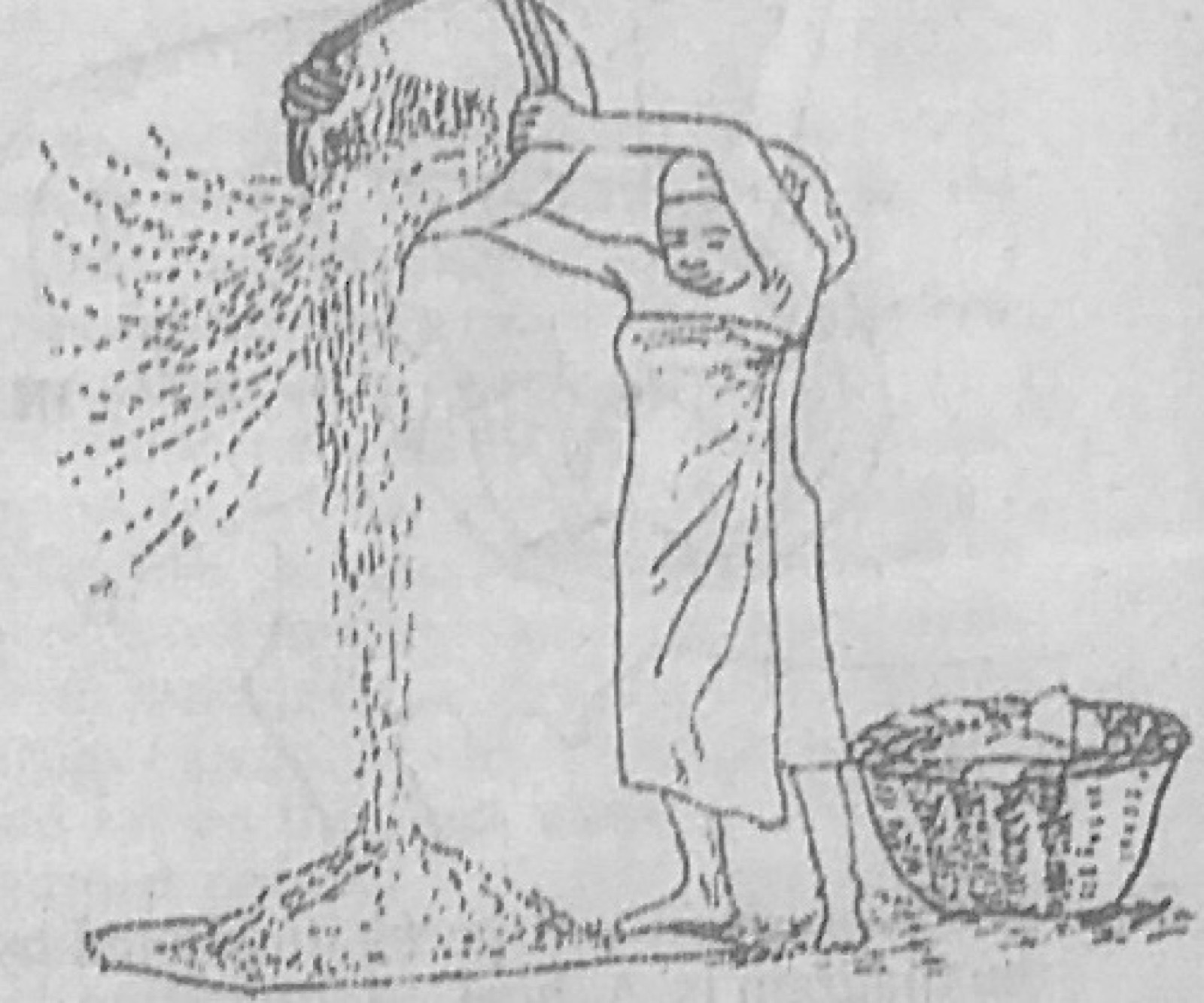
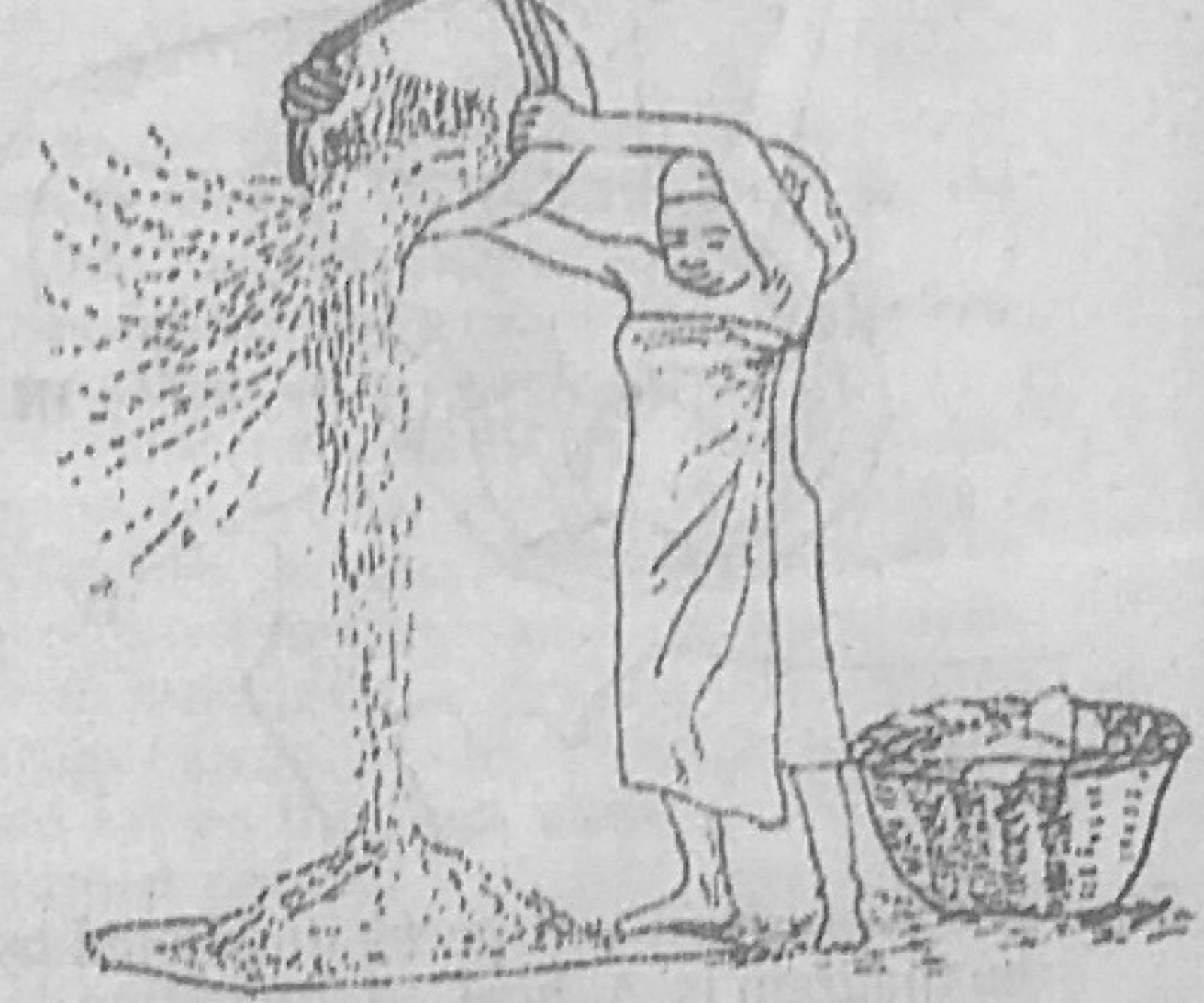
The diagram below illustrates a farm operation.
The illustrated farm operation is known as

Diagram for this question
  1. A.threshing.
  2. B.milling
  3. C.winnowing.
  4. D.shelling.
Show the answer and explanation

Answer: C (winnowing.)

Explanation

Pouring grain in the wind to blow away chaff is winnowing.

Open this question

Question 25

Processing and Storage of Farm Produce

The diagram below illustrates a farm operation.
Examples of crops which require the illustrated farm operation are

Diagram for this question
  1. A.cowpea, millet and okro.
  2. B.pepper, rice and cowpea.
  3. C.rice, groundnut and millet.
  4. D.maize, pepper and tomato.
Show the answer and explanation

Answer: C (rice, groundnut and millet.)

Explanation

Rice, groundnut and millet are winnowed to remove chaff and husks.

Open this question

Question 26

Land Preparation and Cultural Practices

The reduction of three seedlings of maize to two plants per stand is referred to as

  1. A.pruning.
  2. B.thinning.
  3. C.rogueing.
  4. D.weeding.
Show the answer and explanation

Answer: B (thinning.)

Explanation

Removing extra seedlings is thinning.

Open this question

Question 27

Crop Propagation

Seedlings are best transplanted in the field

  1. A.late in the morning and late in the evening.
  2. B.at midday and at dusk.
  3. C.early in the morning and late in the evening.
  4. D.early in the morning and at midday.
Show the answer and explanation

Answer: C (early in the morning and late in the evening.)

Explanation

Cool hours reduce wilting after transplanting.

Open this question

Question 28

Soil Fertility and Plant Nutrition

Which of the following combinations of NPK fertilizer is recommended for the cultivation of yam and cassava?

  1. A.10:10:10
  2. B.10:10:20
  3. C.20:10:10
  4. D.20:20:10
Show the answer and explanation

Answer: B (10:10:20)

Explanation

Tubers need more potassium, the last number in N:P:K.

Open this question

Question 29

Land Preparation and Cultural Practices

Post-planting operations in cocoa plantation include
I. rogueing
II. stumping
III. mulching

  1. A.I and II only.
  2. B.I and III only.
  3. C.II and III only.
  4. D.I, II and III.
Show the answer and explanation

Answer: B (I and III only.)

Explanation

Stumping is done before planting; rogueing and mulching come after.

Open this question

Question 30

Soil Erosion and Conservation

Examples of cover crops are

  1. A.Centrosema pubescens and Mucuna utilis.
  2. B.Calopogonium mucunoides and Gliricidia sepium.
  3. C.Moringa oleifera and Imperata cylindrica.
  4. D.Pancium maximum and Pennisetum purpureum.
Show the answer and explanation

Answer: A (Centrosema pubescens and Mucuna utilis.)

Explanation

Centrosema and Mucuna are creeping legumes used as cover crops.

Open this question

Question 31

Forestry and Wildlife

Which of the following products is not a primary forest product?

  1. A.Timber
  2. B.Pulp
  3. C.Fuelwood
  4. D.Mushroom
Show the answer and explanation

Answer: B (Pulp)

Explanation

Pulp is made by processing wood, so it is a secondary product.

Open this question

Question 32

Forestry and Wildlife

A major reason for encouraging afforestation in arid regions of West Africa is to

  1. A.increase timber production for export.
  2. B.provide shade for crops in taungya farming.
  3. C.serve as windbreak to check desert encroachment.
  4. D.serve as forest reserve for wildlife conservation.
Show the answer and explanation

Answer: C (serve as windbreak to check desert encroachment.)

Explanation

Tree belts slow the wind and stop the desert spreading.

Open this question

Question 33

Ornamental Plants

Ornamental plants are primarily cultivated to

  1. A.serve as raw materials.
  2. B.provide fodder for livestock.
  3. C.serve as mulching materials.
  4. D.beautify the environment.
Show the answer and explanation

Answer: D (beautify the environment.)

Explanation

Ornamentals are grown for beauty.

Open this question

Question 34

Crop Pests

Cotton stainer is an insect pest of

  1. A.onion.
  2. B.pepper.
  3. C.okro.
  4. D.carrot.
Show the answer and explanation

Answer: C (okro.)

Explanation

Cotton stainers attack plants of the cotton family, including okro.

Open this question

Question 35

Animal Anatomy and Physiology

The number of teats in the udder of a cow is

  1. A.two.
  2. B.four.
  3. C.six.
  4. D.eight
Show the answer and explanation

Answer: B (four.)

Explanation

A cow's udder has four quarters, each with one teat.

Open this question

Question 36

Animal Reproduction

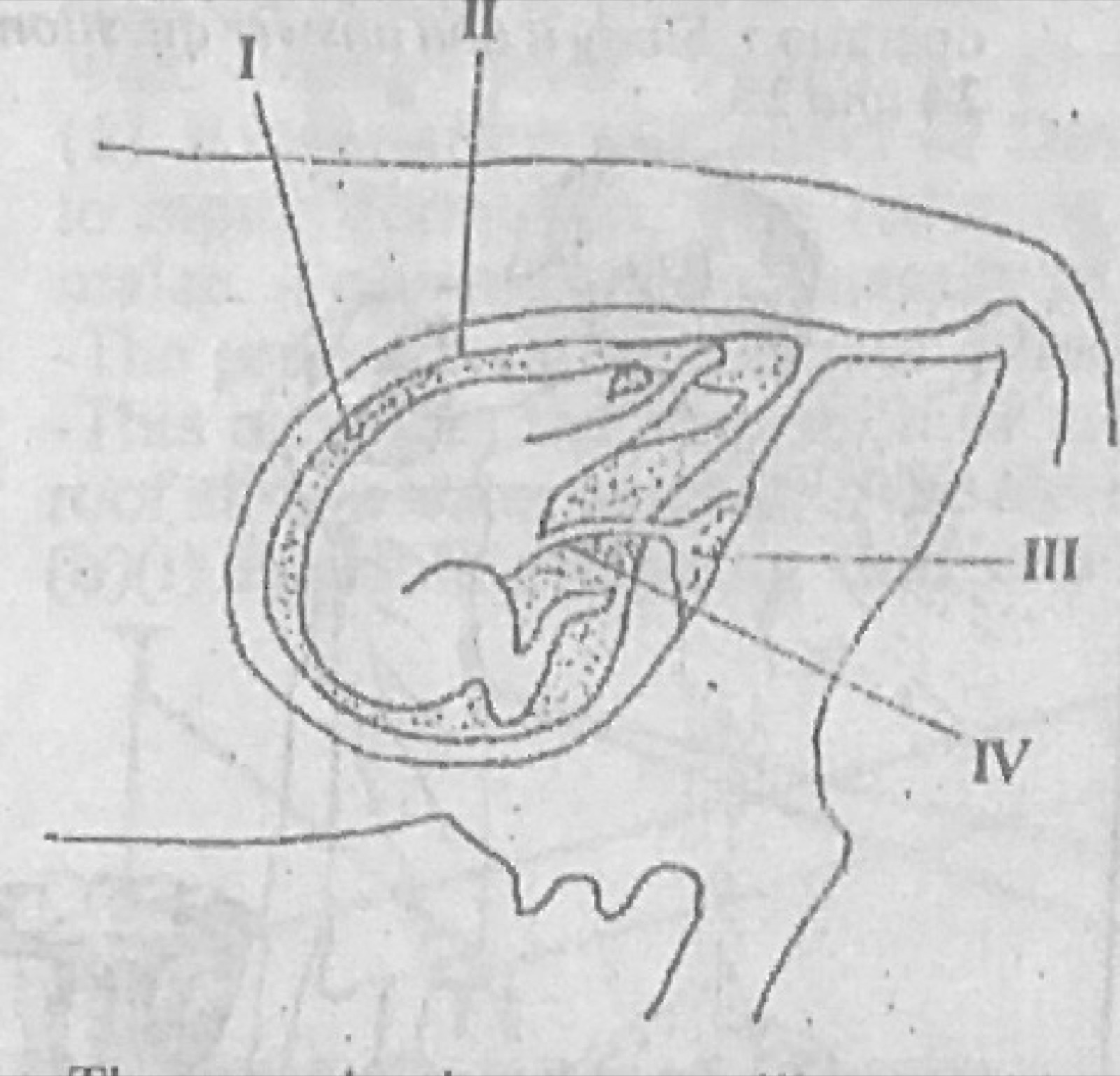
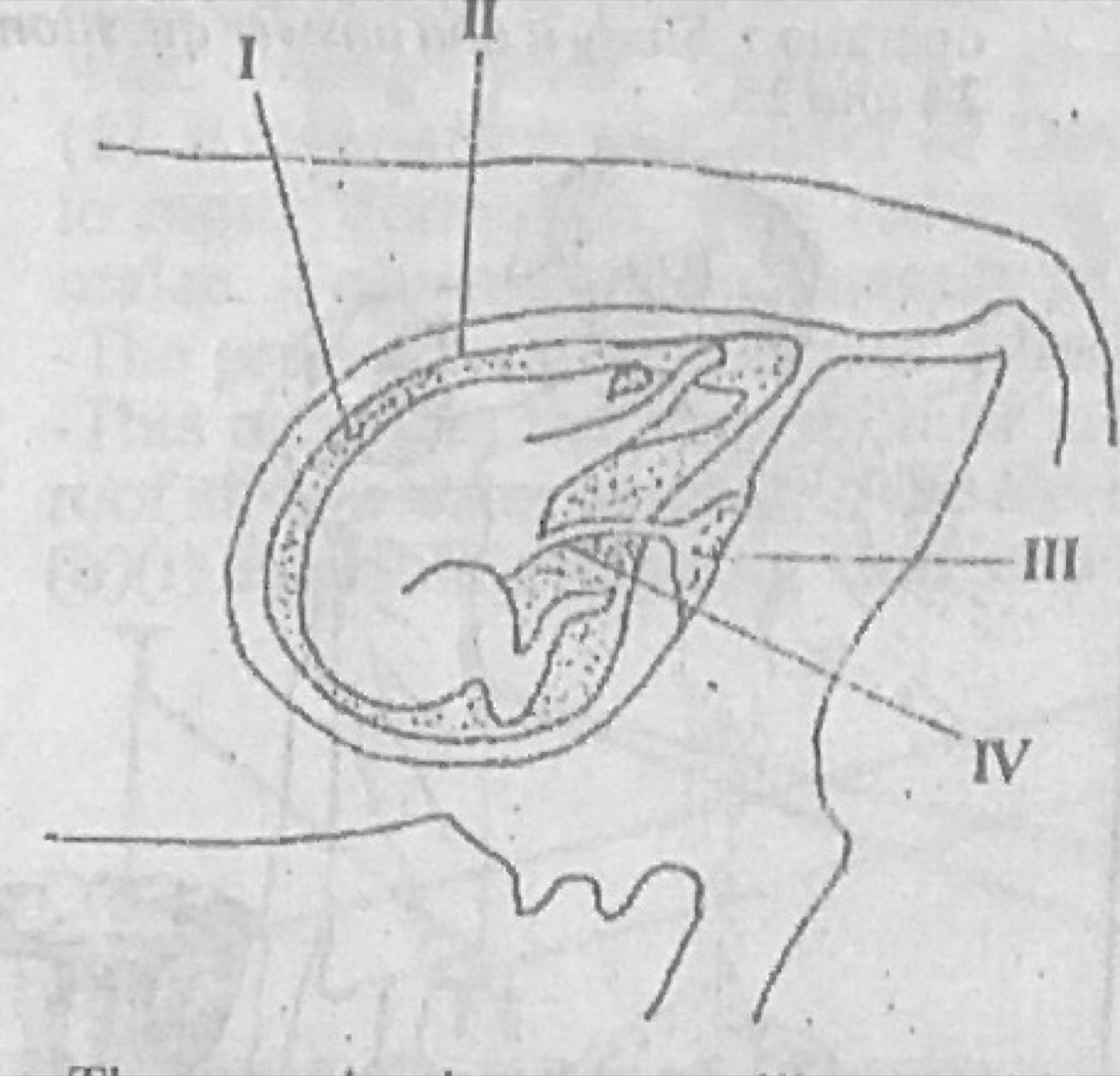
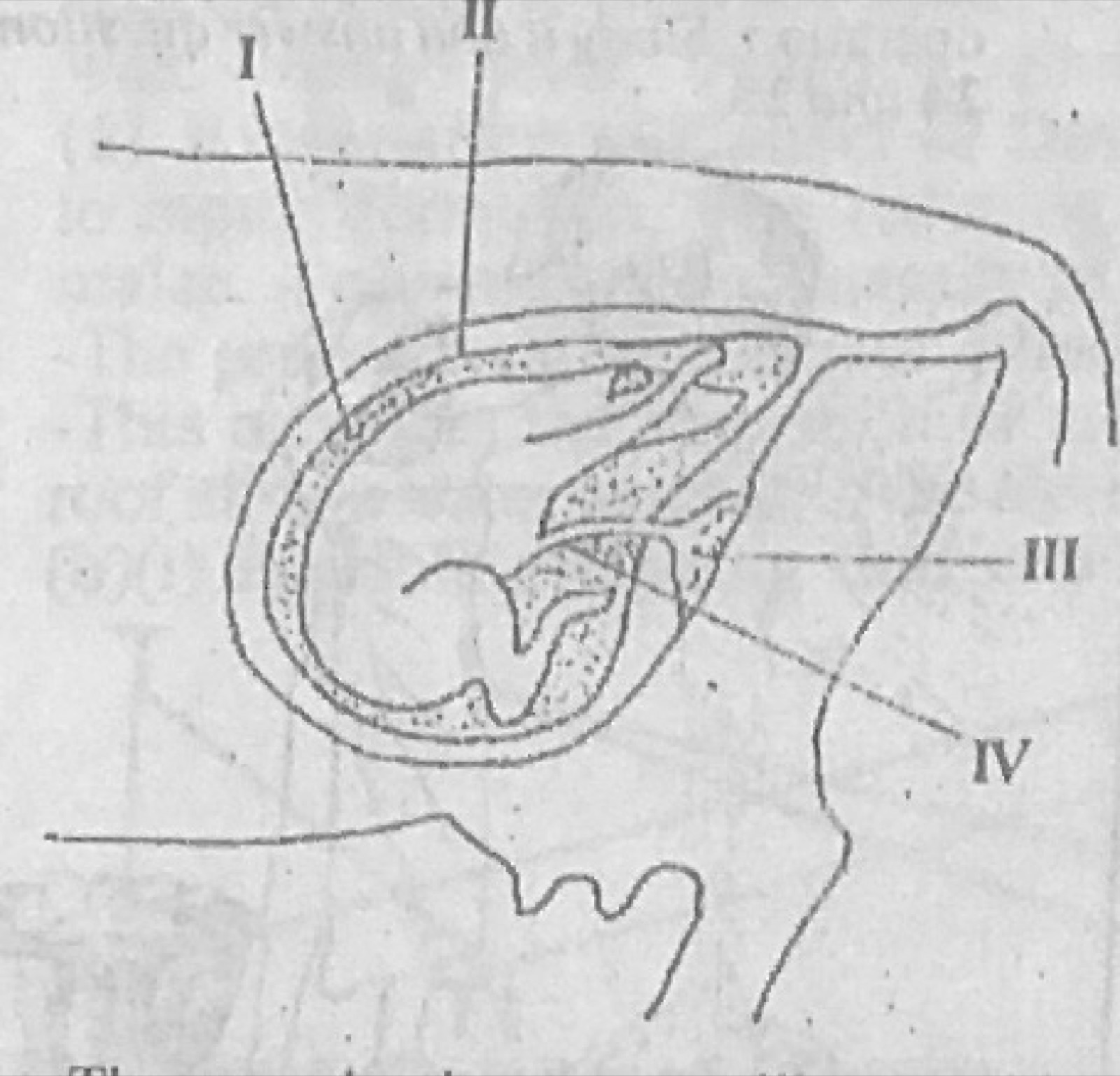
The diagram below illustrates a reproductive process in a farm animal.
The reproductive process illustrated by the diagram is

Diagram for this question
  1. A.heat.
  2. B.ovulation.
  3. C.lactation.
  4. D.gestation.
Show the answer and explanation

Answer: D (gestation.)

Explanation

It shows a foetus developing in the uterus: gestation (pregnancy).

Open this question

Question 37

Animal Reproduction

The diagram below illustrates a reproductive process in a farm animal.
The parts which protect the foetus from mechanical injury are labelled

Diagram for this question
  1. A.I and II.
  2. B.I and III.
  3. C.II and III.
  4. D.III and IV.
Show the answer and explanation

Answer: A (I and II.)

Explanation

I and II are the membranes and fluid-filled sacs (amnion and chorion) that cushion the foetus.

Open this question

Question 38

Animal Reproduction

The diagram below illustrates a reproductive process in a farm animal.
The foetus obtains dissolved oxygen and nutrients from the dam through the parts labelled

Diagram for this question
  1. A.I and II.
  2. B.I and III.
  3. C.II and III.
  4. D.III and IV.
Show the answer and explanation

Answer: D (III and IV.)

Explanation

III is the placenta and IV the umbilical cord, which carry food and oxygen to the foetus.

Open this question

Question 39

Livestock Management

Assuming a sow was serviced on May 1 and conceived the same day, the expected date of parturition is

  1. A.June 2.
  2. B.August 24.
  3. C.October 2.
  4. D.September 30.
Show the answer and explanation

Answer: B (August 24.)

Explanation

Pig gestation is about 114–115 days, which ends around 23–24 August.

Open this question

Question 40

Poultry Production

In a poultry farm, 2,000 birds were laying an average of 1,680 eggs per day.
What is the percentage of birds that did not lay eggs?

  1. A.16%
  2. B.19%
  3. C.46%
  4. D.84%
Show the answer and explanation

Answer: A (16%)

Explanation

2,000 − 1,680 = 320; 320 ÷ 2,000 × 100 = 16%.

Open this question

Question 41

Poultry Production

In a poultry farm, 2,000 birds were laying an average of 1,680 eggs per day.
If an egg tray contains 30 eggs, how many trays of eggs will be collected in one week?

  1. A.240
  2. B.286
  3. C.392
  4. D.526
Show the answer and explanation

Answer: C (392)

Explanation

1,680 × 7 = 11,760 eggs; ÷ 30 = 392 trays.

Open this question

Question 42

Animal Nutrition

Steaming up ration should be fed to

  1. A.breeding female animals.
  2. B.weaned young animals.
  3. C.lactating animals.
  4. D.pregnant animals.
Show the answer and explanation

Answer: D (pregnant animals.)

Explanation

Steaming up is extra feed in late pregnancy.

Open this question

Question 45

Livestock Management

A pest of honeybee is

  1. A.tick.
  2. B.grasshopper.
  3. C.lizard.
  4. D.bird.
Show the answer and explanation

Answer: D (bird.)

Explanation

Bee-eater birds catch and eat bees.

Open this question

Question 46

Farm Management and Records

Study the table below.
Cost price N20,000; useful life Y years; salvage value N5,000; annual depreciation N1,000/annum; total depreciation N15,000
Cost price N60,000; useful life 10 years; salvage value N18,000; annual depreciation N4,200/annum; total depreciation Z
The useful life represented by Y in the illustrated table is

  1. A.3 years.
  2. B.4 years.
  3. C.15 years.
  4. D.20 years.
Show the answer and explanation

Answer: C (15 years.)

Explanation

(20,000 − 5,000) ÷ 1,000 = 15 years.

Open this question

Question 47

Farm Management and Records

Study the table below.
Cost price N20,000; useful life Y years; salvage value N5,000; annual depreciation N1,000/annum; total depreciation N15,000
Cost price N60,000; useful life 10 years; salvage value N18,000; annual depreciation N4,200/annum; total depreciation Z
The total depreciation represented by Z in the illustrated table is

  1. A.N22,200.
  2. B.N42,000.
  3. C.N55,800.
  4. D.N78,000.
Show the answer and explanation

Answer: B (N42,000.)

Explanation

60,000 − 18,000 = N42,000 (or 4,200 × 10).

Open this question

Question 48

Marketing of Agricultural Produce

Grading of farm produce is important because it

  1. A.maintains produce quality.
  2. B.prolongs storability.
  3. C.facilitates transportation.
  4. D.facilitates pricing
Show the answer and explanation

Answer: D (facilitates pricing)

Explanation

Each grade gets its own price, so grading makes pricing easy.

Open this question

Question 49

Farm Management and Records

The risk of production in agricultural business is borne by the

  1. A.farm assistant.
  2. B.farm labour.
  3. C.farm owner.
  4. D.farmer's family.
Show the answer and explanation

Answer: C (farm owner.)

Explanation

The owner (entrepreneur) bears the risk of loss.

Open this question

Question 50

Agricultural Extension

In order to backup extension messages, an extension agent should

  1. A.procure agricultural loans for farmers.
  2. B.provide marketing channels for farmers.
  3. C.assist farmers in locating sources of farm inputs.
  4. D.provide modern machines to farmers.
Show the answer and explanation

Answer: C (assist farmers in locating sources of farm inputs.)

Explanation

Farmers can only act on advice if they can get the inputs.

Open this question

Theory question 101

Agricultural Finance

(a) Differentiate between credit and subsidy in agricultural finance.
(b) Name five agricultural inputs that are subsidised by the government.
(c) Mention six periodic maintenance practices on a tractor.
(d) State five precautions that should be taken when operating farm machinery.

Show the model answer
Model answer

(a) Credit is a loan given to a farmer that must be repaid (usually with interest) over a period; a subsidy is a non-refundable part-payment or aid from government that lowers the cost of inputs or services.
(b) Any five: fertilizers; improved seeds/seedlings; agrochemicals (pesticides, herbicides); improved breeds/day-old chicks; veterinary drugs and vaccines; tractors and implements/tractor hire; irrigation equipment; feeds.
(c) Any six: change engine oil; change oil and fuel filters; grease/lubricate moving parts; check and adjust fan belt tension; recharge or service the battery; tighten loose nuts and bolts; replace worn parts; adjust brakes and clutch; clean or change the air filter; check hydraulic oil level; paint to prevent rust.
(d) Any five: follow the manufacturer's manual; only trained operators should drive; wear protective clothing; keep machines in good working order; do not operate when tired, sick or drunk; keep a first aid kit; take care when hitching implements; keep bystanders away; obey road safety rules and use lights/reflectors.

Explanation

Credit is repaid; a subsidy is not.

Open this question

Theory question 102

Agricultural Ecology

(a) Explain each of the following terms: (i) agricultural ecology (ii) ecosystem.
(b) Mention: (i) two biotic components of a farm ecosystem. (ii) three abiotic components of a farm ecosystem.
(c) State five precautions that should be taken during storage of bags of maize in a store.
(d) Give four examples of bedding plants.

Show the model answer
Model answer

(a)(i) Agricultural ecology: the study of crops and farm animals in relation to their environment (living and non-living factors).
(ii) Ecosystem: a community of living organisms interacting with one another and with their non-living environment.
(b)(i) Any two: crops; farm animals; weeds; soil organisms (earthworms); microorganisms; pests.
(ii) Any three: temperature; rainfall; relative humidity; sunlight; wind; soil; water; rocks/minerals.
(c) Any five: dry grain properly before storage; store must be rain-proof and well ventilated; clean and fumigate the store first; place bags on pallets off the floor and away from walls; use insecticides/fumigants; rat-proof the store; inspect regularly; first in, first out.
(d) Any four: marigold; zinnia; petunia; salvia; celosia; periwinkle (Vinca); balsam; coleus.

Explanation

Bedding plants are low flowering plants grown in beds.

Open this question

Theory question 103

Crop Diseases

(a) Discuss the root knot disease of tomato plants under the following headings: (i) causal organism; (ii) mode of transmission; (iii) two symptoms; (iv) two prevention and control measures.
(b) Describe three effects each of the following farming practices on the soil: (i) fertilizer application; (ii) clean clearing; (iii) overgrazing.
(c) Mention three agricultural uses of land.

Show the model answer
Model answer

(a)(i) Nematodes (eelworms), Meloidogyne spp.
(ii) Infested soil, infected seedlings/transplants, water run-off, contaminated tools and farm equipment.
(iii) Any two: galls/knots/swellings on roots; stunted growth; yellowing and wilting of leaves; low yield.
(iv) Any two: crop rotation with non-host crops; resistant varieties; soil sterilisation/nematicides; uproot and burn infected plants; plant clean seedlings; fallowing.
(b)(i) Fertilizer: adds nutrients and raises fertility; some (e.g. sulphate of ammonia) make soil acidic; excess may harm soil organisms/cause salt build-up.
(ii) Clean clearing: exposes soil to erosion; destroys organic matter; raises soil temperature and moisture loss; kills soil organisms.
(iii) Overgrazing: removes plant cover, causing erosion; compacts the soil; lowers fertility; leads to desertification.
(c) Any three: crop production; livestock rearing/grazing; fish farming; forestry/agroforestry; farm buildings/farmstead; wildlife (game) reserves.

Explanation

Name the nematode in (a)(i).

Open this question

Theory question 104

Crop Husbandry

(a) Outline four steps involved in the planting of cassava stem cuttings.
(b) State three uses of cassava tubers.
(c) If yam is cultivated at a spacing of 100cm by 100cm on 1.5 hectares of farmland and each yam tuber weighs an average of 3.5kg after harvesting, calculate the: (i) expected number of yam plants on the farmland; (ii) total weight of yam tubers harvested in kilogramme.
(d) Distinguish between diet and ration in animal nutrition.

Show the model answer
Model answer

(a) Select healthy, mature stems (about 12–18 months old); cut into pieces 20–30 cm long with 5–8 nodes; plant on prepared ridges/mounds, slanting or vertically, with about two-thirds buried and buds pointing upwards; plant at about 1 m × 1 m; plant early in the rains.
(b) Any three: food (garri, fufu, tapioca, flour); livestock feed; starch for industry; ethanol/alcohol; glucose; adhesives.
(c)(i) 1.5 ha = 15,000 m²; each plant has 1 m × 1 m = 1 m²; number = 15,000 plants.
(ii) 15,000 × 3.5 kg = 52,500 kg.
(d) Diet is the kind and amount of food an animal normally eats; a ration is the measured amount of feed given to an animal in 24 hours to meet its needs.

Explanation

Convert hectares to square metres first.

Open this question

Theory question 105

Animal Health

(a) Complete the table below on diseases of farm animals.
Symptoms: constant cough and production of stringy sputum with blood or pus, in pigs — Disease (i) — Prevention and control (ii), (iii)
Symptoms (iv) — Disease: Ringworm — Prevention and control (v), (vi)
Symptoms: blood-stained diarrhoea; pale comb in poultry — Disease (vii) — Prevention and control (viii), (ix)
(b) State two functions each of the: (i) queen bee; (ii) worker bee, in a bee colony.
(c) Give five reasons why a compost pit should be covered during composting.

Show the model answer
Model answer

(a)(i) Tuberculosis. (ii), (iii) Any two: isolate/slaughter infected animals; test herds regularly (tuberculin test); good ventilation and hygiene; disinfect pens; avoid overcrowding.
(iv) Circular, scaly, hairless patches of skin, with itching/crusts.
(v), (vi) Any two: isolate infected animals; apply antifungal ointment/iodine; disinfect pens and equipment; good hygiene.
(vii) Coccidiosis. (viii), (ix) Any two: coccidiostats in feed or water; keep litter dry and change it regularly; clean feeders and drinkers; avoid overcrowding.
(b)(i) Queen: lays eggs; produces pheromones that hold the colony together and control workers.
(ii) Worker (any two): collects nectar and pollen; makes honey and wax; builds comb; feeds larvae and queen; guards the hive; cleans and cools the hive.
(c) Any five: keeps in heat to speed decomposition; prevents rain from leaching nutrients; prevents drying out; keeps away flies, rodents and animals; reduces bad smell; prevents loss of nitrogen as ammonia; keeps material from being blown away.

Explanation

Name the disease for each set of symptoms.

Open this question

Theory question 106

Farm Management and Records

(a) Using the information below, prepare a profit and loss account for Wellness Farms for the year ended 31st December 2016.
Opening valuation N400,000
Cost of point-of-lay N200,000
Cost of feed N150,000
Cost of drugs N10,000
Transportation costs N10,000
Wages paid to workers N80,000
Sale of eggs N240,000
Sale of spent layers N100,000
Eggs consumed by farmer N10,000
Closing valuation N600,000
(b) Mention five problems faced by financial institutions in granting credit to crop farmers.
(c) State four characteristics of Centrosema pubescens.

Show the model answer
Model answer

(a) Debit (expenditure): opening valuation 400,000; point-of-lay 200,000; feed 150,000; drugs 10,000; transport 10,000; wages 80,000; total N850,000. Credit (income): sale of eggs 240,000; sale of spent layers 100,000; eggs consumed by farmer 10,000; closing valuation 600,000; total N950,000. Net profit = 950,000 − 850,000 = N100,000.
(b) Any five: farmers lack collateral; high risk from weather, pests and diseases; poor or no farm records; small, scattered farms; illiteracy of farmers; loan diversion and default; long gestation of some crops; high cost of administering small loans.
(c) Any four: a perennial legume; trailing/climbing habit with trifoliate leaves; fixes nitrogen; high protein forage; shade tolerant; good cover crop that controls erosion and weeds; purple/mauve flowers; tolerates fairly acidic soil.

Explanation

Put opening valuation and costs on the debit side, sales and closing valuation on the credit side.
Open this question