Which of the following statements about agricultural development are true? It leads to I. increased processing of produce. II. increased food production. III. high productivity. IV. increased agricultural labour force.
A.I, II and III only
B.I, II and IV only
C.I, III and IV only
D.II, III and IV only
Show the answer and explanation
Answer: A (I, II and III only)
Explanation
Development brings more processing, food and productivity; mechanisation usually reduces the labour needed on farms.
Which of the following factors are causes of deforestation in West Africa? I. Expansion of cultivated land II. High population growth rate III. Conservation of wildlife in game reserves IV. Urban growth
A.I, II and III only
B.II, III and IV only
C.I, II and IV only
D.I, II III and IV.
Show the answer and explanation
Answer: C (I, II and IV only)
Explanation
Farming, population growth and urban growth clear forests; game reserves protect them.
If T represents the gene for tallness while t represents dwarfness, use the information to answer questions 37 and 38. When a tall (TT) crop is crossed with a dwarf (tt) crop, the resultant crops will be
A.100% dwarf.
B.100% tall.
C.50% tall and 50% dwarf.
D.75% tall and 25% dwarf.
Show the answer and explanation
Answer: B (100% tall.)
Explanation
All offspring are Tt, and T is dominant, so all are tall.
If T represents the gene for tallness while t represents dwarfness: when a tall (TT) crop is crossed with a dwarf (tt) crop, the genotypic ratio of the second filial generation will be
The weight of a sheep increased from 25kg to 45kg in two months. If the total consumption during the period was 60 kg, determine the feed conversion ratio.
The data for feed consumption and weight gain of four farm animals labelled P, Q, R and S are shown below: P - 50 kg feed consumed and 20 kg weight gained Q - 90 kg feed consumed and 30 kg weight gained R - 100 kg feed consumed and 25 kg weight gained S - 150 kg feed consumed and 30 kg weight gained Which animal is the most efficient feed converter?
A.P
B.Q
C.R
D.S
Show the answer and explanation
Answer: A (P)
Explanation
P needs only 50 ÷ 20 = 2.5 kg of feed per kg gain, the lowest of the four (Q 3, R 4, S 5).
Calculate the annual depreciation of a farm house using the following data: (i) The initial cost of farm house = ₦100,000.00 (ii) Expected life span of farm house = 100 years (iii) Estimated salvage value of farm house = ₦25,000.00
A cowpea farmer obtained a loan of D50,000.00 from his co-operative society at an interest rate of 5%. Calculate the interest to be paid on the borrowed capital after one year.
(a) State three ways in which science and technology have contributed to agricultural development through each of the following: (i) Crop protection; (ii) Climatology and meteorology. (b) Give two functions of each of the following farm machines and implements: (i) bulldozer; (ii) combine harvester; (iii) tractor; (iv) sprayer; (v) planter.
Show the model answer
Model answer
(a)(i) Any three: development of insecticides, fungicides, herbicides, nematicides and rodenticides; spraying equipment; breeding of pest- and disease-resistant varieties; biological control agents; irradiation/fumigation of stored produce. (ii) Any three: weather forecasts to fix planting and harvesting dates; forecasting of pest and disease outbreaks; measurement of rainfall, temperature, humidity and wind; cloud seeding; guidance on choice of crops and drying of produce. (b)(i) Bulldozer: clearing bush and felling trees; uprooting stumps; levelling land; building farm roads. (ii) Combine harvester: harvesting (cutting) cereals; threshing; cleaning/winnowing and bagging grain. (iii) Tractor: pulling implements (ploughs, harrows, ridgers); haulage with trailer; powering stationary machines through PTO; lifting implements hydraulically. (iv) Sprayer: applying pesticides and herbicides; applying liquid fertilizers or hormones. (v) Planter: sowing seeds at the right spacing and depth; some apply fertilizer at planting.
Explanation
"Pesticides" alone is too vague; name the type (insecticide, fungicide…).
(a) In a tabular form, list ten differences between subsistence agriculture and commercial agriculture. (b) State one advantage and one disadvantage of the following sources of farm power: (i) wind; (ii) internal combustion engine; (iii) electricity.
Show the model answer
Model answer
(a) Any ten in a table, subsistence vs commercial: mainly for family vs mainly for sale; small capital vs large capital; family labour vs hired/skilled labour; small land vs large land; local varieties/breeds vs improved varieties/breeds; simple tools vs machines; few agro-chemicals vs much use of fertilizers and chemicals; low yield per hectare vs high yield; records rarely kept vs records kept; mainly food crops vs cash crops too; little processing and storage vs modern processing and storage; poor farmers vs rich farmers/companies. (b)(i) Wind: advantage – free, renewable, clean; disadvantage – unreliable (only when windy), high initial cost, weak for heavy work. (ii) Internal combustion engine: advantage – powerful and dependable, mobile; disadvantage – fuel is costly, pollutes air, needs skilled maintenance. (iii) Electricity: advantage – clean, efficient, easy to use for many machines; disadvantage – not available in many rural areas, power failures, risk of shock, costly installation.
Explanation
Set (a) out in two columns; each row must compare the same feature.
(a) What is soil consistency? (b) Explain how each of the following soil properties influences crop growth: (i) soil texture; (ii) soil pH. (c)(i) List four methods by which soil fertility could be maintained. (ii) Explain two ways in which each of the methods listed in 3(c)(i) contributes to the maintenance of soil fertility.
Show the model answer
Model answer
(a) Soil consistency is the way soil particles hold together, i.e. the soil's resistance to being deformed or broken, shown by its stickiness, plasticity, friability or hardness at different moisture levels. (b)(i) Texture affects water-holding capacity, drainage and aeration, nutrient content, ease of root penetration and workability. (ii) pH affects availability of nutrients, activity of micro-organisms (e.g. nitrogen fixers) and the kind of crops that grow well; very low pH makes Al and Mn toxic. (c)(i) and (ii) any four with two ways each: crop rotation – different rooting depths use different layers; legumes add nitrogen; manuring (organic) – adds nutrients and humus, improves structure; fertilizer use – replaces nutrients removed by crops quickly; liming – raises pH and supplies calcium; cover cropping – checks erosion and adds organic matter; mulching – conserves moisture and adds humus; fallowing – lets soil recover nutrients and organic matter; erosion control – keeps the fertile topsoil.
(a)(i) Define the term soil tillage. (ii) Distinguish between primary tillage and secondary tillage. (b) Outline three roles of each of the following soil management practices: (i) green manuring; (ii) mulching. (c) Give six reasons for carrying out irrigation in crop production.
Show the model answer
Model answer
(a)(i) Tillage is the working (loosening, turning) of the soil with tools or machines to make it suitable for crop growth. (ii) Primary tillage is the first, deep working of the soil that breaks and turns it (ploughing); secondary tillage follows it and breaks clods into a fine tilth and levels or ridges the soil (harrowing, ridging). (b)(i) Green manuring: adds organic matter/humus; adds nutrients, especially nitrogen from legumes; improves soil structure and water holding; increases soil organisms; protects soil from erosion while growing. (ii) Mulching: conserves soil moisture; suppresses weeds; reduces erosion; moderates soil temperature; adds organic matter when it rots. (c) Any six: supplies water during the dry season/drought; allows all-year cropping; supplements irregular rainfall; makes dry land cultivable; softens soil for planting; can carry fertilizers (fertigation); controls soil temperature/frost; leaches excess salts; increases yield.
Explanation
Show the difference in (a)(ii) by when and how each is done.
(a)(i) Define vegetative propagation. (ii) Give three advantages and three disadvantages of vegetative propagation. (b) State four cultural methods used for controlling crop pests in the field. (c) Enumerate four harmful effects of chemical pest control.
Show the model answer
Model answer
(a)(i) Raising new plants from parts of the parent other than seed, e.g. stems, roots, leaves, suckers, tubers. (ii) Advantages: offspring are true to type; plants mature and fruit earlier; useful for plants that produce no viable seed; desirable traits easily kept. Disadvantages: diseases carried over from the parent; materials are bulky and perish quickly; no new varieties arise; costly to transport and store. (b) Any four: crop rotation; early planting/harvesting; clean weeding/field sanitation; destroying crop residues; use of resistant varieties; trap cropping; proper spacing; mixed cropping. (c) Any four: poison humans and animals; residues in food; kill beneficial insects and natural enemies; pollute soil and water; pests develop resistance; high cost; scorching of crops if overdosed.
Explanation
Vegetative propagation advantages and disadvantages should not repeat each other.
(a) Distinguish between a field pest and a storage pest. (b) Give two reasons for early harvesting of maize from the field. (c) Describe each of the following methods of crop improvement: (i) introduction; (ii) cross breeding. (d) List six factors that should be considered in selecting a crop variety for your locality.
Show the model answer
Model answer
(a) A field pest attacks crops while they are growing on the farm (e.g. stem borer, grasshopper); a storage pest attacks harvested produce in store (e.g. weevils, grain moth, rats). (b) Any two: to avoid field pests such as weevils and birds; to avoid theft; to avoid rotting/mould in wet weather; to free the land for the next crop; to sell early at higher prices (green maize). (c)(i) Introduction: bringing in a crop variety from another area or country, testing it and adopting it if it does well (acclimatisation). (ii) Cross breeding: mating (crossing) two different varieties with desired traits so that offspring combine the good qualities of both; selection follows. (d) Any six: yield potential; resistance to pests and diseases; maturity period; adaptability to local climate and soil; market demand/consumers' taste; storage quality; availability of planting material; drought tolerance; nutritive value.
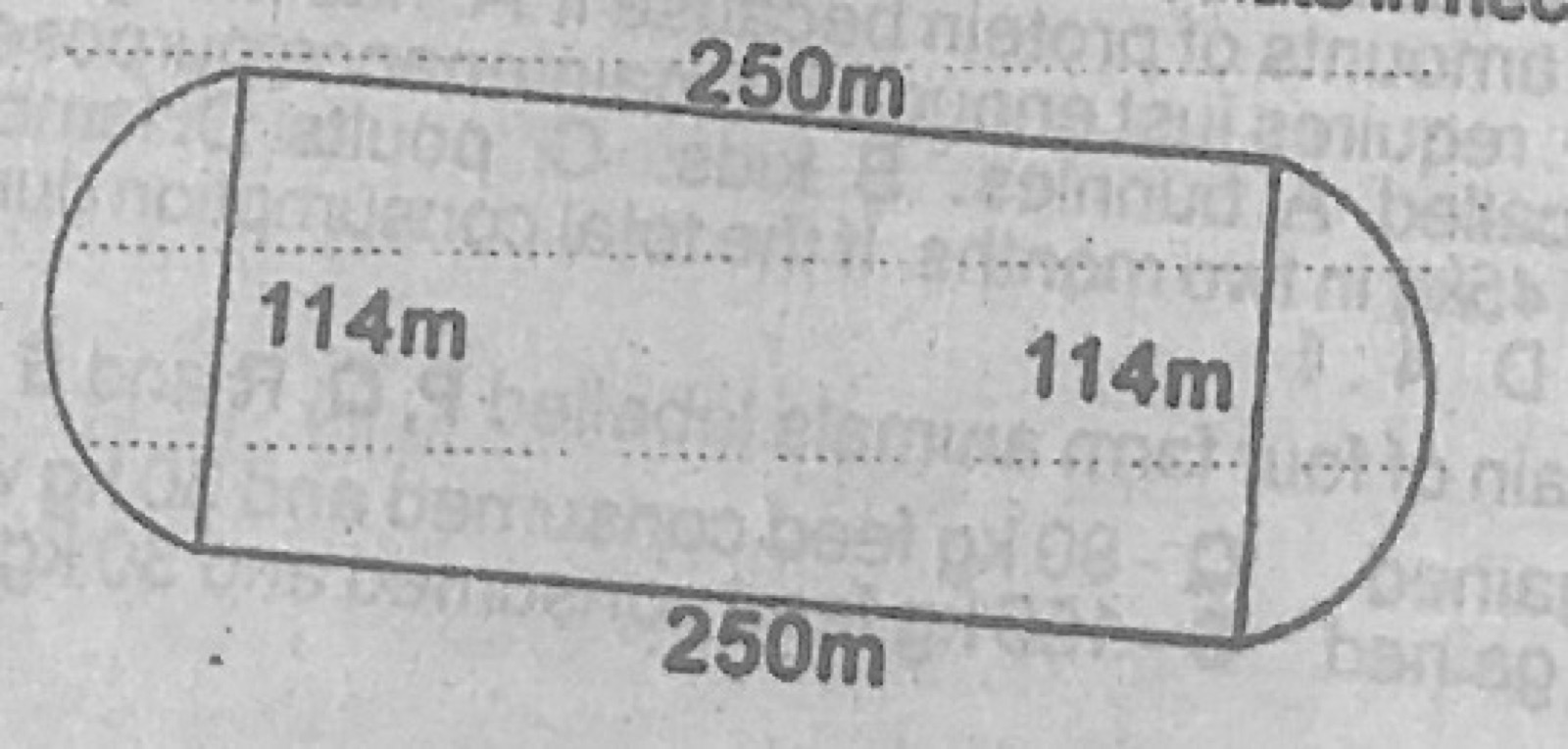
(a) State four ways in which rangeland is important in livestock production. (b) If the recommended grazing area per cattle is 3m x 3m. Calculate in hectares the carrying capacity of the rangeland illustrated in the diagram below. (c) State two benefits of each of the following management practices in animal production: (i) dipping; (ii) vaccination; (iii) artificial insemination.
Show the model answer
Model answer
(a) Any four: cheap source of feed (grass and legumes); grazing space for large herds; provides water and shade; serves as source of hay and silage; reduces cost of production; allows exercise and natural mating. (b) The field is a rectangle 250 m × 114 m with a semicircle (radius 57 m) at each end. Rectangle = 250 × 114 = 28,500 m²; two semicircles = πr² = 3.142 × 57 × 57 ≈ 10,208 m². Total ≈ 38,708 m² ≈ 3.87 ha. Area per animal = 3 m × 3 m = 9 m² = 0.0009 ha. Carrying capacity = 3.87 ha ÷ 0.0009 ha ≈ 4,300 cattle on 3.87 ha. (c)(i) Dipping: kills external parasites (ticks, lice); prevents tick-borne diseases. (ii) Vaccination: protects animals from specific diseases; prevents disease outbreaks and losses. (iii) Artificial insemination: one good male serves many females; spreads improved genes; prevents spread of sexually transmitted diseases; no need to keep a bull.
(a) Give three advantages and three disadvantages of the deep litter system of poultry management. (b) State three reasons for carrying out each of the following animal husbandary practices: (i) castration of goats; (ii) creep feeding of pigs. (c) Name four local breeds of cattle reared in West Africa.
Show the model answer
Model answer
(a) Advantages: birds are protected from predators and weather; litter becomes good manure; less labour than free range; records and feeding are easy; good for large numbers. Disadvantages: diseases and parasites spread easily; egg eating and cannibalism; dusty litter; dirty eggs laid on floor; more space than battery. (b)(i) Castration of goats: makes them docile and easy to handle; prevents unwanted breeding; improves meat quality and removes the strong smell; faster fattening. (ii) Creep feeding of piglets: supplements sow's milk; faster growth and higher weaning weight; prepares piglets for weaning; reduces stress on the sow. (c) Any four: White Fulani; Red Bororo; N'Dama; Muturu; Sokoto Gudali; Keteku; Kuri; West African Shorthorn.
(a)(i) Explain the term farm credit. (ii) List five sources of farm credit. (b) An outbreak of a strange poultry disease is reported in your community. There is the possibility of the disease spreading to other parts of the country. (i) Mention the three main extension teaching methods that could be used to create awareness among farmers about the disease. (ii) Which of the main extension teaching methods is most apropriate for creating awareness about the disease outbreak? (iii) Give two reasons for your choice of extension teaching method in 9(b)(ii). (iv) Mention three problems that could be encountered in the use of the selected extension teaching method.
Show the model answer
Model answer
(a)(i) Farm credit is money or inputs lent to a farmer for farm use, to be repaid later, usually with interest. (ii) Any five: commercial banks; Bank of Agriculture/agricultural development banks; co-operative societies; government agencies/schemes; money lenders; friends and relatives; esusu/thrift societies; merchants. (b)(i) Individual (farm and home visits); group methods (meetings, demonstrations); mass media methods (radio, TV, newspapers). (ii) Mass media method (e.g. radio/television). (iii) It reaches very many farmers over a wide area at once; it is fast, which matters in an emergency; it is cheap per farmer reached. (iv) Any three: some farmers have no radio/TV; power failure; language barrier; no chance for questions/feedback; illiterate farmers cannot read print media; message may be misunderstood.
Explanation
The answer to (b)(ii) is the mass media method; give reasons tied to speed and reach.
(a)(i) What is agricultural extension? (ii) State five demerits of cooperative soceities. (b)(i) Discuss three effects of rural-urban migration on agriculture. (ii) Suggest three ways by which the problems of rural-urban migration could be solved.
Show the model answer
Model answer
(a)(i) Agricultural extension is the service that educates farmers and carries improved farming practices and research findings to them, and their problems back to researchers. (ii) Any five: mismanagement and embezzlement of funds; poor leadership; illiteracy of members; lack of capital; disloyalty and lack of commitment of members; government interference; late repayment of loans; quarrels among members. (b)(i) Any three discussed: shortage and high cost of farm labour; farming left to old people, so production falls; food shortage and higher food prices; abandoned farms and slow adoption of new ideas. (ii) Any three: provide rural amenities (roads, water, electricity, health centres); give credit and inputs to young farmers; mechanise farming to make it attractive; establish agro-industries in rural areas; youth farm schemes and better prices for produce.