WAEC Agricultural Science 2008 past questions and answers

69 questions. Try each one, then open the answer to check yourself and read the explanation.

Question 1

Introduction to Agriculture

Which of the following benefits of agriculture is of least importance to the peasant farmer?

  1. A.Materials for shelter
  2. B.Employment
  3. C.Foreign exchange
  4. D.Income.
Show the answer and explanation

Answer: C (Foreign exchange)

Explanation

Foreign exchange matters to the country, not directly to a peasant family.

Open this question

Question 2

Crop Improvement

Farmers who plant improved maize would harvest

  1. A.pest-infested maize grains
  2. B.a high yield of maize
  3. C.plants with long stalks
  4. D.maize cobs with scattered grains.
Show the answer and explanation

Answer: B (a high yield of maize)

Explanation

Improved varieties are bred for high yield.

Open this question

Question 3

Land Use and Land Tenure

Which of the following land tenure systems allows the owner greatest freedom to dispose of the land as he wishes?

  1. A.Communal
  2. B.Free-hold
  3. C.Lease-hold
  4. D.Share-cropping.
Show the answer and explanation

Answer: B (Free-hold)

Explanation

A freeholder owns the land outright and can sell or give it away.

Open this question

Question 4

Agricultural Development

Which of the following is not a government agricultural programme?

  1. A.Operation Feed the Nation
  2. B.Agricultural Development Projects
  3. C.Farm Settlement Schemes
  4. D.West Africa Rice Development Agency.
Show the answer and explanation

Answer: D (West Africa Rice Development Agency.)

Explanation

WARDA is an international research body, not a national government programme.

Open this question

Question 5

Farming Systems

The practice of planting one type of annual crop each season is referred to as

  1. A.monoculture
  2. B.continuous cropping
  3. C.mono-cropping
  4. D.horticulture.
Show the answer and explanation

Answer: C (mono-cropping)

Explanation

Growing a single crop on the land in a season is mono-cropping.

Open this question

Question 6

Land Use and Land Tenure

The most important use of land for agricultural production is

  1. A.grazing paddocks
  2. B.botanical gardens
  3. C.game reserves
  4. D.farmstead construction.
Show the answer and explanation

Answer: A (grazing paddocks)

Explanation

Grazing paddocks are directly used to produce livestock.

Open this question

Question 7

Crop Pests

Which of the following biotic factors are usually used to control cassava mealybugs?

  1. A.Parasites
  2. B.Predators
  3. C.Pests
  4. D.Pathogens.
Show the answer and explanation

Answer: A (Parasites)

Explanation

A tiny parasitic wasp lays its eggs in the mealybug and kills it.

Open this question

Question 8

Rocks and Soil Formation

The following are types of sedimentary rocks except

  1. A.granite
  2. B.limestone
  3. C.sandstone
  4. D.dolomite.
Show the answer and explanation

Answer: A (granite)

Explanation

Granite is igneous.

Open this question

Question 9

Soil Properties

A reddish coloured soil indicates the presence of

  1. A.copper
  2. B.sodium
  3. C.iron
  4. D.manganese.
Show the answer and explanation

Answer: C (iron)

Explanation

Iron oxides give soil a red colour.

Open this question

Question 10

Rocks and Soil Formation

The three most important physical factors that influence rock weathering are

  1. A.colour, particle size and hardness of rock
  2. B.particle size, hardness and degree of cementation
  3. C.hardness, degree of cementation and colour
  4. D.particle size, temperature and colour.
Show the answer and explanation

Answer: B (particle size, hardness and degree of cementation)

Explanation

Grain size, hardness and how well particles are cemented decide how fast rock breaks down.

Open this question

Question 11

Irrigation and Drainage

Which of the following statements is not true about waterlogged soils?

  1. A.Such soils are heavily leached
  2. B.Denitrifying bacteria are more active in such soils than nitrifying bacteria
  3. C.Nitrosomonas yield best in such soils
  4. D.Soil temperature is usually low.
Show the answer and explanation

Answer: C (Nitrosomonas yield best in such soils)

Explanation

Nitrosomonas needs oxygen, which waterlogged soils lack.

Open this question

Question 12

Farming Systems

Which of the following crops should be planted on a piece of land that has been repeatedly cropped with maize?

  1. A.Guinea corn
  2. B.Millet
  3. C.Rice
  4. D.Cowpea.
Show the answer and explanation

Answer: D (Cowpea.)

Explanation

A legume like cowpea restores nitrogen and breaks the cereal pest cycle.

Open this question

Question 13

Soil Fertility and Plant Nutrition

Sources of nitrogen to the soil include the following except

  1. A.lightning
  2. B.urea
  3. C.blue-green algae
  4. D.residues of burning activities.
Show the answer and explanation

Answer: D (residues of burning activities.)

Explanation

Burning drives nitrogen off as gas.

Open this question

Question 14

Land Preparation and Cultural Practices

Which of the following statements about bush burning is false?

  1. A.It releases mineral nutrients bound in plant tissues
  2. B.It encourages the growth of fresh grasses
  3. C.The heat generated destroys pests
  4. D.The heat generated increases the population of soil organisms.
Show the answer and explanation

Answer: D (The heat generated increases the population of soil organisms.)

Explanation

Heat kills soil organisms.

Open this question

Question 15

Soil Fertility and Plant Nutrition

A farmer applied NPK 15:11:8 at planting. What is the percentage of potassium in the fertilizer?

  1. A.23.53%
  2. B.32.35%
  3. C.33.33%
  4. D.44.12%.
Show the answer and explanation

Answer: A (23.53%)

Explanation

Potassium's share of the nutrients = 8 ÷ (15 + 11 + 8) × 100 = 23.53%.

Open this question

Question 16

Irrigation and Drainage

The following equipment can be used for irrigation except

  1. A.bucket
  2. B.watering can
  3. C.knapsack sprayer
  4. D.siphon tube.
Show the answer and explanation

Answer: C (knapsack sprayer)

Explanation

Knapsack sprayers apply pesticides, not water.

Open this question

Question 17

Irrigation and Drainage

Excessive drainage of soil water can be checked by the addition of adequate quantities of

  1. A.N.P.K. 15 – 15 – 15
  2. B.sulphate of ammonia
  3. C.single superphosphate
  4. D.compost manure
Show the answer and explanation

Answer: D (compost manure)

Explanation

Organic matter holds water in the soil.

Open this question

Question 18

Farm Power

Considering all costs, the cheapest source of energy for domestic use is

  1. A.electricity
  2. B.sunlight
  3. C.biogas
  4. D.water.
Show the answer and explanation

Answer: B (sunlight)

Explanation

Sunlight is free.

Open this question

Question 19

Farm Machinery and Mechanisation

The implement used for pulverising the soil is the

  1. A.planter
  2. B.ridger
  3. C.harrow
  4. D.plough.
Show the answer and explanation

Answer: C (harrow)

Explanation

The harrow breaks clods into fine soil.

Open this question

Question 20

Poultry Production

An incubator is important in supplying

  1. A.heat for day-old chicks
  2. B.heat for embryo development
  3. C.light for candling eggs
  4. D.feed to chicks.
Show the answer and explanation

Answer: B (heat for embryo development)

Explanation

It keeps eggs warm so embryos develop.

Open this question

Question 21

Farm Surveying and Planning

A farm surveying equipment made of steel and used for measuring short distances is called

  1. A.prismatic compass
  2. B.measuring tape
  3. C.gunter's chain
  4. D.theodolite.
Show the answer and explanation

Answer: B (measuring tape)

Explanation

A steel tape measures short lengths; the chain is for long ones.

Open this question

Question 22

Farm Surveying and Planning

Which of the following statements about farmstead planning is false?

  1. A.Administrative blocks should not be located close to the entrance of the farmstead
  2. B.Waste disposal unit should be located far away from the main farm area
  3. C.All buildings should be well ventilated with good lightings
  4. D.Animal pens should not be located too close to the worker's house
Show the answer and explanation

Answer: A (Administrative blocks should not be located close to the entrance of the farmstead)

Explanation

The office should be near the entrance so visitors need not walk through the farm.

Open this question

Question 23

Land Preparation and Cultural Practices

The term supplying in crop production means

  1. A.pruning excess branches of crops
  2. B.spacing out crops during planting
  3. C.replacing ungerminated seeds on seedbeds
  4. D.adding enough fertilizer to the crops.
Show the answer and explanation

Answer: C (replacing ungerminated seeds on seedbeds)

Explanation

Supplying fills gaps where seeds did not germinate.

Open this question

Question 24

Plant Forms and Crop Classification

During photosynthesis, green plants convert carbon dioxide to

  1. A.chlorophyll
  2. B.carbohydrate
  3. C.protein
  4. D.carbonic acid.
Show the answer and explanation

Answer: B (carbohydrate)

Explanation

CO2 and water make sugars (carbohydrate).

Open this question

Question 25

Processing and Storage of Farm Produce

Parboiling in the processing of rice

  1. A.improves its digestibility
  2. B.increases grain mass
  3. C.reduces the percentage of breakage
  4. D.facilitates the polishing of rice.
Show the answer and explanation

Answer: C (reduces the percentage of breakage)

Explanation

Parboiled grains are harder and break less in milling.

Open this question

Question 26

Processing and Storage of Farm Produce

The main reason for removing the barks of cassava tubers before processing the tuber is to

  1. A.reduce the water content
  2. B.improve the protein content of products
  3. C.improve the shelf life of products
  4. D.reduce the cyanide content of products.
Show the answer and explanation

Answer: D (reduce the cyanide content of products.)

Explanation

Much of the cyanide is in the peel.

Open this question

Question 27

Processing and Storage of Farm Produce

Curing is carried out in the processing of

  1. A.cassava
  2. B.tobacco
  3. C.okro
  4. D.tomato.
Show the answer and explanation

Answer: B (tobacco)

Explanation

Tobacco leaves are cured (dried) by air, sun or fire.

Open this question

Question 28

Land Preparation and Cultural Practices

Tomato plants are staked for the following reasons except to

  1. A.produce clean fruits
  2. B.reduce pest damage to fruits
  3. C.increase the yield
  4. D.improve the taste.
Show the answer and explanation

Answer: D (improve the taste.)

Explanation

Staking does not change taste.

Open this question

Question 29

Crop Propagation

A vegetatively propagated citrus plant will produce fruits earlier than the one established from seeds because

  1. A.it would not suffer from gummosis disease
  2. B.insect pests do not attack it
  3. C.it is more advanced at the time of establishment
  4. D.the flowers are wind pollinated.
Show the answer and explanation

Answer: C (it is more advanced at the time of establishment)

Explanation

Budwood comes from a mature tree, so it fruits sooner.

Open this question

Question 30

Crop Diseases

Swollen shoot disease of cocoa is caused by a

  1. A.virus
  2. B.fungus
  3. C.bacteria
  4. D.nematode.
Show the answer and explanation

Answer: A (virus)

Explanation

Cocoa swollen shoot is viral, spread by mealybugs.

Open this question

Question 31

Crop Husbandry

Groundnut grows best on a

  1. A.well-drained, light sandy-loam soil
  2. B.well-drained, clayey friable soil
  3. C.swampy, sandy-clay soil
  4. D.well-drained, clayey-loam soil.
Show the answer and explanation

Answer: A (well-drained, light sandy-loam soil)

Explanation

Pods form underground and need light, loose soil.

Open this question

Question 32

Pasture and Forage Crops

Which of the following characteristics is not true of a good pasture crop?

  1. A.High palatability
  2. B.High nutritive value
  3. C.Resistance to trampling
  4. D.Poor digestibility.
Show the answer and explanation

Answer: D (Poor digestibility.)

Explanation

A good pasture is easy to digest.

Open this question

Question 33

Forestry and Wildlife

The benefits of establishing forests do not include

  1. A.derivation of medicine
  2. B.provision of food
  3. C.improvement of micro-climate
  4. D.shading of crops.
Show the answer and explanation

Answer: D (shading of crops.)

Explanation

Forests are not set up to shade field crops.

Open this question

Question 34

Ornamental Plants

Floriculture is a subdivision of horticulture which deals with the cultivation of

  1. A.fruit crops
  2. B.vegetables
  3. C.ornamental plants
  4. D.spices
Show the answer and explanation

Answer: C (ornamental plants)

Explanation

Floriculture is growing flowers and ornamentals.

Open this question

Question 35

Crop Pests

Which of the following insect pests causes defoliation in crops?

  1. A.Mirid
  2. B.Grasshopper
  3. C.Weevil
  4. D.Aphid.
Show the answer and explanation

Answer: B (Grasshopper)

Explanation

Grasshoppers eat leaves, stripping plants.

Open this question

Question 36

Crop Pests

Which of the following pesticides effectively control maize stem borers?

  1. A.Systemic insecticides
  2. B.Contact poisons
  3. C.Nematicides
  4. D.Fumigants.
Show the answer and explanation

Answer: A (Systemic insecticides)

Explanation

Borers hide inside stems; systemic insecticides move into the plant and reach them.

Open this question

Question 37

Crop Diseases

Which of the following combinations of practices best controls groundnut rosette disease?

  1. A.Late planting and spraying of insecticide
  2. B.Early planting and spraying of nematicide
  3. C.Late planting and spraying of fungicide
  4. D.Early planting and spraying of insecticide.
Show the answer and explanation

Answer: D (Early planting and spraying of insecticide.)

Explanation

Early planting avoids aphid peaks; insecticide kills the aphid vector.

Open this question

Question 38

Weeds and Weed Control

Determine the number of bottles of a herbicide required to spray 25 hectares of farmland, if one bottle is needed to prepare 100 litres and the diluted product is applied at a rate of 20 litres per hectare.

  1. A.2 bottles
  2. B.5 bottles
  3. C.8 bottles
  4. D.11 bottles.
Show the answer and explanation

Answer: B (5 bottles)

Explanation

25 × 20 = 500 litres; 500 ÷ 100 = 5 bottles.

Open this question

Question 39

Animal Anatomy and Physiology

The milk secreting organ in cattle is the

  1. A.dewlap
  2. B.udder
  3. C.comb
  4. D.muzzle.
Show the answer and explanation

Answer: B (udder)

Explanation

The udder secretes milk.

Open this question

Question 40

Animal Reproduction

A developing embryo derives its nutrition from the mother

  1. A.through the blood vessels located in the placenta
  2. B.by sucking the mammary glands
  3. C.by direct diffusion through the blood vessels in the liver
  4. D.through the blood vessels located in the intestine of the mother.
Show the answer and explanation

Answer: A (through the blood vessels located in the placenta)

Explanation

Nutrients pass from the mother's blood through the placenta.

Open this question

Question 41

Animal Anatomy and Physiology

Birds store their food in the

  1. A.crop
  2. B.gizzard
  3. C.proventriculus
  4. D.cloaca.
Show the answer and explanation

Answer: A (crop)

Explanation

The crop stores food.

Open this question

Question 42

Animal Reproduction

The following are examples of natural mating methods except

  1. A.pen mating
  2. B.flock mating
  3. C.hand mating
  4. D.block mating.
Show the answer and explanation

Answer: D (block mating.)

Explanation

Pen, flock and hand mating are recognised methods; "block mating" is not.

Open this question

Question 43

Animal Anatomy and Physiology

The milk collection vessel of the mammary gland is the

  1. A.alveolus
  2. B.gland cistern
  3. C.teat
  4. D.streak canal.
Show the answer and explanation

Answer: B (gland cistern)

Explanation

Milk collects in the gland cistern.

Open this question

Question 44

Poultry Production

Fertile eggs will be produced by breeders if the

  1. A.laying units are well illuminated
  2. B.cocks are always kept with the hens
  3. C.hens are not allowed to brood
  4. D.eggs collected are kept at the correct temperature.
Show the answer and explanation

Answer: B (cocks are always kept with the hens)

Explanation

Eggs are only fertile if hens are mated by cocks.

Open this question

Question 45

Livestock Management

The rabbit is able to utilize forages because

  1. A.it has an enlarged caecum that digests fibre
  2. B.the small intestine is rich in microbes
  3. C.the mouth has large molars for grinding
  4. D.the length of the gut is relatively short.
Show the answer and explanation

Answer: A (it has an enlarged caecum that digests fibre)

Explanation

Microbes in the large caecum digest fibre.

Open this question

Question 46

Poultry Production

If feed efficiency for egg production is defined as feed consumed per 10 eggs, what will be the feed efficiency for a layer that laid 230 eggs and consumed 26kg feed?

  1. A.0.88
  2. B.1.13
  3. C.1.76
  4. D.2.23
Show the answer and explanation

Answer: B (1.13)

Explanation

230 eggs = 23 lots of 10; 26 ÷ 23 = 1.13 kg per 10 eggs.

Open this question

Question 47

Animal Nutrition

When birds are fed on a ration deficient in riboflavin, which of the following symptoms will they show?

  1. A.Night blindness
  2. B.Cataract
  3. C.Curled-toe paralysis
  4. D.Scurvy.
Show the answer and explanation

Answer: C (Curled-toe paralysis)

Explanation

Riboflavin (B2) deficiency causes curled-toe paralysis in chicks.

Open this question

Question 48

Pasture and Forage Crops

Livestock are said to feed on the range when they eat

  1. A.fresh herbage at the milking parlour
  2. B.fresh herbage directly from the pasture
  3. C.harvested herbage in a stall
  4. D.preserved herbage in the form of silage.
Show the answer and explanation

Answer: B (fresh herbage directly from the pasture)

Explanation

Range feeding is grazing directly on pasture.

Open this question

Question 50

Animal Health

Liverfluke infestation causes disturbance in lipid digestion because it

  1. A.blocks the passage of fat to intestine
  2. B.blocks the bile duct and reduces secretion of bile
  3. C.destroys the lipase enzyme
  4. D.prevents fat excretion.
Show the answer and explanation

Answer: B (blocks the bile duct and reduces secretion of bile)

Explanation

Bile is needed to emulsify fat; flukes block the bile ducts.

Open this question

Question 51

Animal Health

A farmer noticed that one of his cows has high fever, blood-stained diarrhoea and often grinds its teeth. This shows that the cow is infected by

  1. A.rinderpest
  2. B.anthrax
  3. C.brucellosis
  4. D.aspergillosis.
Show the answer and explanation

Answer: A (rinderpest)

Explanation

Fever with bloody diarrhoea is typical of rinderpest.

Open this question

Question 52

Fisheries and Aquaculture

Temperature is an important factor in fish ponds because it

  1. A.affects the metabolic processes in fish
  2. B.determines the sex of fishes
  3. C.encourages the growth of phytoplanktons
  4. D.affects the type of species of fish.
Show the answer and explanation

Answer: A (affects the metabolic processes in fish)

Explanation

Fish body processes run at the water temperature.

Open this question

Question 53

Fisheries and Aquaculture

An illegal method of harvesting fish is by the use of

  1. A.drag net
  2. B.potassium cyanide
  3. C.hook and line
  4. D.calcium carbonate.
Show the answer and explanation

Answer: B (potassium cyanide)

Explanation

Poisoning with cyanide is banned.

Open this question

Question 54

Animal Improvement

How can the offspring of a bull continue to be produced long after its death? By

  1. A.using the preserved semen for artificial insemination
  2. B.collecting the semen of the offspring for use in artificial insemination
  3. C.crossing the male and female offspring
  4. D.preserving the body of the dead animal.
Show the answer and explanation

Answer: A (using the preserved semen for artificial insemination)

Explanation

Frozen semen can be used for years.

Open this question

Question 55

Basic Agricultural Economics

Which of the following factors of production has profit as its reward?

  1. A.Land
  2. B.Labour
  3. C.Capital
  4. D.Management.
Show the answer and explanation

Answer: D (Management.)

Explanation

Management (the entrepreneur) earns profit.

Open this question

Question 56

Basic Agricultural Economics

A farm business makes profit when

  1. A.total revenue equals total cost
  2. B.total cost exceeds total revenue
  3. C.total revenue exceeds total cost
  4. D.average cost equals total revenue.
Show the answer and explanation

Answer: C (total revenue exceeds total cost)

Explanation

Profit is revenue above cost.

Open this question

Question 57

Agricultural Finance

Agricultural business is difficult to insure in West Africa mainly because

  1. A.agricultural production is not very profitable
  2. B.agricultural production is highly risky
  3. C.many farmers are very poor
  4. D.the premium is high
Show the answer and explanation

Answer: B (agricultural production is highly risky)

Explanation

Weather, pests and disease make losses frequent and hard to insure.

Open this question

Question 58

Farm Management and Records

A tractor with an expected life of 10 years was bought for Le 15.0m at the end of which it was to be sold for Le 1.0m. Its calculated depreciation is

  1. A.Le 1.4m
  2. B.Le 1.5m
  3. C.Le 1.6m
  4. D.Le 1.7m.
Show the answer and explanation

Answer: A (Le 1.4m)

Explanation

(15.0 − 1.0) ÷ 10 = Le 1.4m a year.

Open this question

Question 59

Agricultural Extension

The aims and objectives of agricultural extension education do not include

  1. A.educating farmers on the use of new tools
  2. B.educating farmers on governments' annual budgets
  3. C.encouraging farmers to obtain loans for farming
  4. D.encouraging farmers to use meteorological information in farming.
Show the answer and explanation

Answer: B (educating farmers on governments' annual budgets)

Explanation

Government budgets are not an extension topic.

Open this question

Question 60

Agricultural Extension

The process which a farmer goes through from the time he hears about a new idea till he finally accepts it, is referred to as

  1. A.evolution
  2. B.revolution
  3. C.diffusion
  4. D.adoption.
Show the answer and explanation

Answer: D (adoption.)

Explanation

Moving from awareness to acceptance is the adoption process.

Open this question

Theory question 101

Introduction to Agriculture

(a)(i) Define agriculture. (ii) List six branches of agriculture.
(b) State five differences between commercial agriculture and subsistence agriculture.
(c) State three merits and three demerits of using animal power on the farm.

Show the model answer
Model answer

(a)(i) Agriculture is the science and art of growing crops and rearing animals for man's use, including processing and marketing of the products
(ii) Any six: crop science; animal science; soil science; agricultural economics; agricultural extension; agricultural engineering; fisheries; forestry; crop protection; home economics
(b) Any five (commercial vs subsistence): large vs small farms; high vs low capital; machines vs simple tools; hired skilled vs family labour; for sale/export vs family use; high vs low output; records kept vs rarely kept; specialised/monocropping vs mixed cropping
(c) Merits (any three): cheap to keep; pull heavy loads; give manure; can work on rough land; little technical skill needed; meat at end of working life. Demerits (any three): slow; get tired and sick; need feeding and care all year; cover small areas; may damage crops; need training

Explanation

Use a table for the differences.

Open this question

Theory question 102

Farm Surveying and Planning

(a)(i) Explain the term farm surveying (ii) State four reasons why farm surveying is important
(b) Enumerate six problems facing agricultural development in West Africa.
(c) List four factors that may affect the efficiency of draught animals.

Show the model answer
Model answer

(a)(i) Farm surveying is measuring and mapping the size, shape, boundaries and features of farmland
(ii) Any four: gives the exact size and boundaries; helps plan layout of fields and buildings; helps estimate inputs; settles land disputes; needed for title documents and loans; shows slopes for drainage and erosion control
(b) Any six: land tenure; poor finance/credit; scarce inputs; poor storage and processing; poor transport; illiteracy and weak extension; pests and diseases; poor marketing; low mechanisation; inconsistent government policy; lack of rural amenities
(c) Any four: health of the animal; breed; age; nutrition/feeding; training; size and strength; temperament; weather; type and weight of the implement; management/handling

Explanation

Define, then lists.

Open this question

Theory question 103

Soil Properties

(a) Define the term soil
(b)(i) List the four components of soil (ii) State the percentage of each component by volume
(c) Describe the process involved in making compost using the pit method under the following headings: (i) materials; (ii) preparation; (iii) storage

Show the model answer
Model answer

(a) Soil is the loose, weathered upper layer of the earth's crust in which plants grow, made up of mineral matter, organic matter, water and air
(b) Mineral matter about 45%; organic matter about 5%; water about 25%; air about 25%
(c)(i) Materials: plant residues (grass, leaves, crop residues), animal dung/urine, kitchen waste, wood ash/lime, topsoil, water, poles or sticks
(ii) Preparation: dig a pit (e.g. 1–2 m wide, about 1 m deep) in a shady well-drained place; put coarse materials at the bottom; add layers of plant material, then dung, then a sprinkle of ash/lime and topsoil; water each layer; repeat to the top; insert a stick to check heat; turn the heap every few weeks; compost is ready in about 2–3 months when dark and crumbly
(iii) Storage: keep covered in a shaded place, protected from sun and rain to prevent loss of nutrients by drying and leaching; use soon

Explanation

Give the four components with approximate volumes.

Open this question

Theory question 104

Soil Erosion and Conservation

(a) Define soil erosion.
(b) List four factors that influence nutrient availability in the soil.
(c) Explain two roles of each of the following factors in soil formation: (i) climate; (ii) living organisms; (iii) topography;
(d) State four problems associated with overhead irrigation.

Show the model answer
Model answer

(a) Soil erosion is the wearing away and removal of the topsoil by water, wind or other agents
(b) Any four: soil pH; leaching; organic matter content; soil texture; soil moisture; soil micro-organisms; temperature and aeration; cation exchange capacity
(c)(i) Climate: rainfall supplies water for chemical weathering and leaching; temperature changes crack rocks and speed reactions
(ii) Living organisms: roots break rocks and add organic matter; animals and microbes mix soil and decompose remains into humus
(iii) Topography: steep slopes lose soil by erosion giving shallow soils; low-lying areas collect deposits and may be waterlogged, giving deep soils
(d) Any four: high cost of equipment and running; needs pumping/pressure; water lost by evaporation and drift in wind; wets leaves, encouraging fungal diseases; can wash off sprayed chemicals; may cause erosion or crusting; needs clean water free of debris

Explanation

Two roles for each soil-forming factor.

Open this question

Theory question 105

Farming Systems

(a)(i) Define crop rotation. (ii) Design a four-year crop rotation system using yam, cassava, maize and groundnut
(b) State four reasons why weeds are difficult to control.
(c) Mention two effects of diseases on crop production.

Show the model answer
Model answer

(a)(i) Crop rotation is the growing of different crops in a planned order on the same piece of land over a number of seasons
(ii) Example (four plots, crops move each year): Year 1 – yam (heavy feeder after fallow); Year 2 – maize; Year 3 – groundnut (legume restores nitrogen); Year 4 – cassava (tolerant of poorer soil); then back to yam. Other orders acceptable if a heavy feeder follows the legume or fallow and crops of the same family do not follow each other
(b) Any four: produce many seeds; seeds stay dormant in soil for years; spread by rhizomes, stolons and tubers; seeds dispersed easily; grow fast; resistant to herbicides; some look like crops; deep roots
(c) Any two: reduce yield; lower quality and market value; kill plants; increase cost of production; reduce viability of seeds

Explanation

Show the rotation as a table of plots and years.

Open this question

Theory question 106

Basic Genetics

(a) Define crop improvement.
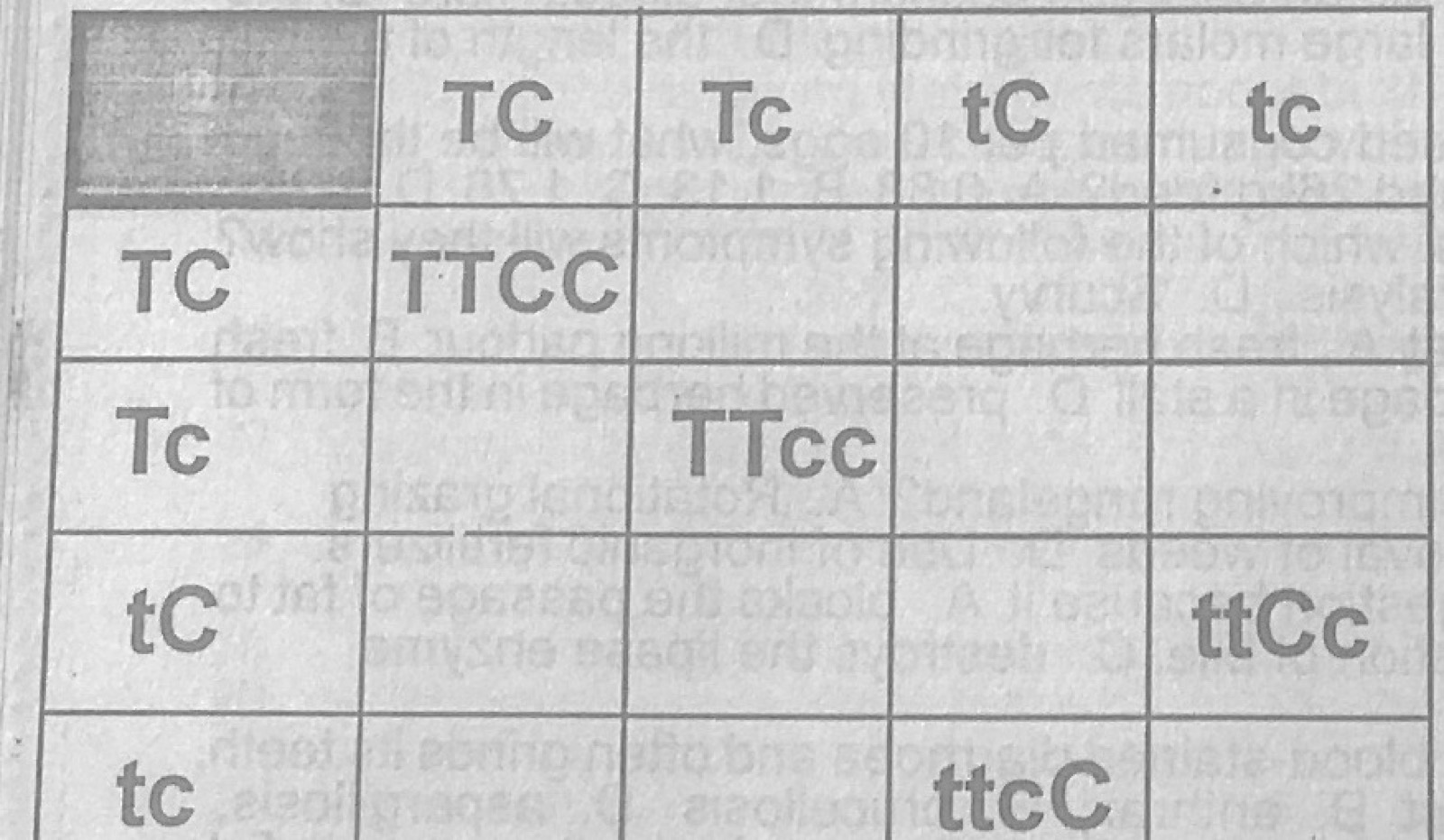
(b) Copy and complete the Punnett square (gametes TC, Tc, tC, tc on each side) based on Mendel's Law of Independent Assortment of Genes (Dihybrid inheritance), where T = Tall, C = Coloured, t = Dwarf, c = White, T and C dominant.
(c) Calculate the percentage of plants in 6(b) above that are: (i) Tall coloured; (ii) Tall white; (iii) Dwarf coloured; (iv) Dwarf white.

Diagram for this question
Show the model answer
Model answer

(a) Crop improvement is the development of better crop varieties (higher yield, quality, resistance) through introduction, selection, breeding and other methods
(b) Rows TC: TTCC, TTCc, TtCC, TtCc; Tc: TTCc, TTcc, TtCc, Ttcc; tC: TtCC, TtCc, ttCC, ttCc; tc: TtCc, Ttcc, ttCc, ttcc
(c) Ratio 9 : 3 : 3 : 1 out of 16: (i) tall coloured 9/16 = 56.25%; (ii) tall white 3/16 = 18.75%; (iii) dwarf coloured 3/16 = 18.75%; (iv) dwarf white 1/16 = 6.25%

Explanation

Fill all 16 boxes, then count phenotypes.

Open this question

Theory question 107

Livestock Management

(a) Name four breeds of rabbits.
(b) Give two reasons why oestrus detection is important in farm animals.
(c) State four functions of each of the following hormones in farm animals: (i) androgen; (ii) oestrogen.
(d)(i) List two viral diseases of poultry (ii) List two ecto-parasites of poultry.

Show the model answer
Model answer

(a) Any four: New Zealand White; Californian; Chinchilla; Flemish Giant; Dutch; Angora; Rex; local rabbit
(b) Any two: to mate/inseminate at the right time; increases conception rate; avoids wasting time and feed on open females; helps plan births; detects reproductive problems
(c)(i) Androgen (testosterone): male secondary sex characters; sperm production; sex drive (libido); muscle growth; development of accessory sex glands
(ii) Oestrogen: heat/oestrus behaviour; female secondary sex characters; development of mammary glands; prepares the uterus for pregnancy; growth of the reproductive tract
(d)(i) Any two: Newcastle disease; fowl pox; Gumboro (infectious bursal disease); Marek's disease; avian influenza; infectious bronchitis
(ii) Any two: lice; mites; fleas; ticks; bed bugs

Explanation

Lists under each part.

Open this question

Theory question 108

Livestock Management

(a) List four methods of identification in cattle production
(b) State three reasons for carrying out each of the following animal husbandary practices: (i) Culling of poultry; (ii) dehorning of cattle
(c) Mention the botanical names of four pasture legumes grown in West Africa
(d) State four ways of preserving harvested fish.

Show the model answer
Model answer

(a) Any four: ear tagging; branding; tattooing; ear notching; neck chains/collars; naming; photographs
(b)(i) Culling poultry (any three): remove poor layers to cut feed cost; remove sick birds to stop spread of disease; remove old/unproductive birds; reduce overcrowding; improve flock productivity
(ii) Dehorning (any three): prevents injury to other animals and handlers; easier handling; less space needed in pens and transport; reduces bruising of carcass and damage to hides
(c) Any four: Centrosema pubescens; Stylosanthes gracilis; Pueraria phaseoloides; Calopogonium mucunoides; Leucaena leucocephala; Desmodium spp.; Mucuna utilis
(d) Any four: smoking; sun drying; salting; freezing/chilling; canning; frying

Explanation

Write botanical names correctly (genus capital, species small).

Open this question

Theory question 109

Basic Agricultural Economics

(a) Define: (i) demand; (ii) price elasticity of demand.
(b) Explain why the demand curve slopes downwards
(c) List four agents of agricultural marketing
(d) State two advantages and one disadvantage of each of the following agricultural extension teaching methods: (i) newspapers; (ii) television.

Show the model answer
Model answer

(a)(i) Demand is the quantity of a commodity consumers are willing and able to buy at a given price and time
(ii) Price elasticity of demand is the degree of responsiveness of quantity demanded to a change in price (% change in quantity ÷ % change in price)
(b) As price falls, more people can afford the commodity and existing buyers buy more (income and substitution effects; diminishing marginal utility), so quantity demanded rises as price falls – the curve slopes downward from left to right
(c) Any four: wholesalers; retailers; middlemen/brokers; cooperative societies; commodity boards; processors; exporters; producers
(d)(i) Newspapers – advantages: reach many people; permanent, can be kept for reference; cheap. Disadvantage: useless to illiterate farmers; may not reach rural areas
(ii) Television – advantages: shows pictures and steps clearly; reaches many people at once; attractive. Disadvantage: costly; needs electricity; no direct feedback

Explanation

Define, explain the curve, then lists.

Open this question

Theory question 110

Basic Agricultural Economics

(a) List four factors that cause a change in supply of agricultural produce
(b) Distinguish between fixed cost and variable cost giving two examples in each case
(c) Explain the following agricultural extension teaching methods: (i) posters; (ii) field trips.

Show the model answer
Model answer

(a) Any four: price of the produce; cost of inputs; weather; technology; government policy (taxes, subsidies); prices of other products; pests and diseases; number of producers; storage and transport facilities
(b) Fixed costs do not change with the level of output (land rent, buildings, machinery depreciation, permanent staff salaries, insurance); variable costs change with output (seeds, fertilizer, feed, casual labour, fuel, chemicals)
(c)(i) Posters: large printed pictures with short messages displayed in public places to draw farmers' attention to a practice or event; cheap but need some literacy
(ii) Field trips: farmers are taken to visit research stations, demonstration plots or successful farms to see improved practices in action; learning by seeing
Explanation

Two examples each for fixed and variable costs.

Open this question