WAEC Agricultural Science 2000 past questions and answers

68 questions. Try each one, then open the answer to check yourself and read the explanation.

Question 1

Introduction to Agriculture

The primary role of agriculture is the provision of

  1. A.foreign exchange earnings
  2. B.raw materials for industries
  3. C.food for man and his animals
  4. D.employment and income for farmers.
Show the answer and explanation

Answer: C (food for man and his animals)

Explanation

Above all, agriculture produces food.

Open this question

Question 2

Introduction to Agriculture

In subsistence agriculture,

  1. A.yields are usually high
  2. B.surplus produced is small
  3. C.savings are made
  4. D.farm sizes are large.
Show the answer and explanation

Answer: B (surplus produced is small)

Explanation

Subsistence farmers produce mainly for their families, leaving little surplus.

Open this question

Question 3

Crop Husbandry

An area of land where fruit trees are grown is commonly called a/an

  1. A.plantation
  2. B.nursery
  3. C.green house
  4. D.orchard.
Show the answer and explanation

Answer: D (orchard.)

Explanation

An orchard is land planted with fruit trees.

Open this question

Question 4

Agricultural Development

The most important factor that determines the rate of agricultural development is

  1. A.adoption of viable agricultural research findings
  2. B.quantity of herbicides used
  3. C.number of machinery available
  4. D.number of people involved in agriculture.
Show the answer and explanation

Answer: A (adoption of viable agricultural research findings)

Explanation

Development depends on farmers putting good research results into practice.

Open this question

Question 5

Land Use and Land Tenure

The Land Use Decree of 1978 vested lands in each state of the country on the

  1. A.individual
  2. B.state governors
  3. C.president of the country
  4. D.commissioner for agriculture.
Show the answer and explanation

Answer: B (state governors)

Explanation

The decree placed land in each state in the hands of the Governor.

Open this question

Question 6

Agricultural Development

Which of the following statements is not correct about agricultural regulations within a country? They are

  1. A.different from one geographical location to another
  2. B.based on the conditions prevailing in a particular country
  3. C.aimed at maintaining good quality farm produce
  4. D.aimed at increasing agricultural production.
Show the answer and explanation

Answer: A (different from one geographical location to another)

Explanation

A country's regulations apply across the whole country, not differently from place to place.

Open this question

Question 7

Agricultural Development

The recommended agricultural practice in farm settlement scheme is

  1. A.poultry farming
  2. B.continuous cropping
  3. C.mixed farming
  4. D.cash crop production.
Show the answer and explanation

Answer: C (mixed farming)

Explanation

Settlers were encouraged to combine crops and livestock (mixed farming).

Open this question

Question 8

Agricultural Finance

Which of the following agricultural programmes covers risk and uncertainties in agricultural business?

  1. A.Agricultural Development Project
  2. B.Agricultural Insurance Scheme
  3. C.River Basin Development Authority
  4. D.Farm Settlement Scheme.
Show the answer and explanation

Answer: B (Agricultural Insurance Scheme)

Explanation

Insurance compensates farmers for losses.

Open this question

Question 9

Agricultural Development

Government agricultural policies include the following except

  1. A.increasing the production of food crops and animals
  2. B.increasing the efficiency of production of export crops
  3. C.supplying raw materials for use in local industries
  4. D.increasing the number of peasant farmers.
Show the answer and explanation

Answer: D (increasing the number of peasant farmers.)

Explanation

Government aims to modernise farming, not to increase peasant farmers.

Open this question

Question 10

Land Use and Land Tenure

Agricultural uses of land include

  1. A.silviculture
  2. B.mining
  3. C.housing
  4. D.transportation.
Show the answer and explanation

Answer: A (silviculture)

Explanation

Silviculture (growing forest trees) is an agricultural use.

Open this question

Question 11

Forestry and Wildlife

The main aim of establishing game reserves is to

  1. A.prevent rare species of wild animals from extinction
  2. B.generate income
  3. C.provide employment
  4. D.discourage poaching.
Show the answer and explanation

Answer: A (prevent rare species of wild animals from extinction)

Explanation

Game reserves protect wildlife from dying out.

Open this question

Question 12

Livestock Management

The equatorial rain forest belt is not usually used for cattle production because of the

  1. A.low relative humidity
  2. B.absence of natural grasslands
  3. C.incidence of tsetse flies
  4. D.dense vegetative growth.
Show the answer and explanation

Answer: C (incidence of tsetse flies)

Explanation

Tsetse flies in the forest spread trypanosomiasis to cattle.

Open this question

Question 13

Rocks and Soil Formation

Which of the following is not an example of metamorphic rock?

  1. A.Granite
  2. B.Gneiss
  3. C.Schist
  4. D.Quartzite.
Show the answer and explanation

Answer: A (Granite)

Explanation

Granite is igneous.

Open this question

Question 14

Soil Erosion and Conservation

The most important factor affecting the rate of erosion is the

  1. A.amount of organic matter in the soil
  2. B.slope of the land
  3. C.composition of soil
  4. D.amount of rainfall.
Show the answer and explanation

Answer: D (amount of rainfall.)

Explanation

Water erosion is driven mainly by the amount and intensity of rain.

Open this question

Question 15

Soil Properties

Which of the following soil characteristics is constant?

  1. A.Moisture content
  2. B.Texture
  3. C.Structure
  4. D.Mineral matter content.
Show the answer and explanation

Answer: B (Texture)

Explanation

Particle sizes (texture) cannot easily be changed.

Open this question

Question 16

Soil Fertility and Plant Nutrition

A farmer who applies gypsum on his farmland intends to

  1. A.decrease soil acidity
  2. B.increase soil acidity
  3. C.decrease soil alkalinity
  4. D.increase soil alkalinity.
Show the answer and explanation

Answer: C (decrease soil alkalinity)

Explanation

Gypsum's calcium replaces sodium in alkaline soils, which is then washed out.

Open this question

Question 17

Soil Fertility and Plant Nutrition

In the nitrogen cycle, nitrosomonas and nitrobacter are responsible for

  1. A.ammonification
  2. B.nitrification
  3. C.denitrification
  4. D.nitrogen reduction.
Show the answer and explanation

Answer: B (nitrification)

Explanation

They oxidise ammonium to nitrite and nitrite to nitrate.

Open this question

Question 18

Soil Fertility and Plant Nutrition

Wood ash and oil palm bunches are rich sources of

  1. A.potassium
  2. B.nitrogen
  3. C.molybdenum
  4. D.sulphur.
Show the answer and explanation

Answer: A (potassium)

Explanation

Ash from wood and empty bunches is rich in potash.

Open this question

Question 19

Soil Fertility and Plant Nutrition

If 200 kg of NPK fertilizer is required for an hectare of maize farm, calculate the amount of the fertilizer required for 15 hectares of maize farm

  1. A.600 kg
  2. B.2,000 kg
  3. C.3,000 kg
  4. D.6,000 kg.
Show the answer and explanation

Answer: C (3,000 kg)

Explanation

200 × 15 = 3,000 kg.

Open this question

Question 20

Soil Fertility and Plant Nutrition

In agriculture, which of the following statements best explains the equation below: (NH4)2SO4 + 4O2 → 2HNO3 + H2SO4 + H2O

  1. A.The increase in soil acidity resulting from sulphate of ammonia
  2. B.The increase of soil nutrients by sulphate of ammonia
  3. C.The release of soil nutrients by sulphate of ammonia
  4. D.The neutralization of sulphate of ammonia in the soil.
Show the answer and explanation

Answer: A (The increase in soil acidity resulting from sulphate of ammonia)

Explanation

The products are nitric and sulphuric acids, so the soil becomes more acidic.

Open this question

Question 21

Farm Power

Which of the following is the correct trend in the historical development of power on the farm?

  1. A.Animal power → man power → mechanical power
  2. B.Man power → animal power → mechanical power
  3. C.Man power → mechanical power → animal power
  4. D.Animal power → mechanical power → man power.
Show the answer and explanation

Answer: B (Man power → animal power → mechanical power)

Explanation

Farmers first used their own strength, then animals, then machines.

Open this question

Question 22

Farm Power

The major advantage of human power over all other sources of power is man's

  1. A.normal power output of 75 watts per day
  2. B.ability to work in any climatic condition
  3. C.intelligence to control work
  4. D.strength when at work.
Show the answer and explanation

Answer: C (intelligence to control work)

Explanation

Only man can think and direct work.

Open this question

Question 23

Farm Machinery and Mechanisation

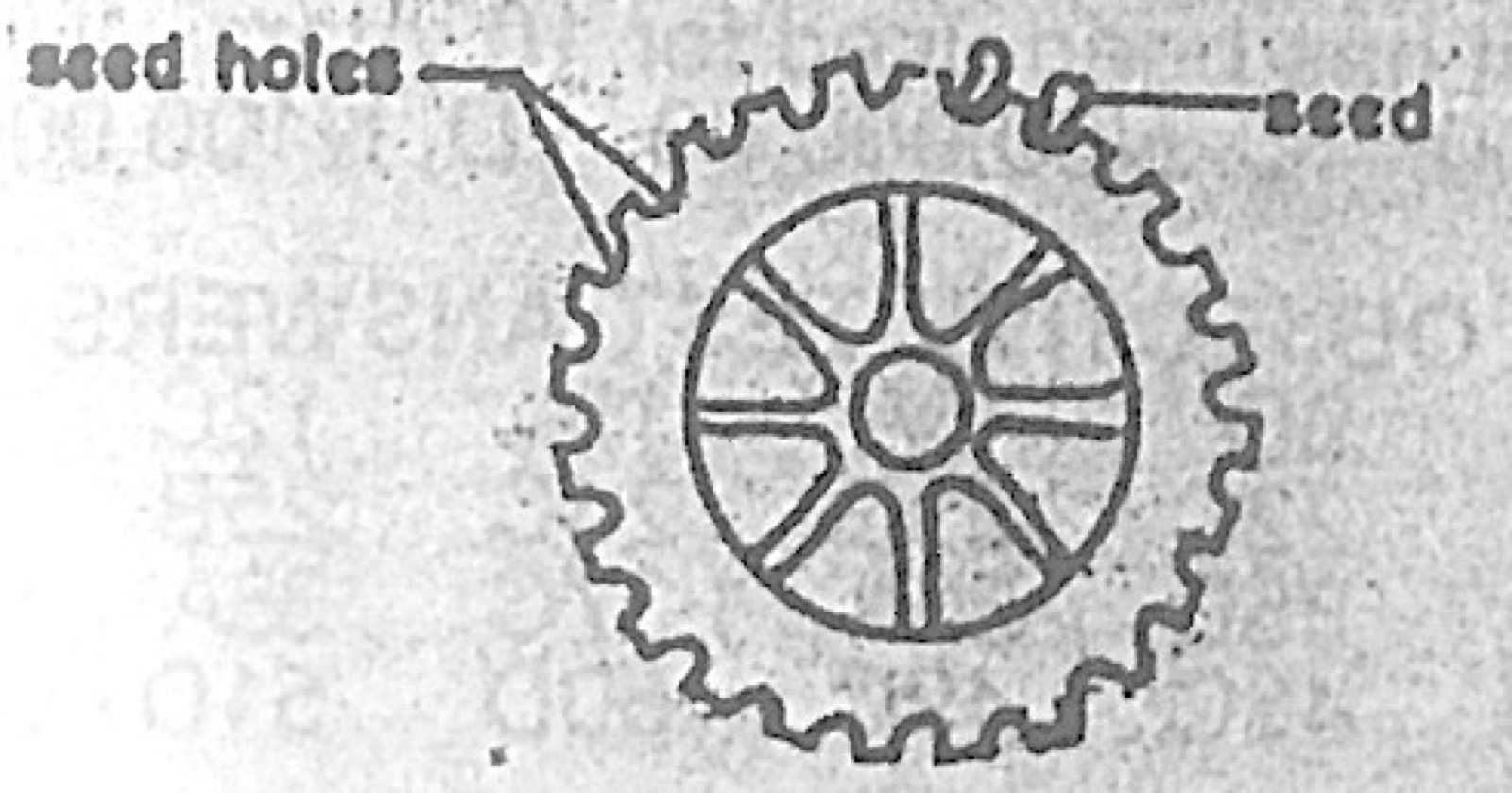
The diagram represents the seed plate of a drill. This seed plate has

Diagram for this question
  1. A.an entire edge
  2. B.pointed edges
  3. C.smooth edges
  4. D.serrated edges.
Show the answer and explanation

Answer: D (serrated edges.)

Explanation

The edge is notched with seed holes like teeth: serrated.

Open this question

Question 24

Farm Machinery and Mechanisation

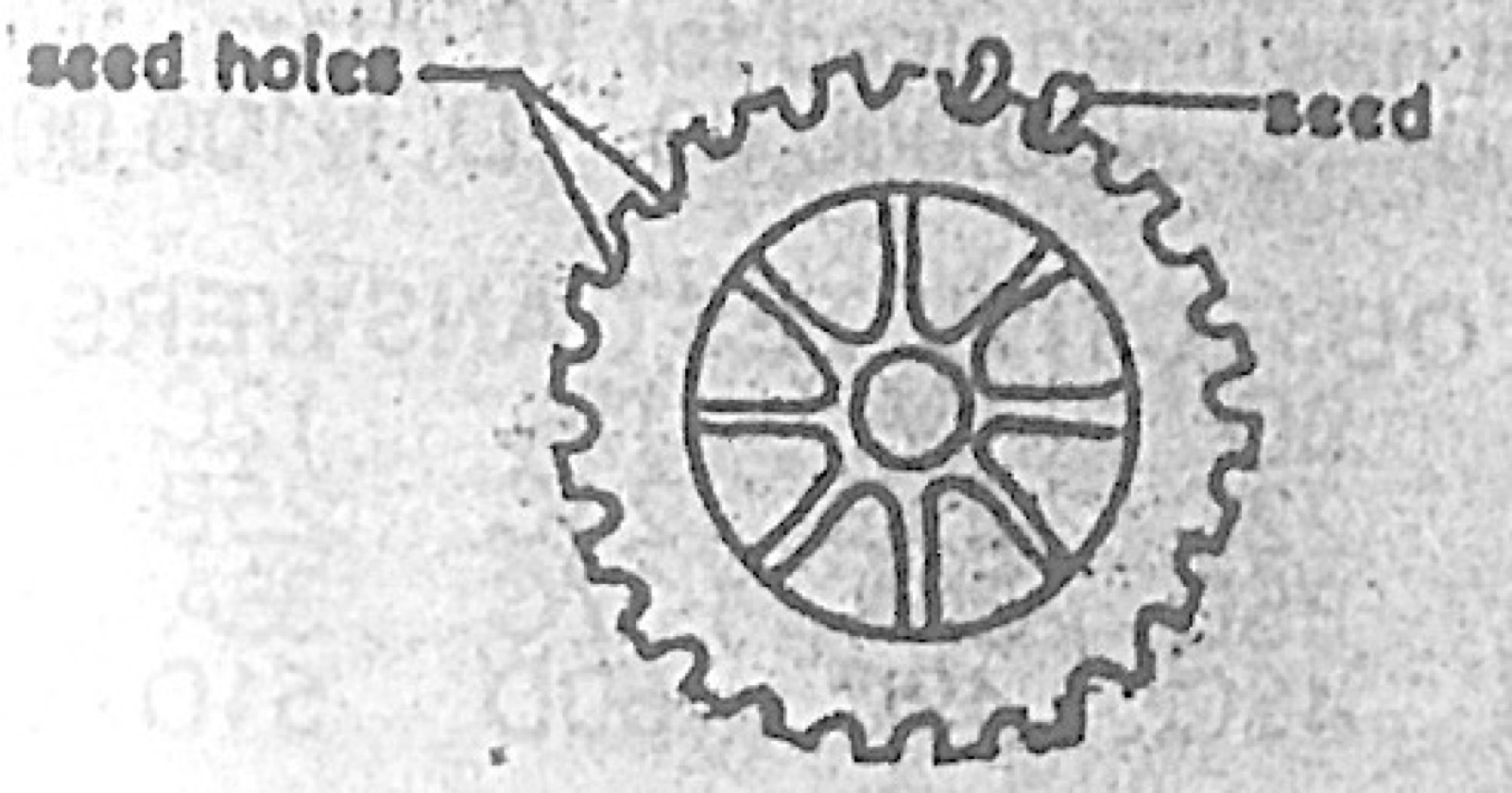
The diagram represents the seed plate of a drill. The seed plate is normally located in the

Diagram for this question
  1. A.harrow
  2. B.mower
  3. C.hopper
  4. D.plough.
Show the answer and explanation

Answer: C (hopper)

Explanation

The plate turns at the bottom of the seed hopper, dropping seeds one at a time.

Open this question

Question 25

Farm Machinery and Mechanisation

Which of the following is a function of the hopper of a grain sheller?

  1. A.Rubbing cobs against one another
  2. B.Receiving maize cobs to be shelled
  3. C.Separating chaff from the grains
  4. D.Drying shelled maize grains.
Show the answer and explanation

Answer: B (Receiving maize cobs to be shelled)

Explanation

The hopper is the inlet where cobs are fed in.

Open this question

Question 26

Land Preparation and Cultural Practices

The amount of planting material needed for a given area of land is known as

  1. A.seed rate
  2. B.plant population
  3. C.seed volume
  4. D.plant density.
Show the answer and explanation

Answer: A (seed rate)

Explanation

Seed rate is the quantity of seed per unit area.

Open this question

Question 27

Crop Husbandry

Cotton can thrive well in the mangrove areas if

  1. A.appropriate fertilizer is applied to the soil
  2. B.sunshine is lower in intensity
  3. C.land is sufficiently drained
  4. D.white flies are controlled.
Show the answer and explanation

Answer: C (land is sufficiently drained)

Explanation

Mangrove soils are waterlogged; cotton needs drained land.

Open this question

Question 28

Plant Forms and Crop Classification

Legumes that produce edible seeds are called

  1. A.pulses
  2. B.spices
  3. C.grains
  4. D.cereals.
Show the answer and explanation

Answer: A (pulses)

Explanation

Grain legumes like beans are pulses.

Open this question

Question 29

Crop Husbandry

When sugarcane is allowed to flower before harvesting, the

  1. A.sucrose content is reduced
  2. B.pith is formed
  3. C.tissue will turn red
  4. D.cane will rot.
Show the answer and explanation

Answer: A (sucrose content is reduced)

Explanation

Flowering uses up stored sugar.

Open this question

Question 30

Animal Nutrition

In a laboratory analysis of maize grains, the following results were obtained: I. The dry matter content of 80 percent made up of 30.0 parts carbohydrate, 3.3 parts ash, 13.8 parts fibre, and 1.7 parts protein. II. The remainder of the dry matter is oil. What is the percentage of oil in the dry matter?

  1. A.31.2
  2. B.39.0
  3. C.48.8
  4. D.64.0.
Show the answer and explanation

Answer: B (39.0)

Explanation

Oil = 80 − (30 + 3.3 + 13.8 + 1.7) = 31.2 parts; as a share of the dry matter: 31.2/80 × 100 = 39%.

Open this question

Question 31

Pasture and Forage Crops

Pennisetum purpureum is the botanical name for

  1. A.gamba grass
  2. B.carpet grass
  3. C.bahama grass
  4. D.elephant grass.
Show the answer and explanation

Answer: D (elephant grass.)

Explanation

Pennisetum purpureum is elephant grass.

Open this question

Question 32

Forestry and Wildlife

The practice of cutting only matured forest trees and allowing other young ones to grow is known as

  1. A.regeneration
  2. B.afforestation
  3. C.deforestation
  4. D.selective exploitation.
Show the answer and explanation

Answer: D (selective exploitation.)

Explanation

Felling only selected mature trees is selective exploitation.

Open this question

Question 33

Processing and Storage of Farm Produce

Which of the following groups of organisms cause the greatest damage to stored grains?

  1. A.Insects
  2. B.Birds
  3. C.Viruses
  4. D.Fungi.
Show the answer and explanation

Answer: A (Insects)

Explanation

Weevils and other insects do the most damage in store.

Open this question

Question 34

Crop Diseases

Disease causing organisms are referred to as

  1. A.vectors
  2. B.pathogens
  3. C.pests
  4. D.insects.
Show the answer and explanation

Answer: B (pathogens)

Explanation

Pathogens cause disease; vectors carry them.

Open this question

Question 35

Crop Diseases

Which of the following is not a viral disease of crops?

  1. A.Cocoa swollen shoot
  2. B.Tobacco mosaic
  3. C.Tomato leaf curl
  4. D.Banana blight.
Show the answer and explanation

Answer: D (Banana blight.)

Explanation

Banana blight (leaf spot/Sigatoka) is fungal.

Open this question

Question 36

Crop Diseases

Smut diseases are often found on

  1. A.maize
  2. B.cassava
  3. C.cowpea
  4. D.grapes.
Show the answer and explanation

Answer: A (maize)

Explanation

Smuts attack cereals such as maize.

Open this question

Question 37

Crop Diseases

The mosaic appearance on cassava leaves is caused by

  1. A.pests
  2. B.bacteria
  3. C.virus
  4. D.nematodes
Show the answer and explanation

Answer: C (virus)

Explanation

Cassava mosaic disease is viral.

Open this question

Question 38

Animal Reproduction

Progesterone is secreted by the

  1. A.corpus luteum
  2. B.seminal vesicle
  3. C.cowper's gland
  4. D.testes.
Show the answer and explanation

Answer: A (corpus luteum)

Explanation

The corpus luteum in the ovary makes progesterone.

Open this question

Question 39

Animal Reproduction

The hormone responsible for milk let-down in cows is

  1. A.oxytocin
  2. B.adrenaline
  3. C.oestrogen
  4. D.progesterone
Show the answer and explanation

Answer: A (oxytocin)

Explanation

Oxytocin releases milk.

Open this question

Question 40

Animal Reproduction

The secretion of reproductive and growth hormone in animals is controlled by the

  1. A.prostate gland
  2. B.pituitary gland
  3. C.adrenal gland
  4. D.ovary.
Show the answer and explanation

Answer: B (pituitary gland)

Explanation

The pituitary (master gland) controls them.

Open this question

Question 41

Poultry Production

During the process of egg formation, albumen deposition begins in the

  1. A.ovary
  2. B.magnum
  3. C.isthmus
  4. D.uterus.
Show the answer and explanation

Answer: B (magnum)

Explanation

The magnum adds the thick albumen.

Open this question

Question 42

Livestock Management

Parturition in the doe (rabbit) is referred to as

  1. A.kidding
  2. B.kindling
  3. C.farrowing
  4. D.lambing.
Show the answer and explanation

Answer: B (kindling)

Explanation

Rabbits kindle.

Open this question

Question 43

Animal Nutrition

Maintenance of osmotic balance in body cells of animals is regulated by

  1. A.calcium and phosphorus
  2. B.magnesium and calcium
  3. C.sodium and potassium
  4. D.iron and phosphorus.
Show the answer and explanation

Answer: C (sodium and potassium)

Explanation

Sodium and potassium control fluid balance.

Open this question

Question 44

Pasture and Forage Crops

Methods of rangeland improvement which ensure continuous herbage growth during the dry season are

  1. A.re-seeding and pest control
  2. B.controlled stocking and disease control
  3. C.rotational grazing and weed control
  4. D.fertilizer application and irrigation.
Show the answer and explanation

Answer: D (fertilizer application and irrigation.)

Explanation

Water and nutrients keep grass growing in the dry season.

Open this question

Question 45

Pasture and Forage Crops

Which of the following is not an objective of pasture management? To obtain

  1. A.the lowest possible dry matter yield of pasture
  2. B.the most palatable mixture of pasture crops
  3. C.high leaf-stem ratio
  4. D.the best possible nutritive value of pasture.
Show the answer and explanation

Answer: A (the lowest possible dry matter yield of pasture)

Explanation

Management aims at the highest, not lowest, yield.

Open this question

Question 46

Animal Health

The intermediate host of liverfluke is

  1. A.fish
  2. B.snail
  3. C.tick
  4. D.man.
Show the answer and explanation

Answer: B (snail)

Explanation

The water snail is the intermediate host.

Open this question

Question 47

Animal Health

Which of the following parasites of livestock is an hermaphrodite?

  1. A.Tsetse fly
  2. B.Flea
  3. C.Tick
  4. D.Liverfluke.
Show the answer and explanation

Answer: D (Liverfluke.)

Explanation

Liver flukes have both male and female organs.

Open this question

Question 49

Animal Nutrition

The deficiency symptom peculiar to vitamin B in livestock is

  1. A.night blindness
  2. B.sterility
  3. C.loss of appetite and weight
  4. D.delay in blood clotting.
Show the answer and explanation

Answer: C (loss of appetite and weight)

Explanation

B vitamins are needed for appetite and use of food; others match vitamins A, E and K.

Open this question

Question 50

Fisheries and Aquaculture

Detailed survey for the site of a fish pond is necessary for the following except

  1. A.location and depth of the spillway
  2. B.determination of the depth of the pond
  3. C.site inspection
  4. D.height of the dam.
Show the answer and explanation

Answer: D (height of the dam.)

Explanation

The key gives the height of the dam as the item not decided by the site survey.

Open this question

Question 51

Fisheries and Aquaculture

Which of the following materials is not allowed in the harvesting of fish?

  1. A.Nets
  2. B.Baskets
  3. C.Traps
  4. D.Chemicals.
Show the answer and explanation

Answer: D (Chemicals.)

Explanation

Poisoning fish with chemicals is banned.

Open this question

Question 52

Fisheries and Aquaculture

The types of ponds in a fresh water fish farm should include the following except

  1. A.nursery pond
  2. B.breeding pond
  3. C.production pond
  4. D.storage pond.
Show the answer and explanation

Answer: D (storage pond.)

Explanation

Fish farms use nursery, breeding and grow-out ponds; storage ponds are not a standard type.

Open this question

Question 53

Fisheries and Aquaculture

Which of the following are the cheapest methods of preserving fish?

  1. A.Salting and sun drying
  2. B.Freezing and chilling
  3. C.Salting and canning
  4. D.Smoking and canning.
Show the answer and explanation

Answer: A (Salting and sun drying)

Explanation

Salt and sunshine cost very little.

Open this question

Question 54

Farm Management and Records

The factor determining the success of the production process in a farm enterprise is

  1. A.fixed asset
  2. B.land
  3. C.labour
  4. D.management.
Show the answer and explanation

Answer: D (management.)

Explanation

Management organises all other factors.

Open this question

Question 55

Basic Agricultural Economics

Capital in agriculture includes the following items except

  1. A.tree crops
  2. B.livestock
  3. C.labour
  4. D.machinery.
Show the answer and explanation

Answer: C (labour)

Explanation

Labour is a separate factor of production.

Open this question

Question 56

Farm Management and Records

The most important farm input contributed by the peasant farmer's family is

  1. A.capital
  2. B.labour
  3. C.planting materials
  4. D.fertilizers.
Show the answer and explanation

Answer: B (labour)

Explanation

Families supply labour.

Open this question

Question 57

Farm Management and Records

Which of the following groups of items will appreciate in value on the farm?

  1. A.Seedlings, calves and chicks
  2. B.Equipment, piglets and lambs
  3. C.Buildings, seedlings and piglets
  4. D.Calves, machinery and chicks.
Show the answer and explanation

Answer: A (Seedlings, calves and chicks)

Explanation

Young plants and animals grow and gain value; equipment and buildings depreciate.

Open this question

Question 58

Basic Agricultural Economics

The quantity of rice that a consumer is willing and able to buy during a given period is simply the consumer's

  1. A.demand for rice
  2. B.elastic limit
  3. C.supply of rice
  4. D.preference for rice.
Show the answer and explanation

Answer: A (demand for rice)

Explanation

That is the definition of demand.

Open this question

Question 60

Farm Management and Records

A tractor costing N80,000.00 was sold for N20,000.00 after it has been used for 10 years. What is the salvage value of the tractor?

  1. A.N20,000.00
  2. B.N60,000.00
  3. C.N80,000.00
  4. D.N100,000.00.
Show the answer and explanation

Answer: A (N20,000.00)

Explanation

The salvage value is the price at disposal: N20,000.

Open this question

Theory question 101

Agricultural Development

(a) Name six Government and four Non-Governmental Organisations (NGOs) that are involved in the improvement of agricultural production in West Africa.
(b) Mention five ways in which Non-Governmental Organisations contribute to agricultural productivity in West Africa.
(c) Explain briefly six ways by which the application of science and technology has helped to boost crop production in your country.

Show the model answer
Model answer

(a) Government (any six): Agricultural Development Projects (ADPs); River Basin Development Authorities; Bank of Agriculture/NACB; Nigerian Agricultural Insurance Corporation; NALDA; research institutes (IAR, NCRI, CRIN etc.); Ministries of Agriculture; National Seed Service; Fadama project
NGOs (any four): FAO; IITA; WARDA/AfricaRice; ICRISAT; World Vision; Catholic Relief Services; Sasakawa Global 2000; Oxfam; farmers' cooperatives
(b) Any five: research into improved varieties and breeds; funding extension and training; supply of inputs and credit; control of pests and diseases; rural infrastructure (water, roads, clinics); farmer education and awareness; marketing support
(c) Any six: improved high-yielding/resistant varieties by breeding; fertilizers; pesticides and herbicides; irrigation; mechanisation; better storage and processing; improved cultural practices (spacing, rotation); weather forecasting; tissue culture/biotechnology

Explanation

Real organisation names; explain each science and technology point.

Open this question

Theory question 102

Farm Surveying and Planning

(a) Describe briefly the Gunter's chain.
(b) A farmer surveyed his triangular farmland with a base length of 2 km and a perpendicular length of 1200 m. Calculate the area of the farm.
(c) State four necessary precautions that should be taken in order to eliminate errors when chaining a farmland.
(d) List four factors required in choosing a site for a new school garden.

Show the model answer
Model answer

(a) Metal chain of 100 links joined by small rings, with a brass handle at each end; total length 66 ft (20.12 m), each link 7.92 inches (20.1 cm); tallies mark every 10 links; used for measuring distances
(b) Area = ½ × base × height = ½ × 2000 m × 1200 m = 1,200,000 m² = 120 hectares (1.2 km²)
(c) Any four: pull the chain straight and taut; keep it horizontal on slopes (step chaining); check for twisted or bent links and correct its length; align with ranging poles; count arrows/chain lengths carefully; record readings immediately
(d) Any four: fertile, well-drained soil; nearness to water supply; accessibility/nearness to school; gentle slope; security; adequate size; free from flooding and shade

Explanation

Show the working for the area and give it in m² and hectares.

Open this question

Theory question 103

Soil Fertility and Plant Nutrition

(a) In a tabular form, briefly discuss the following plant nutrients: (i) Potassium; (ii) Phosphorus; (iii) Calcium. Under the following headings: (i) form in which it is absorbed; (ii) three functions; (iii) one deficiency symptom.
(b) Give two examples of nitrogenous fertilizers.

Show the model answer
Model answer

(a) Potassium – absorbed as K+; functions: strengthens stems, aids starch and sugar formation and movement, increases disease resistance, regulates stomata and water; deficiency: scorching/browning of leaf margins and tips of older leaves, weak stems
Phosphorus – absorbed as H2PO4−/HPO42−; functions: root development, flowering, fruiting and seed formation, early maturity, energy transfer (ATP); deficiency: purple colour on leaves, stunted growth, poor roots, delayed maturity
Calcium – absorbed as Ca2+; functions: forms cell walls (calcium pectate), growth of root and shoot tips, neutralises acids, pod filling in groundnut; deficiency: death of growing tips, distorted young leaves, blossom-end rot, empty groundnut pods
(b) Any two: urea; ammonium sulphate; ammonium nitrate; calcium ammonium nitrate; sodium nitrate

Explanation

Put the three nutrients in rows under the three headings.

Open this question

Theory question 104

Forestry and Wildlife

(a) Define: (i) Taungya farming (ii) crop rotation.
(b) State four advantages of taungya farming.
(c) State four principles underlying the choice of a crop rotation system.
(d) Enumerate four advantages of crop rotation.
(e) Under what situations would you recommend to a farmer to embark on crop rotation?

Show the model answer
Model answer

(a)(i) Taungya: growing food crops between young forest trees on forest land until the tree canopy closes
(ii) Crop rotation: growing different crops on the same piece of land one after another in a planned order
(b) Any four: farmers get free land and food; cheap establishment and weeding of tree plantations; land used fully; fewer land disputes; trees protected from fire and grazing
(c) Any four: deep-rooted crops follow shallow-rooted ones; legumes included to add nitrogen; crops of the same family/sharing pests should not follow each other; heavy feeders follow legumes/manuring; cover crops to protect soil; market demand and farmer's needs
(d) Any four: maintains fertility; controls pests and diseases; controls weeds; reduces erosion; uses nutrients from different depths; spreads labour and income over the year
(e) Where land is limited and must be cropped continuously; where pests, diseases or weeds build up; where soil fertility is falling; on erosion-prone land; where fertilizer is costly

Explanation

Answer each sub-part in turn.

Open this question

Theory question 105

Ornamental Plants

(a) State four ways in which ornamental plants are important.
(b) Give two examples each of (i) ornamental trees, (ii) ornamental shrubs.
(c) Explain the following: (i) pasture. (ii) forage.
(d) State four roles of legumes in agriculture.

Show the model answer
Model answer

(a) Any four: beautify homes, offices and roads; shade; windbreaks and hedges; check erosion; income from sale of flowers/seedlings; reduce noise and dust; recreation and tourism; some are medicinal
(b)(i) Ornamental trees (any two): flamboyant (Delonix regia); Royal palm; Casuarina; Terminalia; Cassia; Ficus; Pride of Barbados
(ii) Ornamental shrubs (any two): Hibiscus; Bougainvillea; Ixora; Croton; Allamanda; Duranta; Acalypha
(c)(i) Pasture: an area of land covered with grasses and legumes on which livestock graze
(ii) Forage: plants or plant parts (grasses, legumes, browse) eaten by livestock, grazed or cut
(d) Any four: fix nitrogen and improve soil fertility; protein-rich food for man (pulses); protein-rich forage for livestock; cover crops checking erosion and weeds; green manure; oil (groundnut, soya bean); break pest cycles in rotation

Explanation

Use real plant examples.

Open this question

Theory question 106

Crop Pests

(a) Discuss seven economic importance of insect pests in crop production.
(b) Name two hosts of cotton stainer.
(c) List two soil dwelling insect pests of crops and state five general control measures of insect pests of crops.

Show the model answer
Model answer

(a) Any seven: reduce yield; reduce quality and market value; transmit diseases; kill plants; damage stored produce; increase cost of production (control); create wounds for pathogens; reduce seed viability; cause food shortage and loss of income
(b) Any two: cotton; okra; kenaf; baobab; hibiscus/roselle (Malvaceae plants)
(c) Soil pests (any two): termites; crickets; cutworms; white grubs/beetle larvae; yam beetle; wireworms; ants
Control (any five): cultural – crop rotation, early planting, clean clearing, burning crop residues, resistant varieties; chemical – insecticide sprays, soil and seed dressing; biological – predators and parasites; physical/mechanical – hand picking, trapping; quarantine; integrated pest management

Explanation

Separate (a), (b) and (c).

Open this question

Theory question 107

Poultry Production

Discuss briefly: (a) Temperature; (b) Relative humidity; (c) Light; in relation to poultry production and state two ways of controlling the effect of each.

Show the model answer
Model answer

(a) Temperature: high temperatures cause heat stress, panting, low feed intake, low egg production, thin shells and death; low temperature chills chicks. Control: good ventilation/open-sided houses, shade trees, cool clean water, roof insulation, brooders/heaters for chicks
(b) Relative humidity: high humidity makes litter wet, encouraging coccidiosis and respiratory disease, and adds to heat stress; very low humidity causes dust. Control: good ventilation, keep litter dry/turn and change litter, avoid water spillage, proper stocking density
(c) Light: day length affects feed intake, growth, sexual maturity and egg laying; too much light causes cannibalism. Control: artificial lighting to give about 14–16 hours for layers, dim/red light to reduce pecking, orientation of house east–west

Explanation

Effect and two controls for each factor.

Open this question

Theory question 108

Animal Improvement

(a) Write short notes on the following systems of breeding: (i) In-breeding; (ii) Line-breeding; (iii) Cross-breeding.
(b) State three methods of collecting semen from a proven male for use in artificial insemination.

Show the model answer
Model answer

(a)(i) In-breeding: mating closely related animals (e.g. brother × sister, sire × daughter); fixes traits but may bring out harmful recessive genes and reduce vigour
(ii) Line-breeding: a mild form of inbreeding that keeps a line related to one outstanding ancestor, to concentrate its good genes
(iii) Cross-breeding: mating animals of different breeds; gives hybrid vigour and combines good traits of both breeds; used to form new breeds
(b) Any three: artificial vagina; electro-ejaculation; massage (of the ampullae/abdomen, used in poultry and bulls); collection from the vagina of a mated female

Explanation

Short note for each system; name three collection methods.

Open this question

Theory question 109

Basic Agricultural Economics

(a) State the law of diminishing returns as it applies to agricultural production.
The table shows, for a 2 ha farm, the quantity of fertilizer used (bags) and yield of maize (bags): 0 – 8; 8 – 24; 12 – 48; 16 – 80; 20 – 120; 24 – 150; 28 – 170; 32 – 180; 34 – 180; 36 – 170.
(b) Complete the table (change in quantity of fertilizer and change in yield of maize).
(c) Draw a graph from the provided data and use it to explain the law of diminishing returns.

Show the model answer
Model answer

(a) When more and more units of a variable input are added to fixed inputs, the extra output from each additional unit eventually falls (and total output may later fall)
(b) Change in fertilizer: –, 8, 4, 4, 4, 4, 4, 4, 2, 2
Change in yield: –, 16, 24, 32, 40, 30, 20, 10, 0, −10
(c) Graph of yield (vertical) against fertilizer (horizontal): rises steeply up to 20 bags (increasing returns), rises more slowly from 20 to 32 bags (diminishing returns begin after 20 bags, where extra yield falls from 40 to 30), levels off at 32–34 bags (maximum 180 bags, zero extra yield) and falls at 36 bags (negative returns)

Explanation

Fill both change columns, then point to where the extra yield starts to fall.

Open this question

Theory question 110

Agricultural Extension

An agricultural research organisation categorised farmers in village X according to the rate of adoption of new ideas and came up with the following: Innovators 10, Early adopters 15, Late adopters 70, Never adopters 25.
(a) Calculate the percentage of early adopters and state the implication of this percentage on the extension system.
(b) Suggest four ways of encouraging the innovators.
(c) State four possible reasons for the high number of late adopters.
(d) State two merits of the print media as a channel for agricultural extension.

Show the model answer
Model answer

(a) Total = 10 + 15 + 70 + 25 = 120 farmers; early adopters = 15/120 × 100 = 12.5%. Implication: few farmers take up new ideas quickly, so the extension system is weak/slow and needs more effort, demonstrations and incentives
(b) Any four: give them inputs/credit and subsidies; use them as contact/demonstration farmers; reward with prizes and recognition; involve them in research trials and field days; link them to markets
(c) Any four: illiteracy; poverty/lack of capital; fear of risk; conservatism and cultural beliefs; poor extension contact; inputs not available; innovations not suited to local conditions; poor results seen elsewhere
(d) Any two: reaches many farmers at once; permanent – can be kept and re-read; cheap per farmer; can carry detailed instructions and pictures
Explanation

Show the percentage calculation.

Open this question