WAEC Agricultural Science 1996 past questions and answers

68 questions. Try each one, then open the answer to check yourself and read the explanation.

Question 1

Introduction to Agriculture

Which of the following defines agriculture?

  1. A.The raising of farm animals by rural communities
  2. B.A way of life by which farmers produce food
  3. C.The raising of crops to satisfy human needs
  4. D.An art of farming inherited from our fore-fathers
  5. E.The science and art of farming to satisfy human needs.
Show the answer and explanation

Answer: E (The science and art of farming to satisfy human needs.)

Explanation

Agriculture is both a science and an art of producing crops and animals for human needs.

Open this question

Question 2

Land Use and Land Tenure

When a piece of land is leased to a farmer, the land is said to be

  1. A.given to him as subsidy
  2. B.purchased on loan
  3. C.allocated on a rental basis
  4. D.given as a gift
  5. E.inherited.
Show the answer and explanation

Answer: C (allocated on a rental basis)

Explanation

A lease lets the farmer use land for a period in return for rent.

Open this question

Question 3

Land Use and Land Tenure

The Nigerian Land Use Act of 1978 puts the right ownership of land on the

  1. A.president of the farmers cooperative
  2. B.head of the family unit
  3. C.head of the society
  4. D.governor of a state
  5. E.traditional rulers
Show the answer and explanation

Answer: D (governor of a state)

Explanation

The Act vested all land in each state in the State Governor.

Open this question

Question 4

Land Use and Land Tenure

Which of the following factors will not influence the use of land for farming?

  1. A.Population density
  2. B.Climatic condition
  3. C.Topography
  4. D.Light intensity
  5. E.Type of vegetation.
Show the answer and explanation

Answer: D (Light intensity)

Explanation

Light is similar everywhere in an area and does not decide whether land is farmed.

Open this question

Question 5

Agricultural Ecology

A biotic factor influencing agricultural production is

  1. A.rainfall
  2. B.predator
  3. C.soil structure
  4. D.wind
  5. E.temperature.
Show the answer and explanation

Answer: B (predator)

Explanation

A predator is a living organism; the others are non-living.

Open this question

Question 6

Agricultural Ecology

Tropical crops grow best within the temperature range of

  1. A.40°C-60°C
  2. B.35°C-55°C
  3. C.30°C-50°C
  4. D.18°C-32°C
  5. E.6°C-15°C.
Show the answer and explanation

Answer: D (18°C-32°C)

Explanation

Most tropical crops grow best between about 18 °C and 32 °C.

Open this question

Question 7

Rocks and Soil Formation

The alternate heating and cooling of rocks will result in

  1. A.molten magma
  2. B.sublimation
  3. C.solidification
  4. D.sedimentation
  5. E.fragmentation.
Show the answer and explanation

Answer: E (fragmentation.)

Explanation

Expansion and contraction crack rocks into fragments.

Open this question

Question 8

Rocks and Soil Formation

Which of the following is an example of igneous rock?

  1. A.Gneiss
  2. B.Limestone
  3. C.Sandstone
  4. D.Granite
  5. E.Quartzite.
Show the answer and explanation

Answer: D (Granite)

Explanation

Granite forms from cooled magma.

Open this question

Question 9

Soil Properties

In an experiment to determine the percentage of humus content in a soil, the following results were obtained: mass of dish = 10 gm; mass of dish and oven-dry soil = 50 gm; mass of dish and soil after heating = 40 gm. Calculate the amount of humus in the soil sample.

  1. A.10 gm
  2. B.40 gm
  3. C.50 gm
  4. D.60 gm
  5. E.90 gm.
Show the answer and explanation

Answer: A (10 gm)

Explanation

Heating burns off the humus: 50 − 40 = 10 g.

Open this question

Question 10

Soil Properties

In an experiment to determine the percentage of humus content in a soil, the following results were obtained: mass of dish = 10 gm; mass of dish and oven-dry soil = 50 gm; mass of dish and soil after heating = 40 gm. Calculate the percentage of humus in the soil sample.

  1. A.10%
  2. B.25%
  3. C.60%
  4. D.75%
  5. E.80%.
Show the answer and explanation

Answer: B (25%)

Explanation

Dry soil = 50 − 10 = 40 g; humus = 10 g; 10/40 × 100 = 25%.

Open this question

Question 11

Rocks and Soil Formation

The texture and the mineral composition of soil depend mainly on

  1. A.topography
  2. B.light intensity
  3. C.organic matter
  4. D.parent material
  5. E.temperature
Show the answer and explanation

Answer: D (parent material)

Explanation

The minerals and particle sizes come from the rock the soil formed from.

Open this question

Question 13

Soil Fertility and Plant Nutrition

Lodging in crops is caused by excess supply of

  1. A.potassium
  2. B.sulphur
  3. C.iron
  4. D.nitrogen
  5. E.sodium.
Show the answer and explanation

Answer: D (nitrogen)

Explanation

Excess nitrogen makes stems lush and weak, so crops lodge.

Open this question

Question 14

Land Preparation and Cultural Practices

Adoption of clean clearing of land in the tropical rain forest is not advisable because it

  1. A.encourages erosion and leaching
  2. B.is very expensive
  3. C.is very difficult to practise
  4. D.deprives the farmer of continuous use of wood
  5. E.encourages compaction of soil.
Show the answer and explanation

Answer: A (encourages erosion and leaching)

Explanation

Bare soil under heavy rain is quickly eroded and leached.

Open this question

Question 15

Soil Fertility and Plant Nutrition

Which of the following is not an effect of bush burning on the soil?

  1. A.Sterilizing soil against some harmful soil micro-organisms
  2. B.Destroying the structure of soil
  3. C.Increasing rate of nitrogen mineralization
  4. D.Predisposing soil to erosion
  5. E.Maintaining high levels of soil nutrient reserves.
Show the answer and explanation

Answer: E (Maintaining high levels of soil nutrient reserves.)

Explanation

Burning loses organic matter and nutrients, so it does not keep nutrient reserves high.

Open this question

Question 16

Irrigation and Drainage

Irrigation can be defined as

  1. A.high water table for plants
  2. B.a system of farming in which crops are provided with water artificially
  3. C.a type of farming where crops depend mostly on rainfall
  4. D.a type of farming practised in the forest zones
  5. E.the storage of water for future farm operation.
Show the answer and explanation

Answer: B (a system of farming in which crops are provided with water artificially)

Explanation

Irrigation is supplying water to crops artificially.

Open this question

Question 17

Farm Machinery and Mechanisation

Which of the following is not an advantage of farm mechanization?

  1. A.Timely farm operations
  2. B.High operating cost
  3. C.Green-manuring
  4. D.Improvement of yields.
  5. E.Rapid land clearing.
Show the answer and explanation

Answer: B (High operating cost)

Explanation

Machines are costly to buy and run, which is a drawback, not an advantage.

Open this question

Question 18

Farm Surveying and Planning

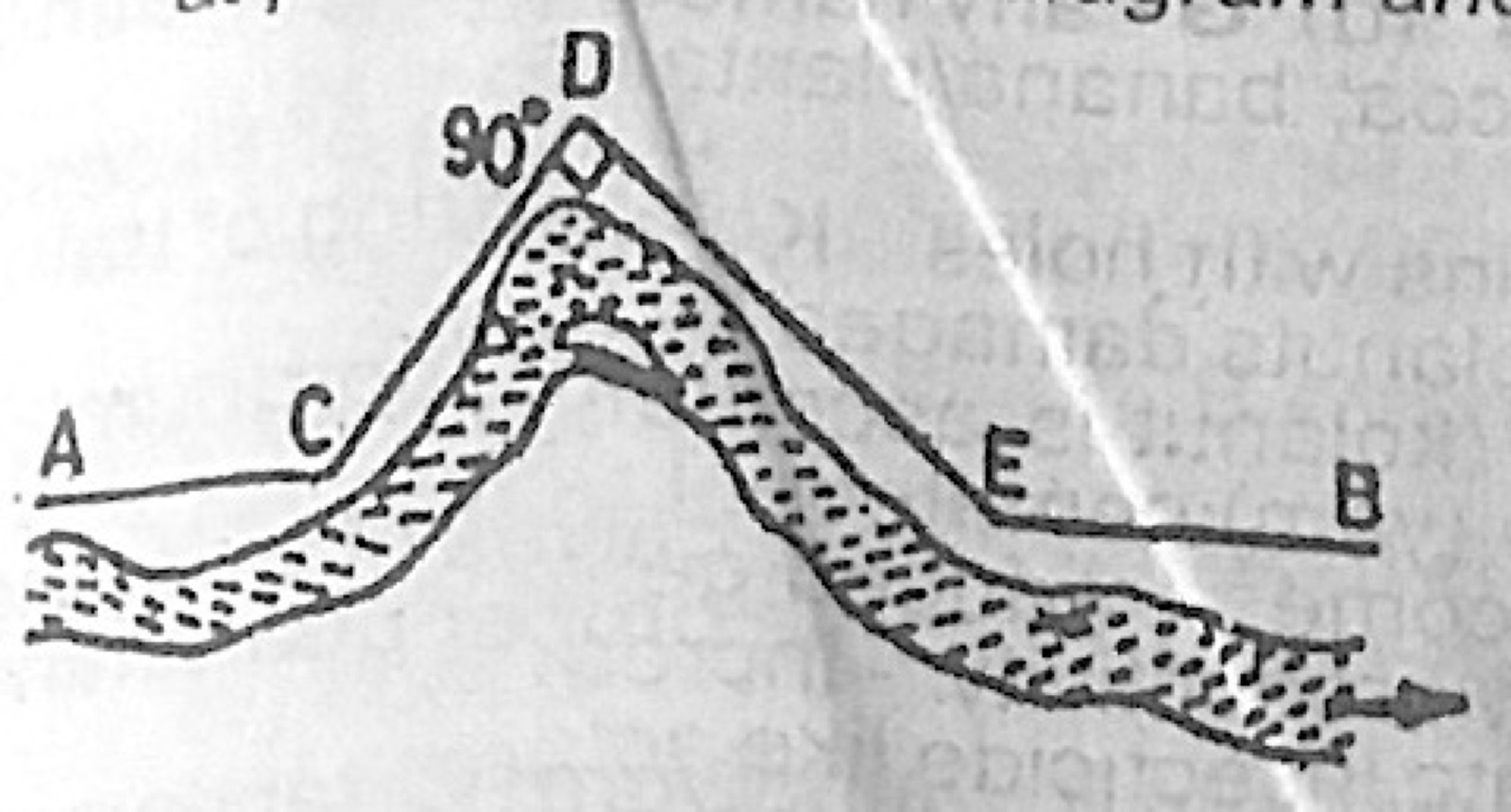
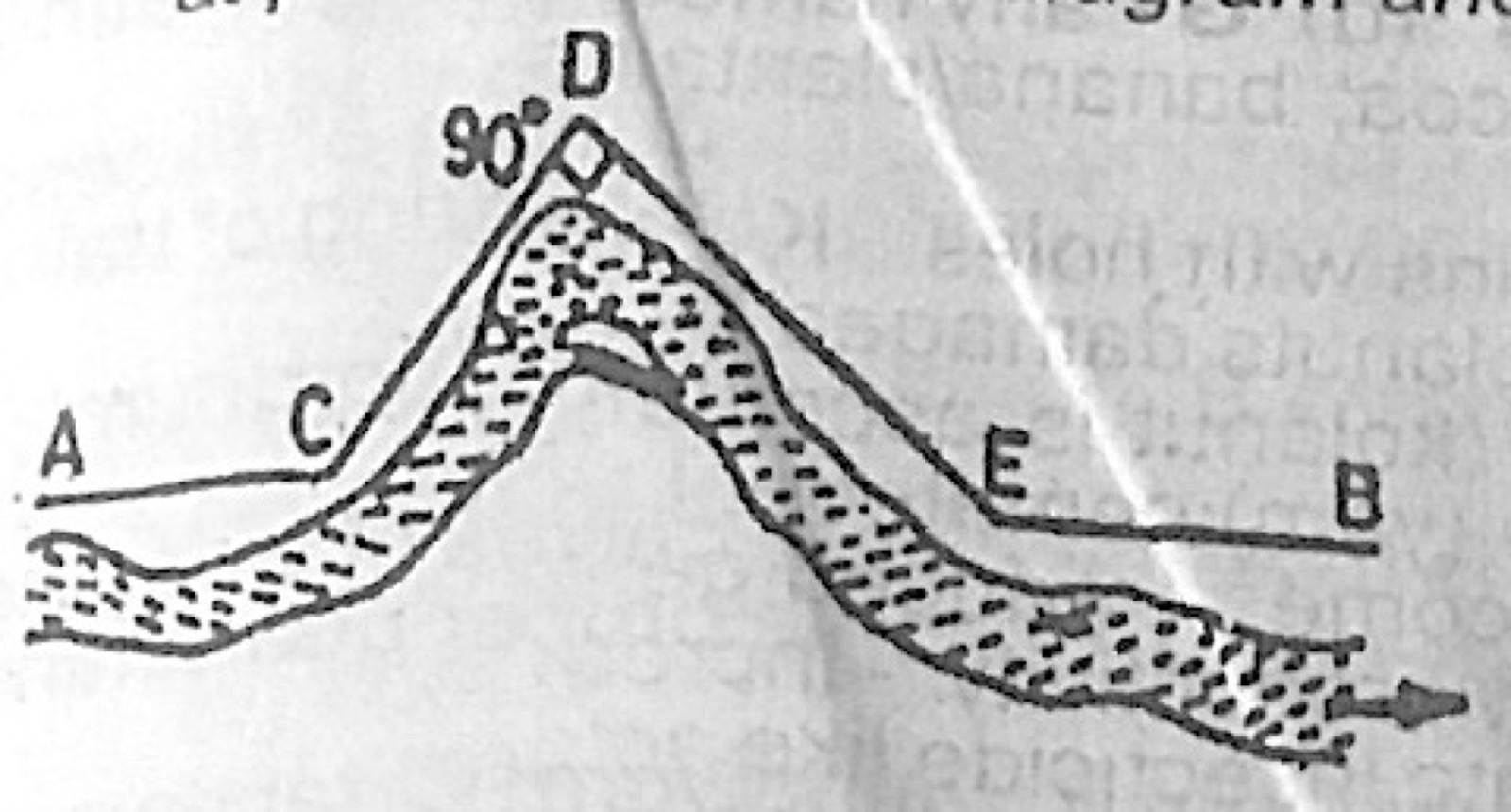
The diagram represents a chain measurement drawing of the school farmland having an obstruction at point C. What will be the length between points A and B of the farmland?

Diagram for this question
  1. A.AC + CD + EB
  2. B.AC + CD + DE + EB
  3. C.AC + DE + EB
  4. D.CD + DE + EB
  5. E.AC + CE + EB
Show the answer and explanation

Answer: E (AC + CE + EB)

Explanation

The straight line AB is made of AC, the hidden part CE, and EB.

Open this question

Question 19

Farm Surveying and Planning

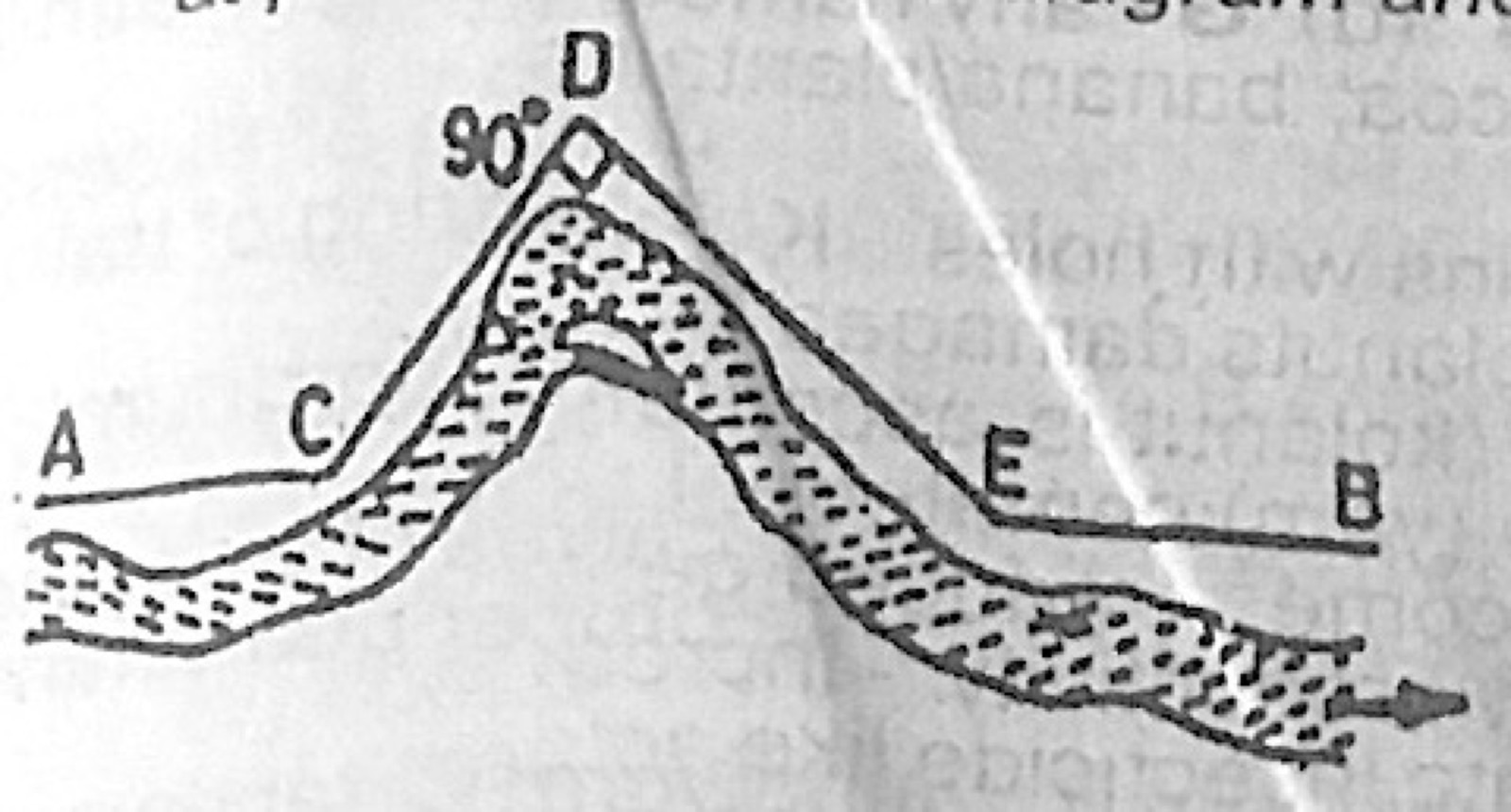
The diagram represents a chain measurement drawing of the school farmland having an obstruction at point C. Which of the following formulae can be used to calculate the distance CE in the diagram?

Diagram for this question
  1. A.CE = CD² + EB²
  2. B.CE = √DE²
  3. C.CE = √CD²
  4. D.CE = CD² + DE²
  5. E.CE = √(CD² + DE²)
Show the answer and explanation

Answer: E (CE = √(CD² + DE²))

Explanation

Angle D is 90°, so by Pythagoras CE² = CD² + DE².

Open this question

Question 20

Farm Surveying and Planning

The diagram represents a chain measurement drawing of the school farmland having an obstruction at point C. Which of the following describes the method used to calculate the distance CE?

Diagram for this question
  1. A.Similar triangular method
  2. B.Double perpendicular
  3. C.Right-angled method
  4. D.Quadrangle
  5. E.Chain method.
Show the answer and explanation

Answer: C (Right-angled method)

Explanation

A right-angled triangle is set out round the obstacle and Pythagoras is used.

Open this question

Question 21

Plant Forms and Crop Classification

A fruit with many seeds that has many joined carpels and dehisces along all sutures from base to apex is referred to as a

  1. A.cereal
  2. B.legume
  3. C.capsule
  4. D.berry
  5. E.nut
Show the answer and explanation

Answer: C (capsule)

Explanation

A capsule is a dry fruit of joined carpels that splits along its sutures.

Open this question

Question 22

Crop Husbandry

The maturity period of tomato in days is about

  1. A.40
  2. B.90
  3. C.140
  4. D.160
  5. E.180
Show the answer and explanation

Answer: B (90)

Explanation

Tomato is ready about 90 days (3 months) after planting.

Open this question

Question 23

Land Preparation and Cultural Practices

Tomato crops are usually staked to

  1. A.accelerate rate of ripening of the fruits
  2. B.accelerate growth
  3. C.prevent rotting of fruits
  4. D.induce flowering
  5. E.expose the leaves adequately.
Show the answer and explanation

Answer: C (prevent rotting of fruits)

Explanation

Staking keeps fruits off the wet soil, so they do not rot.

Open this question

Question 24

Plant Forms and Crop Classification

A perennial is a crop which

  1. A.reaches maturity early and stops producing fruits before two years
  2. B.can grow and produce fruits for more than two years
  3. C.stops producing fruit two years after planting
  4. D.cannot flower during two consecutive growing seasons
  5. E.produces two harvests within a year.
Show the answer and explanation

Answer: B (can grow and produce fruits for more than two years)

Explanation

Perennials live and bear for more than two years.

Open this question

Question 25

Pasture and Forage Crops

Common management practices in pastures include the following except

  1. A.rotational grazing
  2. B.weed and pest control
  3. C.fertilizer application
  4. D.paddocking
  5. E.overstocking.
Show the answer and explanation

Answer: E (overstocking.)

Explanation

Overstocking ruins pastures.

Open this question

Question 26

Pasture and Forage Crops

Which of the following is not a characteristic feature of giant-star grass?

  1. A.Vigorous growth, spreading and perennial
  2. B.Possession of long and rapidly growing-stems
  3. C.Drought resistant and ability to withstand continuous grazing
  4. D.Easy to eradicate once established
  5. E.Easily propagated from young cuttings.
Show the answer and explanation

Answer: D (Easy to eradicate once established)

Explanation

Giant star grass spreads by runners and is hard to get rid of once established.

Open this question

Question 27

Forestry and Wildlife

The process by which a forest is renewed artificially is known as

  1. A.forest regeneration
  2. B.forest plantation
  3. C.selective exploitation
  4. D.deforestation
  5. E.taungya.
Show the answer and explanation

Answer: A (forest regeneration)

Explanation

Regeneration renews a forest after cutting.

Open this question

Question 28

Forestry and Wildlife

Which of the following statements represents the best reason for making access roads in a forest plantation?

  1. A.Fire-fighting purposes
  2. B.Weeding
  3. C.Fertilizer application
  4. D.Mulching
  5. E.Erosion control.
Show the answer and explanation

Answer: A (Fire-fighting purposes)

Explanation

Roads let fire-fighters reach fires and act as fire breaks.

Open this question

Question 29

Forestry and Wildlife

Which of the following is not a protective function of forests?

  1. A.Soil conservation
  2. B.Wind break
  3. C.Wildlife conservation
  4. D.Tourist attraction
  5. E.Erosion control.
Show the answer and explanation

Answer: D (Tourist attraction)

Explanation

Tourism is an economic use, not protection.

Open this question

Question 30

Crop Diseases

A common disease of onion is

  1. A.leaf spot
  2. B.root knot
  3. C.leaf blight
  4. D.twister
  5. E.mosaic
Show the answer and explanation

Answer: D (twister)

Explanation

Twister disease (a fungal disease) twists onion leaves.

Open this question

Question 31

Crop Diseases

Rice blast is caused by

  1. A.a bacterium
  2. B.a nematode
  3. C.a virus
  4. D.a fungus
  5. E.an insect
Show the answer and explanation

Answer: D (a fungus)

Explanation

Rice blast is caused by the fungus Pyricularia (Magnaporthe) oryzae.

Open this question

Question 32

Crop Diseases

Which of the following diseases of crops is not caused by a fungus?

  1. A.Panama disease of banana
  2. B.Smut of rice
  3. C.Mould of stored grain
  4. D.Streak of maize
  5. E.black pod disease of cocoa
Show the answer and explanation

Answer: D (Streak of maize)

Explanation

Maize streak is caused by a virus.

Open this question

Question 33

Crop Pests

Biological control of insect pests of crops can best be carried out through

  1. A.crop rotation
  2. B.use of parasites and predators
  3. C.soil fumigation
  4. D.farm sanitation
  5. E.use of resistant varieties
Show the answer and explanation

Answer: B (use of parasites and predators)

Explanation

Biological control uses living natural enemies.

Open this question

Question 34

Crop Improvement

The aims of crop improvement include the following except

  1. A.increasing yields
  2. B.meeting particular needs of growers
  3. C.meeting the needs of consumers
  4. D.adapting to climatic conditions
  5. E.reducing demand for a particular type of crop.
Show the answer and explanation

Answer: E (reducing demand for a particular type of crop.)

Explanation

Breeders do not aim to reduce demand for a crop.

Open this question

Question 35

Basic Genetics

The chromosomes in a cell are located in the

  1. A.cell wall
  2. B.golgi body
  3. C.vacuole
  4. D.nucleus
  5. E.mitochondrion.
Show the answer and explanation

Answer: D (nucleus)

Explanation

Chromosomes are in the nucleus.

Open this question

Question 36

Crop Improvement

A great disadvantage of introduction as a method of crop improvement is the

  1. A.adaptation of introduced crop to a new area of cultivation
  2. B.usefulness of an introduced crop as basis for a breeding programme
  3. C.incorporation of the desirable characteristics of the introduced crop into the local crop
  4. D.introduction of a new type of disease into a new area of cultivation
  5. E.integration of the introduced variety into the agricultural production of a new area.
Show the answer and explanation

Answer: D (introduction of a new type of disease into a new area of cultivation)

Explanation

Imported plants may bring new diseases and pests.

Open this question

Question 37

Animal Anatomy and Physiology

Which of the following structures does not serve a protective function?

  1. A.Hoof
  2. B.Skin
  3. C.Feathers
  4. D.Bone
  5. E.Hair
Show the answer and explanation

Answer: D (Bone)

Explanation

Hoof, skin, feathers and hair cover and shield the body; bone's main job is support and movement.

Open this question

Question 38

Animal Anatomy and Physiology

The blind sacs at the junction of the small and large intestines of a fowl are called

  1. A.gizzard
  2. B.appendix
  3. C.ileum
  4. D.colons
  5. E.caeca.
Show the answer and explanation

Answer: E (caeca.)

Explanation

Fowls have two caeca where the small and large intestines meet.

Open this question

Question 39

Animal Anatomy and Physiology

One of the peculiarities of the intestinal tract of a fowl is the possession of

  1. A.cloaca
  2. B.stomach
  3. C.oesophageal groove
  4. D.large intestine
  5. E.ileum.
Show the answer and explanation

Answer: A (cloaca)

Explanation

Birds have a cloaca, a common opening for faeces, urine and eggs.

Open this question

Question 40

Animal Anatomy and Physiology

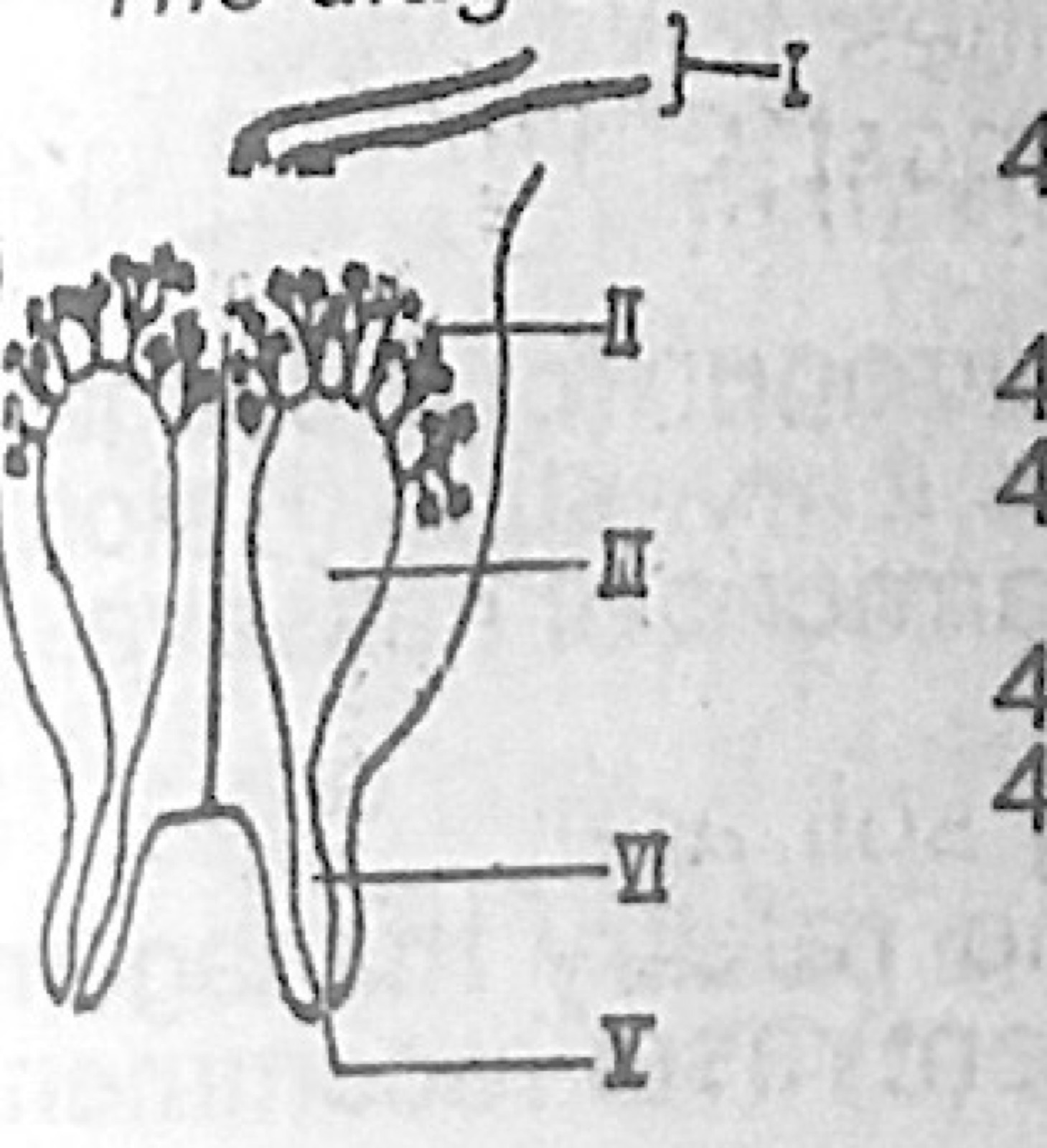
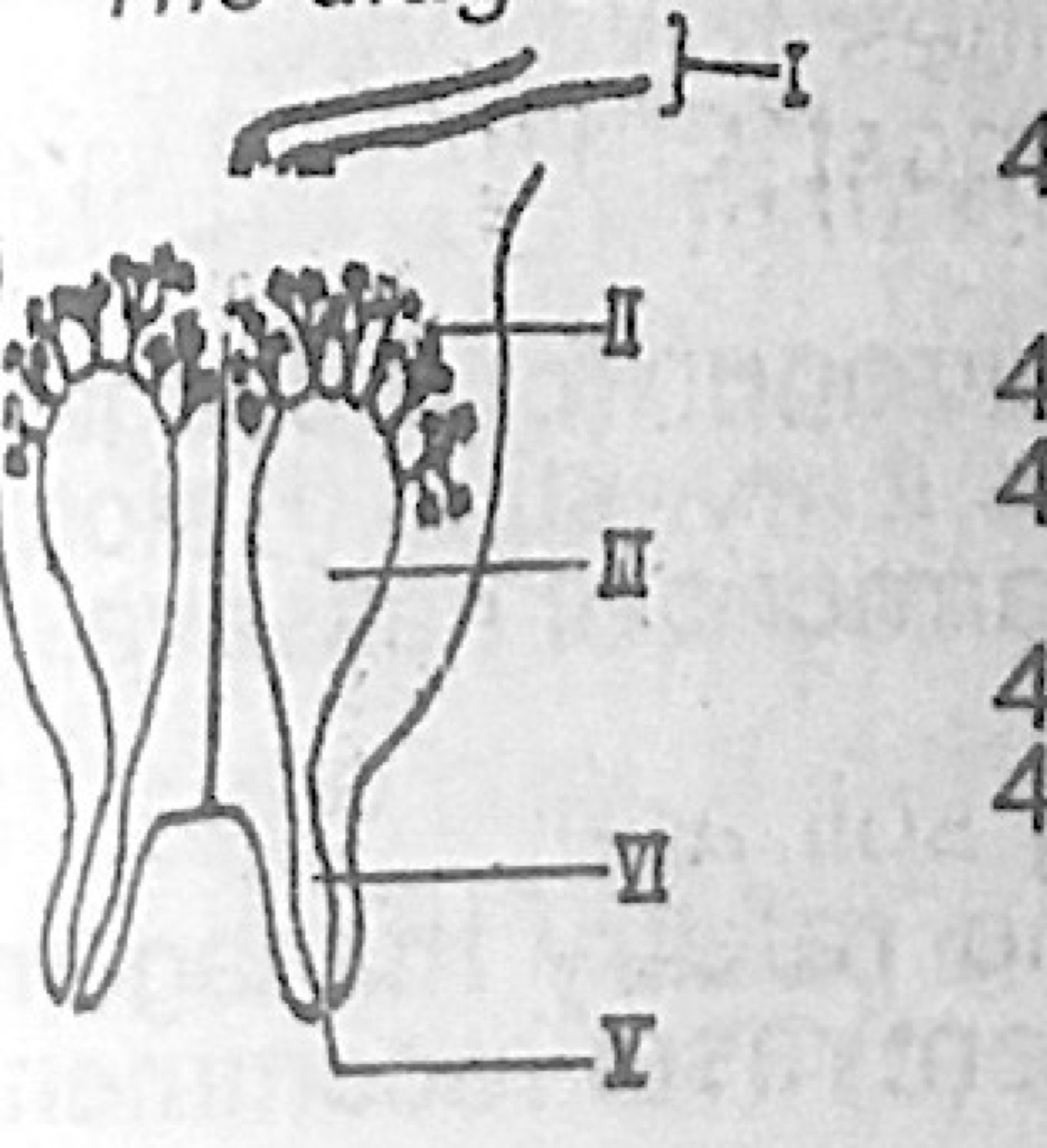
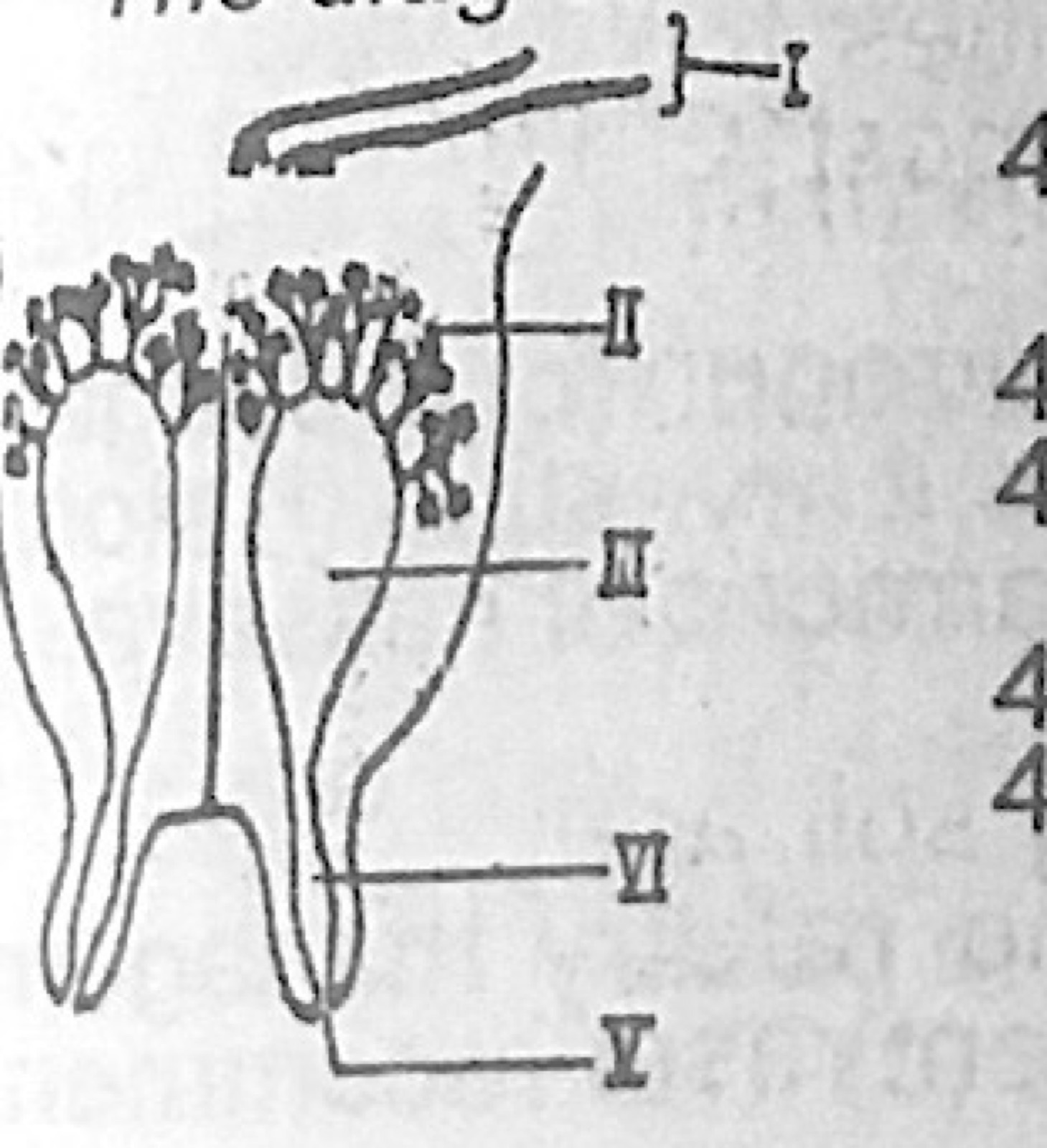
The diagram represents the mammary gland of a cow. Milk contents from the large ducts are emptied directly into the part labelled

Diagram for this question
  1. A.I
  2. B.II
  3. C.III
  4. D.IV
  5. E.V
Show the answer and explanation

Answer: C (III)

Explanation

The large ducts empty into the gland cistern (III).

Open this question

Question 41

Animal Anatomy and Physiology

The diagram represents the mammary gland of a cow. The part labelled I is the

Diagram for this question
  1. A.blood vessel
  2. B.cavity
  3. C.duct
  4. D.canal
  5. E.cell.
Show the answer and explanation

Answer: A (blood vessel)

Explanation

I is the blood vessel bringing blood (milk raw materials) to the udder.

Open this question

Question 42

Animal Anatomy and Physiology

The diagram represents the mammary gland of a cow. What is the function of the part labelled II?

Diagram for this question
  1. A.Milk let-down
  2. B.Milk secretion
  3. C.Blood supply to the organ
  4. D.Blood synthesis
  5. E.Milk storage.
Show the answer and explanation

Answer: B (Milk secretion)

Explanation

II is the alveoli, the grape-like sacs that secrete milk.

Open this question

Question 44

Classification of Farm Animals

The humpless breed of cattle which also possess short horns is

  1. A.Gudali
  2. B.Shuwa Arab
  3. C.White Fulani
  4. D.Red Bororo
  5. E.Muturu.
Show the answer and explanation

Answer: E (Muturu.)

Explanation

Muturu is a small, humpless, short-horned breed.

Open this question

Question 45

Classification of Farm Animals

The breed of goat popularly kept mainly for its skin is

  1. A.Kano brown
  2. B.Bornu red
  3. C.Sokoto red
  4. D.Dwarf goat
  5. E.Bauchi type.
Show the answer and explanation

Answer: C (Sokoto red)

Explanation

Sokoto Red skins make high-quality Morocco leather.

Open this question

Question 46

Animal Health

A livestock farmer was instructed to mix 1 litre of acaricide with 175 litres of water. Calculate the amount of water he needs to mix 20 litres of acaricide

  1. A.20 litres
  2. B.175 litres
  3. C.195 litres
  4. D.1750 litres
  5. E.3500 litres.
Show the answer and explanation

Answer: E (3500 litres.)

Explanation

20 × 175 = 3500 litres of water.

Open this question

Question 47

Animal Nutrition

Which of the following will not be an effect of excessive amount of water content in feeds?

  1. A.decrease in nutritive value
  2. B.formation of toxic products
  3. C.encouraging growth of moulds
  4. D.stimulating fermentation
  5. E.improving quality of such feeds.
Show the answer and explanation

Answer: E (improving quality of such feeds.)

Explanation

Wet feed spoils; it does not improve.

Open this question

Question 48

Livestock Management

Which of the following husbandry practices is not carried out in pig farming?

  1. A.castration of excess males
  2. B.application of iron supplements
  3. C.numbering by ear notching or tattooing
  4. D.shearing of hairs of the skin
  5. E.dipping or spraying of animals.
Show the answer and explanation

Answer: D (shearing of hairs of the skin)

Explanation

Pigs are not sheared.

Open this question

Question 49

Animal Nutrition

The most important source of carbohydrate in livestock feed is

  1. A.maize
  2. B.guinea corn
  3. C.sorghum
  4. D.rice bran
  5. E.wheat bran.
Show the answer and explanation

Answer: A (maize)

Explanation

Maize is the main energy (carbohydrate) feed.

Open this question

Question 50

Animal Health

An effective way of ensuring built-in resistance to diseases in calves is to

  1. A.vaccinate calves at weaning
  2. B.allow calves access to colostrum
  3. C.ensure regular veterinary check-up
  4. D.observe proper quarantine
  5. E.give balance ration.
Show the answer and explanation

Answer: B (allow calves access to colostrum)

Explanation

Colostrum gives the calf antibodies from its mother.

Open this question

Question 51

Animal Health

Which of the following livestock parasites possesses proglottides?

  1. A.liver fluke
  2. B.roundworm
  3. C.tapeworm
  4. D.trypanosome
  5. E.tick
Show the answer and explanation

Answer: C (tapeworm)

Explanation

A tapeworm's body is a chain of segments called proglottids.

Open this question

Question 52

Fisheries and Aquaculture

Which of the following is the first operation in the establishment of a fish pond?

  1. A.purchasing and transportation of fingerlings
  2. B.construction of spill way
  3. C.construction of dam
  4. D.clearing and stumping of site
  5. E.fertilization of pond.
Show the answer and explanation

Answer: D (clearing and stumping of site)

Explanation

The site must be cleared and stumped before anything is built.

Open this question

Question 53

Fisheries and Aquaculture

The importance of fish farming includes the following except

  1. A.supply of proteins in the diet of man
  2. B.boosting the economic of the country
  3. C.supply of vitamins in the diet of man
  4. D.discharge of waste used in the control of pond's pests
  5. E.provision of employment for people.
Show the answer and explanation

Answer: D (discharge of waste used in the control of pond's pests)

Explanation

Fish waste is not used to control pond pests.

Open this question

Question 54

Animal Improvement

Which of the following statements about cross-breeding is not correct?

  1. A.the cross-bred progenies are heterozygous
  2. B.cross-breeding can be used to introduce new genes
  3. C.cross-breeding is used to create new breeds of livestock
  4. D.the individuals used in cross-breeding have all characters in common
  5. E.cross-breeding is almost a routine practice of improving poultry
Show the answer and explanation

Answer: D (the individuals used in cross-breeding have all characters in common)

Explanation

Cross-breeding uses animals of different breeds, which differ in many characters.

Open this question

Question 55

Basic Agricultural Economics

The factors of production include the following except

  1. A.marketing
  2. B.labour
  3. C.capital
  4. D.land
  5. E.management.
Show the answer and explanation

Answer: A (marketing)

Explanation

Marketing is an activity, not a factor of production.

Open this question

Question 56

Basic Agricultural Economics

The most important economic factor which determines the quantity of cassava a consumer will demand is the

  1. A.availability of yams
  2. B.price of cassava
  3. C.supply of cassava
  4. D.source of cassava
  5. E.taste of the consumer.
Show the answer and explanation

Answer: B (price of cassava)

Explanation

Price is the main factor in the law of demand.

Open this question

Question 57

Agricultural Finance

The increasing significance of agricultural finance include the following except

  1. A.farmers' inability to meet its expected production target
  2. B.farmers' ability to adjust to changing economic conditions
  3. C.increase in farm efficiency
  4. D.insuring crops against failure
  5. E.acquisition of large farm size.
Show the answer and explanation

Answer: D (insuring crops against failure)

Explanation

The key gives insuring crops against failure, which is the role of insurance rather than finance.

Open this question

Question 58

Farm Management and Records

Checking on costs and returns enables the farmer to

  1. A.ascertain the immediate financial position of the farm
  2. B.ascertain future financial position of the farm
  3. C.keep farm records
  4. D.plan the organization of a farm annually
  5. E.know when there is excessive depreciation of farm machinery.
Show the answer and explanation

Answer: A (ascertain the immediate financial position of the farm)

Explanation

Comparing costs and returns shows whether the farm is currently making profit or loss.

Open this question

Question 59

Marketing of Agricultural Produce

Marketing agents include the following except

  1. A.marketing boards
  2. B.co-operative societies
  3. C.retailers
  4. D.middlemen
  5. E.merchants.
Show the answer and explanation

Answer: E (merchants.)

Explanation

The key treats merchants as not a separate marketing agent in this list.

Open this question

Question 60

Agricultural Extension

Which of these statements is not a function of Agricultural Extension?

  1. A.teaching people in rural areas how to raise their standard of living
  2. B.acting as a link between the research institutes and farmers
  3. C.providing farmers with the research findings and their application to the solution of farmers' problems
  4. D.fixing of prices of agricultural produce
  5. E.changing farmers' outlook towards their problems.
Show the answer and explanation

Answer: D (fixing of prices of agricultural produce)

Explanation

Price fixing is not an extension job.

Open this question

Theory question 101

Agricultural Development

(a) List six relationships between Agriculture and Industries.
(b) Explain six factors affecting the success of commercial agriculture in Nigeria.
(c) List eight agricultural research institutes in Nigeria.

Show the model answer
Model answer

(a) Any six: agriculture supplies raw materials (cocoa, cotton, rubber, oil palm) to industries; industries supply machines, tools, fertilizers and agrochemicals to agriculture; agriculture provides food for industrial workers; agriculture is a market for industrial goods; industries process and preserve farm produce; industries provide employment/income that raises demand for food; both compete for labour, land and capital; industries provide packaging and transport
(b) Any six explained: availability of capital/credit; land tenure and size; storage and processing facilities; transport; marketing and prices; mechanisation and technical know-how; supply of inputs; government policy; pests and diseases; climate
(c) Any eight: CRIN (Ibadan); NIFOR (Benin); RRIN (Benin); NCRI (Badeggi); NRCRI (Umudike); IAR (Zaria); IAR&T (Ibadan); NIHORT (Ibadan); NAPRI (Shika); NVRI (Vom); NITR (Kaduna); NIFFR (New Bussa); FRIN (Ibadan); LCRI (Maiduguri); IITA (Ibadan)

Explanation

Name real institutes; the location is a bonus.

Open this question

Theory question 102

Farm Surveying and Planning

(a) Describe briefly four common survey equipment or tools including their various uses.
(b) Enumerate the importance of farm surveying and planning in agriculture.

Show the model answer
Model answer

(a) Any four: ranging pole – painted wooden/metal pole for marking stations and straight lines; Gunter's chain – 20.1 m chain of 100 links for measuring distances; measuring tape – linen/steel tape for lengths; prismatic compass – measures bearings; arrows/pins – mark chain lengths; cross-staff/optical square – sets right angles; theodolite – measures angles; level – heights
(b) Any reasonable points: gives exact size and boundaries; helps in layout of plots, roads, buildings, drains; helps estimate inputs (seeds, fertilizer, labour); prevents boundary disputes; needed for land title and loans; helps plan irrigation, drainage and erosion control; shows gradient of land; basis for feasibility studies

Explanation

Describe each instrument and its use.

Open this question

Theory question 103

Soil Properties

Write short notes on the following.
(a) soil pH.
(b) soil texture.
(c) soil organisms.
(d) soil profile.

Show the model answer
Model answer

(a) Soil pH: measure of acidity or alkalinity (hydrogen-ion concentration) on a 0–14 scale; 7 neutral; most crops prefer 6–7; affects nutrient availability and soil organisms; corrected by liming (acid) or sulphur/acid fertilizer (alkaline)
(b) Soil texture: relative proportions of sand, silt and clay; determines water holding, drainage, aeration, fertility and ease of tillage; e.g. sandy, loamy, clayey soils
(c) Soil organisms: living things in soil – macro (earthworms, termites, rodents) and micro (bacteria, fungi, protozoa, actinomycetes); decompose organic matter, fix nitrogen, improve structure and aeration; some cause diseases/pests
(d) Soil profile: vertical section of soil showing layers (horizons) – O (organic), A (topsoil), B (subsoil), C (weathered parent material), R/D (bedrock); shows depth, drainage and fertility

Explanation

One paragraph of definition plus importance for each.

Open this question

Theory question 104

Agricultural Ecology

(a) With the aid of an annotated diagram only, illustrate the water cycle.
(b) State three forms in which water exists in the soil.
(c) List five importance of water to crops.

Show the model answer
Model answer

(a) Annotated diagram: evaporation from seas, rivers and soil; transpiration from plants; condensation into clouds; precipitation (rain); infiltration and percolation into soil and ground water; run-off back to rivers and sea
(b) Gravitational water; capillary water; hygroscopic water (also water vapour)
(c) Any five: raw material for photosynthesis; solvent and carrier of nutrients; keeps cells turgid/supports soft plants; cools the plant by transpiration; needed for seed germination; part of protoplasm; aids enzyme activity and translocation

Explanation

The diagram must show evaporation, condensation, precipitation and run-off with arrows.

Open this question

Theory question 105

Crop Husbandry

Describe briefly the cultivation of maize under the following headings:
(a) land preparation.
(b) propagation.
(c) planting date.
(d) seed rate.
(e) spacing.
(f) fertilizer requirement
(g) weeding
(h) harvesting
(i) storage.

Show the model answer
Model answer

(a) Clear, stump, plough and harrow; ridge or flat beds
(b) By seeds (improved varieties), dressed with fungicide/insecticide
(c) Early season March–April in the south, May–June in the north; late season August
(d) About 20–25 kg per hectare
(e) About 75 cm × 25 cm (one seed per hole) or 90 cm × 30–45 cm (2 seeds per hole), 3–5 cm deep
(f) NPK 15-15-15 at planting (about 200–300 kg/ha) and urea/sulphate of ammonia top dressing at 4–6 weeks
(g) Hand or hoe weeding at 3 and 6 weeks, or pre-emergence herbicide (e.g. atrazine)
(h) Green maize at about 10–12 weeks; dry grain at 3–4 months when husks turn brown and grains are hard; by hand or combine
(i) Dry grain to about 12–13% moisture; shell; store in cribs, silos, rhumbus or sacks; treat with storage insecticide; keep dry and rodent-free

Explanation

Give figures (dates, seed rate, spacing, fertilizer rates).

Open this question

Theory question 106

Crop Diseases

Write short notes on the following plant diseases.
(a) black pod of cocoa.
(b) leaf blight of cassava.

Show the model answer
Model answer

(a) Black pod of cocoa: caused by the fungus Phytophthora palmivora; spread by rain splash, insects and contact in wet weather; symptoms – brown/black spots on pods spreading to cover them, beans rot; control – remove and destroy infected pods, regular harvesting, pruning and shade reduction for aeration, spraying copper fungicides (e.g. Bordeaux mixture, Perenox)
(b) Cassava bacterial leaf blight: caused by the bacterium Xanthomonas (axonopodis) pv. manihotis; spread by infected cuttings, rain splash and tools; symptoms – angular water-soaked leaf spots, leaf wilting and blight, gum exudate, stem dieback; control – plant resistant varieties and clean cuttings, crop rotation, uproot and burn infected plants

Explanation

For each: cause, spread, symptoms and control.

Open this question

Theory question 107

Poultry Production

(a) State (i) four advantages and (ii) four disadvantages of the deep litter system in poultry management.
(b) Mention one disadvantage of using sawdust as litter in a deep-litter house.
(c) The recommended floor space for fowls in a deep litter house is three (3) adult fowls per square metre. Calculate the number of adult fowls that can be kept in a deep-litter house of size 10 metre by 50 metre.
(d) State three other methods of keeping poultry.

Show the model answer
Model answer

(a)(i) Any four: birds protected from predators and weather; easy feeding, watering and supervision; litter becomes good manure; less labour than free range; more birds per area; birds can exercise
(ii) Any four: disease (e.g. coccidiosis) spreads quickly; cannibalism and egg eating; dirty/floor eggs; litter may become wet and smelly; high feed cost; difficult to identify poor layers
(b) Birds may eat the fine sawdust, blocking the crop/gut; it is dusty and may cause breathing problems
(c) Floor area = 10 × 50 = 500 m²; number of fowls = 500 × 3 = 1500 fowls
(d) Free range (extensive); semi-intensive (fold/run); battery cage system

Explanation

Show the working for (c).

Open this question

Theory question 108

Animal Nutrition

(a) Define balanced ration in livestock production.
(b) Outline the stages involved in the preparation of each of the following animal feed ingredients (i) bone meal. (ii) blood meal. (iii) fish meal. (iv) cotton seed meal.

Show the model answer
Model answer

(a) A balanced ration is feed containing all the nutrients an animal needs in the correct proportions and amounts for its age and purpose
(b)(i) Bone meal: collect bones; boil or steam to remove fat and meat; dry; burn or sterilise; grind into powder
(ii) Blood meal: collect fresh blood at the abattoir; boil/cook to coagulate; drain water; dry (sun or oven); grind
(iii) Fish meal: collect waste or trash fish; cook/boil; press out oil and water; dry; grind and bag
(iv) Cotton seed meal: delint and dehull cotton seed; crush/press or solvent-extract the oil; dry the cake; grind into meal (treat to reduce gossypol)

Explanation

Give the stages in order for each.

Open this question

Theory question 109

Basic Agricultural Economics

(a)(i) State the law of supply in relation to agricultural production (ii) Give an example of a supply schedule and draw the supply curve for a named agricultural produce.
(b) State five causes of change in supply of an agricultural produce.

Show the model answer
Model answer

(a)(i) The higher the price of a farm product, the greater the quantity supplied, and the lower the price, the smaller the quantity supplied, other things being equal
(ii) Example for yam: price per tuber ₦50 – 100 tubers; ₦100 – 200; ₦150 – 300; ₦200 – 400; curve drawn with price on the vertical axis and quantity on the horizontal, sloping upward from left to right
(b) Any five: weather/climate; cost of inputs; technology/improved methods; prices of other farm products; pests and diseases; government policy (taxes, subsidies); number of producers; season; storage and transport facilities; expected future prices

Explanation

State the law, draw an upward-sloping curve from a table, then five causes.

Open this question

Theory question 110

Farm Management and Records

(a) State six reasons why farm accounts should be kept by a farmer.
(b) Prepare a profit and loss account for Ada Farms, for the year ending December, 1993 using the following information. (i) cost of maize seeds N1,500.00 (ii) cost of fertilizer N1,600.00 (iii) cost of insecticides N1,000.00 (iv) tractor hiring N1,000.00 (v) cost of herbicides N1,200.00 (vi) sales of cassava stems N1,300.00 (vii) sales of maize N30,000.00 (viii) sales of yam tubers N10,500.00 (ix) sales of cassava tubers N15,000.00 (x) transportation cost N1,500.00 (xi) cost of processing cassava tubers N2,500.00 (xii) sales of cassava stems N2,200.00 (xiii) wages of workers N8,000.00 (xiv) miscellaneous expenses N2,000.00 (xv) maize consumed N500.00 (xvi) yam consumed N800.00 (xvii) opening valuation N45,000.00 (xviii) closing valuation N15,000.00. What is the net profit or loss of the farm?

Show the model answer
Model answer

(a) Any six: know profit or loss; plan and budget; obtain loans; tax assessment; know the value/net worth of the farm; compare enterprises; prevent fraud and settle disputes; track performance over years
(b) Debit side: opening valuation 45,000; maize seeds 1,500; fertilizer 1,600; insecticides 1,000; tractor hiring 1,000; herbicides 1,200; transport 1,500; processing cassava 2,500; wages 8,000; miscellaneous 2,000 – total N65,300
Credit side: sales of cassava stems 1,300 + 2,200; sales of maize 30,000; yam tubers 10,500; cassava tubers 15,000; maize consumed 500; yam consumed 800 (produce used by the household counted as income); closing valuation 15,000 – total N75,300
Net profit = 75,300 − 65,300 = N10,000.00

Explanation

Put costs and opening valuation on the debit side, sales, farm produce consumed and closing valuation on the credit side.
Open this question