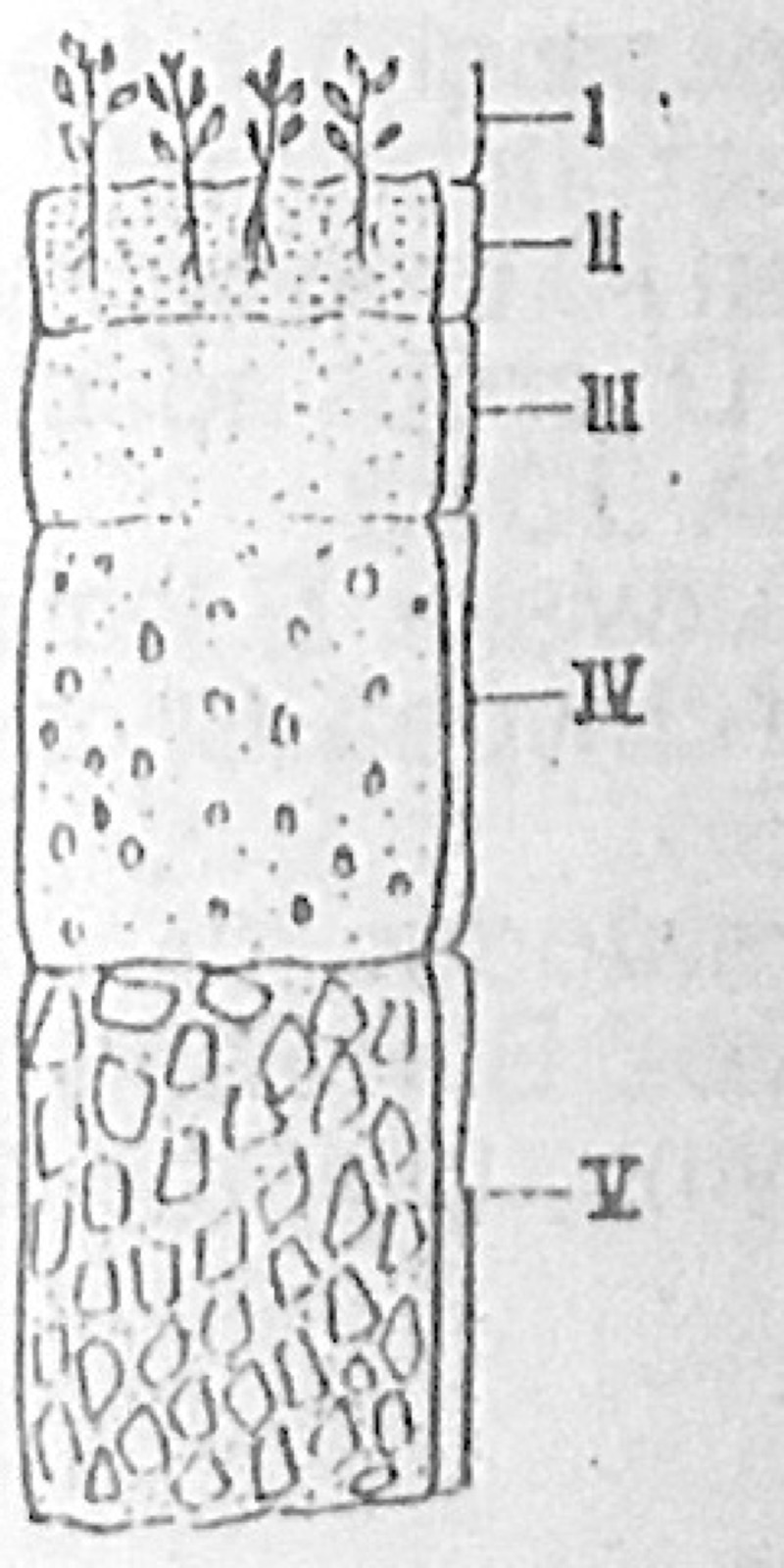
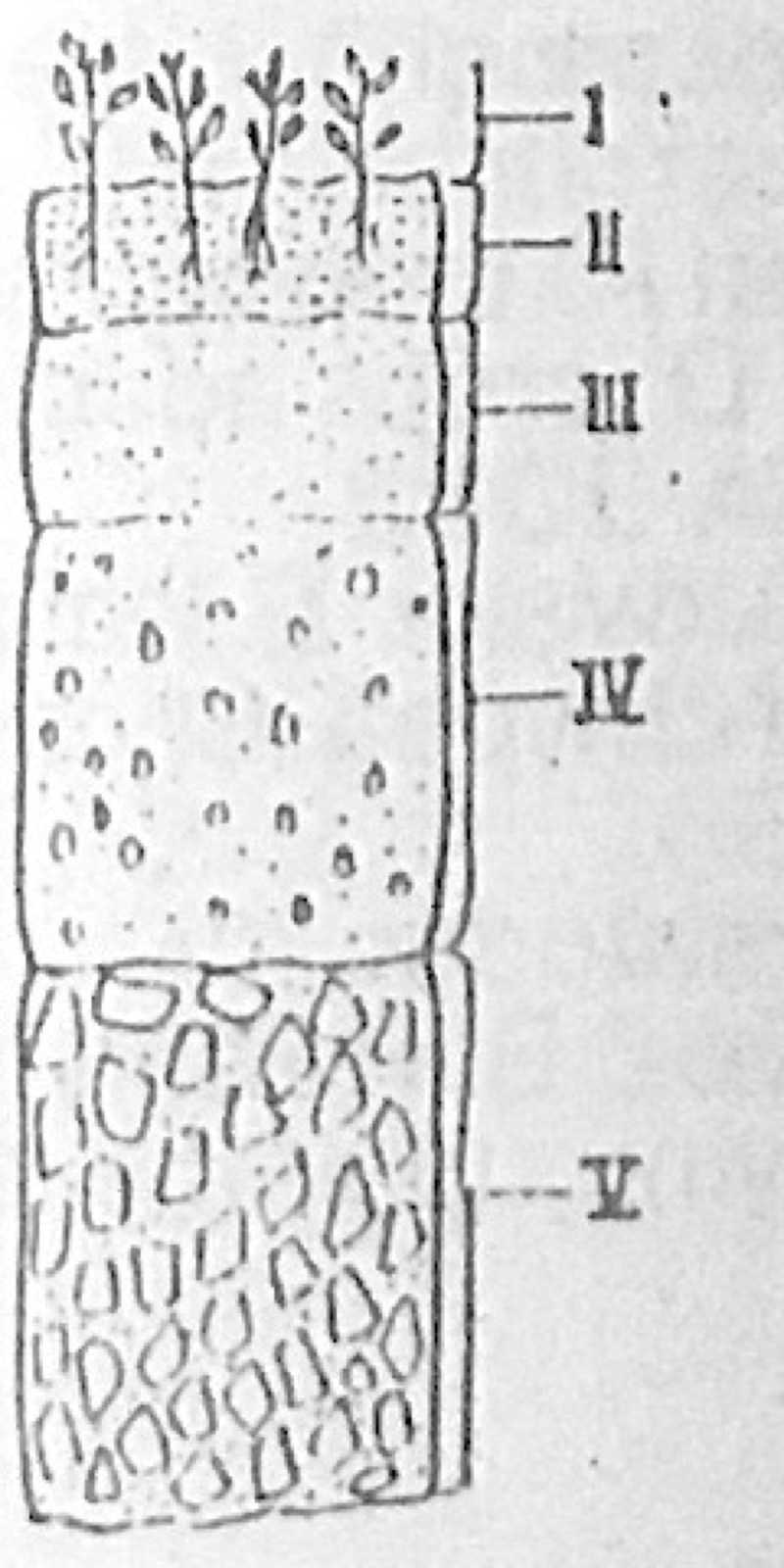
Use the diagram (a soil profile with layers labelled I to V) to answer this question. Which of the following areas has a significant influence on the properties of soils formed from it?
A.V
B.IV
C.III
D.II
E.I.
Show the answer and explanation
Answer: A (V)
Explanation
The bottom layer (V) is the parent rock, which decides the minerals and texture of the soil formed above it.
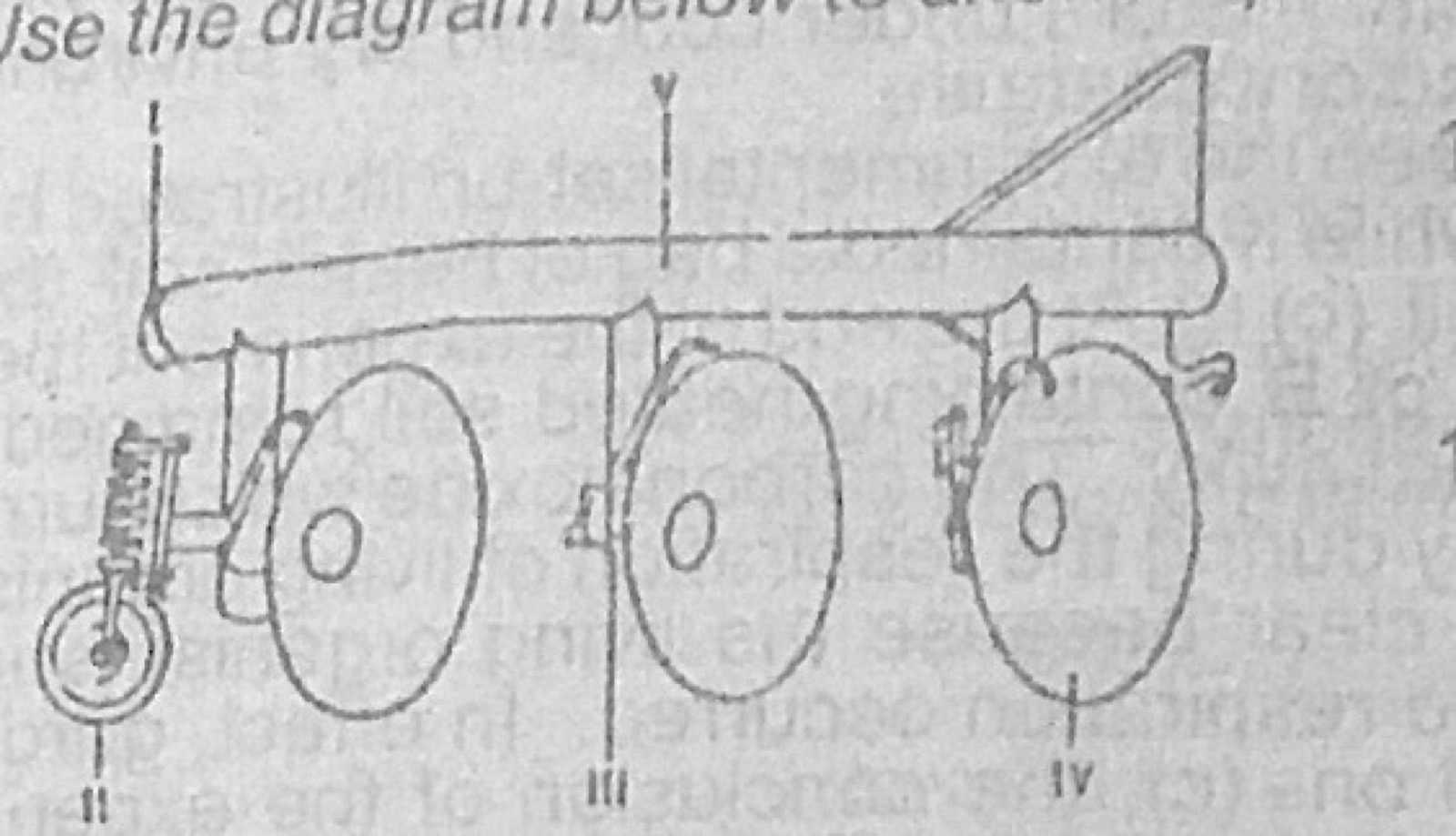
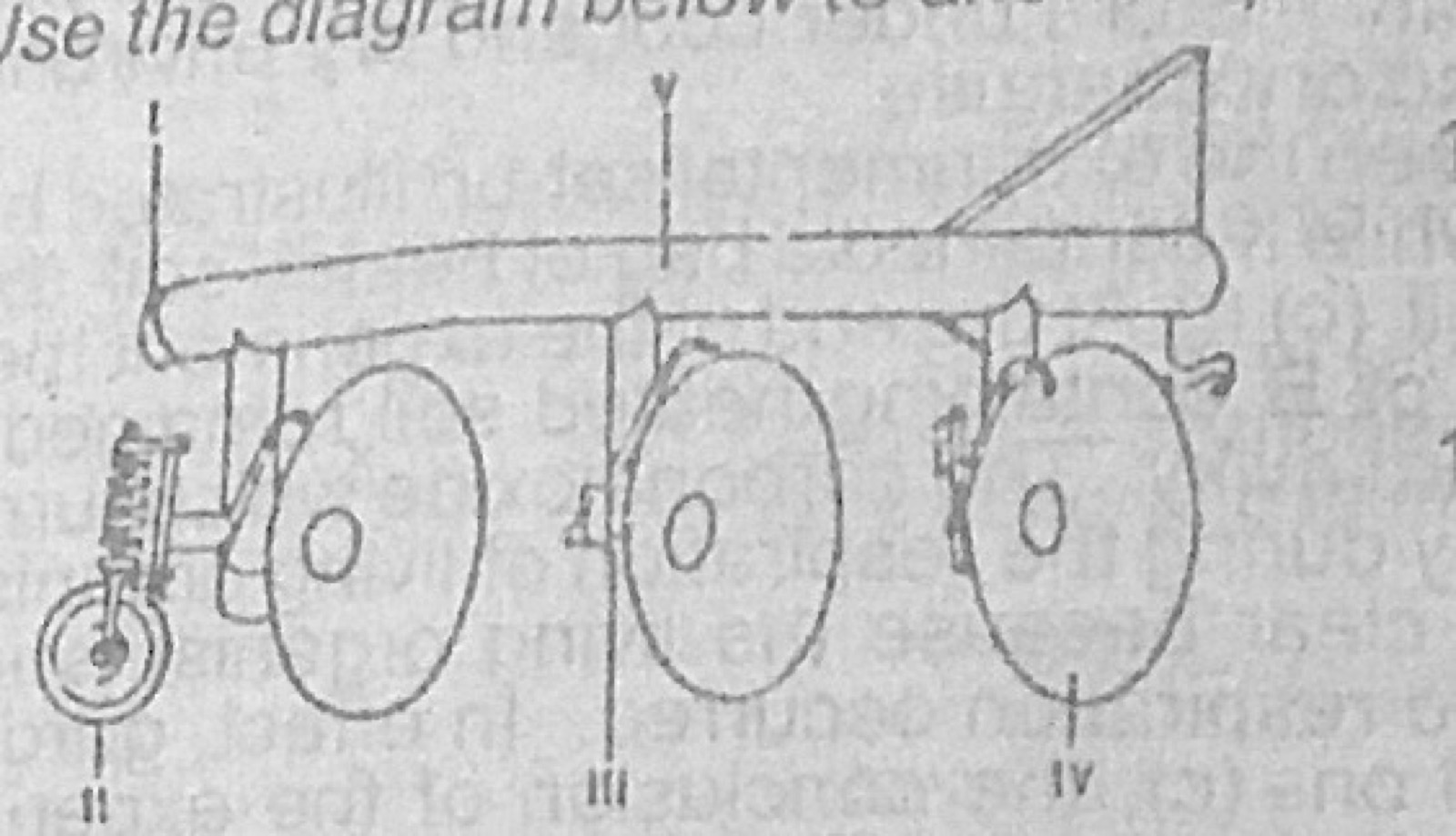
Use the diagram (a disc plough with parts labelled I to V) to answer this question. On which of the labelled parts can more weight be added to increase soil penetration by the implement?
A.V
B.IV
C.III
D.II
E.I
Show the answer and explanation
Answer: A (V)
Explanation
Extra weight is put on the main frame/beam (V) so the discs press deeper into the soil.
Use the diagram (a disc plough with parts labelled I to V) to answer this question. The part that is kept in touch with the ground at the rear end during operation is labelled
A.I
B.II
C.III
D.IV
E.V.
Show the answer and explanation
Answer: B (II)
Explanation
II is the spring-loaded rear furrow wheel, which runs on the ground and steadies the plough.
Use the diagram (a disc plough with parts labelled I to V) to answer this question. Which of the labelled structure carries out the functions of the share, coulter and mouldboard in a mouldboard plough?
A.I
B.II
C.III
D.IV
E.V.
Show the answer and explanation
Answer: D (IV)
Explanation
The concave disc (IV) cuts, lifts and turns the soil, doing the work of share, coulter and mouldboard.
If the ginning percentage of the Samaru variety of cotton is 35, what will be the amount of raw cotton obtained from a 6 hectare farm with a yield of 330 kg seed cotton per hectare?
A.46 kg
B.96.3 kg
C.114 kg
D.693 kg
E.6930 kg.
Show the answer and explanation
Answer: D (693 kg)
Explanation
Seed cotton = 6 × 330 = 1980 kg; 35% of 1980 = 693 kg of lint.
Use the information below: I. spreading and perennial plant with long and rapid growing stems. II. Height of plant about 1.2 m III. Resistance to dry weather. Which of the following pasture grasses has the description given above?
A.Northern gamba grass
B.Bahama grass
C.Guinea grass
D.Elephant grass
E.Giant star grass.
Show the answer and explanation
Answer: E (Giant star grass.)
Explanation
Giant star grass is a perennial that spreads fast by long runners, grows to about 1 m and tolerates drought.
Use the information below: I. Pale leaves II. Shrunken new leaves III. Water-soaked bark which peels off IV. Gum-like exudation from the cracks on the bark. Which of the following diseases of citrus has the symptoms listed above?
A.Die-bark
B.Gum-mosis
C.Blight
D.Tristeza
E.Citrus scab.
Show the answer and explanation
Answer: B (Gum-mosis)
Explanation
Gummosis is named after the gum that oozes from cracked, water-soaked bark.
Use the formula: percentage digestibility of nutrient = (Wt. of nutrient in feed − Wt. of nutrient in faeces)/Wt. of nutrient in feed × 100. If an animal ate 20 kg of feed containing 25% protein and excreted 15 kg of faeces containing 7.5% protein, what will be the digestibility of protein in the feed?
A.67.5%
B.77.5%
C.82.5%
D.87.5%
E.92.5%.
Show the answer and explanation
Answer: B (77.5%)
Explanation
Protein eaten = 5 kg; in faeces = 1.125 kg; (5 − 1.125)/5 × 100 = 77.5%.
(a) State four roles of government in agricultural production. (b) Describe four traditional land ownership systems in Nigeria and give one disadvantage of each system.
Show the model answer
Model answer
(a) Any four: providing credit/loans and subsidies; supplying inputs (improved seeds, fertilizer, chemicals); extension services; research; building roads, storage and processing facilities; price control/marketing support; land reform policies; providing rural amenities (b) Communal – land belongs to the community, members have use rights; disadvantage: cannot be used as collateral/strangers excluded Inheritance – land passes from parents to children; disadvantage: fragmentation into small plots Leasehold – land used for a fixed period on payment; disadvantage: no permanent development beyond the lease Purchase/freehold – land bought outright; disadvantage: expensive, ownership disputes (also gift, pledge, rent/tenancy)
Explanation
Give four roles, then four systems each with one drawback.
Discuss eight maintenance practices including the precautions you would take to keep the tractor operating safely and ensure its durability.
Show the model answer
Model answer
Any eight: check engine oil, water/coolant and fuel daily; check tyre pressure and condition; grease/lubricate moving parts; change oil and filters at service intervals; check and charge the battery; tighten loose nuts and bolts; clean the tractor after use; keep it in a shed; check brakes and steering before use; use a trained operator and follow the manufacturer's manual; do not overload or over-speed; replace worn parts promptly
Explanation
Write eight separate practices, each with why it matters.
(a) List six environmental factors affecting agricultural production in Nigeria. (b) Explain briefly how five of the factors listed in (a) can affect agricultural production in Nigeria.
Show the model answer
Model answer
(a) Any six: rainfall; temperature; relative humidity; sunlight; wind; soil (type, pH, fertility); topography; biotic factors (pests, diseases, weeds, micro-organisms) (b) Any five explained: rainfall decides crops grown and planting time, too much causes erosion and leaching; temperature affects germination, growth and animal comfort; humidity affects transpiration and disease spread; sunlight drives photosynthesis and flowering; wind helps pollination and seed dispersal but causes lodging and erosion; soil fertility and texture decide yield; pests and diseases reduce yield
(a) With the aid of a fully labelled diagram, describe the carbon cycle. (b) Explain the importance of carbon cycle to crops and animals.
Show the model answer
Model answer
(a) Labelled diagram: CO2 in the air → taken in by green plants in photosynthesis → carbon in plant tissues → eaten by animals → returned to air by respiration of plants and animals; dead plants and animals decomposed by micro-organisms release CO2; burning of fuels/vegetation releases CO2; some carbon stored as fossil fuels (b) Supplies CO2 for photosynthesis (food for crops); provides food (carbohydrates) for animals; keeps CO2 and O2 balanced in the atmosphere; decomposition recycles nutrients and forms humus
Explanation
The diagram must show photosynthesis, feeding, respiration, decay and burning with arrows.
Describe briefly the side effects, preventive and control measures of diseases and pests of crops, under the following headings: (a) chemical control (b) biological control (c) cultural method of control.
Show the model answer
Model answer
(a) Chemical control – use of pesticides (insecticides, fungicides, nematicides) by spraying, dusting, seed dressing, fumigation; side effects: pollution of air, water and soil, poisoning of man and animals, residues in food, killing useful organisms, pests developing resistance (b) Biological control – using natural enemies (predators, parasites, pathogens) e.g. parasitic wasp against cassava mealybug; side effects: slow, enemy may become a pest itself or attack useful organisms (c) Cultural control – crop rotation, early planting, clean seed, burning/removing infected plants, resistant varieties, correct spacing, weeding, fallowing; side effects: labour-intensive, slow, may need more land
Explanation
For each method give how it is done and at least two side effects.
(a) Describe briefly five management methods adopted in the forest areas to ensure a continuous timber supply. (b) Enumerate six benefits derived from forestry and range.
Show the model answer
Model answer
(a) Any five: regeneration (natural and artificial replanting); afforestation and reforestation; selective exploitation/felling of mature trees only; forest reserves and regulations/licences; taungya system; control of bush fires; fire tracing; pest and disease control; thinning and pruning (b) Any six: timber and wood; fuel wood; food (fruits, bushmeat); grazing/forage for livestock; medicinal plants; protection against erosion; windbreak; tourism/wildlife; employment and income; regulation of climate and water cycle; raw materials for industry (pulp, resin)
Explanation
Methods concern keeping trees coming; benefits can be listed.
Explain briefly the following terms: (a) ovulation (b) oestrus cycle (c) gestation (d) parturition
Show the model answer
Model answer
(a) Ovulation: release of a mature egg (ovum) from the ovary (b) Oestrus cycle: the regular interval from one heat period to the next in a female animal (e.g. about 21 days in cattle and pigs) (c) Gestation: the period of pregnancy, from fertilisation to birth (d) Parturition: the act of giving birth
(a) What is a balanced ration? (b) If birds at point of lay were fed a ration/feed containing: maize meal - 65%, groundnut cake - 25%, fish meal - 5% and brewers' grain - 5%. Name the other feed ingredients that are essential which are not listed. State the importance of the ingredients you have listed.
Show the model answer
Model answer
(a) A balanced ration is feed that contains all the nutrients an animal needs (carbohydrates, protein, fats, minerals, vitamins, water) in the right amounts and proportions for its needs (b) Missing ingredients and importance: bone meal/oyster shell or limestone – calcium and phosphorus for eggshell and bones; salt – sodium and chlorine for appetite and body fluids; vitamin/mineral premix – prevents deficiency diseases, aids egg production; lysine/methionine (amino acids) – balance protein for growth and egg formation; water – digestion and body functions; (coccidiostat/antibiotic additives optional)
Explanation
The ration listed lacks minerals, salt and vitamins.
State the law of demand and six basic assumptions as related to agricultural products. Illustrate your answer with the aid of a demand schedule and a demand curve.
Show the model answer
Model answer
Law of demand: other things being equal, the higher the price of a commodity, the lower the quantity demanded, and the lower the price, the higher the quantity demanded Assumptions (any six): consumers' income stays the same; tastes and preferences unchanged; prices of substitutes/complements unchanged; population unchanged; no expectation of future price change; commodity is a normal good; no change in government policy (taxes); weather/season constant Demand schedule: table of prices against quantities, e.g. price ₦50 – 10 kg, ₦40 – 20 kg, ₦30 – 30 kg, ₦20 – 40 kg Demand curve: plotted from the schedule with price on the vertical axis and quantity on the horizontal; slopes downward from left to right
Explanation
Include a table and a downward-sloping curve drawn from it.
(a) Explain agricultural marketing and four channels of marketing farm produce. (b) State four problems associated with marketing of farm produce by small-scale farmer.
Show the model answer
Model answer
(a) Agricultural marketing is all the activities in moving farm produce from the farmer to the consumer (assembling, grading, processing, storage, transport, pricing, selling) Channels (any four): producer → consumer (direct/farm gate); producer → retailer → consumer; producer → wholesaler → retailer → consumer; producer → cooperative society → consumer; producer → marketing board/agency → exporter/processor; producer → processor (b) Any four: poor roads/high transport cost; lack of storage, so produce sold at harvest at low prices; perishability; price fluctuation; exploitation by middlemen; small quantities produced; lack of market information; poor grading/standardisation; lack of finance
Explanation
Define marketing, then describe each channel as a chain.