27 questions. Try each one, then open the answer to check yourself and read the explanation.
Question 1
Literary Terms and DevicesA repetition of ideas, symbols or a pattern in a literary work is known as ________
- A.Motif
- B.Tautology
- C.Symbolism
- D.Flow
Show the answer and explanation
Answer: A (Motif)
ExplanationA motif is an idea, image or pattern that recurs through a work.
Question 2
Poetry: GeneralWhich of the following is not a metrical pattern?
- A.Iambus
- B.Anapest
- C.Limerick
- D.Trochee
Show the answer and explanation
Answer: C (Limerick)
ExplanationIambus, anapest and trochee are metrical feet; a limerick is a type of humorous five-line poem.
Question 3
Poetry: GeneralThe following are qualities of an epic except
- A.Didactic in nature
- B.Elegiac in tone
- C.Lengthy in lines
- D.Ascetic in manner
Show the answer and explanation
Answer: D (Ascetic in manner)
ExplanationEpics are long, teach values and are serious in tone; 'ascetic' (self-denying) is not a quality of the form.
Question 5
Literary Terms and DevicesBurlesque is marked by ________ from the original work it imitates and mocks.
- A.Ridiculous disparity
- B.Superfluous remarks
- C.Thematic thrust
- D.Aesthetic distance
Show the answer and explanation
Answer: A (Ridiculous disparity)
ExplanationBurlesque mocks a work by treating its subject in a ridiculously mismatched style.
Question 6
Literary Terms and DevicesThe term "carpe diem" means
- A.Seize the day
- B.Hold forth
- C.Alas!
- D.Expatiate
Show the answer and explanation
Answer: A (Seize the day)
Explanation'Carpe diem' is Latin for 'seize the day'.
Question 7
Literary Terms and Devices"In medias res" translates as ________
- A.From the first act
- B.In the middle of things
- C.From the middle of things
- D.In the storyline
Show the answer and explanation
Answer: B (In the middle of things)
Explanation'In medias res' is Latin for 'into the middle of things'.
Question 8
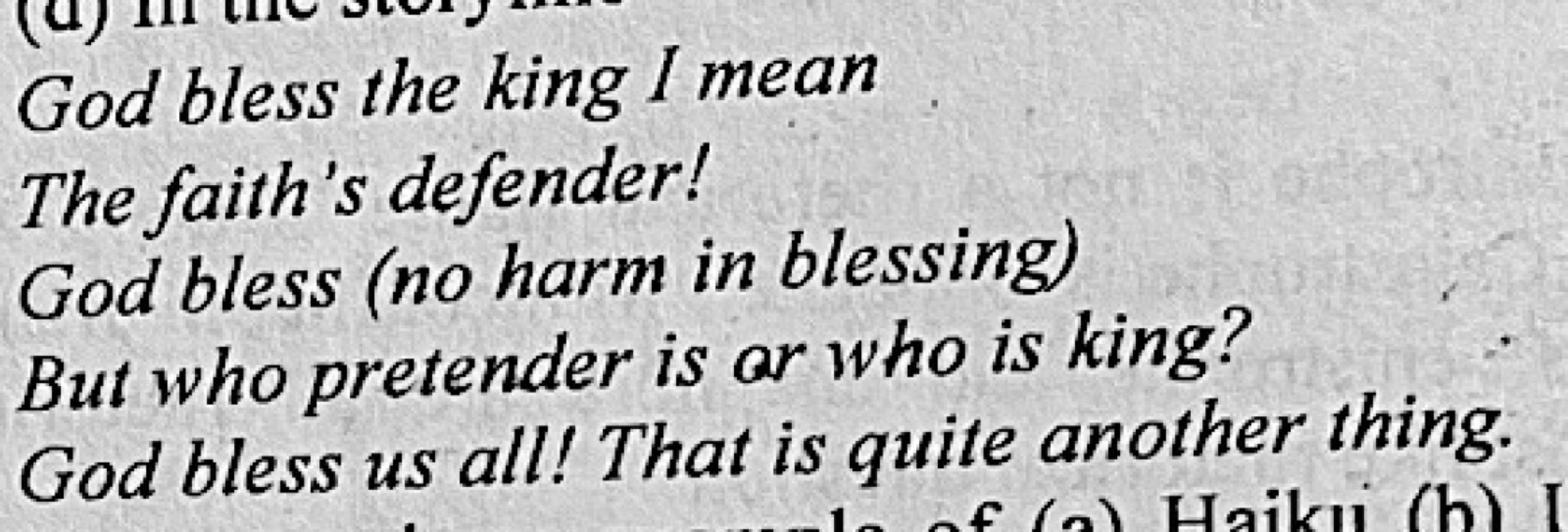
Literary Appreciation: PoetryPoem (John Byrom's epigram on the king and the pretender)
Read the poem. The poem is an example of
- A.Haiku
- B.Limerick
- C.Epigram
- D.Doggerel
Show the answer and explanation
Answer: C (Epigram)
ExplanationIt is a short, witty poem ending in a clever twist, which is an epigram.
Question 9
Drama: GeneralPeripeteia is associated with
- A.Tragedy
- B.Comedy
- C.Farce
- D.Biography
Show the answer and explanation
Answer: A (Tragedy)
ExplanationPeripeteia, the hero's sudden reversal of fortune, is a key part of tragedy (Aristotle).
Question 10
Figures of SpeechEpithet denotes ________
- A.Noun
- B.Adjective
- C.Verb
- D.Pronoun
Show the answer and explanation
Answer: B (Adjective)
ExplanationAn epithet is a describing word or phrase attached to a name, like 'swift-footed Achilles', so it works as an adjective.
Question 11
Figures of SpeechZeugma is yoking together of ________
- A.Two verbs with a noun
- B.Two nouns with a verb
- C.One noun with a verb
- D.One verb with a noun
Show the answer and explanation
Answer: B (Two nouns with a verb)
ExplanationIn zeugma one verb governs two nouns in different senses: 'He lost his money and his temper'.
Question 12
Figures of Speech"ten hands and ten mouths attest to his exploits" expresses ________
- A.Metaphor
- B.Synecdoche
- C.Metonymy
- D.Irony
Show the answer and explanation
Answer: B (Synecdoche)
Explanation'Hands' and 'mouths' are parts standing for whole people (his children or dependants): synecdoche.
Question 13
Figures of Speech"The sun smiled and the wind groaned" is an example of
- A.Zeugma
- B.Prosopopeia
- C.Prosody
- D.Aporia
Show the answer and explanation
Answer: B (Prosopopeia)
ExplanationGiving human actions to the sun and wind is personification, also called prosopopoeia.
Question 14
Literary Terms and DevicesOral literature comprises the following types except
- A.Mime
- B.Folklore
- C.Anecdote
- D.Proverb
Show the answer and explanation
Answer: A (Mime)
ExplanationFolklore, anecdotes and proverbs are spoken; mime is acting without words.
Question 15
Prose: GeneralGothic novel is characterized by the following except
- A.Mysterious disappearance
- B.Bountiful use of ghosts
- C.Supernatural utterances
- D.Wild applause
Show the answer and explanation
Answer: D (Wild applause)
ExplanationGothic novels are full of mystery, ghosts and the supernatural; wild applause is not a feature.
Question 16
Figures of SpeechUnderstatement is an attribute of
- A.Hyperbole
- B.Meiosis
- C.Irony
- D.Metonymy
Show the answer and explanation
Answer: B (Meiosis)
ExplanationMeiosis is deliberate understatement; hyperbole is its opposite.
Question 17
Figures of SpeechMalapropism is ________
- A.Intentional violation of standard diction or grammar
- B.Unintentional violation of standard diction or grammar
- C.Deliberate violation of standard diction or grammar
- D.Careless utterance
Show the answer and explanation
Answer: B (Unintentional violation of standard diction or grammar)
ExplanationA malapropism is the mistaken use of a similar-sounding word, done without meaning to.
Question 18
Poetry: GeneralThere they are my fifty men and women. The line is an example of
- A.Dactyl
- B.Trochee
- C.Anapest
- D.Iambus
Show the answer and explanation
Answer: B (Trochee)
ExplanationThe stress falls on the first syllable of each foot (THERE they / ARE my / FIF-ty…), which is trochaic.
Question 19
Literary Terms and DevicesI pray, do not mock me. I am a very foolish fond old man. The above line is an example of________
- A.Mythos
- B.Pathos
- C.Lament
- D.lyric
Show the answer and explanation
Answer: B (Pathos)
ExplanationLear's humble plea makes the audience feel pity: pathos.
Question 20
Poetry: GeneralPetrarchan sonnet originated from
- A.Egypt
- B.Italy
- C.France
- D.England
Show the answer and explanation
Answer: B (Italy)
ExplanationIt is named after the Italian poet Petrarch.
Question 21
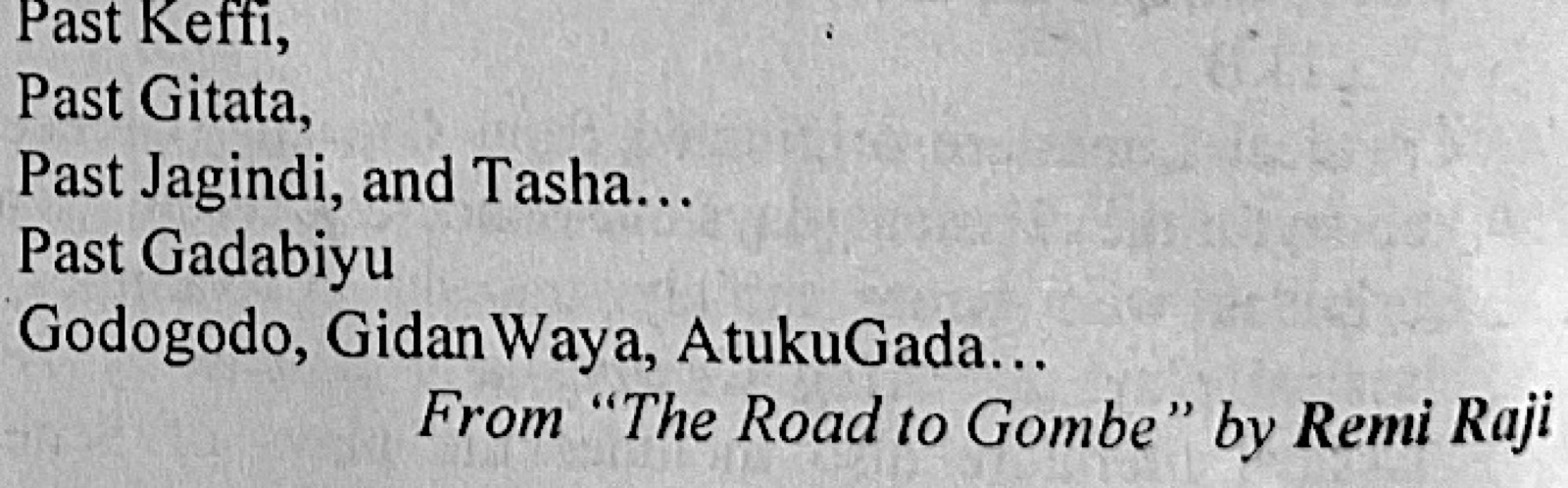
Literary Appreciation: PoetryExtract from Remi Raji, "The Road to Gombe"
Read the extract. The dominant image is ______
- A.Auditory and kinesthetic
- B.Tactile and visual
- C.Gustatory and visual
- D.Thermal and kinesthetic
Show the answer and explanation
Answer: A (Auditory and kinesthetic)
ExplanationThe repeated 'Past…' shows movement (kinesthetic), and the string of sounding place names appeals to hearing (auditory).
Question 23
Figures of SpeechThe numerous villages whistling by illustrates
- A.Personification
- B.Metaphor
- C.Simile
- D.Sibilance
Show the answer and explanation
Answer: A (Personification)
ExplanationVillages cannot whistle; giving them a human action is personification.
Question 25
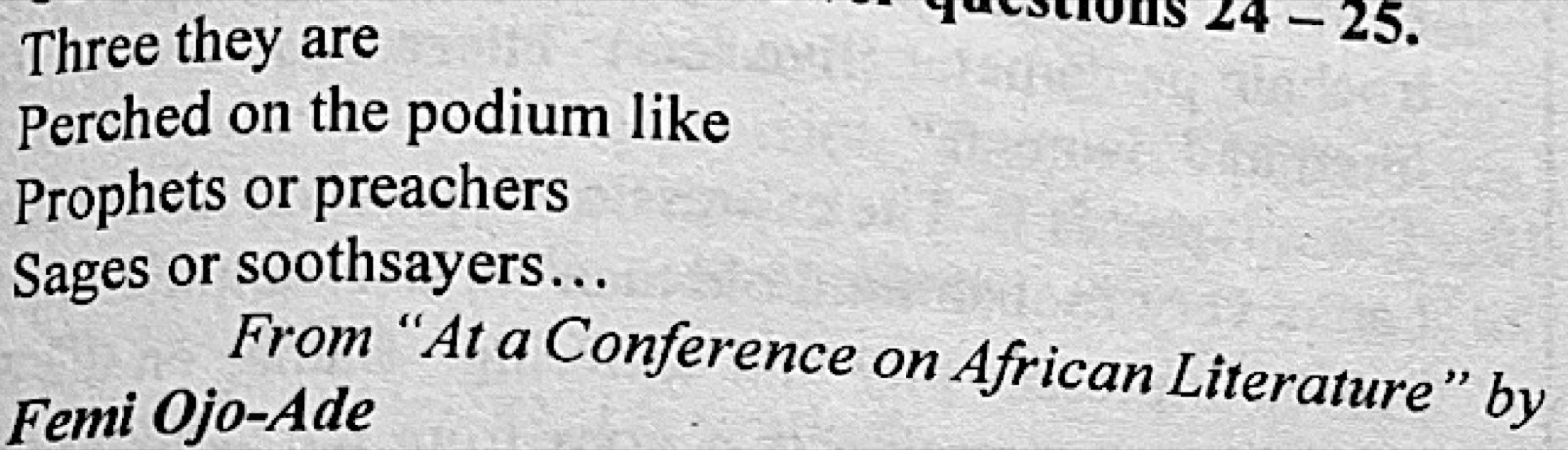
Literary Appreciation: PoetryExtract from Femi Ojo-Ade, "At a Conference on African Literature"
Read the extract. "perched" in the extract is
- A.Laudatory
- B.Derogatory
- C.Acerbic
- D.Assertive
Show the answer and explanation
Answer: B (Derogatory)
Explanation'Perched' makes the speakers sound like birds on a branch, which belittles them.
Question 26
Literary Appreciation: Prose and DramaRead the extract. The last sentence is an example of
- A.Irony
- B.Hyperbole
- C.Synecdoche
- D.Metonymy
Show the answer and explanation
Answer: B (Hyperbole)
ExplanationA few guests cannot be 'the entire continent of Africa': the mayor exaggerates.
Question 27
Literary Appreciation: Prose and DramaRead the extract. The speaker is a ________
- A.Teetotaler
- B.Sycophant
- C.Sybarite
- D.Cipher
Show the answer and explanation
Answer: B (Sycophant)
ExplanationThe mayor fawns on the powerful guests with 'Your excellencies!': he is a sycophant.
Question 28
Other Set Texts: African DramaRead the extract. "Only till I put blade to his lovely throat" is ________
- A.Ironical
- B.Oxymoronic
- C.Antithetical
- D.Metaphorical
Show the answer and explanation
Answer: A (Ironical)
ExplanationCalling the throat she wants to cut 'lovely' is bitterly ironic.
Question 29
Other Set Texts: African DramaRead the extract. "And I'll watch his blood flow, gurgling like fresh wine from the palm tree!" There is an appeal to
- A.Colour
- B.Sight
- C.Movement
- D.Sound
Show the answer and explanation
Answer: B (Sight)
Explanation'I'll watch his blood flow' is a picture for the eye: visual imagery.
Question 30
Other Set Texts: African DramaRead the extract. Yet there is use of
- A.Simile
- B.Metaphor
- C.Irony
- D.Personification
Show the answer and explanation
Answer: A (Simile)
Explanation'gurgling like fresh wine' compares the blood to wine using 'like': a simile.