JAMB Use of English 1988 past questions and answers

92 questions. Try each one, then open the answer to check yourself and read the explanation.

Question 1

Comprehension
JAMB 1988 Passage I: My first day at Freedom University
I was to remember my first day at Freedom University for a long time. One arrival on campus, I expected to be met by some stale students (as was the practice in my secondary school) but every student around was new like myself. I asked the way to Grant Hall but not one could tell me. I asked a number of other questions about issues that bothered me, such as where and how to pay the fees, the way to the dining hall and so on, but on help was forthcoming. 'So in the midst of so many people I am all alone, I mused to myself. The prospect was not in the least cheerful and all the elation I had felt at gaining entry into a renowned university at sixteen bean to disappear. Then, so if propelled by an unknown benevolent force, I walked a little bit down the corridor in the direction of notice board at which some ten young men and women were peering. For want of something to do, I decided to stop and look at the notice board. Alas! I had opened on the key to all the riddles tht had dribbled me since I set foot on campus that morning. On the board there was a big campus map in which I was able to locate Grant Hall and other places of interest, there were details of the various activities lines up for the three days of orientation for freshmen and a comprehensive list of those offered admission into various courses. How blissful I felt to see the light of knowledge, having been wallowing in the darkness of ignorance. Even then I was not able to escape the thought that though I could not be sure how much of the responsibility for the darkness was mine, the fact that something had not been done to draw attention to that apocalypse of a notice board had contributed clearly to my initial predicament. All that notwithstanding, I learnt from that incident an indelible lesson which was to stand me in very good stead throughout my stay in the university; namely, the importance of reading notice boards and handbills if one is to be well informed about places and events in the university.

The writer of the passage felt isolated because

  1. A.there were too many people
  2. B.he was a new student in Freedom University
  3. C.there were too many new students
  4. D.none of the many people around could help him
Show the answer and explanation

Answer: D (none of the many people around could help him)

Explanation

He says 'in the midst of so many people I am all alone' because no one could answer his questions or show him the way.

Open this question

Question 2

Comprehension

The writer says that the prospect was not cheerful because

  1. A.no one could tell him how to get to Grant Hall
  2. B.he had felt too elated when he gained admission into the university
  3. C.there was no hope of getting out of his predicament
  4. D.the other students were hostile
Show the answer and explanation

Answer: C (there was no hope of getting out of his predicament)

Explanation

Since nobody around could help him with anything, he saw no way out of his difficulty, so the outlook seemed gloomy.

Open this question

Question 3

Comprehension

In the passage, 'the darkness of ignorance' refers to the

  1. A.state of the writer before he found the notice board
  2. B.ignorance of illiterates
  3. C.ignorance of those who have not been to university
  4. D.that he was a freshman
Show the answer and explanation

Answer: A (state of the writer before he found the notice board)

Explanation

The 'darkness' is the confusion he was in before the notice board gave him 'the light of knowledge'.

Open this question

Question 4

Comprehension

According to the passage, the writer's predicament was caused by

  1. A.the writer himself
  2. B.those who displayed the notices and perhaps the writer
  3. C.the nature of the notice board and where it was placed
  4. D.those who displayed the notices
Show the answer and explanation

Answer: B (those who displayed the notices and perhaps the writer)

Explanation

He blames the failure to draw attention to the notice board, but admits he could not be sure 'how much of the responsibility for the darkness was mine'.

Open this question

Question 5

Comprehension

The writer remembered his first day in the university for a long time because he

  1. A.had felt very happy at being admitted into the university
  2. B.could not get anybody to help him on his first day in the university
  3. C.had learnt the hard way how to keep informed about happenings in the university
  4. D.eventually discovered the notice board by chance.
Show the answer and explanation

Answer: C (had learnt the hard way how to keep informed about happenings in the university)

Explanation

His bad experience taught him 'an indelible lesson': to read notice boards and handbills to stay informed.

Open this question

Question 6

Comprehension
JAMB 1988 Passage II: Listening
To listen properly is hard job, and probably one of the toughest skills in the art of communication. Good listening has nothing to do with proper functioning of one's auditory organs, which is assumed to be inevitable. Good listening, in the sense we are interested in, is not a biological factor, but a psychological one. Your auditory organs may be in perfect order, when actually you cannot use them creatively. Creative listening implies your being efficient in the art of concentration; in other words, you concentrate on what one is saying so as to make sure that you hear all that is said. At the same time you are concentrating to her all that is being said, you are also thinking fast, disgesting what is being said, allowing your mental faculities and your memory to accept that which you understand, and to reject that which you do not understand, sorting out what you do not understand and storing them somewhere in your brain for future discussion, and , all at the same time, rationalizing what you hear, accepting that which you find rational and rejecting that which you do not find rational.

After you must have listened creatively to what you have been told, then you can respond if the need arises. It is quite proper that you respond, because the process of response enhances the art of communication. But your response ought to be only a necessary response; a response tht will improve your understanding. This response should involve your mentioning some of those things you have been told but which you do not understand, or politely questioning the rationality of some of the speaker's argument. But your response must be constructive; must enhance the communicative worth. It should not be an unnecessary argument, or an opportunity for you to express dissatisfaction or disaffection. The ability to listen properly aids communication and understanding.

The passage says that

  1. A.there are many skills of communication of which listening is one
  2. B.the art of listening is the toughest of all communication skills
  3. C.good listening depends on perfect functioning of the auditory organs
  4. D.good listening needs formal training
Show the answer and explanation

Answer: A (there are many skills of communication of which listening is one)

Explanation

The passage calls listening 'probably one of the toughest skills in the art of communication', i.e. one skill among many. It does not say it is the toughest of all.

Open this question

Question 7

Comprehension

Creative listening involves all the following EXCEPT

  1. A.efficient concentration
  2. B.making sure that what the speaker is saying is audible
  3. C.that the listener must be able to think fast
  4. D.that there must be a co-ordination of all the objective faculties
Show the answer and explanation

Answer: B (making sure that what the speaker is saying is audible)

Explanation

Creative listening concerns what the listener does with his mind: concentrating, thinking fast and using his faculties together. Whether the speaker is audible is not part of it.

Open this question

Question 8

Comprehension

Creative listening implies all EXCEPT

  1. A.a critical enterprise
  2. B.an uncompromising rejection of the speaker's argument
  3. C.some argument with the speaker
  4. D.a great deal of discipline
Show the answer and explanation

Answer: B (an uncompromising rejection of the speaker's argument)

Explanation

The listener should question the speaker 'politely' and respond constructively; rejecting everything the speaker says is not what the passage describes.

Open this question

Question 9

Comprehension

The tone of the passage is

  1. A.sermonizing
  2. B.pleading
  3. C.analytical
  4. D.argumentative
Show the answer and explanation

Answer: C (analytical)

Explanation

The writer calmly breaks listening down into its parts and examines each one, which is an analytical tone.

Open this question

Question 10

Comprehension

A most suitable title for the passage is

  1. A.Communication skills
  2. B.How to listen attentively
  3. C.Listening in Communication
  4. D.Listening argument and understanding
Show the answer and explanation

Answer: C (Listening in Communication)

Explanation

The passage is about listening as a skill in communication and how good listening aids communication.

Open this question

Question 11

Comprehension
JAMB 1988 Passage III: Working in a foreign language
In the past, learning English as a separate subject seemed relatively easy. The textbook selected and graded items of language which were put into context and then practised intensively. New items were carefully controlled so that the student could cope quite easily. Now that English is used as a medium of instruction, however, all this has changed. Unknown items of grammar and vocabulary appear in texts which attempt to explain new and often difficult information. Difficulties with the language interact with difficulties as regards the subject matter. The student's reading in his own subject slows down, and his comprehension becomes less secure. He expresses himself slowly and often fails to convey his ideas exactly. He is disappointed to find tht under pressure he makes a lot of unnecessary mistakes in areas where he knows the correct language forms. His social relations are difficult as he cannot find the right phrase quickly enough to keep a conversation going; so his language often betrays him into dullness, coldness, or worst of all, rudeness. Instead of the students being in control of the language, the language seems now to be in control of the student.

All of this can be very depressing and the student can start to feel very anxious. Working in a foreign language is also very tiring, and the concentration and self-discipline required to correct one's mistakes is very great indeed.

The most appropriate title for this passage is

  1. A.Problems of learning a new language
  2. B.Problems of learning English as a separate subject
  3. C.Problems of working in English as a foreign language
  4. D.Difficulties with interacting in English
Show the answer and explanation

Answer: C (Problems of working in English as a foreign language)

Explanation

The passage describes the difficulties a student meets when he has to study and live in English, a foreign language, as his medium of instruction.

Open this question

Question 12

Comprehension

The student begins to experience difficulties with English when

  1. A.learning English with other subjects
  2. B.learning English as a separate subject
  3. C.his comprehension becomes less secure
  4. D.using English as a medium of instruction
Show the answer and explanation

Answer: D (using English as a medium of instruction)

Explanation

The passage says learning English as a separate subject was easy; the difficulties begin 'now that English is used as a medium of instruction'.

Open this question

Question 13

Comprehension

The expression 'his language often betrays him into dullness, coldness, or worst of all, rudeness' means that

  1. A.his English language lets him down and he becomes dull, cold and rude
  2. B.the way he uses the language gives one the impression that he is dull, cold or rude
  3. C.he betrays his bad manners by using English badly
  4. D.his dullness, coldness or rudeness betrays his bad manners in language
Show the answer and explanation

Answer: B (the way he uses the language gives one the impression that he is dull, cold or rude)

Explanation

Because he cannot find the right phrase quickly, his English makes him come across as dull or rude even though he does not mean to be.

Open this question

Question 14

Comprehension

The statement 'instead of the student being in control of the language, the language seems now to be in control of the student' implies that the

  1. A.writer is not serious; he is only being humorous
  2. B.language can make the student behave like an Englishman
  3. C.language can make the student behave rather badly
  4. D.student should stop using the language so as not to be controlled by it
Show the answer and explanation

Answer: C (language can make the student behave rather badly)

Explanation

Since the language 'betrays him into dullness, coldness ... rudeness', it is the language that decides how he behaves, and it makes him behave badly.

Open this question

Question 15

Comprehension

The most likely source of difficulty for the student working with English as a medium of instruction is

  1. A.the newness of the subject matter in the texts being read
  2. B.unknown items of grammar and vocabulary in the texts
  3. C.the student's slow reading rate in his own subject
  4. D.the tiring nature of working in a foreign language
Show the answer and explanation

Answer: B (unknown items of grammar and vocabulary in the texts)

Explanation

The passage says 'Unknown items of grammar and vocabulary appear in texts'; the slow reading and tiredness are results of this.

Open this question

Question 21

Comprehension
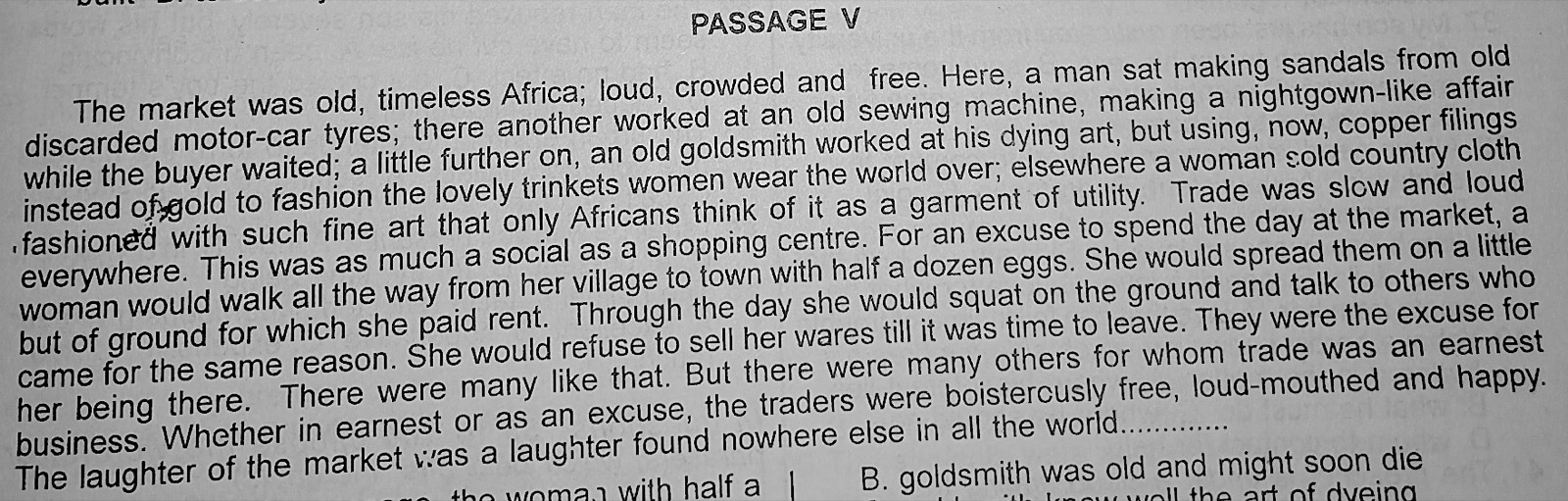
JAMB 1988 Passage V: The market
The passage, as printed

According to the passage, the woman with half a dozen eggs in the market

  1. A.is doing earnest business
  2. B.comes purposely to enjoy herself
  3. C.is like other traders in the market
  4. D.does not like her husband at home
Show the answer and explanation

Answer: B (comes purposely to enjoy herself)

Explanation

Her eggs are only an excuse: she refuses to sell them and spends the day chatting, so she comes for the social pleasure.

Open this question

Question 22

Comprehension

'An old goldsmith worked on his dying art' means that the

  1. A.goldsmith's trade was no longer popular
  2. B.goldsmith was old and might soon die
  3. C.goldsmith knew well the art of dyeing
  4. D.goldsmith now used copper filings
Show the answer and explanation

Answer: A (goldsmith's trade was no longer popular)

Explanation

A 'dying art' is a craft that is disappearing because few people still practise or want it.

Open this question

Question 23

Comprehension

Which of the following titles BEST reflects the content of the passage?

  1. A.a market scene
  2. B.trading in the market
  3. C.an African market scene
  4. D.an African shopping centre
Show the answer and explanation

Answer: C (an African market scene)

Explanation

The passage describes life in a market and stresses that it is 'old, timeless Africa', so 'an African market scene' fits best.

Open this question

Question 26

Antonyms

Choose the option opposite in meaning to the word(s) in italics: Our government is making determined efforts to eradicate illiteracy.

  1. A.compulsory
  2. B.ineffective
  3. C.innocent
  4. D.unreliable
Show the answer and explanation

Answer: B (ineffective)

Explanation

Determined efforts are strong and purposeful; ineffective efforts are weak and achieve nothing.

Open this question

Question 27

Antonyms

Choose the option opposite in meaning to the word(s) in italics: Makerere University has a large intake of students each year.

  1. A.rejection
  2. B.product
  3. C.output
  4. D.turn-out
Show the answer and explanation

Answer: C (output)

Explanation

A university's intake is the students it admits; its output is the graduates it sends out.

Open this question

Question 28

Antonyms

Choose the option opposite in meaning to the word(s) in italics: Florence flogged the girl reluctantly

  1. A.eagerly
  2. B.calmly
  3. C.furiously
  4. D.laboriously
Show the answer and explanation

Answer: A (eagerly)

Explanation

Reluctantly means unwillingly; eagerly means with great willingness.

Open this question

Question 29

Antonyms

Choose the option opposite in meaning to the word(s) in italics: Sola's car is badly damaged; he has to look for an expert mechanic to fix it.

  1. A.uneducated
  2. B.amateurish
  3. C.awkward
  4. D.unscientific
Show the answer and explanation

Answer: B (amateurish)

Explanation

An expert is highly skilled; amateurish means unskilled.

Open this question

Question 30

Antonyms

Choose the option opposite in meaning to the word(s) in italics: Coastal plains are often very densely populated.

  1. A.weakly
  2. B.badly
  3. C.rarely
  4. D.sparsely.
Show the answer and explanation

Answer: D (sparsely.)

Explanation

Densely populated means crowded with people; sparsely populated means having few people.

Open this question

Question 31

Antonyms

Choose the option opposite in meaning to the word(s) in italics: Wilfred was a mindless criminal.

  1. A.strong
  2. B.mindful
  3. C.feeling
  4. D.memorable.
Show the answer and explanation

Answer: B (mindful)

Explanation

Mindless means acting without thought; mindful means thoughtful and aware.

Open this question

Question 32

Antonyms

Choose the option opposite in meaning to the word(s) in italics: The judge blamed the plaintiff for misleading the court.

  1. A.defendant
  2. B.complainant
  3. C.accused
  4. D.prosecution
Show the answer and explanation

Answer: A (defendant)

Explanation

In a civil case the plaintiff brings the complaint and the defendant answers it.

Open this question

Question 33

Antonyms

Choose the option opposite in meaning to the word(s) in italics: The thieves vandalized the vault's lock.

  1. A.repaired
  2. B.arranged
  3. C.serviced
  4. D.actuated
Show the answer and explanation

Answer: A (repaired)

Explanation

To vandalize is to damage on purpose; to repair is to fix.

Open this question

Question 34

Antonyms

Choose the option opposite in meaning to the word(s) in italics: The demonstrators have refused to call off their action.

  1. A.consolidate
  2. B.start
  3. C.resume
  4. D.end
Show the answer and explanation

Answer: C (resume)

Explanation

To call off an action is to stop or cancel it; to resume is to continue it again.

Open this question

Question 35

Antonyms

Choose the option opposite in meaning to the word(s) in italics: The angry waves swallowed the boat.

  1. A.gentle
  2. B.unruffled
  3. C.cool
  4. D.serene
Show the answer and explanation

Answer: B (unruffled)

Explanation

Angry waves are rough and stormy; unruffled water is smooth and calm.

Open this question

Question 36

Idioms and Phrasal Verbs

Choose the option nearest in meaning to the word(s) or phrase(s) in italics: Ngozi and Ekaette were fast friends when we were in the secondary school.

  1. A.friends who run very quickly together
  2. B.friends who go without food for a long time together
  3. C.friends who are not easily separated from each other
  4. D.friends who spend too much time and energy on pleasure and excitement together
Show the answer and explanation

Answer: C (friends who are not easily separated from each other)

Explanation

'Fast' here means firmly fixed, so fast friends are close, loyal friends who stay together.

Open this question

Question 37

Synonyms

Choose the option nearest in meaning to the word(s) or phrase(s) in italics: My son has just been rusticated from the university.

  1. A.sent home to get his fees
  2. B.sent home for misconduct
  3. C.sent home to rest for some time
  4. D.sent home to become rustic
Show the answer and explanation

Answer: B (sent home for misconduct)

Explanation

A rusticated student is sent away from the university for a period as a punishment for misconduct.

Open this question

Question 38

Synonyms

Choose the option nearest in meaning to the word(s) or phrase(s) in italics: All we need is a concerted effort to combat the epidemic.

  1. A.persistent
  2. B.dramatic
  3. C.joint
  4. D.concentrated
Show the answer and explanation

Answer: C (joint)

Explanation

A concerted effort is made by people working together, i.e. a joint effort.

Open this question

Question 39

Synonyms

Choose the option nearest in meaning to the word(s) or phrase(s) in italics: Jimoh has cupboard love for Sidikatu.

  1. A.love that never fails
  2. B.genuine love
  3. C.love for what he wants from her
  4. D.love that can fail in time of trouble
Show the answer and explanation

Answer: C (love for what he wants from her)

Explanation

Cupboard love is affection shown only to get something, like a pet that loves whoever opens the food cupboard.

Open this question

Question 40

Idioms and Phrasal Verbs

Choose the option nearest in meaning to the word(s) or phrase(s) in italics: Yahaya hardly knows on which side his bread is buttered in the matter

  1. A.where his interest lies
  2. B.what he must do
  3. C.where he should go
  4. D.whom to contact for help
Show the answer and explanation

Answer: A (where his interest lies)

Explanation

Knowing which side your bread is buttered means knowing what is to your own advantage.

Open this question

Question 41

Idioms and Phrasal Verbs

Choose the option nearest in meaning to the word(s) or phrase(s) in italics: The preacher is under a cloud among the congregation.

  1. A.out of favour
  2. B.under observation
  3. C.under weather
  4. D.confused
Show the answer and explanation

Answer: A (out of favour)

Explanation

To be under a cloud is to be in disgrace or out of favour.

Open this question

Question 42

Idioms and Phrasal Verbs

Choose the option nearest in meaning to the word(s) or phrase(s) in italics: The politician played to the gallery to win the election

  1. A.obeyed the people
  2. B.sang a good song for the people
  3. C.went to the gallery
  4. D.went out of his way to appeal to the taste of the people
Show the answer and explanation

Answer: D (went out of his way to appeal to the taste of the people)

Explanation

Playing to the gallery means behaving in a way meant to win popular approval.

Open this question

Question 43

Idioms and Phrasal Verbs

Choose the option nearest in meaning to the word(s) or phrase(s) in italics: The hefty warder came in and all the prisoners snuffed out their cigarettes.

  1. A.extinguished
  2. B.put out
  3. C.squeezed
  4. D.put down
Show the answer and explanation

Answer: A (extinguished)

Explanation

To snuff out a cigarette is to put out its flame, i.e. extinguish it.

Open this question

Question 44

Synonyms

Choose the option nearest in meaning to the word(s) or phrase(s) in italics: The popularity of the slogan is beginning to wane.

  1. A.wear
  2. B.slide
  3. C.thin out
  4. D.decline
Show the answer and explanation

Answer: D (decline)

Explanation

To wane is to become gradually smaller or weaker, i.e. to decline.

Open this question

Question 45

Idioms and Phrasal Verbs

Choose the option nearest in meaning to the word(s) or phrase(s) in italics: The policeman looked at the face of the robber and saw tell-tale signs of a dyed-in-the wool convict.

  1. A.hardened
  2. B.remorseless
  3. C.heady
  4. D.hardhearted
Show the answer and explanation

Answer: A (hardened)

Explanation

Dyed-in-the-wool means fixed in one's ways and unlikely to change, so a hardened convict.

Open this question

Question 46

Synonyms

Choose the option nearest in meaning to the word(s) or phrase(s) in italics: 'Marcus bears watching; remarked Emperor Nero.

  1. A.deserves
  2. B.needs
  3. C.favours
  4. D.enjoys
Show the answer and explanation

Answer: B (needs)

Explanation

If someone 'bears watching' he needs to be watched carefully.

Open this question

Question 47

Idioms and Phrasal Verbs

Choose the option nearest in meaning to the word(s) or phrase(s) in italics: The senior prefect had to carry the can because he refused to identify the culprit.

  1. A.dispose the can of refuse
  2. B.accept responsibility
  3. C.be made one of the scape goats
  4. D.bear the brunt.
Show the answer and explanation

Answer: B (accept responsibility)

Explanation

To carry the can is to accept the blame or responsibility for something.

Open this question

Question 48

Idioms and Phrasal Verbs

Choose the option nearest in meaning to the word(s) or phrase(s) in italics: The senior had the habit of setting the cat among the pigeon whenever matters concerning his constituency came up for debate.

  1. A.illuminating issues that are not clear
  2. B.monopolizing the discussion
  3. C.making frequent interruptions in the nature of points of correction
  4. D.introducing elements of controversy and confusion
Show the answer and explanation

Answer: D (introducing elements of controversy and confusion)

Explanation

Setting the cat among the pigeons means saying or doing something that causes trouble and argument.

Open this question

Question 49

Idioms and Phrasal Verbs

Choose the option nearest in meaning to the word(s) or phrase(s) in italics: Adah has not been regular at lectures because she has been off colour.

  1. A.gloomy
  2. B.trying to hide her bleached skin
  3. C.slightly sick
  4. D.upset
Show the answer and explanation

Answer: C (slightly sick)

Explanation

Feeling 'off colour' means feeling slightly ill, a reason for missing lectures.

Open this question

Question 50

Idioms and Phrasal Verbs

Choose the option nearest in meaning to the word(s) or phrase(s) in italics: When the man lost his two sons in a motor accident, he cracked up

  1. A.became broken-hearted
  2. B.became inconsolable
  3. C.became slightly deranged
  4. D.became temperamental
Show the answer and explanation

Answer: C (became slightly deranged)

Explanation

To 'crack up' is to break down mentally under strain. Of the options, only 'became slightly deranged' describes the mind giving way; the others describe sadness.

Open this question

Question 51

Synonyms

Choose the option nearest in meaning to the word(s) or phrase(s) in italics: The news of his performance in the sessional examination has made Okechukwu crestfallen.

  1. A.highly irritable
  2. B.dejected
  3. C.elated
  4. D.pompous
Show the answer and explanation

Answer: B (dejected)

Explanation

Crestfallen means sad and disappointed, i.e. dejected.

Open this question

Question 52

Idioms and Phrasal Verbs

Choose the option nearest in meaning to the word(s) or phrase(s) in italics: The man rebuked his son severely, but his words seem to have cut no ice

  1. A.been unconvincing
  2. B.had no effect
  3. C.not cooled the boy's temper
  4. D.added insult to injury
Show the answer and explanation

Answer: B (had no effect)

Explanation

If words cut no ice, they have no effect or influence on someone.

Open this question

Question 53

Synonyms

Choose the option nearest in meaning to the word(s) or phrase(s) in italics: The urban environment tends to form the nucleus of a common dialect.

  1. A.setting
  2. B.respository
  3. C.cell
  4. D.core
Show the answer and explanation

Answer: D (core)

Explanation

A nucleus is the central part around which something grows, i.e. its core.

Open this question

Question 54

Synonyms

Choose the option nearest in meaning to the word(s) or phrase(s) in italics: I shall be with you presently.

  1. A.now
  2. B.in a moment
  3. C.at present
  4. D.for the time being
Show the answer and explanation

Answer: B (in a moment)

Explanation

'Presently' here means soon, in a short while, not 'now'.

Open this question

Question 55

Synonyms

Choose the option nearest in meaning to the word(s) or phrase(s) in italics: The builder's taste reflected superfluous grandeur

  1. A.excellent
  2. B.superlative
  3. C.expensive
  4. D.too much
Show the answer and explanation

Answer: D (too much)

Explanation

Superfluous means more than is needed, i.e. too much.

Open this question

Question 56

Vocabulary in Context

Choose the word(s) or phrase(s) which best fills the gap(s): The child's recent training has not been very effective, he is likely to....... to his old habits.

  1. A.revert
  2. B.convert
  3. C.reverse
  4. D.revise
Show the answer and explanation

Answer: A (revert)

Explanation

To revert to old habits is to go back to them.

Open this question

Question 57

Vocabulary in Context

Choose the word(s) or phrase(s) which best fills the gap(s): The students went on whispering in..... of the teacher.

  1. A.dishonour
  2. B.disagreement
  3. C.defiance
  4. D.disobedience
Show the answer and explanation

Answer: C (defiance)

Explanation

'In defiance of' means openly refusing to obey someone.

Open this question

Question 58

Vocabulary in Context

Choose the word(s) or phrase(s) which best fills the gap(s): You can never find Okwu; he is a very... person.

  1. A.delusive
  2. B.elusive
  3. C.illusive
  4. D.deceptive
Show the answer and explanation

Answer: B (elusive)

Explanation

An elusive person is hard to find or catch.

Open this question

Question 59

Adjectives and Adverbs

Choose the word(s) or phrase(s) which best fills the gap(s): You could see that Akpan did not give his evidence............

  1. A.honestly completely
  2. B.complete honestly
  3. C.honest completely
  4. D.completely honestly
Show the answer and explanation

Answer: D (completely honestly)

Explanation

'Honestly' describes how he gave evidence and 'completely' modifies 'honestly': 'completely honestly'.

Open this question

Question 60

Vocabulary in Context

Choose the word(s) or phrase(s) which best fills the gap(s): The suspect defrauded his........ victims of large sums of money.

  1. A.unsuspected
  2. B.unsuspecting
  3. C.unexpecting
  4. D.unexpected
Show the answer and explanation

Answer: B (unsuspecting)

Explanation

Unsuspecting victims are people who do not suspect anything is wrong.

Open this question

Question 61

Nouns and Determiners

Choose the word(s) or phrase(s) which best fills the gap(s): The........ of the participating countries will hold a preconference on the eve of the conference.

  1. A.Auditor Generals
  2. B.Auditors General
  3. C.Auditors Generals
  4. D.Auditors Generals
Show the answer and explanation

Answer: B (Auditors General)

Explanation

In titles like 'Auditor General', the main noun is 'Auditor', so it takes the plural: 'Auditors General'.

Open this question

Question 62

Verb Forms

Choose the word(s) or phrase(s) which best fills the gap(s): The drummers struck their drums with great efforts, and the surging crowds of dancers...... and ......... the grounds around the palace.

  1. A.structed/thumped
  2. B.kicked/ stamped
  3. C.thumped/licked
  4. D.stroked/ thumped
Show the answer and explanation

Answer: A (structed/thumped)

Explanation

The dancers strutted (moved proudly) and thumped (struck hard with their feet) the ground in time to the drums.

Open this question

Question 63

Vocabulary in Context

Choose the word(s) or phrase(s) which best fills the gap(s): The chairman's laughter was with no...... to ridicule the applicant.

  1. A.intention
  2. B.intend
  3. C.intendment
  4. D.intent
Show the answer and explanation

Answer: D (intent)

Explanation

'With no intent to' is the set phrase meaning without any purpose to do something.

Open this question

Question 64

Vocabulary in Context

Choose the word(s) or phrase(s) which best fills the gap(s): The water is not good for drinking: it's been....... by the dead rabbit.

  1. A.contaminated
  2. B.infested
  3. C.spoilt
  4. D.diseased
Show the answer and explanation

Answer: A (contaminated)

Explanation

Water made impure by something dirty is contaminated; 'infested' is used of pests.

Open this question

Question 65

Vocabulary in Context

Choose the word(s) or phrase(s) which best fills the gap(s): The austerity of the times has made people to be more...........in their spending.

  1. A.watchful
  2. B.circumspect
  3. C.misely
  4. D.hesitant
Show the answer and explanation

Answer: B (circumspect)

Explanation

Circumspect means careful and cautious, which suits spending in hard times.

Open this question

Question 66

Prepositions

Choose the word(s) or phrase(s) which best fills the gap(s): Are you sure he prefers a horse ride.... a walk?

  1. A.than to take
  2. B.to taking
  3. C.instead to take
  4. D.than
Show the answer and explanation

Answer: B (to taking)

Explanation

'Prefer' is followed by 'to', not 'than': he prefers a horse ride to taking a walk.

Open this question

Question 67

Prepositions

Choose the word(s) or phrase(s) which best fills the gap(s): ...... to your request, we have decided to provide the necessary information.

  1. A.As regards
  2. B.With regards
  3. C.With regard
  4. D.Regarding
Show the answer and explanation

Answer: C (With regard)

Explanation

The correct phrase is 'with regard to'; 'with regards' is a greeting, and 'as regards'/'regarding' do not take 'to'.

Open this question

Question 68

Vocabulary in Context

Choose the word(s) or phrase(s) which best fills the gap(s): The price of everything seems to have.... up in the last few months.

  1. A.climbed
  2. B.shot
  3. C.risen
  4. D.flared
Show the answer and explanation

Answer: B (shot)

Explanation

Prices that 'shoot up' rise suddenly and sharply; 'risen' and 'climbed' do not need 'up'.

Open this question

Question 69

Idioms and Phrasal Verbs

Choose the word(s) or phrase(s) which best fills the gap(s): Just to convince you about my commitment to the project, I shall... at the office before I leave for Kano tomorrow.

  1. A.put up an appearance
  2. B.put in an appearance
  3. C.put up appearance
  4. D.put an appearance
Show the answer and explanation

Answer: B (put in an appearance)

Explanation

To 'put in an appearance' is to go somewhere briefly to show you are present.

Open this question

Question 70

Vocabulary in Context

Choose the word(s) or phrase(s) which best fills the gap(s): There was a ..... of steps.

  1. A.stair
  2. B.height
  3. C.flight
  4. D.climb
Show the answer and explanation

Answer: C (flight)

Explanation

A series of steps is called a flight of steps.

Open this question

Question 71

Vocabulary in Context

Choose the word(s) or phrase(s) which best fills the gap(s): Mary young men of nowadays do not know how to properly... .....their clothes.

  1. A.press
  2. B.iron
  3. C.smoothen
  4. D.stretch
Show the answer and explanation

Answer: B (iron)

Explanation

Clothes are ironed to remove creases; 'iron' is the usual verb.

Open this question

Question 72

Idioms and Phrasal Verbs

Choose the word(s) or phrase(s) which best fills the gap(s): The dancers were all in...... before their departure

  1. A.good spirits
  2. B.good spirit
  3. C.high spirit
  4. D.high spirits
Show the answer and explanation

Answer: D (high spirits)

Explanation

'In high spirits' (always plural) means cheerful and excited. Option A, 'good spirits', is also correct English.

Open this question

Question 73

Idioms and Phrasal Verbs

Choose the word(s) or phrase(s) which best fills the gap(s): Ebun..... the edge of the cliff after his shoes had failed to grip.

  1. A.fell down
  2. B.fell off
  3. C.fell away
  4. D.fell from
Show the answer and explanation

Answer: B (fell off)

Explanation

He fell off the edge of the cliff; 'fall off' is used for coming down from an edge or surface.

Open this question

Question 74

Verb Forms

Choose the word(s) or phrase(s) which best fills the gap(s): That old lady prefers...... bread...... clothes.

  1. A.to bake/than making
  2. B.to bake/to making
  3. C.baking/to making
  4. D.baking/than to make
Show the answer and explanation

Answer: C (baking/to making)

Explanation

'Prefer' compares two -ing forms with 'to': she prefers baking bread to making clothes.

Open this question

Question 75

Sentence Structure

Choose the word(s) or phrase(s) which best fills the gap(s): I wonder how much....

  1. A.cost these earings
  2. B.do these earrings cost
  3. C.are these earrings costin
  4. D.there earrings cost
Show the answer and explanation

Answer: D (there earrings cost)

Explanation

In an indirect question the subject comes before the verb: 'I wonder how much these earrings cost.'

Open this question

Question 76

Idioms and Phrasal Verbs

Choose the word(s) or phrase(s) which best fills the gap(s): The college authorities have....... the students to end the strike.

  1. A.called for
  2. B.called on
  3. C.called
  4. D.called at
Show the answer and explanation

Answer: B (called on)

Explanation

To call on someone to do something is to ask them formally.

Open this question

Question 77

Prepositions

Choose the word(s) or phrase(s) which best fills the gap(s): I have been trying to locate you.....

  1. A.since five days
  2. B.five days now
  3. C.since five days now
  4. D.for five days
Show the answer and explanation

Answer: D (for five days)

Explanation

With the present perfect continuous, a length of time takes 'for': 'for five days'.

Open this question

Question 78

Verb Forms

Choose the word(s) or phrase(s) which best fills the gap(s): The host insisted on..... what he called 'a little gift'

  1. A.me to accept
  2. B.me accepting
  3. C.my accepting
  4. D.my acceptance
Show the answer and explanation

Answer: C (my accepting)

Explanation

'Insist on' is followed by an -ing form, and formal English uses the possessive before it: 'my accepting'.

Open this question

Question 79

Verb Forms

Choose the word(s) or phrase(s) which best fills the gap(s): The whole class looked forward to.... Kainji Dam at Christmas.

  1. A.visiting
  2. B.visit
  3. C.be visiting
  4. D.a visit
Show the answer and explanation

Answer: A (visiting)

Explanation

In 'look forward to', 'to' is a preposition, so it is followed by the -ing form: 'visiting'.

Open this question

Question 80

Verb Forms

Choose the word(s) or phrase(s) which best fills the gap(s): A government spokesman announced that efforts..... the release of the hostages are continuing.

  1. A.to obtain
  2. B.in obtaining
  3. C.for obtaining
  4. D.of obtaining
Show the answer and explanation

Answer: A (to obtain)

Explanation

'Efforts' is followed by a to-infinitive: 'efforts to obtain'.

Open this question

Question 81

Idioms and Phrasal Verbs

Choose the word(s) or phrase(s) which best fills the gap(s): I know you think I'm talking nonsense, Shehu, but.... you'll realize that I was right.

  1. A.at one time
  2. B.on time
  3. C.in time
  4. D.at times
Show the answer and explanation

Answer: C (in time)

Explanation

'In time' means eventually, after a while.

Open this question

Question 83

Idioms and Phrasal Verbs

Choose the word(s) or phrase(s) which best fills the gap(s): The vice principal asked the students to always ...... their answers only from the textbooks recommended for the course.

  1. A.look out
  2. B.search out
  3. C.look up
  4. D.bring up
Show the answer and explanation

Answer: C (look up)

Explanation

To look up information is to search for it in a book.

Open this question

Question 84

Conjunctions

Choose the word(s) or phrase(s) which best fills the gap(s): I know that your friend will not accept the proposal,.........

  1. A.and you neither
  2. B.and neither you
  3. C.neither do you
  4. D.neither will you
Show the answer and explanation

Answer: D (neither will you)

Explanation

The short addition repeats the auxiliary of the main clause ('will not'), so 'neither will you'.

Open this question

Question 85

Idioms and Phrasal Verbs

Choose the word(s) or phrase(s) which best fills the gap(s): Mark is a very handsome fellow who informs me that he has...... for pretty girls.

  1. A.a heart
  2. B.a lip
  3. C.an eye
  4. D.a check
Show the answer and explanation

Answer: C (an eye)

Explanation

To have an eye for something is to notice and appreciate it.

Open this question

Question 86

Prepositions

Choose the word(s) or phrase(s) which best fills the gap(s): Wale Agun, in creating his characters, draws freely ......... his experience in life.

  1. A.by
  2. B.in
  3. C.on
  4. D.of
Show the answer and explanation

Answer: C (on)

Explanation

To 'draw on' experience is to use it as a source.

Open this question

Question 87

Verb Forms

Choose the word(s) or phrase(s) which best fills the gap(s): When I have an appointment with someone, I hate ....... waiting.

  1. A.to be keeping
  2. B.for being kept
  3. C.being kept
  4. D.in being kept
Show the answer and explanation

Answer: C (being kept)

Explanation

'Hate' can take an -ing form; the passive 'being kept waiting' means made to wait.

Open this question

Question 88

Verb Forms

Choose the word(s) or phrase(s) which best fills the gap(s): It's no good........ about the result until you have sat for the examination.

  1. A.to worry
  2. B.for worrying
  3. C.worrying
  4. D.to have worried
Show the answer and explanation

Answer: C (worrying)

Explanation

The expression 'It's no good' is followed by the -ing form.

Open this question

Question 89

Vocabulary in Context

Choose the word(s) or phrase(s) which best fills the gap(s): If you don't want to ............... your car to robbers, then don't travel in the night

  1. A.loose
  2. B.loss
  3. C.lose
  4. D.lost
Show the answer and explanation

Answer: C (lose)

Explanation

'Lose' is the verb; 'loose' means not tight and 'loss' is a noun.

Open this question

Question 90

Idioms and Phrasal Verbs

Choose the word(s) or phrase(s) which best fills the gap(s): The beautiful plan made for the expansion of the business fell..... as soon as the manager died.

  1. A.down
  2. B.out
  3. C.in
  4. D.through
Show the answer and explanation

Answer: D (through)

Explanation

A plan that falls through fails and is not carried out.

Open this question

Question 91

Tenses

Choose the word(s) or phrase(s) which best fills the gap(s): The events reported in the newspapers did not happen years ago; they ....

  1. A.are of recent
  2. B.had happened recently
  3. C.are recent
  4. D.recently happened
Show the answer and explanation

Answer: C (are recent)

Explanation

'Recent' is an adjective and can follow 'are' directly; 'of recent' is not standard English.

Open this question

Question 92

Idioms and Phrasal Verbs

Choose the word(s) or phrase(s) which best fills the gap(s): There is no point getting upset by problems; I take them.......

  1. A.in my stride
  2. B.on the spur of the moment
  3. C.by leaps and bounds
  4. D.in a jiffy
Show the answer and explanation

Answer: A (in my stride)

Explanation

To take problems in your stride is to deal with them calmly.

Open this question

Question 93

Idioms and Phrasal Verbs

Choose the word(s) or phrase(s) which best fills the gap(s): There is no need to stand...... ceremony in matters of this nature.

  1. A.by
  2. B.to
  3. C.on
  4. D.for
Show the answer and explanation

Answer: C (on)

Explanation

To 'stand on ceremony' is to behave very formally.

Open this question

Question 94

Idioms and Phrasal Verbs

Choose the word(s) or phrase(s) which best fills the gap(s): The driver will....... all the students interested in going to Lagos tomorrow at 7 a.m outside the Main Building.

  1. A.lift
  2. B.lift up
  3. C.pick
  4. D.pick up
Show the answer and explanation

Answer: D (pick up)

Explanation

To pick someone up is to collect them in a vehicle.
Open this question

Question 95

Vocabulary in Context

Choose the word(s) or phrase(s) which best fills the gap(s): What bothered me about the lecture was that the speaker..... too many irrelevant works.

  1. A.slighted
  2. B.sighted
  3. C.sited
  4. D.cited
Show the answer and explanation

Answer: D (cited)

Explanation

To cite works is to quote or refer to them; 'sighted' and 'sited' are different words.

Open this question

Question 96

Vocabulary in Context

Choose the word(s) or phrase(s) which best fills the gap(s): The students were suspended because they were.......

  1. A.indisciplined
  2. B.undisciplined
  3. C.undiscipled
  4. D.disciplinary
Show the answer and explanation

Answer: B (undisciplined)

Explanation

The correct adjective is 'undisciplined'; 'indisciplined' is not standard English.

Open this question

Question 97

Vocabulary in Context

Choose the word(s) or phrase(s) which best fills the gap(s): We heard the ....... of breaks which was followed by a crashing noise.

  1. A.screaming
  2. B.sereeching
  3. C.scraping
  4. D.streaking
Show the answer and explanation

Answer: B (sereeching)

Explanation

Brakes make a screeching (high, harsh) sound before a crash.

Open this question

Question 98

Idioms and Phrasal Verbs

Choose the word(s) or phrase(s) which best fills the gap(s): I had not given the question a thought before my answer came........

  1. A.momentarily
  2. B.in an instant
  3. C.on the spur of the moment
  4. D.just like that
Show the answer and explanation

Answer: C (on the spur of the moment)

Explanation

'On the spur of the moment' means suddenly, without planning or thinking first.

Open this question

Question 99

Adjectives and Adverbs

Choose the word(s) or phrase(s) which best fills the gap(s): The small girl....... than her elder sister.

  1. A.more cleverer
  2. B.very cleverer
  3. C.much cleverer
  4. D.much more cleverer
Show the answer and explanation

Answer: C (much cleverer)

Explanation

'Cleverer' is already comparative, so it cannot take 'more'; it can be intensified with 'much'.

Open this question

Question 100

Pronouns

Choose the word(s) or phrase(s) which best fills the gap(s): .......... are good friends.

  1. A.He and I
  2. B.I and him
  3. C.I and he
  4. D.He and me
Show the answer and explanation

Answer: A (He and I)

Explanation

The subject needs subject pronouns, and politeness puts the other person first: 'He and I'.

Open this question