JAMB Principles of Accounts 2017 past questions and answers

14 questions. Try each one, then open the answer to check yourself and read the explanation.

Question 9

Interpretation of Accounts

Use the information below to answer questions 9 and 10.
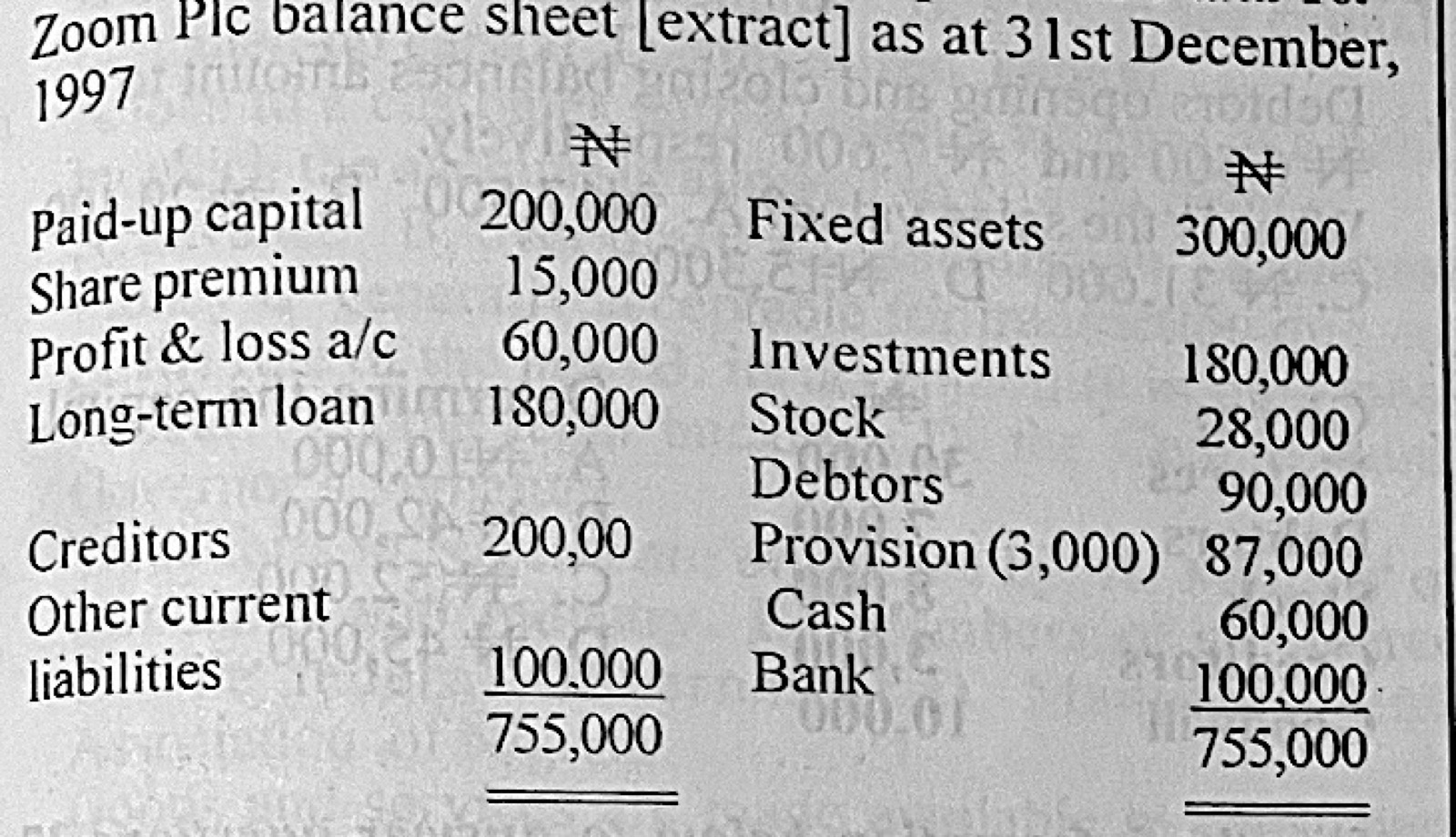
Zoom Plc balance sheet [extract] as at 31st December, 1997 (shown in the figure).

The quick ratio is

Diagram for this question
  1. A.0.95:1
  2. B.0.82:1
  3. C.1:53:1
  4. D.0.91:1
Show the answer and explanation

Answer: B (0.82:1)

Explanation

Quick assets = debtors (net) 87,000 + cash 60,000 + bank 100,000 = ₦247,000. Current liabilities = creditors 200,000 + other 100,000 = ₦300,000. 247,000 ÷ 300,000 ≈ 0.82:1.

Open this question

Question 10

Company Accounts

Use the information below to answer questions 9 and 10.
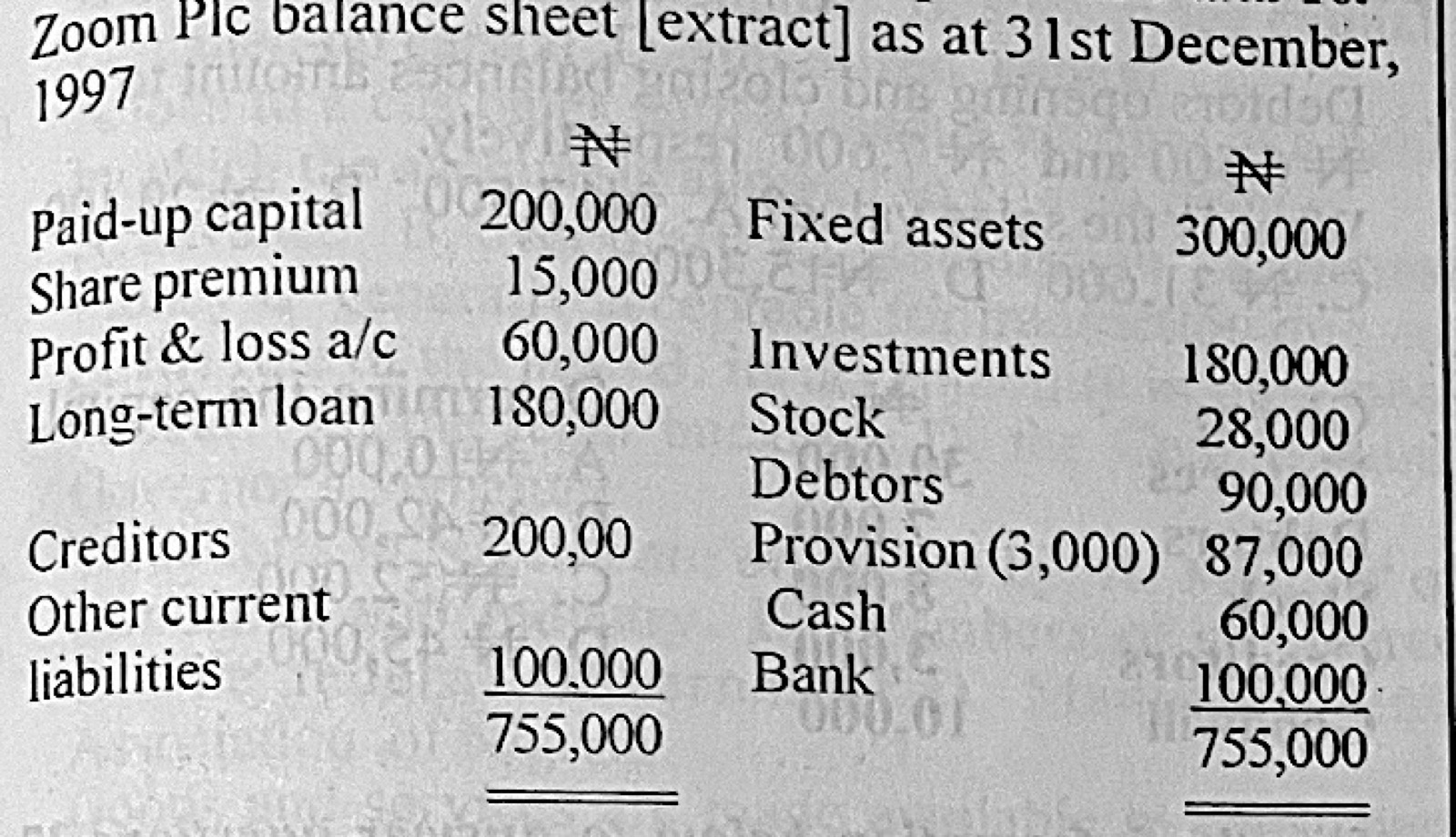
Zoom Plc balance sheet [extract] as at 31st December, 1997 (shown in the figure).

Determine the owners' equity

Diagram for this question
  1. A.₦275,000
  2. B.₦755,000
  3. C.₦200,000
  4. D.₦215,000.
Show the answer and explanation

Answer: A (₦275,000)

Explanation

Owners' equity = paid-up capital 200,000 + share premium 15,000 + profit and loss 60,000 = ₦275,000.

Open this question

Question 15

Interpretation of Accounts

Use the information below to answer questions 15 and 16.
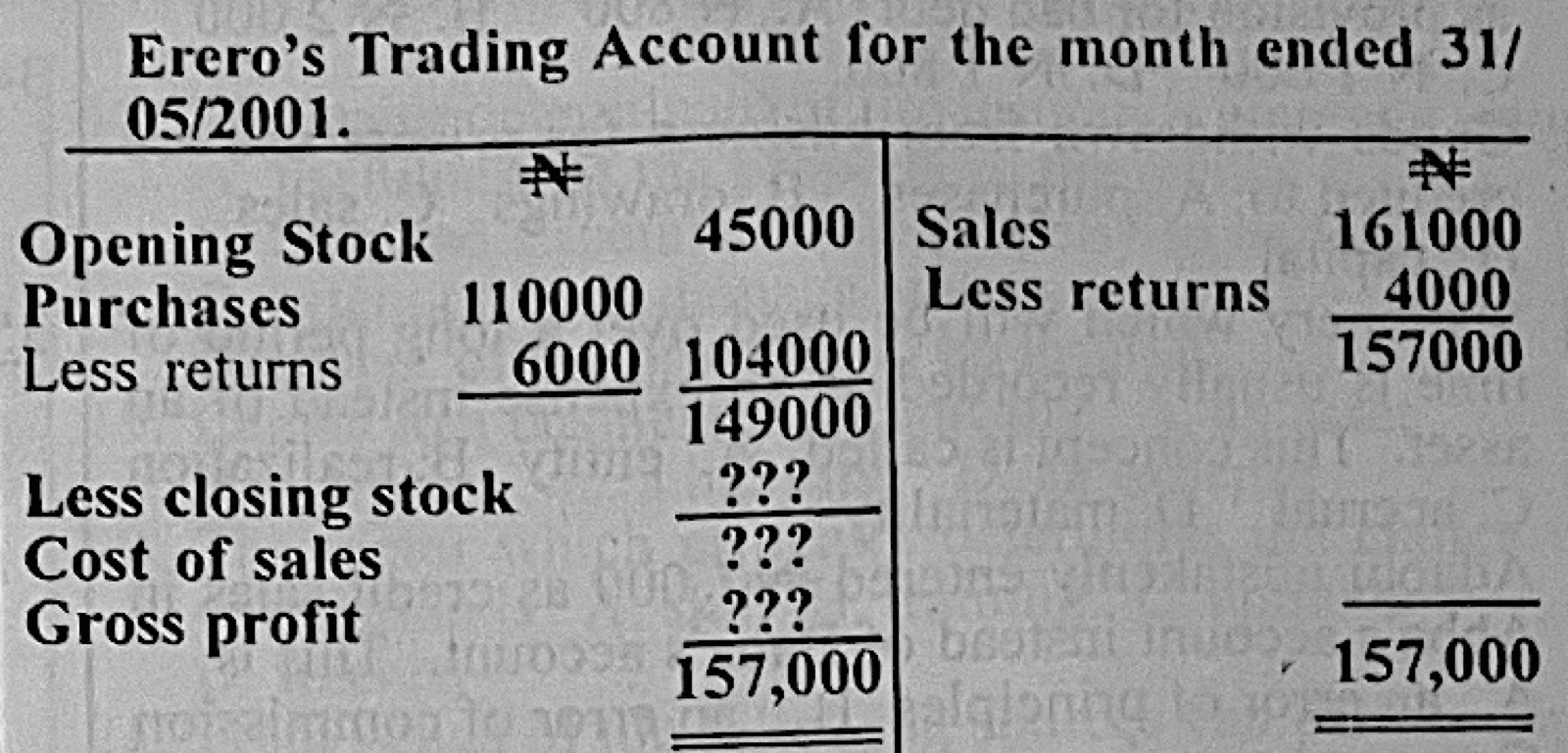
Erero's Trading Account for the month ended 31/05/2001 (shown in the figure).
The gross profit ratio for the company is 25%.

If the total expenses is ₦20845, what will be the net profit for the company during the month?

Diagram for this question
  1. A.₦18405
  2. B.₦21655
  3. C.₦19149
  4. D.₦6168
Show the answer and explanation

Answer: A (₦18405)

Explanation

Gross profit = 25% × net sales 157,000 = ₦39,250. Net profit = 39,250 − 20,845 = ₦18,405.

Open this question

Question 16

Interpretation of Accounts

Use the information below to answer questions 15 and 16.
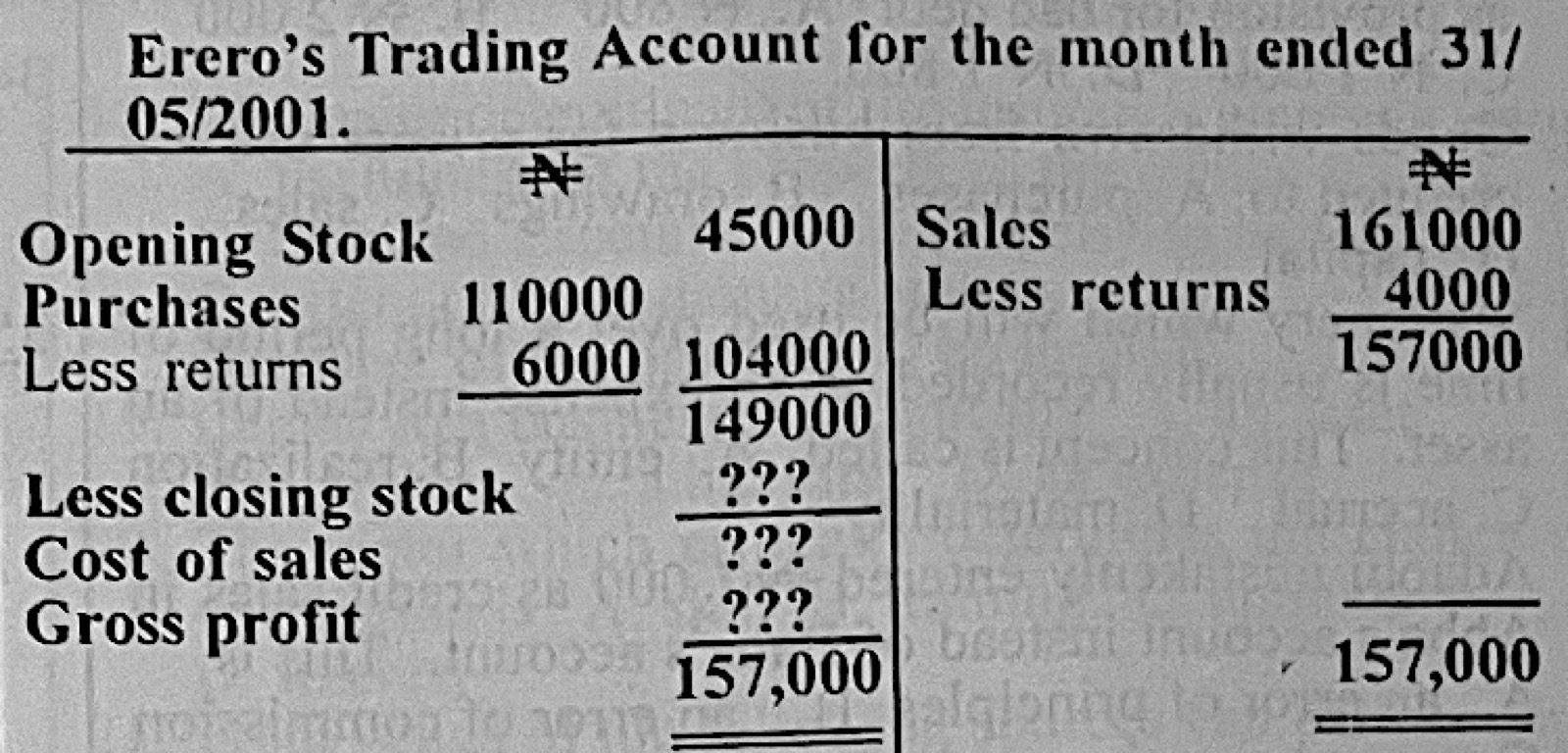
Erero's Trading Account for the month ended 31/05/2001 (shown in the figure).
The gross profit ratio for the company is 25%.

The closing stock for this company is

Diagram for this question
  1. A.₦72000
  2. B.₦42500
  3. C.₦31250
  4. D.₦45000.
Show the answer and explanation

Answer: C (₦31250)

Explanation

Cost of sales = 157,000 − 39,250 = ₦117,750. Closing stock = 149,000 − 117,750 = ₦31,250.

Open this question

Question 17

Final Accounts of a Sole Trader

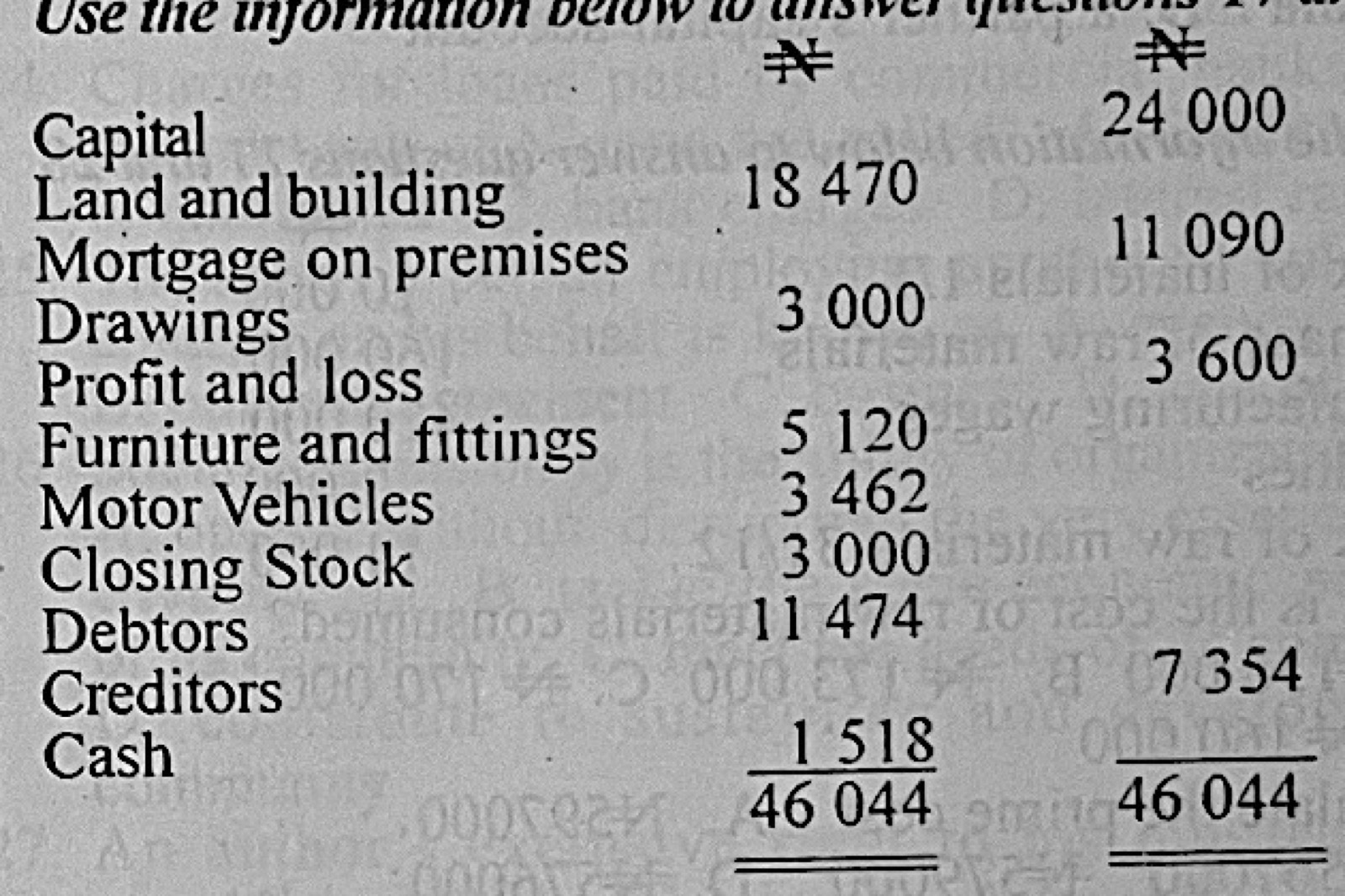
Use the information below to answer questions 17 and 18 (shown in the figure).

What is the capital employed?

Diagram for this question
  1. A.₦44 600
  2. B.₦43 052
  3. C.₦38 600
  4. D.₦43 044
Show the answer and explanation

Answer: D (₦43 044)

Explanation

Taking capital employed as total assets: land 18,470 + furniture 5,120 + motor vehicles 3,462 + stock 3,000 + debtors 11,474 + cash 1,518 = ₦43,044.

Open this question

Question 18

Final Accounts of a Sole Trader

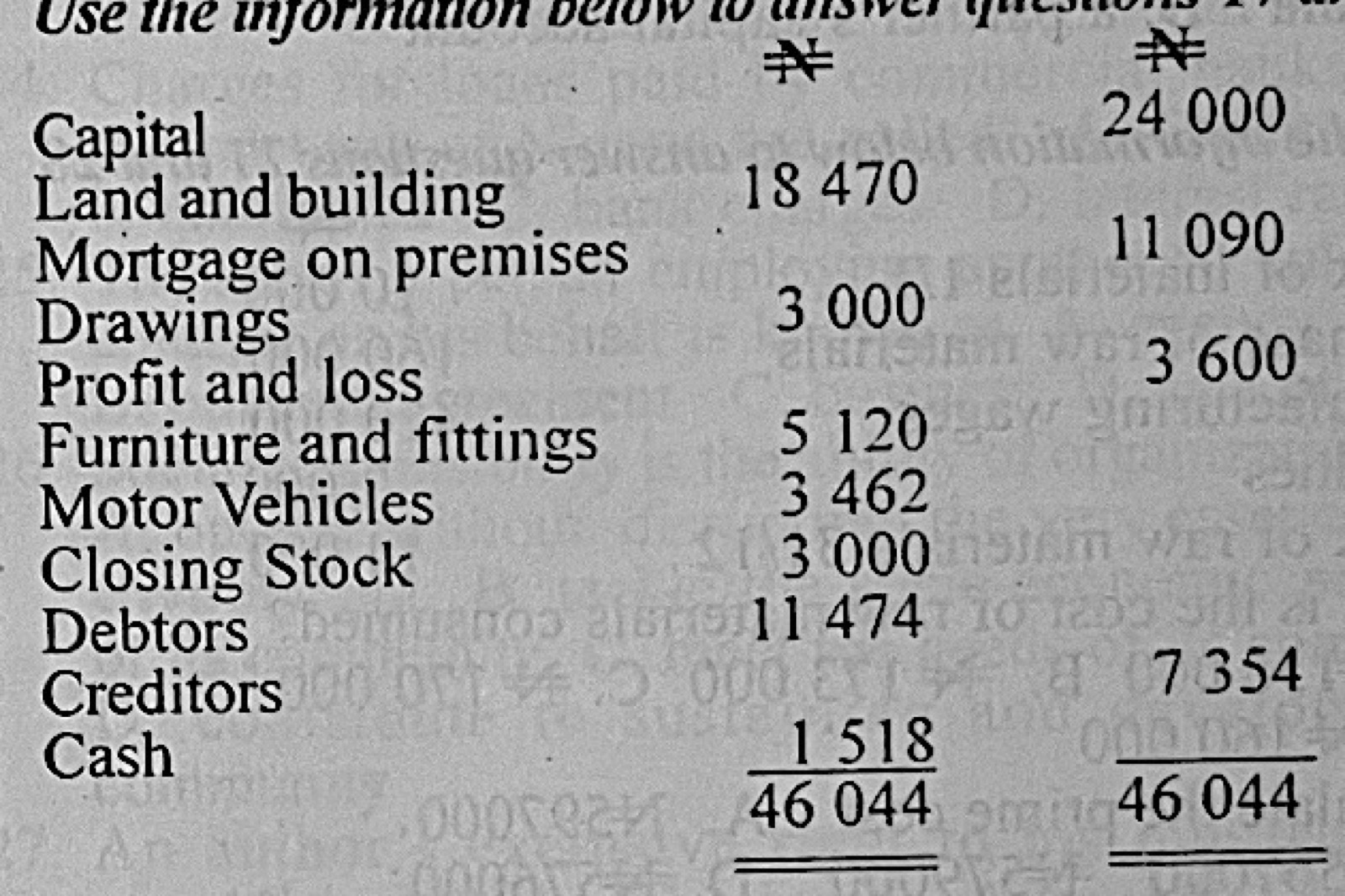
Use the information below to answer questions 17 and 18 (shown in the figure).

Calculate the value of fixed assets

Diagram for this question
  1. A.₦15 992
  2. B.₦18 470
  3. C.₦27 052
  4. D.₦27 000
Show the answer and explanation

Answer: C (₦27 052)

Explanation

Fixed assets = land and building 18,470 + furniture and fittings 5,120 + motor vehicles 3,462 = ₦27,052.

Open this question

Question 19

Departmental Accounts

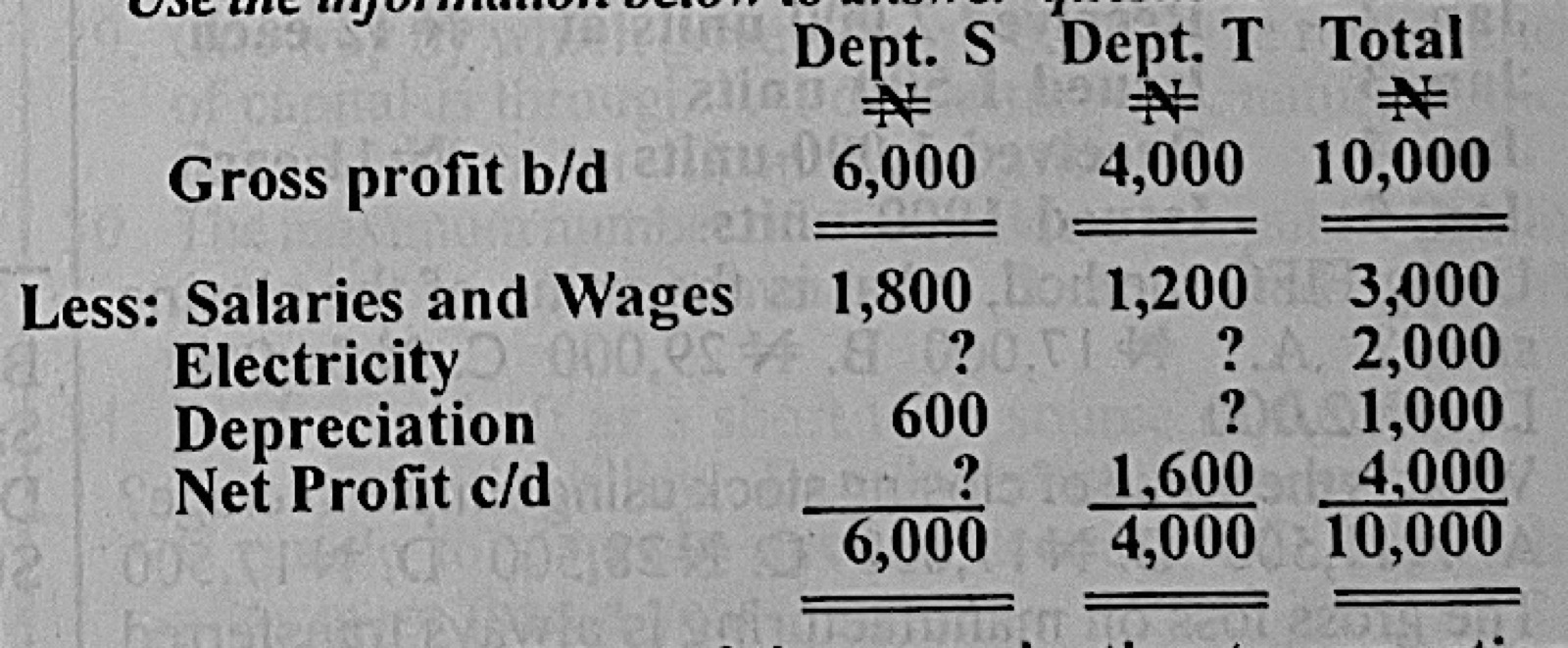
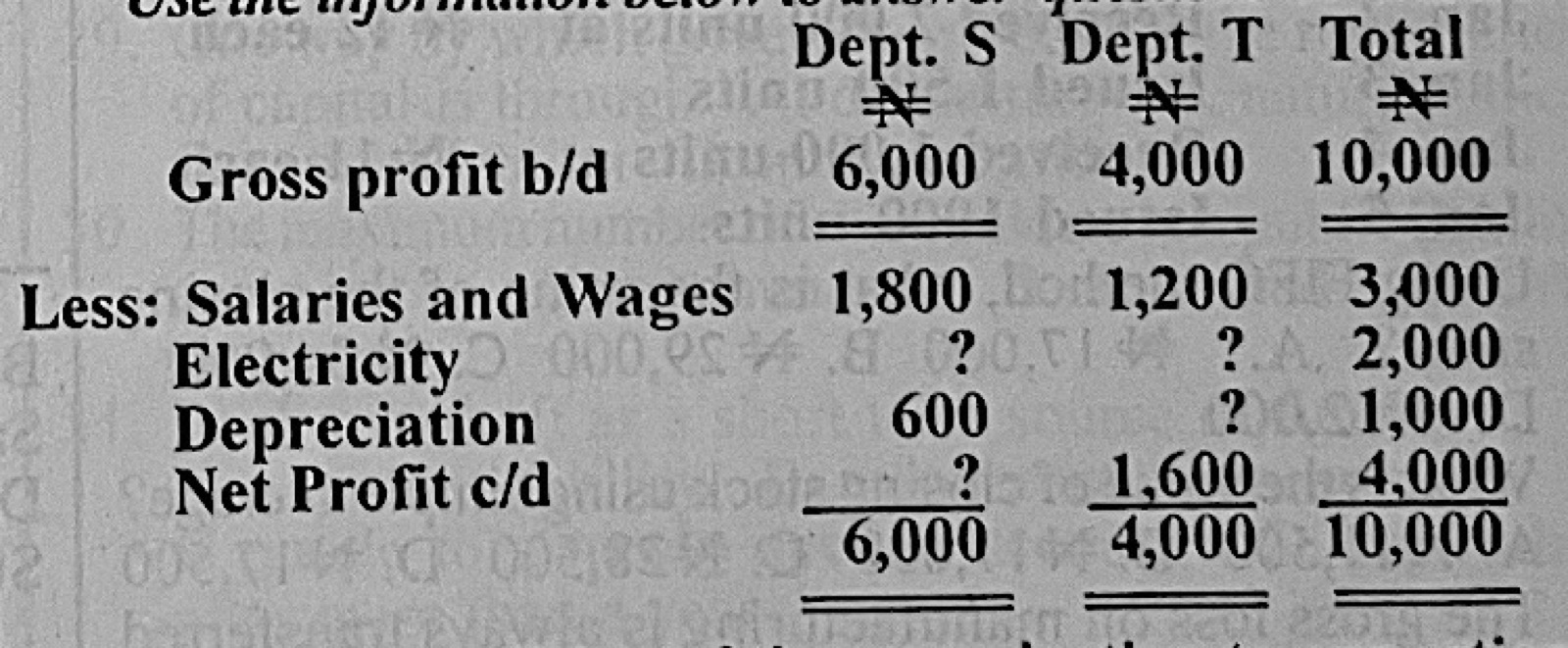
Use the information below to answer questions 19 and 20 (departmental profit and loss extract in the figure).
It is the tradition of the organization to apportion expenses in the proportion 60%:40% for S and T respectively.

What is the net profit made by department S?

Diagram for this question
  1. A.₦2,000
  2. B.₦3,000
  3. C.₦3,600
  4. D.₦2,400
Show the answer and explanation

Answer: D (₦2,400)

Explanation

S's electricity = 60% × 2,000 = ₦1,200. Net profit = 6,000 − 1,800 − 1,200 − 600 = ₦2,400.

Open this question

Question 20

Departmental Accounts

Use the information below to answer questions 19 and 20 (departmental profit and loss extract in the figure).
It is the tradition of the organization to apportion expenses in the proportion 60%:40% for S and T respectively.

The depreciation to be charged to department T is

Diagram for this question
  1. A.₦400
  2. B.₦300
  3. C.₦500
  4. D.₦600
Show the answer and explanation

Answer: A (₦400)

Explanation

Total depreciation is ₦1,000 and S takes ₦600, so T is charged 1,000 − 600 = ₦400 (which is 40%).

Open this question

Question 27

Manufacturing Accounts

Use the information below to answer questions 27 and 28.
Stock of materials 1/1 ₦10 000
Purchase of raw materials ₦160 000
Manufacturing wages ₦420 000
Royalties ₦3 000
Stock of raw materials 31/12 ₦14 000

What is the cost of raw materials consumed?

  1. A.₦156 000
  2. B.₦173 000
  3. C.₦170 000
  4. D.₦160 000
Show the answer and explanation

Answer: A (₦156 000)

Explanation

Raw materials consumed = 10,000 + 160,000 − 14,000 = ₦156,000.

Open this question

Question 28

Manufacturing Accounts

Use the information below to answer questions 27 and 28.
Stock of materials 1/1 ₦10 000
Purchase of raw materials ₦160 000
Manufacturing wages ₦420 000
Royalties ₦3 000
Stock of raw materials 31/12 ₦14 000

Calculate the prime cost

  1. A.₦597000
  2. B.₦567000
  3. C.₦579000
  4. D.₦576000
Show the answer and explanation

Answer: C (₦579000)

Explanation

Prime cost = raw materials consumed 156,000 + wages 420,000 + royalties 3,000 = ₦579,000.

Open this question

Question 29

Stock Valuation

Use the information below to answer questions 29 and 30.
Jan. 1 Received 1,000 units at ₦10 each
Jan. 2 Received 2,000 units at ₦12 each
Jan. 3 Issued 1,500 units
Jan. 4 Received 1,000 units at ₦11 each
Jan. 5 Issued 1000 units

Using FIFO method, what is the value of the closing stock?

  1. A.₦17,000
  2. B.₦29,000
  3. C.₦34,000
  4. D.₦12,000
Show the answer and explanation

Answer: A (₦17,000)

Explanation

FIFO issues the oldest units first. After both issues, 500 units at ₦12 and 1,000 units at ₦11 remain: 6,000 + 11,000 = ₦17,000.

Open this question

Question 30

Stock Valuation

Use the information below to answer questions 29 and 30.
Jan. 1 Received 1,000 units at ₦10 each
Jan. 2 Received 2,000 units at ₦12 each
Jan. 3 Issued 1,500 units
Jan. 4 Received 1,000 units at ₦11 each
Jan. 5 Issued 1000 units

What is the value of closing stock using simple average?

  1. A.₦11,500
  2. B.₦17,000
  3. C.₦28,500
  4. D.₦17,500
Show the answer and explanation

Answer: B (₦17,000)

Explanation

Jan 3: 1,500 units issued at (10 + 12)/2 = ₦11 = ₦16,500, which uses up the ₦10 lot. Jan 5: 1,000 units at (12 + 11)/2 = ₦11.50 = ₦11,500. Closing stock = 45,000 − 16,500 − 11,500 = ₦17,000.

Open this question

Question 37

Final Accounts of a Sole Trader

Use the information below to answer questions 37 and 38.
Sales ₦232,000
Opening stock ₦28,000
Purchases ₦128,000
Carriage inwards ₦4,000
Carriage outwards ₦6,000
Closing stock ₦10,000
Discount received ₦18,000
Expenses ₦20,000

Calculate the gross profit.

  1. A.₦100,000.
  2. B.₦86, 000.
  3. C.₦76,000
  4. D.₦82,000.
Show the answer and explanation

Answer: D (₦82,000.)

Explanation

Cost of sales = 28,000 + 128,000 + 4,000 − 10,000 = ₦150,000. Gross profit = 232,000 − 150,000 = ₦82,000.

Open this question

Question 38

Final Accounts of a Sole Trader

Use the information below to answer questions 37 and 38.
Sales ₦232,000
Opening stock ₦28,000
Purchases ₦128,000
Carriage inwards ₦4,000
Carriage outwards ₦6,000
Closing stock ₦10,000
Discount received ₦18,000
Expenses ₦20,000

Calculate the expenses debited to the profit and loss account.

  1. A.₦17,000.
  2. B.₦23,000.
  3. C.₦30,000.
  4. D.₦26,000.
Show the answer and explanation

Answer: D (₦26,000.)

Explanation

Debits to profit and loss are carriage outwards 6,000 + expenses 20,000 = ₦26,000. Discount received is income and carriage inwards goes to the trading account.
Open this question