40 questions. Try each one, then open the answer to check yourself and read the explanation.
Question 2
Work, Energy and Power
A carpenter on top of a roof 20.0 m high dropped a hammer of mass 1.5 kg and it fell freely to the ground. The kinetic energy of the hammer just before hitting the ground is [g ≈ 10 ms−2]
A.300 J
B.450 J
C.600 J
D.150 J.
Show the answer and explanation
Answer: A (300 J)
Explanation
All the potential energy becomes kinetic energy: KE = mgh = 1.5 × 10 × 20 = 300 J.
A man standing on a lift that is descending does not feel any weight because
A.there is no reaction from the floor of the lift
B.there is no gravitational pull on the man in the lift
C.the inside of the lift is airtight
D.the lift is in vacuum.
Show the answer and explanation
Answer: A (there is no reaction from the floor of the lift)
Explanation
We feel our weight through the push (reaction) of the floor. If the lift falls freely, the floor pushes on the man with zero force, so he feels weightless even though gravity still acts.
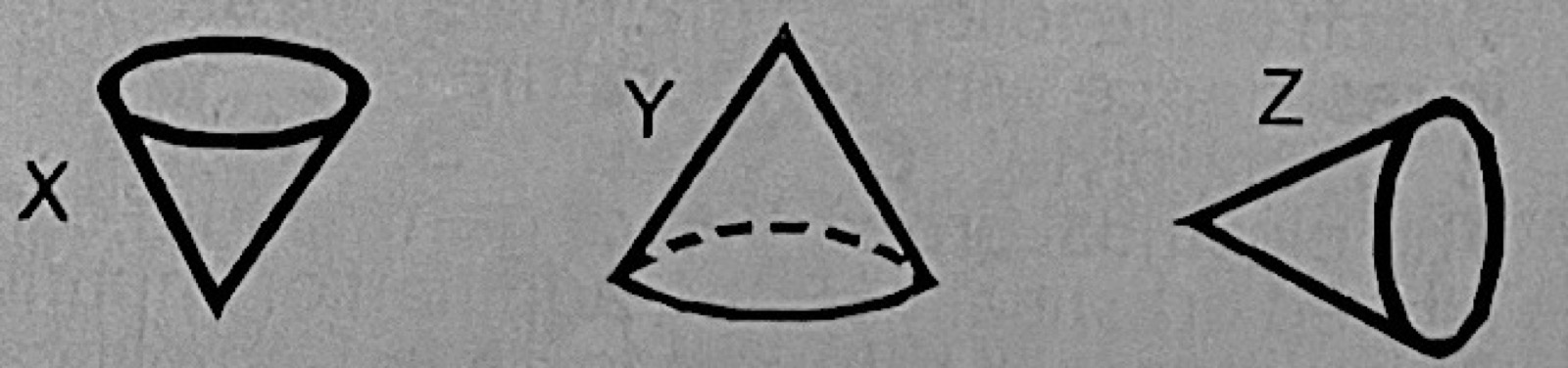
The diagrams above show the positions of a cone. The position which can be described as neutral equilibrium is represented as
A.Y and Z
B.Y and X
C.Z only
D.X only.
Show the answer and explanation
Answer: C (Z only)
Explanation
A cone lying on its side (Z) just rolls to a new position and stays there, so it is in neutral equilibrium. On its base (Y) it is stable; on its apex (X) it is unstable.
If a tube of small radius opened at both ends is placed in a liquid, the liquid will
A.fall below the liquid level if the liquid does not wet the glass
B.rise above the liquid level if the liquid does not wet the glass
C.remain at the same level irrespective of whether the liquid wets the glass or not
D.fall below the liquid level if the liquid wets the glass.
Show the answer and explanation
Answer: A (fall below the liquid level if the liquid does not wet the glass)
Explanation
A liquid that does not wet glass (like mercury) is depressed in a capillary tube, falling below the outside level. A wetting liquid (like water) rises.
I. Density of the liquid. II. Depth below the surface of the liquid. III. Surface area of the liquid. In which of the statements above will pressure be dependent?
A.I, II and III
B.I and III only
C.I and II only
D.II and III only
Show the answer and explanation
Answer: C (I and II only)
Explanation
Pressure in a liquid is p = hρg: it depends on the depth h and the density ρ, but not on the surface area.
I. High thermal capacity. II. High sensitivity. III. Easy readability. IV. Accuracy over a wide range of temperatures. From the statements above, the qualities of a good thermometer are
A.I, III and IV
B.II, III and IV
C.I and II
D.I, II, III and IV
Show the answer and explanation
Answer: B (II, III and IV)
Explanation
A good thermometer should be sensitive, easy to read and accurate over a wide range. It should have a low thermal capacity so it does not change the temperature it is measuring.
Which of the following could be effectively used to reduce friction?
A.Water.
B.Petrol.
C.Kerosene.
D.Grease.
Show the answer and explanation
Answer: D (Grease.)
Explanation
Grease is a thick lubricant that stays between moving surfaces and keeps them apart, reducing friction. Water, petrol and kerosene run off or evaporate.
Steam burn is more severe than that of boiling water because
A.water boils at a higher temperature
B.steam burn is dependent on relative humidity
C.steam burn is independent of relative humidity
D.steam possesses greater heat energy per unit mass.
Show the answer and explanation
Answer: D (steam possesses greater heat energy per unit mass.)
Explanation
Steam at 100°C gives out its large latent heat of vaporisation as it condenses on the skin, on top of the heat boiling water would give, so it burns more.
I. Change of state II. Diffusion III. Radiation IV. Osmosis. Which of the processes above can be explained using the kinetic theory?
A.I, III and IV
B.I, II and IV
C.I, II, III and IV
D.I, II and III
Show the answer and explanation
Answer: B (I, II and IV)
Explanation
Change of state, diffusion and osmosis all come from the motion of molecules, as the kinetic theory describes. Radiation is energy carried by electromagnetic waves, not by moving molecules.
A length of wire has a frequency of 255 Hz when stretched by a force of 225 N. If the force increases to 324 N, what is the new frequency of vibration?
A.488 Hz
B.356 Hz
C.306 Hz
D.512 Hz
Show the answer and explanation
Answer: C (306 Hz)
Explanation
f ∝ √T, so f2 = 255 × √(324/225) = 255 × 18/15 = 306 Hz.
Which of the following electromagnetic waves has the highest frequency?
A.Infrared-rays.
B.X-rays.
C.Ultra-violent rays
D.Radio waves.
Show the answer and explanation
Answer: B (X-rays.)
Explanation
In the electromagnetic spectrum the order of increasing frequency is radio, infrared, visible, ultraviolet, X-rays, gamma rays. Of the options, X-rays are highest.
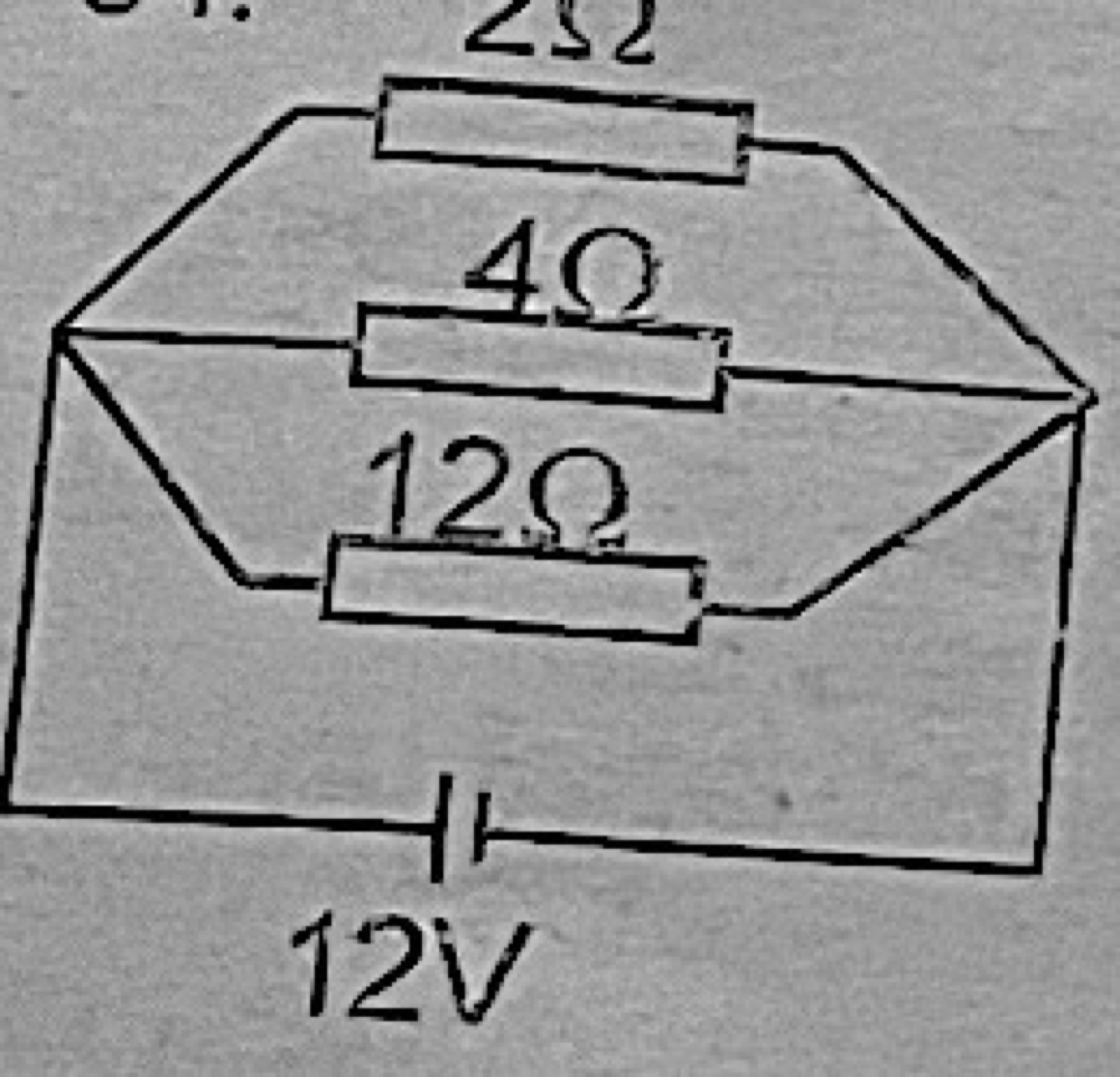
In the circuit above, three resistors, 2Ω, 4Ω and 12Ω are connected in parallel and a 12 V battery is connected across the combination. The current flowing through the 12Ω resistor is
A.3.2 A
B.9.6 A
C.14.4 A
D.1.0 A.
Show the answer and explanation
Answer: D (1.0 A.)
Explanation
Each resistor in parallel has the full 12 V across it, so the current in the 12 Ω resistor is 12 ÷ 12 = 1.0 A.
Three similar cells each of e.m.f 2 V and internal resistance 2Ω are connected in parallel, the total e.m.f and total internal resistance are respectively
A.2 V, 6.0Ω
B.6 V, 0.7Ω
C.6 V, 6.0Ω
D.2 V, 0.7Ω.
Show the answer and explanation
Answer: D (2 V, 0.7Ω.)
Explanation
Identical cells in parallel give the e.m.f. of one cell, 2 V, and an internal resistance of 2 ÷ 3 ≈ 0.7 Ω.