Home › Past questions › JAMB › Mathematics › 2014 46 questions. Try each one, then open the answer to check yourself and read the explanation.
Sign up free to answer these questions on a CBT screen with a timer, then see your score and every answer explained.
Start practising free
Question 2 Number Bases Find the value of 1101112 + 101002
A. 10011112 B. 11010112 C. 1001012 D. 10010112 Show the answer and explanation Answer: D (10010112 )
Explanation 1101112 = 55 and 101002 = 20, so the sum is 75. In base two, 75 = 64 + 8 + 2 + 1 = 10010112 .
Open this question
Question 3 Commercial Arithmetic A woman bought a grinder for ₦60,000. She sold it at a loss of 15%. How much did she sell it?
A. ₦50,000 B. ₦53,000 C. ₦52,000 D. ₦51,000 Show the answer and explanation Answer: D (₦51,000 )
Explanation 15% of ₦60,000 is ₦9,000. Selling price = ₦60,000 − ₦9,000 = ₦51,000.
Open this question
Question 4 Fractions, Decimals and Approximation Express the product of 0.00043 and 2000 in standard form.
A. 8.6 × 10 B. 8.6 × 10⁻³ C. 8.3 × 10⁻² D. 8.6 × 10⁻¹ Show the answer and explanation Answer: D (8.6 × 10⁻¹ )
Explanation 0.00043 × 2000 = 0.86, and 0.86 = 8.6 × 10⁻¹ .
Open this question
Question 5 Commercial Arithmetic A man donates 10% of his monthly net earnings to his church. If it amounts to ₦4,500, what is his net monthly income?
A. ₦62,500 B. ₦40,500 C. ₦45,000 D. ₦52,500 Show the answer and explanation Answer: C (₦45,000 )
Explanation If 10% is ₦4,500, then 100% is 10 × ₦4,500 = ₦45,000.
Open this question
Question 6 Logarithms If log 7.5 = 0.8751, evaluate 2 log 75 + log 750.
A. 66.253 B. 6.6252 C. 6.6253 D. 66.252 Show the answer and explanation Answer: C (6.6253 )
Explanation log 75 = 1.8751 and log 750 = 2.8751. So 2(1.8751) + 2.8751 = 3.7502 + 2.8751 = 6.6253.
Open this question
Question 7 Indices Solve for x: 8x-2 = 2/25
A. 10 B. 4 C. 6 D. 8 Show the answer and explanation Answer: A (10 )
Explanation x-2 = 2/(25 × 8) = 1/100, so x2 = 100 and x = 10.
Open this question
Question 9 Logarithms Evaluate log2 8 + log2 16 − log2 4.
A. 6 B. 3 C. 4 D. 5 Show the answer and explanation Answer: D (5 )
Explanation log2 8 = 3, log2 16 = 4 and log2 4 = 2, so the value is 3 + 4 − 2 = 5.
Open this question
Question 10 Sets If P = {1,2,3,4,5} and P∪Q = {1,2,3,4,5,6,7}, list the elements in Q.
A. {5, 7} B. {6} C. {7} D. {6, 7} Show the answer and explanation Answer: D ({6, 7} )
Explanation 6 and 7 are in the union but not in P, so they must come from Q. The only option containing both is {6, 7}.
Open this question
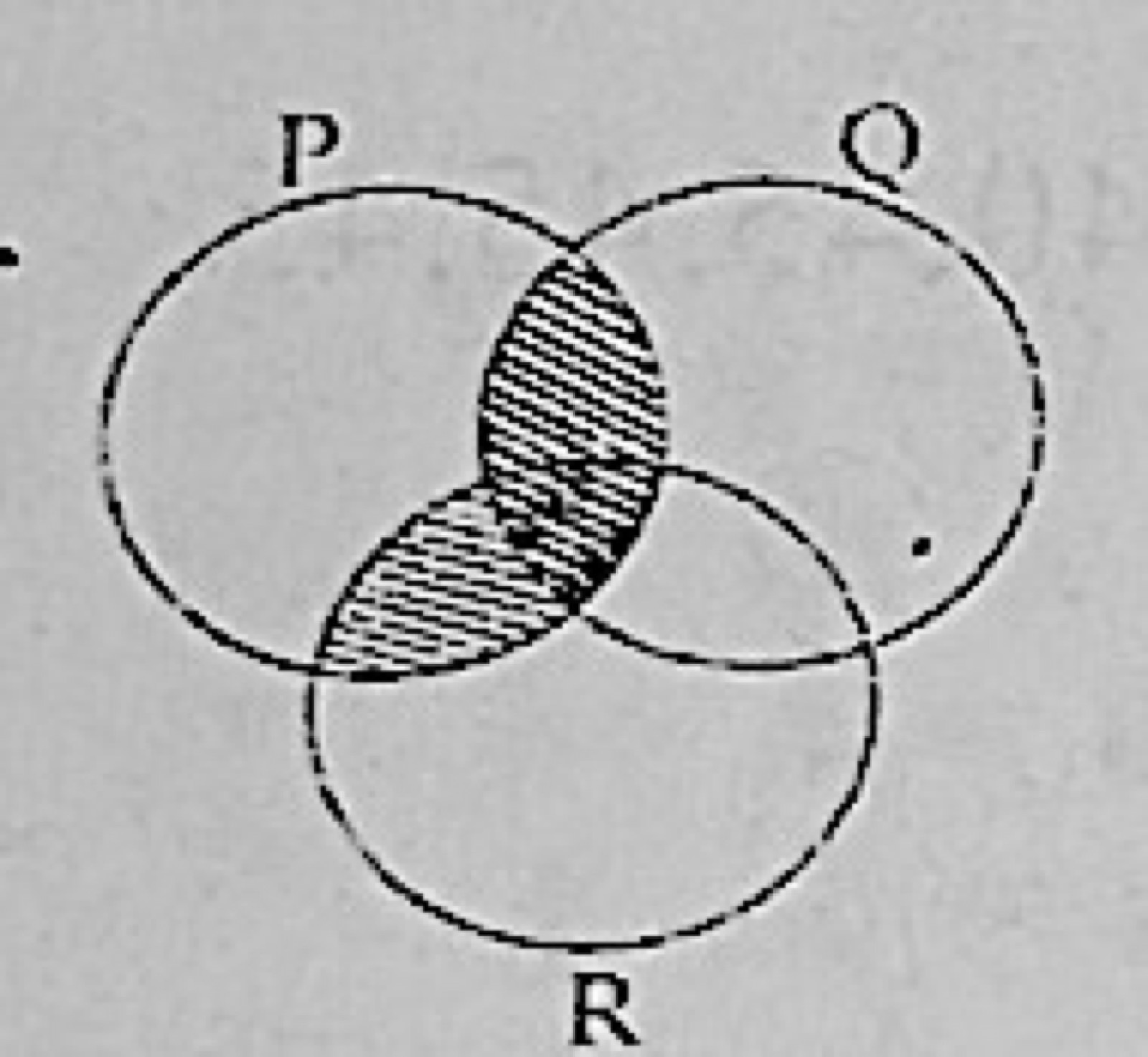
Question 11 Sets From the venn diagram above, the shaded parts represent
A. (P∩Q)∩(P∩R) B. (P∩Q)∪(P∩R) C. (P∪Q)∩(P∪R) D. (P∪Q)∪(P∪R) Show the answer and explanation Answer: B ((P∩Q)∪(P∩R) )
Explanation The shading covers the region common to P and Q together with the region common to P and R. Joining two regions is a union, so the answer is (P∩Q)∪(P∩R).
Open this question
Question 12 Algebraic Expressions If gt2 − k − w = 0, make g the subject of the formula.
A. (k − w)/t B. (k + w)/t2 C. (k − w)/t2 D. (k + w)/t Show the answer and explanation Answer: B ((k + w)/t2 )
Explanation Move k and w across: gt2 = k + w. Divide by t2 : g = (k + w)/t2 .
Open this question
Question 13 Algebraic Expressions Factorise 2y2 − 15xy + 18x2 .
A. (3y + 2x)(y − 6x) B. (2y − 3x)(y + 6x) C. (2y − 3x)(y − 6x) D. (2y + 3x)(y − 6x) Show the answer and explanation Answer: C ((2y − 3x)(y − 6x) )
Explanation (2y − 3x)(y − 6x) = 2y2 − 12xy − 3xy + 18x2 = 2y2 − 15xy + 18x2 .
Open this question
Question 14 Polynomials Find the value of k if y − 1 is a factor of y3 + 4y2 + ky − 6.
A. 0 B. −6 C. −4 D. 1 Show the answer and explanation Answer: D (1 )
Explanation If y − 1 is a factor, putting y = 1 gives zero: 1 + 4 + k − 6 = 0, so k = 1.
Open this question
Question 15 Variation y varies directly as w2 . When y = 8, w = 2, find y when w = 3.
A. 6 B. 18 C. 12 D. 9 Show the answer and explanation Answer: B (18 )
Explanation y = kw2 ; 8 = 4k gives k = 2. When w = 3, y = 2 × 9 = 18.
Open this question
Question 16 Variation P varies directly as Q and inversely as R. When Q = 36 and R = 16, P = 27. Find the relation between P, Q and R.
A. P = 12/(QR) B. P = Q/(12R) C. P = 12Q/R D. P = 12QR Show the answer and explanation Answer: C (P = 12Q/R )
Explanation P = kQ/R, so 27 = 36k/16, giving k = 12. Hence P = 12Q/R.
Open this question
Question 17 Inequalities What is the solution of (x − 5)/(x + 3) < −1?
A. x < −3 or x > 5 B. −3 < x < 1 C. x < −3 or 3 > 1 D. −3 < x < 5 Show the answer and explanation Answer: B (−3 < x < 1 )
Explanation Add 1 to both sides: (x − 5 + x + 3)/(x + 3) < 0, i.e. (2x − 2)/(x + 3) < 0. The top and bottom must have opposite signs, which happens only when −3 < x < 1.
Open this question
Question 18 Inequalities Evaluate the inequality x/2 + 3/4 ≤ 5x/6 − 7/12
A. x ≤ −4 B. x ≥ 4 C. x ≤ 3 D. x ≥ −3 Show the answer and explanation Answer: B (x ≥ 4 )
Explanation Multiply through by 12: 6x + 9 ≤ 10x − 7. Then 16 ≤ 4x, so x ≥ 4.
Open this question
Question 19 Progressions The 4th term of an A.P. is 13 while the 10th term is 31. Find the 24th term.
A. 69 B. 89 C. 75 D. 73 Show the answer and explanation Answer: D (73 )
Explanation a + 3d = 13 and a + 9d = 31, so 6d = 18, d = 3 and a = 4. The 24th term is a + 23d = 4 + 69 = 73.
Open this question
Question 20 Progressions What is the common ratio of the G.P. (√10 + √5) + (√10 + 2√5) + …?
A. 5 B. √2 C. √5 D. 3 Show the answer and explanation Answer: B (√2 )
Explanation r = (√10 + 2√5)/(√10 + √5). Multiply top and bottom by (√10 − √5): the top is 10 − √50 + 2√50 − 10 = √50 = 5√2 and the bottom is 5, so r = √2.
Open this question
Question 21 Binary Operations A binary operation * is defined by x * y = xy . If x * 2 = 12 − x, find the possible values of x.
A. −3, −4 B. 3, 4 C. 3, −4 D. −3, 4 Show the answer and explanation Answer: C (3, −4 )
Explanation x * 2 = x2 , so x2 = 12 − x, i.e. x2 + x − 12 = 0 = (x − 3)(x + 4). So x = 3 or −4.
Open this question
Question 22 Matrices and Determinants Find y, if (5 −6 / 2 −7)(x / y) = (7 / −11)
A. 2 B. 8 C. 5 D. 3 Show the answer and explanation Answer: D (3 )
Explanation The equations are 5x − 6y = 7 and 2x − 7y = −11. Doubling the first and multiplying the second by 5 gives 10x − 12y = 14 and 10x − 35y = −55; subtracting, 23y = 69, so y = 3.
Open this question
Question 23 Matrices and Determinants If the determinant |−x 12 / −1 4| = −12, find x.
A. 6 B. −6 C. −2 D. 3 Show the answer and explanation Answer: A (6 )
Explanation The determinant is (−x)(4) − (12)(−1) = −4x + 12. Setting −4x + 12 = −12 gives x = 6.
Open this question
Question 24 Matrices and Determinants Find the value of the determinant with rows (0 3 2), (1 7 8), (0 5 4).
A. −2 B. 12 C. 10 D. −1 Show the answer and explanation Answer: A (−2 )
Explanation Expanding along the first row: 0(28 − 40) − 3(4 − 0) + 2(5 − 0) = 0 − 12 + 10 = −2.
Open this question
Question 25 Angles and Polygons How many sides has a regular polygon whose interior angle is 135° each?
A. 8 B. 12 C. 10 D. 9 Show the answer and explanation Answer: A (8 )
Explanation Exterior angle = 180° − 135° = 45°. Number of sides = 360° ÷ 45° = 8.
Open this question
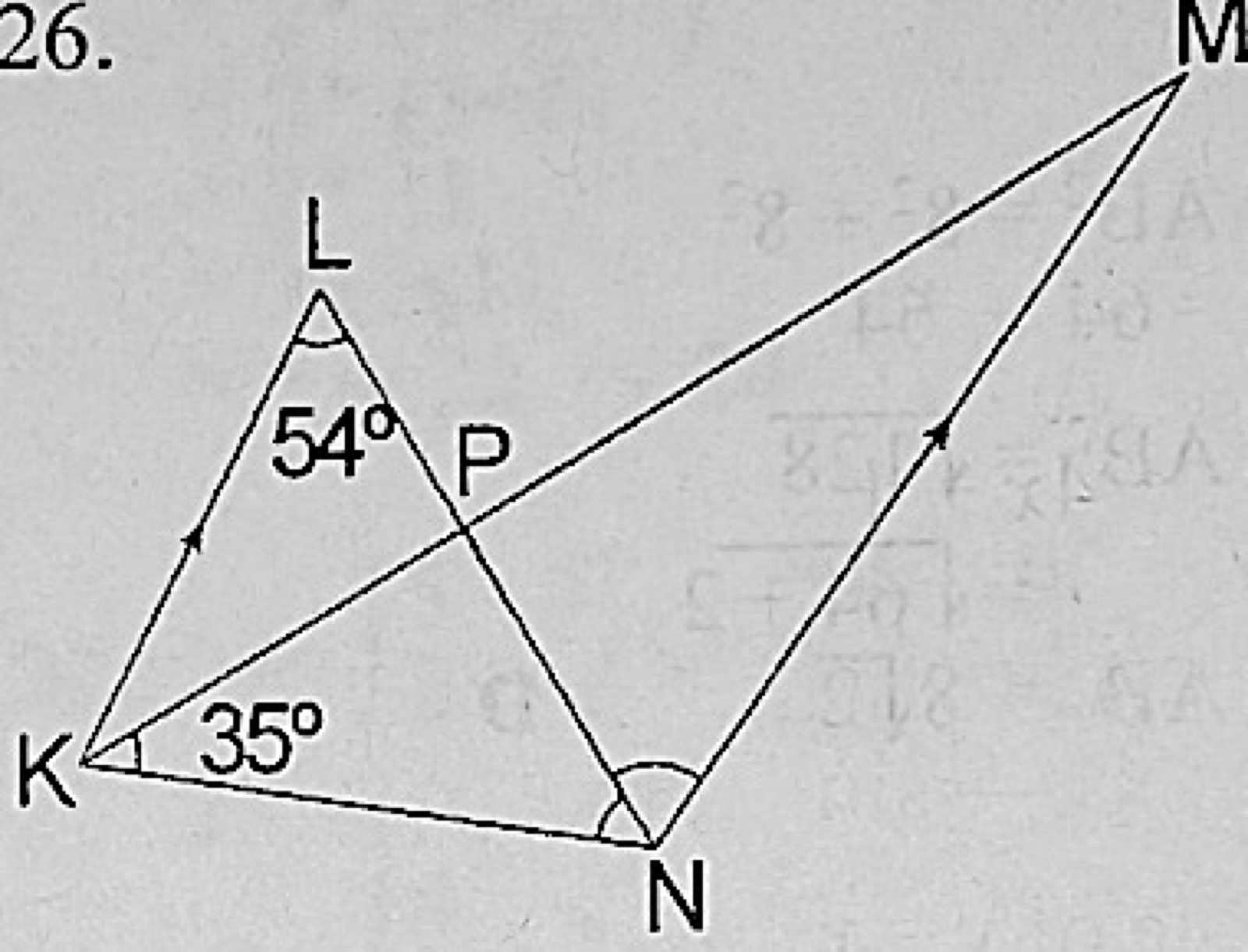
Question 26 Angles and Polygons In the figure above, KL∥NM, LN bisects ∠KNM. If angle KLN is 54° and angle MKN is 35°, calculate the size of angle KMN.
A. 19° B. 91° C. 89° D. 37° Show the answer and explanation Answer: D (37° )
Explanation Since KL∥NM, ∠LNM = ∠KLN = 54° (alternate angles). LN bisects ∠KNM, so ∠KNM = 2 × 54° = 108°. In triangle KMN, ∠KMN = 180° − 108° − 35° = 37°.
Open this question
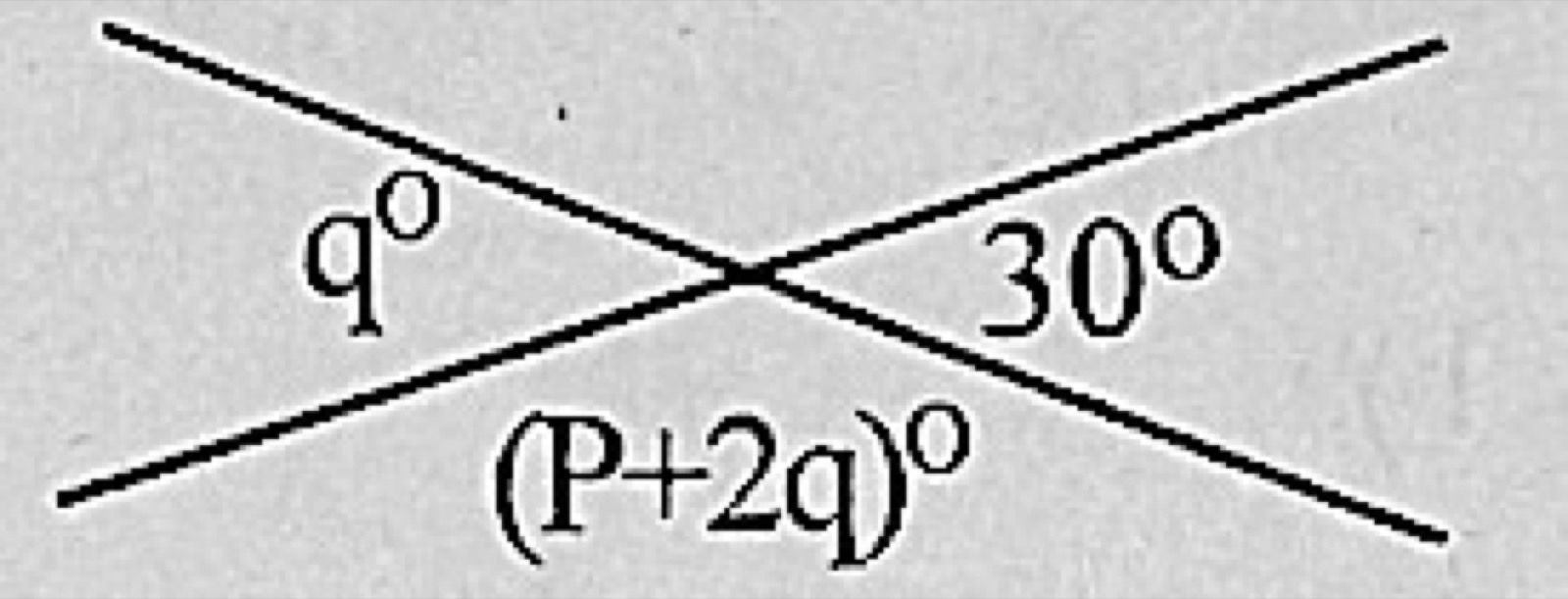
Question 27 Triangles and Quadrilaterals From the figure above, what is the value of p?
A. 45° B. 135° C. 90° D. 60° Show the answer and explanation Answer: C (90° )
Explanation q° and 30° are vertically opposite, so q = 30. (p + 2q)° and 30° lie on a straight line, so p + 60 + 30 = 180, giving p = 90°.
Open this question
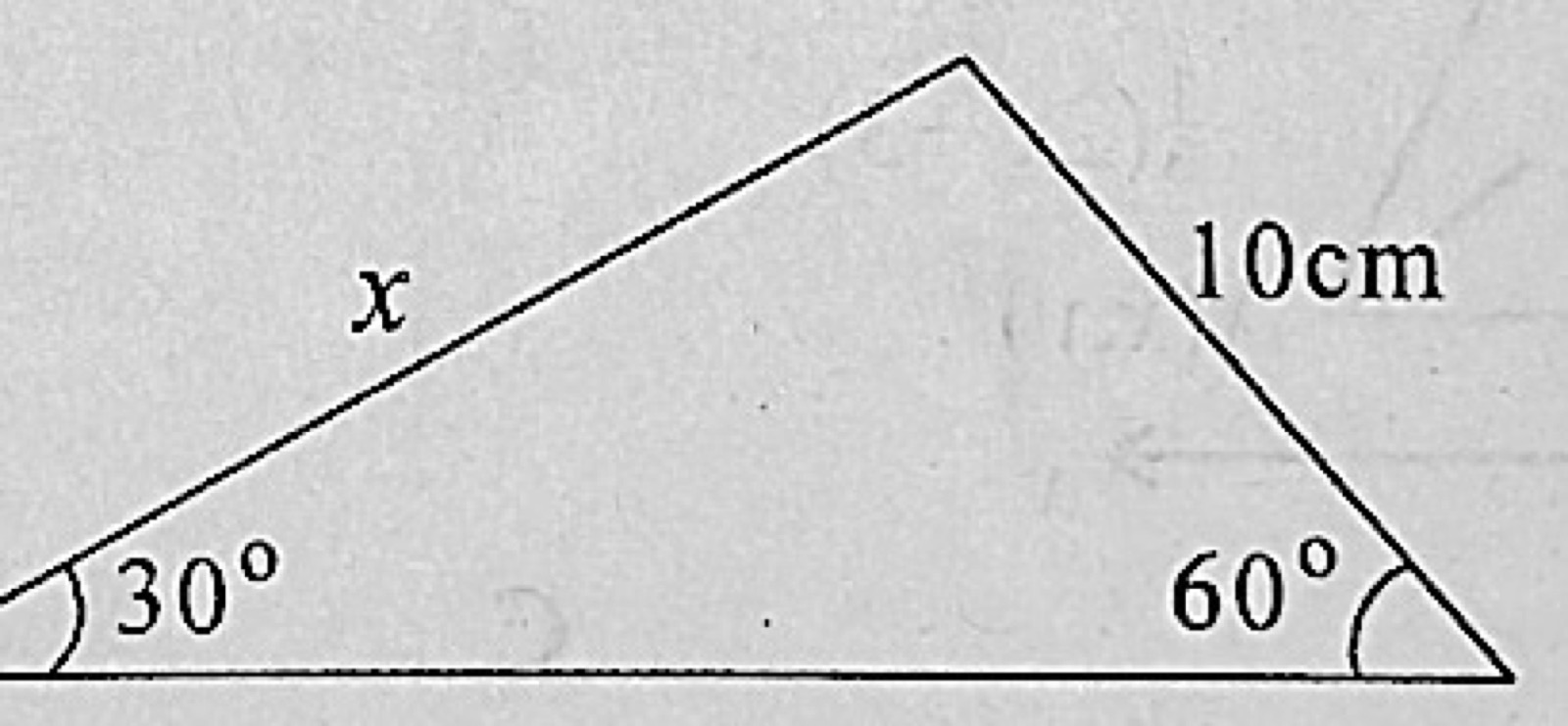
Question 28 Triangles and Quadrilaterals Find the value of x in the figure above.
A. 4√3cm B. 20√3cm C. 10√3cm D. 5√3cm Show the answer and explanation Answer: C (10√3cm )
Explanation The third angle is 90°. By the sine rule, x/sin 60° = 10/sin 30°, so x = 10 × (√3/2) ÷ (1/2) = 10√3 cm.
Open this question
Question 29 Mensuration of Plane Shapes If the angle of a sector of a circle with radius 10.5 cm is 120°, find the perimeter of the sector. [π = 22/7]
A. 48 cm B. 40cm C. 43cm D. 45cm Show the answer and explanation Answer: C (43cm )
Explanation Arc length = (120/360) × 2 × (22/7) × 10.5 = 22 cm. Perimeter = 22 + 2 × 10.5 = 43 cm.
Open this question
Question 30 Mensuration of Solids A cylindrical tank has a capacity of 6160 m3 . What is the depth of the tank if the radius of its base is 28m? [π = 22/7]
A. 2.5 m B. 8.0 m C. 7.5 m D. 5.0 m Show the answer and explanation Answer: A (2.5 m )
Explanation V = πr2 h, so h = 6160 ÷ ((22/7) × 784) = 6160 ÷ 2464 = 2.5 m.
Open this question
Question 31 Loci The locus of a dog tethered to a pole with a rope of 4 m is a
A. semi-circle with radius 4 m B. circle with diameter 4 m C. circle with radius 4 m D. semi-circle with diameter 4 m Show the answer and explanation Answer: C (circle with radius 4 m )
Explanation With the rope pulled tight, the dog is always 4 m from the pole. All points 4 m from a fixed point form a circle of radius 4 m.
Open this question
Question 32 Coordinate Geometry Find the mid point of S(−5,4) and T(−3,−2)
A. 4, −1 B. −4, 2 C. 4, −2 D. −4, 1 Show the answer and explanation Answer: D (−4, 1 )
Explanation Midpoint = ((−5 + −3)/2, (4 + −2)/2) = (−4, 1).
Open this question
Question 33 Coordinate Geometry The gradient of the line joining (x,4) and (1,2) is ½. Find the value of x.
A. −5 B. 5 C. 3 D. −3 Show the answer and explanation Answer: B (5 )
Explanation Gradient = (4 − 2)/(x − 1) = ½, so x − 1 = 4 and x = 5.
Open this question
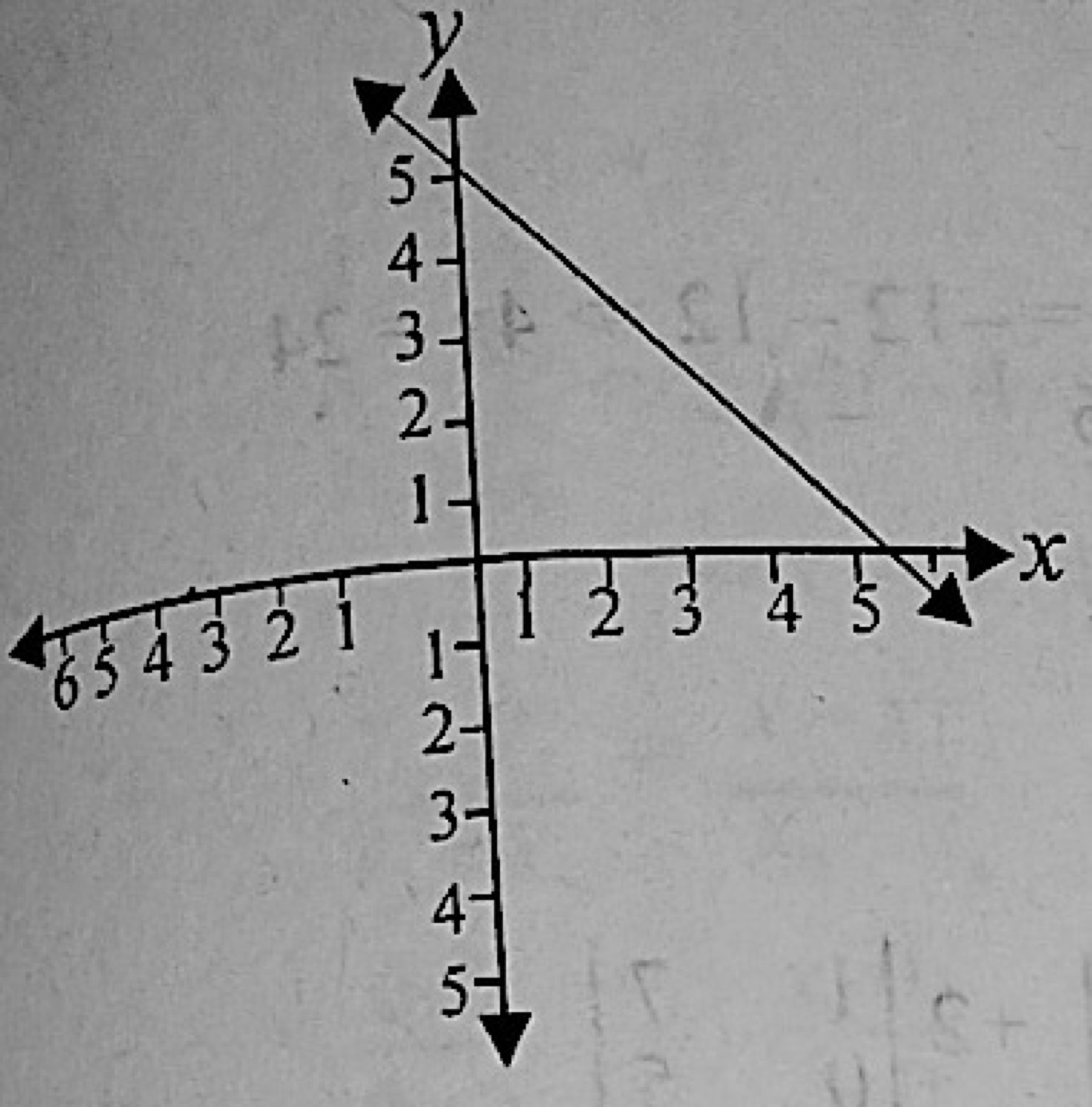
Question 34 Coordinate Geometry In the figure above, what is the equation of the line that passes the y-axis at (0,5) and passes the x-axis at (5,0)?
A. y = −x − 5 B. y = x + 5 C. y = −x + 5 D. y = x − 5 Show the answer and explanation Answer: C (y = −x + 5 )
Explanation Gradient = (0 − 5)/(5 − 0) = −1 and the line cuts the y-axis at 5. So y = −x + 5.
Open this question
Question 35 Coordinate Geometry Calculate the mid point of the line segment y − 4x + 3 = 0 which lies between the x-axis and y-axis.
A. (−2/3, 3/2) B. (3/8, −3/2) C. (3/8, 3/2) D. (−3/2, 3/2) Show the answer and explanation Answer: B ((3/8, −3/2) )
Explanation The line meets the y-axis where x = 0, at (0, −3), and the x-axis where y = 0, at (3/4, 0). The midpoint is (3/8, −3/2).
Open this question
Question 36 Coordinate Geometry Find the equation of the straight line through (−2,3) and perpendicular to 4x + 3y − 5 = 0
A. 5x − 2y − 11 = 0 B. 3x − 4y + 18 = 0 C. 3x + 2y − 18 = 0 D. 4x + 5y + 3 = 0 Show the answer and explanation Answer: B (3x − 4y + 18 = 0 )
Explanation The given line has gradient −4/3, so the perpendicular gradient is 3/4. y − 3 = ¾(x + 2) gives 4y − 12 = 3x + 6, i.e. 3x − 4y + 18 = 0.
Open this question
Question 37 Trigonometry If sin θ = 12/13, find the value of 1 + cos θ.
A. 5/13 B. 25/13 C. 18/13 D. 8/13 Show the answer and explanation Answer: C (18/13 )
Explanation With opposite 12 and hypotenuse 13, the adjacent side is 5, so cos θ = 5/13. Then 1 + 5/13 = 18/13.
Open this question
Question 38 Differentiation If y = 4x3 − 2x2 + x, find dy/dx.
A. 12x2 − 4x + 1 B. 8x2 − 2x + 1 C. 8x2 − 4x + 1 D. 12x2 − 2x + 1 Show the answer and explanation Answer: A (12x2 − 4x + 1 )
Explanation Differentiate term by term: 4 × 3x2 − 2 × 2x + 1 = 12x2 − 4x + 1.
Open this question
Question 39 Differentiation If y = cos 3x, find dy/dx.
A. −3sin 3x B. ⅓sin 3x C. −⅓sin 3x D. 3sin 3x Show the answer and explanation Answer: A (−3sin 3x )
Explanation The derivative of cos u is −sin u × du/dx. Here u = 3x, so dy/dx = −3 sin 3x.
Open this question
Question 40 Differentiation Find the minimum value of y = x2 − 2x − 3
A. −4 B. 4 C. 1 D. −1 Show the answer and explanation Answer: A (−4 )
Explanation dy/dx = 2x − 2 = 0 at x = 1. The minimum value is y = 1 − 2 − 3 = −4.
Open this question
Question 41 Integration Evaluate ∫sin 2x dx.
A. −cos 2x + k B. cos 2x + k C. ½cos 2x + k D. −½cos 2x + k Show the answer and explanation Answer: D (−½cos 2x + k )
Explanation The integral of sin ax is −(1/a) cos ax. With a = 2 the answer is −½cos 2x + k.
Open this question
Question 42 Integration Evaluate ∫(2x + 3)½ dx.
A. (1/12)(2x + 3)¾ + k B. (1/12)(2x + 3)6 + k C. ⅓(2x + 3)½ + k D. ⅓(2x + 3)3/2 + k Show the answer and explanation Answer: D (⅓(2x + 3)3/2 + k )
Explanation Raise the power by one to 3/2, divide by 3/2 and by 2 (the coefficient of x): (2x + 3)3/2 ÷ 3 = ⅓(2x + 3)3/2 + k.
Open this question
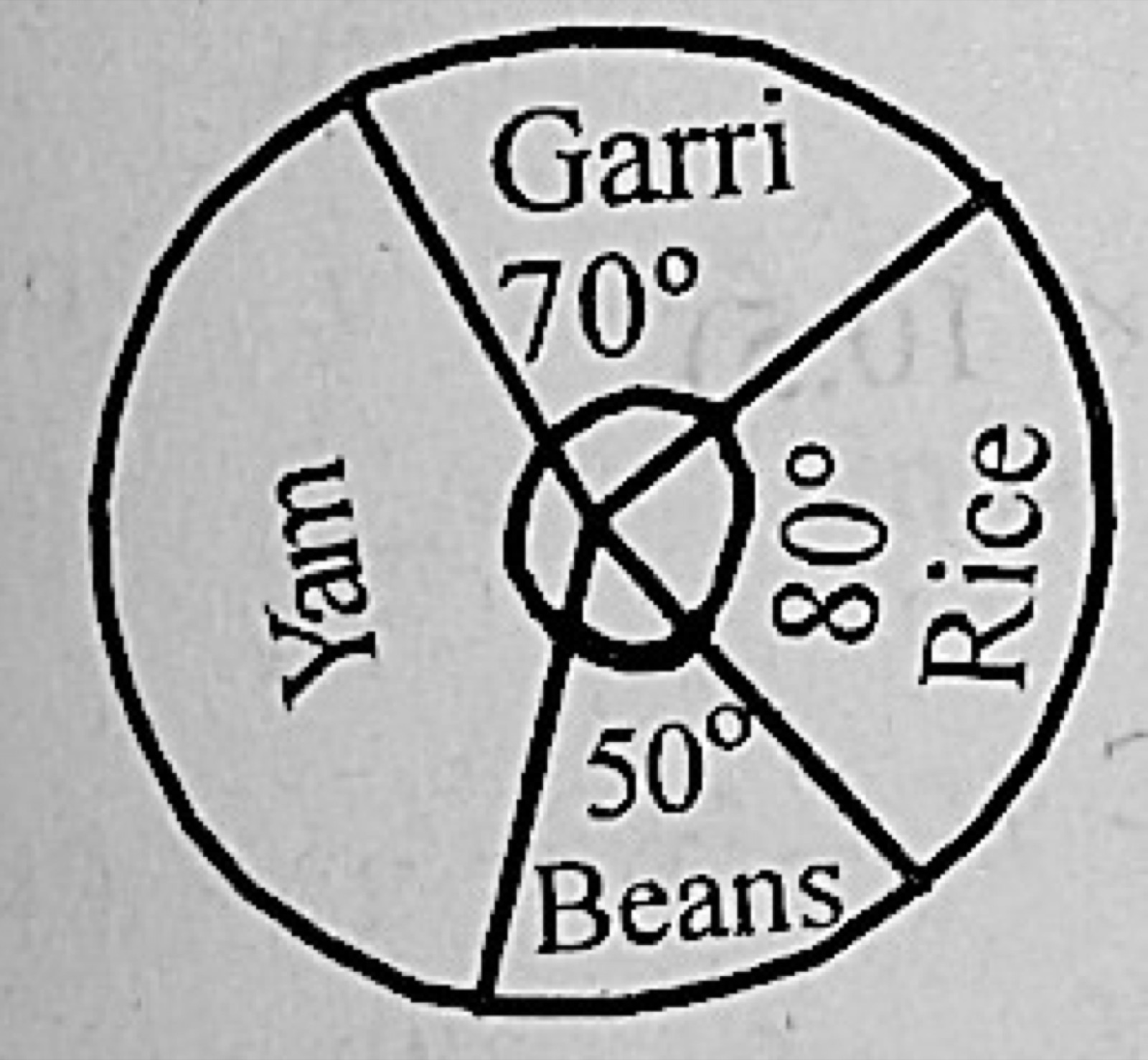
Question 43 Data Presentation The pie chart above shows the monthly distribution of a man's salary on food items. If he spent ₦8,000 on rice, how much did he spend on yam?
A. ₦12,000 B. ₦24,000 C. ₦18,000 D. ₦16,000 Show the answer and explanation Answer: D (₦16,000 )
Explanation The yam sector is 360° − (70° + 80° + 50°) = 160°. Rice's 80° is ₦8,000, so 160° is twice that: ₦16,000.
Open this question
Question 44 Measures of Central Tendency The mean of 2−t, 4+t, 3−2t, 2+t and t−1 is
A. −2 B. t C. −t D. 2 Show the answer and explanation Answer: D (2 )
Explanation The t terms cancel (−t + t − 2t + t + t = 0) and the numbers add to 10. Mean = 10 ÷ 5 = 2.
Open this question
Question 47 Measures of Dispersion Calculate the standard deviation of 5,4,3, 2 and 1.
A. √10 B. √2 C. √3 D. √6 Show the answer and explanation Answer: B (√2 )
Explanation The mean is 3. The squared deviations are 4, 1, 0, 1, 4, which add to 10. Variance = 10 ÷ 5 = 2, so the standard deviation is √2.
Open this question
Question 48 Permutation and Combination In how many ways can a team of 3 girls be selected from 7 girls?
A. 7!/(2!5!) B. 7!/3! C. 7!/4! D. 7!/(3!4!) Show the answer and explanation Answer: D (7!/(3!4!) )
Explanation Order does not matter, so use combinations: 7 C3 = 7!/(3!4!).
Open this question
Question 49 Probability Numbers: 1, 2, 3, 4, 5, 6
A. 3/4 B. 1/5 C. 1/2 D. 2/5 Show the answer and explanation Answer: D (2/5 )
Explanation 'At least 4' means 4, 5 or 6: 16 + 10 + 14 = 40 times out of 100. Probability = 40/100 = 2/5.
Open this question
Question 50 Probability A number is chosen at random from 10 to 30 both inclusive, what is the probability that the number is divisible by 3?
A. 3/5 B. 2/15 C. 1/10 D. 1/3 Show the answer and explanation Answer: D (1/3 )
Explanation There are 21 numbers from 10 to 30. The multiples of 3 are 12, 15, 18, 21, 24, 27, 30: 7 of them. Probability = 7/21 = 1/3.
Open this question Sign up free for every JAMB Mathematics year, practice by topic and timed mocks.
Start practising free