25 questions. Try each one, then open the answer to check yourself and read the explanation.
Question 2
African PoetryIn 'Black Woman' Sedar Senghor expresses
- A.hatred for African woman
- B.dislike for African beauty
- C.beauty of African women
- D.joy of African man
Show the answer and explanation
Answer: C (beauty of African women)
ExplanationSenghor's poem praises the black woman, celebrating her natural beauty as a symbol of Africa.
Question 3
Other Set Texts: Non-African DramaRose Lee, Jim Bono and Gabriel Maxson are characters in
- A.Look Back in Anger
- B.Fences
- C.Second Class Citizen
- D.Invisible man
Show the answer and explanation
Answer: B (Fences)
ExplanationRose (Troy's wife), Jim Bono (his friend) and Gabriel (his brother) are characters in August Wilson's play Fences.
Question 4
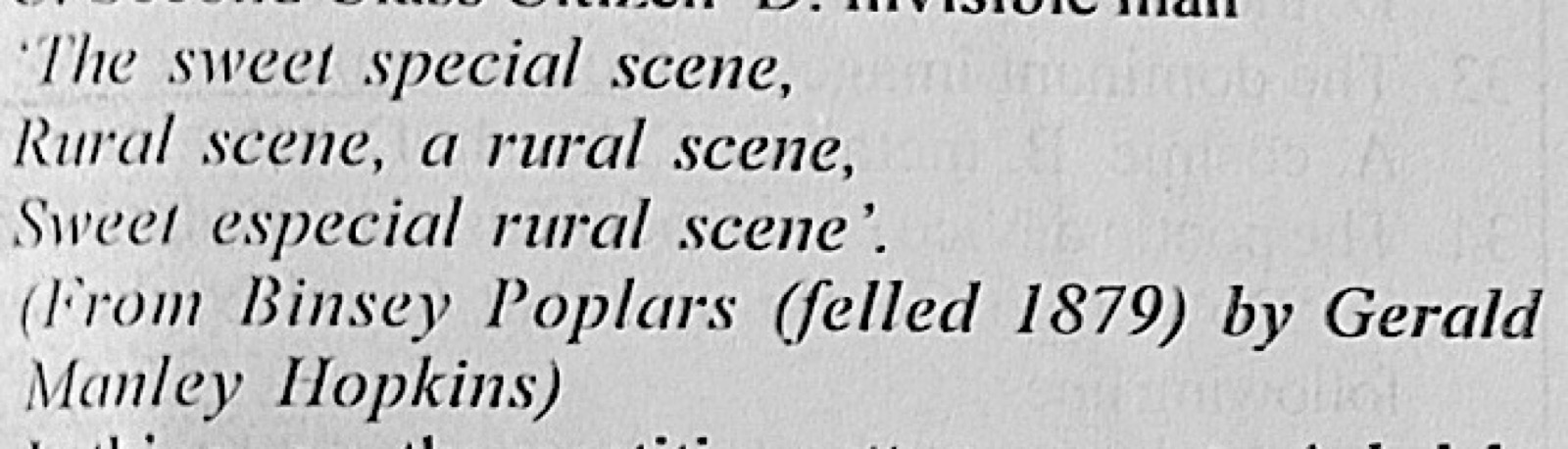
Non-African PoetryGerard Manley Hopkins: Binsey Poplars (felled 1879) (extract)
In this poem, the repetitive pattern suggests
- A.height of the fallen trees
- B.shows how inconsolable the poet-persona feels about his fallen trees
- C.shows how the poet-persona loves to fell trees
- D.he loves trees with sweet fruits
Show the answer and explanation
Answer: B (shows how inconsolable the poet-persona feels about his fallen trees)
ExplanationRepeating 'rural scene' over and over is like a lament: the speaker cannot stop mourning the lost trees and the spoilt landscape.
Question 5
African PoetryThe language of Augustino Neto's 'The Grieved Lands' suggested
- A.the beauty of African country side
- B.that black is beautiful
- C.that the poet is pained by wrongs done to Africa in the past
- D.that the poet sees Africa as a colonial power
Show the answer and explanation
Answer: C (that the poet is pained by wrongs done to Africa in the past)
ExplanationNeto writes of the 'grieved lands' of Africa, mourning the suffering caused by slavery and colonial exploitation.
Question 6
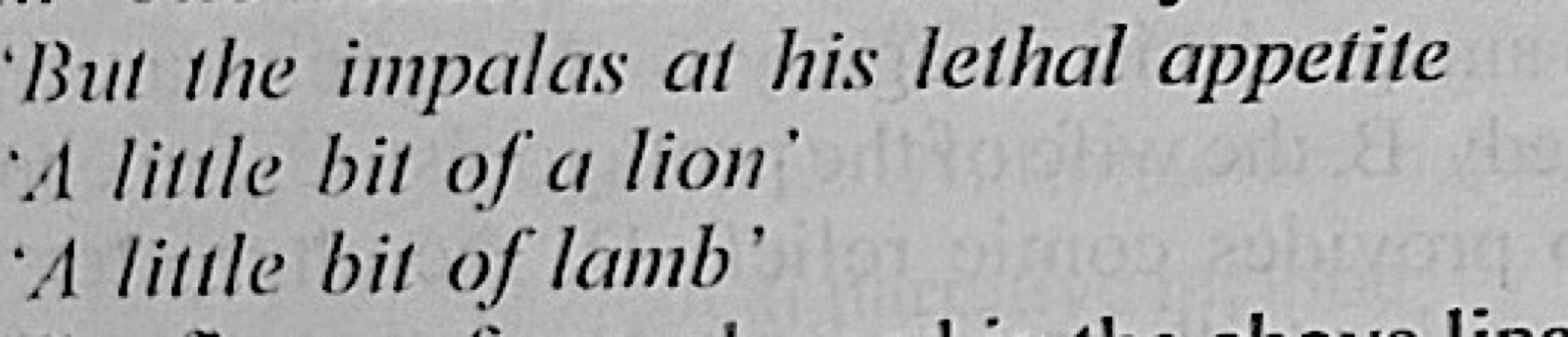
African PoetryNiyi Osundare: The Leader and the Led (extract)
In 'The Leader and the Led' Niyi Osundare writes the lines above. The figure of speech used in the above line is
- A.Metaphor
- B.Simile
- C.Irony
- D.Synecdoche
Show the answer and explanation
Answer: A (Metaphor)
ExplanationThe leader is called 'a little bit of a lion, a little bit of lamb' directly, without 'like' or 'as': a metaphor.
Question 7
Non-African PoetryIn D. H. Lawrence's 'BAT' the poet expresses
- A.his love for bats
- B.his love for swallows
- C.his hatred for swallows
- D.his disgust for bats
Show the answer and explanation
Answer: D (his disgust for bats)
ExplanationThe speaker first mistakes the bats for swallows, then recoils from them as ugly and repulsive: he is disgusted by bats.
Question 9
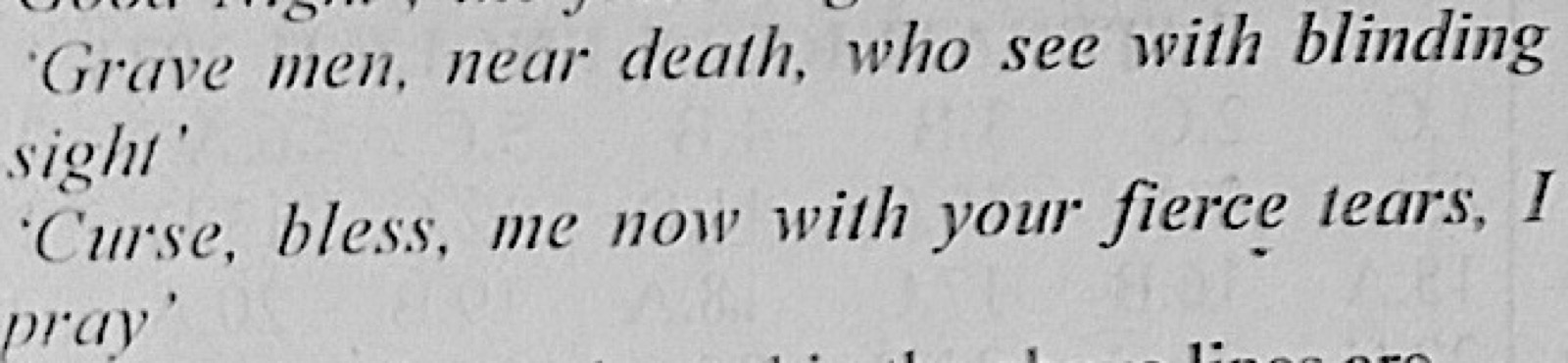
Non-African PoetryDylan Thomas: Do not go Gentle into that Good Night (extract for question 9)
In Dylan Thomas's 'Do not go Gentle into that Good Night', the following line occur. The figure of speech used in the above lines are
- A.Oxymoron
- B.Alliteration
- C.Litotes
- D.Metonymy
Show the answer and explanation
Answer: A (Oxymoron)
Explanation'Blinding sight' and 'fierce tears' that 'curse, bless' put opposite ideas side by side: oxymoron.
Question 10
Set Text: The Lion and the JewelThe Lion and the Jewel by Wole Soyinka
- A.Baroka is a socialist
- B.Baroka is a democratic ruler
- C.Baroka is a dictator
- D.Baroka is a monogamist
Show the answer and explanation
Answer: C (Baroka is a dictator)
ExplanationBaroka rules Ilujinle as he pleases, even bribing the surveyor to keep the railway away; he is an autocratic ruler, and certainly not monogamous.
Question 11
Set Text: A Midsummer Night's DreamIn A Midsummer Night's Dream, Hippolyta is the queen of
- A.Thenians
- B.Romans
- C.Celes
- D.Amazons
Show the answer and explanation
Answer: D (Amazons)
ExplanationHippolyta, whom Theseus is about to marry, is queen of the Amazons.
Question 12
Set Text: A Midsummer Night's DreamOne of the themes of A Midsummer Night's Dream is
- A.how to become a duke
- B.the defeat of evil by good
- C.romantic love as a blind force that can be cruel and forgiving
- D.night dream
Show the answer and explanation
Answer: C (romantic love as a blind force that can be cruel and forgiving)
ExplanationThe lovers fall in and out of love blindly, often hurting one another, which shows love as an irrational, unpredictable force.
Question 15
Other Set Texts: African ProseBuchi Emecheta: Second Class Citizen (extract)
The speaker in the novel second class citizen is
- A.Adah
- B.Francis
- C.Mama
- D.Peggy
Show the answer and explanation
Answer: A (Adah)
ExplanationIt is Adah who is shocked at the poor slum conditions Francis has brought the family to in London and protests in these words.
Question 16
Other Set Texts: African DramaThe author of Let me die Alone is
- A.Shakespeare
- B.Kolosa John Kargbo
- C.Chimmanda Adichie
- D.Buchi Emecheta
Show the answer and explanation
Answer: B (Kolosa John Kargbo)
ExplanationLet Me Die Alone is a play by the Sierra Leonean writer John Kolosa Kargbo.
Question 17
Set Text: The Lion and the JewelThe jewel in Wole Soyinka's The Lion and the Jewel is
- A.Sadiku
- B.Baroka
- C.Sidi
- D.Lakunle
Show the answer and explanation
Answer: C (Sidi)
ExplanationSidi, the village belle, is the jewel; Baroka is the lion.
Question 18
Set Text: The Lion and the JewelThe Lion and the Jewel is a novel based on
- A.cultural clash
- B.politics
- C.folktales
- D.traditional marriage ceremonies
Show the answer and explanation
Answer: A (cultural clash)
ExplanationThe work (actually a play) is built on the clash between traditional African culture and Western modernity.
Question 19
Set Text: A Midsummer Night's DreamIn Midsummer Night's Dream, who complained of his daughter's refusal to marry Demetrius?
- A.Duke of Athens
- B.Egeus
- C.Theseus
- D.Shakespeare
Show the answer and explanation
Answer: B (Egeus)
ExplanationEgeus brings his daughter Hermia before Theseus because she refuses to marry Demetrius.
Question 20
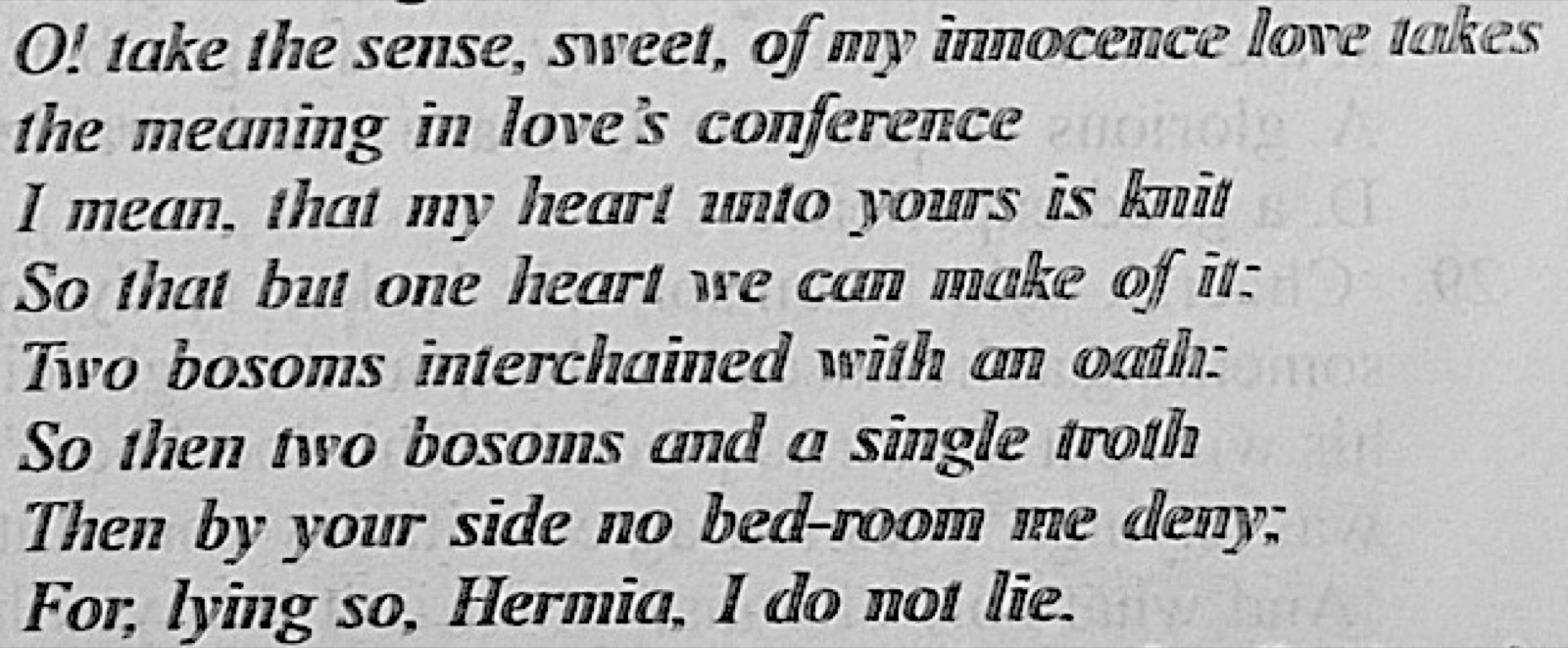
Set Text: A Midsummer Night's DreamWilliam Shakespeare: A Midsummer Night's Dream (extract for question 20)
These words are spoken by
- A.Lysander
- B.Hermia
- C.Oberon
- D.Titania
Show the answer and explanation
Answer: A (Lysander)
ExplanationIn the wood Lysander begs Hermia to let him lie near her, saying their two hearts are knit into one; she asks him to lie further off.
Question 21
Set Text: A Midsummer Night's DreamIn A Midsummer Night's Dream, Hermia refused to marry Demetrius because
- A.Demetrius is blind
- B.Demstrius is of a lower class
- C.she is in love with Lysander
- D.she is in love with Theseus
Show the answer and explanation
Answer: C (she is in love with Lysander)
ExplanationHermia loves Lysander and will not marry the man her father has chosen.
Question 22
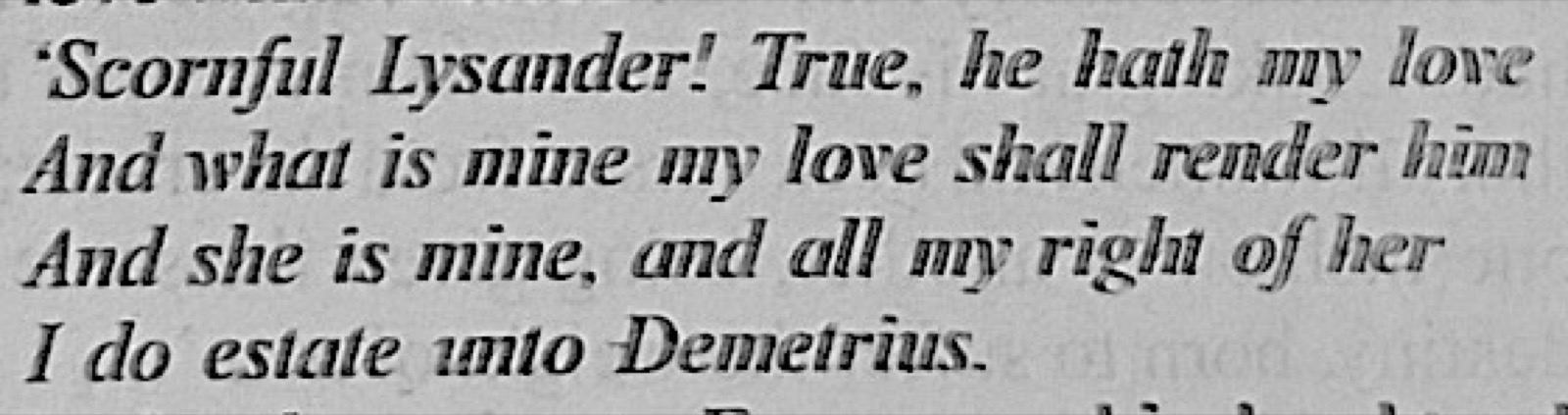
Set Text: A Midsummer Night's DreamWilliam Shakespeare: A Midsummer Night's Dream (extract for question 22)
In the above quote, Egeus sees his daughter, Hermia as a
- A.maid
- B.good daughter
- C.mere property
- D.slave
Show the answer and explanation
Answer: C (mere property)
ExplanationEgeus speaks of Hermia as 'mine' and of his 'right of her' which he can 'estate' (hand over) to Demetrius, as if she were property.
Question 23
Set Text: A Midsummer Night's DreamWhich group of characters appears in Midsummer Night:s Dream?
- A.Duncan, Macdoff, Theseus
- B.Shakespeare, Egeus, Hermia
- C.Macbeth, Hermia, Demetrius
- D.Lysander, Hermia, Egeus
Show the answer and explanation
Answer: D (Lysander, Hermia, Egeus)
ExplanationLysander, Hermia and Egeus are all in A Midsummer Night's Dream; Duncan, Macduff and Macbeth belong to Macbeth.
Question 24
Set Text: A Midsummer Night's DreamIn A Midsummer Night's Dream, the Duke of Athens, plans to marry Hippolyta when
- A.he lost his wife
- B.he defeated Hippolyta in a war
- C.Hippolyta assisted him
- D.he saw the beauty of Hippolyta
Show the answer and explanation
Answer: B (he defeated Hippolyta in a war)
ExplanationTheseus tells Hippolyta, 'I wooed thee with my sword': he won her by defeating the Amazons in battle.
Question 25
Literary Appreciation: PoetryExtract for question 25
The poetic device consciously used here is
- A.personification
- B.apostrophe
- C.alliteration
- D.oxymoron
Show the answer and explanation
Answer: C (alliteration)
ExplanationThe 'f' sound is repeated at the start of nearby words: fair, fancy, few. That is alliteration.
Question 28
Literary Appreciation: PoetryThis verse is taken from a poem written by a soldier at the battle-front. He clearly sees dying in battle as
- A.glorious
- B.patriotic
- C.brave and desirable
- D.a good experience
Show the answer and explanation
Answer: C (brave and desirable)
ExplanationThe soldier compares himself with the hero Achilles, who has already faced death; he sees dying in battle as a brave act that he can look towards.
Question 32
Literary Appreciation: PoetryThe above passage derives its theme from
- A.the repetition of nature images
- B.contrastive use of images
- C.the consistency of its rhyme scheme
- D.the use of the same figures of speech
Show the answer and explanation
Answer: A (the repetition of nature images)
ExplanationThe theme of autumn's ripeness and plenty is built up through image after image of nature: apples, gourds, hazel shells, flowers and bees.
Question 34
Literary Appreciation: PoetryThe poetic device consciously used by Dylan Thomas in 'Do not go Gentle into that Good Night' in the following lines is
- A.simile
- B.oxymoron
- C.anaphora
- D.paradox
Show the answer and explanation
Answer: B (oxymoron)
Explanation'Blinding sight' joins two opposite words, and 'fierce tears' that 'curse, bless' do the same: oxymoron.
Question 37
Literary Terms and DevicesPoint out the odd item
- A.enjambment
- B.rhyme
- C.alliteration
- D.plot
Show the answer and explanation
Answer: D (plot)
ExplanationEnjambment, rhyme and alliteration are poetic devices; plot is the storyline of a narrative or play.