Home › Past questions › JAMB › Literature in English › 2017 32 questions. Try each one, then open the answer to check yourself and read the explanation.
Sign up free to answer these questions on a CBT screen with a timer, then see your score and every answer explained.
Start practising free
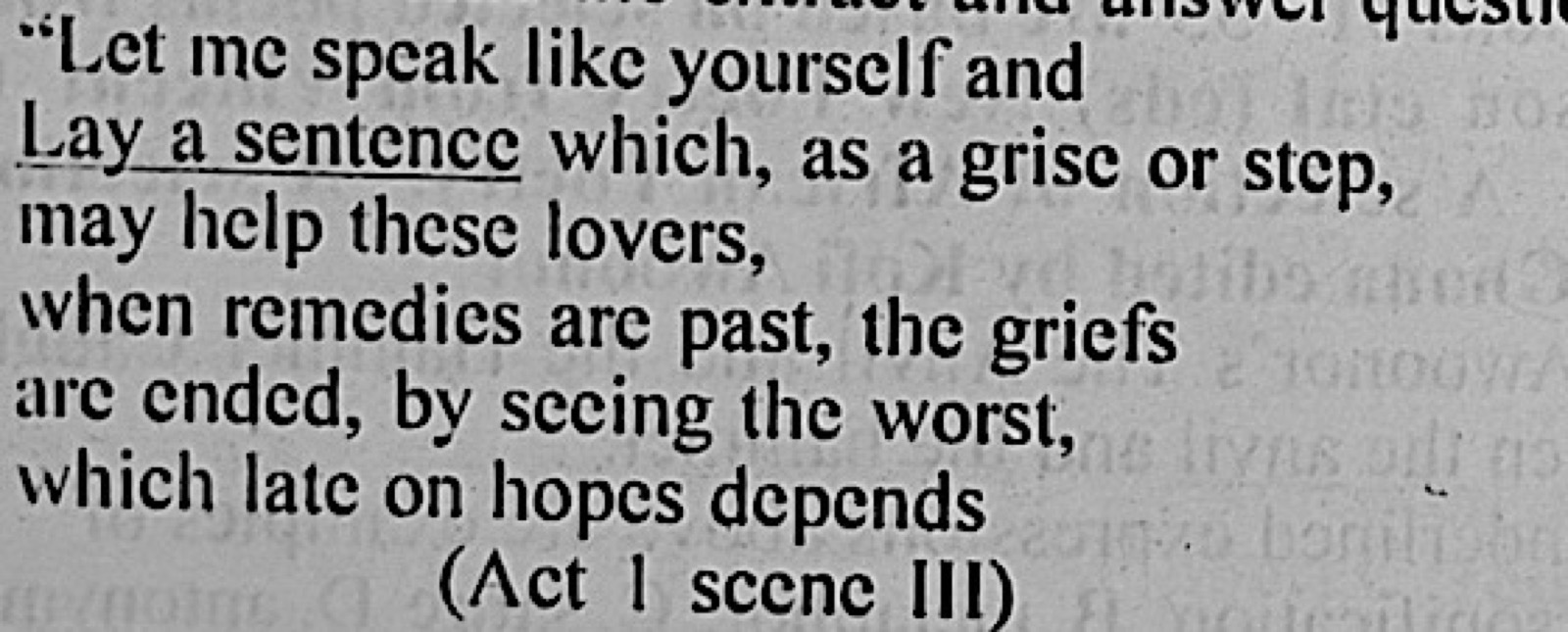
Question 1 Set Text: Othello William Shakespeare: Othello, Act 1 Scene III (extract) The speaker is
A. Brabantio B. Duke C. Montano D. Lodovico Show the answer and explanation Answer: B (Duke )
Explanation In the council chamber the Duke of Venice comforts Brabantio, urging him to accept Othello and Desdemona's marriage since the grief cannot be undone.
Open this question
Question 2 Set Text: Othello He is responding to
A. Montano B. Lago C. Roderigo D. Brabantio Show the answer and explanation Answer: D (Brabantio )
Explanation The Duke is answering Brabantio, who is angry that Desdemona has married Othello.
Open this question
Question 3 Set Text: Othello The setting is
A. a council chamber B. venice, a street C. another street outside the sagittary D. the citadel of Cyprus. Show the answer and explanation Answer: A (a council chamber )
Explanation Act 1 Scene 3 takes place in the Venetian council chamber, where the Duke and senators meet.
Open this question
Question 4 Set Text: Othello These lovers refers to
A. Lago and Emilia B. Cassio and Bianca C. Roderigo and Desdemona D. Othello and Desdemona. Show the answer and explanation Answer: D (Othello and Desdemona. )
Explanation The Duke is speaking of the newly married Othello and Desdemona.
Open this question
Question 5 Set Text: Othello The expression "Lay a sentence" means
A. decide who is guilty B. offer criticism C. give advice D. speak politely. Show the answer and explanation Answer: C (give advice )
Explanation A 'sentence' here is a wise saying; the Duke offers a maxim as advice to help Brabantio accept the marriage.
Open this question
Question 6 Other Set Texts: African Prose Questions 6 and 7 are based on Amma Darko's Faceless. One of the themes in Faceless is
A. parental irresponsibility B. the inevitability of death C. importance of Western Education D. class oppression. Show the answer and explanation Answer: A (parental irresponsibility )
Explanation Maa Tsuru and the fathers fail their children, who end up on the streets; parental neglect is central to the novel.
Open this question
Question 8 Other Set Texts: African Prose In Amma Darko's Faceless, Dina and Kabria hold a confidential talk with
A. Maa Tsuru B. Mute C. Fofo D. Naa Yomo. Show the answer and explanation Answer: C (Fofo )
Explanation Dina and Kabria of MUTE talk privately with Fofo to learn what happened to her sister Baby T.
Open this question
Question 10 Other Set Texts: Non-African Prose Questions 10 and 11 are based on Richard Wright's Native Son. The lady of the house Mrs. Thomas is woken up from her sleep by the clanging of an alarm clock, she shouts orders at her sons
A. Buddy and Jack B. Dalton and Bigger C. Peggy and Jack D. Bigger and Buddy. Show the answer and explanation Answer: D (Bigger and Buddy. )
Explanation The novel opens with Mrs Thomas waking her sons Bigger and Buddy in their one-room Chicago flat.
Open this question
Question 11 Other Set Texts: Non-African Prose In Richard Wright's Native Son, while assisting Mary, Bigger experiences mixed feelings of
A. stubborness and great B. admiration and hate C. surprise and shock D. jealousy and avarice. Show the answer and explanation Answer: B (admiration and hate )
Explanation Bigger is drawn to rich, friendly Mary, yet resents and hates her careless familiarity across the colour line.
Open this question
Question 12 Other Set Texts: African Drama Questions 12 and 13 are based on Frank Ogecche's Harvest of Corruption. Aloho has discovered that she is pregnant for chief, downcast, she sobs ________ consoles her
A. Ochuole B. Ogeyi C. ACP Yakubu D. Madam Hoha. Show the answer and explanation Answer: B (Ogeyi )
Explanation Ogeyi, Aloho's loyal Christian friend, comforts her when she finds she is pregnant.
Open this question
Question 13 Other Set Texts: African Drama In Frank Ogbeche's Harvest of Corruption, the police commissioner plays down on the cocaine matter saying "the court as you rightly said has handled it. What does "it" refers to?
A. Naira embezzlement scandal B. work schedule C. airport drug case D. cocaine matter. Show the answer and explanation Answer: D (cocaine matter. )
Explanation The commissioner is brushing aside the cocaine matter, saying the court has already dealt with it.
Open this question
Question 14 Other Set Texts: African Drama Questions 14 and 15 are based on Dele Charley's The Blood of a Stranger. The mission of the white man is revealed and Soko is enlisted into the
A. plan of work B. game plan C. mission act D. music game. Show the answer and explanation Answer: B (game plan )
Explanation Once the stranger's real aim (the diamonds) is revealed, Soko is drawn into his game plan.
Open this question
Question 15 Other Set Texts: African Drama In Dele Charley's The Blood of a Stranger, Kindo returns to find Maligu and queries him for giving
A. gin drink and evil smelling tobacco B. a negative advice C. a profitable advice D. warning concerning the white man. Show the answer and explanation Answer: A (gin drink and evil smelling tobacco )
Explanation Kindo challenges Maligu over the gin and tobacco handed out, the stranger's bribes to the village.
Open this question
Question 16 Set Text: She Stoops to Conquer Questions 16 and 17 are based on Oliver Goldsmith's She Stoops to Conquer. She stoops to conquer is a play based on
A. comedy-tragedy B. tragedy C. laughing comedy D. comedy. Show the answer and explanation Answer: C (laughing comedy )
Explanation Goldsmith wrote it as a 'laughing comedy' in reaction to the sentimental comedies of his day.
Open this question
Question 17 Set Text: She Stoops to Conquer In Oliver Goldsmith's She Stoops to Conquer, Tony steals the casket containing Constance's
A. clothes B. Jewels C. books D. letters. Show the answer and explanation Answer: B (Jewels )
Explanation Tony takes Constance's jewels from his mother's keeping to help her elope with Hastings.
Open this question
Question 18 Other Set Texts: Non-African Drama Questions 18 to 20 are based on Lorraine Hansberry's A Raisin in the Sun. The title of A Raisin in the Sun comes from the Poem
A. Harlem B. hope C. promise D. vanguard. Show the answer and explanation Answer: A (Harlem )
Explanation The title comes from Langston Hughes's poem 'Harlem': 'What happens to a dream deferred? Does it dry up like a raisin in the sun?'
Open this question
Question 19 Other Set Texts: Non-African Drama In A Raisin in the Sun, on a friday night a few weeks later, packing boxes filled the younger apartment in preparation for the move to their new house in a
A. white neighbourhood B. black neighbourhood C. outskirt of the neighbourhood D. city. Show the answer and explanation Answer: A (white neighbourhood )
Explanation Mama has bought a house in Clybourne Park, an all-white neighbourhood.
Open this question
Question 20 Other Set Texts: Non-African Drama One of the themes in A Raisin in the Sun is
A. warning to renegades B. pain and misery C. abandonment D. right and choice. Show the answer and explanation Answer: D (right and choice. )
Explanation The Youngers fight for the right to choose where and how they live, and each character must make choices about the insurance money.
Open this question
Question 21 African Poetry Extract for question 21 Questions 21 - 25 are based on poems of black Africa. The lines above illustrates,
A. irony B. metonymy C. synecdoche D. iambic. Show the answer and explanation Answer: C (synecdoche )
Explanation 'Eyes', 'ear' and 'heart' stand for whole people who might watch and listen: parts used for the whole, i.e. synecdoche.
Open this question
Question 24 African Poetry These illustrate
A. enjambment B. metaphor C. pun D. assonance. Show the answer and explanation Answer: B (metaphor )
Explanation The anvil, hammer and forging house stand for the forces that shape and batter the poet's people: they are metaphors.
Open this question
Question 25 African Poetry In piano and drums, the poem is a reflection on the impossibility of living two different
A. stanzas B. struggles C. cultures D. African and Ghana. Show the answer and explanation Answer: C (cultures )
Explanation Okara's speaker is torn between the African drums and the Western piano, two cultures he cannot reconcile.
Open this question
Question 26 Non-African Poetry Questions 26 - 30 are based on The Penguin book of English Verse, The Golden Treasury of longer Poems, English Romantic Verse and A Pageant of longer poems. In Alfred Tennyson "Crossing the Bar the major themes are
A. death and hope B. beauty and quest C. formal education and imprisonment D. sinners and the righteous. Show the answer and explanation Answer: A (death and hope )
Explanation Tennyson faces death calmly and hopes to see his 'Pilot face to face' once he has crossed the bar.
Open this question
Question 27 Non-African Poetry Robert frost's "Birches portrays that life can be hard for
A. children B. youth C. adult D. society. Show the answer and explanation Answer: C (adult )
Explanation The adult speaker, weary of life's 'pathless wood', longs to escape for a while as he did swinging birches as a boy.
Open this question
Question 28 Non-African Poetry In the 'School Boy' the poem is an example of ________ that is, a poem written in the form of a speech or statement made by individual character
A. dramatic monologue B. monologue C. aside D. tragic-comedy. Show the answer and explanation Answer: A (dramatic monologue )
Explanation The poem is spoken entirely by one character, the boy, so it is a dramatic monologue.
Open this question
Question 29 Non-African Poetry 'The pulley' is a religious metaphysical poem by
A. William Shakespeare B. George Herbert C. William Blake D. Gbanabam Hallowell. Show the answer and explanation Answer: B (George Herbert )
Explanation The Pulley is by George Herbert, the 17th-century metaphysical poet.
Open this question
Question 30 Non-African Poetry One of the themes in 'The Proud King' is
A. a quest for fulfillment in nature B. pride and the vanity of material wealth C. the beauty and splendour of nature D. immortality of art. Show the answer and explanation Answer: B (pride and the vanity of material wealth )
Explanation The proud king is humbled to show how empty pride and worldly power are.
Open this question
Question 31 Literary Terms and Devices Literary Principles 31 - 40. A character who remains unchanged in a work of art is called
A. a flat character B. a stereotypic character C. a round character D. an illusive character. Show the answer and explanation Answer: A (a flat character )
Explanation A flat character stays the same from beginning to end; a round character develops.
Open this question
Question 32 Figures of Speech The figure of speech in which a poet implicity compares an object or idea with another totally different object or idea is called a
A. simile B. denotation C. connotation D. metaphor. Show the answer and explanation Answer: D (metaphor. )
Explanation A metaphor compares two unlike things without 'like' or 'as', so the comparison is implicit.
Open this question
Question 35 Figures of Speech A figure of speech in which an absent person or an object is addressed as if present is referred to as
A. assonance B. elegy C. apostrophe D. personification. Show the answer and explanation Answer: C (apostrophe )
Explanation Apostrophe is speaking directly to someone absent or dead, or to a thing.
Open this question
Question 38 Prose: General The literary term which describes the angle at which a writer tells his story is
A. point of view B. story angle C. story line D. aside. Show the answer and explanation Answer: A (point of view )
Explanation Point of view is the position from which a story is told, e.g. first person or third person.
Open this question
Question 39 Poetry: General An inherent quality of the lyric is that it must
A. be sung to a musical instrument B. be sung by the poet who composes it C. be simple and successful D. express the Poet's subjective emotions. Show the answer and explanation Answer: D (express the Poet's subjective emotions. )
Explanation A lyric is a short poem expressing the poet's personal feelings.
Open this question
Question 40 Figures of Speech In literary criticism, a casual reference to a figure is
A. alliteration B. allegory C. ambiguity D. allusion. Show the answer and explanation Answer: D (allusion. )
Explanation An allusion is a brief, passing reference to a person, place or event outside the text.
Open this question Sign up free for every JAMB Literature in English year, practice by topic and timed mocks.
Start practising free