Home › Past questions › JAMB › Literature in English › 2014 44 questions. Try each one, then open the answer to check yourself and read the explanation.
Sign up free to answer these questions on a CBT screen with a timer, then see your score and every answer explained.
Start practising free
Question 3 Other Set Texts: African Drama In Women of Owu, Orisaye describes Balogun Kusa as
A. a good leader. B. a great warrior. C. an enemy and a butcher. D. a friend in need. Show the answer and explanation Answer: B (a great warrior. )
Explanation Orisaye speaks of Balogun Kusa as a great warrior who fought to defend Owu.
Open this question
Question 4 Other Set Texts: African Drama In Women of Owu, Erelu is
A. the first wife of the Oba. B. the oldest wife of the Oba Akinjobi. C. a courtier to the Alaafin of Oyo. D. the most brilliant woman in Owu. Show the answer and explanation Answer: B (the oldest wife of the Oba Akinjobi. )
Explanation Erelu Afrikete is the senior (oldest) wife of the fallen Oba Akinjobi, who mourns the city's destruction.
Open this question
Question 5 Other Set Texts: African Drama In Women of Owu, Balogun Kusa is killed by a
A. soldier. B. god. C. herbalist. D. lunatic. Show the answer and explanation Answer: A (soldier. )
Explanation Balogun Kusa dies in the war, killed by an enemy soldier.
Open this question
Question 6 Other Set Texts: Non-African Drama Questions 6 to 10 are based on William Shakespeare's The Tempest. In the play, Ariel is identified as
A. assistant to Sycorax. B. leader of the spirits. C. Prospero's daughter. D. Alonso's wife. Show the answer and explanation Answer: B (leader of the spirits. )
Explanation Ariel is the chief spirit who serves Prospero and commands the lesser spirits of the island.
Open this question
Question 7 Other Set Texts: Non-African Drama In The Tempest, before the shipwreck that occurs at the beginning of the play, Prospero and his daughter have lived in the island for
A. eighteen months. B. two decades. C. twelve years. D. forty days. Show the answer and explanation Answer: C (twelve years. )
Explanation Prospero tells Miranda it is twelve years since they were set adrift from Milan.
Open this question
Question 8 Other Set Texts: Non-African Drama In The Tempest, Caliban's intention to rape Miranda is born out of the desire to
A. marry her. B. destroy the Island. C. compete with Ferdinand. D. populate the Island with Calibans. Show the answer and explanation Answer: D (populate the Island with Calibans. )
Explanation Caliban says that had he not been stopped he would have 'peopled else this isle with Calibans'.
Open this question
Question 9 Other Set Texts: Non-African Drama In The Tempest, the character associated with savagery in the play is
A. Ferdinand. B. Ariel. C. Stephano. D. Caliban. Show the answer and explanation Answer: D (Caliban. )
Explanation Caliban, the half-wild son of Sycorax, is presented as the savage of the island.
Open this question
Question 10 Other Set Texts: Non-African Drama In The Tempest, Prospero is portrayed as a man who is
A. eager to conquer the world. B. full of mistrust for everybody. C. more interested in studying than in governance. D. dependent on the spirits for his survival. Show the answer and explanation Answer: C (more interested in studying than in governance. )
Explanation Prospero lost his dukedom because he left the government to his brother while he buried himself in his books.
Open this question
Question 11 Other Set Texts: African Prose Questions 11 to 13 are based on Asare Konadu's A Woman in Her Prime. The novel explores the theme of
A. child quest of an African woman. B. exploitation of the African woman. C. sex discrimination in Ghana. D. women liberation in Nigeria. Show the answer and explanation Answer: A (child quest of an African woman. )
Explanation The novel follows Pokuwaa's long search for a child.
Open this question
Question 12 Other Set Texts: African Prose According to A Woman in Her Prime, the worst calamity that can befall a woman is
A. barreness. B. inability to bear male children. C. inability to marry. D. divorce. Show the answer and explanation Answer: A (barreness. )
Explanation In Pokuwaa's society childlessness is seen as the greatest misfortune for a woman.
Open this question
Question 13 Other Set Texts: African Prose In A Woman in Her Prime, Asogo is a game in which
A. mothers lure their babies to sleep. B. fathers narrate animal stories. C. boys abuse girls with music. D. girls sing songs of praise and admonition. Show the answer and explanation Answer: B (fathers narrate animal stories. )
Explanation The key gives Asogo as a storytelling pastime in which fathers tell animal stories.
Open this question
Question 14 Other Set Texts: African Prose Questions 14 to 16 are based on Chimamanda Adichie's Purple Hibiscus. In the novel, one of the changes introduced into St. Agnes' Church by Father Benedict is that
A. everyone must take holy communion. B. there must be fasting every month. C. the Credo must be recited in Igbo. D. the Kyrie must be rendered only in Latin. Show the answer and explanation Answer: D (the Kyrie must be rendered only in Latin. )
Explanation Father Benedict, the white priest, insists that the Credo and Kyrie be said only in Latin, not Igbo.
Open this question
Question 15 Other Set Texts: African Prose Eugene Achike in Purple Hibiscus is portrayed as
A. a tough retired soldier. B. a soft and gentle husband. C. an uncompromising traditionalist. D. a fanatical Catholic adherent. Show the answer and explanation Answer: D (a fanatical Catholic adherent. )
Explanation Eugene is a fanatical Catholic who punishes his family harshly for any religious lapse.
Open this question
Question 17 Other Set Texts: Non-African Prose Questions 17 to 20 are based on Ernest Hemingway's The Old Man and the Sea. In the novel, the type of fish caught by Santiago after days of effort is
A. geisha. B. shark. C. iris. D. marlin. Show the answer and explanation Answer: D (marlin. )
Explanation After a long struggle Santiago catches a giant marlin.
Open this question
Question 18 Other Set Texts: Non-African Prose The Old Man and the Sea demonstrates the
A. struggle of man against defeat. B. attempt to catch fish. C. desire to understand life. D. influence of the sea on man. Show the answer and explanation Answer: A (struggle of man against defeat. )
Explanation Santiago fights on against the marlin and the sharks: 'a man can be destroyed but not defeated'.
Open this question
Question 19 Other Set Texts: Non-African Prose In The Old Man and the Sea, the attitude of the old man toward nature is quite
A. warm and friendly. B. cautious and skeptical. C. hostile and callous. D. careless and indifferent. Show the answer and explanation Answer: A (warm and friendly. )
Explanation Santiago loves the sea, calls the fish his brother and sees the birds and turtles as friends.
Open this question
Question 20 Other Set Texts: Non-African Prose In The Old Man and the Sea, Santiago's second dream occurs
A. when he sleeps on the boat for a few hours. B. the night before his fishing expedition. C. in his house. D. at the end of the book. Show the answer and explanation Answer: B (the night before his fishing expedition. )
Explanation The key places Santiago's second dream on the night before he sets out.
Open this question
Question 21 African Poetry Questions 21 to 30 are based on selected poems. The dominant image in Adeoti's Hard Lines is
A. tactile. B. auditory. C. gustatory. D. visual. Show the answer and explanation Answer: B (auditory. )
Explanation The key gives auditory: the poem's images appeal mainly to the sense of hearing.
Open this question
Question 22 African Poetry The tone of Umeh's Ambassadors of Poverty can be described as
A. panegyrical. B. metaphorical. C. sarcastic. D. admonitory. Show the answer and explanation Answer: C (sarcastic. )
Explanation The poem mocks those who parade poverty, so the tone is sarcastic.
Open this question
Question 23 African Poetry In Owonibi's Homeless, not Hopeless , the persona explains that street beggars
A. are concerned with their daily needs. B. always worry about heaven. C. rarely sleep and dream. D. attend conferences in towns. Show the answer and explanation Answer: A (are concerned with their daily needs. )
Explanation The homeless people in the poem are concerned only with getting through each day.
Open this question
Question 24 African Poetry Cheney-Coker's Myopia is a
A. ballad. B. dirge. C. lament. D. sonnet. Show the answer and explanation Answer: A (ballad. )
Explanation The key classifies Myopia as a ballad.
Open this question
Question 25 African Poetry Jared Angira is an African Poet from
A. Ghana. B. Sierra-Leone. C. Kenya. D. South Africa. Show the answer and explanation Answer: C (Kenya. )
Explanation Jared Angira is a Kenyan poet.
Open this question
Question 26 African Poetry The dominant technique used in Serenade is
A. apostrophe. B. metaphor. C. simile. D. oxymoron. Show the answer and explanation Answer: C (simile. )
Explanation The key gives simile as the main device of the poem.
Open this question
Question 27 Non-African Poetry The sun in Donne's The Sun Rising is depicted through the use of
A. apostrophe. B. invocation. C. ellipsis. D. enjambment. Show the answer and explanation Answer: A (apostrophe. )
Explanation The speaker talks directly to the sun ('Busy old fool, unruly sun'): apostrophe.
Open this question
Question 28 Non-African Poetry In Raleigh's The Soul's Errand , the soul is portrayed as a
A. messenger of hope and peace. B. friend of suffering masses. C. fearless message-bearer. D. restorer of lost glory. Show the answer and explanation Answer: C (fearless message-bearer. )
Explanation The soul is sent out to 'give the world the lie', boldly telling court, church and rulers their faults: a fearless messenger.
Open this question
Question 29 Non-African Poetry The allusion in Hughe's The Negro Speaks of Rivers is mainly
A. literacy. B. biblical. C. historical. D. classical. Show the answer and explanation Answer: C (historical. )
Explanation The poem refers to the Euphrates, Congo, Nile and Mississippi, tracing black history through the ages.
Open this question
Question 31 Drama: General An action in a play that stimulates the audience to pity a character is
A. pyrrhic. B. props. C. pathos. D. parody. Show the answer and explanation Answer: C (pathos. )
Explanation Pathos is the quality that makes the audience feel pity or sorrow.
Open this question
Question 32 Drama: General Purgation of emotion, pity and fear is
A. catharsis. B. catastrophe. C. epilogue. D. exposition. Show the answer and explanation Answer: A (catharsis. )
Explanation Catharsis is the release of pity and fear that tragedy produces.
Open this question
Question 33 Drama: General A device in drama where a character speaks alone is
A. soliloquy. B. aside. C. apostrophe. D. dialogue. Show the answer and explanation Answer: A (soliloquy. )
Explanation A soliloquy is a speech by a character alone on stage.
Open this question
Question 34 Literary Terms and Devices A plot in a literary work is about
A. character delineation. B. causal arrangement of events. C. resolution of conflicts. D. law of poetic justice. Show the answer and explanation Answer: B (causal arrangement of events. )
Explanation Plot is the arrangement of events linked by cause and effect.
Open this question
Question 35 Poetry: General Tone and mood of a poem refer to
A. locale. B. atmosphere. C. setting. D. space. Show the answer and explanation Answer: B (atmosphere. )
Explanation Tone and mood together create a poem's atmosphere.
Open this question
Question 36 Drama: General A funny incident within a serious situation is
A. comedy. B. comic relief. C. tragicomedy. D. tragic hero. Show the answer and explanation Answer: B (comic relief. )
Explanation Comic relief is a funny moment inside a serious work that eases the tension.
Open this question
Question 37 Literary Terms and Devices In literature, a flat character can be described as one who
A. is undeveloped. B. undergoes changes. C. dies abruptly. D. achieves greatness. Show the answer and explanation Answer: A (is undeveloped. )
Explanation A flat character is not developed and does not change.
Open this question
Question 38 Drama: General Dramatis personae in a play refers to
A. list of characters. B. order of appearance. C. cast list. D. protagonist and antagonist. Show the answer and explanation Answer: A (list of characters. )
Explanation Dramatis personae means the characters of a play, as listed at the start.
Open this question
Question 39 Drama: General The speech made at the end of a dramatic performance is generally called
A. a prologue. B. an epilogue. C. a dirge. D. a monologue. Show the answer and explanation Answer: B (an epilogue. )
Explanation An epilogue is a closing speech at the end of a play.
Open this question
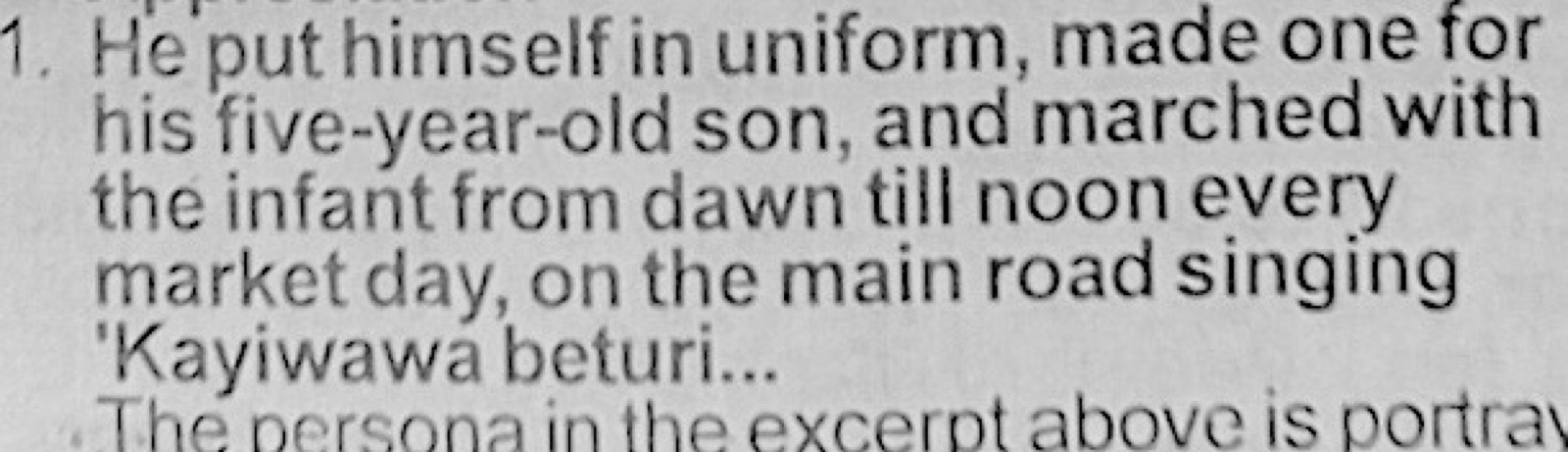
Question 41 Literary Appreciation: Prose and Drama Prose extract for question 41 The persona in the excerpt above is portrayed as
A. a soldier. B. abnormal. C. energetic. D. a policeman. Show the answer and explanation Answer: B (abnormal. )
Explanation A man who dresses himself and his small son in uniform and marches singing on the road every market day is behaving strangely: he is abnormal.
Open this question
Question 42 Literary Appreciation: Poetry The line above is an example of
A. euphemism. B. antithesis. C. epigram. D. oxymoron. Show the answer and explanation Answer: D (oxymoron. )
Explanation 'Faithful liar' joins two contradictory words: an oxymoron.
Open this question
Question 43 Literary Appreciation: Poetry The figure of speech in the line above is
A. litotes. B. innuendo. C. hyperbole. D. euphemism. Show the answer and explanation Answer: B (innuendo. )
Explanation The phrase hints sarcastically that the fighter is mechanical and calculating without saying so directly: innuendo.
Open this question
Question 44 Literary Appreciation: Poetry Horny pads in the lines above is a reference to a
A. sole of a pauper. B. sole of a soldier. C. policeman. D. madman. Show the answer and explanation Answer: B (sole of a soldier. )
Explanation The key reads the hardened, gullied feet that tramp endlessly as those of a marching soldier.
Open this question
Question 45 Literary Appreciation: Poetry The stanza above is an example of a
A. couplet. B. sestet. C. quatrain. D. sonnet. Show the answer and explanation Answer: C (quatrain. )
Explanation The stanza has four lines, so it is a quatrain.
Open this question
Question 46 Literary Appreciation: Poetry The lines are an example of a
A. light verse. B. light opera. C. limerick. D. lampoon. Show the answer and explanation Answer: A (light verse. )
Explanation The playful, humorous complaint to the bed-bugs is light verse.
Open this question
Question 47 Literary Appreciation: Poetry The poet persona expresses dismay about
A. grasshoppers. B. bed-bugs. C. bat. D. cockroaches. Show the answer and explanation Answer: B (bed-bugs. )
Explanation The speaker complains about the parasites sharing his bed and sucking his blood: bed-bugs.
Open this question
Question 48 Literary Appreciation: Poetry The most dominant figure of speech in the excerpt is
A. personification. B. hyperbole. C. metaphor. D. simile. Show the answer and explanation Answer: C (metaphor. )
Explanation The bugs are called 'awful parasites', a direct comparison without 'like' or 'as': metaphor.
Open this question
Question 49 Literary Appreciation: Poetry The lines above are good example of
A. satire. B. lampoon. C. caricature. D. ridicule. Show the answer and explanation Answer: D (ridicule. )
Explanation Comparing the person's head to a drum and ears to fans mocks his looks: ridicule.
Open this question Sign up free for every JAMB Literature in English year, practice by topic and timed mocks.
Start practising free