45 questions. Try each one, then open the answer to check yourself and read the explanation.
Question 3
Set Text: Sons and DaughtersJ.C. De Graft: Sons and Daughters (extract for questions 2 and 3)
The speaker is referring to
- A.Fosuwa
- B.Awere
- C.Maanan
- D.Hannah.
Show the answer and explanation
Answer: D (Hannah.)
ExplanationJames Ofosu addresses 'woman' here: his wife Hannah, with whom he argues about the children's careers.
Question 4
Set Text: Sons and DaughtersThe dominant figure of speech in the excerpt above is
- A.personification
- B.metaphor
- C.metonymy
- D.synecdoche.
Show the answer and explanation
Answer: A (personification)
ExplanationEngineering is told to 'go hang itself', as though it were a person: personification.
Question 5
Set Text: Sons and DaughtersFrom the play Sons and Daughters, the character of Aaron represents the
- A.new generation
- B.old generation
- C.painters
- D.art work.
Show the answer and explanation
Answer: A (new generation)
ExplanationAaron wants to choose his own career in art against his father's wishes, standing for the new generation.
Question 6
Set Text: Romeo and JulietWilliam Shakespeare: Romeo and Juliet (extract for question 6)
The villain in the excerpt above is
- A.engaging in a shouting match
- B.holding a sword to commit murder
- C.attempting to steal
- D.attending a feast uninvited.
Show the answer and explanation
Answer: D (attending a feast uninvited.)
ExplanationTybalt complains that Romeo, a Montague, has come uninvited to the Capulets' feast.
Question 7
Set Text: Romeo and JulietThe lines above reveal the speaker as a
- A.real Montague
- B.trouble shooter
- C.violence seeker
- D.peace maker
Show the answer and explanation
Answer: C (violence seeker)
ExplanationTybalt scorns the very word peace and attacks Benvolio at once: he is looking for a fight.
Question 8
Set Text: Romeo and JulietIn Romeo and Juliet, Romeo's mood, at the beginning of the play can be described as
- A.frustrated and pensive
- B.gay and elated
- C.melancholic and sentimental
- D.dreamy and hopeful.
Show the answer and explanation
Answer: C (melancholic and sentimental)
ExplanationAt the start Romeo is sad and lovesick over Rosaline, shutting himself away and sighing: melancholic and sentimental.
Question 9
Set Text: Romeo and JulietWilliam Shakespeare: Romeo and Juliet (extract for question 9)
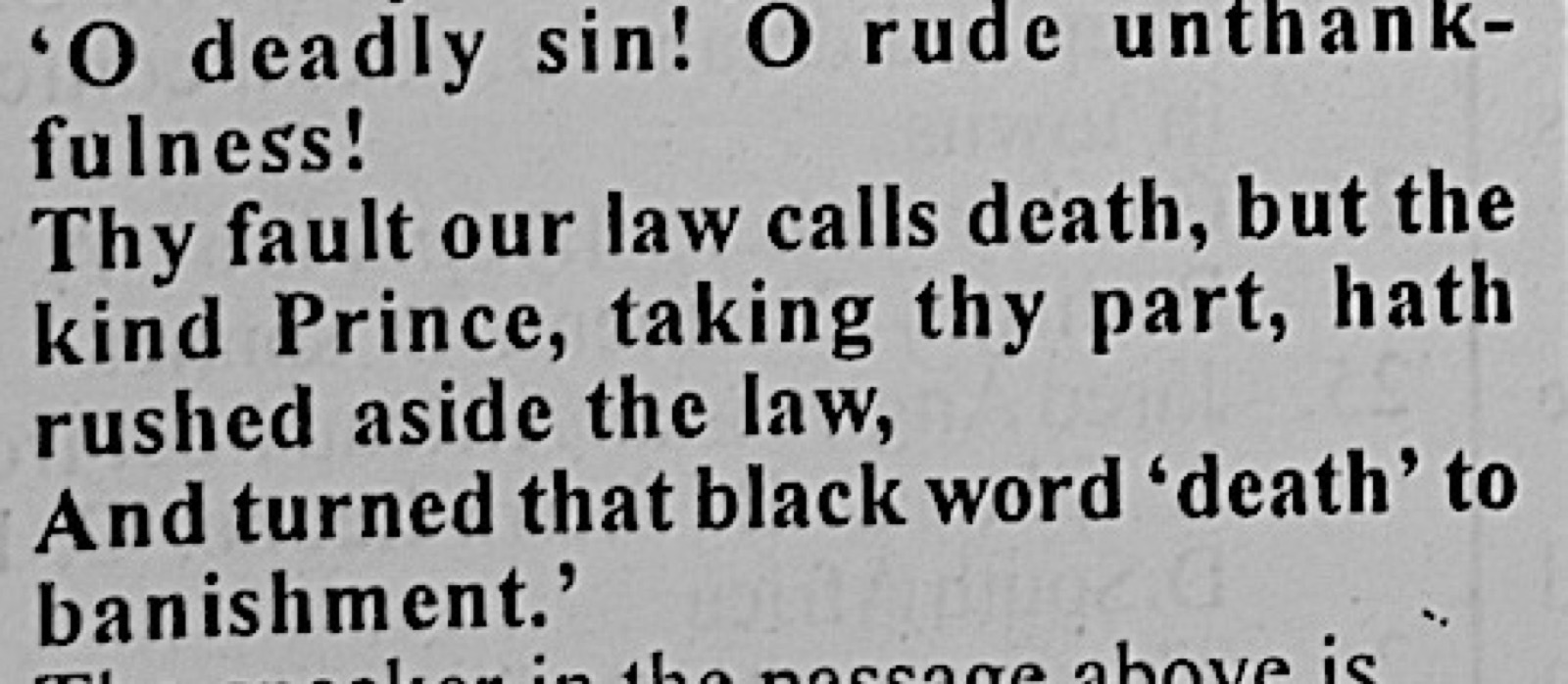
The speaker in the passage above is
- A.Apothecary
- B.Lord Capulet
- C.Lord Montague
- D.Friar Lawrence.
Show the answer and explanation
Answer: D (Friar Lawrence.)
ExplanationFriar Lawrence scolds Romeo in his cell for calling banishment worse than death, when the Prince has shown him mercy (Act 3 Scene 3).
Question 10
Set Text: Romeo and JulietThe speech above is made when
- A.Romeo and Paris engage themselves in a fight
- B.Benvolio tries to separate the servants of the feuding families
- C.Tybalt challenges Romeo to duel
- D.Prince Escalus arrives to make peace between the families.
Show the answer and explanation
Answer: B (Benvolio tries to separate the servants of the feuding families)
ExplanationIn the opening street brawl Benvolio draws his sword to part the fighting servants and asks Tybalt to help him.
Question 13
Other Set Texts: African ProseIn The Old Man and the Medal, to the white men, the medal that is given to Meka symbolizes
- A.peace
- B.friendship
- C.harmonious relationship
- D.love.
Show the answer and explanation
Answer: B (friendship)
ExplanationThe Commandant presents the medal as a sign of friendship between France and Meka.
Question 14
Other Set Texts: African ProseQuestions 14 to 16 are based on Buchi Emecheta's The Joys of Motherhood. In the Novel, Nnu Ego is blamed for the misfortunes of her
- A.parents
- B.husband
- C.siblings
- D.children.
Show the answer and explanation
Answer: B (husband)
ExplanationNnu Ego is blamed for Nnaife's troubles and failures as the head of the family.
Question 15
Other Set Texts: African ProseAccording to The Joys of Motherhood, Nnaife becomes frustrated when
- A.his wife gives birth to female twins
- B.he is recruited into the army
- C.Oshiaju secures a scholarship to study abroad
- D.he is arrested and charged for attempted murder of his in-law.
Show the answer and explanation
Answer: D (he is arrested and charged for attempted murder of his in-law.)
ExplanationNnaife's life collapses when he attacks the Yoruba man courting his daughter and is jailed for attempted murder.
Question 16
Other Set Texts: African ProseIn The Joys of Motherhood, Adaku remains faithful to Nnaife until she
- A.is rebuked by the Ibuza society for abusing Nnu Ego
- B.becomes rich and powerful
- C.starts keeping unnecessary friends
- D.is unable to give birth to a male child.
Show the answer and explanation
Answer: A (is rebuked by the Ibuza society for abusing Nnu Ego)
ExplanationAfter the Ibuza elders take Nnu Ego's side and rebuke Adaku at the family meeting, Adaku decides to leave Nnaife and live on her own as a trader.
Question 17
Other Set Texts: Non-African ProseQuestions 17 to 20 are based on George Orwell's Nineteen Eighty-Four. The Ministry of Love is concerned with
- A.peace and freedom
- B.torture and pain
- C.joy and peace
- D.hatred and pain.
Show the answer and explanation
Answer: B (torture and pain)
ExplanationDespite its name, the Ministry of Love is where the Party tortures and 're-educates' people like Winston.
Question 18
Other Set Texts: Non-African ProseIn Nineteen Eighty-Four, the instruments of power and torture belong to
- A.the thought police
- B.individuals
- C.the government
- D.the party.
Show the answer and explanation
Answer: D (the party.)
ExplanationAll power in Oceania, including the means of torture, is held by the Party.
Question 19
Other Set Texts: Non-African ProseIn Nineteen Eighty-Four, the action in the novel is built around
- A.Julia
- B.Big Brother
- C.Winston Smith
- D.O' Brien.
Show the answer and explanation
Answer: C (Winston Smith)
ExplanationThe story follows Winston Smith, the protagonist.
Question 20
Other Set Texts: Non-African ProseIn Nineteen Eighty-Four, Winston Smith works in the Record Department of the Ministry of
- A.Peace
- B.Plenty
- C.Love
- D.Truth.
Show the answer and explanation
Answer: D (Truth.)
ExplanationWinston rewrites old records in the Records Department of the Ministry of Truth.
Question 21
African PoetryQuestions 21 to 30 are based on selected poems. The dominant poetic technique employed in Adeoti's Naked Soles is
- A.hyperbole
- B.onomatopoeia
- C.zeugma
- D.oxymoron.
Show the answer and explanation
Answer: B (onomatopoeia)
ExplanationThe key gives onomatopoeia: the poem uses words that imitate the sounds of the marching feet.
Question 23
African PoetryKunene: The Heritage of Liberation (extract)
The device employed in the line above from Kunene's The Heritage of Liberation, is an example of
- A.anecdote
- B.aside
- C.apostrophe
- D.allusion.
Show the answer and explanation
Answer: C (apostrophe)
ExplanationThe speaker addresses 'you' directly, as though the absent person could hear: apostrophe.
Question 24
African PoetryThe lines above from Give Me The Minstrel's Seat is an example of
- A.ironical statement
- B.rhetorical question
- C.pathetic fallacy
- D.chiasmus.
Show the answer and explanation
Answer: B (rhetorical question)
ExplanationThe speaker asks questions that expect no answer in order to make a point: rhetorical questions.
Question 25
Non-African PoetryThe line above from Marvell's To His Coy Mistress depicts
- A.the measurement of time
- B.how fast events unfold
- C.how fast time flies
- D.the usefulness of time.
Show the answer and explanation
Answer: C (how fast time flies)
ExplanationTime is pictured as a winged chariot racing behind the lovers: time flies quickly.
Question 26
Non-African PoetryLawrence's Bat opens with the description of the
- A.bats
- B.scenery
- C.scene
- D.creatures.
Show the answer and explanation
Answer: B (scenery)
ExplanationThe poem begins with the evening view over Florence (the sunset, the river, the bridge) before the bats appear.
Question 27
Non-African PoetryThe theme of Eliot's The Journey of Magi is
- A.nature
- B.journey
- C.quest for salvation
- D.escape from persecution.
Show the answer and explanation
Answer: C (quest for salvation)
ExplanationThe wise men's hard journey to the Christ child stands for the search for salvation and spiritual rebirth.
Question 28
African PoetryAcquah's In the Navel of the Soul describes the
- A.lack of experienced midwives in the society
- B.excesses of the new generation churches and politicians
- C.complications of motherhood and childbearing
- D.conflict between the church and tradition.
Show the answer and explanation
Answer: B (excesses of the new generation churches and politicians)
ExplanationThe poem attacks the greed and excesses of new-generation churches and politicians.
Question 29
African PoetryLaunko: End of the War (extract)
The lines above from Launkos' End of the War, enhance the
- A.language of the poem
- B.use of imagery
- C.rhyme scheme
- D.rhythm of the poem.
Show the answer and explanation
Answer: A (language of the poem)
ExplanationThe proverb-like lines about drums and echoes enrich the language of the poem.
Question 30
Non-African PoetryThe language of Cope's Sonnet VII is generally
- A.poetic
- B.difficult
- C.complicated
- D.simple.
Show the answer and explanation
Answer: A (poetic)
ExplanationThe sonnet uses elevated, figurative, poetic language.
Question 31
Literary Terms and DevicesA device used by a writer to recall past event in a literary work is
- A.flashback
- B.foreshadowing
- C.interlude
- D.anti-climax.
Show the answer and explanation
Answer: A (flashback)
ExplanationA flashback takes the story back to earlier events.
Question 32
Prose: GeneralA paragraph in prose is equivalent to a
- A.stanza in poetry
- B.metre in poetry
- C.trope in poetry
- D.verse in poetry.
Show the answer and explanation
Answer: A (stanza in poetry)
ExplanationA stanza groups lines of a poem the way a paragraph groups sentences in prose.
Question 33
Prose: GeneralA fable is a brief narrative illustrating wisdom and
- A.custom
- B.truth
- C.urgency
- D.origin.
Show the answer and explanation
Answer: B (truth)
ExplanationA fable is a short story that teaches a moral truth.
Question 34
Figures of SpeechA device used in poetry to achieve emphasis or stress a point is known as
- A.assonance
- B.repetition
- C.alliteration
- D.rhyme.
Show the answer and explanation
Answer: B (repetition)
ExplanationPoets repeat words or lines to emphasise an idea.
Question 35
Literary Terms and DevicesA literary work that ridicules the shortcomings of people or ideas is
- A.an irony
- B.a fable
- C.a masque
- D.a satire.
Show the answer and explanation
Answer: D (a satire.)
ExplanationSatire uses humour and ridicule to expose people's faults.
Question 36
Figures of SpeechThe figure of speech in which the writer means the exact opposite of what he intends to say is
- A.paradox
- B.metaphor
- C.satire
- D.irony.
Show the answer and explanation
Answer: D (irony.)
ExplanationIrony is saying one thing while meaning the opposite.
Question 37
Drama: GeneralAction without speech in a play is
- A.epilogue
- B.mime
- C.soliloquy
- D.aside.
Show the answer and explanation
Answer: B (mime)
ExplanationMime tells a story through movement and gesture without words.
Question 38
Literary Terms and DevicesA literary work that teaches moral is said to be
- A.instructive
- B.corrective
- C.impressive
- D.didactic.
Show the answer and explanation
Answer: D (didactic.)
ExplanationA didactic work is written mainly to teach a moral lesson.
Question 39
Drama: GeneralA mistake committed by the hero which leads to his downfall is known as
- A.climax
- B.tragic flaw
- C.comic relief
- D.terse.
Show the answer and explanation
Answer: B (tragic flaw)
ExplanationThe tragic flaw (hamartia) is the error or weakness that brings about the hero's fall.
Question 40
Drama: GeneralThe speech made by a character to himself on stage is
- A.aside
- B.soliloquy
- C.monologue
- D.epilogue.
Show the answer and explanation
Answer: B (soliloquy)
ExplanationIn a soliloquy a character alone on stage speaks his thoughts aloud.
Question 41
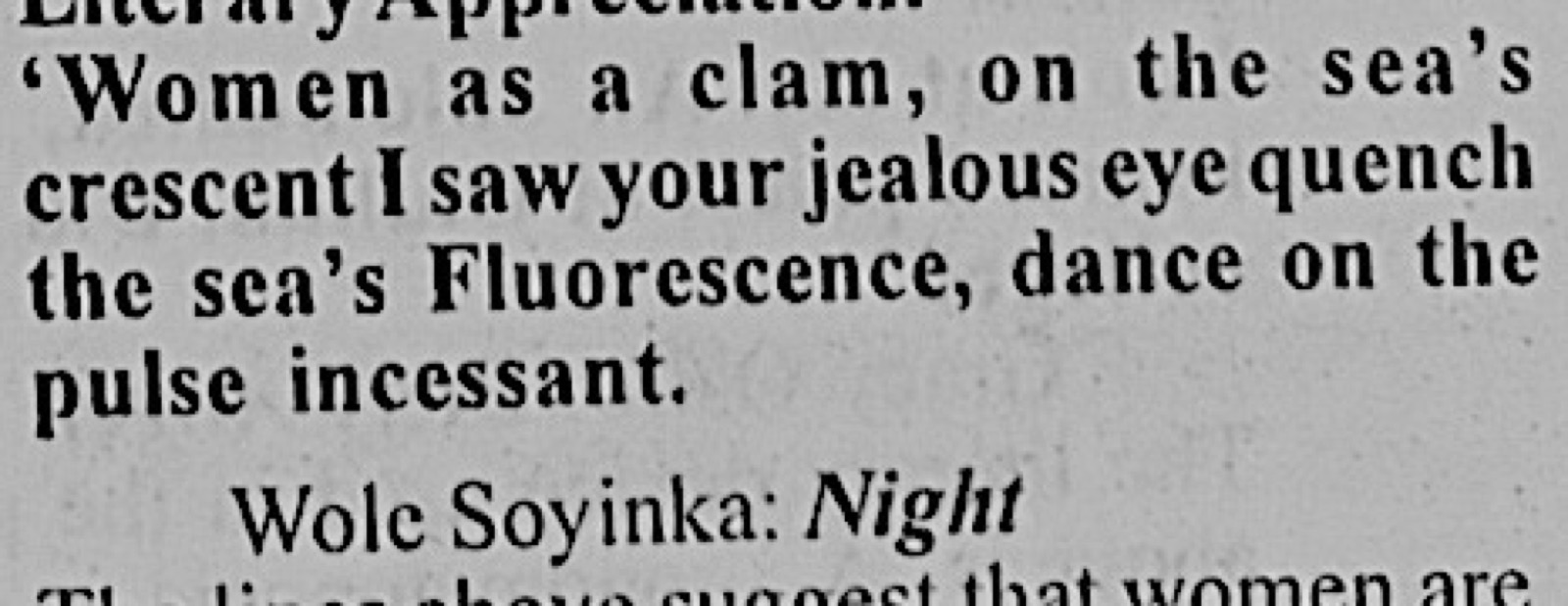
Literary Appreciation: PoetryWole Soyinka: Night (extract)
The lines above suggest that women are
- A.dogmatic
- B.seers
- C.magicians
- D.covetous.
Show the answer and explanation
Answer: D (covetous.)
ExplanationThe night is pictured as a woman whose 'jealous eye' puts out the sea's glow: a jealous, covetous nature.
Question 42
Literary Appreciation: PoetryThe excerpt suggests
- A.welcoming the sun
- B.indictment of the sun
- C.praise of nature
- D.invitation to the sun.
Show the answer and explanation
Answer: B (indictment of the sun)
ExplanationThe speaker scolds the sun as a 'busy old fool' for disturbing the lovers: an indictment of the sun.
Question 43
Literary Appreciation: PoetryThe figure of speech involved in the lines is
- A.epigram
- B.pun
- C.simile
- D.personification.
Show the answer and explanation
Answer: D (personification.)
ExplanationThe sun is treated as a nosy, foolish person who calls on the lovers through their windows.
Question 44
Literary Appreciation: PoetryThe lines show that the persona
- A.so hates the words of the girl
- B.understands the girl's song
- C.does not understand the girl's language
- D.is so much in love with the girl.
Show the answer and explanation
Answer: C (does not understand the girl's language)
ExplanationThe speaker asks 'Will no one tell me what she sings?': he cannot understand the language of her song.
Question 45
Literary Appreciation: PoetryThe lines end in a literary device known as
- A.irony
- B.conceit
- C.transferred epithet
- D.rhetorical question.
Show the answer and explanation
Answer: D (rhetorical question.)
ExplanationThe passage closes with a question the speaker does not expect anyone to answer: a rhetorical question.
Question 46
Literary Appreciation: PoetryThe literary device used in the first line is
- A.burlesque
- B.rhetoric question
- C.passion
- D.apostrophe.
Show the answer and explanation
Answer: D (apostrophe.)
ExplanationThe speaker cries out directly to God ('Oh incomprehensible God!'): apostrophe.
Question 47
Literary Appreciation: PoetryFrom the lines above, the poet sees the sun as
- A.illumination after darkness
- B.an unnecessary evil
- C.a necessary evil
- D.a light provider.
Show the answer and explanation
Answer: B (an unnecessary evil)
ExplanationCalling the sun a 'busy old fool' and 'unruly' shows the speaker sees it as an unwanted nuisance.
Question 48
Literary Appreciation: PoetryThe theme of the poem is
- A.non-peaceful nature of love
- B.diminishing nature of love
- C.permanence of love
- D.decaying nature of wood.
Show the answer and explanation
Answer: A (non-peaceful nature of love)
ExplanationThe poem ends on the rival who weeps: love always brings pain and rivalry to someone, so it is never peaceful.
Question 49
Literary Appreciation: PoetryNo lover peaceful while the rival weeps means that
- A.the pain of one lover is felt by the other
- B.there is no permanent love
- C.there is true and permanent love
- D.the two lovers weep together.
Show the answer and explanation
Answer: A (the pain of one lover is felt by the other)
ExplanationA lover cannot be at peace while his rival suffers: one person's pain in love affects the other.
Question 50
Literary Appreciation: Prose and DramaThe literary device used in the passage above is
- A.onomatopoeia
- B.metaphor
- C.simile
- D.parallelism.
Show the answer and explanation
Answer: D (parallelism.)
ExplanationThe speaker repeats the same sentence pattern ('Will college make you...? Will it make you...?'): parallelism.