Home › Past questions › JAMB › Literature in English › 2012 45 questions. Try each one, then open the answer to check yourself and read the explanation.
Sign up free to answer these questions on a CBT screen with a timer, then see your score and every answer explained.
Start practising free
Question 2 Set Text: Sons and Daughters Questions 2 to 5 are based on J.C. De Graft's Sons and Daughters. Who is the paternal aunt to Aaron and Maanan?
A. Mrs Bonu. B. Hannah. C. Fosuwa. D. Adwao. Show the answer and explanation Answer: C (Fosuwa. )
Explanation Aunt Fosuwa is James Ofosu's sister, so she is the paternal aunt of his children Aaron and Maanan.
Open this question
Question 3 Set Text: Sons and Daughters From the play Sons and Daughters, George is a
A. laboratory attendant B. pharmacist C. nurse D. medical doctor. Show the answer and explanation Answer: D (medical doctor. )
Explanation George is one of James Ofosu's sons who has followed a respected profession and become a medical doctor.
Open this question
Question 4 Set Text: Sons and Daughters J.C. De Graft: Sons and Daughters (extract) The statement is made by
A. Maanan to lawyer B B. Maanan to Mrs Bonu C. James to Awere D. Awere to Aaron Show the answer and explanation Answer: A (Maanan to lawyer B )
Explanation Maanan threatens Lawyer Bonu with a bottle when he tries to force his attentions on her.
Open this question
Question 5 Set Text: Sons and Daughters The issue at stake is that
A. Maanan is trying to compromise B. Lawyer B is trying to kiss Maanan C. James sees Awere as a bad influence D. Mrs Bonu is taunting Maanan for loving her husband. Show the answer and explanation Answer: B (Lawyer B is trying to kiss Maanan )
Explanation Lawyer Bonu, a family friend, makes advances to Maanan and tries to kiss her, so she defends herself.
Open this question
Question 6 Set Text: Romeo and Juliet The lines above suggest that the tragedy in the play
A. could have been averted B. is predestined C. is brought on by enmity D. brought misfortune on the lovers. Show the answer and explanation Answer: B (is predestined )
Explanation The Prologue calls Romeo and Juliet 'star-crossed lovers': their fate is written in the stars, i.e. predestined.
Open this question
Question 7 Set Text: Romeo and Juliet From the lines above, Juliet's beauty is presented
A. in contrast to the dark night B. as a source of envy to all C. in terms of riches D. as being outstanding. Show the answer and explanation Answer: A (in contrast to the dark night )
Explanation Romeo pictures Juliet as a bright torch and a jewel shining against the dark cheek of night: her beauty is set against darkness.
Open this question
Question 8 Set Text: Romeo and Juliet The lines above are spoken by
A. Count Paris in praise of Juliet B. Romeo in praise of Juliet C. Romeo in praise of Roseline D. Lady Capulet in praise of Roseline Show the answer and explanation Answer: C (Romeo in praise of Roseline )
Explanation Before he meets Juliet, Romeo tells Benvolio that the all-seeing sun never saw a match for Rosaline (Act 1 Scene 2).
Open this question
Question 9 Set Text: Romeo and Juliet In Romeo and Juliet, the major role of Mercutio in the play is to
A. serve as a contrast to Romeo B. aid and abet Romeo's passion C. annoy Tybalt D. accompany Romeo to Friar Lawrence. Show the answer and explanation Answer: A (serve as a contrast to Romeo )
Explanation Witty, cynical Mercutio mocks romantic love, which makes Romeo's dreamy passion stand out: he is Romeo's foil.
Open this question
Question 10 Set Text: Romeo and Juliet Romeo and Juliet shares the feature of classical tragedy through the use of
A. violence on stage B. chorus C. comic relief D. flashback. Show the answer and explanation Answer: B (chorus )
Explanation Like a Greek tragedy, the play uses a Chorus to speak the Prologue; classical tragedy kept violence off stage.
Open this question
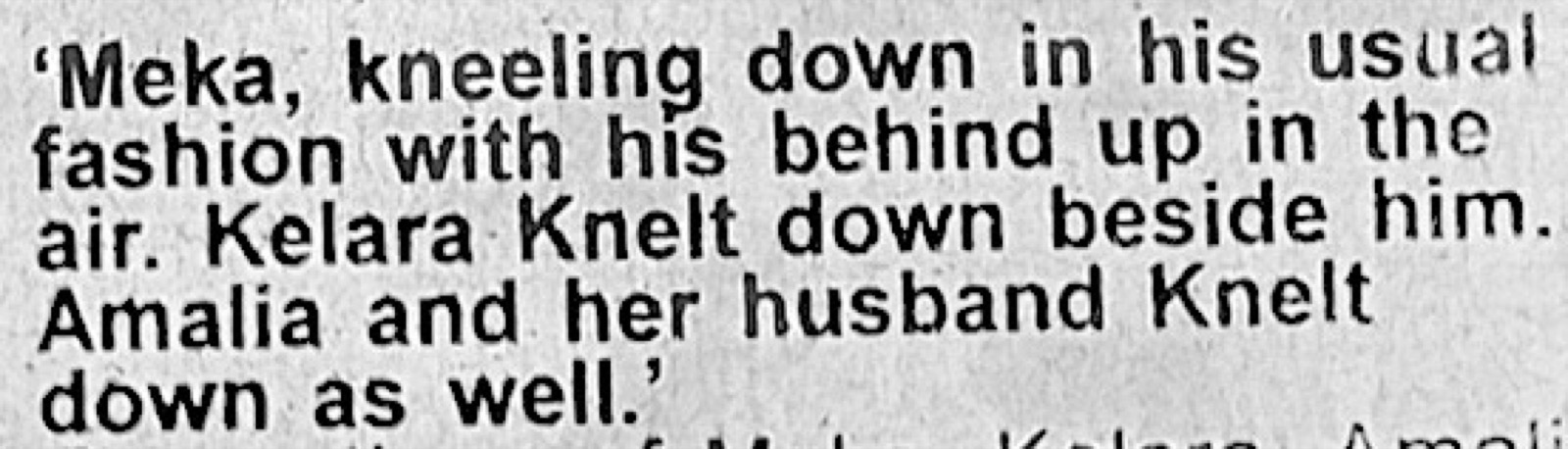
Question 11 Other Set Texts: African Prose Ferdinand Oyono: The Old Man and the Medal (extract for question 11) The actions of Meka, Kelara, Amalia and her husband signify
A. parade B. dance C. prayer D. celebration. Show the answer and explanation Answer: C (prayer )
Explanation The family kneel down together in the usual way of Christian prayers: they are praying.
Open this question
Question 12 Other Set Texts: African Prose The description above is in reference to the foot of
A. Kelara B. Meka C. Egamba D. Mvondo. Show the answer and explanation Answer: B (Meka )
Explanation The narrator describes old Meka's battered feet, toenail-less and twisted by yaws, which suffer in his new shoes at the medal ceremony.
Open this question
Question 13 Other Set Texts: African Prose The dominant figure of speech in the excerpt above is
A. rhetorical question B. simile C. metaphor D. mixed metaphor. Show the answer and explanation Answer: B (simile )
Explanation The kneeling worshippers are compared to camels using 'like': a simile.
Open this question
Question 14 Other Set Texts: African Prose Questions 14 to 16 are based on Buchi Emecheta's The Joys of Motherhood. As a symbol of marital success and fulfilment, Ibuza community places a lot of importance on
A. childbirth B. wealth C. male child D. female child. Show the answer and explanation Answer: A (childbirth )
Explanation In Ibuza a marriage is judged a success only when the wife bears children.
Open this question
Question 15 Other Set Texts: African Prose In The Joys of Motherhood, Ona on her dying bed appeals to Agbadi to
A. give her a befitting burial B. take good care of her children C. take another wife D. allow Nnu Ego marry a man of her choice. Show the answer and explanation Answer: D (allow Nnu Ego marry a man of her choice. )
Explanation Dying, Ona begs Agbadi to let their daughter Nnu Ego have a husband if she wants one and live her own life as a woman.
Open this question
Question 17 Other Set Texts: Non-African Prose Questions 17 to 20 are based on George Orwell's Nineteen Eighty-Four. The novel is mainly classified as a
A. metaphor B. hyperbole C. satire D. fiction. Show the answer and explanation Answer: C (satire )
Explanation Nineteen Eighty-Four is a political satire (a dystopia) attacking totalitarian government.
Open this question
Question 18 Other Set Texts: Non-African Prose In Nineteen Eighty-Four, Winston writes that the hope of the country lies on the
A. ministry of truth B. proles C. party D. children. Show the answer and explanation Answer: B (proles )
Explanation Winston writes in his diary: 'If there is hope, it lies in the proles.'
Open this question
Question 19 Other Set Texts: Non-African Prose In the novel Nineteen Eighty-Four, two minutes hate is a programme designed for
A. parents B. thought police C. the community D. children. Show the answer and explanation Answer: C (the community )
Explanation Every day, Party members in Oceania gather in front of a telescreen for the Two Minutes Hate, shouting at images of Goldstein and the enemy; it is meant for the whole community of Party members, to unite them in hatred.
Open this question
Question 20 Other Set Texts: Non-African Prose In Nineteen Eighty-Four, to drop his philosophy of life and imbib the tenets of the party, Winston is subjected to all forms of torture and inhuman treatment by
A. O' Brien B. thought Police C. Big Brother D. Goldstein. Show the answer and explanation Answer: A (O' Brien )
Explanation In the Ministry of Love it is O'Brien who personally tortures and 're-educates' Winston.
Open this question
Question 21 African Poetry Questions 21 to 30 are based on selected poems. The movement in Adeoti's Naked Soles is characterised by
A. hope and agreement B. freedom and self-determination C. pricks and tears D. disappointment and disarray. Show the answer and explanation Answer: B (freedom and self-determination )
Explanation The poem follows people moving forward on their bare feet towards a free future of their own making.
Open this question
Question 22 African Poetry One of the dominant themes of Rubadiri's An African Thunderstorm is the
A. relationship between man and nature B. activities of man during rainy seasons C. effect of rain on women and children D. problem of climate change. Show the answer and explanation Answer: A (relationship between man and nature )
Explanation The poem shows how people in the village react to the approaching storm, linking human life with the power of nature.
Open this question
Question 23 African Poetry In Kunene's A Heritage of Liberation , the weapons are to be preserved for the generation yet unborn by the
A. gods B. elders C. people D. government. Show the answer and explanation Answer: B (elders )
Explanation The poem charges the older generation to keep the weapons of the struggle and hand them down to those not yet born.
Open this question
Question 24 African Poetry Give Me The Minstrel's Seat ends on a clarion call for
A. freedom B. peace C. rectitude D. commitment. Show the answer and explanation Answer: A (freedom )
Explanation The poem closes with a strong call for freedom.
Open this question
Question 25 Non-African Poetry Andrew Marvell: To His Coy Mistress (extract) The excerpt above from Marvell's To His Coy Mistress is an example of
A. simile B. anaphora C. paradox D. onomatopoeia. Show the answer and explanation Answer: A (simile )
Explanation The young colour of her skin is compared to morning dew using 'like': a simile.
Open this question
Question 26 Non-African Poetry In Lawrence's Bat, the poet compares bats with
A. sparrows B. swans C. swallows D. crows. Show the answer and explanation Answer: C (swallows )
Explanation The speaker first takes the flying creatures for swallows before realising they are bats.
Open this question
Question 27 Non-African Poetry Elliot's The Journey of the Magi could be said to examine the issues of
A. three trees on the low sky B. empty wine-skins C. spiritual rebirth D. holy pilgrimage. Show the answer and explanation Answer: C (spiritual rebirth )
Explanation The Magus finds that seeing Christ's birth was also a death of his old self: the poem explores spiritual rebirth.
Open this question
Question 29 African Poetry The casualties in Launko's End of the War are
A. women B. children C. men D. soldiers. Show the answer and explanation Answer: C (men )
Explanation The poem mourns the men who are lost in war.
Open this question
Question 30 Non-African Poetry The theme of Cope's Sonnet VII is
A. art of poetry B. adventure C. contempt for literature D. isolation. Show the answer and explanation Answer: B (adventure )
Explanation The sonnet celebrates the spirit of adventure.
Open this question
Question 31 Literary Terms and Devices A literary work in which the characters and events are used as symbols is known as
A. characterization B. allegory C. metaphor D. paralellism. Show the answer and explanation Answer: B (allegory )
Explanation In an allegory the characters and events stand for ideas outside the story.
Open this question
Question 32 Prose: General Characterization in a novel refers to the
A. writer's opinion of the characters B. way the characters are revealed to the reader C. characters and the way they behave D. reader's opinion of the characters. Show the answer and explanation Answer: B (way the characters are revealed to the reader )
Explanation Characterization is the method by which a writer presents and reveals characters to the reader.
Open this question
Question 33 Literary Terms and Devices In literary work, verbal irony refers to a
A. device in which the speaker means the opposite of what he says B. situation in which a character speaks or acts against the trend of events C. difficult situation which defies a logical or rational resolution D. device in which the actor on stage means exactly what he says. Show the answer and explanation Answer: A (device in which the speaker means the opposite of what he says )
Explanation Verbal irony is saying one thing while meaning the opposite.
Open this question
Question 34 Drama: General In the theatre, words spoken by a character that are meant to be heard by the audience but not by the other characters on stage is called
A. aside B. soliloquy C. accoustic D. tone. Show the answer and explanation Answer: A (aside )
Explanation An aside is heard by the audience but, by convention, not by the other characters on stage.
Open this question
Question 35 Drama: General Drama is the representation of a complete series of actions by means of
A. movement and gesture for the screen and audience B. speech, movement and gesture for the stage only C. speech, movement and gesture for the stage, screen and radio D. speech, gesture and movement for the screen and radio. Show the answer and explanation Answer: C (speech, movement and gesture for the stage, screen and radio )
Explanation Drama uses speech, movement and gesture and can be presented on stage, screen or radio.
Open this question
Question 36 Poetry: General A poet's use of regular rhythm is known as
A. allegory B. assonance C. metre D. onomatopoeia. Show the answer and explanation Answer: C (metre )
Explanation Metre is the regular pattern of stressed and unstressed syllables in verse.
Open this question
Question 37 Drama: General A literary genre which directly imitates human action is
A. drama B. comedy C. prose D. poetry. Show the answer and explanation Answer: A (drama )
Explanation Drama imitates human actions directly through actors performing them.
Open this question
Question 38 Prose: General A fable is a story in which
A. allegations are made about characters B. animals or things are used as characters C. there is an important setting D. the story is told in poetic form. Show the answer and explanation Answer: B (animals or things are used as characters )
Explanation Fables use animals (or objects) as characters to teach a moral.
Open this question
Question 39 Figures of Speech The juxtaposition of two contrasting ideas in a line of poetry is
A. euphemism B. synecdoche C. catharsis D. oxymoron. Show the answer and explanation Answer: D (oxymoron. )
Explanation An oxymoron places two contradictory ideas side by side, e.g. 'cruel kindness'.
Open this question
Question 40 Literary Terms and Devices The main aim of caricature is to
A. describe B. expose C. emphasize D. ridicule. Show the answer and explanation Answer: D (ridicule. )
Explanation Caricature exaggerates features in order to make fun of (ridicule) someone.
Open this question
Question 41 Literary Appreciation: Poetry Extract for question 41 The figure of speech in the lines above is
A. antithesis B. invocation C. personification D. apostrophe. Show the answer and explanation Answer: D (apostrophe. )
Explanation The speaker addresses 'Ceremony' directly, as if it could hear and answer: apostrophe.
Open this question
Question 42 Literary Appreciation: Poetry The tone of the lines above is one of
A. sarcasm B. sacrilege C. chiasmus D. eulogy. Show the answer and explanation Answer: A (sarcasm )
Explanation Diop mocks Africans who laugh with the large mouths of big children and expect others to listen: the tone is sarcastic.
Open this question
Question 43 Literary Appreciation: Poetry The rhyme scheme of the poem above is
A. bbaa B. aabb C. abab D. baba Show the answer and explanation Answer: B (aabb )
Explanation chair/hair rhyme (aa) and sap/lap rhyme (bb), giving aabb.
Open this question
Question 44 Literary Appreciation: Poetry The lines above show that the speaker
A. detests discrimination B. is desirous of adventure C. hates his old wife D. knows much of his city men. Show the answer and explanation Answer: B (is desirous of adventure )
Explanation Ulysses is bored with handing out laws to a people who only hoard, sleep and feed; his restlessness shows his desire to set out on new adventures.
Open this question
Question 45 Literary Appreciation: Prose and Drama The feeling conveyed by the speaker above is one of
A. anger B. alienation C. hope D. despair. Show the answer and explanation Answer: D (despair. )
Explanation The speaker feels trapped: everyone around him admires wealth like Koomson's, and he sees no way to resist it, so he despairs.
Open this question
Question 47 Literary Appreciation: Poetry The dominant mood in the lines above is one of
A. apprehension B. defiance C. joy D. indifference. Show the answer and explanation Answer: A (apprehension )
Explanation 'Serrated shadows', 'night thieves' and the pain of sensation create a mood of fear and unease.
Open this question
Question 48 Literary Appreciation: Poetry The poet in the excerpt above uses
A. litotes B. symbolism C. onomatopoeia D. alliteration. Show the answer and explanation Answer: B (symbolism )
Explanation The drums (funerals and mourning) and the guns (war) stand for bigger things: the grief at home outweighs the fighting. That is symbolism.
Open this question
Question 49 Literary Appreciation: Poetry The imagery created in the above excerpt is achieved through
A. metaphor B. personification C. synecdoche D. metonymy. Show the answer and explanation Answer: B (personification )
Explanation The funeral piles are said to be 'eating up' the forests, a human action given to a thing: personification.
Open this question Sign up free for every JAMB Literature in English year, practice by topic and timed mocks.
Start practising free