40 questions. Try each one, then open the answer to check yourself and read the explanation.
Question 2
Set Text: Sons and DaughtersIn J.C. De Graft's Sons and Daughters, from it's resolution of conflicts, the play can be described as a
- A.tragedy
- B.farce
- C.melodrama
- D.comedy.
Show the answer and explanation
Answer: D (comedy.)
ExplanationJames finally accepts his children's choices and the family is reconciled: a happy resolution, so the play is a comedy.
Question 4
Set Text: Sons and DaughtersIn J.C. De Graft's Sons and Daughters, the final harassment of Maanan takes place in
- A.Ofosu's office
- B.Lawyer B's chamber
- C.Ofosu's house
- D.Lawyer B's house.
Show the answer and explanation
Answer: C (Ofosu's house)
ExplanationLawyer B's last advance on Maanan happens in her father's house, where she threatens him with a bottle.
Question 5
Set Text: Sons and DaughtersJ.C. De Graft: Sons and Daughters (extract)
The speaker in the quotation above is
- A.happy
- B.excited
- C.tired
- D.frustrated.
Show the answer and explanation
Answer: D (frustrated.)
ExplanationAaron (or Maanan) complains that everything in the room offends the artist in him and kills his creativity: he is frustrated.
Question 6
Set Text: Romeo and JulietIn William Shakespeare's Romeo and Juliet, the intention of the speaker above is to
- A.commit suicide
- B.commit murder
- C.escape from harsh realities of life
- D.take a temporary harmful substance.
Show the answer and explanation
Answer: D (take a temporary harmful substance.)
ExplanationJuliet is about to drink the Friar's potion, which will make her seem dead for a while so she can escape marrying Paris.
Question 7
Set Text: Romeo and JulietIn William Shakespeare's Romeo and Juliet, the play reaches the point of denouement
- A.at the family feast
- B.at the reconciliation of the feuding families
- C.when Romeo is informed of Juliet's death
- D.when Romeo kills Paris at the tomb.
Show the answer and explanation
Answer: B (at the reconciliation of the feuding families)
ExplanationThe denouement is the final unravelling: after the lovers' deaths, the Montagues and Capulets make peace.
Question 8
Set Text: Romeo and JulietIn William Shakespeare's Romeo and Juliet, the news of Juliet's death is broken to Romeo in Mantua by
- A.Balthasar
- B.Boy
- C.Friar John
- D.Friar Lawrence.
Show the answer and explanation
Answer: A (Balthasar)
ExplanationRomeo's servant Balthasar rides to Mantua to tell him Juliet is dead; Friar John never delivers the Friar's letter.
Question 9
Set Text: Romeo and JulietIn William Shakespeare's Romeo and Juliet, Mercutio can be described as
- A.fraudulent
- B.gentle
- C.kind-hearted
- D.quarrelsome.
Show the answer and explanation
Answer: D (quarrelsome.)
ExplanationMercutio is witty but hot-headed; he picks the fight with Tybalt that leads to his death.
Question 12
Other Set Texts: African ProseIn Ferdinand Oyono's The Old Man and the Medal, Vandermayer's attitude and action towards Meka illustrates the church's
- A.despondency
- B.infuriation
- C.hypocrisy
- D.suspicion.
Show the answer and explanation
Answer: C (hypocrisy)
ExplanationFather Vandermayer took Meka's land for the church yet treats him with contempt; the church preaches brotherhood but does not practise it.
Question 15
Other Set Texts: African ProseIn Buchi Emecheta's The Joys of Motherhood, Nwokocha Agbadi is famous for his oratorical power and
- A.height
- B.illiteracy
- C.wealth
- D.treachery.
Show the answer and explanation
Answer: C (wealth)
ExplanationAgbadi is a rich and powerful chief, known for his wealth as well as his speeches.
Question 16
Other Set Texts: African ProseIn Buchi Emecheta's The Joys of Motherhood, the handing over of a baby boy in a dream to Nnu Ego by her personal god signifies
- A.reincarnation
- B.idol worship
- C.doom
- D.future blessing.
Show the answer and explanation
Answer: D (future blessing.)
ExplanationThe dream baby given to her by her chi promises that she will have a son: a blessing to come.
Question 17
Other Set Texts: Non-African ProseIn George Orwell's Nineteen Eighty-Four, the novel draws a picture of
- A.a useless past
- B.an unstable moment
- C.a peaceful atmosphere
- D.a totalitarian future.
Show the answer and explanation
Answer: D (a totalitarian future.)
ExplanationWritten in 1948, the novel imagines a future world ruled by a totalitarian party.
Question 18
Other Set Texts: Non-African ProseIn George Orwell's Nineteen Eighty-Four, the power and oppression of an irresistible evil debased Winton's dreams of
- A.freedom and democracy
- B.wealth and capitalism
- C.sovereignty
- D.internal security.
Show the answer and explanation
Answer: A (freedom and democracy)
ExplanationThe Party crushes Winston's hope of freedom and truth.
Question 19
Other Set Texts: Non-African ProseIn George Orwell's Nineteen Eighty-Four, Room 101 symbolizes a place of
- A.rest
- B.humiliation
- C.torture
- D.fun.
Show the answer and explanation
Answer: C (torture)
ExplanationRoom 101 holds 'the worst thing in the world' for each prisoner; it is the place of the final torture.
Question 20
Other Set Texts: Non-African ProseIn George Orwell's Nineteen Eighty-Four, the novel can be described as
- A.optimistic
- B.persuasive
- C.pessimistic
- D.antagonistic.
Show the answer and explanation
Answer: C (pessimistic)
ExplanationWinston is broken and ends loving Big Brother: the novel's outlook is pessimistic.
Question 22
African PoetryIn Rubadiri's An African Thunderstorm, the thunderstorm begins with
- A.rain from the west
- B.rain from the east
- C.clouds from the west
- D.clouds from the east
Show the answer and explanation
Answer: C (clouds from the west)
ExplanationThe poem opens: 'From the west / Clouds come hurrying with the wind'.
Question 24
African PoetryIn Kunene's A Heritage of Liberation, the persona is concerned with the
- A.people's struggle for survival
- B.intolerance of the new generation
- C.celebration of African tradition
- D.criticism of modern tradition.
Show the answer and explanation
Answer: A (people's struggle for survival)
ExplanationThe poem is about handing on the long struggle of the people to the next generation.
Question 25
African PoetryLaunko's End of the War portrays the
- A.silence of battlefield
- B.irony of life
- C.arrangement of war
- D.usefulness of praise singers.
Show the answer and explanation
Answer: B (irony of life)
ExplanationThe end of the war brings no joy to the widows: the poem shows the irony of life.
Question 26
African PoetryGive Me The Minstrel's Seat (extract)
The statement above from the poem Give Me The Minstrel's Seat exemplifies
- A.litotes
- B.transferred epithet
- C.synecdoche
- D.rhetorical question.
Show the answer and explanation
Answer: D (rhetorical question.)
Explanation'What is there in that to vex some of them so?' is asked for effect, not for an answer: a rhetorical question.
Question 27
Non-African PoetryMarvell, in To His Coy Mistress uses the imagery of death to
- A.appreciate God's power
- B.condemn the lady
- C.scare the lady
- D.underscore life's transcience.
Show the answer and explanation
Answer: D (underscore life's transcience.)
ExplanationImages of the tomb and worms remind the lady that life is short, so she should love now.
Question 28
Non-African PoetryTo sustain the interest of readers, Lawrence in Bat uses
- A.elision
- B.suspense
- C.oxymoron
- D.hyperbole.
Show the answer and explanation
Answer: B (suspense)
ExplanationThe reader, like the speaker, at first thinks the creatures are swallows; the truth that they are bats is held back.
Question 29
Non-African PoetryT.S. Eliot: Journey of the Magi (extract)
In the excerpt above from Eliot's Journey of the Magi, the dominant literary device is
- A.oxymoron
- B.hyperbole
- C.alliteration
- D.personification.
Show the answer and explanation
Answer: D (personification.)
ExplanationThe water-mill is said to be 'beating the darkness', a human action given to a thing: personification.
Question 30
Non-African PoetryThe tone of Cope's Sonnet VII is generally
- A.persuasive
- B.optimistic
- C.mournful
- D.humorous.
Show the answer and explanation
Answer: D (humorous.)
ExplanationWendy Cope's sonnets are light and witty; the poem's tone is humorous.
Question 31
Drama: GeneralThe large space above the proscenium in a theatre from which the scenes are controlled is called
- A.aside
- B.anachronism
- C.flies
- D.setting.
Show the answer and explanation
Answer: C (flies)
ExplanationThe flies (fly loft) are the space above the stage from which scenery is raised and lowered.
Question 32
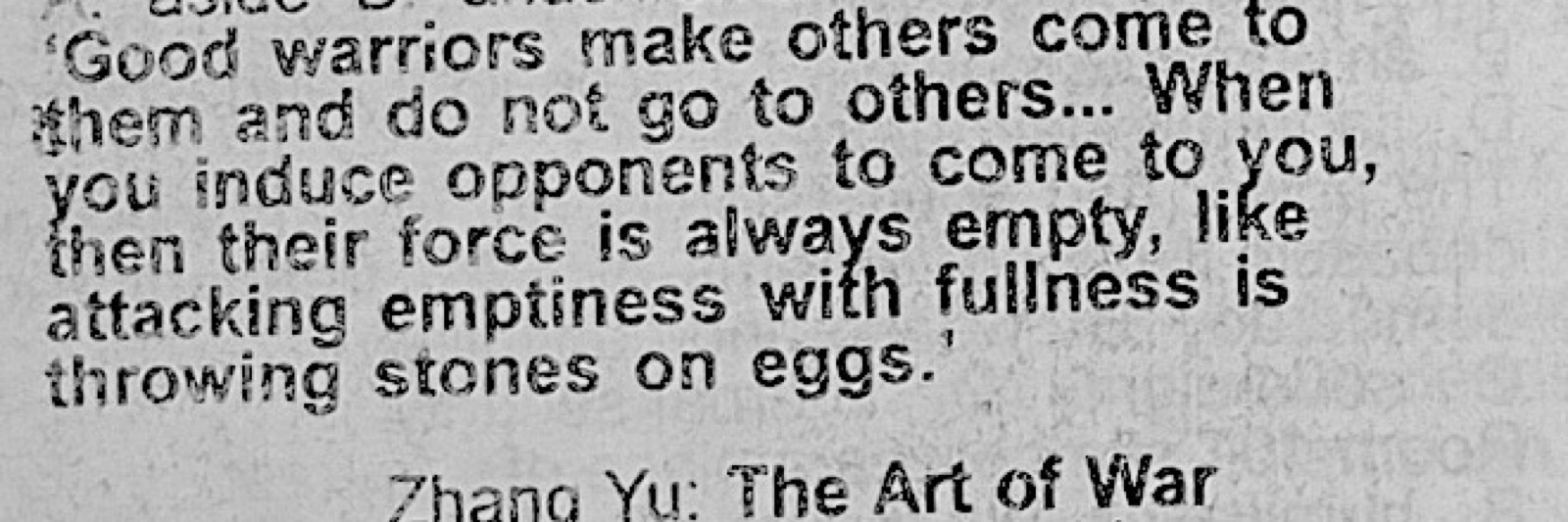
Literary Appreciation: Prose and DramaZhang Yu: The Art of War (extract)
The theme of the passage above is
- A.folly of soldiers
- B.spurring people to action
- C.war
- D.inspiration
Show the answer and explanation
Answer: C (war)
ExplanationThe passage gives advice on how good warriors draw their enemies to them: its subject is war.
Question 33
Figures of SpeechThe repetition of single words or phrases at the beginning of lines is
- A.assonance
- B.onomatopoeia
- C.alliteration
- D.parallelism.
Show the answer and explanation
Answer: D (parallelism.)
ExplanationRepeating the same words at the start of lines (anaphora) builds parallel structure; of these options only parallelism fits.
Question 34
Poetry: GeneralA ballad is meant to be
- A.acted
- B.discussed
- C.read
- D.sung.
Show the answer and explanation
Answer: D (sung.)
ExplanationA ballad is a story in song, made to be sung.
Question 35
Drama: GeneralIn drama, dramaturge is he who
- A.writes or edits plays
- B.directs a play
- C.acts a film
- D.features in a play
Show the answer and explanation
Answer: A (writes or edits plays)
ExplanationA dramaturge writes plays or adapts and edits them for performance.
Question 36
Prose: GeneralTravellogue is a work of art written
- A.by a famous playwright
- B.by an unpopular novelist
- C.on a journey
- D.before the death of the author.
Show the answer and explanation
Answer: C (on a journey)
ExplanationA travelogue is an account of a journey.
Question 37
Drama: GeneralPlays are basically meant to
- A.change the world
- B.be read for pleasure
- C.be presented on stage
- D.keep people out of trouble.
Show the answer and explanation
Answer: C (be presented on stage)
ExplanationA play is written to be performed by actors on a stage.
Question 38
Literary Terms and DevicesA character who re-enacts familiar experiences that readers easily identify with is
- A.round character
- B.stock character
- C.static character
- D.flat character
Show the answer and explanation
Answer: B (stock character)
ExplanationA stock character is a familiar type (the miser, the jealous husband) that readers recognise at once.
Question 40
Poetry: GeneralThe metric pattern in a line of poetry with five stressed and five unstressed syllables is
- A.trochaic decametre
- B.iambic pentametre
- C.anapestic metre
- D.dactylic metre.
Show the answer and explanation
Answer: B (iambic pentametre)
ExplanationFive iambs (unstressed-stressed) make iambic pentameter: ten syllables, five stressed.
Question 41
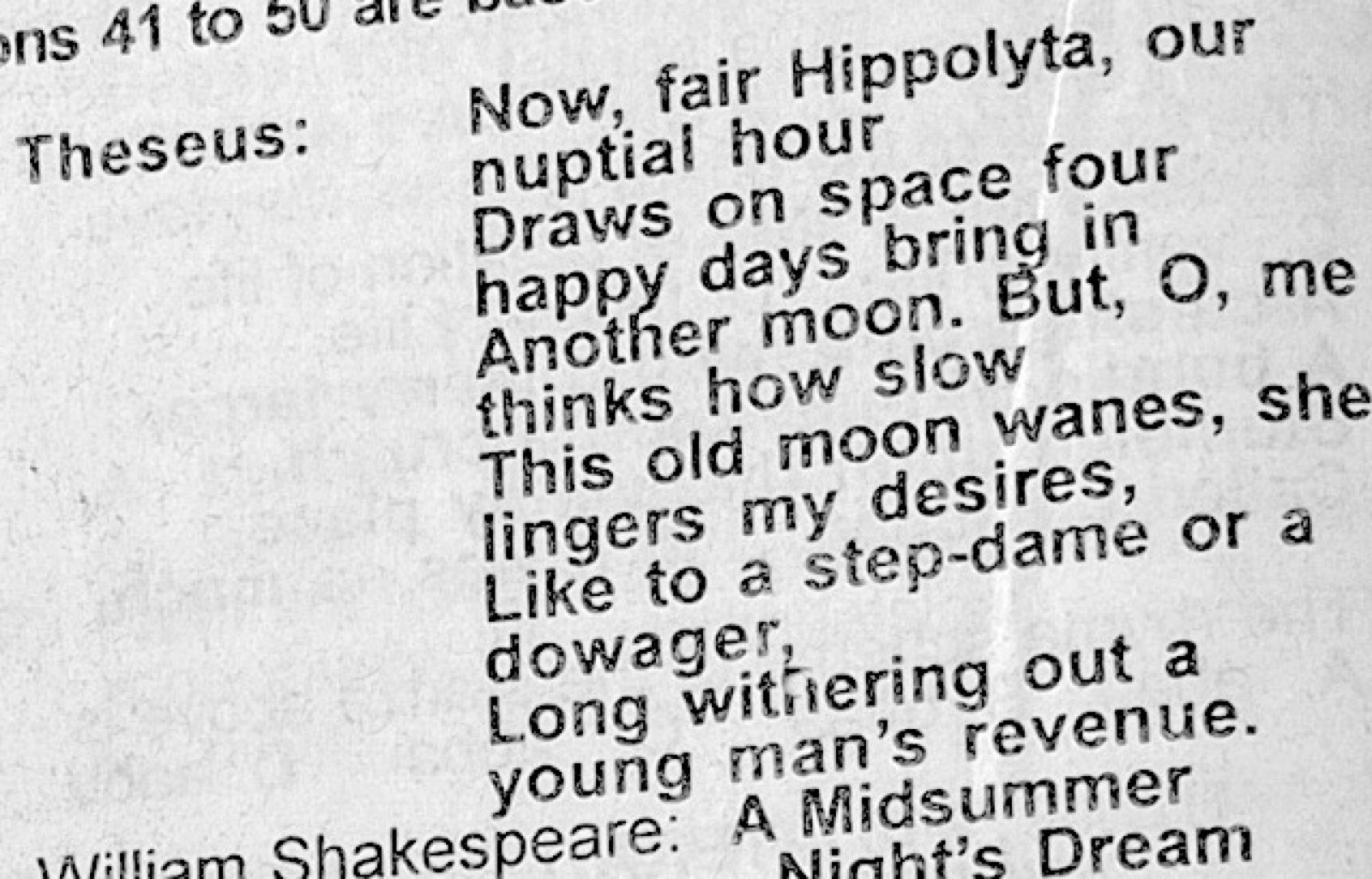
Set Text: A Midsummer Night's DreamWilliam Shakespeare: A Midsummer Night's Dream (extract)
The literary devices used in the excerpt above are
- A.personification and simile
- B.alliteration and synecdoche
- C.rhyme and refrain
- D.irony and suspense.
Show the answer and explanation
Answer: A (personification and simile)
ExplanationThe old moon 'lingers' Theseus's desires (personification) and is 'like to a step-dame or a dowager' (simile).
Question 42
Literary Appreciation: PoetryThe excerpt above achieves its rhetorical effect through the use of
- A.repetition and meiosis
- B.caesura and hyperbole
- C.alliteration and irony
- D.metaphor and rhyme.
Show the answer and explanation
Answer: D (metaphor and rhyme.)
ExplanationThe beloved is called 'the silent code of pleasure' and 'the hive of treasure' (metaphors), and 'pleasure' rhymes with 'treasure'.
Question 43
Literary Appreciation: Prose and DramaIn the excerpt above, the subject's experience in the lift is
- A.timely
- B.unpleasant
- C.amusing
- D.comfortable.
Show the answer and explanation
Answer: B (unpleasant)
ExplanationHe is squeezed in, can hardly breathe because of a passenger's body odour and sighs with relief when he gets out: unpleasant.
Question 44
Set Text: The Gods Are Not to BlameIn the excerpt above, the land is not at peace because of
- A.chieftaincy tussle
- B.political unrest
- C.sickness and death
- D.famine and war.
Show the answer and explanation
Answer: C (sickness and death)
ExplanationOdewale speaks to people 'ailing and dying': a plague is killing the people of Kutuje.
Question 45
Literary Appreciation: PoetryThe dominant literary device used in the lines above is
- A.pun
- B.personification
- C.simile
- D.metaphor.
Show the answer and explanation
Answer: B (personification)
ExplanationCivilization 'kicked us in the face' and holy water 'slapped our cringing brows': abstract things act like people.
Question 47
Set Text: Twelfth NightA heart of stone in the lines above is an example of
- A.metonymy
- B.assonance
- C.metaphor
- D.litotes
Show the answer and explanation
Answer: C (metaphor)
ExplanationThe heart is called stone directly, without 'like' or 'as': a metaphor.
Question 48
Literary Appreciation: Prose and DramaThe narrator's attitude to the king is one of
- A.envy
- B.suspicion
- C.contempt
- D.sympathy.
Show the answer and explanation
Answer: C (contempt)
ExplanationThe narrator shows the king as a weak, empty man pushed into a 'comfortless hole' by rejection, viewing him with scorn rather than pity.
Question 49
African PoetryThe excerpt above is an example of
- A.invocation
- B.ode
- C.elegy
- D.limerick.
Show the answer and explanation
Answer: A (invocation)
ExplanationThe poet calls on the goddess Peregede to bring good tidings: an invocation.
Question 50
Literary Appreciation: PoetryThe subject matter of the lines above is
- A.death
- B.famine
- C.storm
- D.rainfall.
Show the answer and explanation
Answer: A (death)
ExplanationEverything decays and dies: woods fall, man is buried, the swan dies (Tennyson's 'Tithonus').