44 questions. Try each one, then open the answer to check yourself and read the explanation.
Question 2
Set Text: Sons and DaughtersJ.C. De Graft: Sons and Daughters (extract)
The speaker above is referring to
- A.Hannah and George
- B.Aaron and Maanan
- C.Lawyer B and Mrs. B
- D.Fosuwa and Maidservant.
Show the answer and explanation
Answer: B (Aaron and Maanan)
ExplanationJames Ofosu complains that everybody has let him down; he means his children Aaron and Maanan, who will not follow the careers he chose for them.
Question 3
Set Text: Sons and DaughtersIn J.C. De Graft's Sons and Daughters, Maanan expresses dislike for Lawyer B because of
- A.his recent advances towards her
- B.the betrayal of her father's trust
- C.the betrayal of his wife's trust
- D.his condemnation of her choice of career.
Show the answer and explanation
Answer: A (his recent advances towards her)
ExplanationLawyer B, her father's friend, makes sexual advances to Maanan, which disgusts her.
Question 5
Set Text: Sons and DaughtersIn J.C. De Graft's Sons and Daughters, where does the play take place?
- A.In George's place
- B.In Aunt's house
- C.in Ofosu's place
- D.On the street.
Show the answer and explanation
Answer: C (in Ofosu's place)
ExplanationThe action happens in James Ofosu's house.
Question 6
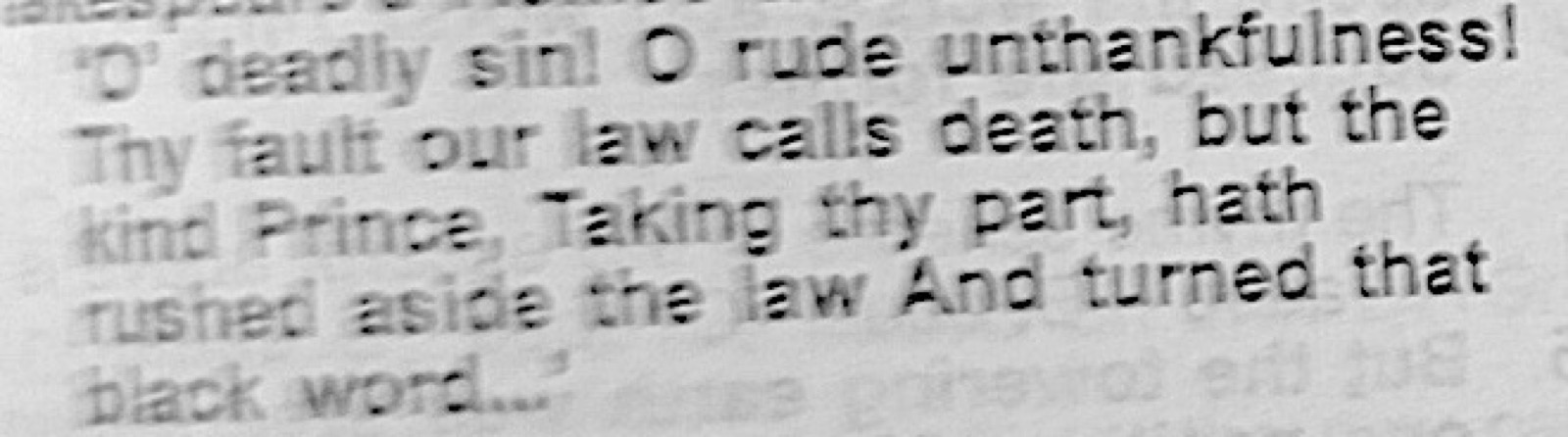
Set Text: Romeo and JulietWilliam Shakespeare: Romeo and Juliet (extract for question 6)
In William Shakespeare's Romeo and Juliet, Deadly sin refers to the
- A.suicide of Romeo
- B.Murder of Paris
- C.murder of Tybalt
- D.suicide of Juliet.
Show the answer and explanation
Answer: C (murder of Tybalt)
ExplanationFriar Lawrence scolds Romeo for being ungrateful: his 'fault' (killing Tybalt) deserves death, but the Prince has only banished him.
Question 7
Set Text: Romeo and JulietIn William Shakespeare's Romeo and Juliet, the play is mostly written in
- A.free verse
- B.metres
- C.foot
- D.blank verse.
Show the answer and explanation
Answer: D (blank verse.)
ExplanationMost of the play is in blank verse, unrhymed iambic pentameter, with some rhymed lines and prose.
Question 8
Set Text: Romeo and JulietWilliam Shakespeare: Romeo and Juliet (extract for question 8)
The statement above refers to
- A.Romeo
- B.Tybalt
- C.Benvolio
- D.Juliet.
Show the answer and explanation
Answer: A (Romeo)
ExplanationJuliet says this of Romeo when she hears he has killed her cousin Tybalt: he looked beautiful but hid a serpent's heart.
Question 9
Set Text: Romeo and JulietIn William Shakespeare's Romeo and Juliet, the spatial setting of the play is
- A.Verona
- B.Padua
- C.Venice
- D.Athens.
Show the answer and explanation
Answer: A (Verona)
ExplanationThe play takes place mainly in Verona (with one part in Mantua).
Question 10
Set Text: Romeo and JulietIn William Shakespeare's Romeo and Juliet, Romeo is banished to Mantua because he
- A.marries Juliet without parental consent
- B.attends Capulet's party uninvited
- C.attempts to kill Paris his rival
- D.kills Tybalt in a street duel.
Show the answer and explanation
Answer: D (kills Tybalt in a street duel.)
ExplanationAfter Romeo kills Tybalt in a street fight, the Prince banishes him from Verona.
Question 12
Other Set Texts: African ProseIn Buchi Emecheta's The Joys of Motherhood, the medicine man links the lump discovered on the head of Nnu Ego at birth, to the
- A.wound inflicted on the slave woman buried with Agbadi's wife
- B.coming back of the Agunwa to the society to live again
- C.ill-luck and tragic events attributed to a predestined fate
- D.possession of physical admirable qualities that makes her an epitome of perfection.
Show the answer and explanation
Answer: A (wound inflicted on the slave woman buried with Agbadi's wife)
ExplanationThe slave woman killed at Agunwa's burial was struck on the head; Nnu Ego's lump marks her as that slave reborn, and the slave becomes her chi.
Question 13
Other Set Texts: African ProseIn Buchi Emecheta's The Joys of Motherhood, the constant companions of Nnaife's family are
- A.poverty and hunger
- B.sickness and joblessness
- C.disagreement and humiliation
- D.togetherness and happiness.
Show the answer and explanation
Answer: A (poverty and hunger)
ExplanationNnaife's large family in Lagos is always short of money and food.
Question 16
Other Set Texts: African ProseIn Ferdinand Oyono's The Old Man and the Medal, the colonialists treat the Africans with
- A.disdain
- B.indifference
- C.honour
- D.kid gloves.
Show the answer and explanation
Answer: A (disdain)
ExplanationThe French officials look down on the Africans, as Meka learns when he is mocked and thrown into a cell.
Question 17
Other Set Texts: Non-African ProseIn George Orwell's Nineteen Eighty-Four, the Ministry of Peace is concerned with making
- A.weapons
- B.wars
- C.reconciliation
- D.instruments.
Show the answer and explanation
Answer: B (wars)
ExplanationIn Oceania's doublespeak the Ministry of Peace (Minipax) runs the war.
Question 18
Other Set Texts: Non-African ProseIn George Orwell's Nineteen Eighty-Four, the subject matter of the novel is
- A.exploitation and cruelty
- B.retributive justice
- C.class segregation
- D.totalitarian dictatorship.
Show the answer and explanation
Answer: D (totalitarian dictatorship.)
ExplanationThe novel shows a state where the Party controls everything: a totalitarian dictatorship.
Question 19
Other Set Texts: Non-African ProseIn George Orwell's Nineteen Eighty-Four, how did Winston start his rebellion against the state?
- A.By keeping a private diary
- B.When he started a secret affair
- C.When he spied on the party
- D.By engaging in anti-party activities.
Show the answer and explanation
Answer: A (By keeping a private diary)
ExplanationWinston's first act of rebellion is to buy a diary and write his private thoughts in it.
Question 20
Other Set Texts: Non-African ProseIn George Orwell's Nineteen Eighty-Four, the party seeks power for
- A.its own sake
- B.its members
- C.peoples' sake
- D.the nation.
Show the answer and explanation
Answer: A (its own sake)
ExplanationO'Brien tells Winston that the Party wants power entirely for its own sake.
Question 21
African PoetryAs the dancers move through paths strewn with glass chips, the images in Adeoti's Naked Soles change from
- A.inaction to action
- B.pain to grief
- C.sorrow to joy
- D.joy to excitement.
Show the answer and explanation
Answer: B (pain to grief)
ExplanationDancing barefoot on glass chips brings physical pain that deepens into grief as the poem goes on.
Question 22
African PoetryRubadiri's An African Thunderstorm, says that during thunderstorm in the village
- A.children play in the rain
- B.children are delighted while women move in and out
- C.both women and children are delighted
- D.women cook their food.
Show the answer and explanation
Answer: B (children are delighted while women move in and out)
ExplanationThe poem shows children screaming with delight while women, babies on their backs, dart in and out of the huts.
Question 23
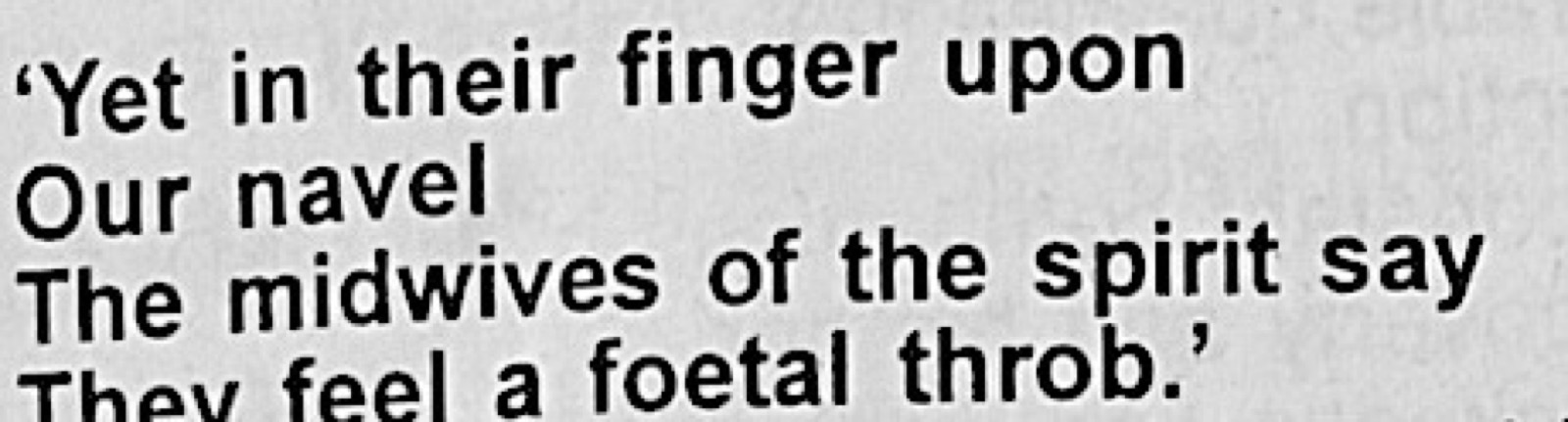
African PoetryAcquah: In the Navel of the Soul (extract)
The dominant literary device used in the extract above from Acquahs' In the Navel of the Soul is
- A.allegory
- B.enjambment
- C.rhythm
- D.epigram.
Show the answer and explanation
Answer: B (enjambment)
ExplanationEach line runs straight into the next without a pause ('upon / Our navel', 'say / They feel'): enjambment.
Question 24
African PoetryIn Kunene's A heritage of Liberation, the poet persona requests that the weapons of warfare be handed to their
- A.relations
- B.grand children
- C.families
- D.friends.
Show the answer and explanation
Answer: B (grand children)
ExplanationThe speaker asks that the weapons of struggle be passed on to the grandchildren, so that the fight continues.
Question 25
African PoetryThe predominant device in Launko's End of the War is
- A.antithesis
- B.oxymoron
- C.paradox
- D.onomatopoeia.
Show the answer and explanation
Answer: C (paradox)
ExplanationThe end of the war, which should bring joy, brings anguish to the widows: a paradox.
Question 26
African PoetryThe theme of the poem Give Me The Minstrel's Seat centres on
- A.fortune
- B.marriage
- C.companionship
- D.divorce.
Show the answer and explanation
Answer: C (companionship)
ExplanationThe poem is about the need for companions and the support of others in life.
Question 27
Non-African PoetryThe poet persona in Marvell's To His Coy Mistress is willing to praise the lady's eyes for
- A.six decades
- B.two centuries
- C.a century
- D.thirty thousand years.
Show the answer and explanation
Answer: C (a century)
ExplanationThe speaker says 'An hundred years should go to praise / Thine eyes', i.e. a century.
Question 28
Non-African PoetryIn Lawrence's Bat, the poet persona mistakes the bats for
- A.swallows
- B.pipistrello
- C.sparrows
- D.owls.
Show the answer and explanation
Answer: A (swallows)
ExplanationAt first the speaker thinks the flying creatures are swallows, then realises they are bats.
Question 29
Non-African PoetryIn Eliot's Journey of the Magi, the magi are aided on their journey by
- A.horses
- B.camels
- C.chariots
- D.donkeys.
Show the answer and explanation
Answer: B (camels)
ExplanationThe Magi travel on camels, which become 'galled, sore-footed, refractory'.
Question 30
Non-African PoetryAccording to Cope's Sonnet VII, poetry is basically
- A.therapeutic
- B.philosophical
- C.inspiring
- D.boring.
Show the answer and explanation
Answer: A (therapeutic)
ExplanationThe sonnet presents poetry as something that heals and soothes the troubled mind.
Question 31
Drama: GeneralA play which mainly aims at provoking excessive laughter is called
- A.comedy
- B.a farce
- C.satire
- D.a tragi-comedy.
Show the answer and explanation
Answer: B (a farce)
ExplanationA farce aims mainly at loud laughter through exaggeration and absurd situations.
Question 32
Drama: GeneralBoth comedy and tragedy have
- A.climax
- B.tragic hero
- C.stanza
- D.happy ending.
Show the answer and explanation
Answer: A (climax)
ExplanationEvery play, comic or tragic, rises to a climax.
Question 33
Literary Terms and DevicesA formal dignified speech or writing praising a person or a thing for past or present deeds is
- A.eulogy
- B.anthology
- C.lampoon
- D.premiere.
Show the answer and explanation
Answer: A (eulogy)
ExplanationA eulogy is a formal speech or piece of writing in praise of someone.
Question 34
Prose: GeneralThe narrative style in which the hero tells his own story directly is the
- A.subjective
- B.first-person
- C.third-person
- D.objective.
Show the answer and explanation
Answer: B (first-person)
ExplanationWhen the hero tells his own story using 'I', it is first-person narration.
Question 35
Literary Terms and DevicesThe physical, historical or cultural background of a literary work is referred to as
- A.plot
- B.time
- C.setting
- D.episode.
Show the answer and explanation
Answer: C (setting)
ExplanationSetting is the place, time and social background of a story.
Question 36
Literary Terms and DevicesA plot structure that defies chronology can be described as
- A.circular
- B.episodic
- C.organic
- D.open-ended.
Show the answer and explanation
Answer: B (episodic)
ExplanationAn episodic plot is made of separate episodes that need not follow strict time order.
Question 37
Figures of SpeechPun as a literary device deals with
- A.placing words side by side
- B.playing on words
- C.arrangement of words.
- D.placing two opposite phrases.
Show the answer and explanation
Answer: B (playing on words)
ExplanationA pun plays on a word's double meaning or on words that sound alike.
Question 38
Poetry: GeneralIn a narrative poem, the poet attempts to
- A.describe a place
- B.preach a sermon
- C.tell a story
- D.summarize a story.
Show the answer and explanation
Answer: C (tell a story)
ExplanationA narrative poem tells a story.
Question 39
Prose: GeneralThe account of experiences of an individual during the course of a journey is known as
- A.an autobiography
- B.a catalogue
- C.a memoir
- D.a travelogue.
Show the answer and explanation
Answer: D (a travelogue.)
ExplanationA travelogue describes the places and experiences of a journey.
Question 40
Figures of SpeechSatirical writing employs
- A.synecdoche
- B.irony
- C.onomatopoeia
- D.epigram
Show the answer and explanation
Answer: B (irony)
ExplanationSatire mocks its targets mainly through irony: saying one thing while meaning another.
Question 41
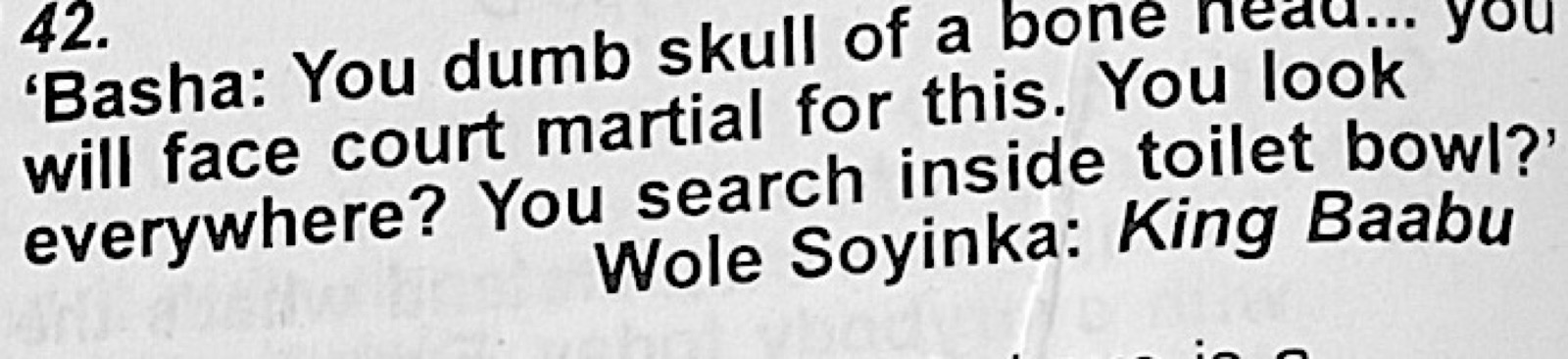
Other Set Texts: African DramaWole Soyinka: King Baabu (extract)
The person being addressed above is a
- A.student
- B.domestic servant
- C.lawyer
- D.soldier.
Show the answer and explanation
Answer: D (soldier.)
ExplanationBasha threatens the man with a court martial, which only applies to soldiers.
Question 42
Other Set Texts: African DramaFrom the tone of the speech above, the speaker is obviously
- A.lackadaisical
- B.elated
- C.happy
- D.enraged.
Show the answer and explanation
Answer: D (enraged.)
ExplanationInsults like 'dumb skull of a bone head' and the threat of court martial show he is furious.
Question 43
Other Set Texts: African ProseThe mood conveyed in the excerpt above is one of
- A.frustration
- B.sympathy
- C.dilemma
- D.sadness.
Show the answer and explanation
Answer: D (sadness.)
ExplanationThe harvest is 'sad, like a funeral', farmers weep and one man hangs himself: the mood is sadness.
Question 44
Literary Appreciation: PoetryThe rhyme scheme in the excerpt above is
- A.aabb
- B.abab
- C.abba
- D.bbaa.
Show the answer and explanation
Answer: B (abab)
ExplanationRead as four lines, 'first' rhymes with 'worst' and 'warmer' with 'former', alternating: abab.
Question 45
Literary Appreciation: Prose and DramaThe subject matter of the extract above is
- A.sea waves
- B.house movement
- C.earthquake
- D.Storm.
Show the answer and explanation
Answer: C (earthquake)
ExplanationThe earth 'moved' suddenly, houses crumbled and mountains heaved: an earthquake.
Question 47
Literary Appreciation: Prose and DramaThe speaker in the excerpt above is
- A.uncertain
- B.afraid
- C.confident
- D.hopeless.
Show the answer and explanation
Answer: C (confident)
ExplanationThe speaker gives calm, firm instructions ('Don't panic. Be calm.'), showing self-assurance.
Question 48
Literary Appreciation: PoetryThe poem can be described as
- A.an epic
- B.a sonnet
- C.an elegy
- D.a lyric.
Show the answer and explanation
Answer: C (an elegy)
ExplanationThe poem mourns a dead soldier and questions why life was ever made: it is an elegy (Wilfred Owen's 'Futility').
Question 49
Literary Appreciation: PoetryThe theme of the poem is
- A.distortion of life
- B.creation of life
- C.vanity of life
- D.futility of life.
Show the answer and explanation
Answer: D (futility of life.)
ExplanationThe speaker asks why the sun bothered to create life at all if it ends like this: life seems futile.
Question 50
Literary Appreciation: PoetryThe rhyme scheme of the stanza above is
- A.abab
- B.bbaa
- C.abba
- D.aabb
Show the answer and explanation
Answer: A (abab)
ExplanationThe line endings alternate: face/place and crutch/much, giving abab.