Home › Past questions › JAMB › Literature in English › 2008 40 questions. Try each one, then open the answer to check yourself and read the explanation.
Sign up free to answer these questions on a CBT screen with a timer, then see your score and every answer explained.
Start practising free
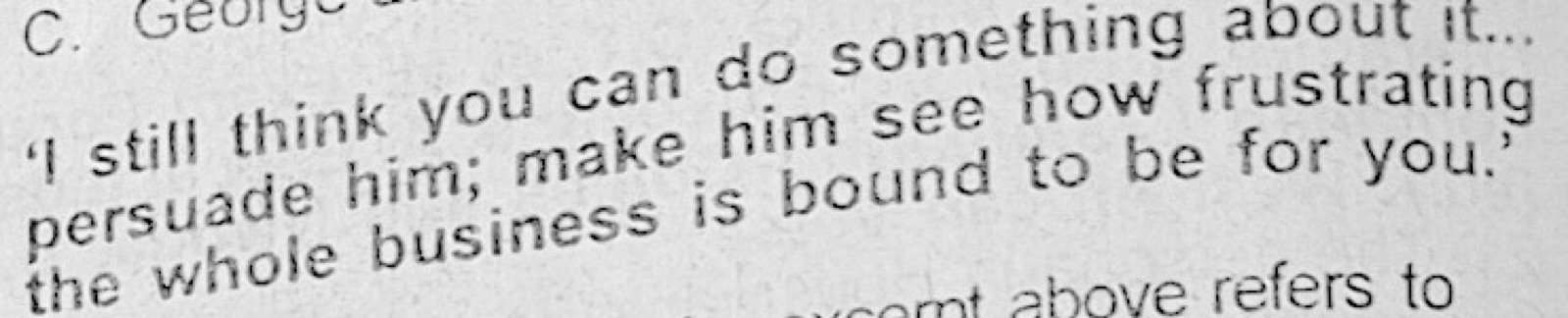
Question 3 Set Text: Sons and Daughters JAMB 2008: J. C. de Graft, Sons and Daughters (extract) The whole business in the excerpt above refers to
A. marriage proposal B. career choice C. business contract D. political transition. Show the answer and explanation Answer: B (career choice )
Explanation The 'business' that is so frustrating is James's insistence on choosing careers for his children instead of letting Aaron and Maanan follow their talents.
Open this question
Question 4 Set Text: Sons and Daughters In J. C. de Graft's Sons and Daughters , the central conflict in the play is
A. religious B. romantic C. generational D. communal. Show the answer and explanation Answer: C (generational )
Explanation The conflict is between the father, James, and his children over their careers: old against young, i.e. generational.
Open this question
Question 5 Set Text: Sons and Daughters In J. C. de Graft's Sons and Daughters , the change in fortune is achieved in the play when
A. James agrees that Aaron and Maanan should study what they want B. Lawyer B harasses Maanan in his office C. Haanah, James' wife convinces him D. Aaron and Maanan agree to read the courses James chooses for them. Show the answer and explanation Answer: A (James agrees that Aaron and Maanan should study what they want )
Explanation The play is resolved happily when James finally gives in and lets Aaron and Maanan study the courses they want.
Open this question
Question 6 Set Text: Romeo and Juliet JAMB 2008: William Shakespeare, Romeo and Juliet (extract) The statement above is in reference to the speaker's
A. retirement B. imminent death C. state of health D. short-tempered nature. Show the answer and explanation Answer: B (imminent death )
Explanation Friar Laurence says his 'short date of breath' (the little life left to an old man) is shorter than a long story, so he refers to his approaching death.
Open this question
Question 7 Set Text: Romeo and Juliet In William Shakespeare's Romeo and Juliet , Romeo's death becomes inevitable because
A. Friar Lawrence's letter is not delivered B. Juliet is married to Paris C. Romeo kills Tybalt in a duel D. Juliet has committed suicide. Show the answer and explanation Answer: A (Friar Lawrence's letter is not delivered )
Explanation Friar John cannot deliver the letter telling Romeo that Juliet's death is faked, so Romeo hears only that she is dead and goes to her tomb to die.
Open this question
Question 8 Set Text: Romeo and Juliet In William Shakespeare's Romeo and Juliet , the multiple deaths in the play serve as a punishment for
A. imposing life partner on children B. treating others with hatred C. disobeying one's own parents D. shedding kinsmen's blood. Show the answer and explanation Answer: B (treating others with hatred )
Explanation At the end the Prince tells the two fathers that heaven has punished their hatred by killing their children: 'See what a scourge is laid upon your hate.'
Open this question
Question 9 Set Text: Romeo and Juliet In William Shakespeare's Romeo and Juliet , the major reason for Juliet's grief is
A. the death of her cousin B. her reluctant marriage to the County C. the banishment of her lover D. her imminent death. Show the answer and explanation Answer: C (the banishment of her lover )
Explanation Juliet says the one word 'banished' is worse than the death of ten thousand Tybalts: Romeo's banishment is her greatest sorrow.
Open this question
Question 10 Set Text: Romeo and Juliet In William Shakespeare's Romeo and Juliet , the chorus in the prologue of the play is essentially meant to
A. foreshadow the play B. highlight the characters C. estimate the actions D. introduce the play. Show the answer and explanation Answer: A (foreshadow the play )
Explanation The Chorus tells us from the start that two 'star-crossed lovers' will take their lives and end their parents' feud, so it foreshadows what will happen.
Open this question
Question 11 Other Set Texts: Non-African Prose In George Orwell's Nineteen Eighty-Four , Big Brother metaphorizes a
A. totalitarian authority B. benevolent leader C. revolutionary leader D. party brotherhood. Show the answer and explanation Answer: A (totalitarian authority )
Explanation Big Brother, who is always watching, is the face of the Party's total control over every part of people's lives.
Open this question
Question 12 Other Set Texts: Non-African Prose In George Orwell's Nineteen Eighty-Four , Orwell attempts to
A. satirize the artificiality of a machine controlled society B. eulogize the beauty of the socialist system C. condemn the disgusting hypocrisy of all communist systems D. laud the boundless possibilities of the human intellect. Show the answer and explanation Answer: C (condemn the disgusting hypocrisy of all communist systems )
Explanation The Party claims to serve the people while it lies, spies and tortures; Orwell is attacking the hypocrisy of totalitarian communist rule.
Open this question
Question 13 Other Set Texts: Non-African Prose In George Orwell's Nineteen Eighty-Four , Winston Smith begins his rebellion against the power of the state by
A. purchasing arms B. keeping a private diary C. opposing the law D. educating the youth. Show the answer and explanation Answer: B (keeping a private diary )
Explanation Winston's first act of rebellion is starting a secret diary in which he writes 'DOWN WITH BIG BROTHER'.
Open this question
Question 14 Other Set Texts: Non-African Prose In George Orwell's Nineteen Eighty-Four , the Ministry of Truth is concerned with
A. news, entertainment, education and fine arts B. propaganda, war, publishing and enlightenment C. investigation, propaganda and fine arts D. economic affairs, education and propaganda Show the answer and explanation Answer: A (news, entertainment, education and fine arts )
Explanation Orwell describes the Ministry of Truth as dealing with news, entertainment, education and the fine arts, which it uses to rewrite the truth.
Open this question
Question 15 Other Set Texts: African Prose In Ferdinand Oyono's The Old Man and the Medal , the events following the ceremony confirm Meka's
A. disillusion with the whites B. satisfaction with the medal C. contribution to the colonialists D. admiration for the church. Show the answer and explanation Answer: A (disillusion with the whites )
Explanation After the ceremony Meka is arrested and beaten by the same whites who honoured him, and he realises how little they respect him.
Open this question
Question 16 Other Set Texts: African Prose JAMB 2008: Ferdinand Oyono, The Old Man and the Medal (extract) In the statement above, The night rat doesn't tell what happened to him in the dark! refers to
A. the whiteman's treatment of Meka B. Meka's treatment of the medal in the whitewashed circle C. people's unwillingness to talk about how whitemen treat them D. people's freedom of expression. Show the answer and explanation Answer: C (people's unwillingness to talk about how whitemen treat them )
Explanation The proverb means that people keep quiet about what was done to them in secret; here, Africans do not speak about how the whites treat them.
Open this question
Question 19 Other Set Texts: African Prose In Buchi Emecheta's The Joys of Motherhood , Nnaife's conscription into the army is portrayed as part of
A. family conflict B. British oppression C. family tradition D. societal intrigue. Show the answer and explanation Answer: B (British oppression )
Explanation Nnaife is taken by force to fight in Britain's war, which Emecheta shows as one of the ways colonial rule oppressed ordinary Nigerians.
Open this question
Question 20 Other Set Texts: African Prose In Buchi Emecheta's The Joys of Motherhood , the attitude of Nnu Ego when she was told that her Chi would not give her a child is one of
A. indifference B. despair C. apathy D. hope. Show the answer and explanation Answer: B (despair )
Explanation For Nnu Ego, a woman's worth lay in having children, so being told her chi would deny her a child plunged her into despair.
Open this question
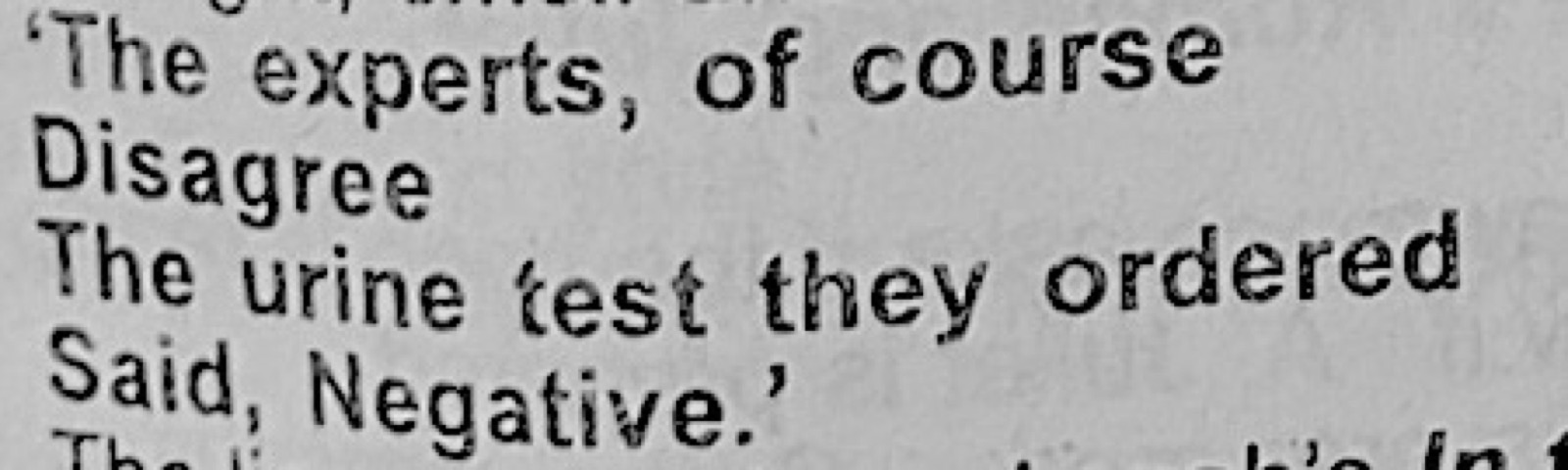
Question 23 African Poetry JAMB 2008: Acqah, In the Navel of the Soul (extract) The lines above from Acqah's In the Navel of the Soul depict
A. contradiction B. inevitability C. progress D. awareness. Show the answer and explanation Answer: A (contradiction )
Explanation The experts disagree, while the test says 'Negative': the lines show opinions that contradict each other.
Open this question
Question 24 African Poetry In Kunene's A Heritage of Liberation , freedom is to be achieved through the efforts of
A. the old generation B. new generation C. present generation D. successive generations. Show the answer and explanation Answer: D (successive generations. )
Explanation Kunene sees the struggle for freedom as a heritage passed on from one generation to the next until it is won.
Open this question
Question 25 African Poetry Launko's End of the War suggests that war brings about
A. ultimate solution to all problems B. partial solution to problems C. multifaceted problems D. only temporary relief. Show the answer and explanation Answer: C (multifaceted problems )
Explanation The poem shows that even after the fighting ends, war leaves behind many kinds of problems.
Open this question
Question 27 Non-African Poetry Marvel's To His Coy Mistress is written mainly in
A. alternate rhymes B. blank verse C. heroic couplets D. middle rhymes. Show the answer and explanation Answer: C (heroic couplets )
Explanation The poem is written in rhyming couplets throughout (strictly, four-beat couplets), the nearest of the options to heroic couplets.
Open this question
Question 29 Non-African Poetry The language used in Eliot's The Journey of the Magi is generally
A. difficult B. complex C. simple D. complicated. Show the answer and explanation Answer: C (simple )
Explanation The poem is told by one of the wise men in plain, conversational words, even though its ideas are deep.
Open this question
Question 31 Drama: General An interlude is a brief
A. presentation in the interval of a dramatic performance B. play before the main dramatic performance C. presentation after the main dramatic performance D. dialogue between two persons. Show the answer and explanation Answer: A (presentation in the interval of a dramatic performance )
Explanation An interlude is a short piece of entertainment performed between the parts of a play.
Open this question
Question 32 Poetry: General An epic is a heroic story which includes
A. ballad B. lyric C. myth D. dialogue. Show the answer and explanation Answer: C (myth )
Explanation Epics tell of heroes and are full of myth: gods, supernatural beings and legendary deeds.
Open this question
Question 33 Drama: General Farce can be described as a dramatic piece marked by
A. movement from serious to the light-hearted mood B. comic and exaggerated actions C. actions devoid of meaning D. gloomy actions with momentary reliefs. Show the answer and explanation Answer: B (comic and exaggerated actions )
Explanation Farce is comedy built on wildly exaggerated situations, horseplay and absurd action.
Open this question
Question 34 Prose: General A long story narrating a series of complicated events is called a
A. saga B. discourse C. monologue D. harangue. Show the answer and explanation Answer: A (saga )
Explanation A saga is a long narrative of many connected adventures, often across generations of a family.
Open this question
Question 35 Figures of Speech Oxymoron is the use of two contrasting words that are
A. placed far apart B. different in meaning C. placed side by side D. similar in meaning. Show the answer and explanation Answer: C (placed side by side )
Explanation An oxymoron puts two opposite words right next to each other, as in 'bitter sweet' or 'living death'.
Open this question
Question 36 Poetry: General A line or a group of lines repeated in the course of a poem is called
A. chorus B. refrain C. repetition D. prologue. Show the answer and explanation Answer: B (refrain )
Explanation A refrain is a line or lines that come back at intervals in a poem or song, usually at the end of each stanza.
Open this question
Question 37 Poetry: General Limerick is a light verse which consists of five lines that are
A. anapestic B. trochaic C. spondaic D. dactylic. Show the answer and explanation Answer: A (anapestic )
Explanation A limerick's five lines rhyme AABBA and move in anapests (two light beats then a stressed one).
Open this question
Question 38 Poetry: General A short narrative or lyrical poem intended to be sung is a
A. leich B. lay C. lauda D. letrilla. Show the answer and explanation Answer: B (lay )
Explanation A lay (lai) is a short narrative or lyric poem meant to be sung, as in the medieval lays of the minstrels.
Open this question
Question 39 Figures of Speech A figurative device in which a statement is made and then withdrawn is referred to as
A. metanoia B. metaphysical C. metalanguage D. metalepsis. Show the answer and explanation Answer: A (metanoia )
Explanation Metanoia is when a speaker says something and then corrects or takes it back, e.g. 'She is pretty, no, beautiful.'
Open this question
Question 40 Literary Terms and Devices A literary work which imitates another in a distorted form is called
A. exodium B. isocohen C. metonymy D. burlesque. Show the answer and explanation Answer: D (burlesque. )
Explanation A burlesque mocks a serious work by imitating it in an exaggerated or distorted way.
Open this question
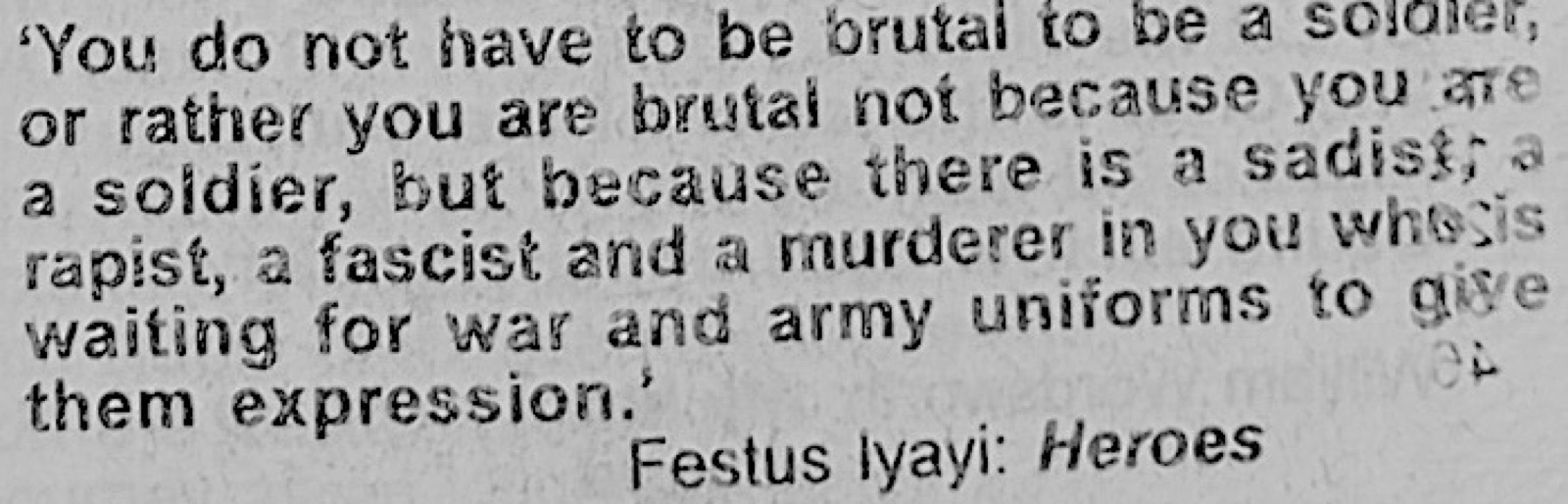
Question 41 Literary Appreciation: Prose and Drama JAMB 2008: Festus Iyayi, Heroes (extract) The speaker here contends that
A. soldiers are generally wicked B. human nature has to do with a profession C. soldiers are characteristically gentle D. the latent brutality in man finds expression in war. Show the answer and explanation Answer: D (the latent brutality in man finds expression in war. )
Explanation The speaker argues that the brutality is already hidden inside a person, and war and a uniform simply let it come out.
Open this question
Question 42 Literary Appreciation: Prose and Drama The subject matter of the passage is
A. earthquake B. demolition C. flood D. storm. Show the answer and explanation Answer: A (earthquake )
Explanation The earth 'moved, suddenly', houses crumbled and mountains heaved: this describes an earthquake.
Open this question
Question 43 Literary Appreciation: Prose and Drama The image depicted is one of
A. destruction B. dejection C. happiness D. admiration. Show the answer and explanation Answer: A (destruction )
Explanation Crumbling houses, heaving mountains and the loss of 'the work of million years' all paint a picture of destruction.
Open this question
Question 44 Literary Appreciation: Poetry The tone of the poem above is
A. satiric B. affectionate C. indifferent D. sympathetic. Show the answer and explanation Answer: A (satiric )
Explanation Cullen pokes fun at the lady's belief that in heaven her class will sleep late while black 'cherubs' do the chores, exposing her racism through mockery.
Open this question
Question 45 Literary Appreciation: Poetry From the extract above, the poet suggests that
A. life is full of care B. there can't be life without strive C. life is worthwhile without care D. strive makes life worth living. Show the answer and explanation Answer: D (strive makes life worth living. )
Explanation Spice gives food its taste; calling striving 'life's spice' means that effort and struggle are what make life worth living.
Open this question
Question 46 Literary Appreciation: Poetry The subject of the poem above is
A. a prostitute B. the lying father C. the son D. the orphan. Show the answer and explanation Answer: C (the son )
Explanation The poem is about 'an unlucky creation', the child born to a street walker and a lying father: the son (the bastard of the title).
Open this question
Question 47 Literary Appreciation: Poetry The dominant rhetorical device in the excerpt above is
A. rhyme B. alliteration C. repetition D. onomatopoeia. Show the answer and explanation Answer: B (alliteration )
Explanation The 's' sound is repeated at the start of many words: 'sweet smile', 'snarl', 'spite of sneer', 'sing', 'save a snared', 'stream of strife'. That is alliteration.
Open this question
Question 48 Literary Appreciation: Poetry The expression The child is the father of the man in the poem above is an example of
A. paradox B. metaphor C. simile D. ellipsis. Show the answer and explanation Answer: A (paradox )
Explanation A child cannot literally father a man, yet the line is true: the person we are as children shapes the adult we become. A seeming contradiction that is true is a paradox.
Open this question
Question 49 Literary Appreciation: Prose and Drama The technique employed in narrating the excerpt above is
A. flashback B. stream of consciousness C. foreshadowing D. play-within-the-play. Show the answer and explanation Answer: B (stream of consciousness )
Explanation The passage follows the character's thoughts as they come, in short broken phrases, which is the stream-of-consciousness technique.
Open this question Sign up free for every JAMB Literature in English year, practice by topic and timed mocks.
Start practising free