Home › Past questions › JAMB › Literature in English › 2007 37 questions. Try each one, then open the answer to check yourself and read the explanation.
Sign up free to answer these questions on a CBT screen with a timer, then see your score and every answer explained.
Start practising free
Question 1 Set Text: Hamlet In William Shakespeare's Hamlet , the death of Polonius can be partly blamed on Hamlet's
A. anger B. procrastination C. fear D. disenchantment Show the answer and explanation Answer: A (anger )
Explanation In a fit of rage during his quarrel with Gertrude, Hamlet stabs blindly through the curtain, thinking Claudius is hiding there, and kills Polonius.
Open this question
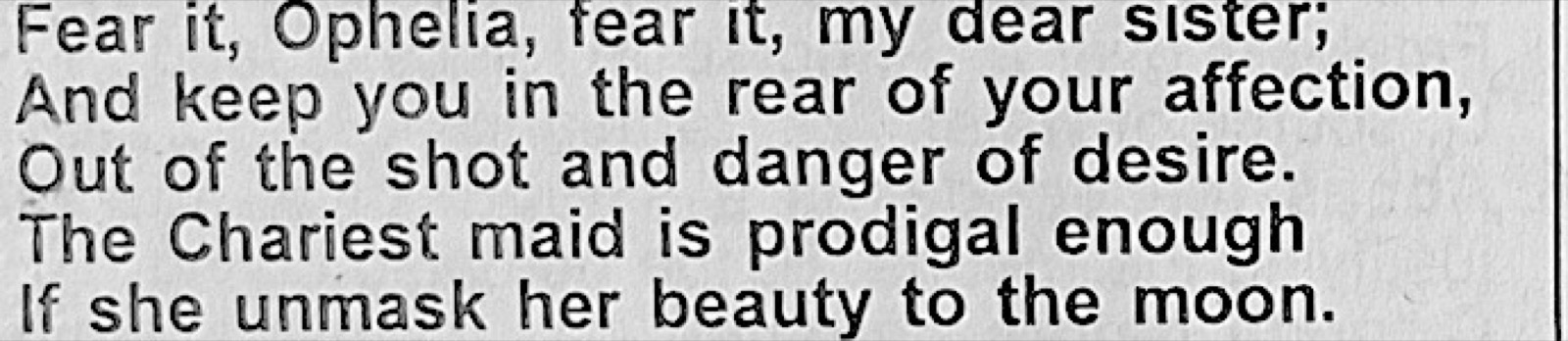
Question 2 Set Text: Hamlet JAMB 2007: William Shakespeare, Hamlet (extract: Laertes to Ophelia) In the excerpt above, Laertes warns Ophelia to beware of Hamlet's attentions because
A. of his insanity B. such attentions cannot be given by too young a person C. of his mournful state D. the sincerity of his love is in doubt. Show the answer and explanation Answer: D (the sincerity of his love is in doubt. )
Explanation Laertes tells Ophelia that Hamlet's love may be only a passing fancy and that as a prince he cannot choose freely whom to marry, so she should not trust it.
Open this question
Question 3 Set Text: Hamlet Those effects which Claudius is still possessed of from the excerpt above are
A. Hamlet's orchard and his crown B. young Hamlet and Gertrude C. the crown and the queen D. Norway and young Fortinbras. Show the answer and explanation Answer: C (the crown and the queen )
Explanation Claudius goes on to name them: 'My crown, mine own ambition, and my queen.' He cannot be forgiven while he keeps what the murder won him.
Open this question
Question 4 Set Text: Hamlet In William Shakespeare's Hamlet , the two revenge plots revolve around
A. Hamlet against Polonius and Laertes against Claudius B. Hamlet against Claudius and Laertes against Hamlet C. Claudius against Hamlet and Laertes against Gertrude D. Ophelia against Hamlet and Laertes against Hamlet. Show the answer and explanation Answer: B (Hamlet against Claudius and Laertes against Hamlet )
Explanation Hamlet seeks revenge on Claudius for murdering his father, and Laertes seeks revenge on Hamlet for killing Polonius.
Open this question
Question 5 Set Text: Hamlet In William Shakespeare's Hamlet , how does Queen Gertrude finally die?
A. Through strangulation. B. By venomed sword. C. From poisoned drink. D. Of snake bite. Show the answer and explanation Answer: C (From poisoned drink. )
Explanation During the duel Gertrude drinks from the poisoned cup Claudius had prepared for Hamlet, and she dies.
Open this question
Question 7 Other Set Texts: African Drama In Ahmed Yerima's Attahiru , the play is about
A. resistance to British administration B. opposition to Christianity C. disunity among the Hausa states D. unity in the caliphate. Show the answer and explanation Answer: A (resistance to British administration )
Explanation The play shows Caliph Attahiru and Sokoto resisting the British conquest and rule led by Lugard.
Open this question
Question 9 Other Set Texts: African Drama In Ahmed Yerima's Attahiru , how does Lugard describe the battle between the white man and the Sokoto Caliphate?
A. One between superior and inferior powers. B. One between Christians and Muslims. C. One of life and death. D. One of the superiority of wills. Show the answer and explanation Answer: A (One between superior and inferior powers. )
Explanation Lugard presents the British as the superior power which the Caliphate must accept.
Open this question
Question 11 Other Set Texts: Non-African Prose In Thomas Hardy's Tess of the d'Urbervilles , one thing that Angel Clare hates most is
A. the notion of old family B. marrying a girl of her parents' choice C. Cambridge education D. becoming a minister Show the answer and explanation Answer: A (the notion of old family )
Explanation Angel Clare despises the idea of old, decayed families and noble blood; the dairy folk say he cannot stand old families.
Open this question
Question 12 Other Set Texts: Non-African Prose In Thomas Hardy's Tess of the d'Urbervilles , at what time does Tess often look so transformed before Angel Clare?
A. At 3 am on their way to milking the cow. B. At 12 midnight while retiring to bed. C. At twilight. D. At 12 noon. Show the answer and explanation Answer: A (At 3 am on their way to milking the cow. )
Explanation Hardy describes Tess and Angel meeting in the grey half-light before dawn on the way to milking, when she looks to him like a spirit or goddess.
Open this question
Question 14 Other Set Texts: Non-African Prose In Thomas Hardy's Tess of the d'Urbervilles , Mrs. Joan Durbeyfield is portrayed as
A. reticent and deeply emotional B. strong-willed and boisterous C. pretentious and calculating D. fastidious and overbearing. Show the answer and explanation Answer: C (pretentious and calculating )
Explanation Joan sends Tess to the rich d'Urbervilles hoping for a profitable marriage and is proud of the family's 'noble' descent: she is pretentious and calculating.
Open this question
Question 18 Other Set Texts: African Prose In Ayi Kwei Armah's Fragments , it can be safely assumed that the novel is
A. culturally simple B. structurally complex C. naturally simple D. physically relevant Show the answer and explanation Answer: B (structurally complex )
Explanation The story is not told in a straight line: it shifts between time periods and between Naana's voice and the narrator's account of Baako, which makes its structure complex.
Open this question
Question 19 Other Set Texts: African Prose In Ayi Kwei Armah's Fragments , the outdooring ceremony of Araba's child, fixed for the fifth day after his birth, is opposed to by Naana because the child
A. is still in the custody of the spirits B. makes the spirits angry C. is reincarnated in the father D. needs the uncle's support. Show the answer and explanation Answer: A (is still in the custody of the spirits )
Explanation By tradition a baby is outdoored on the eighth day; Naana believes that before then the child still belongs to the spirit world, so bringing it out early is dangerous.
Open this question
Question 21 Non-African Poetry The persona in Housman's To an Athlete Dying Young addresses the dead athlete using
A. monologue B. apostrophe C. dialogue D. admonition. Show the answer and explanation Answer: B (apostrophe )
Explanation Apostrophe is addressing someone absent or dead as if they could hear; the speaker talks to the dead athlete throughout.
Open this question
Question 22 Non-African Poetry In Keats' On the Grasshopper and Cricket , the frost of winter evenings is said to cause
A. violence B. luxury C. silence D. loneliness. Show the answer and explanation Answer: C (silence )
Explanation Keats says that on a winter evening the frost 'has wrought a silence', which the cricket's song then breaks.
Open this question
Question 23 Non-African Poetry In Milton's On His Blindness , the poet's attitude towards his blindness is one of
A. anger B. sorrow C. fortitude D. apathy. Show the answer and explanation Answer: C (fortitude )
Explanation After a moment of complaint Milton accepts his blindness patiently, concluding that 'they also serve who only stand and wait': this is fortitude.
Open this question
Question 24 African Poetry In Senghor's I will Pronounce Your Name , 'cinnamon' is significant for its
A. dramatic irony B. botanical allusion C. olfactory image D. extended metaphor. Show the answer and explanation Answer: C (olfactory image )
Explanation Cinnamon is known for its fragrance, so the word appeals to the sense of smell, which is an olfactory image.
Open this question
Question 26 African Poetry In Brutus' A Troubadour I Traverse , the poet juxtaposes
A. love with hatred B. defiance with submission C. suffering with pleasure D. safety with danger. Show the answer and explanation Answer: A (love with hatred )
Explanation The speaker's love for his land is set against the hostility of the authorities who try to stop him, placing love beside hatred.
Open this question
Question 27 African Poetry The concern of the poet in Serenade is to
A. boast about the lover's wealth B. appeal to the lady in question C. examine the gloomy side of marriage D. express the lady's sense of grief. Show the answer and explanation Answer: B (appeal to the lady in question )
Explanation A serenade is a song sung by a lover to win a lady, so the poet's concern is to appeal to her.
Open this question
Question 29 African Poetry In Odia Ofeimun's We must Learn Again to Fly , the use of 'we' gives the poem a
A. universal appeal B. personifying effect C. symbolic undertone D. dramatic sensation. Show the answer and explanation Answer: A (universal appeal )
Explanation 'We' includes the reader and everyone else in the poet's call, so the message applies to all people.
Open this question
Question 30 African Poetry In Clark's Agbor Dancer , the poet watches the dancer with
A. spite B. despair C. nostalgia D. rhapsody. Show the answer and explanation Answer: C (nostalgia )
Explanation The dancer's harmony with her tradition makes the poet long for the cultural roots he has lost, a feeling of nostalgia.
Open this question
Question 31 Literary Terms and Devices A character that heavily relies on cultural types for his manner of speech, his personality and other distinguishing characteristics is
A. a fictional character B. a stock character C. a rounded character D. an antagonist. Show the answer and explanation Answer: B (a stock character )
Explanation A stock character is a familiar, conventional type, such as the wicked stepmother or the boastful soldier, recognised by audiences from tradition.
Open this question
Question 32 Poetry: General Monometer is a
A. single meter of Coleridge's poem, 'Christabel' B. single foot used in John Milton's sonnets C. line repeated in the first syllable of a word D. line of verse consisting of a metrical foot. Show the answer and explanation Answer: D (line of verse consisting of a metrical foot. )
Explanation 'Mono' means one: a monometer is a line of verse with only one metrical foot.
Open this question
Question 33 Figures of Speech Zeugma is a figurative device in which a
A. noun refers to two parts of an expression B. conjunction governs two parts of an expression C. verb refers to two parts of an expression D. pronoun governs two parts of an expression. Show the answer and explanation Answer: C (verb refers to two parts of an expression )
Explanation In zeugma one word, usually a verb, governs two others in different senses, e.g. 'She lost her keys and her temper.'
Open this question
Question 35 Drama: General The part of a play when climax approaches is known as
A. epitasis B. protasis C. catharsis D. catastasis. Show the answer and explanation Answer: A (epitasis )
Explanation In classical play structure the protasis introduces the action, the epitasis builds it up towards the climax, and the catastrophe resolves it.
Open this question
Question 36 Drama: General Black theatre is drama concerned with
A. mourners dressed in black B. actors of black origin C. the identity of black Americans D. Africans of West Indian origin. Show the answer and explanation Answer: B (actors of black origin )
Explanation Black theatre is drama written, produced and performed by people of black African descent about their own experience.
Open this question
Question 38 Poetry: General A final stanza of a poem that is shorter than the preceding one is called
A. epanalepsis B. antithesis C. envoi D. irony. Show the answer and explanation Answer: C (envoi )
Explanation An envoi (envoy) is a short stanza at the end of a poem, often addressing someone or summing up.
Open this question
Question 39 Literary Terms and Devices That quality in a literary work which evokes tenderness, pity or sorrow is
A. pathos B. patois C. pataphysics D. pathopoeia. Show the answer and explanation Answer: A (pathos )
Explanation Pathos is the quality in writing that moves the reader to pity or sadness.
Open this question
Question 40 Drama: General The moment of recognition of truth when ignorance gives way to knowledge in a character is known as
A. hamartia B. anagnorisis C. hubris D. anamnesis. Show the answer and explanation Answer: B (anagnorisis )
Explanation Anagnorisis is the point where a character discovers the truth, e.g. when Oedipus learns who he really is.
Open this question
Question 41 Literary Appreciation: Poetry JAMB 2007: Ismeal Heron, Pardon me (extract) The repetition in the lines above is a poetic device of
A. plagiarism B. anaphora C. paralipsis D. alliteration. Show the answer and explanation Answer: B (anaphora )
Explanation Anaphora is the repetition of the same word or phrase at the start of successive lines, here 'If I'.
Open this question
Question 42 Literary Appreciation: Poetry The poem achieves its significant effect through the use of
A. quatrain and imagery B. rhyme and simile C. onomatopoeia and alliteration D. alliteration and personification. Show the answer and explanation Answer: A (quatrain and imagery )
Explanation The lines form a four-line stanza (a quatrain) and paint a vivid picture of a sack 'with bulging stomach', so the effect comes from the quatrain and its imagery.
Open this question
Question 43 Literary Appreciation: Poetry The device used in the line above is
A. repetition B. chronological C. refrain D. parallelism. Show the answer and explanation Answer: A (repetition )
Explanation 'I will' and 'Obi' are repeated within the line for emphasis, which is repetition.
Open this question
Question 44 Literary Appreciation: Poetry From the excerpt above, it can be said that the poet is being
A. paradoxical B. antithetical C. illogical D. tautological. Show the answer and explanation Answer: A (paradoxical )
Explanation 'A beginning that was the end of an era' seems self-contradictory but contains a truth (one age ends as another begins), which is a paradox.
Open this question
Question 45 Literary Appreciation: Prose and Drama In the excerpt above, it is clear that the speaker is
A. contented B. indifferent C. anxious D. enthusiastic. Show the answer and explanation Answer: C (anxious )
Explanation Kate fears she will be shamed now that her bridegroom has not arrived, and she pours out her distress: she is anxious and upset, not indifferent.
Open this question
Question 46 Literary Appreciation: Prose and Drama From the excerpt above, the speaker is
A. bereaved B. homeless C. recovering from an illness D. a trained nurse. Show the answer and explanation Answer: A (bereaved )
Explanation She came home to nurse her sick mother and found 'a house of ruin': her mother had died, so she is bereaved.
Open this question
Question 47 Literary Appreciation: Prose and Drama The language of the speaker above is
A. submissive B. inciting C. diplomatic D. imploring. Show the answer and explanation Answer: A (submissive )
Explanation The Caliph says he is willing to accept Allah's will and asks for fortitude to accept His commands: the language of submission.
Open this question
Question 49 Literary Appreciation: Prose and Drama The speaker in the excerpt above is a
A. trader B. surgeon C. meddler D. cobbler. Show the answer and explanation Answer: D (cobbler. )
Explanation He lives 'by the awl' and is 'a surgeon to old shoes': he mends shoes, so he is a cobbler.
Open this question
Question 50 Literary Appreciation: Prose and Drama In the excerpt above, 'his silver hairs' refers to
A. a judicial wig B. make-up C. old age D. wealth. Show the answer and explanation Answer: C (old age )
Explanation The conspirators want old Cicero to join them because his grey ('silver') hair, a sign of age and wisdom, will win them respect.
Open this question Sign up free for every JAMB Literature in English year, practice by topic and timed mocks.
Start practising free