JAMB Literature in English 2006 past questions and answers

37 questions. Try each one, then open the answer to check yourself and read the explanation.

Question 1

African Poetry

In We must Learn Again to Fly, Ofeimum exhorts the reader

  1. A.not to lose hope in the face of adversity
  2. B.to enjoy his success
  3. C.to give up if he does not succeed
  4. D.to work harder even if he succeeds
Show the answer and explanation

Answer: A (not to lose hope in the face of adversity)

Explanation

Ofeimun's poem urges people who have been knocked down to rise and try again, so it is a call not to lose hope when things go badly.

Open this question

Question 3

Non-African Poetry

Keats' On the Grasshopper and Cricket is best described as

  1. A.romantic
  2. B.medieval
  3. C.metaphysical
  4. D.platonic
Show the answer and explanation

Answer: A (romantic)

Explanation

John Keats is one of the great English Romantic poets, and this sonnet celebrates the never-ending 'poetry of earth' in nature, a typical Romantic theme.

Open this question

Question 5

African Poetry

Apart from his lover, the poet in Senghor's I will Pronounce Your Name is also concerned with his

  1. A.religion
  2. B.continent
  3. C.cinnamon
  4. D.wealth
Show the answer and explanation

Answer: B (continent)

Explanation

While praising his beloved, Senghor fills the poem with images of Africa, so he is also celebrating his continent.

Open this question

Question 6

Non-African Poetry

In Houseman's To an Athlete Dying Young, the poet sees the death of the young athlete as

  1. A.belated
  2. B.permanent
  3. C.temporary
  4. D.timely
Show the answer and explanation

Answer: D (timely)

Explanation

Housman calls the athlete a 'smart lad' to die at the height of his glory, before his fame could fade, so he sees the death as timely.

Open this question

Question 7

African Poetry

Brutus' A Troubadour I Traverse paints the picture of

  1. A.peace amidst pestilence
  2. B.love in a hostile environment
  3. C.hatred inspired by state terror
  4. D.hunger in the midst of plenty
Show the answer and explanation

Answer: B (love in a hostile environment)

Explanation

The speaker is a wandering lover singing of his land as his mistress while dodging arrests and the police: love that survives in a hostile, oppressive setting.

Open this question

Question 9

Non-African Poetry

Milton's On His Blindness teaches human beings to

  1. A.discountenance physical disabilities
  2. B.regard disabilities as enduring
  3. C.keep on struggling endlessly
  4. D.use their talents sparingly
Show the answer and explanation

Answer: A (discountenance physical disabilities)

Explanation

Milton concludes that 'they also serve who only stand and wait': a disability should not be allowed to stop anyone serving God, so physical handicaps are set aside as no barrier.

Open this question

Question 10

African Poetry

In Clark's Agbor Dancer, the drum is central to the message because it

  1. A.portrays the drummer as an expert
  2. B.reminds the poet of his cultural roots
  3. C.provides the rhythm for the dancer
  4. D.draws the spectators to the dancing arena
Show the answer and explanation

Answer: B (reminds the poet of his cultural roots)

Explanation

Watching the dancer move in tune with the drum makes the poet long to be at one again with the traditions he has drifted from, so the drum stands for his cultural roots.

Open this question

Question 11

Literary Appreciation: Prose and Drama
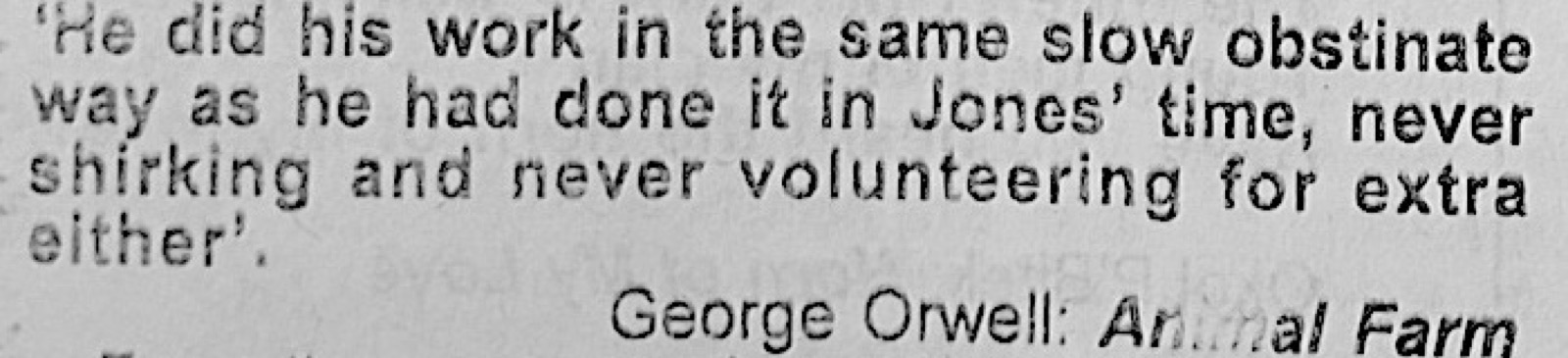
JAMB 2006: George Orwell, Animal Farm (extract)
The passage, as printed

From the passage above, the character being described is

  1. A.enthusiastic
  2. B.altruistic
  3. C.cynical
  4. D.lazy
Show the answer and explanation

Answer: C (cynical)

Explanation

This describes Benjamin the donkey, who works exactly as before the revolution, never more and never less, because he believes nothing will really change: he is cynical.

Open this question

Question 12

Literary Appreciation: Poetry

The extract above is an example of

  1. A.elegy
  2. B.ballad
  3. C.epic
  4. D.eulogy
Show the answer and explanation

Answer: A (elegy)

Explanation

An elegy is a sad, reflective poem about death. These lines lament that the hunter and the blacksmith die and leave nothing but poverty behind.

Open this question

Question 13

Literary Appreciation: Prose and Drama

The passage above achieves a mock-heroic effect through the use of

  1. A.meiosis
  2. B.epigram
  3. C.allusion
  4. D.symbolism
Show the answer and explanation

Answer: C (allusion)

Explanation

Comparing a schoolboy's stolen grapefruit to the apple that tempted Eve in Paradise Lost is an allusion; setting a trivial act beside a grand biblical story makes it mock-heroic.

Open this question

Question 14

Literary Appreciation: Poetry

The literary device used in the lines above is

  1. A.repetition
  2. B.refrain
  3. C.consonance
  4. D.assonance
Show the answer and explanation

Answer: D (assonance)

Explanation

The same long 'ee' vowel sound is repeated in 'fleeting', 'gleam', 'dream' and 'cream'; repetition of vowel sounds is assonance.

Open this question

Question 15

Literary Appreciation: Prose and Drama

The subject matter of the speech above is

  1. A.regicide
  2. B.suicide
  3. C.infanticide
  4. D.parricide
Show the answer and explanation

Answer: A (regicide)

Explanation

Richard speaks of 'the death of kings', of kings deposed, slain and poisoned. The killing of a king is regicide.

Open this question

Question 16

Literary Appreciation: Poetry

The dominant mood in the excerpt above is that of

  1. A.exhilaration
  2. B.pleasure
  3. C.rage
  4. D.terror
Show the answer and explanation

Answer: D (terror)

Explanation

Broken walls, bats, shadows of a stranger and an abandoned gate create an eerie, frightening atmosphere, so the mood is one of terror.

Open this question

Question 18

Literary Appreciation: Poetry

A device used in the second line of the excerpt above is

  1. A.simile
  2. B.hyperbole
  3. C.metaphor
  4. D.paradox
Show the answer and explanation

Answer: A (simile)

Explanation

The line compares the speaker's jealousy to Jehovah's using 'like', which makes it a simile.

Open this question

Question 19

Literary Appreciation: Prose and Drama

The tone of the passage above is

  1. A.derisive
  2. B.ironic
  3. C.melancholic
  4. D.harsh
Show the answer and explanation

Answer: A (derisive)

Explanation

The writer quotes the job-seekers' clumsy English ('Yours obediently servant') to laugh at them, so the tone is mocking, i.e. derisive.

Open this question

Question 20

Literary Appreciation: Poetry

The device used in the excerpt above is

  1. A.synecdoche
  2. B.imagery
  3. C.metaphor
  4. D.irony
Show the answer and explanation

Answer: C (metaphor)

Explanation

The childless person is directly called 'the cold nests' where no eggs are laid, without 'like' or 'as': this is a metaphor.

Open this question

Question 21

Other Set Texts: Non-African Prose

In Thomas Hardy's Tess of the d'Urbervilles, Angel Clare prefers Tess to Mercy Chant as a wife because she

  1. A.is an accomplished lady
  2. B.is from a very godly family
  3. C.understands farm life
  4. D.is a good Christian
Show the answer and explanation

Answer: C (understands farm life)

Explanation

Angel plans to be a farmer, and he argues to his parents that a dairymaid like Tess, who knows farm work, will suit him better than the pious, ladylike Mercy Chant.

Open this question

Question 23

Other Set Texts: Non-African Prose

In Thomas Hardy's Tess of the d'Urbervilles, most of Tess' misery as a girl-mother comes from the thought of

  1. A.herself as the parent of a nameless child
  2. B.the world's concern about her breaking social law
  3. C.herself as a spouseless mother
  4. D.her inexperience in childcare.
Show the answer and explanation

Answer: B (the world's concern about her breaking social law)

Explanation

Hardy says most of Tess's misery came from imagining what the world thought of her for breaking its social rules, not from her own feelings.

Open this question

Question 24

Other Set Texts: Non-African Prose

In Thomas Hardy's Tess of the d'Urbervilles, the theme of chance is graphically demonstrated by the

  1. A.meeting of Parson Tringham and Mr. Durbeyfield
  2. B.rape scene
  3. C.sudden return of Angel Clare from Brazil
  4. D.death of Tess' child.
Show the answer and explanation

Answer: A (meeting of Parson Tringham and Mr. Durbeyfield)

Explanation

The whole tragedy begins with a chance encounter: Parson Tringham happens to meet John Durbeyfield on the road and tells him he descends from the noble d'Urbervilles.

Open this question

Question 28

Other Set Texts: African Prose

In Ayi Kwei Armah's Fragments, the message State Express 555 is an advertisement for

  1. A.an imported alcoholic drink
  2. B.a brand of elitist cigarette
  3. C.a newly commissioned road network
  4. D.Gold Coast Transport Corporation.
Show the answer and explanation

Answer: B (a brand of elitist cigarette)

Explanation

State Express 555 is a brand of expensive cigarettes; in the novel its advertisement stands for the imported status symbols Ghana's elite crave.

Open this question

Question 29

Other Set Texts: African Prose

In Ayi Kwei Armah's Fragments, the fact that Baako ultimately goes mad indicates that

  1. A.the visionary is usually a sacrificial lamb
  2. B.society is incurable
  3. C.man is a fateful being
  4. D.the evils that men do live after them.
Show the answer and explanation

Answer: A (the visionary is usually a sacrificial lamb)

Explanation

Baako refuses to join the materialistic scramble and is broken by his family and society; Armah shows the person of vision being sacrificed by a corrupt society.

Open this question

Question 31

Set Text: Hamlet

In William Shakespeare's Hamlet, the king who is poisoned in the Garden in the play-within-the-play is

  1. A.Gozango
  2. B.Negtine
  3. C.Bernardo
  4. D.Hamlet.
Show the answer and explanation

Answer: A (Gozango)

Explanation

Hamlet explains during the performance: 'He poisons him i' the garden for his estate. His name's Gonzago.' The scene copies Claudius's murder of King Hamlet.

Open this question

Question 32

Set Text: Hamlet

In William Shakespeare's Hamlet, Ghost serves to

  1. A.accelerate dramatic conflict
  2. B.intensify dramatic conflict
  3. C.initiate dramatic conflict
  4. D.complicate dramatic conflict.
Show the answer and explanation

Answer: C (initiate dramatic conflict)

Explanation

The ghost reveals the murder and orders Hamlet to take revenge, which sets the whole conflict of the play in motion.

Open this question

Question 33

Set Text: Hamlet
JAMB 2006: William Shakespeare, Hamlet (extract)
The passage, as printed

The ghost exhorts young Hamlet not to kill his mother because

  1. A.his wife is bewitched into falling for Claudius' seduction
  2. B.the ghost wishes her to be left to the torment of her conscience
  3. C.the ghost still loves his wife even in death
  4. D.the young Hamlet will be guilty of matricide.
Show the answer and explanation

Answer: B (the ghost wishes her to be left to the torment of her conscience)

Explanation

Right after these lines the ghost tells Hamlet to 'leave her to heaven, and to those thorns that in her bosom lodge': Gertrude is to be punished by her own guilty conscience.

Open this question

Question 34

Set Text: Hamlet

In William Shakespeare's Hamlet, the king's clown whose skull is exhumed by Grave-digger is

  1. A.Rosencrantz
  2. B.Yorick
  3. C.Sexton
  4. D.Fortinbras.
Show the answer and explanation

Answer: B (Yorick)

Explanation

The gravedigger digs up the skull of Yorick, the old king's jester, and Hamlet says 'Alas, poor Yorick! I knew him, Horatio.'

Open this question

Question 35

Set Text: Hamlet

In William Shakespeare's Hamlet, the seeming shifty structure of the play is used to

  1. A.assist in the development of the characters
  2. B.sustain the reader's interest
  3. C.reflect the emotional and psychological state of Hamlet
  4. D.slow down the pace of the plot development.
Show the answer and explanation

Answer: B (sustain the reader's interest)

Explanation

The many twists, delays and sub-plots keep the audience guessing what Hamlet will do next, which sustains interest throughout the play.

Open this question

Question 36

Other Set Texts: African Drama

In Ahmed Yerima's Attahiru, from the viewpoint of the British government, the attack on the Sokoto Caliphate is

  1. A.one of superiority
  2. B.a war of attrition
  3. C.one of vengeance
  4. D.a jihad.
Show the answer and explanation

Answer: A (one of superiority)

Explanation

To Lugard and the British, conquering Sokoto was a matter of showing that the white man's power was superior and must be accepted.

Open this question

Question 40

Other Set Texts: African Drama

Ahmed Yerima's Attahiru is historical because it deals with

  1. A.the jihad led by Caliph Attahiru
  2. B.real personages and places
  3. C.Lugard's attempt to amalgamate the southern and northern protectorates
  4. D.Attahiru's ascension to the caliphacy in November 1902.
Show the answer and explanation

Answer: B (real personages and places)

Explanation

Historical drama is built on real people and places from the past; Attahiru shows real figures such as Caliph Attahiru and Lugard and real places such as Sokoto and Burmi.
Open this question

Question 42

Drama: General

An anti-social action taken by the tragic hero which results in a catastrophe is called

  1. A.anagnorisis
  2. B.premonition
  3. C.harmatia
  4. D.empathy.
Show the answer and explanation

Answer: C (harmatia)

Explanation

Hamartia is the tragic hero's error or flaw that leads to his downfall; anagnorisis is the moment of recognition.

Open this question

Question 43

Prose: General

A work which takes place in a non-existent world or which concerns an incredible character is

  1. A.romance
  2. B.fantasy
  3. C.parody
  4. D.superstition.
Show the answer and explanation

Answer: B (fantasy)

Explanation

Fantasy is fiction set in imaginary worlds or full of impossible beings and events.

Open this question

Question 44

Drama: General

A humorous scene, incident or speech in the course of a serious fiction or drama is a

  1. A.play-within-the-play
  2. B.comic scene
  3. C.comic relief
  4. D.tragi-comedy.
Show the answer and explanation

Answer: C (comic relief)

Explanation

Comic relief is a funny moment placed inside a serious work to ease the tension, like the gravediggers in Hamlet.

Open this question

Question 45

Prose: General

A travelogue is

  1. A.the account of the travails of a character in a novel
  2. B.a record of the writer's experiences during a journey
  3. C.a variant of a novel written in a free style on a writer's journey
  4. D.the account of the experiences of an individual during his lifetime.
Show the answer and explanation

Answer: B (a record of the writer's experiences during a journey)

Explanation

A travelogue is a piece of writing (or film) describing the places and experiences of the writer's travels.

Open this question

Question 46

Literary Terms and Devices

Flashback in a literary work helps to

  1. A.fill the missing link
  2. B.reveal the characters' mindsets
  3. C.place the story in proper perspective
  4. D.relate events that are extraneous to the story.
Show the answer and explanation

Answer: A (fill the missing link)

Explanation

A flashback goes back in time to show past events that explain the present, supplying information the story would otherwise be missing.

Open this question

Question 47

Poetry: General

An address to a metaphysical source of inspiration by a poet is called

  1. A.clairvoyance
  2. B.inspiration
  3. C.invocation
  4. D.nemesis.
Show the answer and explanation

Answer: C (invocation)

Explanation

An invocation is the poet's call to a muse or god for help, as at the start of epics like Paradise Lost.

Open this question

Question 48

Drama: General

The sides of a stage are called

  1. A.the ways
  2. B.both sides
  3. C.the pits
  4. D.the wings.
Show the answer and explanation

Answer: D (the wings.)

Explanation

The wings are the areas at the sides of a stage, hidden from the audience, where actors wait to enter.

Open this question

Question 49

Poetry: General

A metrical pause occurring in the middle of a line in a poem is called

  1. A.rhythm
  2. B.tetrametre
  3. C.assonance
  4. D.caesura.
Show the answer and explanation

Answer: D (caesura.)

Explanation

A caesura is a break or pause inside a line of poetry, often marked by punctuation.

Open this question

Question 50

Literary Terms and Devices

A complex plot can be described as the plot structure that has

  1. A.multiple scenes
  2. B.strands of events runnings concurrently
  3. C.well-developed characters
  4. D.an abstract subject and setting.
Show the answer and explanation

Answer: B (strands of events runnings concurrently)

Explanation

A complex plot has several lines of action (a main plot and sub-plots) running side by side, unlike a simple plot with one line.

Open this question