Home › Past questions › JAMB › Literature in English › 2005 37 questions. Try each one, then open the answer to check yourself and read the explanation.
Sign up free to answer these questions on a CBT screen with a timer, then see your score and every answer explained.
Start practising free
Question 3 Other Set Texts: African Drama In Ahmed Yerima's Attahiru , Lord Lugard and the British military find it easy to penetrate the Sokoto Caliphate because the
A. Muslim faithfuls fight with bows and arrows while the British soldiers use rifles B. Emir of Zazzau calls the whitemen to save him from the attack of a fellow Muslim, the Emir of Kontagora C. emirates of Sokoto and Zaria have not been friends since the reign of Caliph Abdulrahman D. emirates are only united to fight the whitemen when it is the turn of Sokoto Show the answer and explanation Answer: D (emirates are only united to fight the whitemen when it is the turn of Sokoto )
Explanation The emirates do not stand together; each is left to face the British alone and they unite only when Sokoto itself is attacked, which makes conquest easy.
Open this question
Question 5 Other Set Texts: African Drama Ahmed Yerima, Attahiru (extract, Q5) In Ahmed Yerima's Attahiru , the statement above is prompted by the
A. abolition of slave trade B. undermining of caliphal authority C. introduction of direct rule D. imposition of taxes Show the answer and explanation Answer: C (introduction of direct rule )
Explanation Madawaki objects that the white man, a guest, wants to 'dictate': he resents the British taking over government directly.
Open this question
Question 6 Set Text: Hamlet In William Shakespeare's Hamlet , Claudius, though a murderer, is presented as a character
A. who has a superlative administrative style B. with a living conscience that torments him C. to whom past events have no significance D. with an admirable physical appearance Show the answer and explanation Answer: B (with a living conscience that torments him )
Explanation In his prayer scene Claudius admits his 'offence is rank' and is tormented by guilt for killing his brother.
Open this question
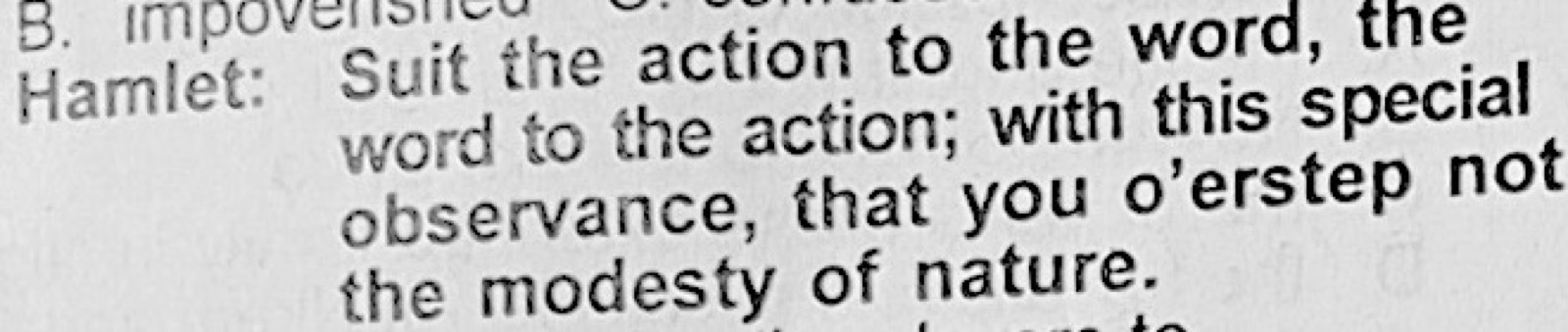
Question 8 Set Text: Hamlet William Shakespeare, Hamlet (extract, Q8) In William Shakespeare's Hamlet , here, Hamlet is urging the players to
A. reflect reality B. be good actors C. justify their actions D. be creative on stage Show the answer and explanation Answer: A (reflect reality )
Explanation Hamlet tells the actors to match action to words and not 'o'erstep the modesty of nature': acting should mirror real life.
Open this question
Question 9 Set Text: Hamlet In William Shakespeare's Hamlet , the principal function of the play-within-the-play in Hamlet is to
A. amuse Claudius B. confirm the claim of the ghost C. divert attention from the main event D. create some comic relief in the tragedy Show the answer and explanation Answer: B (confirm the claim of the ghost )
Explanation Hamlet stages 'The Mouse-trap' to watch Claudius's reaction and so prove whether the Ghost told the truth.
Open this question
Question 10 Set Text: Hamlet In William Shakespeare's Hamlet , in The Mouse-trap , the murderer is
A. Claudius B. Lucianus C. Gozango D. Baptista Show the answer and explanation Answer: B (Lucianus )
Explanation In 'The Mouse-trap' Lucianus pours poison into the sleeping king Gonzago's ear, copying Claudius's crime.
Open this question
Question 14 Other Set Texts: African Prose In Ayi Kwei Armah's Fragments , the novel suggests that an individual who stays apart from his society will
A. be praised for his action B. be alienated by his society C. be broken by his society D. live a fulfilled life Show the answer and explanation Answer: B (be alienated by his society )
Explanation Baako refuses to join in the corruption and materialism around him, and his family and society reject and isolate him.
Open this question
Question 15 Other Set Texts: African Prose In Ayi Kwei Armah's Fragments , the setting of the novel is the
A. traditional Nigerian society B. post-independence Ghanaian society C. pre-independence Ghanaian society D. modern Nigerian society Show the answer and explanation Answer: B (post-independence Ghanaian society )
Explanation Baako returns from America to Ghana after independence; the novel attacks the materialism of that society.
Open this question
Question 17 Other Set Texts: Non-African Prose In Thomas Hardy's Tess of the d'Urbervilles , Angel Clare is depicted as
A. a rebellious and self-opinionated character B. an independent-minded character C. a fastidious and garrulous character D. a flirtatious and impulsive young man Show the answer and explanation Answer: B (an independent-minded character )
Explanation Angel breaks with his family's plan for him to become a clergyman and goes his own way as a farmer: he is independent-minded.
Open this question
Question 18 Other Set Texts: Non-African Prose In Thomas Hardy's Tess of the d'Urbervilles , 'Phases' in the novel refers to
A. phases of the moon and their effects on the plot B. moments of awareness of Tess' misfortune C. points of conflict between good and evil D. stages of development in the life of Tess Show the answer and explanation Answer: D (stages of development in the life of Tess )
Explanation The novel is divided into seven 'Phases' (such as 'The Maiden', 'Maiden No More') that trace the stages of Tess's life.
Open this question
Question 19 Other Set Texts: Non-African Prose In Thomas Hardy's Tess of the d'Urbervilles , from the tragedy of Tess, it can be said that Thomas Hardy is concerned with the evils of
A. modernization B. industrialization C. democratization D. colonization Show the answer and explanation Answer: B (industrialization )
Explanation The threshing machine at Flintcomb-Ash and the decline of rural life show Hardy's worry about the harm done by industrialisation.
Open this question
Question 20 Other Set Texts: Non-African Prose In Thomas Hardy's Tess of the d'Urbervilles , Angel Clare's ambition in marrying Tess d'Urberville is to secure a wife with
A. high social standing B. great fortune C. rustic innocence D. a wide knowledge of the world Show the answer and explanation Answer: C (rustic innocence )
Explanation Angel idealises Tess as a pure, simple country girl; he wants a wife of rustic innocence.
Open this question
Question 21 African Poetry Brutus' A Troubadour I Traverse is inspired by his struggle against
A. injustice B. capitalism C. colonialism D. zealotry Show the answer and explanation Answer: A (injustice )
Explanation Dennis Brutus spent his life fighting the injustice of apartheid; the troubadour roams the land in that struggle.
Open this question
Question 22 African Poetry The theme of Wangusa's A Taxi Driver on His Death is
A. the taxi driver's contemplation of the vehicle as the likely cause of his death B. that a driver's death must surely be caused by his vehicle C. the danger in the driving profession D. that roads are death-traps for drivers Show the answer and explanation Answer: A (the taxi driver's contemplation of the vehicle as the likely cause of his death )
Explanation The dead driver reflects that the vehicle he lived by is also what killed him.
Open this question
Question 23 African Poetry J.P. Clark's Agbor Dancer portrays
A. a sophisticated dancer B. a girl attuned to her culture C. an uncivilized dancer D. a wild girl Show the answer and explanation Answer: B (a girl attuned to her culture )
Explanation Clark shows the dancer moving in perfect harmony with the drums and her ancestral tradition, and he envies her closeness to her culture.
Open this question
Question 25 African Poetry The tone of Ofeimun's We Must Learn Again to Fly is that of
A. encouragement B. discouragement C. disappointment D. enthusiasm Show the answer and explanation Answer: A (encouragement )
Explanation As the title shows, the poem urges people to rise again after failure: its tone is encouraging.
Open this question
Question 26 African Poetry In Cheney-Coker's Myopia , the myopic ones are the
A. peasants B. rulers C. poets D. traders Show the answer and explanation Answer: B (rulers )
Explanation The 'short-sighted' ones in the poem are the leaders who cannot see beyond their own gain.
Open this question
Question 28 Non-African Poetry A.E. Housman, To an Athlete Dying Young (line) From the statement above in Housman's To an Athlete Dying Young , what happens to the athlete?
A. He comes to a disgraceful end B. He loses his medal to another C. He dies eventually D. He dies prematurely Show the answer and explanation Answer: D (He dies prematurely )
Explanation The athlete dies young, at the height of his fame, so he never sees his name forgotten as happens to men who outlive their glory.
Open this question
Question 29 Non-African Poetry In Keats' On the Grasshopper and Cricket , 'poetry of earth' refers to
A. poetry written about earth B. songs by grasshopper and cricket C. poetry written by mother earth D. songs by birds, grasshoppers and crickets Show the answer and explanation Answer: D (songs by birds, grasshoppers and crickets )
Explanation Keats says 'the poetry of earth is never dead': in summer birds and the grasshopper sing, and in winter the cricket takes over.
Open this question
Question 30 Non-African Poetry In On His Blindness , Milton uses the experience of his blind state to
A. condemn himself B. appreciate God C. abuse God D. disregard his fellow men Show the answer and explanation Answer: B (appreciate God )
Explanation Milton ends by accepting God's will: 'They also serve who only stand and wait'. His blindness leads him to appreciate God.
Open this question
Question 31 Prose: General The predominant use of the third-person pronoun in a novel creates a
A. sense of detachment on the part of the writer B. sense of detachment on the part of the reader C. psychological affinity with the characters D. balance of opinion among the characters Show the answer and explanation Answer: A (sense of detachment on the part of the writer )
Explanation Writing about 'he', 'she' and 'they' places the narrator outside the story, so the writer stands back from the characters.
Open this question
Question 32 Poetry: General A poem without a regular rhyme scheme is a
A. traditional poem B. ballad C. lyrical poem D. blank verse Show the answer and explanation Answer: D (blank verse )
Explanation Blank verse is unrhymed (in iambic pentameter); ballads and most traditional poems rhyme.
Open this question
Question 33 Literary Terms and Devices Aesthetics in literature has to do with the creation of
A. imagery B. lines C. beauty D. themes Show the answer and explanation Answer: C (beauty )
Explanation Aesthetics is the study and creation of beauty in art and literature.
Open this question
Question 34 Drama: General Cast in a play refers to
A. all the actors B. three of the actors C. a few of the actors D. an exclusive social class in the play Show the answer and explanation Answer: A (all the actors )
Explanation The cast is the whole group of actors who perform in a play.
Open this question
Question 35 Drama: General A tragic hero, according to the Aristotelian precept, must be a
A. noble character with hubris B. lowly character who suddenly stumbles on some fortunes C. king with deep affection for his subjects D. central character after whom the play is named Show the answer and explanation Answer: A (noble character with hubris )
Explanation Aristotle's tragic hero is a person of high standing whose flaw, often pride (hubris), causes his fall.
Open this question
Question 37 Literary Terms and Devices The insertion of material unrelated or distantly related to the specific subject under discussion in a given work is called
A. digression B. flashback C. regression D. reverie Show the answer and explanation Answer: A (digression )
Explanation A digression is a passage that wanders away from the main subject.
Open this question
Question 38 Literary Terms and Devices When an object is invested with a meaning beyond its immediate reference, it becomes
A. an irony B. a symbol C. a subject D. an epigram Show the answer and explanation Answer: B (a symbol )
Explanation A symbol is an object that stands for something more than itself, as a dove stands for peace.
Open this question
Question 39 Drama: General Unity of time in a tragedy implies that all actions should take place
A. simultaneously B. intermittently C. in a single revolution of the sun D. within the same locale Show the answer and explanation Answer: C (in a single revolution of the sun )
Explanation The classical unity of time requires the action of a play to happen within one day, a single revolution of the sun.
Open this question
Question 40 Literary Terms and Devices A short, carefully phrased expression meant to elicit amusement and surprise is
A. hyperbole B. limerick C. tercet D. wit Show the answer and explanation Answer: D (wit )
Explanation Wit is clever, neatly phrased speech that surprises and amuses; a limerick is a five-line poem and a tercet a three-line stanza.
Open this question
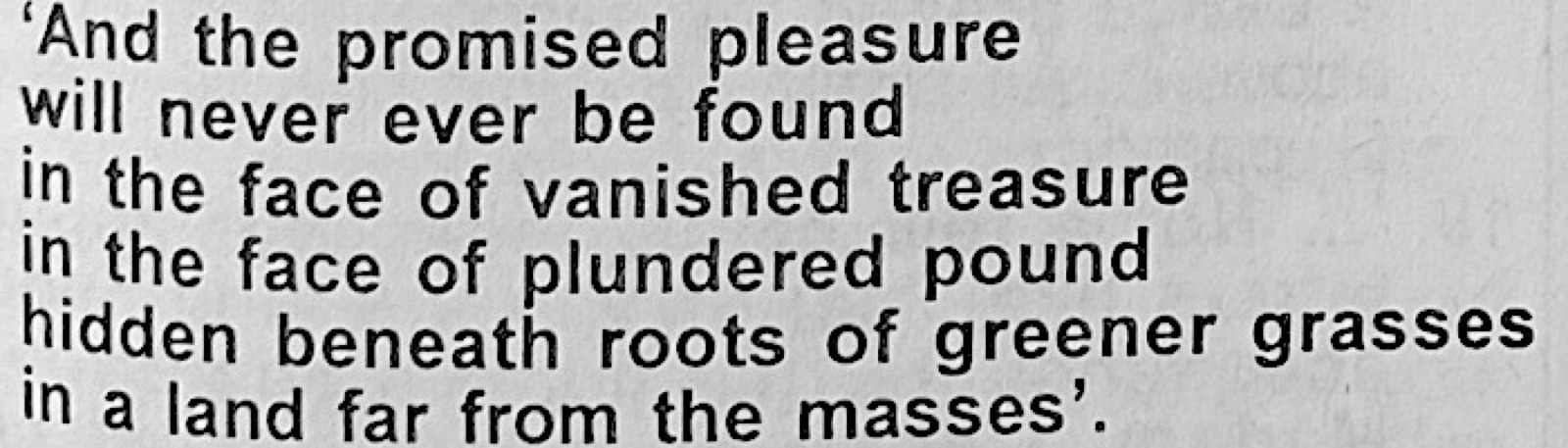
Question 43 Literary Appreciation: Poetry JAMB 2005 Literary Appreciation: poem extract (Q43) The tone of the poem above is
A. pessimistic B. optimistic C. interrogative D. persuasive Show the answer and explanation Answer: A (pessimistic )
Explanation The lines say the promised pleasure 'will never ever be found' because the wealth has been plundered: the tone is pessimistic.
Open this question
Question 44 Figures of Speech The expression 'The ripest is the saddest encounter' is an example of
A. euphemism B. paradox C. hyperbole D. metaphor Show the answer and explanation Answer: B (paradox )
Explanation We expect the ripest (best) moment to be the happiest; calling it the saddest is a seeming contradiction that hides a truth: a paradox.
Open this question
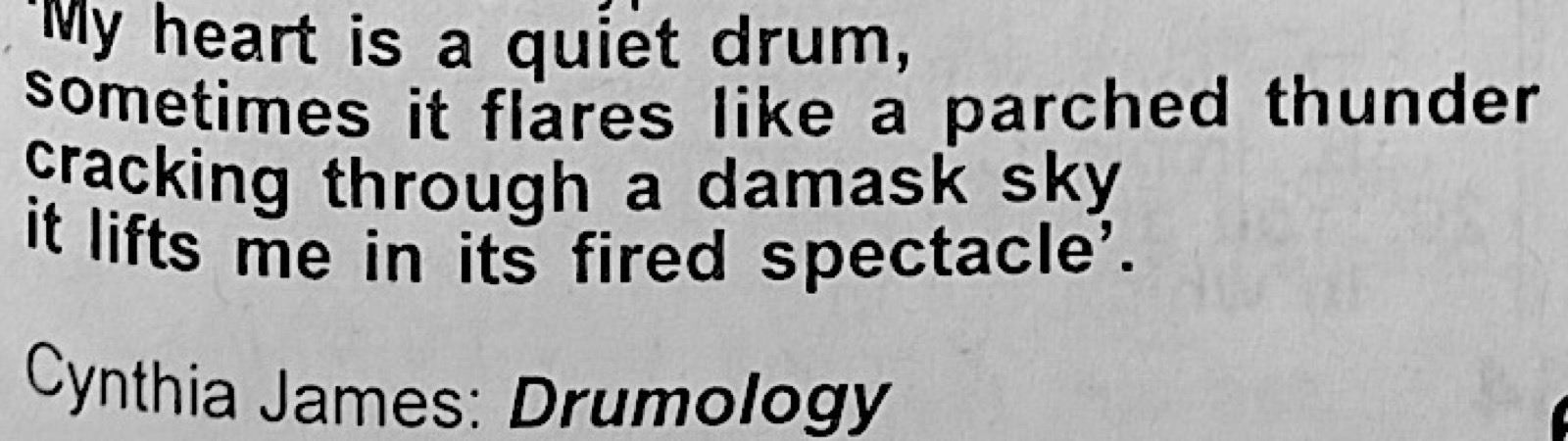
Question 45 Literary Appreciation: Poetry Cynthia James, Drumology (extract) The imagery in the excerpt above is largely
A. olfactory and visual B. olfactory and tactile C. tactile and auditory D. auditory and visual Show the answer and explanation Answer: D (auditory and visual )
Explanation The drum and the thunder cracking appeal to hearing, while the flaring, the damask sky and the 'fired spectacle' appeal to sight.
Open this question
Question 46 Literary Appreciation: Poetry The poem above achieves its literary effect through the use of
A. alliteration B. parallelism C. repetition D. solecism Show the answer and explanation Answer: C (repetition )
Explanation Key words are repeated from line to line ('eagle', 'coin'), linking the images and driving home the point.
Open this question
Question 47 Literary Appreciation: Prose and Drama The passage above describes a troop of
A. cows B. elephants C. camels D. horses Show the answer and explanation Answer: D (horses )
Explanation Snorting, manes and long tails streaming, bay, brown and grey backs, hoofs and cruppers all describe horses.
Open this question
Question 48 Literary Appreciation: Prose and Drama In the passage above, the speaker can be described as
A. domineering B. treacherous C. friendly D. hungry Show the answer and explanation Answer: A (domineering )
Explanation She gives orders ('Get dressed and let's go') and decides where they will meet next time: she is domineering.
Open this question
Question 49 Literary Appreciation: Prose and Drama In the excerpt above, Mr. Beckley is trying to
A. put the addressee on the defensive B. show off to the listener C. provoke a fight D. find out the truth from the addressee Show the answer and explanation Answer: D (find out the truth from the addressee )
Explanation Mr Beckley demands a straight answer: 'Did you or did you not savagely attack the child?' He wants to know the truth.
Open this question
Question 50 Literary Appreciation: Poetry The overriding feeling of the persona in this extract is
A. anxiety B. certainty C. frustration D. joy Show the answer and explanation Answer: A (anxiety )
Explanation The persona keeps asking where her love has blown his horn and whether anyone has heard it: she is anxious about him.
Open this question Sign up free for every JAMB Literature in English year, practice by topic and timed mocks.
Start practising free