Home › Past questions › JAMB › Literature in English › 2004 31 questions. Try each one, then open the answer to check yourself and read the explanation.
Sign up free to answer these questions on a CBT screen with a timer, then see your score and every answer explained.
Start practising free
Question 2 African Poetry '... a huge senseless cathedral of doom' in Kofi Awoonor's The Cathedral implies
A. meaningless foreign religious practices B. meaningless indigenous religious practices C. the architectural beauty of the cathedral D. the Catholic Church practices Show the answer and explanation Answer: A (meaningless foreign religious practices )
Explanation The cathedral was built by foreigners where the village tree once stood; calling it 'senseless' and 'of doom' shows the poet sees the imported religion as meaningless.
Open this question
Question 7 African Poetry Arthur Nortje's Nightfall is written against the backdrop of
A. apartheid B. revolution C. celebration D. violence Show the answer and explanation Answer: A (apartheid )
Explanation Nortje wrote as a 'coloured' South African; the darkness and gloom of 'Nightfall' reflect the oppression of apartheid.
Open this question
Question 8 Non-African Poetry The allusion to Eurydice's experience in Robert Frost's Wild Grapes is an imagery of death and
A. reincarnation B. resurrection C. rebirth D. growth Show the answer and explanation Answer: B (resurrection )
Explanation In Greek myth Orpheus went down to the underworld to bring the dead Eurydice back to life; the allusion suggests death and resurrection.
Open this question
Question 10 Non-African Poetry In John Donne's Death, be not Proud , the poet believes that death is
A. immortal B. mighty C. pleasurable D. dreadful Show the answer and explanation Answer: C (pleasurable )
Explanation Donne argues that if rest and sleep, which are only pictures of death, give pleasure, then death itself must give even more: death is pleasurable, not mighty or dreadful.
Open this question
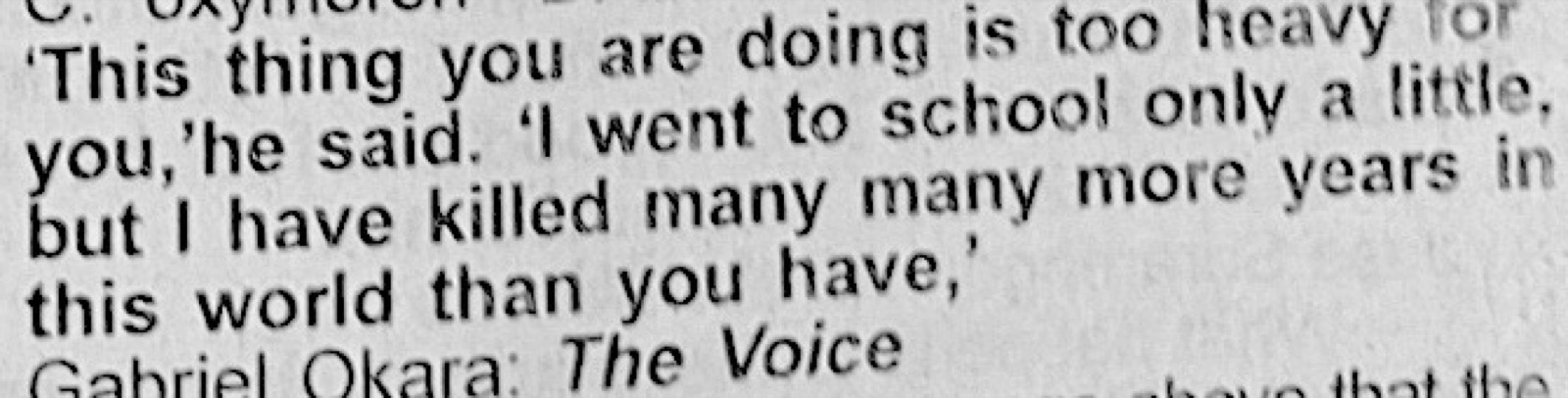
Question 12 Literary Appreciation: Prose and Drama Gabriel Okara, The Voice (extract) It can be inferred from the passage above that the
A. listener is a porter B. listener is wise C. speaker is a murderer D. speaker is more experienced Show the answer and explanation Answer: D (speaker is more experienced )
Explanation The speaker says he has 'killed many many more years in this world' than the listener, meaning he has lived longer and is more experienced.
Open this question
Question 13 Literary Appreciation: Poetry The allusion in the excerpt above is
A. mythical B. biblical C. historical D. classical Show the answer and explanation Answer: B (biblical )
Explanation Passing 'through the needle's eye' echoes Jesus's saying that it is easier for a camel to go through the eye of a needle than for a rich man to enter heaven.
Open this question
Question 14 Literary Appreciation: Poetry The poet's attitude here is
A. paradoxical B. envious C. ironical D. sarcastic Show the answer and explanation Answer: D (sarcastic )
Explanation Diop mocks the 'brother' who copies his white master, using cutting, scornful phrases such as 'blue-eyed faithful look' and 'parlours of condescension': this is sarcasm.
Open this question
Question 15 Literary Appreciation: Prose and Drama The subject matter of the passage above is the
A. uncritical acceptance of European values B. woes of English marriage C. adventures in England D. intransigence of an African wife Show the answer and explanation Answer: A (uncritical acceptance of European values )
Explanation Mr Borofo complains that since his wife went to England everything must be done because 'it is done in England': she blindly copies European ways.
Open this question
Question 16 Literary Appreciation: Poetry The dominant technique in the lines above is
A. irony B. rhyme C. alliteration D. metaphor Show the answer and explanation Answer: B (rhyme )
Explanation The lines are built on rhyming words: 'there' with 'there', and 'grope' with 'cope'.
Open this question
Question 17 Literary Appreciation: Prose and Drama The author's attitude to Inman in the passage above is one of
A. praise B. hatred C. ridicule D. admiration Show the answer and explanation Answer: C (ridicule )
Explanation Calling Inman 'an odd-looking duck' made of 'a series of balls piled one atop the other' makes fun of his appearance: ridicule.
Open this question
Question 18 Literary Appreciation: Prose and Drama What happens to the unknown woman in the passage above?
A. she runs away B. she is awake C. she falls asleep D. she is dead Show the answer and explanation Answer: D (she is dead )
Explanation Senhor Jose finds 'the place where she lay, a good six feet beneath an earth': her grave, so she is dead.
Open this question
Question 19 Literary Appreciation: Poetry The poet-persona here expresses a feeling of
A. elation B. anger C. nostalgia D. sorrow Show the answer and explanation Answer: C (nostalgia )
Explanation Alone 'from a plain away from home', the persona sends song and tears 'homewards': a longing for home, which is nostalgia.
Open this question
Question 20 Literary Appreciation: Poetry The lines above are an example of
A. epitaph B. anaphora C. tautology D. epigram Show the answer and explanation Answer: B (anaphora )
Explanation Anaphora is the repetition of the same word or phrase at the start of successive lines; here every line starts with 'Be him'.
Open this question
Question 21 Drama: General A dramatic composition or musical play in which many or all the words are sung is called
A. an oratorio B. a motet C. an opera D. a concert Show the answer and explanation Answer: C (an opera )
Explanation An opera is a staged drama in which most or all of the words are sung to music.
Open this question
Question 22 Poetry: General The poetic device that forcefully brings together two seemingly unrelated ideas or concepts is
A. conceit B. contrast C. couplet D. diatribe Show the answer and explanation Answer: A (conceit )
Explanation A conceit (as in the Metaphysical poets) is a far-fetched comparison that forces two very different ideas together.
Open this question
Question 23 Drama: General For a play to be successful on stage, it must not be short of
A. audiences B. speeches C. actions D. characters Show the answer and explanation Answer: C (actions )
Explanation Drama is meant to be acted; without enough action a play becomes static and fails on stage.
Open this question
Question 24 Poetry: General The setting in pastoral poetry is usually
A. oceanic B. urban C. ecumenical D. idyllic Show the answer and explanation Answer: D (idyllic )
Explanation Pastoral poetry is set in an idealised, peaceful countryside: an idyllic setting.
Open this question
Question 25 Literary Terms and Devices The exclusive right given to authors to protect their works from unlawful production is
A. a copyright B. an authority to write C. an author's right D. a constitutional provision Show the answer and explanation Answer: A (a copyright )
Explanation Copyright is the legal right that stops others from copying or publishing an author's work without permission.
Open this question
Question 26 Prose: General In a narration, the first person is
A. the author B. a participant C. the publisher D. an observer Show the answer and explanation Answer: B (a participant )
Explanation A first-person narrator ('I') tells the story from inside it, as one of the characters taking part.
Open this question
Question 27 Literary Terms and Devices A deliberate imitation of a literary style with the intention to ridicule is
A. paradox B. prosody C. pun D. parody Show the answer and explanation Answer: D (parody )
Explanation A parody copies the style of a work or writer in an exaggerated way in order to mock it.
Open this question
Question 28 Drama: General Point of denouement in a literary work is the
A. point at which the major character is shown in his true colours B. point of disagreement in a narrative C. point of the resolution of the puzzling issues D. cathartic point in a tragedy Show the answer and explanation Answer: C (point of the resolution of the puzzling issues )
Explanation The denouement is the final unravelling of the plot, where the complications are resolved.
Open this question
Question 29 Figures of Speech Periphrasis in poetic diction is marked by
A. circumlocution B. irony C. proverb D. parable Show the answer and explanation Answer: A (circumlocution )
Explanation Periphrasis means saying something in a roundabout way with more words than needed, which is circumlocution.
Open this question
Question 30 Drama: General Melodrama is a theatrical performance in which
A. the serious is treated in a satirical way B. subordination of characterization to plot occurs C. music and dance predominate D. evil triumphs over good Show the answer and explanation Answer: B (subordination of characterization to plot occurs )
Explanation A melodrama relies on thrilling events and strong emotions; characters are flat types, so characterisation is subordinate to plot.
Open this question
Question 31 Other Set Texts: African Drama In J.P. Clark's The Wives' Revolt , the tradition of Erhuwaren endorses
A. polyarchy B. anarchy C. matriarchy D. patriarchy Show the answer and explanation Answer: D (patriarchy )
Explanation In Erhuwaren the men hold power and make the decisions, as in sharing the oil money: the tradition is patriarchal.
Open this question
Question 36 Set Text: She Stoops to Conquer In Oliver Goldsmith's She Stoops to Conquer , the major thematic preoccupation of the play is
A. the constraints on parental obligations B. the problems of class and English mannerisms C. the presentation of a mannerless society D. changing the traditional view about English comedy Show the answer and explanation Answer: B (the problems of class and English mannerisms )
Explanation Marlow is shy with upper-class ladies but bold with servants; the comedy grows out of class differences and manners.
Open this question
Question 37 Set Text: She Stoops to Conquer In Oliver Goldsmith's She Stoops to Conquer , Miss Hardcastle is able to 'conquer' at the end of the play because of her
A. indiscretion B. beauty C. wit D. brawn Show the answer and explanation Answer: C (wit )
Explanation Kate cleverly 'stoops' to play a barmaid, which lets the shy Marlow talk freely to her and fall in love: she conquers by her wit.
Open this question
Question 38 Set Text: She Stoops to Conquer In Oliver Goldsmith's She Stoops to Conquer , one of the enriching features of the play is the
A. matchmaking attempts by Mrs. Hardcastle B. manipulation of appearance and reality C. use of rural and urban settings D. lopsided resolution of conflicts Show the answer and explanation Answer: B (manipulation of appearance and reality )
Explanation A house is taken for an inn and a lady for a barmaid; the play's comedy comes from the gap between appearance and reality.
Open this question
Question 40 Set Text: She Stoops to Conquer Oliver Goldsmith, She Stoops to Conquer (extract, Q40) In Oliver Goldsmith's She Stoops to Conquer , the two gentlemen in the excerpt above are
A. Diggory and Saunders B. Marlow and Hastings C. Marlow and Hardcastle D. Diggory and Hastings Show the answer and explanation Answer: B (Marlow and Hastings )
Explanation Marlow and Hastings get lost on the way to Mr Hardcastle's house and arrive at the inn, the Three Pigeons.
Open this question
Question 41 Set Text: Animal Farm In George Orwell's Animal Farm , the turn of events in the novel shows that the novelist is
A. iconoclastic B. fatalistic C. rhetorical D. optimistic Show the answer and explanation Answer: B (fatalistic )
Explanation By the end the pigs cannot be told apart from the humans; Orwell suggests that revolutions are bound to end in new tyranny, a fatalistic view.
Open this question
Question 43 Set Text: Animal Farm In George Orwell's Animal Farm , the last major battle in the novel is the battle
A. of the Cowshed B. of the Windmill C. to oust Mr. Jones D. to overthrow Snowball Show the answer and explanation Answer: B (of the Windmill )
Explanation The Battle of the Cowshed comes early; the later Battle of the Windmill, when Frederick's men blow up the windmill, is the last.
Open this question
Question 44 Set Text: Animal Farm In George Orwell's Animal Farm , the ideological leader of the revolution in the novel is
A. Squealer B. Old Major C. Napoleon D. Snowball Show the answer and explanation Answer: B (Old Major )
Explanation Old Major's speech and dream give the animals the ideas of the rebellion, though he dies before it happens.
Open this question Sign up free for every JAMB Literature in English year, practice by topic and timed mocks.
Start practising free