Home › Past questions › JAMB › Literature in English › 2003 42 questions. Try each one, then open the answer to check yourself and read the explanation.
Sign up free to answer these questions on a CBT screen with a timer, then see your score and every answer explained.
Start practising free
Question 1 Literary Appreciation: Prose and Drama JAMB 2003 Literary Appreciation: Jibunoh 'Jibunoh was simply a difficult man. He was hated by all his neighbours and deserted by his relations. He was the first and only person to beat a policeman in the entire village. He also had ten cases instituted against him for either stealing or violating the rights of others. He had no regard for decency or normal conduct. No lover of peace or order could be his friend. It is not surprising that his death elicited jubilation rather than mourning.'
The passage above reveals that Jibunoh symbolizes
A. wickedness B. insanity C. lawlessness D. isolation Show the answer and explanation Answer: C (lawlessness )
Explanation Jibunoh beats a policeman, steals, violates other people's rights and has no regard for normal conduct or order: he stands for lawlessness.
Open this question
Question 2 Literary Appreciation: Poetry A.E. Housman, Loveliest of Trees, the Cherry Tree (extract) In the excerpt above, the subject matter is
A. love of trees B. cherry bloom C. snow at easter D. woodland tide Show the answer and explanation Answer: B (cherry bloom )
Explanation The lines picture the cherry tree covered with white flowers at Eastertide, so the subject matter is the cherry in bloom.
Open this question
Question 3 Literary Appreciation: Poetry The tone of this poem is generally
A. appreciative B. serious C. imaginative D. conversational Show the answer and explanation Answer: B (serious )
Explanation The lines describe good men dying quietly while friends watch for the last breath; the subject of death is treated in a calm, serious tone.
Open this question
Question 4 Literary Appreciation: Poetry The persona in the poem appears happy to have died
A. a noble death B. during the day C. at an old age D. an untimely death Show the answer and explanation Answer: A (a noble death )
Explanation The persona blames no one and blesses God 'for a noble departure', so he is content with having died a noble death.
Open this question
Question 5 Literary Appreciation: Poetry The lines above express
A. anniversary B. procreation C. incarnation D. resurrection Show the answer and explanation Answer: A (anniversary )
Explanation 'The day recycles itself today / When I slept in the Lord in February' means the date of the persona's death has come round again: an anniversary.
Open this question
Question 6 Literary Appreciation: Prose and Drama JAMB 2003 Literary Appreciation: on God and evil 'If God is the sole author of man's life and all that befall him on earth, does it not stand to reason that all evils that befall man are God sanctioned? If man generally turns to God to bail him out of evil or bad occurrences, is one wrong then to conclude that He allows evils to befall man to bring him back to Him?'
The literary style used in the passage above is
A. discursive B. rhetorical C. accusative D. interrogative Show the answer and explanation Answer: D (interrogative )
Explanation The whole passage is made up of questions ('does it not stand to reason…?', 'is one wrong then…?'), so its style is interrogative.
Open this question
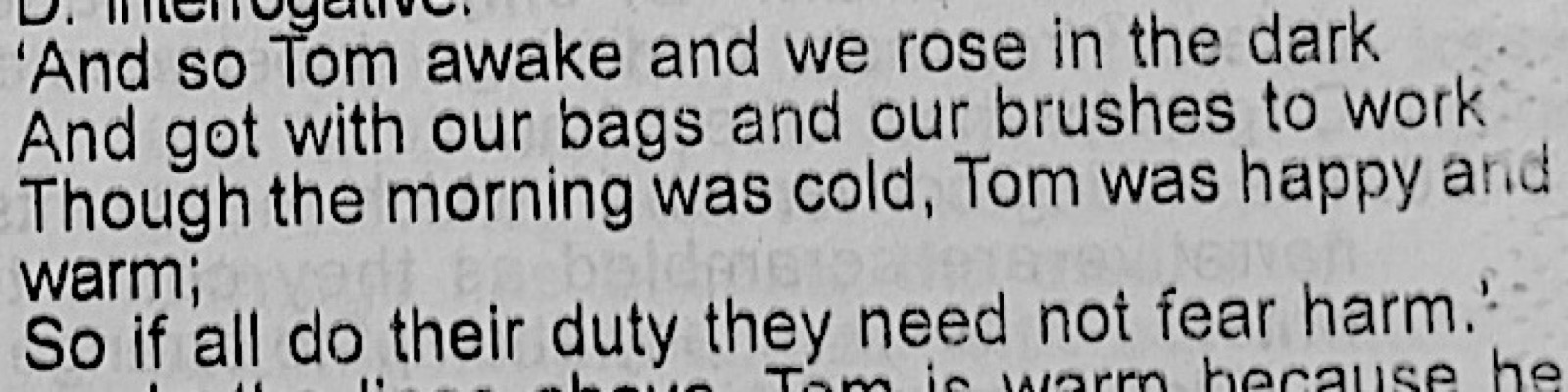
Question 7 Literary Appreciation: Poetry JAMB 2003 Literary Appreciation: poem extract (Q7) In the lines above, Tom is warm because he
A. has just woken from sleep B. is doing his duty C. is wearing warm clothes D. is working indoors Show the answer and explanation Answer: B (is doing his duty )
Explanation The last line gives the reason: 'if all do their duty they need not fear harm'. Tom feels warm because he is doing his duty.
Open this question
Question 8 Literary Appreciation: Prose and Drama JAMB 2003 Literary Appreciation: James and Buchi 'James started showing interest in Buchi a long time ago. In playing the hunter, he realised that he needed a bait. This turned out to be his frequent offer of assistance to the needy young woman. But Buchi has proved to be a difficult game. The more James trailed her the more he realised that she could not be easily caught.'
The choice of words in the passage above is remarkable because it is
A. largely confusing B. very difficult C. quite appropriate D. drawn from hunting Show the answer and explanation Answer: D (drawn from hunting )
Explanation Words like 'hunter', 'bait', 'game', 'trailed' and 'caught' all come from hunting; James's pursuit of Buchi is described as a hunt.
Open this question
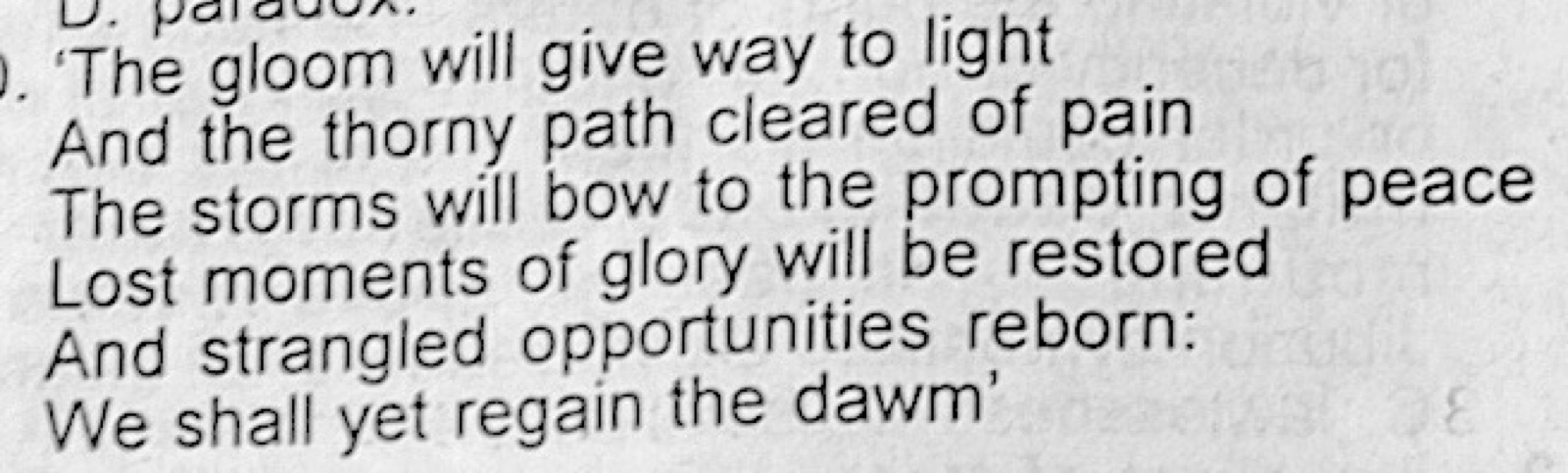
Question 10 Literary Appreciation: Poetry JAMB 2003 Literary Appreciation: poem extract (Q10) The suggestion that runs through the short poem above is that of
A. anxiety and worry B. anticipation of positive change C. sorrow and dejection D. fear of change Show the answer and explanation Answer: B (anticipation of positive change )
Explanation Every line looks forward to something better: gloom giving way to light, glory restored, 'We shall yet regain the dawn'. It anticipates positive change.
Open this question
Question 11 Drama: General Farce thrives on
A. big events B. premonition C. absurdity D. incidents Show the answer and explanation Answer: C (absurdity )
Explanation Farce is comedy built on wildly improbable, absurd situations and actions.
Open this question
Question 12 Poetry: General The form of poetry that celebrates with nostalgia the ideal world of the countryside is referred to as
A. an ode B. a ballad C. an elegy D. a pastoral Show the answer and explanation Answer: D (a pastoral )
Explanation A pastoral poem idealises simple country life, shepherds and the countryside.
Open this question
Question 13 Poetry: General One rhyme scheme typical of the English sonnet is
A. abab cdcd cdedce B. abba abba cde cde C. abba abba cde dce D. abab cdcd efef gg Show the answer and explanation Answer: D (abab cdcd efef gg )
Explanation The English (Shakespearean) sonnet has three quatrains and a closing couplet: abab cdcd efef gg. The abba abba pattern belongs to the Italian sonnet.
Open this question
Question 14 Drama: General The tragic character is the person whose experiences arouse pity and
A. terror B. horror C. frustration D. sympathy Show the answer and explanation Answer: A (terror )
Explanation According to Aristotle, the tragic hero's fall arouses pity and fear (terror) in the audience, leading to catharsis.
Open this question
Question 15 Literary Terms and Devices Allegory is used to describe a work in which
A. humans are transposed into animals B. both animals and humans swap roles C. animals are given human characters D. abstract ideas are personified Show the answer and explanation Answer: D (abstract ideas are personified )
Explanation In an allegory, characters and events stand for abstract ideas such as virtue, sin or a political system, often by personifying them.
Open this question
Question 16 Prose: General The author of a novel sustains readers' interest through the use of
A. ambiguity B. anecdotes C. prologue D. suspense Show the answer and explanation Answer: D (suspense )
Explanation Suspense keeps readers eager to know what will happen next, so it holds their interest.
Open this question
Question 17 Drama: General 'Theatre-in-the-round' is employed to achieve a
A. quick resolution of conflicts B. hilarious ending C. contest between the hero and the villain D. close rapport between players and spectators Show the answer and explanation Answer: D (close rapport between players and spectators )
Explanation In theatre-in-the-round the audience sits all around the stage, close to the actors, which creates intimacy between players and spectators.
Open this question
Question 18 Prose: General In its classic form, the short story is distinguished by its
A. resolution B. narrative form C. compact plot D. prosaic conception Show the answer and explanation Answer: C (compact plot )
Explanation A short story is brief, so it has a compact plot focused on a single incident or a few characters.
Open this question
Question 19 Drama: General In literary convention, 'aside' is used to
A. make a pointed remark B. emphasize scenes as different from acts C. distinguish between events D. gossip about other characters Show the answer and explanation Answer: A (make a pointed remark )
Explanation An aside is a short remark a character makes to the audience, unheard by the others on stage, to reveal a thought or comment pointedly.
Open this question
Question 20 Prose: General The writing convention in which the events in a narrative are scrambled as they come to the writer's mind without any attempt to arrange them in orderly sequence is called
A. shifting style B. narrator's mind style C. psycho-consciousness style D. stream of consciousness Show the answer and explanation Answer: D (stream of consciousness )
Explanation Stream of consciousness records thoughts and memories in the jumbled order in which they pass through the mind.
Open this question
Question 21 Other Set Texts: African Drama In J.P. Clark's The Wives' Revolt , the mutual exchange of abuse in the play is reminiscent of
A. Ikaki B. Ekpe C. Udje D. Etiyeri Show the answer and explanation Answer: C (Udje )
Explanation Udje is the Urhobo tradition of satirical song-poetry in which rival groups abuse and ridicule one another; the quarrelling in the play echoes it.
Open this question
Question 22 Other Set Texts: African Drama In J.P. Clark's The Wives' Revolt , the central idea is that gender equality is
A. both undesirable and unattainable B. attainable and desirable C. obnoxious but desirable D. desirable but unattainable Show the answer and explanation Answer: D (desirable but unattainable )
Explanation The women's revolt shows that equal treatment is a fair and desirable goal, yet the play ends without the women achieving it.
Open this question
Question 24 Other Set Texts: African Drama J.P. Clark, The Wives' Revolt (extract, Q24) In J.P. Clark's The Wives' Revolt , those being ridiculed in the lines above are the
A. spinsters B. husbands C. wives D. old women Show the answer and explanation Answer: B (husbands )
Explanation The men talk loudly as 'great orators' in the town assembly but are helpless 'poor nannies' at home once their wives leave: the husbands are mocked.
Open this question
Question 26 Set Text: She Stoops to Conquer In Oliver Goldsmith's She Stoops to Conquer , in the lines above, the speaker implies that
A. his gesture means nothing B. he is a pious man C. he is being sentimental D. his heart is pressing against his face and eye Show the answer and explanation Answer: A (his gesture means nothing )
Explanation He describes a 'sententious look, that nothing means': his solemn expression is empty and means nothing.
Open this question
Question 27 Set Text: She Stoops to Conquer In Oliver Goldsmith's She Stoops to Conquer , the use of the traditional verse form in the play applies to
A. the character of Sir Charles Marlow B. the prologue, songs and the epilogue C. male characters D. female characters Show the answer and explanation Answer: B (the prologue, songs and the epilogue )
Explanation The dialogue of the play is in prose; only the prologue, Tony's song and the epilogue are written in verse.
Open this question
Question 28 Set Text: She Stoops to Conquer In Oliver Goldsmith's She Stoops to Conquer , the story of the play would have been different but for
A. Miss Hardcastle's attitude towards her guests B. Mr. Hardcastle's ignorance of Young Marlow's true identity C. the insensitivity of Mrs. Hardcastle D. Tony's misinformation of Young Marlow and Mr. Hastings Show the answer and explanation Answer: D (Tony's misinformation of Young Marlow and Mr. Hastings )
Explanation Tony tricks Marlow and Hastings into believing Mr Hardcastle's house is an inn; all the comic mistakes of the play follow from this prank.
Open this question
Question 29 Set Text: She Stoops to Conquer In Oliver Goldsmith's She Stoops to Conquer , the success of the play as a comedy relies on the author's use of
A. dramatic irony B. stock comic characters C. comic relief D. stage and scenic disguise Show the answer and explanation Answer: A (dramatic irony )
Explanation The audience knows the house is not an inn and that the 'barmaid' is Kate, while the characters do not; this dramatic irony drives the comedy.
Open this question
Question 30 Set Text: She Stoops to Conquer In Oliver Goldsmith's She Stoops to Conquer , the Dorothy of the play is
A. Tony Lumpkin's mother B. Young Marlow's mother C. Miss Neville's mother D. Kate, Hardcastle's daughter Show the answer and explanation Answer: A (Tony Lumpkin's mother )
Explanation Dorothy is Mrs Hardcastle, Mr Hardcastle's wife and Tony Lumpkin's mother.
Open this question
Question 32 Other Set Texts: African Prose In Abubakar Gimba's Witnesses to Tears , the subject matter of the novel is
A. marital infidelity B. the evils of materialism C. child abuse D. the gains of love Show the answer and explanation Answer: B (the evils of materialism )
Explanation The novel shows how the love of money and possessions corrupts people and causes suffering, so its subject is the evils of materialism.
Open this question
Question 33 Other Set Texts: African Prose In Abubakar Gimba's Witnesses to Tears , the stealing of three thousand naira by the messenger and the manner of its presentation can be interpreted as Gimba's
A. sentimental attachment to money B. approbation of stealing C. condemnation of social injustice D. justification of social vices Show the answer and explanation Answer: C (condemnation of social injustice )
Explanation The poor messenger's theft is shown against the much bigger wrongs of the rich, so Gimba uses it to condemn an unjust society.
Open this question
Question 34 Set Text: Animal Farm In George Orwell's Animal Farm , 'animalism' is a system of thought that emphasizes
A. conformity B. equality C. animality D. disparity Show the answer and explanation Answer: B (equality )
Explanation Animalism, drawn from Old Major's teaching, is built on the idea that all animals are equal.
Open this question
Question 35 Set Text: Animal Farm In George Orwell's Animal Farm , the dominant technique in the book is
A. irony B. foreshadowing C. symbolism D. reminiscence Show the answer and explanation Answer: C (symbolism )
Explanation The animals and events stand for real people and events of the Russian Revolution (Napoleon for Stalin, Snowball for Trotsky), so symbolism dominates.
Open this question
Question 36 Set Text: Animal Farm In George Orwell's Animal Farm , Boxer is respected for his
A. duplicity B. reticence C. intellect D. hard work Show the answer and explanation Answer: D (hard work )
Explanation Boxer, the strong cart-horse whose motto is 'I will work harder', is admired by all for his tireless labour.
Open this question
Question 37 Set Text: Animal Farm In George Orwell's Animal Farm , the overthrow of Jones happens sooner than expected because the animals
A. experience acute suffering B. are milked by Jones C. are better schemers D. receive assistance from Foxwood Show the answer and explanation Answer: A (experience acute suffering )
Explanation Jones neglects the animals and leaves them unfed; their hunger drives them to break into the store-shed and rebel earlier than planned.
Open this question
Question 41 Non-African Poetry In Robert Frost's 'Wild Grapes', the girl's brother throws down grapes in the manner he does to
A. make his sister have her fill B. allow himself time in-between to eat C. make his sister desire to climb the tree D. allow himself to have some fun Show the answer and explanation Answer: B (allow himself time in-between to eat )
Explanation The brother drops the grapes to his sister a bunch at a time so that he can keep eating in between.
Open this question
Question 42 Non-African Poetry Mohan Singh, A Village Girl (extract) The lines above from Mohan Singh's 'A Village Girl' suggest the girl's
A. firmness of bearing B. slow movement C. difficulty in walking D. psychedelic movement Show the answer and explanation Answer: C (difficulty in walking )
Explanation Comparing her footprints to a prisoner's chain suggests she drags her feet heavily in the sand, as if walking were hard.
Open this question
Question 43 Non-African Poetry Donne's 'Death, be not Proud' is
A. an epic B. a dirge C. a ballad D. a sonnet Show the answer and explanation Answer: D (a sonnet )
Explanation 'Death, be not Proud' is one of Donne's Holy Sonnets: a 14-line poem.
Open this question
Question 44 African Poetry The arrangement of David Diop's 'Loser of Everything' in two stanzas reflects his use of
A. reinforcement B. enjambment C. contrast D. amplification Show the answer and explanation Answer: C (contrast )
Explanation The first stanza shows happy African life before the Europeans came and the second shows the ruin after: the two stanzas are set in contrast.
Open this question
Question 45 African Poetry The subject matter of Kassam's 'Maji Maji' is
A. socio-economic crises B. independence C. politics D. colonialism Show the answer and explanation Answer: D (colonialism )
Explanation The poem recalls the Maji Maji rising against German colonial rule in Tanganyika, so its subject is colonialism.
Open this question
Question 46 African Poetry The mood of the persona in Nortje's 'Nightfall' is one of
A. joy and helplessness B. sadness and hopelessness C. joy and gaiety D. sadness and joy Show the answer and explanation Answer: B (sadness and hopelessness )
Explanation The poem's nightfall imagery reflects the persona's gloom and despair under oppression: sadness and hopelessness.
Open this question
Question 48 African Poetry Kalu Uka, Earth to Earth (extract) The sound device in the stanza above from Kalu Uka's 'Earth to Earth' is
A. onomatopoeia B. a refrain C. rhyme D. repetition Show the answer and explanation Answer: C (rhyme )
Explanation Line endings such as 'unblown', 'pollen' and 'swollen' echo one another in sound: the device is rhyme.
Open this question
Question 49 African Poetry The dominant images in 'She Came in Silken Drapes' are
A. monumental B. medical C. horticultural D. agricultural Show the answer and explanation Answer: C (horticultural )
Explanation Lenrie Peters fills the poem with images of flowers, buds and gardens, which are horticultural images.
Open this question
Question 50 African Poetry The tone of Kofi Awoonor's 'The Cathedral' is one of
A. reverence B. contempt C. indifference D. awe Show the answer and explanation Answer: B (contempt )
Explanation Awoonor mourns the tree cut down by foreigners and scorns the 'huge senseless cathedral of doom' built in its place: the tone is contempt.
Open this question Sign up free for every JAMB Literature in English year, practice by topic and timed mocks.
Start practising free