49 questions. Try each one, then open the answer to check yourself and read the explanation.
Question 1
Other Set Texts: African ProseAbubakar Gimba's Witnesses to Tears: In the novel, Al-Amin's initial reservations about his daughter's engagement to Lahab are informed by
- A.a premonition of his death
- B.Lahab's doubtful morality
- C.Hussaina's immaturity
- D.his fear of loneliness
Show the answer and explanation
Answer: B (Lahab's doubtful morality)
ExplanationAl-Amin hesitates because he doubts Lahab's moral character, not because of his own fears or his daughter's age.
Question 2
Other Set Texts: African ProseAbubakar Gimba's Witnesses to Tears: The witnesses to the tears in the novel are
- A.Saahir and Lahab
- B.Lahab and Hussaina
- C.Lahab and Sagiir
- D.Al-Amin and Hussaina
Show the answer and explanation
Answer: B (Lahab and Hussaina)
ExplanationThe book's key gives Lahab and Hussaina, the couple at the centre of the story, as the witnesses to the tears.
Question 3
Other Set Texts: African ProseAbubakar Gimba's Witnesses to Tears: The novel is largely set in
- A.Futa Toro
- B.Sabonville city
- C.Alligator city
- D.Nuclear city
Show the answer and explanation
Answer: B (Sabonville city)
ExplanationMost of the action takes place in Sabonville, the city where Gimba sets the story.
Question 4
Set Text: Animal FarmGeorge Orwell's Animal Farm: Old Major ends his speech to the animals with a song in order to
- A.spur them to action
- B.entertain them
- C.display his ability to sing
- D.teach them how to sing an anthem
Show the answer and explanation
Answer: A (spur them to action)
ExplanationOld Major closes with 'Beasts of England', a song of a future free of man, to stir the animals to rebel.
Question 5
Set Text: Animal FarmGeorge Orwell's Animal Farm: The execution of some of the animals on the orders of Napoleon is to
- A.prevent Snowball from coming back to the farm
- B.make the pigs constitute themselves into a special class
- C.achieve the pigs' socialist goals without further delay
- D.pave way for Napoleon to become an absolute ruler
Show the answer and explanation
Answer: D (pave way for Napoleon to become an absolute ruler)
ExplanationThe forced confessions and killings frighten every animal into obedience, removing all opposition so Napoleon can rule absolutely.
Question 6
Set Text: Animal FarmGeorge Orwell's Animal Farm: The message of the novel is that
- A.capitalism is as bad as communism
- B.humanism is better than animalism
- C.communism is better than capitalism
- D.no society exists where everyone is equal
Show the answer and explanation
Answer: D (no society exists where everyone is equal)
ExplanationThe final commandment, 'All animals are equal but some animals are more equal than others', shows that perfect equality never comes.
Question 7
Set Text: Animal FarmGeorge Orwell's Animal Farm: After the expulsion of Snowball from the farm, the triumvirate that ran the farm was composed of
- A.Minimus, Napoleon and Squealer
- B.Jessie, Napoleon and Bluebell
- C.Boxer, Old Major and Napoleon
- D.Squealer, Boxer and Napoleon
Show the answer and explanation
Answer: A (Minimus, Napoleon and Squealer)
ExplanationAfter Snowball is chased away, Napoleon sits on the platform with Squealer and the poet-pig Minimus to run the farm.
Question 8
Other Set Texts: African ProseS.I. Osammor's The Triumph of the Water Lily: The dominant impression of the first person narrative in the novel gives it
- A.an omniscient character
- B.an epistolary character
- C.a biographical character
- D.an autobiographical character
Show the answer and explanation
Answer: D (an autobiographical character)
ExplanationThe narrator tells her own life story as 'I', so the novel reads like an autobiography.
Question 9
Other Set Texts: African ProseS.I. Osammor's The Triumph of the Water Lily: The persona of the novel sees death as a welcome event provided one
- A.has loved and cared for one's spouse
- B.has left behind children to be remembered by
- C.has fulfilled one's destiny on earth
- D.will haunt the living for the past offences
Show the answer and explanation
Answer: C (has fulfilled one's destiny on earth)
ExplanationThe narrator accepts death calmly as long as a person has done what they were born to do, i.e. fulfilled their destiny.
Question 10
Other Set Texts: African ProseS.I. Osammor's The Triumph of the Water Lily: The metaphor of the 'Water Lily' in the novel is indicative of
- A.the tragic demise of Odibe
- B.death as the finality of man's experience
- C.victory over tribulation
- D.the tragic demise of Nkem
Show the answer and explanation
Answer: C (victory over tribulation)
ExplanationThe water lily rises and blooms above muddy water, a picture of triumph over hardship.
Question 11
Other Set Texts: Non-African ProseWilliam Golding, Lord of the Flies (extract)
Golding, Lord of the Flies: In the passage above, the conch symbolises
- A.bestiality
- B.authority
- C.dictatorship
- D.civilization
Show the answer and explanation
Answer: B (authority)
ExplanationThe boys choose Ralph as leader partly because he held the conch; whoever holds it has the right to speak, so it stands for authority.
Question 12
Literary Appreciation: Prose and DramaGeorge Eliot, Silas Marner: In the statement above, the Squire is portrayed as a
- A.kind and generous friend
- B.father to everyone in the community
- C.miserly and ungracious ruler
- D.quick tempered and adamant man
Show the answer and explanation
Answer: D (quick tempered and adamant man)
ExplanationHe makes decisions 'in violent anger' (quick-tempered) and will not change them once calm (adamant).
Question 13
Literary Appreciation: Prose and DramaThe speaker in the statement above is being
- A.symbolical
- B.analogical
- C.metaphorical
- D.parabolical
Show the answer and explanation
Answer: C (metaphorical)
ExplanationThe speaker calls the argument an 'old trap' and pictures himself as a wet rat, describing his situation in figurative, metaphorical terms.
Question 14
Literary Appreciation: PoetryCharity Angya, The Cycle of the Moon: The mood captured in the lines above is one of
- A.fear
- B.happiness
- C.indifference
- D.joy
Show the answer and explanation
Answer: A (fear)
ExplanationHowling winds and time that will 'make minced meat of your prey' create a threatening, fearful mood.
Question 15
Literary Appreciation: PoetryCharity Angya, The Cycle of the Moon: The literary device used is
- A.parallelism
- B.irony
- C.onomatopoeia
- D.repetition
Show the answer and explanation
Answer: D (repetition)
ExplanationWords are repeated for effect: 'howl forth-howl forth', 'hold back hold back', 'time... time'.
Question 16
Literary Appreciation: Prose and DramaDambudzo Marechera, Black Sunlight: The passage above expresses the state of mind of
- A.an alienated man
- B.an adventurer
- C.a renegade soldier
- D.a prisoner
Show the answer and explanation
Answer: A (an alienated man)
ExplanationHe searches everywhere for 'my true people', finds only caricatures and feels he is on the wrong planet: he is alienated.
Question 17
Literary Appreciation: Prose and DramaShakespeare, Othello: From the statement above it can be inferred that the speaker is
- A.disobedient
- B.quarrelsome
- C.servile
- D.scheming
Show the answer and explanation
Answer: D (scheming)
ExplanationIago plans to get Cassio drunk so he will start a fight: he is plotting, i.e. scheming.
Question 18
Literary Appreciation: Prose and DramaWole Soyinka, The Interpreters: The idiolectal feature of the character's speech is the
- A.repetition of consonant sounds
- B.multiplication of medial consonant sounds
- C.repetition of initial consonant sounds
- D.duplication of consonant sound clusters
Show the answer and explanation
Answer: C (repetition of initial consonant sounds)
ExplanationSekoni stammers, so he repeats the opening consonant of words: 'd-d-dome', 'b-b-because', 'g-g-go'.
Question 19
Literary Appreciation: Prose and DramaJohn Updike, The Centaur: The long haul in the narrative above describes
- A.a long strike
- B.Christmas and Easter holidays
- C.a long period of hard work
- D.a long vacation
Show the answer and explanation
Answer: C (a long period of hard work)
ExplanationThe father calls the months of teaching between the Christmas and Easter holidays 'the long haul': a long, hard period of work.
Question 20
Literary Appreciation: PoetryThe sonority and rhythmical structure of the lines above are achieved through a pause-pattern called
- A.enjambment
- B.caesura
- C.apostrophe
- D.scansion
Show the answer and explanation
Answer: B (caesura)
ExplanationThe semicolons create regular pauses within the lines; a pause in the middle of a line of verse is a caesura.
Question 21
Literary Terms and DevicesA body of imaginative men and women of letters is generally referred to as
- A.litterateur
- B.laureattes
- C.literaria
- D.literati
Show the answer and explanation
Answer: D (literati)
ExplanationThe literati are educated people who write or are interested in literature, taken as a group.
Question 22
Poetry: GeneralA poem written to celebrate one's wedding is
- A.a pastoral
- B.an epithalamium
- C.a prothalamium
- D.a terza rima
Show the answer and explanation
Answer: B (an epithalamium)
ExplanationAn epithalamium is a song or poem in honour of a bride and groom on their wedding.
Question 23
Poetry: GeneralAn iambic metrical foot consists of
- A.an unstressed syllable following a stressed syllable
- B.a stressed syllable following another stressed syllable
- C.an unstressed syllable following another unstressed syllable
- D.a stressed syllable following an unstressed syllable
Show the answer and explanation
Answer: D (a stressed syllable following an unstressed syllable)
ExplanationAn iamb is one unstressed syllable followed by one stressed syllable, as in 'a-bout'.
Question 24
Drama: GeneralEmpathy is achieved when the audience
- A.feels betrayed by the director
- B.denounces and humiliates the protagonist
- C.vicariously participates in the stage experience
- D.attacks the character foil
Show the answer and explanation
Answer: C (vicariously participates in the stage experience)
ExplanationEmpathy means sharing a character's feelings as if they were one's own, i.e. living the stage experience through the characters.
Question 25
Drama: GeneralThe overall design of a drama to which all other components relate is its
- A.catharsis
- B.exposition
- C.structure
- D.symbol
Show the answer and explanation
Answer: C (structure)
ExplanationStructure is the overall design or arrangement of a play, and every other element relates to it.
Question 26
Prose: GeneralWhat does the protagonist do in a picaresque novel?
- A.He embarks on a journey
- B.He slows down the narration
- C.He draws illustrative pictures
- D.He becomes an artist
Show the answer and explanation
Answer: A (He embarks on a journey)
ExplanationThe hero of a picaresque novel, a roguish wanderer, travels from place to place having one adventure after another.
Question 27
Prose: GeneralIn the plot of a novel emphasis should be placed on
- A.showing casual connection of incidents
- B.the vivid presentation of incidents
- C.the accurate presentation of incidents
- D.narrating the truth of incidents
Show the answer and explanation
Answer: A (showing casual connection of incidents)
ExplanationA plot is a chain of events linked by cause and effect, so the connection between incidents matters most.
Question 28
Drama: GeneralAn irredeemable reversal of the hero's fortune in a tragedy is called
- A.anagnorisis
- B.peripeteia
- C.purgation
- D.hubris
Show the answer and explanation
Answer: B (peripeteia)
ExplanationPeripeteia is Aristotle's term for the sudden reversal of the hero's fortune; anagnorisis is the moment of recognition.
Question 30
Poetry: GeneralA limerick has
- A.ornate style, humour, irony and seven lines
- B.humour, rhyme scheme and five lines
- C.formal and elaborate style and humour
- D.a stinging climax, rhyme scheme and five lines
Show the answer and explanation
Answer: B (humour, rhyme scheme and five lines)
ExplanationA limerick is a humorous poem of five lines rhyming aabba.
Question 31
African PoetryDavid Diop, Loser of Everything (extract)
In the lines above from David Diop's 'Loser of Everything' the imagery depicts a displacement of
- A.innocence by violence
- B.nature by science
- C.village life by barrack life
- D.the natural by the artificial
Show the answer and explanation
Answer: A (innocence by violence)
ExplanationThe children leave their 'peaceful nakedness' (innocence) for 'the uniform of iron and blood' (violence and war).
Question 32
African PoetryYusuf Kassam's 'Maji Maji' is presented as a
- A.traditional poem
- B.narrative poem
- C.lyric
- D.dirge
Show the answer and explanation
Answer: B (narrative poem)
ExplanationThe poem tells a story about a young man who loses his leg in the struggle, so it is a narrative poem.
Question 33
Non-African PoetryMohan Singh, A Village Girl (extract)
The literary devices used in the lines above from Mohan Singh's 'A Village Girl' are
- A.enjambment and alliteration
- B.rhyme and limerick
- C.simile and irony
- D.repetition and assonance
Show the answer and explanation
Answer: C (simile and irony)
ExplanationThe flowers are compared to eyes with 'like' (simile), and the key also reads irony in the playful picture of flowers peeping.
Question 34
African PoetryThe theme of Kalu Uka's 'Earth to Earth' is
- A.the destruction of the earth
- B.the early death of a loved one
- C.burial and death
- D.man and mortality
Show the answer and explanation
Answer: C (burial and death)
ExplanationThe title echoes the burial service ('earth to earth, ashes to ashes'); the poem is about death and laying the dead in the ground.
Question 35
African PoetryLenrie Peters in 'She came in Silken Drapes' reflects
- A.the paradox of childbirth
- B.the joy of motherhood
- C.the mystery of love and childbirth
- D.a woman's agony in labour
Show the answer and explanation
Answer: A (the paradox of childbirth)
ExplanationThe poem shows childbirth as both painful and joyful, life coming out of suffering, which is a paradox.
Question 36
Non-African PoetryJohn Donne's 'Death be not Proud' is informed by a
- A.romantic inquest into the nature of mortality
- B.rejection of the belief in eternity
- C.metaphysical attack on the omnipotence of God
- D.metaphysical persuasion on the immortality of man
Show the answer and explanation
Answer: D (metaphysical persuasion on the immortality of man)
ExplanationUsing clever metaphysical argument, Donne tells Death it is powerless because after death 'we wake eternally'.
Question 37
Non-African PoetryThe mood of the narrator in Mohan Singh's 'A Village Girl' is one of
- A.affection
- B.antagonism
- C.admiration
- D.hatred
Show the answer and explanation
Answer: C (admiration)
ExplanationThe speaker praises the village girl's beauty and natural grace, a mood of admiration.
Question 38
African PoetryThe dominant imagery in Kofi Awoonor's 'The Cathedral' is
- A.olfactory
- B.auditory
- C.tactile
- D.visual
Show the answer and explanation
Answer: D (visual)
ExplanationThe poem sets the picture of the shady tree against the huge cathedral built in its place: images we see.
Question 39
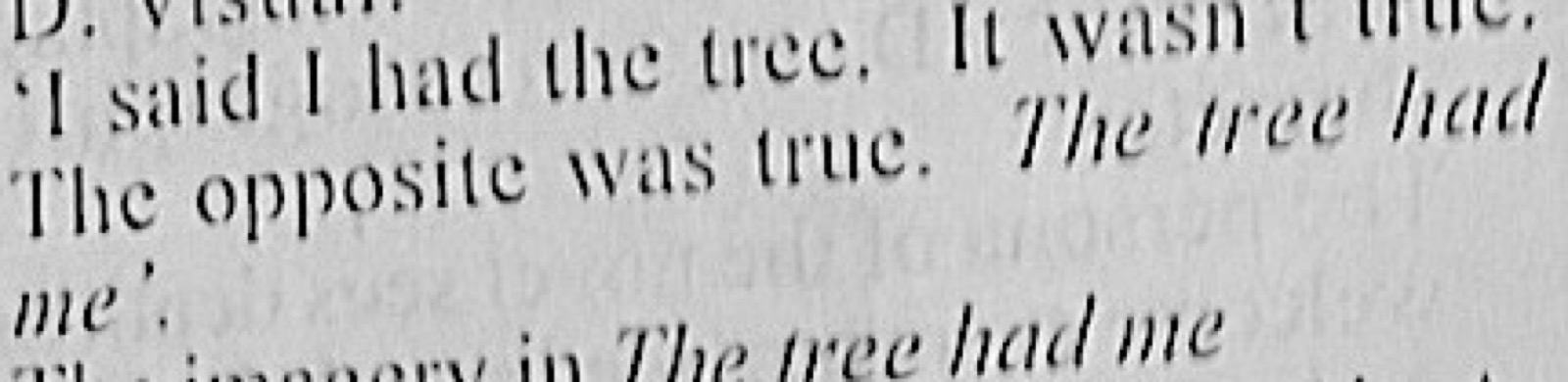
Non-African PoetryRobert Frost, Wild Grapes (extract)
The imagery in The tree had me from Robert Frost's 'Wild Grapes' is
- A.from the adventures of some wild children in the forest
- B.the dramatic suspension of a child on a tree
- C.the successful climbing of an adventurous boy
- D.reminiscent of man's transcendentalism
Show the answer and explanation
Answer: B (the dramatic suspension of a child on a tree)
ExplanationThe girl in the poem clings to a bending birch and is lifted into the air, left hanging: the tree had her, not she the tree.
Question 40
African PoetryArthur Nortje's 'Nightfall' despicts
- A.the yearning for self-fulfilment in life
- B.the horrors of nightfall
- C.the yearning for love
- D.anxiety at nightfall
Show the answer and explanation
Answer: B (the horrors of nightfall)
ExplanationThe poem presents night as a time of terror and danger, so it depicts the horrors of nightfall.
Question 41
Set Text: She Stoops to ConquerOliver Goldsmith's She Stoops to Conquer: The play is essentially about the
- A.theft of Miss Neville's trinket box
- B.comedy of errors of one night
- C.incompatibility of Mr. and Mrs. Hardcastle
- D.love affair between Kate and Marlow
Show the answer and explanation
Answer: B (comedy of errors of one night)
ExplanationThe play's subtitle is 'The Mistakes of a Night': Marlow and Hastings take the Hardcastles' house for an inn and confusion follows.
Question 42
Set Text: She Stoops to ConquerOliver Goldsmith's She Stoops to Conquer: In the play, the general picture depicted is that of
- A.lower-class degeneracy
- B.successfully arranged marriages
- C.chaotic value systems
- D.clearly focused personalities
Show the answer and explanation
Answer: C (chaotic value systems)
ExplanationTown and country manners clash and characters are confused about class and behaviour, a picture of mixed-up values.
Question 43
Set Text: She Stoops to ConquerOliver Goldsmith's She Stoops to Conquer: From the stage directions, it is apparent that Oliver Goldsmith makes use of a
- A.set each for the upper and lower classes
- B.different set for each Act
- C.variety of sets to suit the subject matter
- D.single set in the whole play
Show the answer and explanation
Answer: C (variety of sets to suit the subject matter)
ExplanationThe scenes move between the Hardcastles' house, the alehouse and the garden, so the sets change to suit the action.
Question 44
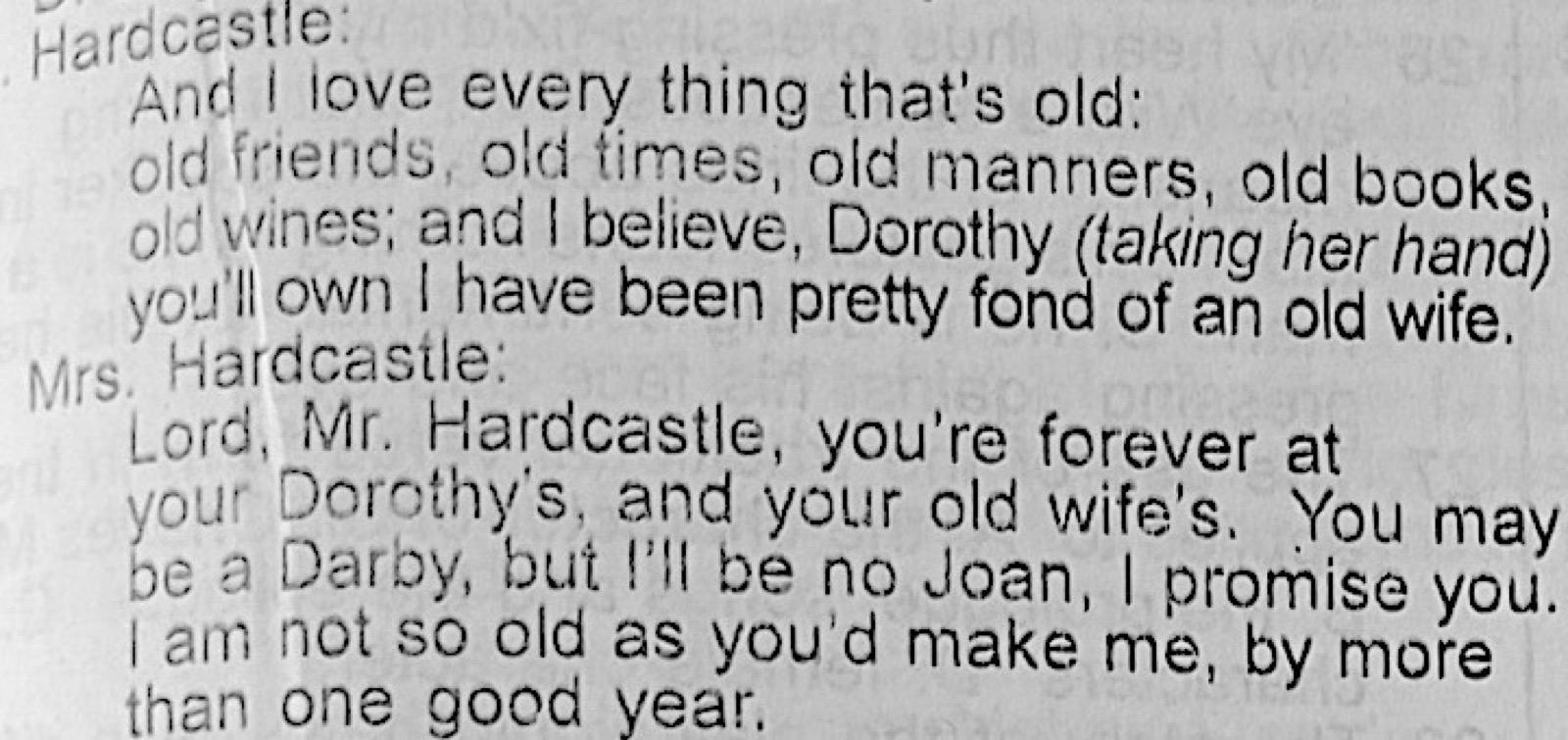
Set Text: She Stoops to ConquerOliver Goldsmith, She Stoops to Conquer (extract)
Oliver Goldsmith's She Stoops to Conquer: The dialogue above reveals the couple's
- A.fear of the unknown
- B.difference in lifestyle
- C.love for each other
- D.humorous disposition
Show the answer and explanation
Answer: B (difference in lifestyle)
ExplanationMr Hardcastle loves everything old, while Mrs Hardcastle wants fashion and does not want to be thought old: their tastes differ.
Question 45
Set Text: She Stoops to ConquerOliver Goldsmith's She Stoops to Conquer: Kate could best be described as
- A.a mild-tempered heroine
- B.an unassuming aristocrat
- C.a hot-tempered aristocrat
- D.an acutely sensitive character
Show the answer and explanation
Answer: B (an unassuming aristocrat)
ExplanationKate is a gentleman's daughter who happily dresses plainly and poses as a barmaid to win Marlow: an unassuming aristocrat.
Question 46
Other Set Texts: African DramaJ.P. Clark's The Wives' Revolt: Characterization in the play is
- A.economical but ineffective
- B.economical and effective
- C.elaborate but ineffective
- D.elaborate and effective
Show the answer and explanation
Answer: B (economical and effective)
ExplanationClark uses only a few characters, yet each is clearly drawn, so the characterisation is economical and effective.
Question 47
Other Set Texts: African DramaJ.P. Clark's The Wives' Revolt: The play is preoccupied with
- A.the fight by women to keep their goats
- B.the evil that oil money breeds
- C.women liberation from male domination
- D.women's protest against men's wickedness
Show the answer and explanation
Answer: D (women's protest against men's wickedness)
ExplanationThe wives walk out in protest at the men's unfair sharing of the oil money and the ban on goats, which they see as wicked.
Question 48
Other Set Texts: African DramaJ.P. Clark's The Wives' Revolt: The highest measure women in the community can take to register their protest is to
- A.take to prostitution
- B.carry out the nude act
- C.abandon their husbands
- D.abandon their children
Show the answer and explanation
Answer: C (abandon their husbands)
ExplanationThe women leave Erhuke and go to Ukpe, abandoning their husbands, as their strongest form of protest.
Question 49
Other Set Texts: African DramaJ.P. Clark's The Wives' Revolt: The plot of the play is lineal as reflected in the
- A.episodic nature of the play
- B.movement of the women
- C.arrangement of the events in the play
- D.progression of the argument of Okoro
Show the answer and explanation
Answer: C (arrangement of the events in the play)
ExplanationThe events follow one another in time order from beginning to end, so the arrangement of events is linear.
Question 50
Other Set Texts: African DramaJ.P. Clark, The Wives' Revolt (extract)
J.P. Clark's The Wives' Revolt: The event above happens in
- A.Iyara when Okoro discovers Koko's infidelity
- B.Erhuwaren when Koko suspects and accuses her husband
- C.Erhuwaren when Okoro suspects Koko of infidelity
- D.Erhuwaren before Koko's return from Iyara
Show the answer and explanation
Answer: C (Erhuwaren when Okoro suspects Koko of infidelity)
ExplanationAt home in Erhuwaren, Okoro suspects his wife Koko of unfaithfulness and threatens her, and Idama pushes her to safety.