Home › Past questions › JAMB › Literature in English › 2001 48 questions. Try each one, then open the answer to check yourself and read the explanation.
Sign up free to answer these questions on a CBT screen with a timer, then see your score and every answer explained.
Start practising free
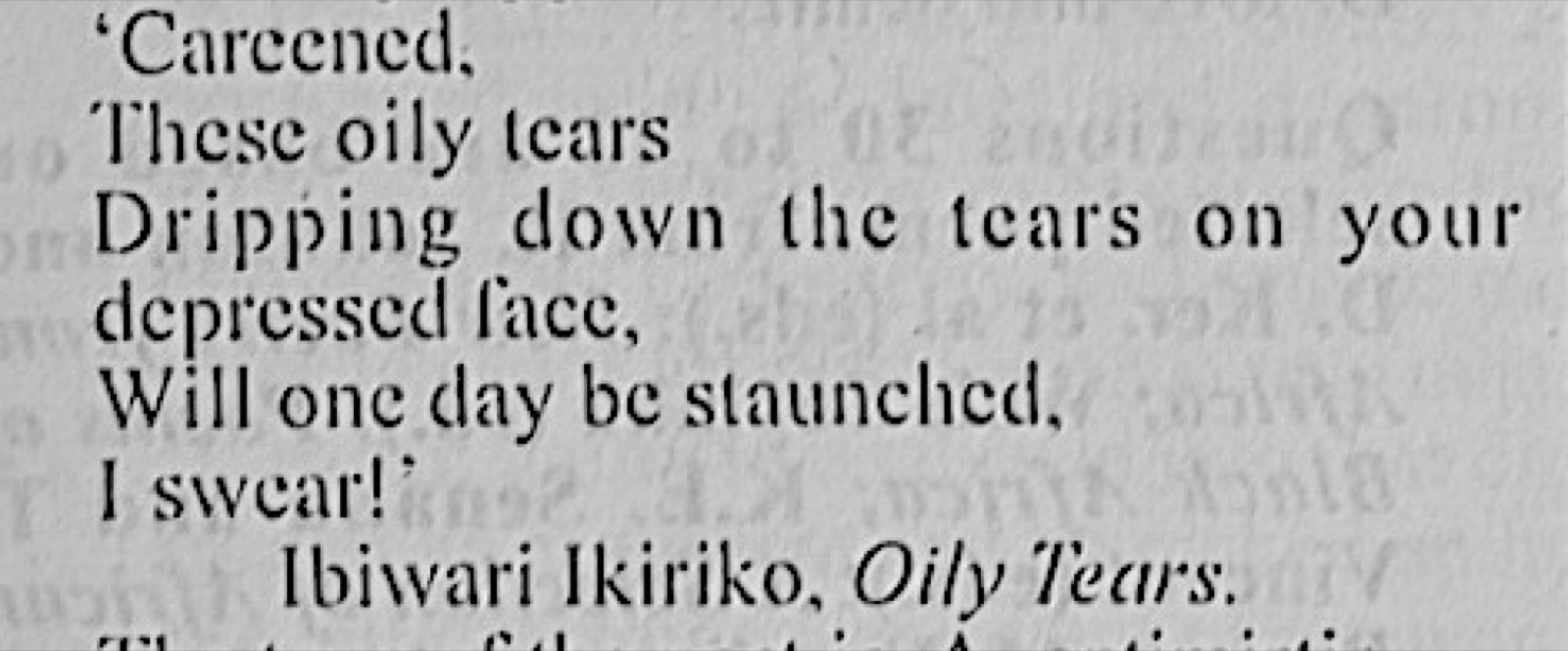
Question 1 Literary Appreciation: Poetry Ibiwari Ikiriko, Oily Tears (extract) Ibiwari Ikiriko, Oily Tears : The tone of the poet is
A. optimistic B. supplicatory C. sympathetic D. piteous Show the answer and explanation Answer: A (optimistic )
Explanation The poet promises 'I swear!' that the oily tears will one day be stopped, a hopeful, optimistic tone.
Open this question
Question 2 Literary Appreciation: Poetry P.B. Shelley, Sonnet : The stanza above is an example of a
A. quatrain B. couplet C. free verse D. limerick Show the answer and explanation Answer: A (quatrain )
Explanation The extract is a four-line unit of verse, and a four-line stanza is a quatrain.
Open this question
Question 3 Literary Appreciation: Poetry Frank Collymore, Hymn to the Sea : The address to the sea in the lines above is done by the use of
A. personification B. praise C. symbolism D. apostrophe Show the answer and explanation Answer: A (personification )
Explanation The sea is called 'Mother and destroyer' and said to give birth to life and dreams, so it is given human qualities: personification.
Open this question
Question 4 Literary Appreciation: Prose and Drama Isidore Okpewho, The Last Duty : The reaction in the passage above is that of
A. rejection B. anger C. protest D. nausea Show the answer and explanation Answer: D (nausea )
Explanation The odour shocks him, he corks the bottle at once and spits on the floor: a feeling of sickness, or nausea.
Open this question
Question 5 Literary Appreciation: Prose and Drama Wole Soyinka, The Beautification of Area Boy : The literary devices in the dialogue above are
A. humour and irony B. allusion and paradox C. irony and parody D. hyperbole and allusion Show the answer and explanation Answer: D (hyperbole and allusion )
Explanation Shaving 'an entire battalion between one coup and the next' is exaggeration (hyperbole), and the coups refer to Nigeria's military history (allusion).
Open this question
Question 6 Literary Appreciation: Poetry John Updike, Wash : The images set in the lines above are of
A. the days of Noah B. rain and flood in June C. discomfort and likely destruction D. an animal, insects and fun Show the answer and explanation Answer: C (discomfort and likely destruction )
Explanation A week of rain and a storm turning like a dog, with people as fleas complaining in its hair, suggest discomfort and the threat of being shaken off.
Open this question
Question 7 Literary Appreciation: Prose and Drama Ralph Ellison, Juneteenth : The force of the speech above is sustained on
A. delivery B. musicality C. repetition D. oratory Show the answer and explanation Answer: C (repetition )
Explanation The word 'asleep' is repeated again and again to drive the point home, so the speech draws its force from repetition.
Open this question
Question 8 Literary Appreciation: Prose and Drama Charles Dickens, Hard Times : From the passage above, Thomas Gradgrind is
A. dogmatic B. hostile C. theoretical D. eloquent Show the answer and explanation Answer: A (dogmatic )
Explanation He holds fixed principles ('two and two are four, and nothing over') and will not be persuaded otherwise, which is dogmatic.
Open this question
Question 9 Literary Appreciation: Prose and Drama Gabriel Garcia Marquez, The General in His Labyrinth : The master in the passage above is obviously in a state of
A. labyrinth B. drowning C. forgetfulness D. trance Show the answer and explanation Answer: D (trance )
Explanation The General lies floating with open eyes, lost in an ecstasy as if no longer of this world: a trance, not drowning.
Open this question
Question 10 Other Set Texts: Non-African Prose Ernest Hemingway's The Old Man and the Sea : The character 'boy' is used alongside 'the old Man' in the novel to demonstrate
A. the humiliation that is in old age B. man's refusal to grow old C. different types of characters in the story D. the failing productivity that accompanies old age Show the answer and explanation Answer: D (the failing productivity that accompanies old age )
Explanation Manolin, young and able, contrasts with Santiago, who has gone 84 days without a fish; the pairing shows how productivity declines with age.
Open this question
Question 11 Other Set Texts: Non-African Prose The Old Man and the Sea epitomizes
A. the relationship between a man and a fish B. the vain expectations of man C. life on the high seas D. a fulfilled life Show the answer and explanation Answer: B (the vain expectations of man )
Explanation Santiago's great catch, his hope of success, is eaten away to a skeleton, which sums up how man's high expectations often come to nothing.
Open this question
Question 12 Other Set Texts: Non-African Prose Ernest Hemingway's The Old Man and the Sea : The skeleton of the marlin implies the
A. sharks' predatory inclination B. futility of human struggle C. old man's lack of faith D. old man's incompetence in fishing Show the answer and explanation Answer: B (futility of human struggle )
Explanation After all his effort Santiago brings home only bones, a picture of how human struggle can end in nothing.
Open this question
Question 13 Other Set Texts: Non-African Prose Ernest Hemingway's The Old Man and the Sea : Santiago loses his catch to the sharks because
A. the blood attracts them B. he does not sail home early C. the sharks are predators D. it is too dark Show the answer and explanation Answer: A (the blood attracts them )
Explanation The wounded marlin, lashed to the boat, leaves a trail of blood in the water that draws shark after shark to it.
Open this question
Question 14 Other Set Texts: African Prose Camara Laye's The African Child : Laye's stay with Uncle Mamadou reveals a lot about
A. his unwillingness to stay with his parents B. his affection for his uncle C. the strength of communal living in Africa D. the irresponsibility of his parents Show the answer and explanation Answer: C (the strength of communal living in Africa )
Explanation In Conakry Laye lives with his uncle's family as if it were his own, showing how the extended family supports its members.
Open this question
Question 15 Other Set Texts: African Prose Camara Laye's The African Child : The setting of The African Child is a kingdom with
A. Islamic and modern traditions B. pre-Islamic and Islamic traditions C. pre-Islamic traditions D. pre-Islamic and modern traditions Show the answer and explanation Answer: B (pre-Islamic and Islamic traditions )
Explanation Laye's family are Muslims, yet they also keep older animist beliefs such as the guardian snake and initiation rites, so both traditions live side by side.
Open this question
Question 16 Other Set Texts: African Prose Camara Laye's The African Child : Laye's first-person narrative technique
A. makes the work very humorous B. makes his work less realistic C. quickens the tempo of his narrative D. makes his story more believable Show the answer and explanation Answer: D (makes his story more believable )
Explanation Telling his own childhood as 'I' gives the reader an eyewitness account, which makes the story feel true and believable.
Open this question
Question 17 Other Set Texts: African Prose Buchi Emecheta's Second Class Citizen : Pa Noble became a living legend because
A. several conflicting stories were woven around him B. he attained the status of a first-class citizen C. he was the only successful son of a Benin chief D. he was rich and very generous Show the answer and explanation Answer: A (several conflicting stories were woven around him )
Explanation Pa Noble was a mysterious figure about whom people told many different, contradictory stories, which made him a legend.
Open this question
Question 18 Other Set Texts: African Prose Buchi Emecheta's Second Class Citizen : The marriage of Adah and Francis collapses because of
A. Adah's unfaithfulness to Francis B. the influence of British culture C. Adah's desire for personal fulfilment D. external pressures on the couple Show the answer and explanation Answer: C (Adah's desire for personal fulfilment )
Explanation Adah wants to work, write and grow, but Francis wants a submissive wife and even burns her manuscript; her drive for fulfilment ends the marriage.
Open this question
Question 19 Other Set Texts: African Prose Buchi Emecheta's Second Class Citizen : The central theme in Second Class Citizen is that women should
A. be involved in national and international politics B. beware of men and their sweet words C. seek spiritual guidance before going into marriage D. free themselves from the negative forces of patriarchy Show the answer and explanation Answer: D (free themselves from the negative forces of patriarchy )
Explanation Adah's story shows a woman breaking free from men's control in the family and society, i.e. from patriarchy.
Open this question
Question 20 Other Set Texts: African Drama Femi Osofisan's Morountodun : The character of Marshal in the play shows that
A. human beings are selfless B. human beings are the same C. men love women D. human beings love power Show the answer and explanation Answer: A (human beings are selfless )
Explanation Marshal gives himself completely to the peasants' cause, putting the struggle above his own safety, which shows selflessness.
Open this question
Question 22 Other Set Texts: African Drama Femi Osofisan's Morountodun : The war in the play symbolizes the struggle between the
A. capitalists and the socialists B. bourgeoisie and the proletariat C. market women and the men D. farmers and the consumers Show the answer and explanation Answer: B (bourgeoisie and the proletariat )
Explanation The farmers' revolt against the rich and the government stands for the class struggle of the poor (proletariat) against the wealthy (bourgeoisie).
Open this question
Question 23 Other Set Texts: African Drama Femi Osofisan's Morountodun : The diction of the play can be described as
A. political and rhetorical B. arrogant and condemnatory C. urgent but apolitical D. poetic but difficult Show the answer and explanation Answer: A (political and rhetorical )
Explanation The play is about class struggle and uses speeches meant to persuade, so its language is political and rhetorical.
Open this question
Question 24 Other Set Texts: African Drama Femi Osofisan's Morountodun : The frequent intervention of the Director makes the stage experience of Morountodun very
A. prolonged B. boring C. informal D. uncoordinated Show the answer and explanation Answer: C (informal )
Explanation The Director breaks into the action and talks to the audience, which removes the barrier of the stage and makes the performance informal.
Open this question
Question 25 Set Text: Twelfth Night William Shakespeare, Twelfth Night (Malvolio's speech) William Shakespeare's Twelfth Night : The images in the quotation above express the speaker's
A. contempt and admiration B. hatred and pity C. contempt and disregard D. disregard and pity Show the answer and explanation Answer: A (contempt and admiration )
Explanation Malvolio sneers at the young messenger as neither man nor boy, yet admits he is 'very well-favoured' and speaks sharply: contempt mixed with admiration.
Open this question
Question 26 Set Text: Twelfth Night William Shakespeare's Twelfth Night : In the lines above, the character is
A. expressing his preference for a cypress coffin B. expressing his unhappiness about death C. lamenting over his unreciprocated love D. wishing for death to come Show the answer and explanation Answer: C (lamenting over his unreciprocated love )
Explanation Feste sings this song for Orsino about a lover killed by a cruel maid, which matches Orsino's grief at Olivia's refusal of his love.
Open this question
Question 27 Set Text: Twelfth Night William Shakespeare's Twelfth Night : The traditional verse form of speech as dialogue in Twelfth Night is used to symbolize the
A. impressiveness of the character B. distinction between verse and prose C. function of poetry in the play D. traditionality of the play Show the answer and explanation Answer: A (impressiveness of the character )
Explanation Noble characters such as Orsino, Olivia and Viola usually speak in verse, which marks their rank and dignity.
Open this question
Question 29 Set Text: Twelfth Night Twelfth Night is preoccupied with the juxtaposition of
A. death and disappointment B. appearance and reality C. life and disappointment D. love and death Show the answer and explanation Answer: B (appearance and reality )
Explanation Disguise and mistaken identity (Viola as Cesario, Malvolio fooled by a forged letter) set what things seem against what they really are.
Open this question
Question 30 African Poetry In Niyi Osundare's 'They Too Are The Earth' , musical effect is achieved by
A. repetition B. double rhymes C. assonance D. end rhymes Show the answer and explanation Answer: A (repetition )
Explanation Osundare repeats words and lines, such as the title phrase, to give the poem its song-like rhythm.
Open this question
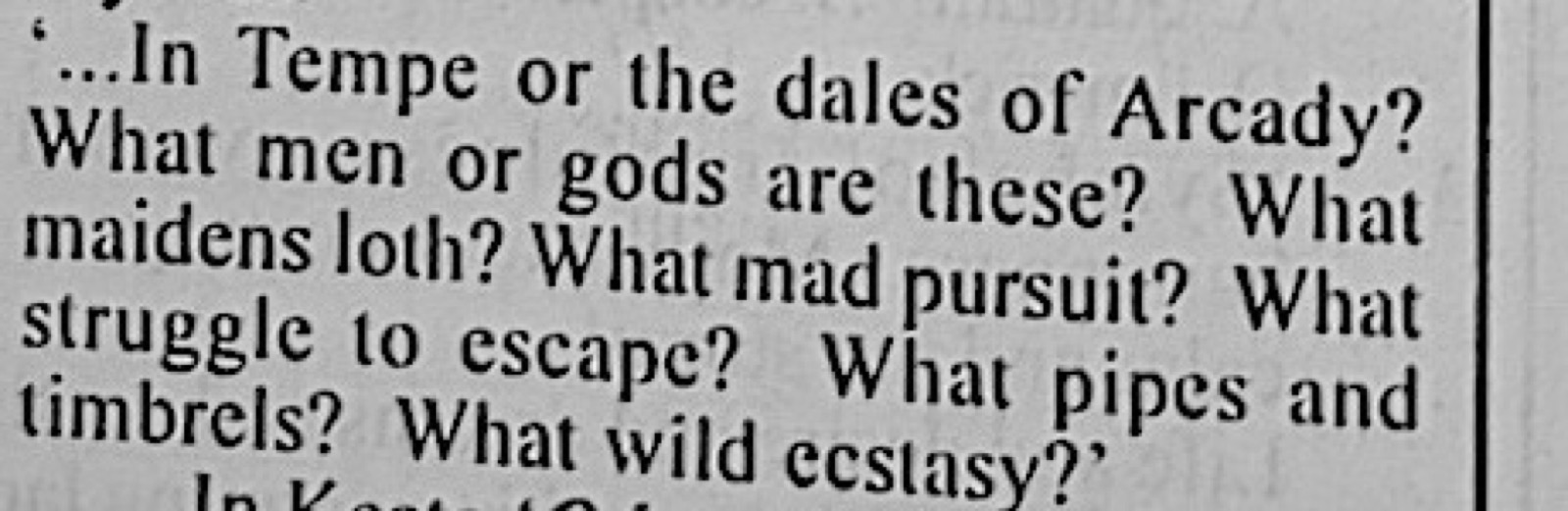
Question 31 Non-African Poetry John Keats, Ode on a Grecian Urn (extract) In Keats 'Ode on a Grecian Urn' , the recurrent use of the rhetorical question in the lines above suggests
A. admiration and amazement B. confusion and fear C. shock and surprise D. worry and sadness Show the answer and explanation Answer: A (admiration and amazement )
Explanation The speaker fires question after question about the scene on the urn because he is fascinated and amazed by it.
Open this question
Question 32 African Poetry The rhyming pattern in the last stanza of Okigbo's 'Hurrah for Thunder' makes the stanza
A. an octave B. a quatrain C. a couplet D. a sestet Show the answer and explanation Answer: C (a couplet )
Explanation The last stanza is two rhyming lines ('...hell' / '...bell'), which is a couplet.
Open this question
Question 33 Non-African Poetry The theme of Browning's 'My Last Duchess' is
A. an aristocrat's marital problems B. the pitfalls of a duchess now dead C. an ambassador's personal life D. the pride and arrogance of an aristocrat Show the answer and explanation Answer: D (the pride and arrogance of an aristocrat )
Explanation The Duke reveals his pride in his name and his arrogant wish to control his wife, which led to her death.
Open this question
Question 34 African Poetry Tanure Ojaide's 'The Owl Wakes Us' portrays a society that is
A. unstable B. hunted by the owl C. gripped with fear D. peaceful Show the answer and explanation Answer: A (unstable )
Explanation The poem shows a troubled society moving from one nightmare to another, with no settled peace: an unstable society.
Open this question
Question 35 African Poetry In Mapanje's 'When This Carnival Finally Closes' , the poet is describing the
A. role of spirits in a carnival B. preparation for a carnival C. role of drumming and dancing in a carnival D. role of sycophancy and bad leadership Show the answer and explanation Answer: D (role of sycophancy and bad leadership )
Explanation The 'carnival' is the dictator's reign of praise-singing; the poem attacks the flatterers and the bad ruler they serve.
Open this question
Question 36 African Poetry From the tone of Wole Soyinka's 'Telephone Conversation' , the two persons talking hold each other in
A. mutual suspicion B. deep affection C. high esteem D. outright contempt Show the answer and explanation Answer: A (mutual suspicion )
Explanation The landlady is wary of a black tenant and the man is wary of her prejudice; each is suspicious of the other.
Open this question
Question 37 Non-African Poetry The major theme of Thomas Gray's 'Elegy Written in a Country Churchyard' is that death renders life
A. meaningless for the rich B. meaningful for the poor C. meaningless for all D. meaningful for all Show the answer and explanation Answer: C (meaningless for all )
Explanation 'The paths of glory lead but to the grave': death ends rich and poor alike, so worldly achievement counts for nothing.
Open this question
Question 38 African Poetry In Rubadiri's 'Stanley Meets Mutesa' , the poet portrays the hardship experienced by the explorer's party through
A. visual and verbal images B. visual and tactile images C. olfactory and visual images D. auditory and olfactory images Show the answer and explanation Answer: C (olfactory and visual images )
Explanation The poem lets us see the weary, ragged carriers and smell the sweat and decay along the way, using sight and smell images.
Open this question
Question 39 Non-African Poetry Browning's 'My Last Duchess' apparently shows Duke's
A. hatred for common love B. desire to marry beautiful women C. appreciation of works of art D. praise of Fra Pandolf Show the answer and explanation Answer: A (hatred for common love )
Explanation The Duke resents that the Duchess gave her smiles and thanks to everyone alike; he hated her ordinary, undiscriminating love.
Open this question
Question 40 Non-African Poetry John Keats' 'Ode on a Grecian Urn' expresses the idea that
A. the Grecian Urn is ancient B. the Grecian Urn is mysterious C. every work of art is beautiful D. life is long, art is longer Show the answer and explanation Answer: D (life is long, art is longer )
Explanation Keats shows the urn's figures lasting for ever while people grow old and die: art outlasts life.
Open this question
Question 41 African Poetry In Oswald Mtshali's 'Nightfall in Soweto' , night
A. drives man's enemy B. fools man's enemy C. hides man's enemy D. aids man's enemy Show the answer and explanation Answer: D (aids man's enemy )
Explanation In the poem night is when thugs and police attack, so the darkness helps those who prey on the people.
Open this question
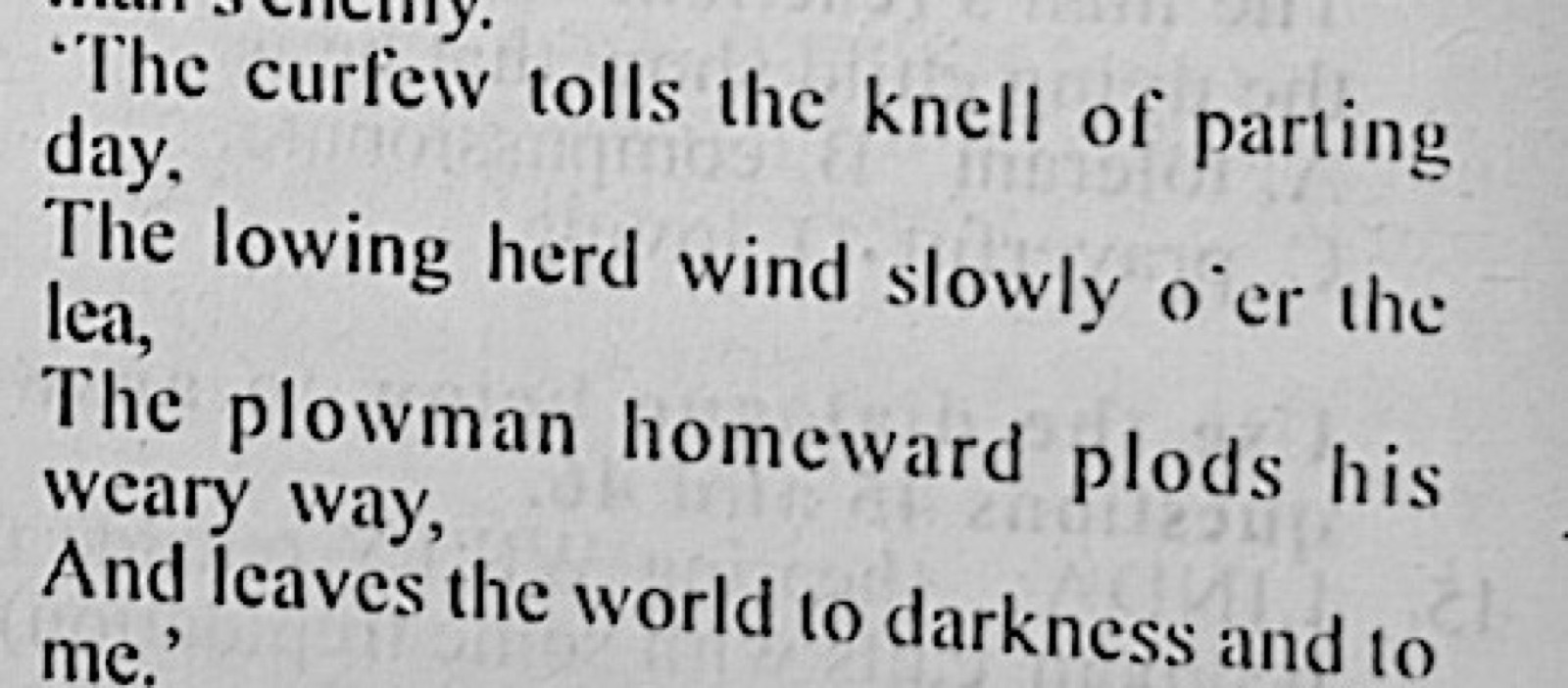
Question 42 Non-African Poetry Thomas Gray, Elegy Written in a Country Churchyard (extract) In the lines above from Gray's 'Elegy Written in a Country Churchyard' , the imagery is
A. of an approaching night in a rustic setting B. of an approaching death in a village C. about a village under a curfew one night D. of a man abandoned in his homeward journey Show the answer and explanation Answer: A (of an approaching night in a rustic setting )
Explanation The evening bell, the cattle going home and the ploughman leaving the fields picture nightfall in the countryside.
Open this question
Question 43 Poetry: General The most important concepts in poetry are
A. story and action B. plot and rhythm C. rhythm and imagery D. plot and character Show the answer and explanation Answer: C (rhythm and imagery )
Explanation Story, plot and character belong mainly to prose and drama; poetry depends above all on rhythm and imagery.
Open this question
Question 44 Literary Terms and Devices The literary device which anticipates that an event will take place is best described as
A. foreshadowing B. rising action C. flashback D. parody Show the answer and explanation Answer: A (foreshadowing )
Explanation Foreshadowing gives hints of what will happen later in a story.
Open this question
Question 45 Literary Terms and Devices The flat character in a literary work
A. is the same as the round character B. cannot be found in an allegory C. is capable of growing D. always embodies a quality Show the answer and explanation Answer: D (always embodies a quality )
Explanation A flat character is built around a single idea or quality and does not change.
Open this question
Question 46 Drama: General The overwhelming pride that destroys the tragic hero is called
A. tragedy B. nemesis C. catharsis D. hubris Show the answer and explanation Answer: D (hubris )
Explanation Hubris is excessive pride that leads the tragic hero to his downfall.
Open this question
Question 47 Drama: General A farce refers to a drama that has elements of the
A. serious B. satiric C. comic D. tragic Show the answer and explanation Answer: C (comic )
Explanation A farce is a light comedy built on absurd situations and horseplay meant to make people laugh.
Open this question
Question 48 Drama: General Catharsis is experienced
A. after one has written a play B. when a play is still being staged C. before watching a play D. after watching a play Show the answer and explanation Answer: D (after watching a play )
Explanation Catharsis is the cleansing of pity and fear that the audience feels when a tragedy reaches its end.
Open this question
Question 49 Prose: General An extended fictional narrative which is realistic is known as a
A. diary B. novel C. novella D. short story Show the answer and explanation Answer: B (novel )
Explanation A novel is a long fictional prose story, usually realistic; a novella and a short story are shorter.
Open this question
Question 50 Drama: General The technique in which both the stage and the auditorium are involved in a play production is called
A. theatre of the absurd B. role-playing C. audience participation D. total theatre Show the answer and explanation Answer: C (audience participation )
Explanation When the audience in the auditorium is drawn into the action on stage, the technique is audience participation.
Open this question Sign up free for every JAMB Literature in English year, practice by topic and timed mocks.
Start practising free