Home › Past questions › JAMB › Literature in English › 1999 42 questions. Try each one, then open the answer to check yourself and read the explanation.
Sign up free to answer these questions on a CBT screen with a timer, then see your score and every answer explained.
Start practising free
Question 1 Other Set Texts: African Drama In the play, social change is achieved through
A. collectivism B. sectionalism C. individualism D. communism. Show the answer and explanation Answer: A (collectivism )
Explanation In Morountodun the farmers win change by acting together as a group.
Open this question
Question 2 Other Set Texts: African Drama Titubi joins the farmers' revolt
A. to ensure its success B. as a spy for the establishment C. in pursuit of Marshal D. to defy the police. Show the answer and explanation Answer: B (as a spy for the establishment )
Explanation Like Moremi in the legend, Titubi lets herself be taken by the farmers in order to spy on them for the government.
Open this question
Question 5 Set Text: Twelfth Night 'She bore a mind that envy could not but call fair' The statement above characterizes
A. Maria B. Olivia C. Roderigo D. Viola. Show the answer and explanation Answer: D (Viola. )
Explanation Sebastian praises his lost twin sister Viola: even an envious person would call her mind fair.
Open this question
Question 6 Set Text: Twelfth Night According to the play, the Duke of Illyria is fascinated by
A. the idea of love B. the food of love C. music D. entertainment. Show the answer and explanation Answer: A (the idea of love )
Explanation Orsino is more in love with being in love than with Olivia herself.
Open this question
Question 7 Set Text: Twelfth Night DUKE: ...Thou know'st no less but all: I have unclasped To thee the book even of my secret soul. What exactly has the Duke unclasped?
A. The book of his relationship with Olivia B. The secret of his soul C. The details of his relationship with Viola D. The details of his relationship with Olivia. Show the answer and explanation Answer: D (The details of his relationship with Olivia. )
Explanation Orsino has told "Cesario" everything about his love for Olivia before sending him to woo her.
Open this question
Question 8 Set Text: Twelfth Night 'I'll do my best To woo your lady.' What is the sincere desire of the person who made the statement above?
A. That she succeeds in winning the love for the master B. That her best is good enough to win affection C. That she herself becomes the beloved D. That she herself wins the love. Show the answer and explanation Answer: C (That she herself becomes the beloved )
Explanation Viola, disguised as Cesario, loves Orsino and wishes she could be his wife instead of Olivia.
Open this question
Question 10 Set Text: Twelfth Night What would you consider to be the major theme of the play?
A. Love at first sight B. Unrequited love C. Illusion and reality D. Humour and tragedy. Show the answer and explanation Answer: B (Unrequited love )
Explanation Orsino loves Olivia, Olivia loves Cesario, Viola loves Orsino: love that is not returned runs through the play.
Open this question
Question 12 Other Set Texts: African Prose The father permits his son to go to Paris because he
A. sees no future in traditional African ways B. is encouraged by the missionaries C. wants him to be a future leader D. wishes to free him from blacksmithing. Show the answer and explanation Answer: A (sees no future in traditional African ways )
Explanation The father accepts that the old ways cannot give his son the future that education in France can.
Open this question
Question 13 Other Set Texts: African Prose The author makes the reader believe his story by using
A. a confessional style B. elements of humour C. detailed description D. another narrator. Show the answer and explanation Answer: C (detailed description )
Explanation Laye describes his father's workshop, the fields and the ceremonies in close detail.
Open this question
Question 14 Other Set Texts: African Prose The novel is a mixture of
A. fiction and fantasy B. the objective and the absurd C. pessimism and optimism D. the real and the supernatural. Show the answer and explanation Answer: D (the real and the supernatural. )
Explanation Everyday village life sits beside snakes that guide his father and other supernatural events.
Open this question
Question 15 Other Set Texts: African Prose Which of these features give the novel an African setting?
A. Marabouts, spirits and family life B. Family life, death and marabouts C. Blacksmiths, spirits and magicians D. Spirits, magicians and death. Show the answer and explanation Answer: A (Marabouts, spirits and family life )
Explanation Marabouts, spirits and the extended family belong to the West African world of the book.
Open this question
Question 16 Other Set Texts: African Prose In Adah's view, the white society in the novel is one in which
A. there is communal feeling B. neighbourliness is lacking C. neighbours live happily D. members are unfriendly. Show the answer and explanation Answer: D (members are unfriendly. )
Explanation In London Adah finds people cold and unfriendly to her.
Open this question
Question 17 Other Set Texts: African Prose To raise the reader's anxiety about the story, the author sometimes
A. stops the main story to narrate other events B. creates a lot of funny episodes C. puts too many difficulties in Adah's way D. shows that Francis is weak. Show the answer and explanation Answer: C (puts too many difficulties in Adah's way )
Explanation Adah faces one problem after another (housing, money, Francis, pregnancy), so we keep worrying about her.
Open this question
Question 18 Other Set Texts: Non-African Prose The struggle between the old man and the fish symbolizes
A. the blood thirsty nature of sharks B. man's refusal to grow old C. man's struggle for survival in a harsh world D. the uncertainty of life in a cruel world. Show the answer and explanation Answer: C (man's struggle for survival in a harsh world )
Explanation Santiago's long fight with the marlin stands for every person's struggle to survive.
Open this question
Question 19 Other Set Texts: Non-African Prose "I wish the boy was here,..." The old man's cry demonstrates
A. a desperation for productivity B. bitterness C. humiliation D. a yearning for human brotherhood. Show the answer and explanation Answer: D (a yearning for human brotherhood. )
Explanation Alone far out at sea, Santiago longs for the boy's company and help.
Open this question
Question 20 Other Set Texts: Non-African Prose One of the universal themes of the novel is the
A. selfishness of man against his own environment B. relationship between man and nature C. great struggle between the old man and the fish D. connection of the sea to human greed. Show the answer and explanation Answer: B (relationship between man and nature )
Explanation Santiago loves and respects the sea and the fish even as he must fight them.
Open this question
Question 21 African Poetry Okigbo's 'Hurrah for Thunder' is a prophetic poem because it
A. correctly predicts the end of those who abuse power B. predicts the coming of military rulers C. pictures the return of politicians to the scene D. pictures the poet going to hell. Show the answer and explanation Answer: A (correctly predicts the end of those who abuse power )
Explanation The poem foresaw the fall of the corrupt politicians who abused power.
Open this question
Question 23 African Poetry In Rubadiri's 'Stanley Meets Mutesa', the king receives the explorer with
A. suspicion B. delight C. optimism D. relief. Show the answer and explanation Answer: B (delight )
Explanation The poem ends with the king's welcome, 'Mtu mweupe karibu' (white man, you are welcome): Mutesa receives the explorer gladly.
Open this question
Question 24 African Poetry The most dominant pair of poetic device in Mtshali's 'Nightfall in Soweto' is
A. simile and repetition B. rhythm and metaphor C. metaphor and alliteration D. repetition and personification. Show the answer and explanation Answer: D (repetition and personification. )
Explanation "Nightfall! Nightfall!" is repeated, and night is spoken of as a living enemy.
Open this question
Question 25 African Poetry Osundare's 'They Too are the Earth' can be interpreted as
A. a defence of the underprivileged B. an apology for the affluent C. a song of sorrow D. a reaction against labour. Show the answer and explanation Answer: A (a defence of the underprivileged )
Explanation The poet insists that the beggars and labourers are also "the earth" and deserve respect.
Open this question
Question 26 African Poetry The villains in this poem by Osundare are
A. the beggars sprawled in gutters B. those who squander the wealth of the earth C. the thousands buried alive D. the people who die in abandon. Show the answer and explanation Answer: B (those who squander the wealth of the earth )
Explanation Those who fritter the forest and live richly while others suffer are the villains.
Open this question
Question 28 African Poetry The owl is used by Ojaide in this poem as a
A. metaphor B. symbol C. simile D. satire. Show the answer and explanation Answer: B (symbol )
Explanation The owl stands for evil and bad omens.
Open this question
Question 29 Non-African Poetry Gray's 'Elegy Written in a Country Churchyard' is a
A. lamentation over a dead friend B. lamentation over the passing of life C. reflection on the passing of life D. reflection on nature. Show the answer and explanation Answer: C (reflection on the passing of life )
Explanation Gray thinks quietly about death and the lives of the humble dead.
Open this question
Question 30 Non-African Poetry The Duke's most precious gift to the Duchess in Browning's 'My Last Duchess' is
A. his family name B. a wedding ring C. his aristocratic class D. the title of a Duchess. Show the answer and explanation Answer: A (his family name )
Explanation The Duke is angry that she did not value his ancient family name above everything.
Open this question
Question 31 Non-African Poetry In Browning's 'My Last Duchess', the Duke complains that his wife is
A. a snob B. a coquette C. a spendthrift D. disrespectful. Show the answer and explanation Answer: D (disrespectful. )
Explanation He resents that she smiled at everyone alike and did not honour him above others.
Open this question
Question 32 African Poetry 'Nightfall! Nightfall! You are my mortal enemy'. The figurative name for the manner in which nightfall is directly addressed as though present in Mtshali's 'Nightfall in Soweto' is
A. an ode B. allusion C. apostrophe D. dramatic monologue. Show the answer and explanation Answer: C (apostrophe )
Explanation Speaking directly to something absent or not human is apostrophe.
Open this question
Question 33 African Poetry The line 'under snakeskin shoes and Mercedes tyres' in Osundare's 'They Too are the Earth' is a good example of
A. alliteration B. metonymy C. contrast D. similitude. Show the answer and explanation Answer: B (metonymy )
Explanation "Snakeskin shoes" and "Mercedes tyres" stand for the wealthy class.
Open this question
Question 34 Drama: General A denouement in a play
A. causes conflicts B. creates conflicts C. resolves conflicts D. creates catastrophe. Show the answer and explanation Answer: C (resolves conflicts )
Explanation The denouement unties the plot and settles the conflicts.
Open this question
Question 35 Poetry: General A couplet refers to
A. two successive lines of rhyming verse B. two stanzas that cannot stand alone C. four irregular verses in stanzas D. poetry that is acted on stage. Show the answer and explanation Answer: A (two successive lines of rhyming verse )
Explanation A couplet is a pair of rhyming lines.
Open this question
Question 36 Drama: General In drama, the term climax is used
A. as a figure of speech connoting beauty B. for the point of highest dramatic tension C. when the crisis in the play is resolved D. when the hero's tragic flaw is revealed. Show the answer and explanation Answer: B (for the point of highest dramatic tension )
Explanation The climax is the turning point of greatest tension.
Open this question
Question 38 Figures of Speech 'Whereat: with blade, with bloody blameful blade He bravely broached his boiling bloody best'. The dominant figure of speech in the lines above is
A. simile B. alliteration C. assonance D. repetition. Show the answer and explanation Answer: B (alliteration )
Explanation The "b" sound is repeated again and again.
Open this question
Question 39 Drama: General A humorous play based on an unrealistic situation is considered in drama as
A. comedy B. tragedy C. farce D. burlesque. Show the answer and explanation Answer: C (farce )
Explanation A farce gets its laughs from absurd, improbable situations.
Open this question
Question 40 Figures of Speech The device used by writers to give truths by indirection is called
A. satire B. hyperbole C. paradox D. irony. Show the answer and explanation Answer: D (irony. )
Explanation Irony states a truth by saying something different from, or opposite to, what is meant.
Open this question
Question 41 Prose: General The arrangement of incidents in a novel in which one action precipitates another is called
A. sub theme B. chronology C. suspense D. causality. Show the answer and explanation Answer: D (causality. )
Explanation One event leading to another is cause and effect: causality.
Open this question
Question 42 Literary Terms and Devices The theme of a literary work is the
A. dominant pre-occupation of the work B. interesting issues raised in the work C. different views on a particular topic D. psychological issues in the work. Show the answer and explanation Answer: A (dominant pre-occupation of the work )
Explanation The theme is the main concern of the work.
Open this question
Question 43 Prose: General A metaphor in which objects, persons and events in a story are equated with meanings that lie outside the narrative itself is
A. fable B. personification C. allegory D. symbolism. Show the answer and explanation Answer: C (allegory )
Explanation An allegory is an extended metaphor whose characters and events stand for other meanings.
Open this question
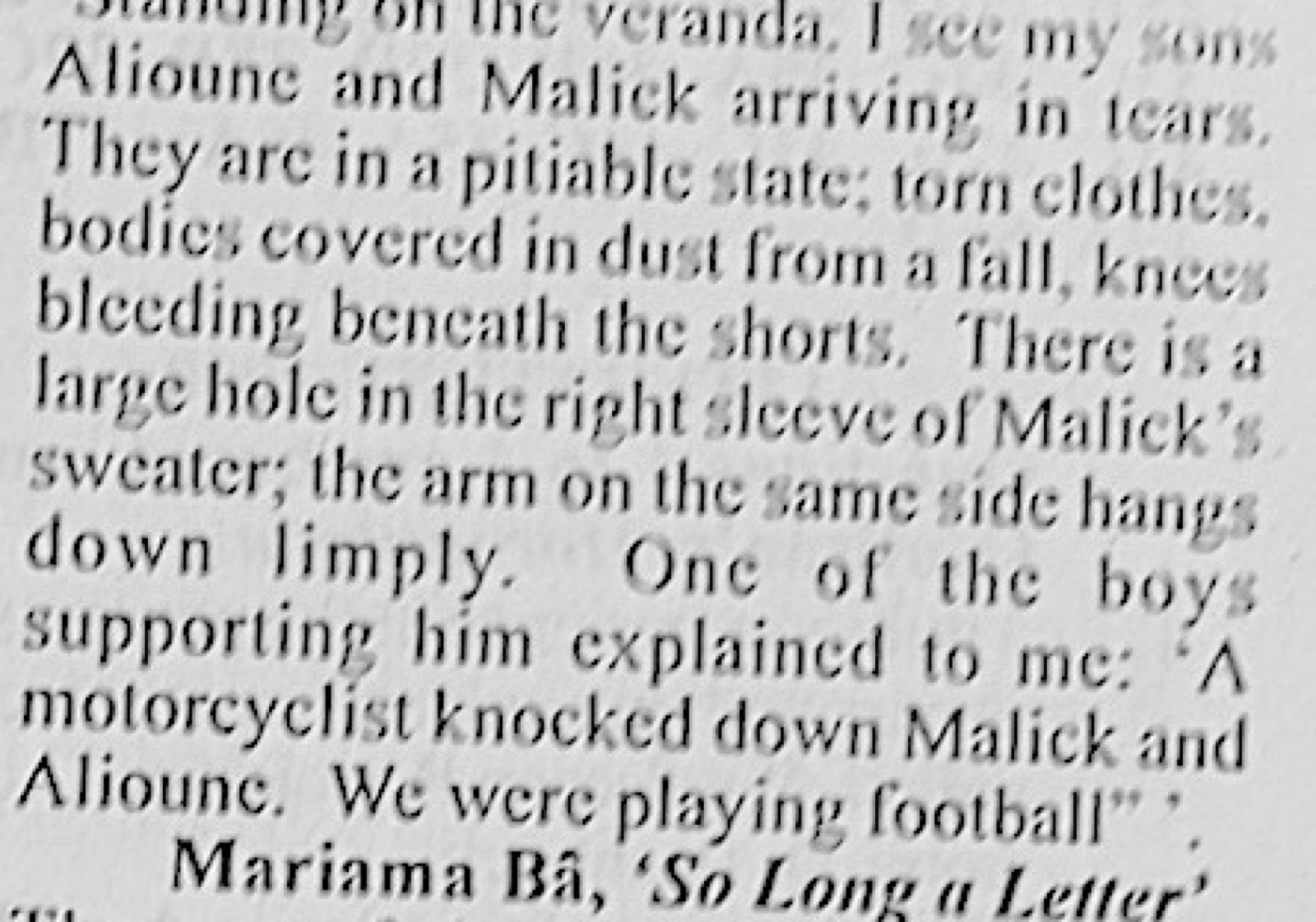
Question 45 Other Set Texts: African Prose Mariama Bâ, 'So Long a Letter' The use of the present tense in the passage
A. makes it dramatic B. heightens its objectivity C. captures the narrator's anger D. makes it farcical. Show the answer and explanation Answer: A (makes it dramatic )
Explanation Telling it in the present ("I see my sons arriving") makes us feel we are watching it happen.
Open this question
Question 46 Literary Appreciation: Prose and Drama In the passage above, the author evokes the atmosphere of
A. cannibalism B. monstrosity C. evil D. doom. Show the answer and explanation Answer: D (doom. )
Explanation A dark crypt lined with human bones creates a heavy sense of death and doom.
Open this question
Question 47 Other Set Texts: Non-African Prose In the passage above, the sea is
A. romanticised B. personified C. criticised D. praised. Show the answer and explanation Answer: B (personified )
Explanation The sea is called "her" and spoken of as a woman.
Open this question
Question 48 African Poetry The poem above is memorable for its
A. pun B. heroism C. metaphor D. lyricism. Show the answer and explanation Answer: C (metaphor )
Explanation Ibadan is pictured as "a running splash of rust and gold" scattered over the hills.
Open this question
Question 49 Literary Appreciation: Prose and Drama The character in the poem above is obviously a
A. veteran B. prisoner C. mercenary D. refugee. Show the answer and explanation Answer: A (veteran )
Explanation He still wears his uniform and sings the theme song of his Burma campaign: an old soldier.
Open this question
Question 50 African Poetry The mood in the lines above is one of
A. fear B. sorrow C. joy D. indignation. Show the answer and explanation Answer: D (indignation. )
Explanation The speaker angrily says they can no longer wait and will "deliver you with force".
Open this question Sign up free for every JAMB Literature in English year, practice by topic and timed mocks.
Start practising free