Home › Past questions › JAMB › Literature in English › 1989 47 questions. Try each one, then open the answer to check yourself and read the explanation.
Sign up free to answer these questions on a CBT screen with a timer, then see your score and every answer explained.
Start practising free
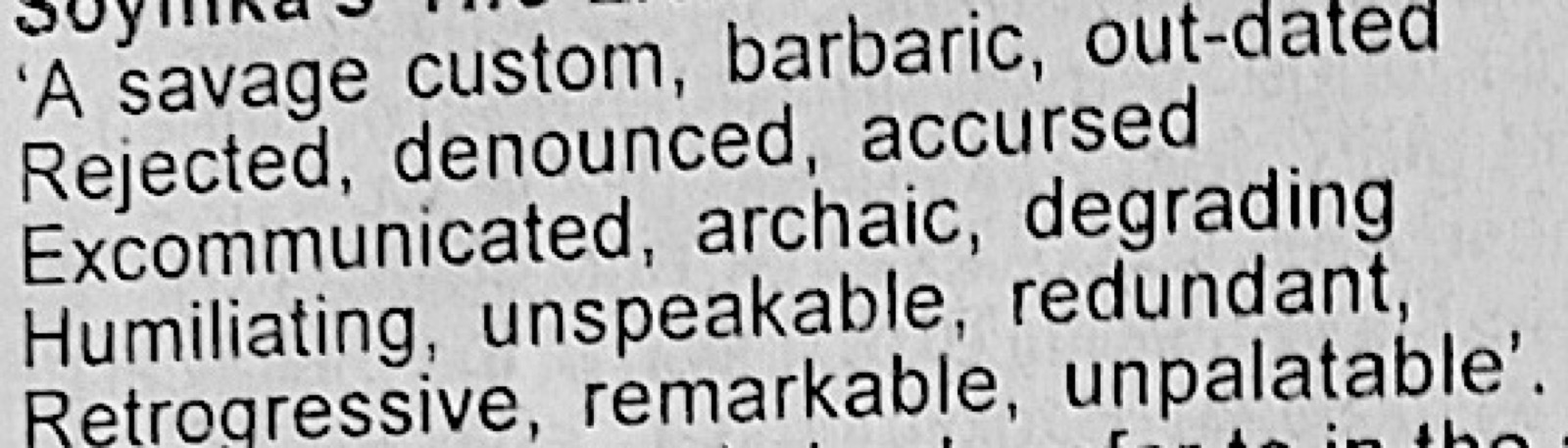
Question 1 Set Text: The Lion and the Jewel From The Lion and the Jewel (Wole Soyinka) What custom does Lakunle refer to in the above excerpt?
A. The seduction of a maiden B. Wrestling contests as an exercise C. The practice of polygamy D. The payment of bride price. Show the answer and explanation Answer: D (The payment of bride price. )
Explanation Lakunle refuses to pay the bride price for Sidi, calling it a savage, outdated custom.
Open this question
Question 2 Set Text: The Lion and the Jewel In the light of subsequent happenings, these words reveal that the speaker
A. abhors polygamy B. has become impotent C. is a crafty seducer D. is disgusted with life. Show the answer and explanation Answer: C (is a crafty seducer )
Explanation Baroka spreads the story of his impotence so that Sidi will come to mock him, and then he wins her.
Open this question
Question 3 Set Text: The Lion and the Jewel What is the nature of the balm referred to by the speaker?
A. An antiseptic ointment B. A special method of massage C. News about Sidi D. A gourd of palm wine. Show the answer and explanation Answer: C (News about Sidi )
Explanation Baroka hopes Sadiku brings good news of Sidi, which would soothe him more than any ointment.
Open this question
Question 4 Set Text: The Lion and the Jewel The immediate consequence of the publication of Sidi's pictures is to make her
A. want to marry the photographer B. feel more important than Baroka C. want to go to the city D. appreciate Lakunle's learning. Show the answer and explanation Answer: B (feel more important than Baroka )
Explanation Her photographs in the magazine make Sidi so proud that she thinks herself greater than the Bale.
Open this question
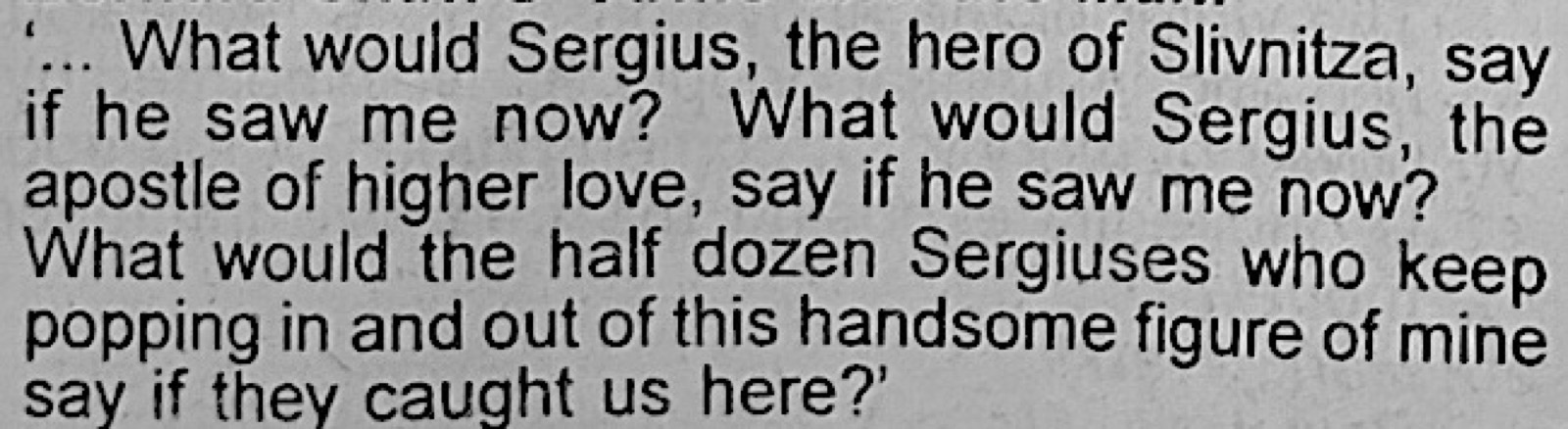
Question 6 Other Set Texts: Non-African Drama From Arms and the Man (George Bernard Shaw) These questions are addressed to
A. Louka B. Sophia C. Raina D. Catherine. Show the answer and explanation Answer: A (Louka )
Explanation Sergius flirts with the maid Louka behind Raina's back.
Open this question
Question 7 Other Set Texts: Non-African Drama 'Excuse me Bluntschli, what did you say had spoiled your chances in life?' According to Bluntschli what had spoiled his chances in life was
A. an irrepressible Casanovan trait B. a chronic baromial temperament C. a hard boiled classical disposition D. an incurably romantic disposition. Show the answer and explanation Answer: D (an incurably romantic disposition. )
Explanation Bluntschli admits he has "an incurably romantic disposition" (it made him climb into Raina's room and come back).
Open this question
Question 8 Other Set Texts: Non-African Drama The initial reluctance of the Petkoff's family to accept Bluntschli's marriage proposition to Raina was on the account of his
A. lowly birth B. low military status C. inadequate material possession D. strange origin. Show the answer and explanation Answer: C (inadequate material possession )
Explanation The Petkoffs think he cannot support Raina until he reveals his great inheritance.
Open this question
Question 9 Other Set Texts: Non-African Drama Which of the following characters fight against vague idealism in life?
A. Major Petkoff B. Captain Bluntschli C. Catherine D. Raina. Show the answer and explanation Answer: B (Captain Bluntschli )
Explanation Bluntschli's practical common sense exposes the false romantic ideals of Raina and Sergius.
Open this question
Question 10 Other Set Texts: Non-African Drama The play ends on a note of
A. cynicism B. idealism C. realism D. despair. Show the answer and explanation Answer: C (realism )
Explanation Raina chooses the practical Bluntschli and Sergius turns to Louka: romance gives way to realism.
Open this question
Question 11 African Poetry From Birago Diop's 'Vanity' 'Vanity' expresses
A. regret and disappointment B. disillusion and despair C. disdain and disgust D. satisfaction and pleasure. Show the answer and explanation Answer: A (regret and disappointment )
Explanation The people regret that they never listened to their dead, and now no one listens to them.
Open this question
Question 12 African Poetry The oilbean in Christopher Okigbo's 'The Passage' refers to
A. one of the totems of Idoto B. the only totem of Idoto C. the abundance of oilbean trees by the river D. the use of the oilbean for magical purposes. Show the answer and explanation Answer: A (one of the totems of Idoto )
Explanation The oilbean is one of the sacred things (with the tortoise and python) linked to the goddess Idoto.
Open this question
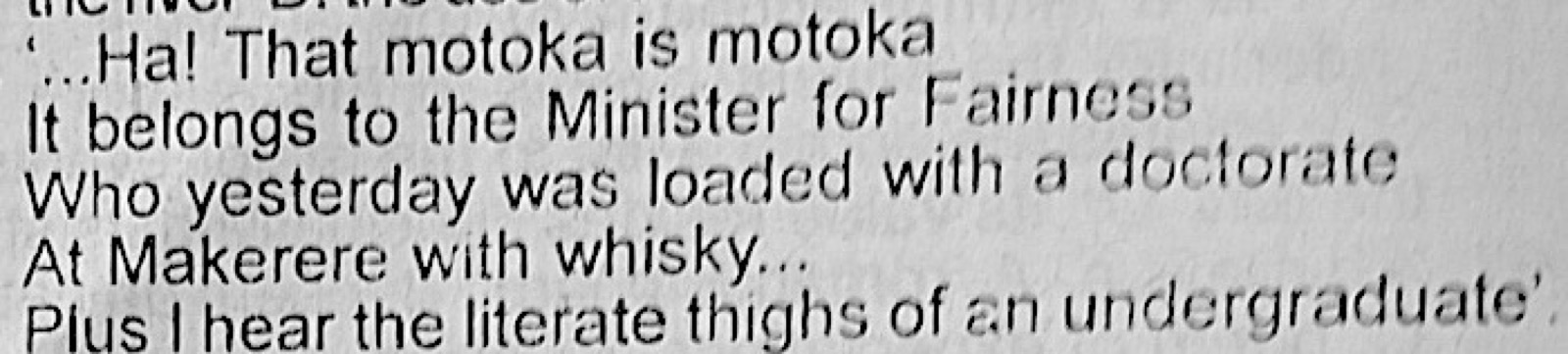
Question 13 African Poetry From Theo Luzuka's 'The Motoka' The above stanza from Theo Luzuka's 'The Motoka' demonstrates that the minister is
A. corrupt and immoral B. a gifted doctoral graduate of Makerere C. an owner of a motor-car which is laden with whisky D. undeserving of the literate thighs of an undergraduate. Show the answer and explanation Answer: A (corrupt and immoral )
Explanation He got a doctorate by "loading" the university with whisky and chases students: corrupt and immoral.
Open this question
Question 15 African Poetry In Odia Ofeimun's 'The Prodigals', the attitude of the returnees is best described as
A. remorseful B. unrepentant C. hopeful D. despondent. Show the answer and explanation Answer: D (despondent. )
Explanation The prodigals come home tired and without hope.
Open this question
Question 16 African Poetry The lesson learnt from 'The Fulani Creation Story' is that Doondari cannot tolerate
A. man B. blindness C. sleep D. pride. Show the answer and explanation Answer: D (pride. )
Explanation Each created thing becomes too proud and is overcome, until Doondari himself comes down to defeat death.
Open this question
Question 17 African Poetry J.P. Clark's 'Streamside Exchange', depicts an interplay of
A. anxiety and passion B. ignorance and wisdom C. excitement and passion D. anxiety and ignorance. Show the answer and explanation Answer: D (anxiety and ignorance. )
Explanation The worried child asks about his mother, and the bird says it cannot know.
Open this question
Question 18 African Poetry '... Horrors were your flowers then, the bright red bougainvilla'. The above lines from Kwesi Brew's 'The Executioner's Dream' depict the executioner's
A. attractiveness B. beauty consciousness C. gentleness D. callousness. Show the answer and explanation Answer: D (callousness. )
Explanation Calling horrors his flowers shows that killing was something he enjoyed without feeling.
Open this question
Question 19 African Poetry '... and we learn to sing half familiar half strange songs. We learn to dance to half familiar half strange rhythms...'
A. songs compositional complexity B. singers' weakness of perception C. singers' cultural problems D. singers' innate stupidity. Show the answer and explanation Answer: C (singers' cultural problems )
Explanation Songs and dances that are half familiar and half strange show people caught between two cultures.
Open this question
Question 21 Other Set Texts: African Prose Nwaka's hostility to Ezeulu is attributable to
A. his great wealth and sense of importance B. the rivalry between Umuneora and Umuachala C. the instigation of Ezidemili D. his jealousy of Ezeulu's mysterious powers. Show the answer and explanation Answer: C (the instigation of Ezidemili )
Explanation Nwaka is urged on by his friend Ezidemili, priest of Idemili, who resents Ezeulu's power.
Open this question
Question 22 Other Set Texts: African Prose Ezeulu sent his son, Oduche, to join the Christians because
A. of his great love for the whiteman B. he had come to distrust the power of Ulu C. he did not want Oduche to succeed him as chief priest D. he wanted a representative in the group in case they became powerful. Show the answer and explanation Answer: D (he wanted a representative in the group in case they became powerful. )
Explanation Ezeulu sends Oduche to be his "eye" among the Christians, in case their religion grows strong.
Open this question
Question 23 Other Set Texts: African Prose The lesson which emerges from the fate of Ezeulu is that
A. the will of the priest is the will of his god B. Christianity is superior to traditional religion C. no man ever won judgement against his clan D. Captain Winterbottom was right afterall. Show the answer and explanation Answer: C (no man ever won judgement against his clan )
Explanation Ezeulu sets himself against Umuaro and is destroyed, as the proverb says.
Open this question
Question 24 Other Set Texts: African Prose '... a man who brings ant-ridden faggots into his hut should expect the visit of lizards...' What does Nwaka refer to as 'ant-ridden faggots' in this context?
A. The visit of the court messenger B. The unexpected consultation of Ezeulu with the chiefs of Umuaro C. The friendship between Ezeulu and the whiteman D. Ezeulu's rejection of the kind gesture of some chiefs to accompany him to Okperi. Show the answer and explanation Answer: C (The friendship between Ezeulu and the whiteman )
Explanation Nwaka says Ezeulu brought trouble on himself by befriending the white man.
Open this question
Question 25 Other Set Texts: African Prose From Arrow of God (Chinua Achebe) The above statement was made by Ofoka about
A. Nwaka B. Akuebue C. Ezeulu D. Obika. Show the answer and explanation Answer: C (Ezeulu )
Explanation Ezeulu had said a man must dance the dance of his time when he sent his son to the church.
Open this question
Question 26 Other Set Texts: African Prose Whom do you consider to be Ezeulu's closest friend and confidant in Umuaro?
A. Nwaka of Umuneora B. Ogbuefi Akuebue C. Nwokeke Nnaberi D. The priest of Idemili. Show the answer and explanation Answer: B (Ogbuefi Akuebue )
Explanation Akuebue is the friend Ezeulu talks to openly.
Open this question
Question 27 Other Set Texts: African Prose What special function does Ramatoulaye's diary perform?
A. It is a record of her personal experiences B. It brings succour to her in distress C. It helps her understand current events D. It aids her memory of past events. Show the answer and explanation Answer: B (It brings succour to her in distress )
Explanation Writing to Aissatou during her mourning comforts Ramatoulaye in her pain.
Open this question
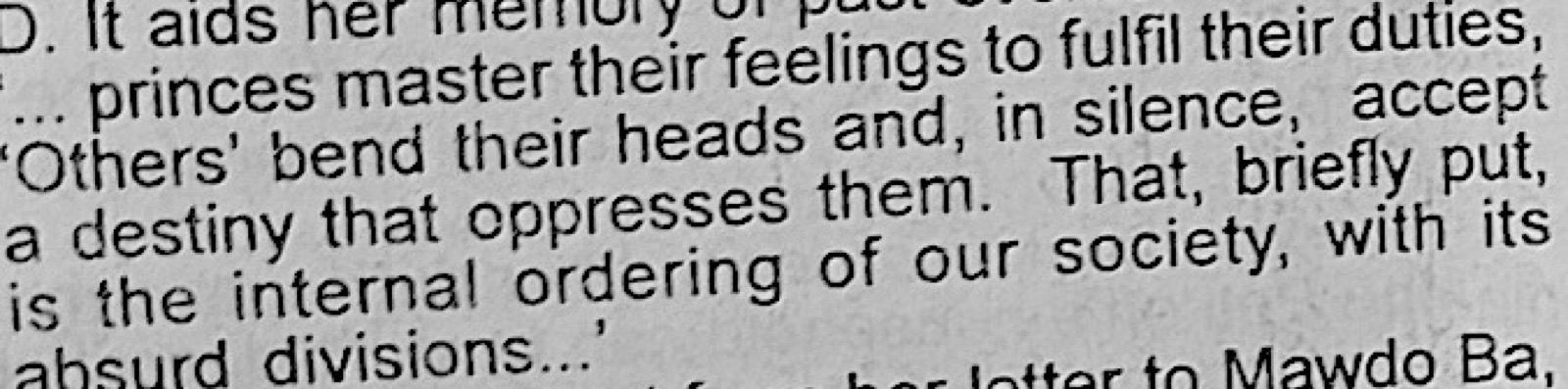
Question 28 Other Set Texts: African Prose From So Long a Letter (Mariama Ba) In the above excerpt from her letter to Mawdo Ba, Aissatou sees society as
A. benefiting the ruling classes B. unequal and unjust C. oppressing the working classes D. giving every person his just deserts. Show the answer and explanation Answer: B (unequal and unjust )
Explanation Aissatou attacks the caste divisions that make some people bow to a fate that oppresses them.
Open this question
Question 29 Other Set Texts: African Prose 'Was it madness, weakness, irresistible love? What inner confusion led Modou Fall to marry Binetou?...' Ramatoulaye finds the answers to these questions in
A. the inherent weakness of man B. the Islamic tradition C. human destiny D. the fickleness of human nature. Show the answer and explanation Answer: A (the inherent weakness of man )
Explanation Ramatoulaye concludes that Modou simply gave in to the weakness of a man for a young girl.
Open this question
Question 30 Other Set Texts: African Prose Ramatoulaye's attitude to her co-wife is that of
A. jealousy B. anger C. contempt D. pity. Show the answer and explanation Answer: D (pity. )
Explanation She sees young Binetou as a victim pushed by her greedy mother into a loveless marriage.
Open this question
Question 31 Literary Terms and Devices In a work of literature, plot is constructed on
A. the principles of conflict B. exciting and memorable episodes C. the use of figurative language D. recurring events. Show the answer and explanation Answer: A (the principles of conflict )
Explanation Plot grows out of a conflict and its development to a resolution.
Open this question
Question 32 Literary Terms and Devices In literary work, setting refers to the
A. starting point of the story B. sum total of physical, social and historical circumstances C. orderly arrangement of episodes D. point at which the fortunes of the hero begin to decline. Show the answer and explanation Answer: B (sum total of physical, social and historical circumstances )
Explanation Setting is the time, place and social background of a work.
Open this question
Question 33 Literary Terms and Devices The prologue of any work is the
A. conclusion B. introduction C. middle D. turning point. Show the answer and explanation Answer: B (introduction )
Explanation A prologue comes before the main action and introduces it.
Open this question
Question 34 Literary Terms and Devices Otivation in any work is the
A. special figure of speech that is used in the work B. ovation encountered in the work C. difficult expression found in the work D. explanation of the behaviour of the characters. Show the answer and explanation Answer: D (explanation of the behaviour of the characters. )
Explanation Motivation is the reason behind what characters do.
Open this question
Question 35 Drama: General In a comic-tragedy, the unknotting of the plot, the resolution of the mystery and the resolution of the misunderstanding is called
A. peripety B. exposition C. denouement D. catharsis. Show the answer and explanation Answer: C (denouement )
Explanation Denouement means "untying" the plot.
Open this question
Question 36 Poetry: General Which of the following BEST describes a ballad?
A. Short literary song B. Short literary story C. Short story that contains a song D. Short song that tells a story. Show the answer and explanation Answer: D (Short song that tells a story. )
Explanation A ballad is a song-like poem that tells a story.
Open this question
Question 37 Prose: General A story, exemplifying a moral thesis, in which animals talk and act like human beings, is called
A. an anecdote B. a parable C. a fable D. an exemplum. Show the answer and explanation Answer: C (a fable )
Explanation Fables use talking animals to teach a moral.
Open this question
Question 38 Literary Terms and Devices The main distinguishing feature of literature is that it
A. tells untrue stories B. is relevant to life C. deals with exciting and memorable events D. presents fictional accounts of human experience. Show the answer and explanation Answer: D (presents fictional accounts of human experience. )
Explanation Literature presents imagined versions of human experience.
Open this question
Question 39 Poetry: General A poem written in honour and praise of somebody else is
A. a eulogy B. an epic C. an epigram D. a lyric. Show the answer and explanation Answer: A (a eulogy )
Explanation A eulogy praises a person.
Open this question
Question 40 Literary Terms and Devices In literary criticism, the vocabulary or language used by a writer is generally known as
A. diction B. figures of speech C. characterization D. rhythms. Show the answer and explanation Answer: A (diction )
Explanation Diction is a writer's choice of words.
Open this question
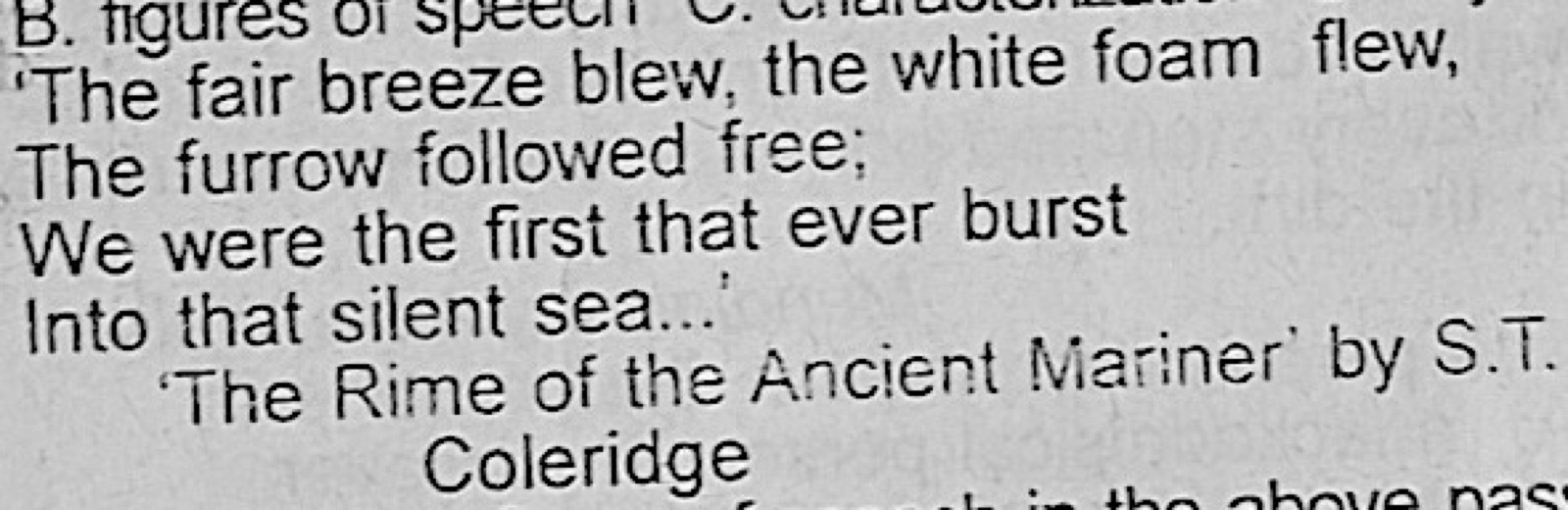
Question 41 Non-African Poetry 'The Rime of the Ancient Mariner' by S.T. Coleridge The dominant figure of speech in the above passage is
A. paradox B. repetition C. alliteration D. antithesis. Show the answer and explanation Answer: C (alliteration )
Explanation "Fair breeze blew", "foam flew", "furrow followed free" repeat the "f" and "b" sounds.
Open this question
Question 42 Non-African Poetry The main figure of speech in the above passage is
A. apostrophe B. hyperbole C. euphemism D. metonymy. Show the answer and explanation Answer: A (apostrophe )
Explanation The poet speaks directly to the skylark as "blithe spirit".
Open this question
Question 43 Literary Appreciation: Prose and Drama The literary term used for this kind of writing is
A. biography B. autograph C. orthography D. autobiography. Show the answer and explanation Answer: D (autobiography. )
Explanation The writer tells "the story of my life": an autobiography.
Open this question
Question 44 Set Text: Twelfth Night The above lamentation is an example of a
A. simile B. metaphor C. personification D. zeugma. Show the answer and explanation Answer: B (metaphor )
Explanation "A heart of stone" calls a hard heart stone without "like": a metaphor.
Open this question
Question 45 Figures of Speech 'Hee, thou great Anna! whom three realms obey, Dost sometimes counsel take – and sometimes tea'. The literary device used in this passage is
A. antithesis B. climax C. epigram D. anticlimax. Show the answer and explanation Answer: D (anticlimax. )
Explanation The grand build-up about a queen ends on the trivial "tea": anticlimax.
Open this question
Question 46 Figures of Speech 'In the morning Benjamin complained of a headache; at noon he collapsed; by midnight he was as dead and cold as a stone'. The dominant literary device in the above statement is
A. simile B. epigram C. climax D. anticlimax. Show the answer and explanation Answer: C (climax )
Explanation Events rise step by step in seriousness to death: climax.
Open this question
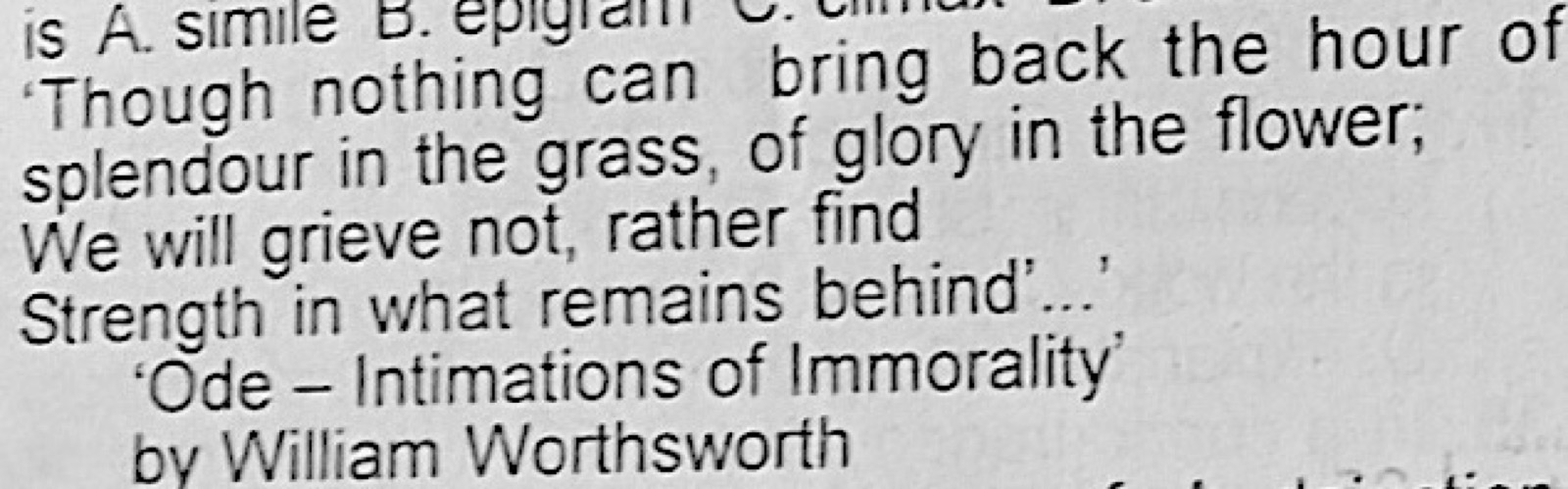
Question 47 Non-African Poetry 'Ode – Intimations of Immorality' by William Worthsworth The above lines convey a sense of
A. dejection B. uneasy acceptance C. deep distress D. nostalgia. Show the answer and explanation Answer: B (uneasy acceptance )
Explanation The poet admits the lost glory cannot return but resolves to find strength in what remains.
Open this question
Question 48 Literary Appreciation: Prose and Drama The style of writing in the passage can be described as
A. introspective B. confused C. confrontational D. passive. Show the answer and explanation Answer: A (introspective )
Explanation The narrator studies his own feelings and perceptions closely.
Open this question
Question 49 Literary Appreciation: Prose and Drama The person described in the passage is
A. a lackadaisical person B. unsaver C. uninteresting D. a finicky individual. Show the answer and explanation Answer: A (a lackadaisical person )
Explanation A dreamy, unambitious man who walks unhurriedly is relaxed and easy-going.
Open this question
Question 50 African Poetry The poem ends on a note of
A. indecision B. despair C. hope D. determination. Show the answer and explanation Answer: C (hope )
Explanation Her love lights the way and he sees "the road that I should take".
Open this question Sign up free for every JAMB Literature in English year, practice by topic and timed mocks.
Start practising free