46 questions. Try each one, then open the answer to check yourself and read the explanation.
Question 1
Set Text: Romeo and Juliet'Wisely and slow. They stumble that run fast'. This note of caution comes from
- A.Benvolio to Mercutio
- B.Capulet to Paris
- C.Friar to Romeo
- D.Nurse to Juliet.
Show the answer and explanation
Answer: C (Friar to Romeo)
ExplanationFriar Lawrence warns Romeo not to rush into marrying Juliet.
Question 2
Set Text: Romeo and JulietIn the play, the dramatic significance of Mercutio's character is to
- A.serve as a contrast to Romeo's
- B.aid and abet Romeo's passion
- C.annoy Tybalt
- D.persuade Romeo to forget Rosaline.
Show the answer and explanation
Answer: A (serve as a contrast to Romeo's)
ExplanationMercutio's jokes about love and his realism show up Romeo's lovesick idealism.
Question 3
Set Text: Romeo and JulietFrom Romeo and Juliet (Shakespeare)
The speaker of these lines is
- A.Capulet
- B.Prince Escalus
- C.Mountague
- D.Friar Lawrence.
Show the answer and explanation
Answer: B (Prince Escalus)
ExplanationAt the end of the play the Prince blames both families, and himself for winking at their quarrels.
Question 4
Set Text: Romeo and JulietThis appeal is made by
- A.Romeo to Mercutio
- B.Benvolio to Tybalt
- C.Benvolio to both Tybalt and Mercutio
- D.Romeo to both Mercutio and Tybalt.
Show the answer and explanation
Answer: C (Benvolio to both Tybalt and Mercutio)
ExplanationIn Act 3 Scene 1 Benvolio tries to stop Tybalt and Mercutio quarrelling in the street.
Question 5
Set Text: Romeo and JulietThe following epithets refer to
- A.Tybalt
- B.Romeo
- C.Mercutio
- D.Benvolio.
Show the answer and explanation
Answer: A (Tybalt)
ExplanationMercutio makes fun of Tybalt as a fashionable, show-off swordsman.
Question 6
Set Text: The Gods Are Not to Blame'If you think that you can drum for my downfall, and hope that drum will sound, then your head is not good'. Odewale says this because
- A.Aderopo is a skilful drummer
- B.he believes that Aderopo is plotting his overthrow
- C.he thinks that Aderopo is mad
- D.Aderopo has not learnt how to drum well.
Show the answer and explanation
Answer: B (he believes that Aderopo is plotting his overthrow)
ExplanationOdewale wrongly suspects that Aderopo is plotting to take his throne.
Question 7
Set Text: The Gods Are Not to BlameIn the prologue, the narrator's role to blame
- A.explains why the gods are not to blame
- B.narrates the life history of the hero
- C.reminds the principal characters of their functions
- D.explains to the audience the mimed action on the stage.
Show the answer and explanation
Answer: D (explains to the audience the mimed action on the stage.)
ExplanationThe narrator explains the mimed scenes of Odewale's birth and the oracle to the audience.
Question 9
Set Text: The Gods Are Not to BlameWhat is the significance of Alaka and Gbonka to the plot of the play?
- A.They are major figures in the drama
- B.They alone held the vital clues for revealing the identity of Odewale
- C.They were friends of the late Ogundele
- D.Their meeting with Odewale would help assuage his sorrow.
Show the answer and explanation
Answer: B (They alone held the vital clues for revealing the identity of Odewale)
ExplanationGbonka gave the baby away and Alaka knew Odewale's foster home; together they reveal who he is.
Question 10
Set Text: The Gods Are Not to BlameA dominant device which Ola Rotimi uses to suggest an authentic background in the play is
- A.dialogue
- B.rituals
- C.proverbs
- D.songs and dances.
Show the answer and explanation
Answer: C (proverbs)
ExplanationYoruba proverbs fill the characters' speech and root the play in its setting.
Question 11
African Poetry'Night, and Abiku sucks the oil From lamps'.
- A.Abiku drinks oil
- B.For Abiku, oil is water
- C.While other babies suck the breast, Abiku sucks oil
- D.The lamp is kept burning all night on account of Abiku.
Show the answer and explanation
Answer: D (The lamp is kept burning all night on account of Abiku.)
ExplanationThe worried parents keep a lamp burning all night to watch over the sickly child.
Question 12
African PoetryIn Lenrie Peter's 'We Have Come Home', the return of the successful scholar is not fulfilling because
- A.the achievement seems out of touch with his society back home
- B.the tropical atmosphere is full of happiness
- C.the dispensation he meets provides mixed satisfaction
- D.he has become indifferent to his own society.
Show the answer and explanation
Answer: C (the dispensation he meets provides mixed satisfaction)
ExplanationThe returnee finds home both welcoming and troubled, so his joy is mixed.
Question 13
African PoetryIn David Diop's 'The Vultures', the colonialists are portrayed as
- A.hypocritical and oppressive
- B.intellectual and civilized
- C.humanitarian and sympathetic
- D.adventurous and daring.
Show the answer and explanation
Answer: A (hypocritical and oppressive)
ExplanationThey preached Christianity while enslaving and brutalising Africans.
Question 15
African PoetryThe choice of imagery in J.P. Clark's 'Olokun' suggests that the poem is intended to arouse
- A.jealousy
- B.secular sentiments
- C.religious sentiments
- D.erotic feelings.
Show the answer and explanation
Answer: D (erotic feelings.)
ExplanationThe sea goddess is described with images of physical desire and love.
Question 16
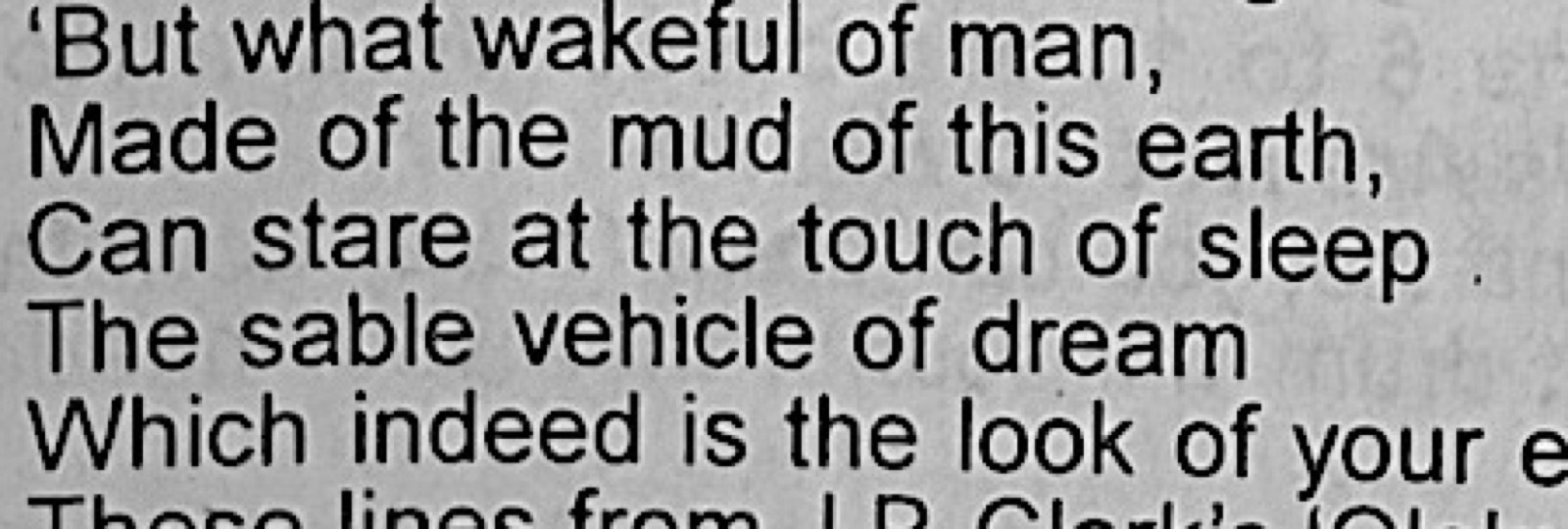
African PoetryFrom J.P. Clark's 'Olokun'
These lines from J.P. Clark's 'Olokun' suggest that Olokun's eyes
- A.hypnotize
- B.cause sleeplessness
- C.terrify
- D.prevent dreams.
Show the answer and explanation
Answer: A (hypnotize)
ExplanationNo man can stare at her eyes, "the sable vehicle of dream", without falling under their spell.
Question 17
African PoetryIn Leopold Senghor's 'Long, long you have held between your hands', the poet addresses himself to
- A.his beloved country for which he yearns
- B.his love
- C.his love interfused with yearning for his country
- D.a not easily discernible subject.
Show the answer and explanation
Answer: C (his love interfused with yearning for his country)
ExplanationThe woman he speaks to also stands for Africa, so love and homesickness are mixed.
Question 18
African PoetryIn Christopher Okigbo's 'Idoto', Idoto symbolizes
- A.an object of religious worship
- B.the poet's mother
- C.the poet's cultural traditions
- D.a river in the poet's village.
Show the answer and explanation
Answer: A (an object of religious worship)
ExplanationIdoto is the river goddess of his village, before whom the poet kneels in worship.
Question 19
African PoetryFrom Christopher Okigbo's 'Idoto'
In the above lines from Christopher Okigbo's 'Idoto', the speaker is a 'prodigal' because he
- A.has wasted all his mother's money
- B.is repentant over his plan to waste all his mother's money
- C.has come back to worship the goddess which he had neglected
- D.has been caught desecrating the shrine of the goddess.
Show the answer and explanation
Answer: C (has come back to worship the goddess which he had neglected)
ExplanationLike the prodigal son, the poet returns to the faith of his ancestors that he had abandoned.
Question 20
African PoetryThe title of Birago Diop's 'Vanity', is intrigue because the people described in the poem are
- A.inglorious
- B.gentle
- C.wretches
- D.humble.
Show the answer and explanation
Answer: C (wretches)
ExplanationThe people in the poem are miserable wretches crying out unheard, so their vanity is striking.
Question 21
Other Set Texts: African ProseThe real victims are
- A.Ndidi and Ogo
- B.Nwanze and Obanua
- C.Ubaka and Bomboy
- D.Nwabunor and Ogugua.
Show the answer and explanation
Answer: C (Ubaka and Bomboy)
ExplanationThe two innocent boys die because of the adults' quarrels.
Question 22
Other Set Texts: African ProseThe fact that the Roman Catholic priest fears and believes that the white robed figures seen in the night are spirits confirms that
- A.the priest was only an impostor
- B.superstition reigns supreme in Ozala
- C.traditional religion will never succumb to Christianity in Ozala
- D.the pieces of stones these white robed figures carried away were indeed sacred.
Show the answer and explanation
Answer: B (superstition reigns supreme in Ozala)
ExplanationEven the priest shares the town's belief in spirits.
Question 24
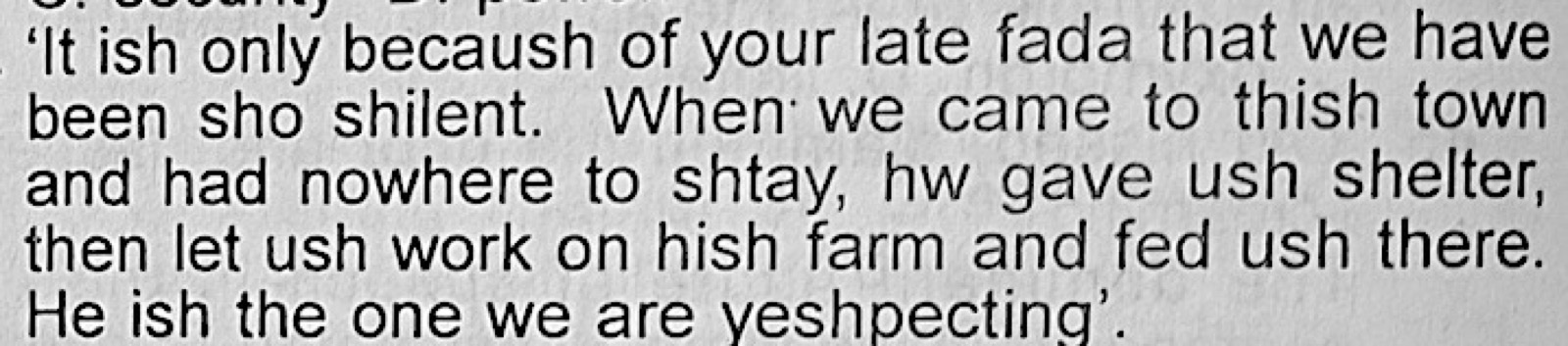
Other Set Texts: African ProseFrom The Victims (Isidore Okpewho)
This passage is written in this way in order to show that the speaker
- A.cannot spell correctly
- B.cannot speak English correctly
- C.is a stranger
- D.is very angry.
Show the answer and explanation
Answer: B (cannot speak English correctly)
ExplanationThe "sh" sounds copy the speaker's faulty pronunciation of English.
Question 25
Other Set Texts: African ProseThe story in the book is told from the point of view of
- A.Nwabunor
- B.Obanua
- C.a first person narrator
- D.a third person narrator.
Show the answer and explanation
Answer: D (a third person narrator.)
ExplanationAn outside narrator tells the story using "he" and "she".
Question 26
Other Set Texts: Non-African ProseMiss Havisham was a nasty, vindictive recluse because she was
- A.born an eccentric
- B.cruelly ill-used by a man
- C.by nature nasty and shy of company
- D.badly brought up.
Show the answer and explanation
Answer: B (cruelly ill-used by a man)
ExplanationCompeyson jilted her on her wedding day, and she has hated men ever since.
Question 27
Other Set Texts: Non-African Prose'On the rampage, Pip and off the rampage, rip; –such is Life!'. Joe summarized his wife's behaviour in this way after Mrs. Gargery's quarrel with
- A.Pip
- B.Orlick
- C.Joe
- D.Biddy.
Show the answer and explanation
Answer: B (Orlick)
ExplanationMrs Joe quarrels with Orlick the journeyman, and Joe has to fight him.
Question 28
Other Set Texts: Non-African ProsePip is made most conscious of his ingratitude to Joe Margery through
- A.the complaints of Biddy
- B.the pretensions of Pumblechook
- C.his rejection by Estella
- D.the death of his sister.
Show the answer and explanation
Answer: A (the complaints of Biddy)
ExplanationBiddy's quiet reproaches make Pip see how badly he treats Joe.
Question 29
Other Set Texts: Non-African ProseIn the character of Mrs. Pocket, Dickens satirizes
- A.cruelty to servants
- B.aristocratic snobbery
- C.gossiping females
- D.over-indulgent parents.
Show the answer and explanation
Answer: B (aristocratic snobbery)
ExplanationMrs Pocket lives only for her family's noble connections while her home falls apart.
Question 30
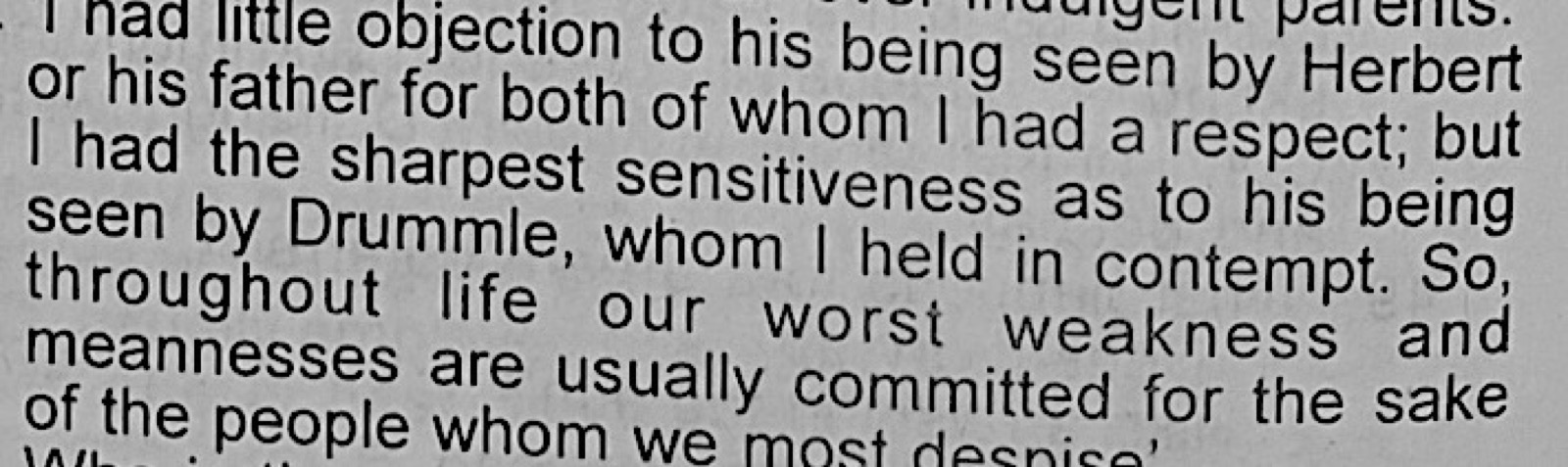
Other Set Texts: Non-African ProseFrom Great Expectations (Charles Dickens)
Who is the person whose expected visit is being discussed here?
- A.Abel Magwich
- B.Mr. Wopsle
- C.Mr. Punblechook
- D.Joe Gargery.
Show the answer and explanation
Answer: D (Joe Gargery.)
ExplanationPip dreads Joe's visit to London because Drummle might see the simple blacksmith.
Question 31
Drama: GeneralA play is called a comedy when
- A.there is peaceful atmosphere and laughter in it
- B.nobody dies in it
- C.there is no serious quarrel in it
- D.there is a happy resolution of contradictions.
Show the answer and explanation
Answer: D (there is a happy resolution of contradictions.)
ExplanationA comedy's conflicts are resolved happily at the end.
Question 32
Drama: GeneralThe persons who take part in a play are sometimes referred to as
- A.audience
- B.dramatists
- C.dramatis personae
- D.comedians.
Show the answer and explanation
Answer: C (dramatis personae)
Explanation"Dramatis personae" means the characters of a play.
Question 33
Poetry: GeneralA form of writing in which the poet writes with nostalgia about simple village life is
- A.pastoral
- B.ballad
- C.romance
- D.epic.
Show the answer and explanation
Answer: A (pastoral)
ExplanationPastoral writing idealises country life.
Question 34
Literary Terms and DevicesAn imitation, bordering on ridicule of an author's style and ideas is known as
- A.mime
- B.paradox
- C.criticism
- D.parody.
Show the answer and explanation
Answer: D (parody.)
ExplanationA parody mocks a writer by imitating his style.
Question 35
Literary Terms and Devices'Genres of literature' aptly describes
- A.tragedy, comedy, tragi-comedy
- B.ode, elegy, sonnet
- C.short story, novel, autobiography
- D.poetry, prose, drama.
Show the answer and explanation
Answer: D (poetry, prose, drama.)
ExplanationThe three main genres are poetry, prose and drama; the others are sub-types.
Question 36
Prose: GeneralAn autobiography becomes a literary work when
- A.it is a faithful account of the author's
- B.it underlines the salient events in the author's life
- C.it relates the author's life to the major events of the day
- D.its value resides principally in its style.
Show the answer and explanation
Answer: D (its value resides principally in its style.)
ExplanationWhat makes any writing literature is the artistic quality of its language.
Question 37
Poetry: GeneralA dirge is a
- A.romantic poem
- B.poem on nature
- C.poem of expectations
- D.poem of lament.
Show the answer and explanation
Answer: D (poem of lament.)
ExplanationA dirge is a song of mourning.
Question 38
Poetry: GeneralIn poetry, a quatrain is a group of four
- A.lines
- B.stanzas
- C.refrains
- D.poems.
Show the answer and explanation
Answer: A (lines)
ExplanationA quatrain is a four-line stanza.
Question 39
Literary Terms and DevicesCriticism is a literary activity which seeks to
- A.discover the beauty of a literary work
- B.finds faults in a literary work
- C.analyse and evaluate a literary work
- D.compare literary works.
Show the answer and explanation
Answer: C (analyse and evaluate a literary work)
ExplanationLiterary criticism examines and judges a work.
Question 40
Poetry: GeneralIn poetry, 'run-on-line' can be found
- A.in most kinds of poems
- B.only in free verse
- C.uniquely in blank verse
- D.peculiarly in rhyming couplets.
Show the answer and explanation
Answer: A (in most kinds of poems)
ExplanationRun-on lines (enjambment) appear in all kinds of poetry.
Question 41
Literary Appreciation: PoetryVerse extract (Question 41)
The figure of speech most prominently used in the passage above is
- A.oxymoron
- B.alliteration
- C.euphemism
- D.hyperbole.
Show the answer and explanation
Answer: A (oxymoron)
Explanation"I burn and freeze", "fear and hope", "flee above the wind yet cannot arise" join opposites.
Question 42
Other Set Texts: African ProseThe mood of the quotation in this passage is
- A.tragically comic
- B.deadly serious
- C.playfully serious
- D.humorously comic.
Show the answer and explanation
Answer: D (humorously comic.)
ExplanationThe host's anxious refilling of glasses, as if stopping him drinking would stop him reaching heaven, is funny.
Question 43
Literary Appreciation: Prose and DramaThe greater emphasis in this passage is on the
- A.feeling of doubt
- B.feeling of despair
- C.feeling of desperation
- D.sense of failure.
Show the answer and explanation
Answer: B (feeling of despair)
ExplanationHe needs only one naira yet knows nobody will lend it to him: he feels hopeless.
Question 44
Other Set Texts: African DramaThe two most prominent weapons of satire in this passage are
- A.understatement and hyperbole
- B.irony and metaphor
- C.simile and personification
- D.irony and understatement.
Show the answer and explanation
Answer: D (irony and understatement.)
ExplanationFarmers' "patriotic duties of starving" so rulers can "belch" is bitter irony, told in a calm, understated tone.
Question 45
Non-African PoetryThese lines from Alexander Pope's 'Essay on Man' show a skilful exploitation of the rhetorical device of
- A.zeugma
- B.oxymoron
- C.antithesis
- D.conceit.
Show the answer and explanation
Answer: C (antithesis)
ExplanationOpposites are set in balanced pairs: rise/fall, lord/prey, truth/error.
Question 47
Non-African Poetry'The child is father of the Man' is an example of
- A.personification
- B.oxymoron
- C.metonymy
- D.paradox.
Show the answer and explanation
Answer: D (paradox.)
ExplanationA child cannot be a man's father, yet it is true that childhood shapes the adult.
Question 48
Literary Appreciation: PoetryThe dominant figure of speech in the above piece is
- A.assonance
- B.dissonance
- C.slapstick
- D.alliteration.
Show the answer and explanation
Answer: A (assonance)
ExplanationRepeated vowel sounds, as in "glutted and plotted" and "mad as a hatter", give assonance.
Question 49
Literary Appreciation: Prose and DramaThe writer of the above passage is
- A.jealous of rich and influential people
- B.overwhelmed by the power of money
- C.contemptuous of the poor
- D.indirectly exposing the negative influence of money.
Show the answer and explanation
Answer: D (indirectly exposing the negative influence of money.)
ExplanationBy pretending money cures ugliness and stupidity, the writer mocks how money corrupts values.
Question 50
Literary Appreciation: PoetryIn the above lyric, the words in italics are examples of
- A.assonance
- B.onomatopoeia
- C.alliteration
- D.consonance.
Show the answer and explanation
Answer: B (onomatopoeia)
Explanation"Bow-wow" and "Hark, hark" imitate the sounds of barking dogs.