Home › Past questions › JAMB › Literature in English › 1987 41 questions. Try each one, then open the answer to check yourself and read the explanation.
Sign up free to answer these questions on a CBT screen with a timer, then see your score and every answer explained.
Start practising free
Question 1 Set Text: The Gods Are Not to Blame In the play The Gods Are Not To Blame , Odewale became king of Kutuje by
A. usurpation in a typical Ijekun manner B. deserting the people of Ikolu whose army he led C. divulging the war secrets of Ikolu to Kutuje D. leading Kutuje in a war against Ikolu. Show the answer and explanation Answer: D (leading Kutuje in a war against Ikolu. )
Explanation Odewale led the people of Kutuje to victory over Ikolu, and they made him king.
Open this question
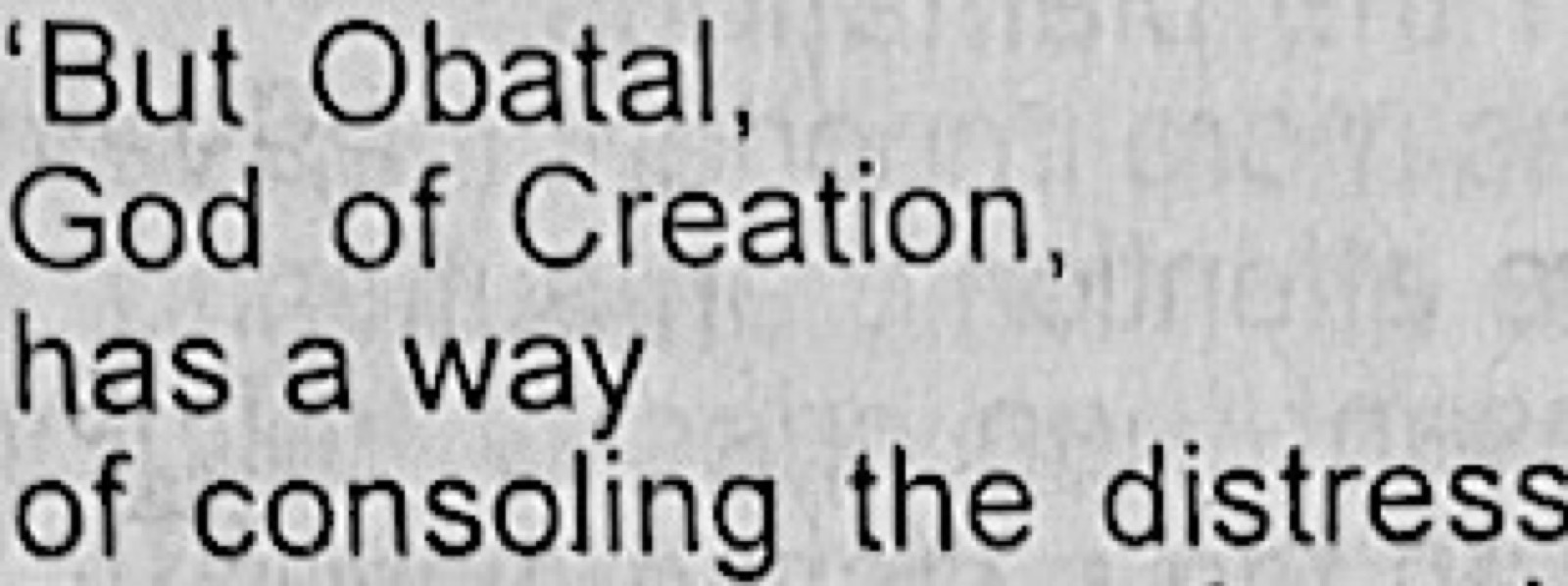
Question 4 Set Text: The Gods Are Not to Blame From The Gods Are Not to Blame (Ola Rotimi) The consolation referred to by the narrator in The Gods Are Not To Blame is the
A. great peace that reigned in the land of Kutuje B. subjugation of the warlike people of Ikolu C. pregnancy of Aburo, Odewale's second wife D. birth of Aderopo by Ojuola. Show the answer and explanation Answer: D (birth of Aderopo by Ojuola. )
Explanation After the sorrow of giving away their first son, the king and queen are comforted by the birth of Aderopo.
Open this question
Question 5 Set Text: The Gods Are Not to Blame FIRST BODYGUARD: A madman wanting to see the King! The world, indeed, is mad OJUOLA: How do you know he is a madman? Which of the following is the answer given by the Second Bodyguard to Ojuola in The Gods Are Not To Blame?
A. Everyone can see he is mad, your highness B. Only a madman would want to see the King now, your highness C. We all know him very well, your highness D. He is not a man of our tribe, your highness. Show the answer and explanation Answer: D (He is not a man of our tribe, your highness. )
Explanation The bodyguard's answer shows the people's distrust of strangers, a theme of the play.
Open this question
Question 6 Set Text: Romeo and Juliet 'From forth the fatal lions of these two foes A pair of star-crossed lovers take their life...' These lines from Romeo and Juliet suggest that the
A. tragedy could have been averted B. tragedy was predestined C. tragedy was brought on by enmity D. lovers brought misfortune on themselves. Show the answer and explanation Answer: B (tragedy was predestined )
Explanation "Star-crossed" means doomed by the stars: their fate was fixed.
Open this question
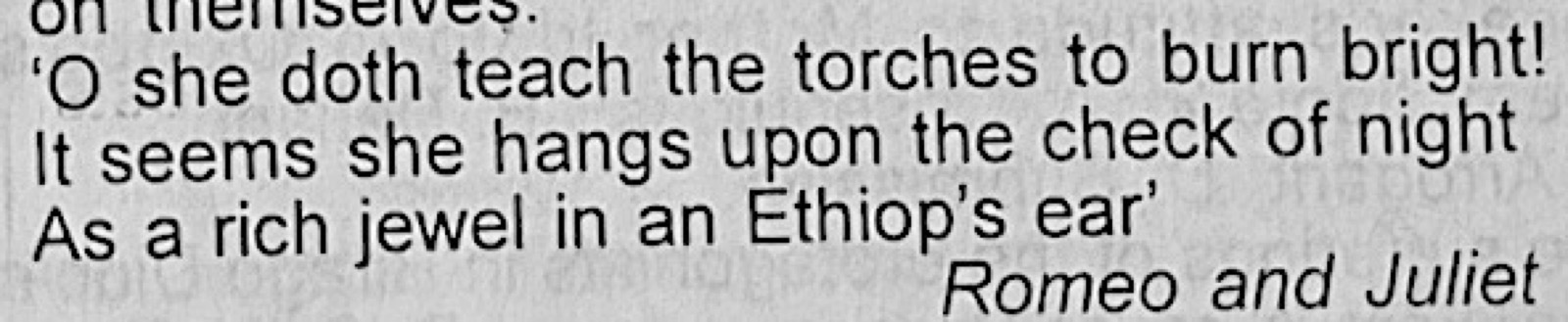
Question 7 Set Text: Romeo and Juliet From Romeo and Juliet (Shakespeare) In these lines Juliet's beauty is presented
A. in contrast to the dark night B. as a source of envy to all C. in terms of riches D. as being unparalleled in the kingdom. Show the answer and explanation Answer: A (in contrast to the dark night )
Explanation Juliet shines like a bright jewel against the dark cheek of night.
Open this question
Question 8 Set Text: Romeo and Juliet 'The all-seeing sun Ne'er saw her match since first the world begun' The above lines were spoken in Romeo and Juliet by
A. Count Paris in praise of Juliet B. Romeo in praise of Juliet C. Romeo in praise of Rosaline D. Lady Capulet in praise of Rosaline. Show the answer and explanation Answer: C (Romeo in praise of Rosaline )
Explanation Before he meets Juliet, Romeo swears no one is lovelier than Rosaline.
Open this question
Question 9 Set Text: Romeo and Juliet Which of the following illustrates the element of chance in Romeo and Juliet?
A. Friar John's delay in giving Friar Lawrence's letter to Romeo B. Rosaline's rejection of Romeo's love C. Juliet's confiding in her nurse D. The death of Lady Mountague. Show the answer and explanation Answer: A (Friar John's delay in giving Friar Lawrence's letter to Romeo )
Explanation Friar John is held up by a plague quarantine by bad luck, so Romeo never learns of the plan.
Open this question
Question 10 Set Text: Romeo and Juliet The tragedy in Romeo and Juliet occurs as a result of
A. a flaw in the character of Romeo B. a flaw in the character of Juliet C. Friar Lawrence's advice D. circumstances rather than flaws in character. Show the answer and explanation Answer: D (circumstances rather than flaws in character. )
Explanation The feud, accidents and bad timing, more than any personal fault, destroy the lovers.
Open this question
Question 11 African Poetry In 'Abiku', the statement 'Yams do not sprout in amulets To earth Abiku's limbs...' simply means
A. Abiku should not be buried with amulets B. yams and amulets are repugnant to Abiku C. Abiku cannot be appeased D. yams cannot grow on Abiku's grave. Show the answer and explanation Answer: C (Abiku cannot be appeased )
Explanation Charms and offerings cannot hold Abiku to the earth; nothing can make him stay.
Open this question
Question 12 African Poetry From Lenrie Peters' 'We Have Come Home' Lenrie Peters in his poem, 'We Have Come Home' makes this statement because
A. the future is unpredictable B. past sufferings are best forgotten C. there is no point crying over spilled milk D. mourning can be postponed. Show the answer and explanation Answer: C (there is no point crying over spilled milk )
Explanation There is no use mourning past wrongs that cannot be undone.
Open this question
Question 13 African Poetry In David Diop's 'The Vultures', the statement 'And the monotonous rhythm of the paternoster Drowned the howling on the plantations,' suggests that
A. music was more important than work B. boredom received more attention than suffering C. music was more pleasant than cries D. religion received more attention than the suffering slaves. Show the answer and explanation Answer: D (religion received more attention than the suffering slaves. )
Explanation Prayers were said while the cries of the slaves were ignored.
Open this question
Question 14 African Poetry At the end of the poem 'Pianos and Drums', the protagonist is best described as
A. an authentic African B. a cultural mulatto C. a sophisticated African D. a cultured youth. Show the answer and explanation Answer: B (a cultural mulatto )
Explanation He ends "lost in the morning mist" between African and European cultures, belonging fully to neither.
Open this question
Question 16 African Poetry In J.P. Clark's 'Olokun', the line 'So drunken like ancient walls' means that the worshippers are drunken with
A. wine served at Olokun's altar B. sacred water since Olokun rules the sea C. desire for the bounties to be bestowed by Olokun D. intense awe of Olokun. Show the answer and explanation Answer: D (intense awe of Olokun. )
Explanation The worshippers are overwhelmed with reverence for the sea goddess, not alcohol.
Open this question
Question 17 African Poetry 'I shall sleep under the roof of other heads of hair in shelter from storms'. In Leopold Senghor's poem 'Long long you have held between your hands', the word 'storms' in the above line refers to
A. sea storms B. rain storms C. storming raids by the racist police D. storms of passion. Show the answer and explanation Answer: D (storms of passion. )
Explanation The "storms" are inner troubles of the heart from which he seeks shelter.
Open this question
Question 19 African Poetry The sufferings of the protagonists in Birago Diop's 'Vanity' are
A. caused by circumstance B. Self-inflicted C. imposed on them by enemies D. the act of fate. Show the answer and explanation Answer: B (Self-inflicted )
Explanation The poem says the people suffer because they will not listen to the voices of their dead.
Open this question
Question 20 African Poetry In 'Vanity', Birago Diop portrays the African predicament as arising from
A. sad complaining voices of beggars B. pitiful anger bowing like a tumour C. not listening to the dead D. clamouring and crying roughly over our torments. Show the answer and explanation Answer: C (not listening to the dead )
Explanation The poem blames the people for ignoring the ancestors' voices.
Open this question
Question 21 Other Set Texts: African Prose In The Victims , the two old women play the role of
A. guardians of tradition B. eavesdroppers C. witches D. chorus. Show the answer and explanation Answer: D (chorus. )
Explanation Like a Greek chorus, the two old women comment on the family's troubles.
Open this question
Question 22 Other Set Texts: African Prose In The Victims , the affection between Ubaka and Bomboy is significant because it
A. results in the death of Ubaka B. shows that young people are more affectionate than their elders C. contrasts with the general hatred in their family D. leads to reconciliation in the family. Show the answer and explanation Answer: C (contrasts with the general hatred in their family )
Explanation The half-brothers' love stands out against the bitterness between their mothers.
Open this question
Question 26 Other Set Texts: Non-African Prose In Great Expectations , Pip's nursing of Magwitch is significant because it
A. prevents Magwitch's immediate death by prolonging his life B. enables Magwitch to confirm Pip as his heir C. recalls Herbert's nursing of Pip D. shows Pip's moral regeneration. Show the answer and explanation Answer: D (shows Pip's moral regeneration. )
Explanation Caring for the convict he once despised shows Pip has become humble and grateful.
Open this question
Question 27 Other Set Texts: Non-African Prose At the very end of Great Expectations , Estella disclosed to Pip that the source of her present maturity and wisdom was
A. the sound education she had at school B. her pleasant association with Mrs. Harvisham C. the suffering she had experienced in life D. her long exposure to high society. Show the answer and explanation Answer: C (the suffering she had experienced in life )
Explanation Estella says suffering has "bent and broken" her into a better shape.
Open this question
Question 29 Other Set Texts: Non-African Prose In Great Expectations, while Pip was going away from home to take the coach to London, Joe and Biddy threw old shoes at him because
A. Pip had in a haste forgotten to pack those old shoes of his B. they wanted to play a practical joke on Pip for the last time C. Pip had made them angry by his joy to leave home D. they believed that the act would bring him good luck. Show the answer and explanation Answer: D (they believed that the act would bring him good luck. )
Explanation Throwing an old shoe after someone setting out was a custom for good luck.
Open this question
Question 30 Other Set Texts: Non-African Prose Pip's flippant remarks concerning the tombstones in the opening chapter of Great Expectations indicate
A. his longing for death B. the child's inability to understand C. his yearning for his parents D. his fascination for inscriptions on stonework. Show the answer and explanation Answer: B (the child's inability to understand )
Explanation Little Pip imagines his parents' looks from the shape of the letters: a child's innocent misunderstanding.
Open this question
Question 31 Literary Terms and Devices Caricature is used to
A. ridicule a person by distorting his most prominent features B. censure an individual by emphasizing his weakness C. expose the folly in literature D. elicit the artistic potential of dramatists. Show the answer and explanation Answer: A (ridicule a person by distorting his most prominent features )
Explanation A caricature exaggerates someone's features to make fun of them.
Open this question
Question 32 Figures of Speech The substitution of a mild and pleasant expression for a harsh and blunt one is called
A. ambiguity B. climax C. peripety D. euphemism. Show the answer and explanation Answer: D (euphemism. )
Explanation That is euphemism, e.g. "passed away" for "died".
Open this question
Question 33 Literary Terms and Devices Any work of Literature which sets out to instruct may be called
A. dialetic B. decadent C. definitive D. didactic. Show the answer and explanation Answer: D (didactic. )
Explanation Didactic means meant to teach.
Open this question
Question 34 Prose: General The novel, The Novella and the Short Story are the major sub-genres of
A. non-fiction B. prose fiction C. poetry D. drama. Show the answer and explanation Answer: B (prose fiction )
Explanation All three are invented stories in prose.
Open this question
Question 35 Literary Terms and Devices An antagonist is a character in a narrative who
A. uses abusive language to antagonize other characters B. works against the interests of the protagonist C. works against the interests of other characters D. champions the cause of the protagonist. Show the answer and explanation Answer: B (works against the interests of the protagonist )
Explanation The antagonist opposes the main character.
Open this question
Question 36 Poetry: General A sonnet is a poem of
A. fourteen lines B. ten lines C. seven stanzas D. six stanzas. Show the answer and explanation Answer: A (fourteen lines )
Explanation A sonnet has fourteen lines.
Open this question
Question 37 Poetry: General A couplet is a
A. succession of three rhyming lines B. succession of two rhyming lines C. poem of two stanzas D. poem of three stanzas. Show the answer and explanation Answer: B (succession of two rhyming lines )
Explanation A couplet is a pair of rhyming lines.
Open this question
Question 38 Literary Terms and Devices An allegory is a story
A. in which people or things or events have another meaning B. which aims at teaching a moral lesson C. in which allegations are made about the characters D. told in verse. Show the answer and explanation Answer: A (in which people or things or events have another meaning )
Explanation In an allegory characters and events stand for something else, as in Animal Farm.
Open this question
Question 40 Poetry: General An ode is best described as a
A. story told in poetic form B. poetic composition of fourteen lines C. narration about nature and natural objects D. lyrical poem addressed to some persons or things. Show the answer and explanation Answer: D (lyrical poem addressed to some persons or things. )
Explanation An ode is a lyric poem that addresses and praises a person or thing.
Open this question
Question 41 Figures of Speech Dialogue (Question 41) In this brief dialogue, the first line contains the device known as
A. synecdoche B. paradox C. oxymoron D. hyperbole. Show the answer and explanation Answer: A (synecdoche )
Explanation "Hands" stands for workers: a part used for the whole person.
Open this question
Question 42 Literary Appreciation: Prose and Drama The dominant literary device in this passage is
A. metaphor B. oxymoron C. synecdoche D. personification. Show the answer and explanation Answer: D (personification. )
Explanation The day has "eyes" and the breeze "caressed" the world like a hand: things are given human actions.
Open this question
Question 43 Literary Appreciation: Poetry The dominant figure of speech in the above passage is
A. synecdoche B. rhetorical question C. parody D. apostrophe. Show the answer and explanation Answer: B (rhetorical question )
Explanation Each line asks "was it for this...?" without expecting an answer.
Open this question
Question 44 Literary Appreciation: Poetry The phrase 'darkness visible' in the above lines is an example of
A. metaphor B. hyperbole C. oxymoron D. litotes. Show the answer and explanation Answer: C (oxymoron )
Explanation Darkness cannot be seen; joining the contradictory words makes an oxymoron.
Open this question
Question 45 Figures of Speech 'Olu hissed, slammed the door and dashed out screaming'. The dominant figure of speech in the above sentence is
A. zeugma B. oxymoron C. hyperbole D. onomatopoeia. Show the answer and explanation Answer: D (onomatopoeia. )
Explanation "Hissed", "slammed" and "dashed" sound like the actions they name.
Open this question
Question 46 Literary Appreciation: Poetry Verse extract (Question 46) The tone in these lines suggest
A. the author's desire to accomplish more in life B. anxiety and tension C. tediousness and boredom D. anger and exasperation. Show the answer and explanation Answer: C (tediousness and boredom )
Explanation A life "measured out with coffee spoons", the same each day, is dull and boring.
Open this question
Question 47 Literary Appreciation: Poetry The passage gives ample evidence of the poet's
A. sensuous description B. meticulous attention to matters concerning women C. mastery of the Spenserian stanza D. sensual feelings and emotions. Show the answer and explanation Answer: A (sensuous description )
Explanation Warm jewels, a fragrant bodice and rustling silk appeal to touch, smell, sight and hearing.
Open this question
Question 48 Literary Appreciation: Prose and Drama The passage indicates that the author's experience in marriage was
A. exhilarating like skiing B. steeped in boredom and monotony C. full of fear of the unknown D. fraught with grief and despair. Show the answer and explanation Answer: D (fraught with grief and despair. )
Explanation Marriage felt like falling off a cliff and waiting for the smash: a painful, hopeless experience.
Open this question
Question 49 Literary Appreciation: Poetry In the above lines, the poet achieves special effect by the use of
A. transferred epithet B. synecdoche C. alliteration D. simile. Show the answer and explanation Answer: D (simile. )
Explanation The deferred dream is compared "like a raisin in the sun" and "like a sore".
Open this question
Question 50 Literary Appreciation: Prose and Drama The passage directs its appeal primarily to the sense of
A. hearing B. sight C. touch D. smell. Show the answer and explanation Answer: B (sight )
Explanation A white ball of fire and a tree of fire leaping up are things we see.
Open this question Sign up free for every JAMB Literature in English year, practice by topic and timed mocks.
Start practising free