Home › Past questions › JAMB › Literature in English › 1986 47 questions. Try each one, then open the answer to check yourself and read the explanation.
Sign up free to answer these questions on a CBT screen with a timer, then see your score and every answer explained.
Start practising free
Question 1 Set Text: The Gods Are Not to Blame 'The oracle warns us that we have left our pot unwatched, and our food now burns.' This statement in The Gods Are Not to Blame refers to
A. the killing of King Adetusa B. the crime of incest committed by King Odewale C. Aderopo's quarrel with King Odewale D. the banishment of Aderopo. Show the answer and explanation Answer: A (the killing of King Adetusa )
Explanation The plague comes because the murderer of the old king Adetusa has not been found and punished.
Open this question
Question 2 Set Text: The Gods Are Not to Blame '...the toad likes water but not when the water is boiling'. King Odewale in The Gods Are Not to Blame uses this proverb to explain why he
A. exiled himself from the home of his supposed parents B. exiled Aderopo from his presence C. treated Baba Fakunle with disrespect D. no longer likes the land of Kutuje. Show the answer and explanation Answer: A (exiled himself from the home of his supposed parents )
Explanation Odewale left the home of the couple he thought were his parents to escape the fate foretold for him.
Open this question
Question 3 Set Text: The Gods Are Not to Blame From The Gods Are Not to Blame (Ola Rotimi) The order to return nine cowries was given by Baba Fakunle because he
A. wanted to spite the King by taking only one cowrie B. felt insulted that he was given only ten cowries C. did not want to meddle with leprous money given with bloody hands D. wanted to emphasize that the messenger of Olodumare takes only one cowrie. Show the answer and explanation Answer: D (wanted to emphasize that the messenger of Olodumare takes only one cowrie. )
Explanation The seer takes just one cowrie to show he is the god's messenger and does not work for money.
Open this question
Question 4 Set Text: The Gods Are Not to Blame In the context of The Gods Are Not to Blame , the person who made this statement is alleging that King Adetusa
A. died falling into a pit B. fell victim to man eating crocodiles C. was killed by the people of Kutuje D. was killed by the Ijekun people. Show the answer and explanation Answer: C (was killed by the people of Kutuje )
Explanation "Crocodiles eating their own eggs" means the king was killed by his own people.
Open this question
Question 5 Set Text: The Gods Are Not to Blame Odewale shifts the blame for his tragedy from the gods to himself and claims that his tragedy is a result of his own weakness. The weakness he claims is love of
A. power B. adventure C. his tribe D. divination Show the answer and explanation Answer: C (his tribe )
Explanation Odewale says he was quick to anger whenever his tribe was insulted, and this led him to kill.
Open this question
Question 6 Set Text: Julius Caesar The treatment meted out to Cinna the poet in Julius Caesar shows
A. that Roman soldiers despised poets generally B. Shakespeare's use of mistaken identity for comic effect in the play C. the misfortune of Roman poets D. the spontaneous reaction of the plebians after the assassination of Caesar. Show the answer and explanation Answer: D (the spontaneous reaction of the plebians after the assassination of Caesar. )
Explanation Roused by Antony, the mob kills Cinna the poet just because he shares a conspirator's name.
Open this question
Question 7 Set Text: Julius Caesar The specific case cited by Antony in his funeral oration to show that Caesar was not as ambitious as Brutus made him out to be, was that Caesar had
A. refused to take ransom after his victory B. pardoned all his captives C. thrice refused the crown during the feast of Lupercal D. been a friend of the Senators. Show the answer and explanation Answer: C (thrice refused the crown during the feast of Lupercal )
Explanation Antony reminds the crowd that Caesar refused the crown three times on the Lupercal.
Open this question
Question 8 Set Text: Julius Caesar Shakespeare based the story of Julius Caesar on
A. actual historical records B. Plutarch's Lives C. Greek mythology D. John Bunyan's Lives . Show the answer and explanation Answer: B (Plutarch's Lives )
Explanation Shakespeare took the story from Plutarch's Lives of the Noble Grecians and Romans.
Open this question
Question 9 Set Text: Julius Caesar From Julius Caesar (Shakespeare) According to this passage, the crowning of Julius Caesar is
A. extremely desirable B. bound to change Caesar's nature for the better C. bound to promote the breeding of adders D. something to be approached with great caution. Show the answer and explanation Answer: D (something to be approached with great caution. )
Explanation Brutus says the bright day brings out the adder "that craves wary walking": a crown might make Caesar dangerous.
Open this question
Question 10 Set Text: Julius Caesar In Julius Caesar, one occasion when the misunderstanding of the ordinary people of Rome caused a big problem was
A. at the Capitol when Caesar was given a crown B. at the Capitol when Brutus and Mark Antony addressed the Romans C. at the battlefield when Brutus attacked the army of Octavius D. in the streets of Rome when Cinna the poet was killed. Show the answer and explanation Answer: D (in the streets of Rome when Cinna the poet was killed. )
Explanation The crowd mistakes Cinna the poet for the conspirator Cinna and kills him.
Open this question
Question 12 Other Set Texts: African Prose Medza's mission to Kala was important to him mainly because it
A. helped him to make acquaintance with his relations in Kala B. enabled him to discover Edima C. gave him the glory of bringing back Niam's wife D. made him discover the realities of the condition of colonized people. Show the answer and explanation Answer: D (made him discover the realities of the condition of colonized people. )
Explanation In Kala the educated Medza learns how little he knows about real life and the colonised people around him.
Open this question
Question 13 Other Set Texts: African Prose The attitude of the young men of Kala towards their Chief can be described as
A. disdainful B. suspicious C. disrespectful D. courteous. Show the answer and explanation Answer: A (disdainful )
Explanation The young men look down on the Chief.
Open this question
Question 14 Other Set Texts: African Prose 'Why the hell can't some of you catch him for me. Are you going to let a boy make a public laughing stock of his own father? The speaker of these words is the father of
A. Bikokolo B. Niam C. Albert D. Medza. Show the answer and explanation Answer: D (Medza. )
Explanation Medza's harsh father shouts this when Medza runs from him on his return.
Open this question
Question 15 Other Set Texts: African Prose From Madza's behaviour after his return from Kala it can be deduced that the most important lesson he learned from his sojourn in Kala is that
A. the secret of happiness is to be found among unsophisticated Africans B. everyman is free to set his own goals and chart his own course in life C. formal education is the ideal way to true wisdom D. it is highly rewarding to abide scrupulously by the mores of one's own community. Show the answer and explanation Answer: B (everyman is free to set his own goals and chart his own course in life )
Explanation Medza finally stands up to his father and leaves home to make his own way.
Open this question
Question 16 Other Set Texts: Non-African Prose The protagonist of Charles Dickens' Great Expectations is
A. Drummle B. Magwitch C. Miss Havishman D. Pip. Show the answer and explanation Answer: D (Pip. )
Explanation Pip is the hero and narrator of the novel.
Open this question
Question 17 Other Set Texts: Non-African Prose The effect of Pip's association with the inmates of Satis House was to make him
A. realize that he was an orphan B. despair of ever being a gentleman C. aspire to improve his education and make himself less common D. love Biddy more ardently. Show the answer and explanation Answer: C (aspire to improve his education and make himself less common )
Explanation Estella calls him "common", so Pip wants to learn and become a gentleman.
Open this question
Question 18 Other Set Texts: Non-African Prose Joe Gargery is important in Great Expectations mainly because he
A. is used as a foil to Pip B. provides the comedy in the story C. helped to bring Pip up by hand D. nursed Pip when he was sick in London. Show the answer and explanation Answer: A (is used as a foil to Pip )
Explanation Joe's simple goodness shows up Pip's snobbery and ingratitude by contrast.
Open this question
Question 19 Other Set Texts: Non-African Prose When Mr. Jaggers told Joe Gargery to 'bear in mind, that Brag is a good dog, but Holdfast is a better', what he meant was that
A. Holdfast was a better dog when compared to Brag B. it was better to hold fast to one's beliefs than to brag about them C. a faithful, steadfast dog was better than a dog that gives one cause to brag of its beauty D. Joe Gargery should keep his mouth shut. Show the answer and explanation Answer: B (it was better to hold fast to one's beliefs than to brag about them )
Explanation The proverb means that firmly holding on matters more than boasting; Jaggers is warning Joe that big words are not enough.
Open this question
Question 20 Other Set Texts: Non-African Prose In Great Expectations, Pip's reaction to the news that his fortune had been bestowed on him by Magwitch was
A. a sense of disillusionment B. a feeling of utter shame C. anger and disgust D. one of excitement. Show the answer and explanation Answer: A (a sense of disillusionment )
Explanation Pip's dream that Miss Havisham was his patron and meant him for Estella collapses.
Open this question
Question 21 African Poetry The dominant mood in J.P. Clark's 'Night Rain' is that of
A. indignation B. sorrow C. joy D. optimism. Show the answer and explanation Answer: C (joy )
Explanation Snug under the roof with the family, the speaker welcomes the rain's lullaby.
Open this question
Question 22 African Poetry The impression created of the rain in J.P. Clark's 'Night Rain' is that of
A. an implacable destructive force B. an invading but paradoxically welcome force C. a welcome and benevolent force D. a sinister and ominous force. Show the answer and explanation Answer: B (an invading but paradoxically welcome force )
Explanation The rain leaks in and makes the mother move pots, yet it soothes the speaker back to sleep.
Open this question
Question 23 African Poetry From the poem itself, it is easy to tell that J.P. Clark's 'Abiku' is set in
A. ancient times B. a hut in a riverine village C. a modern city by the sea D. the only mansion in the village. Show the answer and explanation Answer: B (a hut in a riverine village )
Explanation The poem mentions a leaking thatched roof and a low bamboo house: a poor village hut.
Open this question
Question 24 African Poetry The tone of Wole Soyinka's 'Abiku' is
A. arrogant and cynical B. mysterious and cunning C. understanding but cynical D. kind and thoughtful. Show the answer and explanation Answer: A (arrogant and cynical )
Explanation Soyinka's Abiku boasts that charms cannot keep him and mocks the parents' efforts.
Open this question
Question 26 African Poetry In the poem 'The Vultures', David Diop suggests that the Christian missionaries were agents of
A. agrarian revolution B. baptism C. justice D. colonialism. Show the answer and explanation Answer: D (colonialism. )
Explanation Holy water "slapped our cringing brows" alongside the "civilization" that kicked Africans: religion served colonial rule.
Open this question
Question 27 African Poetry 'The vultures built in the shadow of their talons The blood-stained monument of tutelage.' The image used in the above lines associates the civilizing missions with
A. redemption from ignorance B. violence and oppression C. conversion from paganism D. the building of beautiful edifices. Show the answer and explanation Answer: B (violence and oppression )
Explanation Talons and blood stains link colonial "teaching" with violence.
Open this question
Question 28 African Poetry Much of the poetic effect of Birago Diop's 'Viaticum' is gained by the poet's use of
A. repetition of symbolic references B. rhetorical questions C. exaggeration D. flowering language. Show the answer and explanation Answer: A (repetition of symbolic references )
Explanation The three jugs, three fingers and three marks are repeated like ritual symbols.
Open this question
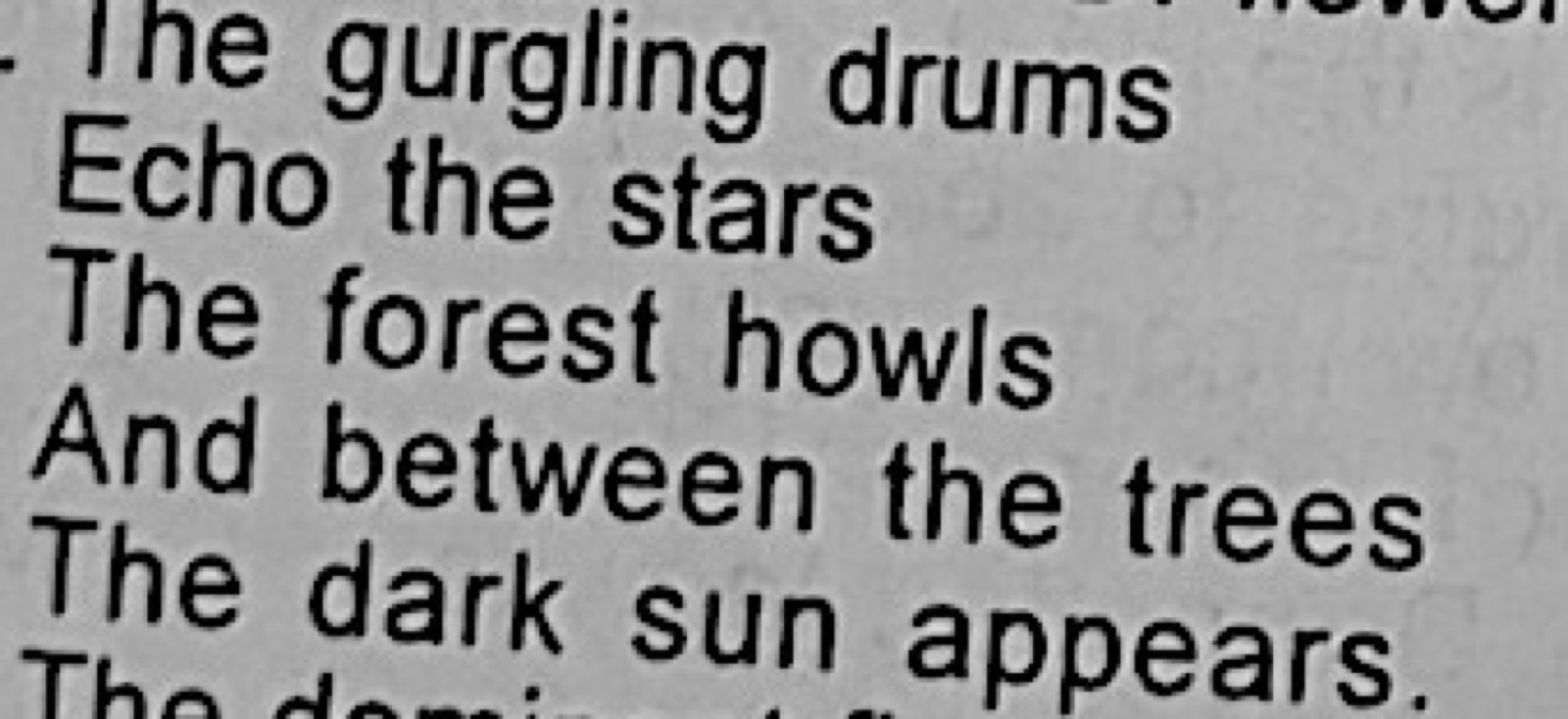
Question 29 African Poetry From Lenrie Peters' 'We Have Come Home' The dominant figure of speech in the above lines from Lenrie Peter's 'We Have Come Home' is
A. synecdoche B. simile C. metaphor D. personification. Show the answer and explanation Answer: D (personification. )
Explanation Drums "gurgle" and "echo the stars" and the forest "howls", as if they were alive.
Open this question
Question 30 African Poetry The theme of Gabriel Okara's 'Piano and Drums' is usually summed up in the phrase
A. clash of cultures B. primal youth of the African C. beauty of the Concerto D. the decay of African civilization. Show the answer and explanation Answer: A (clash of cultures )
Explanation The poet is torn between the African drums and the European piano.
Open this question
Question 31 Figures of Speech Tunde's long and vigorous speech was followed by a deafening silence . The phrase deafening silence is used as a figure of speech called
A. oxymoron B. metaphor C. simile D. hyperbole. Show the answer and explanation Answer: A (oxymoron )
Explanation Silence cannot be deafening; joining opposites is an oxymoron.
Open this question
Question 32 Other Set Texts: Non-African Drama From Macbeth (Shakespeare) In the above lines the figure of speech used is
A. metaphor B. simile C. hyperbole D. paradox. Show the answer and explanation Answer: C (hyperbole )
Explanation Macbeth exaggerates that his bloody hand could turn all the seas red.
Open this question
Question 33 Drama: General When a speech is written so as to be understood in one way by a certain character, while the audience or another character understands it to have some secret and special meaning, the literary device used in this context is called
A. dramatic irony B. paradox C. allusion D. hyperbole. Show the answer and explanation Answer: A (dramatic irony )
Explanation That is the definition of dramatic irony.
Open this question
Question 34 Drama: General The epilogue in a play refers to the
A. conflict in the play B. tail-piece C. opening chorus D. dramatic action. Show the answer and explanation Answer: B (tail-piece )
Explanation An epilogue is a closing speech or section after the main action.
Open this question
Question 35 Poetry: General Which of the following is NOT a form of poetic expression?
A. Sestet B. Lyric C. Sonnet D. Elegy. Show the answer and explanation Answer: A (Sestet )
Explanation A sestet is a six-line stanza, a part of a poem, not a kind of poem.
Open this question
Question 36 Literary Terms and Devices Reversal of fortune as used in the criticism of a literary work describes the
A. rise to fame of the central character B. success of the hero or heroine C. reward of the hero or heroine for his or her courage D. sudden change in the fate of the central character. Show the answer and explanation Answer: D (sudden change in the fate of the central character. )
Explanation Reversal (peripeteia) is a sudden turn in the hero's fortune.
Open this question
Question 37 Poetry: General Which of the following could be said to be a permanent feature of a poem?
A. Rhyme B. Repetition C. Rhythm D. Symbolism. Show the answer and explanation Answer: C (Rhythm )
Explanation Not every poem rhymes, but every poem has rhythm.
Open this question
Question 38 Drama: General Which of the following terms is exclusive to drama?
A. Dialogue B. Plot C. Protagonist D. Soliloquy. Show the answer and explanation Answer: D (Soliloquy. )
Explanation A soliloquy is a speech made alone on stage, found only in plays.
Open this question
Question 39 Figures of Speech The literary device which uses ridicule to correct social ills is known as
A. satire B. paradox C. hyperbole D. epigram. Show the answer and explanation Answer: A (satire )
Explanation Satire mocks wrongdoing in order to correct it.
Open this question
Question 40 Poetry: General A poem of mourning and dedication written on the death of an individual is called
A. an elegy B. an eulogy C. a sonnet D. an ode. Show the answer and explanation Answer: A (an elegy )
Explanation An elegy laments someone's death.
Open this question
Question 41 Poetry: General A poem written on a grand theme, in an appropriately grand style, dealing with heroic figures is called
A. a soliloquy B. a tragi-comedy C. an epic D. an epigram. Show the answer and explanation Answer: C (an epic )
Explanation That is an epic.
Open this question
Question 42 Prose: General Characterization in a novel means the
A. list of characters featuring in it B. mode of presenting the fictional individuals C. peculiar mannerisms of the narrator D. resolution of the conflict between the characters. Show the answer and explanation Answer: B (mode of presenting the fictional individuals )
Explanation Characterization is how a writer presents and develops characters.
Open this question
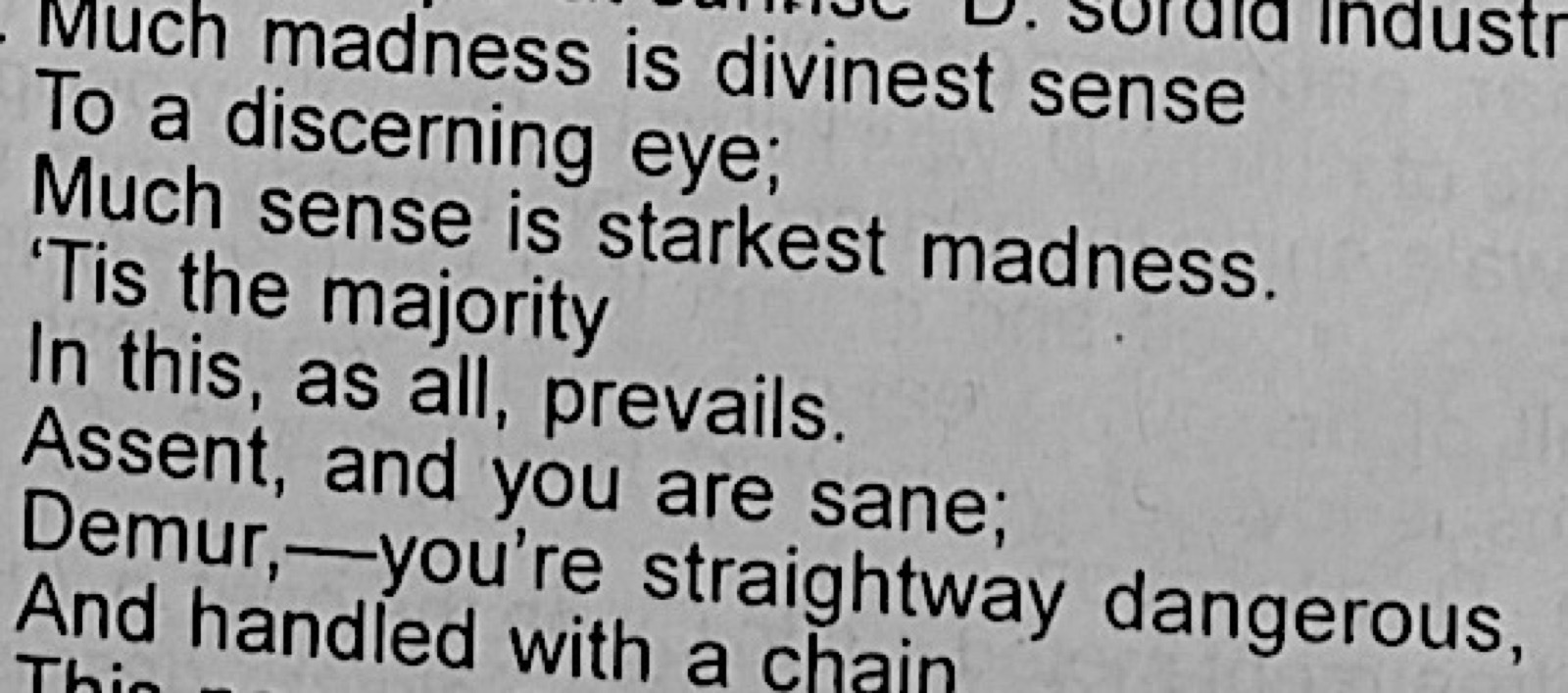
Question 44 Literary Appreciation: Poetry Verse extract (Question 44) This poem reflects the
A. tyranny of the majority B. approval of the majority factor C. unhappiness that might be right D. great love for mad people. Show the answer and explanation Answer: A (tyranny of the majority )
Explanation Whoever disagrees with the majority is called dangerous and chained: the majority rules by force.
Open this question
Question 45 Literary Appreciation: Poetry The predominant mood of this poem is best captured by the words
A. misplaced anxiety B. great relief C. solemn resignation D. morbid fear. Show the answer and explanation Answer: C (solemn resignation )
Explanation The family quietly sweeps up the heart and puts love away: calm, solemn acceptance of death.
Open this question
Question 46 Literary Appreciation: Prose and Drama The tone of this passage is
A. sensual B. detached C. playful D. stimulating. Show the answer and explanation Answer: A (sensual )
Explanation Love "ripeness" in her eye and the pull between the lovers give the passage a sensual tone.
Open this question
Question 47 Literary Appreciation: Prose and Drama In this passage, axe of intemperance means
A. hot temper B. cool temper C. evil mind D. recklessness. Show the answer and explanation Answer: D (recklessness. )
Explanation Intemperance is lack of self-control, careless excess, which "chops" a man's strength away.
Open this question
Question 48 Literary Appreciation: Prose and Drama The phrase, something which seemed to the town just a bit out of place , is an example of
A. hyperbole B. understatement C. sarcasm D. synecdoche. Show the answer and explanation Answer: B (understatement )
Explanation Saying he had seen the devil three times was only "a bit out of place" plays it down: understatement.
Open this question
Question 49 Figures of Speech 'In Germany, under the law, everything is prohibited except that which is permitted. In France, under the law, everything is permitted except that which is prohibited. In the Soviet Union, everything is prohibited, including that which is permitted'. The last sentence is an example of
A. innuendo B. paradox C. euphemism D. allusion. Show the answer and explanation Answer: B (paradox )
Explanation Even what is permitted is prohibited: a self-contradiction that makes a point.
Open this question
Question 50 Figures of Speech 'His sleepy mouth, plugged by the heavy nipple Tugs like a puppy, grunting as he feeds'. The repeated u sound in the above passage is an example of
A. onomatopoeia B. alliteration C. assonance D. consonance. Show the answer and explanation Answer: C (assonance )
Explanation Repeating the vowel sound "u" (plugged, tugs, puppy, grunting) is assonance.
Open this question Sign up free for every JAMB Literature in English year, practice by topic and timed mocks.
Start practising free