Home › Past questions › JAMB › Literature in English › 1985 46 questions. Try each one, then open the answer to check yourself and read the explanation.
Sign up free to answer these questions on a CBT screen with a timer, then see your score and every answer explained.
Start practising free
Question 2 Set Text: The Gods Are Not to Blame 'Is Aderopo jealous that I am sharing a bed with his mother? Very well then, let him come and sleep with his mother'. Odewale's statement is a good example of
A. euphemism B. pun C. irony D. sarcasm E. jargon. Show the answer and explanation Answer: C (irony )
Explanation Odewale mocks Aderopo, not knowing that he himself is sleeping with his own mother: his words are deeply ironic.
Open this question
Question 3 Set Text: The Gods Are Not to Blame From The Gods Are Not to Blame (Ola Rotimi) The speaker's statement is prompted by
A. guilty conscience B. oedipus complex C. delusive grandeur D. persecution complex E. patriotic fervour. Show the answer and explanation Answer: D (persecution complex )
Explanation Odewale keeps imagining that the people of Kutuje are plotting against him because he is a stranger.
Open this question
Question 4 Set Text: The Gods Are Not to Blame Odewale: I thought you were leaving with your son, Aderopo. Ojuola: It is you I married your highness, not my son. This exchange from The Gods are not to Blame is an example of
A. flashback technique B. dramatic irony C. poetic licence D. false analogy E. pathetic fallacy. Show the answer and explanation Answer: B (dramatic irony )
Explanation The audience knows Odewale is also Ojuola's son, so her words mean more than she realises.
Open this question
Question 6 Other Set Texts: Non-African Prose In which of the following London neighbourhoods mentioned in Great Expectations is Mr. Jagger's office located?
A. Hammersmith B. Soho C. Walworth D. Richmond E. Little Britain. Show the answer and explanation Answer: E (Little Britain. )
Explanation Pip first finds Jaggers' office in Little Britain, near Smithfield; Walworth is where Wemmick lives.
Open this question
Question 7 Other Set Texts: Non-African Prose The major lesson Pip's experience in Great Expectations teaches us is that
A. it is not good to be born poor B. wealth guarantees happiness C. an orphan has to be industrious to survive D. education is needed only by the poor E. ambition should be moderated by fairness and humane consideration for others. Show the answer and explanation Answer: E (ambition should be moderated by fairness and humane consideration for others. )
Explanation Pip's ambition to be a gentleman makes him snobbish and ungrateful until he learns to value Joe and Magwitch.
Open this question
Question 8 Other Set Texts: Non-African Prose Miss Havisham grooms Estella the way she does so as to make Estella
A. a model lady B. a good wife to Pip C. a dependable character D. unattractive to men E. a means of torturing menfolk. Show the answer and explanation Answer: E (a means of torturing menfolk. )
Explanation Jilted on her wedding day, Miss Havisham raises Estella to break men's hearts in revenge.
Open this question
Question 9 Other Set Texts: Non-African Prose The characters of Joe and Biddy are contrasted with those of Pip and Estella in order to show
A. the advantages of formal education B. the advantages of simplicity, sincerity and true love C. the advantages of sophisticated high-class living D. the difference between urban and rural people E. that contrast is an inevitable aspect of characterization in a novel. Show the answer and explanation Answer: B (the advantages of simplicity, sincerity and true love )
Explanation Simple, honest Joe and Biddy are happy and good, while proud Pip and Estella suffer.
Open this question
Question 10 Other Set Texts: Non-African Prose A 'gentleman' in the sense in which it is used in Great Expectations is
A. a man of wealth B. a chivalrous young man C. an educated man of some means D. a man who has inherited a fortune E. a man who lives in a big city. Show the answer and explanation Answer: C (an educated man of some means )
Explanation To Pip, being a gentleman means having money to live on and an education, without working with his hands.
Open this question
Question 11 Other Set Texts: African Prose As Medza was getting near to his village on his way from Kala he drinks at the palmwine bar because
A. he wants to patronize the local drink B. he is very happy to return to his village C. he is very thirsty D. he wants to pick up courage to face his father E. his journey has been very successful. Show the answer and explanation Answer: D (he wants to pick up courage to face his father )
Explanation Medza dreads facing his stern father, so he stops to drink first.
Open this question
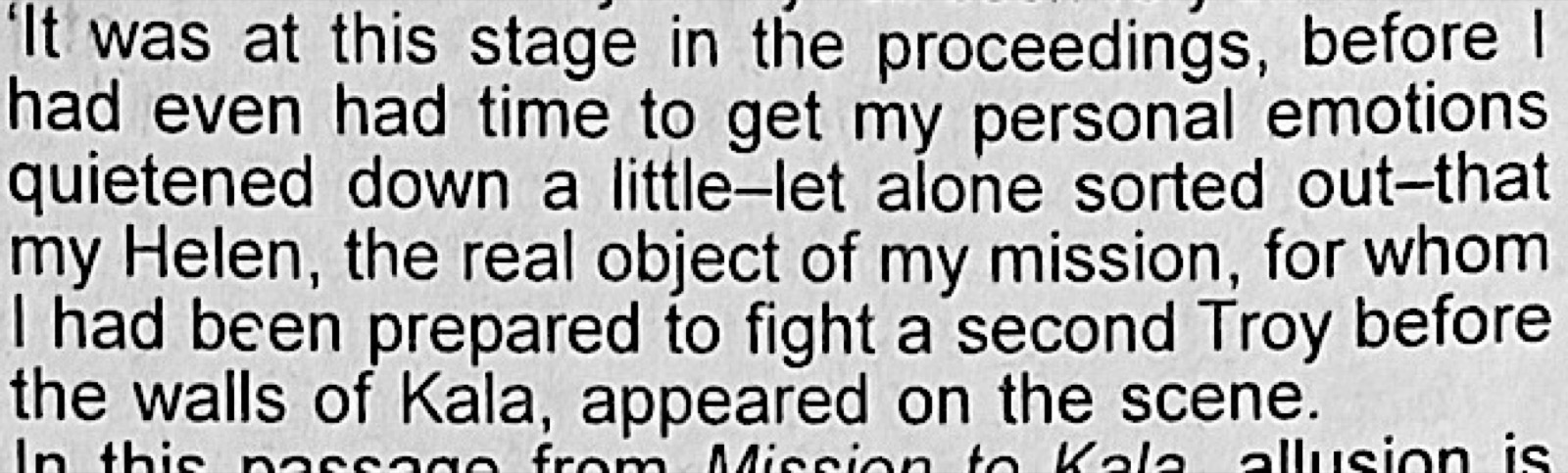
Question 12 Other Set Texts: African Prose From Mission to Kala (Mongo Beti) In this passage from Mission to Kala, allusion is made to
A. Brazilian legend B. Greek mythology C. French cosmology D. American history E. African folklore. Show the answer and explanation Answer: B (Greek mythology )
Explanation Helen and the walls of Troy come from the Greek story of the Trojan War.
Open this question
Question 14 Other Set Texts: African Prose The events that happened later in Mission to Kala show that the speaker in the passage is
A. mildly offended by the daughter's behaviour B. truly outraged by the daughter's behaviour C. merely pretending to be outraged by the daughter's behaviour D. deeply offended by the daughter's behaviour E. indifferent to the daughter's behaviour. Show the answer and explanation Answer: C (merely pretending to be outraged by the daughter's behaviour )
Explanation The mother's loud anger is for show; the family later happily accepts Medza as a match for the girl.
Open this question
Question 15 Other Set Texts: African Prose The narrator in Mission to Kala is
A. Mongo Beti B. Medza C. Mama D. Niam E. Zambo. Show the answer and explanation Answer: B (Medza )
Explanation Medza tells his own story in the first person.
Open this question
Question 16 Set Text: Julius Caesar Who persuades Caesar to disregard Calpurnia's appeal?
A. Decius Brutus B. Lucius C. Cassius D. Portia E. Octavius. Show the answer and explanation Answer: A (Decius Brutus )
Explanation Decius flatters Caesar by reinterpreting Calpurnia's dream and saying the Senate will mock him if he stays home.
Open this question
Question 17 Set Text: Julius Caesar From Julius Caesar (Shakespeare) This means that Mark Antony
A. will be assassinated with Caesar B. will become harmless once Caesar is dead C. is as powerless as Caesar's arm to control Caesar D. is as dangerous as Caesar's arm E. cannot do more harm than Caesar is capable of. Show the answer and explanation Answer: B (will become harmless once Caesar is dead )
Explanation Brutus thinks Antony is only Caesar's limb and will be helpless once Caesar is dead.
Open this question
Question 18 Set Text: Julius Caesar 'Gentle knave' refers to
A. Lucius B. Cassius C. Portia D. Messala E. Lucius. Show the answer and explanation Answer: A (Lucius )
Explanation Brutus speaks kindly to his sleepy servant boy Lucius, who has been playing music for him.
Open this question
Question 19 Set Text: Julius Caesar 'Good friends, go in, and taste some wine with me; And, we like friends, will straightway go together'. This statement by Julius Caesar is an example of
A. dramatic dialogue B. monologue C. mistaken identity D. dramatic irony E. paradox. Show the answer and explanation Answer: D (dramatic irony )
Explanation Caesar calls the conspirators his friends minutes before they kill him; the audience knows what he does not.
Open this question
Question 20 Set Text: Julius Caesar In Julius Caesar, Shakespeare portrays the Roman plebians as
A. fickle-minded B. strong-willed C. compassionate D. machiavellian E. enterprising. Show the answer and explanation Answer: A (fickle-minded )
Explanation The crowd changes sides quickly, first with Brutus, then with Antony.
Open this question
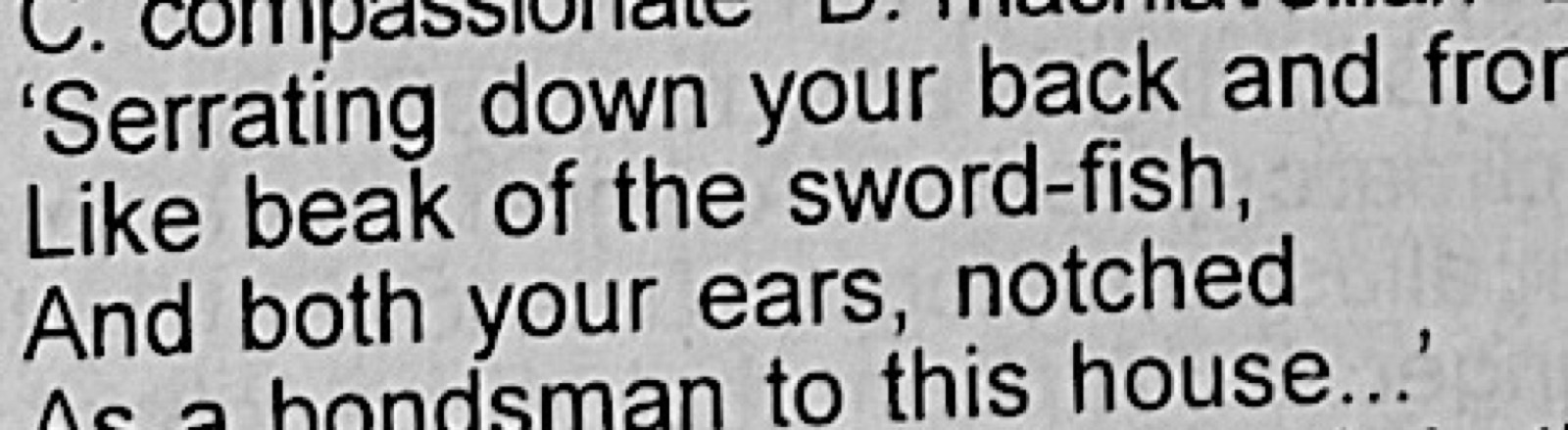
Question 21 African Poetry From J.P. Clark's 'Abiku' The dominant figure of speech in the above lines from J.P. Clarke's 'Abiku' is
A. onomatopoeia B. synecdoche C. simile D. metaphor E. verisimilitude. Show the answer and explanation Answer: C (simile )
Explanation The comparisons use "like" and "as": like the beak of a sword-fish, notched as a bondsman.
Open this question
Question 22 African Poetry The above lines from 'Night Rain' are intended to emphasize the fact that the speaker
A. drank like a fish B. took a heavy dose of sleeping pills C. slept with his belly facing upwards D. dreamt of fish in deep streams E. was suddenly roused from sleep. Show the answer and explanation Answer: E (was suddenly roused from sleep. )
Explanation Like a stunned fish floating up, the speaker rises out of deep sleep when the rain wakes him.
Open this question
Question 23 African Poetry In Soyinka's 'Abiku', the statement, 'The ripest fruit was saddest', is an example of
A. metaphysical conceit B. equivocation C. slasng D. a paradox E. a proverb. Show the answer and explanation Answer: D (a paradox )
Explanation Ripe fruit should bring joy, yet it is the saddest: a seeming contradiction with a truth in it.
Open this question
Question 24 African Poetry When David Diop in 'The Vultures' says that 'civilization kicked us in the face' and 'holy water slapped our cringing brows', he is using
A. slapstick B. a curse C. invective D. personification E. sacrilege. Show the answer and explanation Answer: D (personification )
Explanation Civilization "kicks" and holy water "slaps", as if they were people.
Open this question
Question 25 African Poetry The mood expressed in 'We Have Come Home' by Lenrie Peters is that of
A. hope and joy at one's return B. tension over the past and uncertainty of the future C. jubilation and a sense of achievement D. cautious optimism E. apprehension and defeat. Show the answer and explanation Answer: B (tension over the past and uncertainty of the future )
Explanation The soldiers return from war scarred by the past and unsure what lies ahead.
Open this question
Question 26 African Poetry In the poem, 'The Vultures', David Diop expresses his
A. hope that Africa will triumph over colonialism B. hatred of Africans C. affection for the colonial masters D. love of forced romances E. hatred of women. Show the answer and explanation Answer: A (hope that Africa will triumph over colonialism )
Explanation Despite the cruelty, "hope lived in us like a citadel" and spring will be reborn.
Open this question
Question 27 African Poetry The poem 'Viaticum' portrays a ritual preparation for
A. life's journey B. a war dance C. wrestling match D. slaughtering cattle E. a moonlight game. Show the answer and explanation Answer: A (life's journey )
Explanation A viaticum is provision for a journey; the mother's ritual protects the child for life's journey.
Open this question
Question 29 African Poetry David Diop's poem, 'The Vultures', ends in a
A. denunciation of colonialism B. resignation to oppression C. vindication of apartheid D. renunciation of African culture E. proclamation of hope. Show the answer and explanation Answer: E (proclamation of hope. )
Explanation The last lines say spring will be reborn under our bright steps.
Open this question
Question 30 African Poetry In the poem 'Piano and Drums' Okara uses the drums to symbolize
A. sources of poetic inspiration B. traditional African ways of life C. the complex rhythms of human life D. festivals which are held annually E. the noisy pastimes of hunters. Show the answer and explanation Answer: B (traditional African ways of life )
Explanation The drums stand for simple traditional Africa; the piano for Western culture.
Open this question
Question 31 Poetry: General What distinguishes poetry from other forms of Literature is its
A. emotion and feeling B. ungrammatical expressions C. irony and paradox D. rhyme and verse E. rhythm and metaphor. Show the answer and explanation Answer: D (rhyme and verse )
Explanation Poetry is written in verse lines, often with rhyme, unlike prose and most drama.
Open this question
Question 32 Drama: General A play is a tragedy when
A. the author presents life as a hopeless adventure B. the main character dies before the play ends C. there is much bloodshed in the play D. the main character is a wicked person E. a weakness in the main character leads to his downfall. Show the answer and explanation Answer: E (a weakness in the main character leads to his downfall. )
Explanation Tragedy shows the fall of a hero through a flaw in his character.
Open this question
Question 33 Literary Terms and Devices In a work of Literature, the hero is one
A. whose name is mentioned the greatest number of times in the text B. who is antagonistic to everyone else C. whose experiences provide the central conflict in the work D. who dies in the course of the story E. who performs brave and heroic deeds. Show the answer and explanation Answer: C (whose experiences provide the central conflict in the work )
Explanation In literature the hero (protagonist) is the central character whose experiences make up the main conflict of the work, whether or not he does brave deeds.
Open this question
Question 34 Poetry: General Which of the following is a correct definition of the ballad?
A. A climatic episode B. An impersonal dramatic piece C. An allusive dialogue D. a love story told by ballad singer E. A poem that tells a folk story. Show the answer and explanation Answer: E (A poem that tells a folk story. )
Explanation A ballad is a song-like poem that tells a popular story.
Open this question
Question 35 Poetry: General Assonance in poetry is the repetition of
A. internal vowels in words B. stressed syllables in words C. consonant sounds in words D. final sounds at the end of a line E. final sounds at the beginning of a line. Show the answer and explanation Answer: A (internal vowels in words )
Explanation Assonance repeats vowel sounds inside words.
Open this question
Question 36 Literary Appreciation: Poetry Verse extract (Question 36) For the girls mentioned here, the hours spent at school mean
A. creativity B. amusement C. relaxation D. restriction E. freedom. Show the answer and explanation Answer: D (restriction )
Explanation They are "uncaged" from school, so school was like a cage.
Open this question
Question 37 Drama: General In a play denouement is the
A. entry of the central character B. development of the central conflict C. introduction of a minor conflict alongside the major conflict D. climatic point in the development of the plot E. the resolution of the conflicts in the plot. Show the answer and explanation Answer: E (the resolution of the conflicts in the plot. )
Explanation Denouement means the "untying" of the plot after the climax.
Open this question
Question 38 Prose: General The central organizing idea which unites character, action, language and style in a work of fiction is known as
A. theory B. plot C. theme D. characterization E. fable. Show the answer and explanation Answer: C (theme )
Explanation The theme is the main idea the whole work is built around.
Open this question
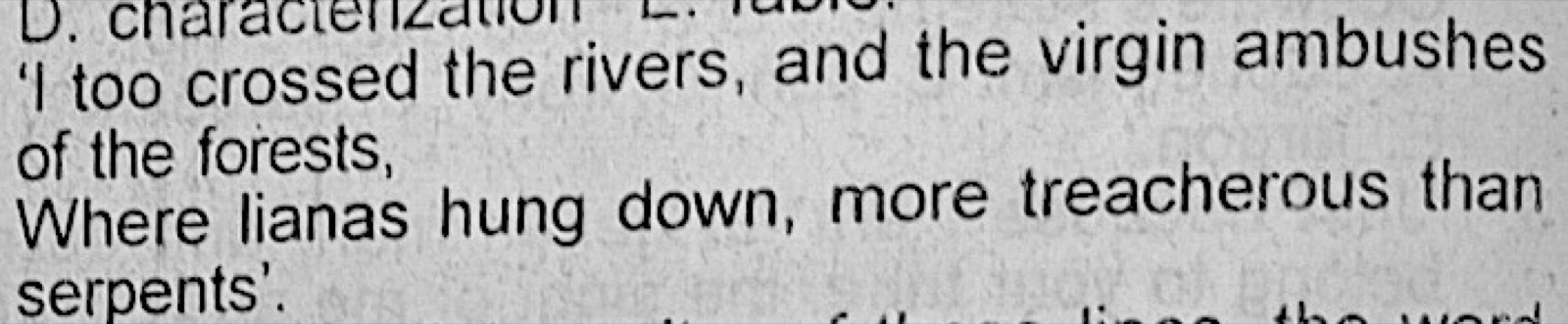
Question 39 Literary Appreciation: Poetry Verse extract (Question 39) In the eyes of the writer of these lines, the word 'forests' stands for
A. friendliness B. insecurity C. innocence D. fertility E. safety. Show the answer and explanation Answer: B (insecurity )
Explanation Ambushes and treacherous lianas make the forest a place of danger.
Open this question
Question 40 Literary Appreciation: Prose and Drama The dominant mood in this passage is one of
A. sadness B. anger C. anxiety D. nonchalance E. joy. Show the answer and explanation Answer: C (anxiety )
Explanation The child keeps asking why the mother will not answer: worry and anxiety.
Open this question
Question 41 Literary Appreciation: Prose and Drama The narrator here is full of
A. gloom B. fears C. doubts D. cheer E. uncertainty. Show the answer and explanation Answer: D (cheer )
Explanation The African sun is shining in his heart "shedding a flood of light": he is cheerful.
Open this question
Question 42 Literary Appreciation: Prose and Drama The speaker uses a string of
A. hyperboles B. parables C. metaphors D. riddles E. understatements. Show the answer and explanation Answer: C (metaphors )
Explanation He is called a jigger, a louse, mistletoe, a parasite, with no "like": metaphors.
Open this question
Question 43 Set Text: Julius Caesar A trade, sir, that, I hope, I may use with a safe conscience; which is, indeed, sir, a mender of bad soles. The passage is referring to a
A. religious preacher who saves sinful souls B. physician who cures diseases of the sole C. workman who repairs shoes D. trader who prevents bad sales E. trader who cheats customers during sales. Show the answer and explanation Answer: C (workman who repairs shoes )
Explanation The cobbler in Julius Caesar puns on "soles" and "souls"; he mends shoes.
Open this question
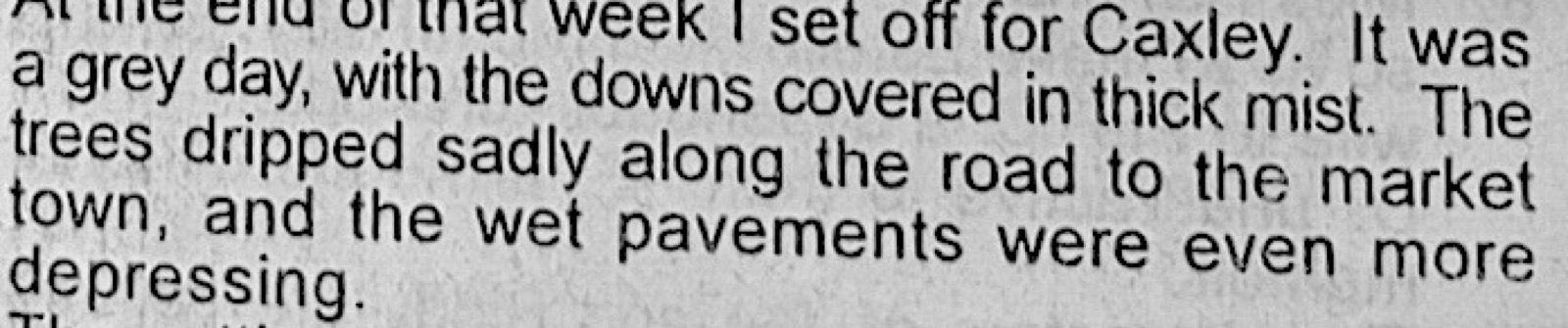
Question 44 Literary Appreciation: Prose and Drama Prose extract (Question 44) The setting is best described as
A. bracing B. dismal C. exhilarating D. delightful E. pleasant. Show the answer and explanation Answer: B (dismal )
Explanation Grey day, thick mist, dripping trees and depressing pavements make the setting gloomy.
Open this question
Question 45 Figures of Speech A deliberate use of exaggeration for humour or emphasis is known as
A. exclamation B. litotes C. metonymy D. hyperbole E. antonym. Show the answer and explanation Answer: D (hyperbole )
Explanation Hyperbole is deliberate exaggeration.
Open this question
Question 46 Figures of Speech 'The pen is mightier than the sword' is an example of
A. metonymy B. antonomasia C. comparison D. synecdoche E. paradox. Show the answer and explanation Answer: A (metonymy )
Explanation "Pen" stands for writing and "sword" for war: things named by something closely linked to them.
Open this question
Question 47 Poetry: General In poetry, the elegiac mood typically attends the occasion or experience of
A. triumph and fulfilment B. birth and growth C. death and decay D. joy and ecstacy E. illumination and discovery. Show the answer and explanation Answer: C (death and decay )
Explanation An elegy is a poem of mourning, usually for the dead.
Open this question
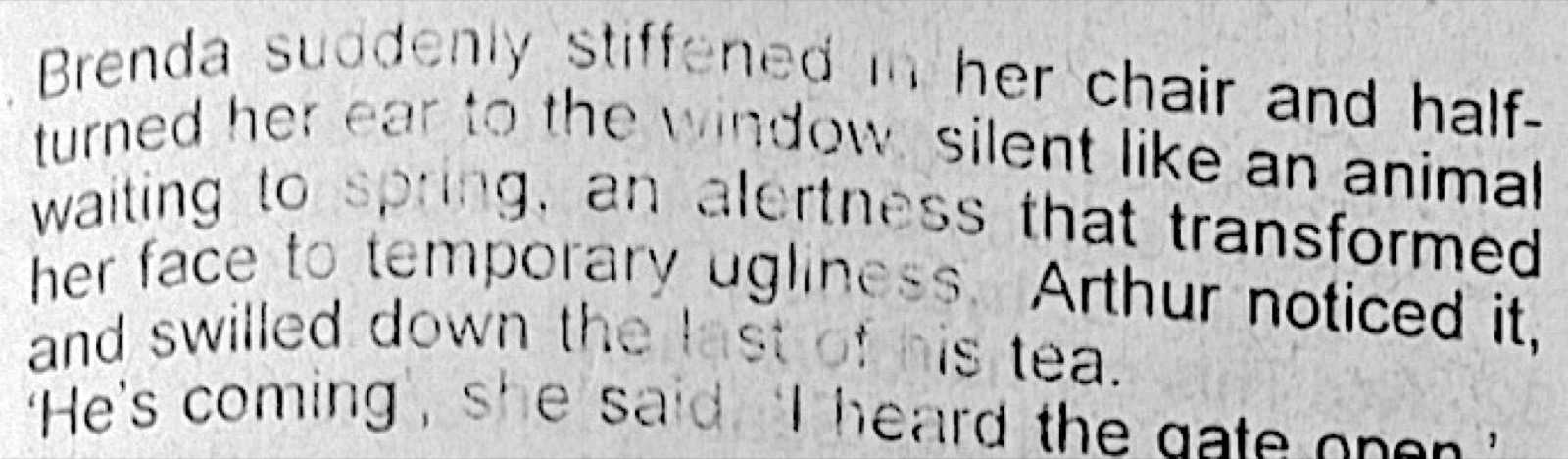
Question 48 Literary Appreciation: Prose and Drama Prose extract (Question 48) In this short passage, the writer succeeds in creating
A. anti-climax B. pity C. comic relief D. suspense E. characters. Show the answer and explanation Answer: D (suspense )
Explanation Brenda stiffens and listens like an animal about to spring: we wait to see who is coming.
Open this question
Question 49 Prose: General As a literary form the short story is most closely related to
A. poetry B. the discourse C. tragedy D. the novel E. drama. Show the answer and explanation Answer: D (the novel )
Explanation Both are prose fiction; the short story is simply shorter.
Open this question
Question 50 Set Text: Julius Caesar 'How many ages hence Shall this our lofty scene be acted over?' In this passage lofty scene refers to
A. a great event B. the meeting of the conspirators C. the funeral of Caesar D. a scene acted on a raised platform E. the assassination of Caesar. Show the answer and explanation Answer: E (the assassination of Caesar. )
Explanation Cassius says this over Caesar's body, imagining their deed acted in future ages.
Open this question Sign up free for every JAMB Literature in English year, practice by topic and timed mocks.
Start practising free