Home › Past questions › JAMB › Literature in English › 1984 47 questions. Try each one, then open the answer to check yourself and read the explanation.
Sign up free to answer these questions on a CBT screen with a timer, then see your score and every answer explained.
Start practising free
Question 1 Set Text: Julius Caesar In Julius Caesar, we learn that political success depends largely on
A. virtue, honesty, and patriotism B. cunning and a readiness to make use of others C. a strong body and a good career as a soldier D. a sound training in political science and public speaking E. having a generous, sympathetic and God-fearing spirit. Show the answer and explanation Answer: B (cunning and a readiness to make use of others )
Explanation Cassius and Antony succeed by cunning and by using others (Brutus, the crowd), while honest Brutus fails.
Open this question
Question 2 Set Text: Julius Caesar 'Hence! Wilt thou lift up Olympus?' is a memorable lines from Julius Caesar by
A. Brutus B. Mark Antony C. Octavius Caesar D. Cassius E. Julius Caesar. Show the answer and explanation Answer: E (Julius Caesar. )
Explanation Caesar says this proudly to the kneeling conspirators just before they stab him.
Open this question
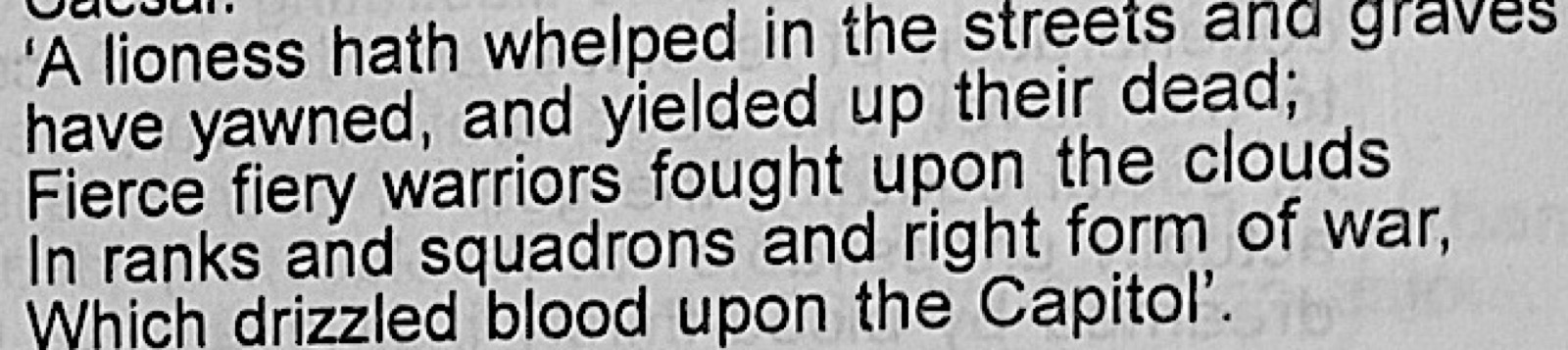
Question 3 Set Text: Julius Caesar From Julius Caesar (Shakespeare) The incident referred to in these lines is
A. Caesar's victorious return to Rome B. Calpurnia's hideous dream C. Mark Antony's oration at Caesar's funeral D. the plebeians' reaction to Caesar's death E. the soothsayer's meeting with Portia. Show the answer and explanation Answer: B (Calpurnia's hideous dream )
Explanation Calpurnia, frightened by omens and her dream, describes these horrors to persuade Caesar to stay home.
Open this question
Question 4 Set Text: Julius Caesar The combined reactions of the plebeians after the separate speeches of Brutus and Antony show that the common man as portrayed in Julius Caesar
A. is knowledgeable, has a mind of his own, and is reliable B. is fickle-minded, changeable and not dependable C. considers Caesar a tyrant and wants him killed D. does not consider Caesar an over-ambitious man deserving death E. is actually unconcerned whether Caesar lives or dies. Show the answer and explanation Answer: B (is fickle-minded, changeable and not dependable )
Explanation The crowd cheers Brutus, then minutes later turns against him after Antony speaks.
Open this question
Question 5 Set Text: Julius Caesar Brutus joined the conspiracy against Caesar because he
A. knew that Caesar was ambitious B. was a great lover of freedom C. was made to believe that Caesar was ambitious D. respected Casca and had a high opinion of Cassius E. was greatly loved by the Romans. Show the answer and explanation Answer: C (was made to believe that Caesar was ambitious )
Explanation Cassius plants forged letters to persuade Brutus that Rome feared Caesar's ambition.
Open this question
Question 6 Other Set Texts: African Drama What literary mode best describes Soyinka's The Trials of Brother Jero?
A. Tragedy B. Satire C. Tragi-comedy D. Epic E. Baroque. Show the answer and explanation Answer: B (Satire )
Explanation The play laughs at false prophets to expose them: satire.
Open this question
Question 7 Other Set Texts: African Drama Brother Jero's attitude to his vocation is
A. self-denying B. commercial C. philanthropic D. nonchalant E. messianic. Show the answer and explanation Answer: B (commercial )
Explanation Jero treats prophecy as a trade, competing for customers on the beach.
Open this question
Question 8 Other Set Texts: African Drama Of the issues raised by Wole Soyinka in The Trials of Brother Jero , the most central deals with the
A. frustrations of an incompatible marriage B. rivalry of religious sects C. negative qualities of women D. evils of religious demagogy E. disadvantages of the over-ambitious, naive personality. Show the answer and explanation Answer: D (evils of religious demagogy )
Explanation The play centres on a false prophet who manipulates his followers.
Open this question
Question 9 Other Set Texts: African Drama The 'curse' the old master put on Brother Jero is that he would
A. drown in water B. be killed by armed robbers C. come to ruin by women D. loss his prophetic vision E. die in a road mishap. Show the answer and explanation Answer: C (come to ruin by women )
Explanation The old prophet cursed Jero that the daughters of Eve would bring his downfall.
Open this question
Question 10 Other Set Texts: African Drama 'Vanished. Transported. Utterly transmuted. I knew it. I knew I stood in the presence of God ...' This statement of ecstasy was made in The Trials of Brother Jero by
A. Brother Jero B. Chume C. the old prophet D. the unnamed penitent woman E. the unnamed member of parliament. Show the answer and explanation Answer: E (the unnamed member of parliament. )
Explanation The Member of the Federal House sees Jero "vanish" and believes he has met a holy man.
Open this question
Question 11 African Poetry The dominant mood in Senghor's poem 'In Memoriam' is one of
A. nostalgia B. sadness C. despair D. joy E. frustration. Show the answer and explanation Answer: A (nostalgia )
Explanation The poet in Europe longs for his dead ancestors and his African home.
Open this question
Question 12 African Poetry In 'Nuit de Sine,' the word 'dark' in 'listen to our dark blood beat' is used
A. figuratively B. scientifically C. literally D. imaginatively E. culturally. Show the answer and explanation Answer: A (figuratively )
Explanation "Dark blood" is not about colour; it stands for African identity.
Open this question
Question 14 African Poetry From Senghor's 'Nuit de Sine' The dang in the verse from 'Nuit de Sine' refers to
A. wheels for spinning cotton into yarn B. sea-weed, full of salt C. a Wolof word for granulated flour meal, known also as couscous D. a Northern Ugandan local brew, usually strong and meant for men E. a kind of narcotic or stimulant. Show the answer and explanation Answer: C (a Wolof word for granulated flour meal, known also as couscous )
Explanation A "dang" is a millet couscous dish, which steams warm from the fire.
Open this question
Question 16 African Poetry 'Nkosi Sikekela' in Brutus' 'After Exile', refers to a
A. general in the Zulu army B. Zulu song used as a national anthem by Africans south of Zambezi C. soldier in the Zulu army D. Zulu poem E. Zulu poet. Show the answer and explanation Answer: B (Zulu song used as a national anthem by Africans south of Zambezi )
Explanation "Nkosi Sikelel' iAfrika" (God bless Africa) is the hymn sung as an anthem by black South Africans.
Open this question
Question 17 African Poetry The speaker in 'When a Strainer Takes in Water' invokes a series of natural impossibilities in order to
A. display his magical powers as a traditional priest B. show the poetic beauty of incantatory songs C. show the marvel about natural objects D. practise witchcraft on his enemies E. psychologically and magically disarm his enemies. Show the answer and explanation Answer: E (psychologically and magically disarm his enemies. )
Explanation Like a strainer that cannot hold water, his enemies are meant to be unable to harm him.
Open this question
Question 18 African Poetry From Kofi Awoonor's 'More Messages' The most obvious sound device in these lines from Kofi Awoonor's 'More Messages' is
A. onomatopoeia B. repetition C. assonance D. alliteration E. consonance. Show the answer and explanation Answer: D (alliteration )
Explanation The "f" sound begins word after word: full, fish, following, fathers', foot-prints.
Open this question
Question 19 African Poetry In the poem 'Night' Soyinka considers nightfall as
A. welcome and totally pleasant B. unwelcome and unpleasant C. dangerous and uninviting D. seductive and threatening E. beautiful and wholesome. Show the answer and explanation Answer: D (seductive and threatening )
Explanation Night is beautiful and alluring yet full of hidden dangers for the speaker.
Open this question
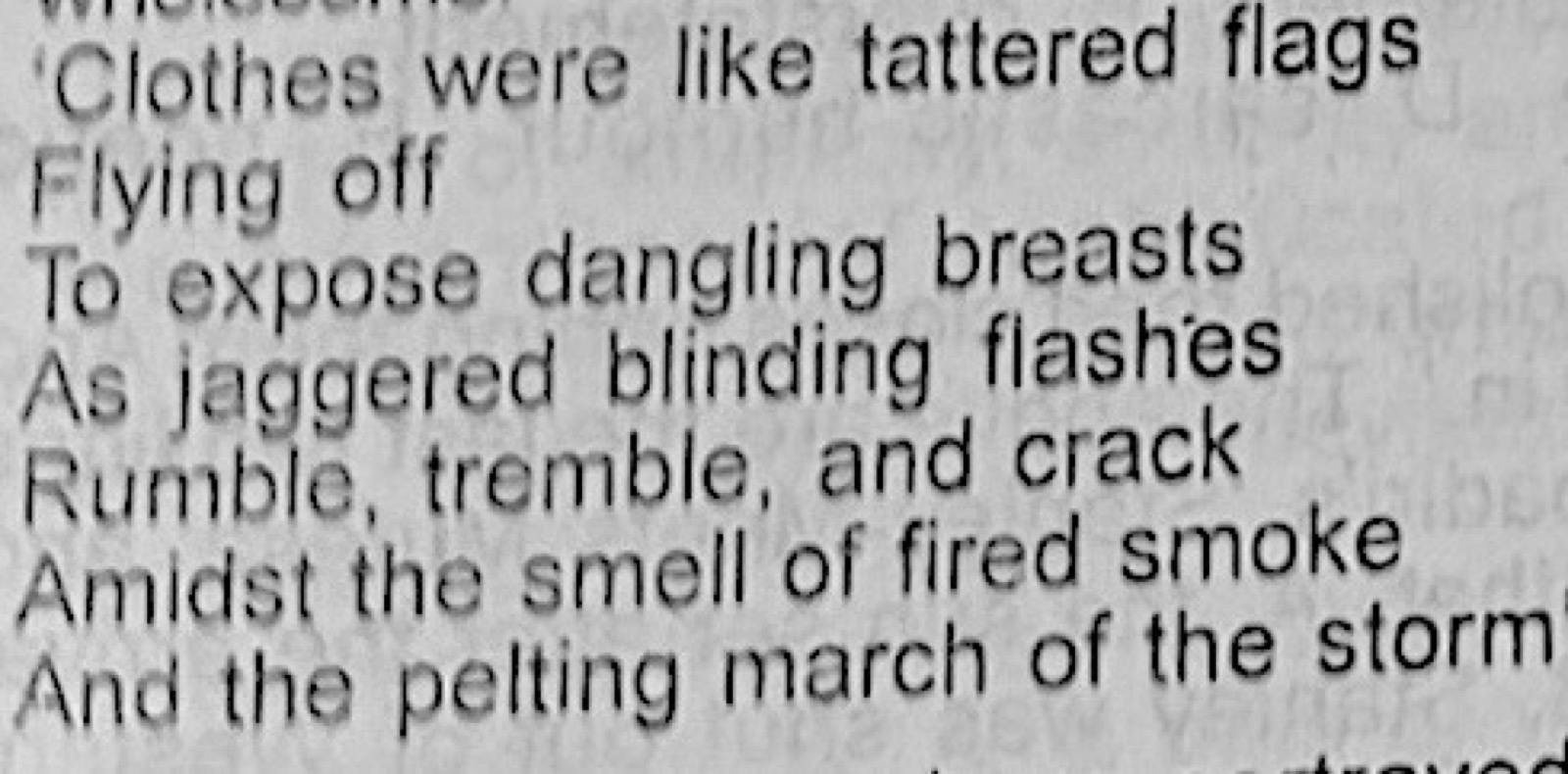
Question 20 Literary Appreciation: Poetry Verse extract (Question 20) The general atmosphere portrayed in the above passage is one of
A. peace and quiet B. contentment and calm C. anger and anxiety D. commotion and confusion E. poverty and want. Show the answer and explanation Answer: D (commotion and confusion )
Explanation Flying clothes, flashes, rumbling and pelting rain show the noise and disorder of the storm.
Open this question
Question 21 Set Text: Animal Farm In Animal Farm , the commandments originally drawn up by Snowball and Napoleon sought to declare
A. the supremacy of animal over man B. that animals shall in no way imitate human activities C. that man is infinitely superior D. that animal and man are equal E. that animals are inferior to humans. Show the answer and explanation Answer: B (that animals shall in no way imitate human activities )
Explanation Most of the Seven Commandments forbid the animals to copy man: they must not wear clothes, sleep in beds, drink alcohol or kill one another.
Open this question
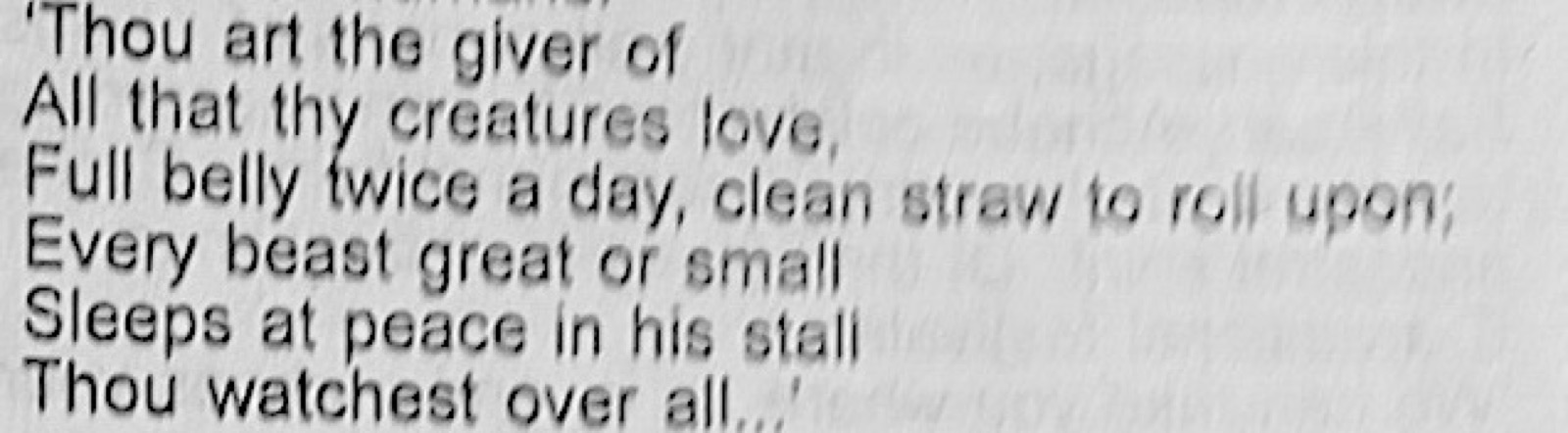
Question 22 Set Text: Animal Farm Poem from Animal Farm (George Orwell) The poem (in Animal Farm ) refers to
A. Squealer B. Snowball C. Napoleon D. Boxer E. Clover. Show the answer and explanation Answer: C (Napoleon )
Explanation Minimus' poem praises Napoleon as the giver of everything the animals love.
Open this question
Question 23 Set Text: Animal Farm In Animal Farm , the song was first sung by
A. Snowball B. Squealer C. Old Major D. Napoleon E. Bluebell. Show the answer and explanation Answer: C (Old Major )
Explanation Old Major sings "Beasts of England" at the meeting where he describes his dream.
Open this question
Question 24 Set Text: Animal Farm Since George Orwell was in fact writing about men while pretending to be writing about animals, his novel, Animal Farm , can be classified as
A. a realistic novel B. an allegorical novel C. a naturalistic novel D. a novel of adventure E. a sentimental novel. Show the answer and explanation Answer: B (an allegorical novel )
Explanation A story whose characters stand for real people and events is an allegory.
Open this question
Question 25 Set Text: Animal Farm 'All animals are equal but some animals are more equal than others.' In the context of Animal Farm this statement means that equality
A. is possible only under socialism B. is possible only under capitalism C. is not desirable D. was possible only in the past E. is desirable but impossible. Show the answer and explanation Answer: E (is desirable but impossible. )
Explanation The animals wanted equality, but power-hungry leaders always make themselves "more equal".
Open this question
Question 26 Other Set Texts: African Prose Achebe's Things Fall Apart can be described as a
A. regional novel B. detective novel C. romantic novel D. historical novel E. novel of social criticism. Show the answer and explanation Answer: D (historical novel )
Explanation The novel recreates Igbo life at the time the British and missionaries first arrived, a real period in history.
Open this question
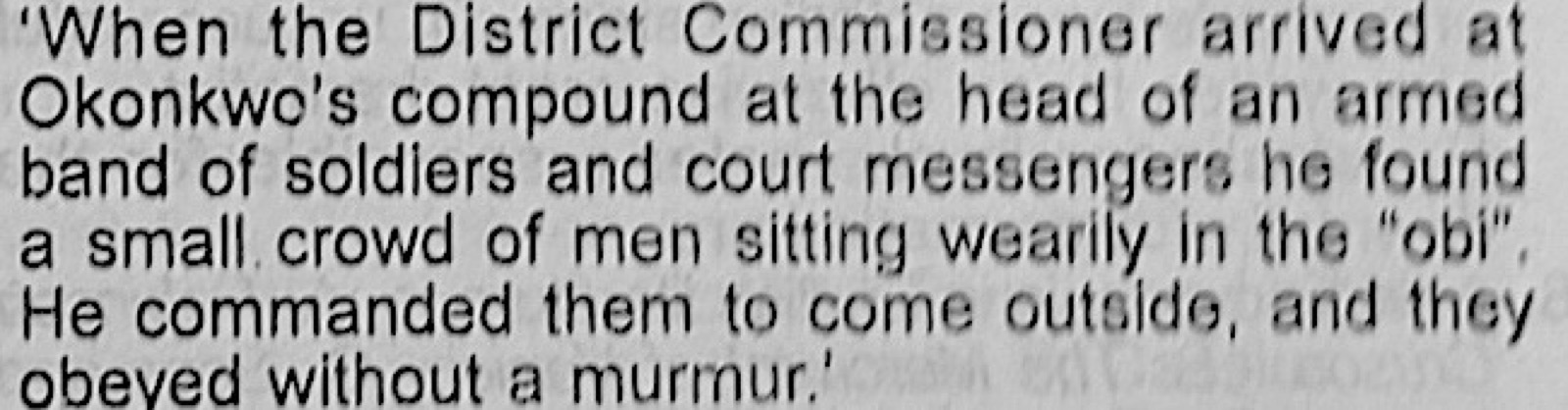
Question 27 Other Set Texts: African Prose From Things Fall Apart (Chinua Achebe) This passage from Things Fall Apart suggests that one of the reasons why traditional African society disintegrated was that Africans are
A. weary, lazy people B. very docile people C. peace-loving people D. militarily weak people E. inferior beings compared to white people. Show the answer and explanation Answer: D (militarily weak people )
Explanation The men obey "without a murmur" because they face armed soldiers they cannot resist.
Open this question
Question 28 Other Set Texts: African Prose The mood described in this passage from Things Fall Apart had been brought on by the
A. death of Unoka B. killing of Ikemefuna C. exiling of Okonkwo D. transfer of Mr. Brown E. imprisonment of Okonkwo. Show the answer and explanation Answer: B (killing of Ikemefuna )
Explanation Nwoye weeps after Ikemefuna, whom he loved like a brother, is killed.
Open this question
Question 29 Other Set Texts: African Prose The episode in which the priestess of Agbala takes Ezinma to the shrine at night is meant to demonstrate how
A. daring Okonkwo is B. much the priestess dislikes Okonkwo's family C. much concerned for his family Okonkwo is D. disrespectful to traditional office-holders Umuofia is E. rude and unfeeling the priestess is. Show the answer and explanation Answer: C (much concerned for his family Okonkwo is )
Explanation Okonkwo, who hides his feelings, follows the priestess all night because he fears for his daughter.
Open this question
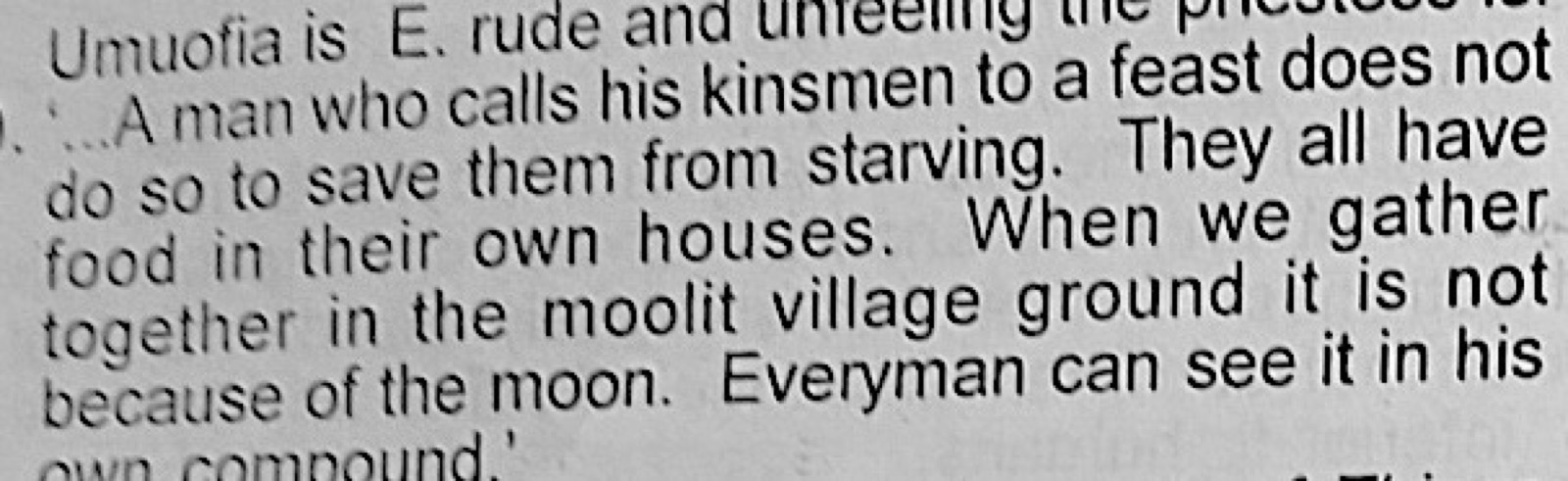
Question 30 Other Set Texts: African Prose From Things Fall Apart (Chinua Achebe) In this passage, as in many other parts of Things Fall Apart , Achebe celebrates
A. living according to nature B. the spirit of communal living C. the ancestral spirit D. the virtues of self-reliance E. traditional festivals. Show the answer and explanation Answer: B (the spirit of communal living )
Explanation People gather in the moonlight and feast together for the sake of togetherness, not need.
Open this question
Question 31 Other Set Texts: African Prose 'We can take you where he is, and perhaps your men will help us.' In the above sentence taken from Achebe's Things Fall Apart , the pronoun he refers to
A. Obierika B. Okoli C. Odukwe D. Okonkwo E. Ezenwa. Show the answer and explanation Answer: D (Okonkwo )
Explanation The men lead the District Commissioner to Okonkwo, who has hanged himself.
Open this question
Question 32 Figures of Speech A question put, not chiefly to elicit an answer, but to make an emphatic statement is known as
A. paradoxical B. metaphysical C. logical D. rhetorical E. leading. Show the answer and explanation Answer: D (rhetorical )
Explanation That is a rhetorical question.
Open this question
Question 33 Figures of Speech Writing about an abstract object as though it had human qualities is known as
A. apostrophe B. personification C. denotation D. allusion E. imitation. Show the answer and explanation Answer: B (personification )
Explanation Personification treats things or ideas as if they were people.
Open this question
Question 34 Literary Terms and Devices A short, emphatic, witty saying, often involving antithesis or paradox is an
A. epithet B. epigram C. invective D. impression E. analogy. Show the answer and explanation Answer: B (epigram )
Explanation That is the definition of an epigram.
Open this question
Question 35 Literary Terms and Devices The plot of a story generally refers to the
A. intrigue made by a character against the hero B. intrigue made by a hero against a character C. way the writer begins the story D. way the writer ends the story E. way in which the events of the story are organized. Show the answer and explanation Answer: E (way in which the events of the story are organized. )
Explanation Plot is the arrangement of events in a story.
Open this question
Question 36 Literary Terms and Devices The protagonist of a story is generally
A. the protest made by the principal character against his adversaries B. the principal character of the story C. the theme of the story D. one of the minor characters in the story E. the protest made by a character against the hero. Show the answer and explanation Answer: B (the principal character of the story )
Explanation The protagonist is the main character.
Open this question
Question 37 Drama: General What we call 'tragic flaw' is the
A. element of plot that makes a work dramatic B. typographical error occurring in a work of drama C. pronunciation error made by an actor on stage D. unsuccessful play written by an otherwise great dramatist E. weakness in character responsible for the downfall of a dramatic hero. Show the answer and explanation Answer: E (weakness in character responsible for the downfall of a dramatic hero. )
Explanation A tragic flaw is the hero's weakness, such as Macbeth's ambition, that causes his fall.
Open this question
Question 38 Literary History A wellknown epic in English literature is
A. Robinson Crusoe B. The Merchant of Venice C. Sons and Lovers D. Treasure Island E. Paradise Lost .Show the answer and explanation Answer: E (Paradise Lost .
Explanation Milton's Paradise Lost is a long heroic poem, an epic; the others are novels or a play.
Open this question
Question 39 Poetry: General 'Assonance' is the product of a poet's use of
A. masculine rhyme B. many consonant C. regular rhythm D. similar sounding vowels E. imaginative metaphors. Show the answer and explanation Answer: D (similar sounding vowels )
Explanation Assonance is the repetition of vowel sounds.
Open this question
Question 40 Drama: General To be complete, a play MUST have
A. a prologue B. an epilogue C. dramatic irony D. a conflict E. several soliloquies. Show the answer and explanation Answer: D (a conflict )
Explanation Every play is built on a conflict; the others are optional.
Open this question
Question 42 Literary History Which of the following novels was written by a Nigerian?
A. The Beautiful Ones Are Not Yet Born B. Weep Not Child C. Mine Boy D. A Man of the People E. Mission to Kala .Show the answer and explanation Answer: D (A Man of the People
Explanation Achebe wrote A Man of the People; the others are by Armah (Ghana), Ngugi (Kenya), Abrahams (South Africa) and Beti (Cameroon).
Open this question
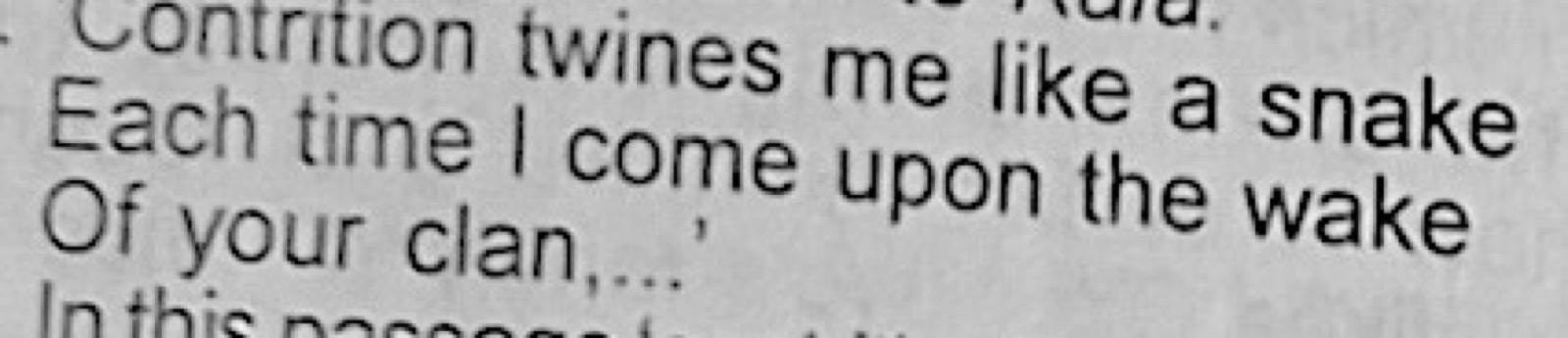
Question 43 Literary Appreciation: Poetry Verse extract (Question 43) In this passage 'contrition' is
A. personified B. satirized C. exaggerated D. modified E. emphasized. Show the answer and explanation Answer: A (personified )
Explanation Contrition "twines" round the speaker like a snake: it is treated as a living thing.
Open this question
Question 44 Literary Appreciation: Prose and Drama The description of the town in this passage suggests
A. peaceful co-existence B. lack of progress C. warmth and friendliness D. organized living E. monotony. Show the answer and explanation Answer: E (monotony. )
Explanation Streets all alike and people all alike doing the same thing at the same hours: monotony.
Open this question
Question 45 Literary Appreciation: Poetry The mood captured in this passage is one of
A. nostalgia B. despair C. confidence D. hope E. joy. Show the answer and explanation Answer: A (nostalgia )
Explanation The poet looks back with longing to a time when everything seemed to glow, a glory now lost.
Open this question
Question 46 Literary Appreciation: Prose and Drama The writer here is suggesting that political language is
A. convincing B. deceptive C. interesting D. destructive E. commendable. Show the answer and explanation Answer: B (deceptive )
Explanation Language that makes lies sound true is deceptive.
Open this question
Question 47 Literary Appreciation: Prose and Drama In describing the action of the climber, the writer has used the literary device of
A. simile B. hyperbole C. irony D. onomatopoeia E. personification. Show the answer and explanation Answer: E (personification. )
Explanation The plant "flaunted" its flowers, as a proud person shows off.
Open this question
Question 48 Literary Appreciation: Prose and Drama In recounting his criminal life, this speaker's tone is
A. repentant B. boastful C. regretful D. subdued E. remorseful. Show the answer and explanation Answer: B (boastful )
Explanation He brags that he fears nothing and has done every crime.
Open this question
Question 49 Literary Appreciation: Prose and Drama The last statement in this passage is an example of
A. understatement B. overstatement C. hyperbole D. sarcastic humour E. poetic diction. Show the answer and explanation Answer: D (sarcastic humour )
Explanation A tiny room with one weak bulb did not make anyone feel welcome; he means the opposite.
Open this question
Question 50 African Poetry 'The gate of polished reed closes behind them And the west is let in.' The above are the last two lines of David Rubadiri's 'Stanley Meets Mutesa' and they suggest that
A. the sun set after the arrival of Stanley B. Stanley was shut out of Western civilization C. Stanley symbolizes the advent of colonization D. Stanley was very well received E. Stanley thought he would be eaten up by the natives. Show the answer and explanation Answer: C (Stanley symbolizes the advent of colonization )
Explanation Letting Stanley in means letting "the west" in: the start of colonial rule.
Open this question Sign up free for every JAMB Literature in English year, practice by topic and timed mocks.
Start practising free